Showing posts with label Glasgow Print Studio. Show all posts

Monday, 3 November 2014

Alasdair Gray

Alasdair Gray Season, a Glasgow Polymath


I don't know Alasdair Gray but I feel that I should as he has been such a familiar sight in Glasgow for many years.

I've seen him at things. I've been to events that he has been involved in, and heard him talk at events I've been to. I've heard him talk about Scottish Independence, about books and about nuclear war. I've been to events where he was meant to be talking, but had nodded off and nobody wanted to wake him. I've been enticed into buying other people's books for his illustrations. I've walked over floors with his murals upon them and sat in bars with his murals adorning the walls. I've read and enjoyed some of his books and read and not enjoyed some of his other books. In September 2012 I came up an escalator to find myself amidst Nicola Sturgeon's official "opening ceremony" of his mural at Hillhead subway station. (They were kind enough to let me duck under the red ribbon to escape before they cut it.) He is literally and metaphorically in with the bricks of Glasgow.

Hillhead Subway station mural being officially opened by Nicola Sturgeon in 2012

Just taking a few minutes to ponder what I think about Alasdair Gray makes me think of the diverse things that he does. Brought up in the east end of Glasgow he went to Glasgow School of Art where he spent 4 years training in mural making. His distinctive novels usually have the author's hand not only in the story but in designing the typeface and layout, with pictures and words coming together to tell the tale.

Alasdair Gray in book format
On my shelves I've got novels, short stories, some history of English literature, a play, an essay on "Why Scots Should Rule Scotland", pictorial autobiographies and an illuminated book of Scottish song. They are all instantly recognisable from his style which is often described as being inspired by William Blake and Hieronymus Bosch but also has elements of his childhood readings of the Beano and the Dandy where, according to a video interview on show in Kelvingrove at present, he became familiar with the idea of words and pictures telling a story together.

Characters and ideas are often remembered and reworked in other places, such as Bella Caledonia who is first seen in the book Poor Things in 1992. She also appears on the ceiling mural of Oran Mor, has become the symbol of an online magazine since 2007 and an illustration for the First Minister's Christmas card in 2011. The Christmas card artwork is now on display in Colin Beattie's Granny Gibbs pub in Whiteinch. The Hillhead illustration adorning the walls of the subway station on Byres Road is adapted from an illustration in the book Old Men In Love.
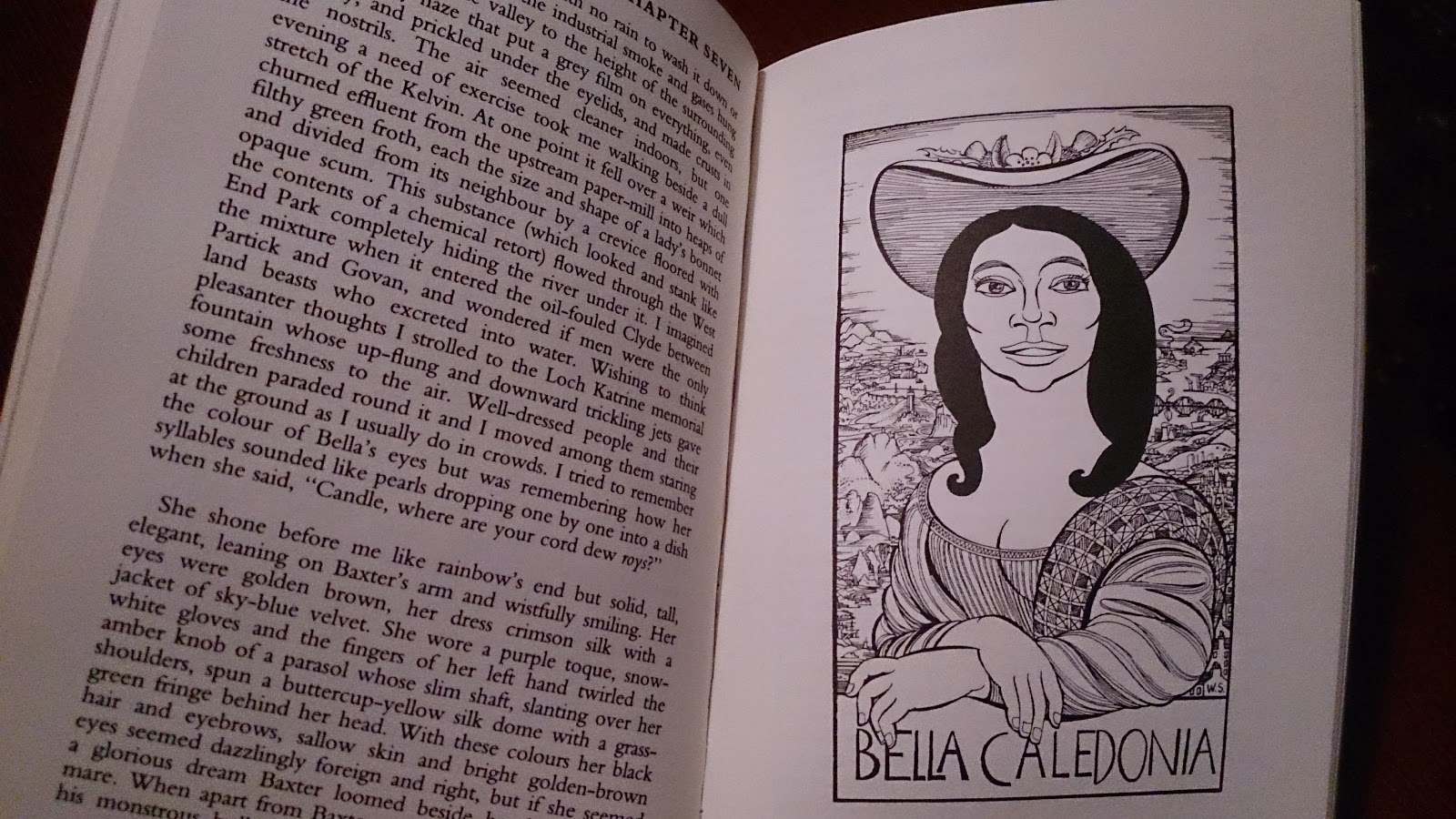
Bella Caledonia in Poor Things, 1992.
As he celebrates his 80th birthday this year, Alasdair Gray says in an interview on show at the Kelvingrove exhibition "Oh dear, I'm becoming popular in Glasgow. I never expected that in my lifetime."

To mark his birthday there is currently an "Alasdair Gray Season" running in Glasgow. At present there are exhibitions on at the Glasgow Print Studio in the Trongate (for free) and in the basement at Kelvingrove Art Gallery and Museum (for £5). Later there will be linked exhibitions within the Gallery of Modern Art and the Glasgow School of Art looking at his "Spheres of Influence".

The Glasgow Print Studio exhibition is titled "A Life In Print and Posters". This includes numerous old posters for plays and the like, which he has produced over the years at the Print Studio as well as showing draft versions of some of his prints to illustrate the process which he goes through. There are also early written pieces, produced by the Print Studio's old literary wing, Print Studio Press, such as his "The Comedy of The White Dog". Screenprints of illuminated poems which have more recently been on display here also line the walls but for me the highlight was seeing a series of new screenprints he has produced, based upon the artwork of his most famous book, Lanark. Some of these, the title pages of the four "books" of Lanark are versions of classic title pages from Versalius's anatomical book De Humani Corporis Fabrica, from Hobbes's Leviathon, from Bacon's Novum Organum and Raleigh's History of the World.  Each is given his individual twist, such as the Glasgow University logo appearing in one and James Kelman's face in another and these new versions are great to see (view here).

Lanark, the book, is now regarded as a Scottish classic. Published in 1981 it tells the parallel stories of Duncan Thaw in Glasgow, and of a young man called Lanark in a Glasgow-like town of Unthank, with Kafkaesque oddities and twists. I read and enjoyed it years ago now, but seeing the new versions of the prints has made me dust down my copy and give it a go again.

The exhibition in the basement space at Kelvingrove Art Gallery is titled "From The Personal to the Universal". Excellently curated by Sorcha Dallas who continue to represent Alasdair Gray, it is a retrospective of his work from his schoolboy art classes in Kelvingrove galleries, to the present day. As is often the case with many of his works, some are listed as unfinished as he often goes back and alters and colours old works. From his earliest works on show here he really grabs the attention. In the first room a piece from his student days in the Glasgow School of Art of the "cutty sark" episode in Tam O'Shanter show his already developing distinctive style.

A room of seemingly simple portraits belies the attention to small detail contained within them. In one, which is only shown as a photograph, of Scottish Nationalist and Socialist Bill Skinner in his Otago Street flat in 1968, if you look closely a fire can be seen outside his window. This is the old Kelvinbridge train station burning down, which I had only read about a week before. This attention to documenting detail was picked up on by Elspeth King when she commisioned him as "city recorder". Whilst curator of the People's Palace in Glasgow in the early 1970s she was aware that it contained no scenes of Glasgow or its people from its more recent past. There is great pleasure to be gained by spending some time looking at the detail he got into these drawings. Whether it is the ticket stubs collected from a typist's handbag when she was sketched on a break from work or the shop hoardings, crumbling buildings or a motorbike in the background of a drawing of Arcadia Street. Some of the best are of Glaswegians he knew and he documented their lives with great insight such as poet Tom Leonard, union leader Jimmy Reid both pictured with their families or of James Kelman, with his influential bookshelves behind him.

London Road Between Templeton's Carpet Factory and Monaco Bar, 1977 by Alasdair Gray
 Several of his own self portraits are seen here too, a familiar sight in many of his books, often with the artists' hand still drawing in the style of Escher's hands drawing each other.


There is a brief section on his mural painting here, with a recreation of his first mural commission. This was for the Scotland-USSR Friendship Society premises on Belmont Crescent and rather than ape the Socialist Realism style that you may have expected, he created a rather more dystopian vision in "Horrors of War", inspired by works of Durer and Brueghel. As a child I attended many functions in this building with my family, and cannot for the life of me recall ever seeing this mural before, but I do remember playing in the long garden that they had at the back of the building. The building has since been sold on and the mural is now underneath wallpaper apparently.
Part of the roof mural at Oran Mor by Alasdair Gray

Other murals however can be seen in the west end of Glasgow, such as mentioned above in the entrance to Hillhead underground station, outside the bar in the Western Baths Club, lining the walls of the Ubiquitous Chip stairwell and most famously adorning the roof and walls of Oran Mor's auditorium.

Floor mural at the Western Baths Club, Glasgow

Palacerigg Nature Reserve, Cumbernauld
If you aren't handy for the west end of Glasgow then you can see other murals out at the Greenbank Parish Church in Clarkston, Kirkfield Tavern near Lanark or in Cumbernauld on the walls of the exhibition centre of Palacerigg Nature Reserve (which is a grand wee day out if you've got children).

Alasdair Gray has spent years recording a version of Glasgow in words and pictures, so it is great to see Glasgow trying to return the compliment and I would encourage anyone who hasn't been to these exhibitions yet to go along and see them.

Wednesday, 9 April 2014

Glasgow International 2014, Quick Review

I was looking forward to the return of the Glasgow International festival this year, after it being such an entertaining and engaging event two years ago. Sadly, however, I have found very few of the exhibits in this year's Glasgow International to be particularly relevant, engaging, interesting or thought provoking in any way whatsoever. Many times the idea behind the exhibits are so cryptic and pretentious that the festival guide reads like the Pseuds Corner world cup event qualifying, the navel-gazing round perhaps.

I like a lot of modern art. I particularly enjoy it when it elicits some kind of response, whether it is sadness, disgust, happiness, memories, laughter or even just admiration for the skill or technique on display. Artists should be part of the real world and can engage with events, politics, life, injustices, etc. On spending a couple of days catching up on things at various venues this year the most common emotion it created was disappointment. So much of it seemed cobbled together, cheap, pointless or pretentious. It seemed to be occurring in another reality where there is no national debate on whether Glasgow should be part of a new country, where there is no politics or emotion or engagement. It feels very petty. The real world seems not to have touched many of the things on show, they are happening in a bubble removed from anything I could connect with.

So what did I like?

  • Counterflows is an annual event in Glasgow of experimental and contemporary music. This year it was included under the umbrella of Glasgow International and was a resounding success. (Review here)
"The Colours of the Palestinian Flag" by Khaled Hourani
  • Khaled Hourani is a Palestinian artist who has work on display at the Centre for Contemporary Arts. Some of the work reflects the surreal nature of current events in Palestine with works here commenting on the Palestinian winner of "Arab Idol", donkeys painted as zebras in a Gaza zoo and a photo of a Picasso painting on display in Palestine. I didn't even notice the Picasso at the centre of the photo until I read the title, so distracted was I by the guards in the forefront. Every piece is stimulating, thought provoking and double edged.
Aleksandra Domanovic's work at GOMA
  • Aleksandra Domanovic's work is on show in the main hall at the Gallery of Modern Art. The Berlin based artist has filled the hall with huge celluloid screens with images from sci-fi films, reflecting the inferior roles women are often given in science fiction literature and films. The punchline comes on the last panel where a letter to a woman applying as an artist in the Disney studios is reproduced, showing where a woman's place is in that world. 

Reclaimed
  • Reclaimed-The Second Life of Sculpture is an exhibition in the main hall at the Briggait. You could put an ice cream van on display and I would come in to see it as I just enjoy getting into this building where my great-great granny used to have a fish stall. This exhibition displays sculptures held in long term storage and raises questions about fashions in art and when it becomes disposable. Much of the exhibits on at other venues in Glasgow International give weight to the argument that there is plenty of sculpture out there that should have by-passed the galleries and gone straight into storage. A treat for any Glaswegian is seeing the "love it or loathe it" sculpture Spirit of Kentigern that used to sit at the bottom of Buchanan Street on display. I always thought it was meant to be a whale's tail until I read this week that it is actually representing the bird that never flew. Who knew?
Bricolage
  • Bricolage at The Pipe Factory. An interesting collection of stuff in an interesting building.

So what was mildly distracting?


  • At the Modern Institute Tobias Madison, Emanuel Rosseti, Stefan Tcherepnin have changed the frontage to resemble a ghost train, whilst the inside has become a sort of carpetted corridor. Ten out of ten for effort.
  • Gabriel Kuri at The Common Guild has made a colourful and interesting collection of sculptures, which make more sense once you flick through his book whilst going around (this was a recurring problem, exhibitions with no gallery staff helping to explain things or not raising their faces out of their iPhones to engage with you or with no leaflets left). The staff at The Common Guild and Modern Institute were very helpful, chatty and engaging as always.
Henrik Patzke at Project Ability
Work by Gareth Moore at Glasgow Sculpture Studios
  • Canadian sculptor Gareth Moore shows the products of his three month residency at Glasgow Sculpture Studios, drawing from the surroundings with discarded materials from the adjacent Forth and Clyde Canal and clay dug from local claypits.
Le Swimming at Fleming House
  • Also interesting, although maybe a bit unevenly executed, was Le Swimming in the disused underground car park under a shabby modernist building, Fleming House, in the city centre. It was quite witty and made a good point about the lack of such non-commercial amenities in the city centre and the folly of the construction of these buildings 
  • At David Dale Gallery in Bridgeton Claudia Comte has a collection of interesting sculptures, and top marks for venue goes to those behind Baldachini  under one of the arches on Cleland Lane by the Citizens Theatre.

So what was rubbish?

  • Well, following on from the point made about the lack of public amenities in Glasgow city centre I was keen to see inside the old Govanhill Baths, closed several years ago by Glasgow City Council but trying to find a second life as a community resource. It is meant to be home to a collection of inflatables (LOVE) by Anthea Hamilton and Nicholas Byrne but on the two days I tried to go I wasn't allowed in to see the building, because one of the inflatables had a leak. I really feel I could have mustered the imaginative powers to conceive the exhibition in all its glory without the full display but was told I wasn't getting in. Poor show. 
  • Kling Klang, an installation at Queen's Park Train Station was impossible to fathom. Were the two turned off electric guitars meant to be the "open access electronic music studio" promised in the programme?
  • The McLellan Galleries building was more impressive to see then any of the four exhibitions therein. Photocopies of an artist's genitals, video installations akin to many pop videos complete with someone shagging the pavement. I've got a bit tired of exhibitions where the attendants stop you at the door to say "oh....you might not want to take your children in there..."
  • Hydrapangea at the Botanic Gardens and Simon Martin at Kelvingrove sounded good on paper, but in reality were unengaging. Kelvingrove Art Gallery and the Botanics were both mobbed during the school holidays when I was in them, but the bland video installations in both were completely ignored by everyone. They were making no connection with their surroundings or the visitors to them who were all walking past. Both exhibitions were overwhelmed by their settings. This seemed particularly ironic in Simon Martin's case as the description claimed he was paying "attention to the relationship between viewer and artefact".
  • Gymnasia was full of ideas that sounded better than its actual execution, as were another pile of exhibitions I could mention, but won't.
  • Welshman Bedwyr Williams and America's Michael Smith have video installations at Tramway, the former in the main hall given a creepy twist with an abandoned coach illuminating the darkened main hall. However both seemed in thrall to TV and not unlike too many well known shows or similar characters I know drawn as roundly in comics I've read. Both were entertaining but there are a lot of videos on show in the festival. These installations come over as cheap and easy enough to dispatch to festivals around the world, but the world watches these things on YouTube, on their phones and tablets these days. It just often feels too disposable.
  • Sometimes getting access to buildings housing the exhibits was more worthwhile than the exhibits they held. SWG3 have a couple of disjointed exhibitions on in the studio spaces in the top floor there. It was nice to get to see the huge space up there but I would have been disappointed if I had climbed the stairs hoping to find a hidden artistic gem. Nowhere was this more apparent than at the new Glasgow Art School building in Garnethill. It was great to see inside the new building and to use Michael Stumpf's exhibition across the road as an excuse to re-visit the Mackintosh Building.
Atelier Public #2 takes over a floor at GoMA
  • Atelier Public #2 at GoMA? Is this really the best use of the space, recreate a children's play area in a shopping mall, but give the public less art materials than you'd get in one of these places.

So...

The Glasgow International 2014 festival seemed incredibly bitty and disjointed. There were too many videos and exhibitions which seemed to lack a curator's touch or any point to them. Some of the favourite things which I saw were not part of the festival, such as the new art school building and Martin Boyce's glasswork in its entrance or Iain Hamilton Finlay's exhibition of prints in the GOMA. These displayed more wit, skill and bite than so much of the stuff that is in the festival. However it is all free, there is tons more that I haven't managed to see yet. I just think it requires more of a guiding hand than it seems to have, or maybe that just costs more money.

Martin Boyce's glasswork in the foyer of the new Reid Building at the Art School 


Monday, 12 November 2012

What's on in Glasgow this week?

A quick review of current exhibitions at GoMA, Tramway, The Modern Institute and The Glasgow Print Studio


I'm off work for a few days, and with the kids all still at school am being self-indulgent and swanning around Glasgow during the day. Sometimes I think you forget to check all the things which are going on in your own city. You just take them for granted.

On show at GoMA just now
I've avoided GoMA for a while, because it was always the same stuff on display that I'd seen before, but when I went in to have a look around recently it had all been changed. With the help of The Common Guild and The Art Fund the museum has acquired a lot of new works and has them all on show. There are videos, photography, paintings, sculpture and ceramics spread throughout the building and although not all of it is to my taste, there is a lot of good stuff there. At present the gallery justifies the word "modern" in it's title.

The Tramway is another place I don't go to that often, but I made a rare expedition to the southside to see what was happening there this week. The draw for me was to have a nosey at The Glad Cafe, a new cafe and venue on Pollokshaws Road which has opened. It has hosted a great selection of musicians and talks since it opened and I think if it was nearer my house I'd be a regular by now. I think it is in an ex-snooker hall and has been nicely set up. On their website they speak positively of being at "the heart of Scotland's most ethnically diverse community" and I hope they are taking steps to engage all of that diverse community as on the day I visited it was a wholly white, middle-class looking crowd that was there. The food was tasty, the ambience laid back and the forthcoming events intriguing, so good luck to them.

Richard Hughes "Community fun day"
The Tramway has a great selection of stuff on just now. The current Sonica festival has a lot on the go here (more on that another day). The main hall has an exhibition of work by Richard Hughes entitled "Where It All Happened Once", familiar objects recreated in phenomenal detail in resin and fibreglass amongst other things. Familiar objects range from discarded cardboard boxes and sleeping bags to a community centre dropped on its side. It is at times familiar and also very surreal. Even things like the drainpipes on the gallery walls, which look mundane at first glance, spell out words when viewed at a certain angle. It's a lot of fun.

"Sleeping Rust" by Richard Hughes
Upstairs at the Tramway there is the Koestler Exhibition, a great exhibition of prisoners' artwork curated by David Shrigley.

All of these exhibitions I've mentioned above are free to visit. So too are The Modern Institute and the Glasgow Print Studio where I went next. The Print Studio at the Trongate has an exhibition upstairs called "Academians II" featuring the work of John Byrne, Norman Ackroyd, Philip Reeves and Chris Orr. My favourite works where by the latter, whose stuff I don't really know. I particularly liked Nagasaki Mon Amour.
Nagasaki Mon Amour by Chris Orr
The Modern Institute is just around the corner, hiding on Osbourne Street. I always forget about it, but whenever I go it always has really imaginative, bizarre or interesting exhibitions. In the main space just now are new works by Glasgow based artist Cathy Wilkes, who represented Scotland at the Venice Biennale in 2005 and was a Turner Prize nominee in 2008. It is slightly creepy wandering between her strange mannequins and the various other objects strewn about the gallery. I found it hard to work out what the context was which made it a bit eerie, but I kept thinking that they looked like Glasgow children from a Joan Eardley painting.

Cathy Wilkes at The Modern Institute


Upstairs there are a selection of ceramics by Japanese artist Shio Kusaka, arranged on a plain table. I didn't really know what to make of this. Empty vessels? Nice jugs? You decide.


A lot of these exhibitions don't have much longer to run, except for Richard Hughes stuff, so if any of that grabs your fancy, get yourself along.