Showing posts with label Glasgow International. Show all posts

Saturday, 21 April 2018

Glasgow International 2018 - Ah, but is it art?


Glasgow International 2018. Festival of Contemporary Art


A quick first impressions review of some of the stuff that is on at the sprawling Glasgow International art festival in the city for the next two weeks. It is an absolute pleasure to have this kind of gala appear in the city every two years, and much of it feeds off of the community of people making art in Glasgow. In the space of a few hours I battered around over 30 different exhibitions at 18 different venues on my bike, and would have kept going if I hadn't needed to get home for my daughter getting in from school, and I still felt that I had barely scratched the surface.

Maybe by Urs Fischer
However, it must be said that a fair amount of the stuff on show this year is high in concept, low on execution. If it takes you longer to read the accompanying blurb than it does to ponder the work itself, that's not usually a good thing. Sometimes you need no explanation, such as with the fabulous pair of mechanical (and very life-like) snails crawling around the floor of the Modern Institute's Aird Lane space. "Maybe" by Urs Fischer makes you laugh, makes you linger and is beautifully executed. Another highlight for me is found in the main space on Osborne Street of the Modern Institute, given over to the powerful post-modernist images created by Duggie Fields.

Inside Oxford House
Less successful are the many exhibits at House For an Art Lover, the Oxford House and Stallan-Brand Architect Office beside the Sherriff Court, and the Savings Bank on Bridge Street. However even in these places it is at least a chance to get inside these beautiful and fascinating Glasgow buildings not always open to the public.

Toby Paterson's Pallisade on High Street
Nicolas Party's big purple head outside Aird Lane and Toby Paterson's "Pallisade" outside the old Linen Bank on High Street are colourful distractions, whilst Turner Prize winner Lubaina Himid's jolly dragon which stretches across the main hall in Kelvingrove Art Gallery looks like the kind of bland decoration you would find in a department store during some nondescript festival.

More head scratching ensued when we came across the combined efforts of eight artists in the Botanic Gardens glasshouse. I really did not feel that it explored either the "paradoxes relating to the interplay of global and local forces upon the communities and places of Glasgow" or the "heterotopic space containing its own oppositions; interior and exterior, nature and culture, global and local." Equally disappointing was Lauren Gault and Sarah Rose's "Sequins" floating in the Forth and Clyde Canal, resembling little more than the other detritus floating nearby.

In the Kibble Palace, Glasgow
One exhibition where it was productive to read the accompanying blurb was in the Briggait, where Montreal-based artist Nadia Myre had riffed on the once upon a time sizable Glasgow industry of clay tobacco pipe production. With old pipe stems fashioned into various other items it raised questions about colonialism and waste and was a rare instance of concept and execution coming together to create something memorable.

Soft Measures by Kapwani Kiwanga
Ciara Phillips's prints in Glasgow Print Studio were beautifully presented and fascinating to see, and also worth seeing were the sculptural creations of Kapwani Kiwanga at Tramway, lumps of granite suspended on curtains of fabric. Next door in the main hall at Tramway Mark Leckey had a solitary carved figure, a blown up version of an 18th century figurine, facing off against a video of his cavities being explored, all perfectly entertaining once your eyes had adjusted to the gloom.

Nobodaddy by Mark Leckey
Two highlights for me were the photography on show at the Hunterian Art Gallery at Glasgow University and that on show at SWG3. German photographer and film-maker Ulrike Ottinger has an extensive exhibition of bizarre and unsettling photographs, evoking cabaret acts and freak shows, on show alongside some of her films at the Hunterian. At SWG3 Hugo Scott's street photographs are full of humour and interesting characters, each one a short story.  Also worth seeing at SWG3 were the sculpture in the main hall from Richard Wentworth and Victoria Miguel, and across the lane the creations and collages of punk designer Judy Blame.

A Roomful of Lovers by Richard Wentworth and Victoria Migual
The Gallery of Modern Art has a jumble of interesting ideas and images, nine artists collectively displayed under the name Cellular World, but it all feels rather disjointed. If you rummage about in the main hall there are some interesting bits and pieces among all the clutter, Joseph Buckley's concrete wall I found the most engaging.

Cellular World at GOMA 
Finishing off my day at The Common Guild felt like a gentle palate cleanser after the barrage of stuff earlier in the day. A solo exhibition by German artist Katinka Bock, a collection of small, quiet, clay and, slowly oxidising, bronze sculptures.

There are two weeks to go, and at times it is a bit hard to sift out the wheat from the chaff, but there is surely something there for all tastes. Just keep looking.


Saturday, 9 April 2016

Glasgow International 2016, a Festival of Contemporary Art


Yet again Glasgow International rolls into town, a two week festival of international contemporary art, which arrives here every second year. There are dozens of exhibitions and events on the go until April 25th, which does cause a bit of stress to a completist like me. However to maybe help you chose what to see I will give a quick review of the stuff I have managed to see in the first couple of days. One of the best things about Glasgow International is that it is all free.

West End

I started out at the Hunterian Art Gallery at the University of Glasgow. Apart from a small Glasgow International exhibition, there is an excellent exhibition upstairs here on the history and influence of comic books, including possibly the world's first comic book from 1825, The Glasgow Looking Glass.

Work by William Hunter, anatomist
Work by Damien Hirst, sort of artist

The theme of the exhibition here is to show "moments of mutual synergy" between science and art. What it does show is that the 18th century anatomical casts of a truncated pregnant women and illustrations from a 19th century textbook of histology are far superior works of art than Damien Hirst's Necromancer display cabinet.

Kelvin Hall , Glasgow
The Kelvin Hall is currently undergoing refurbishment before opening next year as the new home of the Hunterian Museum from Glasgow University. Whilst it is still a building site the foyer has been used during Glasgow International to house works by Helen Johnson and Claire Barclay. I'm afraid I was drawn as much by the chance to sneak a peek at the building wrk inside the building as by the artworks on show, but I was impressed by both.
A crumbling room in the Kelvin Hall
Both artists on display here used history as inspiration with painter Helen Johnson creating large canvases riffing on scenes from Ovid's Metamorphosis and reflecting on colonialism (this was the site if the Great Empire Exhibition), and upstairs Claire Barclay's elaborate sculptures reflect on the 1951 Exhibition of Industrial Power from the Kelvin Hall in 1951, but also from the annual carnival that used to be held here.
Claire Barclay's sculptures at the Kelvin Hall
Across the road from the Kelvin Hall, Kelvingrove Art Gallery and Museum was built for the Glasgow International Exhibition of 1901.
Kelvingrove Art Gallery and Museum, Glasgow
Upstairs on the balcony, opposite to the organ is a small, but interesting exhibition by Aaron Angel , who also has pieces withing the Botanic Gardens this year. These sculptures (The Death of Robin Hood) reflect pastoral crafts, but skillfully executed and tie in with a program of organ recitals within Kelvingrove.
Four sculptures by Aaron Angel in Kelvingrove Art Gallery
Kelvingrove pipe organ viewed through the sculpture

City Centre

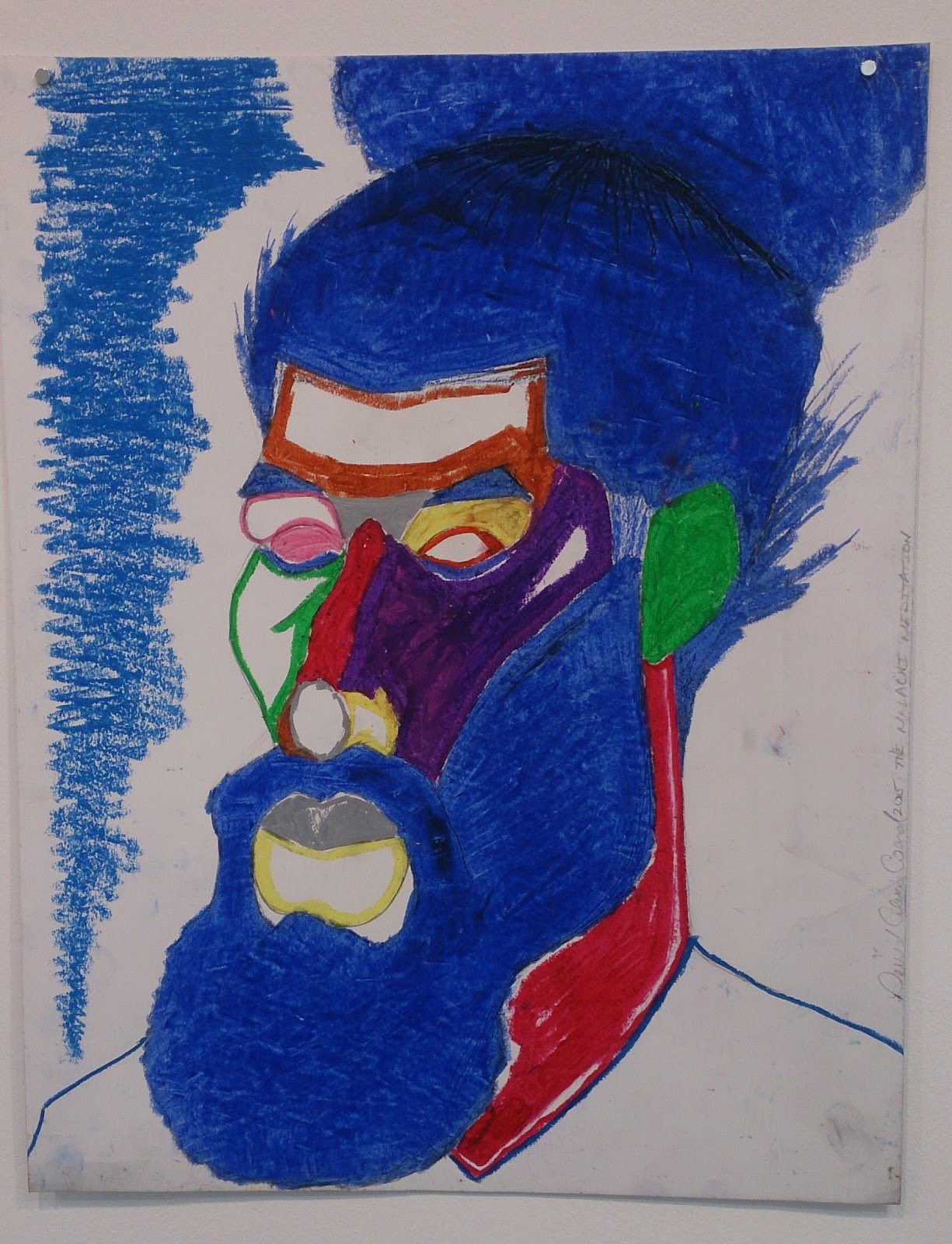
Trongate 103 is a hive of activity with Glasgow Print Studio, Transmission Gallery and Street Level Photoworks all holding exhibitions. Most eye catching is the stuff at Project Ability, an arts organisation supporting people with disabilities and mental health problems. They have a series of drawings by American artist Derrick Alexis Coard, imagined portraits of bearded African-American men. They leap off of the page with colour and vigour, really enjoyed seeing them. 

Work by Derrick Alexis Coard in Project Ability
Further up High Street, in what is being called "Civic Room", a former British Linen Bank building in danger of vanishing unless it is looked after, is the work of Brazilian artist AndrĂ© Komatsu. In an early example of Victorian concrete an steel construction, he exhibits Disseminacao Concreta, a life sized clothed body of a man, made from concrete boulders. At the from of the building he also has a piece, Borders 1, on display.  I really liked this concrete man, particularly in the shabby back room of this former bank, with the steel door of its safe behind his carcass. It is a lovely use the building

Former British Linen Bank, High Street Glasgow
Disseminacao Concreta by André Komatsu
At their Aird's Lane gallery the Modern Institute have a collapsed steel framework by Monica Sosnowska, modeled on a structure from an Eastern European scheme, with more twisted metal sculptures outside, whilst at their Parnie Street gallery a child-like talking desk critiques the world of art production and distribution. The work is by Joanne Tatham and Tom O'Sullivan and looks like the result of a weekend of brainstorming by the Ikea design team when someone sneaked LSD into their tea.
A Petition for an Enquiry into a Condition of Anxiety at the Modern Institute
Monica Sosnowska's work outside the Modern Institute, Aird's Lane
The main hall at the Briggait has a sculpture made of polythene sheets suspended from the ceiling by Heather Lander and Simon Harlow. This may be more impressive when seen at night when they have projections on them. Also in the Briggait are sculptures and drawings by Jock Mooney, which look set for a religious ceremony created by a comic book artist in the style of Frank Quitely.

Part of Jock Mooney's exhibition
There is more humour in the excellent exhibitions within the Mitchell Library. In the main hall Tamara Henderson's giant, totemic scarecrows inhabit this great big space. The gallery invigilator encouraged me to sit in the dilapidated car in the middle of the room to watch the video that goes along with it all. Upstairs in the Jeffrey Room, incongruously set amongst the shelves of leather bound books the works of Jacob Kerray and George Ziffo look like home made banners from a football match but riff on subjects such as racism and commercialiation. This was one of my personal favourites of my day.

Jacob Kerray and George Ziffo at the Mitchell Library
At the CCA Pilvi Takala has multiple video works on display looking back over ten years of work. They are humorous, silly and very engaging, such as trying to get into Disneyland dressed as Snow White, and being refused. I am not always a big fan of video artworks as I am too impatient at times but these are worth watching. Also there is a wall of posters for lost pigeons. Have you seen any of these birds? Some of these have been posted around Glasgow, haven't they, or am I imagining that?

Pilvi Takala
Within the Reid Building at Glasgow School of Art I really liked Serena Korda's suspended fungi, which are accompanied by musical chanting that you hear through headphones whilst walking around if there is not a live performance on the go. Her archival material in the room next door is fascinating too.
Serena Korda's Hold Fast, Stand Sure, I Scream a Revolution
I like the pop art inspired works by Emily Mae Smith on near St Enochs Square at Mary Mary Gallery. Bright, cheerful, but also with dark hints within them. I liked the marching broomsticks from Disney's Fantasia posed like Andy Warhol's gun-slinging Elvises. Pop culture reference overload. 


Emily Mae Smith at Mary Mary Gallery
There is plenty to see in the Gallery of Modern Art too, with the main hall filled with sculptures, paintings and videos by Cosima von Bonin. She was born in Kenya and lives and works in Germany. Her works have lots of toy-like sea creatures and "Missy Misdemeanor, the vomiting white chick" who sits astride a huge pink rocket. Tessa Lynch's sculptures upstairs are interesting too and the blurb that goes with it talks about the "questionable existence of the female flaneur, or flaneuse". It is a funny idea to find questionable when the city is ideally set up just now for male and female flaneurs to wander aimlessly, stumbling across things and just observing people. 


Sculpture by Cosima von Bonin at GOMA

Southside

House for an Art Lover, Bellahouston Park
A cluster of exhibitions sit in the "Artpark" buildings that sit alongside Charles Rennie Mackintosh's House For An Art Lover in Bellahouston Park. I didn't know this place existed and it has a fantastic permanent exhibition on the heritage, architecture and history of the are, including the shipyards which I spent most of my time here at to be honest. Gabriella Boyd and Marco Giordano fill one shed with engaging paintings and sculpture. For the other works here, I was more impressed with the buildings and gardens, where the hyacinths are just beginning to flower with their distinctive smell that you either love or loathe (*metaphor klaxon*).

Artpark at House for an Art Lover

Artpark at House for an Art Lover
Scotland Street School Museum, again an overwhelmingly impressive building by Charles Rennie Mackintosh, has a small exhibition in their ground floor gallery space next door to the cafe. This shows work from the varied career of Glasgow born artist Raoul Reynolds. I had never heard of this interesting character. He was born in 1882 and led a nomadic life between Glasgow and Marseilles, and died in New York in 1969. His father was a shipyard owner and his mother from a Marseilles manufacturing family. He was influenced by European avant-garde art movements but doesn't ever seem to have fitted in anywhere. His life story turns out to be more interesting than his work if I'm being honest, with hints of someone having more money than imagination. Perhaps I am just being over cynical. 

Work by Raoul Reynolds at Scotland Street School
There are several major exhibitions on at the nearby Tramway, a group show including work by Alexandra Birken, Lawrence Lek, Sheila Hicks, Mika Rottenberg and Amie Siegel. The premse of the exhibition is to explore ideas around production, manufacture and history. Like the exhibitors in the Kelvin Hall the interactions with the building's history is part of that. Many of the spaces used in Glasgow for studio space and galleries are disused industrial spaces, such as this massive tram depot on the southside. Many of the works here are meant to be using that idea, but most of them weare video works and I didn't have the patience to sit through them. I admit I wasn't in the most receptive frame of mind after just being stopped by the Police on the way here for jumping a red light on my bike. At the subsequent set of lights (which were green) two pedestrians then just about bundled me off of my bike by not noticing me. I arrived at the Tramway in a peevish mood. However I was still a bit disappointed by it all. On a side note, could someone at the Tramway think about installing a few cycle racks in the vicinity, there aren't many easy places to chain up a bike nearby. Ta.

A sculpture made of coloured linen by Sheila Hicks at Tramway.
 Also in the Southside, Glasgow graduate JosĂ©e Aubin Ouellette has a display of ergonomic soft sculptures on the floor of the pool at Govanhill Baths. You are encouraged to put on a pair of felt slippers and go down and loll about on these pieces. I preferred to nostalgically stare at the wooden changing cubicles lining the pool, remembering my childhood swims in Whiteinch Pool. 
Govanhill Baths, Glasgow
Who knew that there was a Roller Disco in Kinning Park? (Oh.Well I didn't know). This is the scene for performances by Asparagus Piss Raindrop, the self proclaimed "crypto conceptual science fiction anti-climax band". I have seen them perform before at the Glasgow Tectonics festival and they usually tread a fine line between taking themselves very seriously and being very silly. I am not sure whch side of this line they've fallen this time but I liked the idea of them performing on roller skates to electronic music and live percussion and saxophone. It feels like an unsuccessful 1970s dystopian film that failed at the box office because of the poor special effects and I would not have been surprised to see a young Donald Sutherland with handlebar moustache appear amidst the chaos. Whilst five of them kept skating around and performing three others acted as a transvestite, a saxophonist and compere. You get the gist.

Asparagus Piss Raindrop at Roller Stop, Glasgow

Asparagus Piss Raindrop at Roller Stop, Glasgow

What else?

There is a fantastic amount on show all over the city, much more than I have mentioned here. I plan to head to the Glasgow Sculpture Studios and Glue Factory in the north of the city and to the David Dale Gallery in the east end. I also fancy going back again to see the works at the Art School, CCA and the Civic Room which were some of my highlights.

Wednesday, 9 April 2014

Glasgow International 2014, Quick Review

I was looking forward to the return of the Glasgow International festival this year, after it being such an entertaining and engaging event two years ago. Sadly, however, I have found very few of the exhibits in this year's Glasgow International to be particularly relevant, engaging, interesting or thought provoking in any way whatsoever. Many times the idea behind the exhibits are so cryptic and pretentious that the festival guide reads like the Pseuds Corner world cup event qualifying, the navel-gazing round perhaps.

I like a lot of modern art. I particularly enjoy it when it elicits some kind of response, whether it is sadness, disgust, happiness, memories, laughter or even just admiration for the skill or technique on display. Artists should be part of the real world and can engage with events, politics, life, injustices, etc. On spending a couple of days catching up on things at various venues this year the most common emotion it created was disappointment. So much of it seemed cobbled together, cheap, pointless or pretentious. It seemed to be occurring in another reality where there is no national debate on whether Glasgow should be part of a new country, where there is no politics or emotion or engagement. It feels very petty. The real world seems not to have touched many of the things on show, they are happening in a bubble removed from anything I could connect with.

So what did I like?

  • Counterflows is an annual event in Glasgow of experimental and contemporary music. This year it was included under the umbrella of Glasgow International and was a resounding success. (Review here)
"The Colours of the Palestinian Flag" by Khaled Hourani
  • Khaled Hourani is a Palestinian artist who has work on display at the Centre for Contemporary Arts. Some of the work reflects the surreal nature of current events in Palestine with works here commenting on the Palestinian winner of "Arab Idol", donkeys painted as zebras in a Gaza zoo and a photo of a Picasso painting on display in Palestine. I didn't even notice the Picasso at the centre of the photo until I read the title, so distracted was I by the guards in the forefront. Every piece is stimulating, thought provoking and double edged.
Aleksandra Domanovic's work at GOMA
  • Aleksandra Domanovic's work is on show in the main hall at the Gallery of Modern Art. The Berlin based artist has filled the hall with huge celluloid screens with images from sci-fi films, reflecting the inferior roles women are often given in science fiction literature and films. The punchline comes on the last panel where a letter to a woman applying as an artist in the Disney studios is reproduced, showing where a woman's place is in that world. 

Reclaimed
  • Reclaimed-The Second Life of Sculpture is an exhibition in the main hall at the Briggait. You could put an ice cream van on display and I would come in to see it as I just enjoy getting into this building where my great-great granny used to have a fish stall. This exhibition displays sculptures held in long term storage and raises questions about fashions in art and when it becomes disposable. Much of the exhibits on at other venues in Glasgow International give weight to the argument that there is plenty of sculpture out there that should have by-passed the galleries and gone straight into storage. A treat for any Glaswegian is seeing the "love it or loathe it" sculpture Spirit of Kentigern that used to sit at the bottom of Buchanan Street on display. I always thought it was meant to be a whale's tail until I read this week that it is actually representing the bird that never flew. Who knew?
Bricolage
  • Bricolage at The Pipe Factory. An interesting collection of stuff in an interesting building.

So what was mildly distracting?


  • At the Modern Institute Tobias Madison, Emanuel Rosseti, Stefan Tcherepnin have changed the frontage to resemble a ghost train, whilst the inside has become a sort of carpetted corridor. Ten out of ten for effort.
  • Gabriel Kuri at The Common Guild has made a colourful and interesting collection of sculptures, which make more sense once you flick through his book whilst going around (this was a recurring problem, exhibitions with no gallery staff helping to explain things or not raising their faces out of their iPhones to engage with you or with no leaflets left). The staff at The Common Guild and Modern Institute were very helpful, chatty and engaging as always.
Henrik Patzke at Project Ability
Work by Gareth Moore at Glasgow Sculpture Studios
  • Canadian sculptor Gareth Moore shows the products of his three month residency at Glasgow Sculpture Studios, drawing from the surroundings with discarded materials from the adjacent Forth and Clyde Canal and clay dug from local claypits.
Le Swimming at Fleming House
  • Also interesting, although maybe a bit unevenly executed, was Le Swimming in the disused underground car park under a shabby modernist building, Fleming House, in the city centre. It was quite witty and made a good point about the lack of such non-commercial amenities in the city centre and the folly of the construction of these buildings 
  • At David Dale Gallery in Bridgeton Claudia Comte has a collection of interesting sculptures, and top marks for venue goes to those behind Baldachini  under one of the arches on Cleland Lane by the Citizens Theatre.

So what was rubbish?

  • Well, following on from the point made about the lack of public amenities in Glasgow city centre I was keen to see inside the old Govanhill Baths, closed several years ago by Glasgow City Council but trying to find a second life as a community resource. It is meant to be home to a collection of inflatables (LOVE) by Anthea Hamilton and Nicholas Byrne but on the two days I tried to go I wasn't allowed in to see the building, because one of the inflatables had a leak. I really feel I could have mustered the imaginative powers to conceive the exhibition in all its glory without the full display but was told I wasn't getting in. Poor show. 
  • Kling Klang, an installation at Queen's Park Train Station was impossible to fathom. Were the two turned off electric guitars meant to be the "open access electronic music studio" promised in the programme?
  • The McLellan Galleries building was more impressive to see then any of the four exhibitions therein. Photocopies of an artist's genitals, video installations akin to many pop videos complete with someone shagging the pavement. I've got a bit tired of exhibitions where the attendants stop you at the door to say "oh....you might not want to take your children in there..."
  • Hydrapangea at the Botanic Gardens and Simon Martin at Kelvingrove sounded good on paper, but in reality were unengaging. Kelvingrove Art Gallery and the Botanics were both mobbed during the school holidays when I was in them, but the bland video installations in both were completely ignored by everyone. They were making no connection with their surroundings or the visitors to them who were all walking past. Both exhibitions were overwhelmed by their settings. This seemed particularly ironic in Simon Martin's case as the description claimed he was paying "attention to the relationship between viewer and artefact".
  • Gymnasia was full of ideas that sounded better than its actual execution, as were another pile of exhibitions I could mention, but won't.
  • Welshman Bedwyr Williams and America's Michael Smith have video installations at Tramway, the former in the main hall given a creepy twist with an abandoned coach illuminating the darkened main hall. However both seemed in thrall to TV and not unlike too many well known shows or similar characters I know drawn as roundly in comics I've read. Both were entertaining but there are a lot of videos on show in the festival. These installations come over as cheap and easy enough to dispatch to festivals around the world, but the world watches these things on YouTube, on their phones and tablets these days. It just often feels too disposable.
  • Sometimes getting access to buildings housing the exhibits was more worthwhile than the exhibits they held. SWG3 have a couple of disjointed exhibitions on in the studio spaces in the top floor there. It was nice to get to see the huge space up there but I would have been disappointed if I had climbed the stairs hoping to find a hidden artistic gem. Nowhere was this more apparent than at the new Glasgow Art School building in Garnethill. It was great to see inside the new building and to use Michael Stumpf's exhibition across the road as an excuse to re-visit the Mackintosh Building.
Atelier Public #2 takes over a floor at GoMA
  • Atelier Public #2 at GoMA? Is this really the best use of the space, recreate a children's play area in a shopping mall, but give the public less art materials than you'd get in one of these places.

So...

The Glasgow International 2014 festival seemed incredibly bitty and disjointed. There were too many videos and exhibitions which seemed to lack a curator's touch or any point to them. Some of the favourite things which I saw were not part of the festival, such as the new art school building and Martin Boyce's glasswork in its entrance or Iain Hamilton Finlay's exhibition of prints in the GOMA. These displayed more wit, skill and bite than so much of the stuff that is in the festival. However it is all free, there is tons more that I haven't managed to see yet. I just think it requires more of a guiding hand than it seems to have, or maybe that just costs more money.

Martin Boyce's glasswork in the foyer of the new Reid Building at the Art School