Showing posts with label Kelvingrove Glasgow Art Gallery. Show all posts

Saturday, 21 April 2018

Glasgow International 2018 - Ah, but is it art?


Glasgow International 2018. Festival of Contemporary Art


A quick first impressions review of some of the stuff that is on at the sprawling Glasgow International art festival in the city for the next two weeks. It is an absolute pleasure to have this kind of gala appear in the city every two years, and much of it feeds off of the community of people making art in Glasgow. In the space of a few hours I battered around over 30 different exhibitions at 18 different venues on my bike, and would have kept going if I hadn't needed to get home for my daughter getting in from school, and I still felt that I had barely scratched the surface.

Maybe by Urs Fischer
However, it must be said that a fair amount of the stuff on show this year is high in concept, low on execution. If it takes you longer to read the accompanying blurb than it does to ponder the work itself, that's not usually a good thing. Sometimes you need no explanation, such as with the fabulous pair of mechanical (and very life-like) snails crawling around the floor of the Modern Institute's Aird Lane space. "Maybe" by Urs Fischer makes you laugh, makes you linger and is beautifully executed. Another highlight for me is found in the main space on Osborne Street of the Modern Institute, given over to the powerful post-modernist images created by Duggie Fields.

Inside Oxford House
Less successful are the many exhibits at House For an Art Lover, the Oxford House and Stallan-Brand Architect Office beside the Sherriff Court, and the Savings Bank on Bridge Street. However even in these places it is at least a chance to get inside these beautiful and fascinating Glasgow buildings not always open to the public.

Toby Paterson's Pallisade on High Street
Nicolas Party's big purple head outside Aird Lane and Toby Paterson's "Pallisade" outside the old Linen Bank on High Street are colourful distractions, whilst Turner Prize winner Lubaina Himid's jolly dragon which stretches across the main hall in Kelvingrove Art Gallery looks like the kind of bland decoration you would find in a department store during some nondescript festival.

More head scratching ensued when we came across the combined efforts of eight artists in the Botanic Gardens glasshouse. I really did not feel that it explored either the "paradoxes relating to the interplay of global and local forces upon the communities and places of Glasgow" or the "heterotopic space containing its own oppositions; interior and exterior, nature and culture, global and local." Equally disappointing was Lauren Gault and Sarah Rose's "Sequins" floating in the Forth and Clyde Canal, resembling little more than the other detritus floating nearby.

In the Kibble Palace, Glasgow
One exhibition where it was productive to read the accompanying blurb was in the Briggait, where Montreal-based artist Nadia Myre had riffed on the once upon a time sizable Glasgow industry of clay tobacco pipe production. With old pipe stems fashioned into various other items it raised questions about colonialism and waste and was a rare instance of concept and execution coming together to create something memorable.

Soft Measures by Kapwani Kiwanga
Ciara Phillips's prints in Glasgow Print Studio were beautifully presented and fascinating to see, and also worth seeing were the sculptural creations of Kapwani Kiwanga at Tramway, lumps of granite suspended on curtains of fabric. Next door in the main hall at Tramway Mark Leckey had a solitary carved figure, a blown up version of an 18th century figurine, facing off against a video of his cavities being explored, all perfectly entertaining once your eyes had adjusted to the gloom.

Nobodaddy by Mark Leckey
Two highlights for me were the photography on show at the Hunterian Art Gallery at Glasgow University and that on show at SWG3. German photographer and film-maker Ulrike Ottinger has an extensive exhibition of bizarre and unsettling photographs, evoking cabaret acts and freak shows, on show alongside some of her films at the Hunterian. At SWG3 Hugo Scott's street photographs are full of humour and interesting characters, each one a short story.  Also worth seeing at SWG3 were the sculpture in the main hall from Richard Wentworth and Victoria Miguel, and across the lane the creations and collages of punk designer Judy Blame.

A Roomful of Lovers by Richard Wentworth and Victoria Migual
The Gallery of Modern Art has a jumble of interesting ideas and images, nine artists collectively displayed under the name Cellular World, but it all feels rather disjointed. If you rummage about in the main hall there are some interesting bits and pieces among all the clutter, Joseph Buckley's concrete wall I found the most engaging.

Cellular World at GOMA 
Finishing off my day at The Common Guild felt like a gentle palate cleanser after the barrage of stuff earlier in the day. A solo exhibition by German artist Katinka Bock, a collection of small, quiet, clay and, slowly oxidising, bronze sculptures.

There are two weeks to go, and at times it is a bit hard to sift out the wheat from the chaff, but there is surely something there for all tastes. Just keep looking.


Wednesday, 7 October 2015

The Turner Prize and Other Exhibitions in Glasgow

Art Galleries in Glasgow and the Turner Prize Exhibition


With the annual jamboree of the Turner Prize visiting Glasgow at present a few national newspapers have done "What to see in Glasgow" sections, which have been a wee bit on the unimaginative side I have to say. So I wanted to have a quick run around some of the galleries in Glasgow that I like to visit in order to encourage other people to go and have a wee look at them from time to time. As attractions go these Glasgow galleries generally have the advantage of regularly changing their exhibits, so that if there is nothing that you fancy when you visit, there'll be another one along soon. Also they are usually absolutely free to visit.

Glasgow has established a reputation for being home to some of the best and most imaginative contemporary artists in Britain, often referred to as the "Glasgow miracle". The galleries in the city, and their visitors, have been an important part of that.

Kelvingrove Art Gallery and Museum, Glasgow

Kelvingrove Art Gallery and Museum

Anybody wanting to find art in Glasgow should start at Kelvingrove Art Gallery and Museum .

Main Hall at Kelvingrove Art Gallery
Alasdair Gray often talks about his childhood visits here starting him on his road to becoming an artist and like many people I can remember being brought here with my school class and being asked to pick an exhibit from the galleries and draw it for their regular competitions. The museum lies on Dumbarton Road in the west end of Glasgow. Opened in 1901 as The Palace of Fine Arts for the Glasgow International Exhibition of that year it has been an integral part of the city ever since It is where my great-uncle Andy who worked in the shipyards liked to take my mum for a day out and where I have spent many days with my own children. I really don't visit it as often as I used to since it re-opened after refurbishment in 2002, I knew the dusty old layout like the back of my hand and felt it lost a bit of character with the revamp. However it remains the most visited museum in the UK outside of London, a great advert for free entry to museums. 


As well as an impressive collection of French impressionists' paintings and Dutch and Flemish art there is a large collection of Scottish art on permanent display. This includes a small selection of works by the Scottish Colourists and a room of works by the Glasgow Boys, a loose alliance of about 20 artists from the 1880s. However many people come specifically to see one painting, Salvador Dali's Christ of St John's on the Cross. A controversial acquisition in 1952, at one time attacked in protest, it has proven to be a very astute purchase by then director, Tom Honeyman. I presume that any controversy over Dali's depiction of Christ has died down, as when I went to see it last week there was a nun sitting alongside me inspecting it.

Salvador Dali's Christ of St John on the Cross

Downstairs there is a temporary exhibition space, which charges an entry fee, currently for an exhibition on 19th century fashions.


Hunterian Art Gallery


Hunterian Art Gallery and Mackintosh House, Glasgow

Not far from Kelvingrove Art Gallery is found another fine collection of world class paintings. The University of Glasgow is home to the Hunterian, one of Scotland's oldest public museums, founded in 1908. The collection is currently displayed on two separate sites within the university, although part of it will soon be moving to a new space in nearby Kelvin Hall (opening summer 2016). It was founded with a bequest from 18th century anatomist Dr William Hunter and has many artifacts collected by him on display in the museum, which is housed in the main university building. Across University Avenue in a modern building beneath the high towers of the University Library is The Hunterian Art Gallery. 


Works by Joan Eardley in the Hunterian Art Gallery, Glasgow

Behind the large metal doors designed by Eduardo Paolozzi  are paintings from the likes of Rubens and Rembrandt. The Glasgow Boys and Joan Eardley are well represented and there is a fabulous selection of works from the Scottish Colourists. This includes one of my favourite pictures in the world, Les Eus by JD Fergusson, a huge and joy-filled canvas painted about the same time as Matisse's Dance. 


Les Eus by JD Ferguson

Other highlights here are the extensive collection of works by James Abbott McNeill Whistler and by Charles Rennie Mackintosh, the latter of which are on display in a recreation of his (now demolished) nearby house. There are also rotating temporary exhibitions here (currently on animals in the art of George Stubbs and others). In the upper floor there is another temporary exhibition space which houses an ever changing selection of displays which sometimes incur an entry fee, although the current one on Scottish archaeology is free.


The Common Guild 


The Common Guild, Woodlands Terrace, Glasgow

A lesser known gallery space in nearby Park Circus is The Common Guild. Home to a visual arts organisation you can browse through the art books in their library whilst visiting their exhibitions. They use the ground floor and first floor of a handsome Victorian town house as gallery space, usually open from Wednesdays to Sundays. Until 13th December they have an exhibition by German artist Thomas Demand called "Daily Show". As so many people record all sorts of images day to day, on phone cameras he has used a mobile phone camera to record undramatic scenes from daily life and produced large prints of them, from missing roof tiles in an office to clothes pegs on a line. As a camera phone addict myself I enjoyed seeing his take on this sort of thing. I must try harder with my efforts.


Glasgow Print Studio


Trongate 103

The next galleries are all housed in one block in the city centre at Trongate103. At the corner of Trongate and King Street can be found a building where you can see, amongst other things, the fantastical junk sculptures of Sharmanka Kinetic Theatre  (makers of the big mechanical clock in the National Gallery of Scotland in Edinburgh), the gallery space of Project Ability, a visual arts workshop for people with learning difficulties and the Glasgow Print Studio. Here a diverse and constantly changing range of exhibitions make it a place worth coming back to again and again. Having just finished with an exhibition of comicbook art from the world of Mark Millar, they now have on upstairs an exhibition of  etchings and monotypes by Ken Currie (until 18th October). He became known as one of the "New Glasgow Boys" along with fellow 1980s Glasgow Art School trained Adrian Wisniewski, Steven Campbell and Peter Howson.


Dead Finches, Kelvingrove, Ken Currie
There is a lot of death and darkness on show in Ken Currrie's prints, and known for portrait painting his portraits stand out in the exhibition. Amongst images of dead birds from North Uist I did like this one above of "Dead Finches, Kelvingrove" showing that the days of my primary school trips to draw from the Kelvingrove displays live on in this 2015 etching.

Iranian born Jila Peacock's paintings downstairs depicting scenes from the medieval Persian poem The Conference of the Birds were a colourful contrast to what's going on upstairs. Loved them.

Transmission Gallery


Also housed here at Trongate103 is Transmission Gallery. This gallery is often cited as one of the reasons the Glasgow art scene has blossomed in recent decades. Set up in 1983 by Glasgow Art School graduates it aims to encourage, support and exhibit young artists. If you are walking down to get a mushroom burger and some music at Mono, you might be tempted in by some strange offering in the big windows here. At present it looks like they are clearing up between exhibitions or from a Transmission party.


Street Level Photoworks


Next door to Transmission gallery is found Street Level Photoworks, a gallery for local and international art photography. Their current exhibition Surface Tension (until 8th November) shows the work of four artists. I was attracted to the pictures by Karen L Vaughan of east coast fishing villages from Angus to Pittenweem, presented as fragmentary panoramas. 

The Modern Institute


The Modern Institute, Glasgow

Just around the corner from the Tron Theatre on Osborne Street is The Modern Institute which presents a very varied selection of exhibitions from artists which they represent. Currently their ground floor exhibition space is showing works by Merseyside born Michael Wilkinson called Sorry Had To Done. As well as there being plenty of visual fun here, there were pieces that left me stroking my beard in contemplation. I liked the fluorescent strip light bulbs bound together as "fasces" and the huge tower of Lego beside "Dream a Garden", a pile of concrete rubble from a recently demolished tower block in the east end of Glasgow arranged into a neat rectangle. A former tower block resident myself I've watched my childhood home of grey concrete be reduced to rubble recently. I liked the whole range of ideas the title triggered off. 

SORRY HAD TO DONE by Michael Wilkinson, Modern Institute, Glasgow
The Modern Institute have another space across the road from the Briggait on Aird's Lane.


The Centre For Contemporary Arts (CCA)


CCA on Sauchiehall Street, Glasgow

The Centre For Contemporary Arts (CCA) on Sauchiehall Street occupies an old 'Greek' Thomson building and has exhibition space, a cinema, music venues, a vegetarian cafe, a bookshop and arty gift shop. It has been home to the Glasgow avant-garde since the 1970s when it was called the Third Eye Centre. In the late 70s my mum worked in the cafe whilst she was at college. During the school holidays their laid back approach to childcare meant that my brother and me spent a lot of time there when my mum was working: refilling the filter coffee machine, changing the big boxes in the milk fridge or just playing in the gallery spaces. It wasn't me that kicked over the lines of sawdust we didn't realise were an exhibition (that may have been my wee brother).

The Referendum Made Me Horny by In The Shadow of the Hand, at CCA, Glasgow

The current exhibition The Shock of Victory is a sad/ironic look at the world exactly a year after the Scottish independence referendum, including building an archive from the campaign. It is as unusual as you would expect from an exhibition here, but benefits from the viewer spending a bit of time reading the ideas behind the pieces. Symposia, talks and films run alongside the exhibition. Lovely place to have a beer, a coffee or a lunch.

Gallery of Modern Art Glasgow


When The Gallery of Modern Art Glasgow opened in the Royal Exchange Square in 1996 Douglas Gordon that year became the first Scottish artist to win the Turner Prize. Yet the modern Scottish artists of the time, who were successfully exhibiting their works around the world had any works on display in this gallery of modern art. No longer. With the Turner Prize exhibition visiting the city at present at the Tramway, the main hall of the gallery is at present given over to an exhibition of works made in the city since that time. Over twenty artists, including several former winners or nominees for the Turner Prize are on show, starting with the neon signs outside, by Ross Sinclair. I am glad to see such a comprehensive exhibition being put on, whilst some of the space in the museum is closed off for renovation. David Shrigley has some animations on show, paintings and sculptures by Martin Boyce, Toby Paterson Jim Lambie and others fill the hall.

Devils in the Making at GOMA, Glasgow
Upstairs there are exhibitions worth seeing including rarely seen works from the Glasgow Museums archive chosen by modern artists, including a lovely oil painting by Walter Sickert and a painting by Bridget Riley. On the top floor woman in art are highlighted in an engaging exhibition in collaboration with the Glasgow Women's Library.

Glasgow Sculpture Studios


Glasgow Sculpture Studios at The Whisky Bond building

On the banks of the Forth and Clyde Canal lies The Whisky Bond building, now home to numerous studio spaces and the Glasgow Sculpture Studios. Their gallery on the ground floor is open Wednesday to Saturday, making it a wee place to stop off at on your way to get some shopping at SeeWoo or on your walk along the canal to see Partick Thistle. Currently they have some work by Nicolas Deshayes, Darling, Gutter, expanded foam around the hot water pipes of the room, making these blobby shapes also functioning radiators as it were.

Darling, Gutter by Nicolas Deshayes

Tramway


Enterence to the Tramway in Pollokshields, Glasgow

Okay, last but not least, I made it to the Tramway where the current Turner Prize exhibition is displayed. Originally a tram shed built in 1893 the building was made into the Glasgow Transport Musuem in the 1960s when Glasgow decided that trams were the transport of the past (Doh!). As my granny lived in Mosspark we came here regularly to see the vehicles that are now housed in the modern Riverside Museum designed by Zaha Hadid. Since 1988 this old industrial building has been an arts venue and now also home to Scottish Ballet. 

Turner Prize nominees 2015
The main hall at the Tramway has been broken up into large white cubes where the four nominees for this years prize show their stuff. There is a long and illustrious list of past winners and nominees on one wall of the exhibition, from Gilbert and George to Antony Gormley, Damien Hirst and Rachel Whiteread. Then Scottish based artists start to feature regularly like Martin Boyce who won in 2011 and David Shrigley and Ciara Phillips nominated in recent years. Ironically in the year the show is in Glasgow no locals are represented.

I arrived at the Tramway today a bit hungry and the food I got in the cafe was, to say the least, disappointing so I may have looked around the exhibition in a bit of a bad mood. However the exhibition didn't really lift my spirits much. Nicole Wermers spoke of people claiming public space for themselves by putting a coat on a chair, when I would have thought it is usually just that it would be otherwise too hot or a case of dumping it on the floor. To illustrate it with pelts of dead animals stripped of their coats just annoyed me. Then nothing winds me up more than people going on about the paranormal, so a roomful of it from Bonnie Camplin was never going to be for me. Janice Kerbel has some unaccompanied opera singers reciting her words, something I've seen Richard Youngs producing more effectively recently at  Counterflows festival in Glasgow without a nomination for an art prize. The final display is of a showroom/workshop of the Assemble collective about their work in working with a Liverpool housing re-development.

As a visual spectacle the Turner exhibition is a bit earnest and the logo emblazoned everywhere "Show Me Some Thing New" feels a bit at odds with the actual exhibits.

There are plenty of new, innovative, imaginative, thoughtful, fun, interesting exhibitions on in Glasgow just now. I haven't included some galleries which I didn't get to, or which didn't have an exhibition on the days this week I was wandering about such as the Collins Gallery, The Pipe Factory or David Dale Gallery. So go beyond the Turner exhibition to see if you can spot next year's nominees.

Monday, 3 November 2014

Alasdair Gray

Alasdair Gray Season, a Glasgow Polymath


I don't know Alasdair Gray but I feel that I should as he has been such a familiar sight in Glasgow for many years.

I've seen him at things. I've been to events that he has been involved in, and heard him talk at events I've been to. I've heard him talk about Scottish Independence, about books and about nuclear war. I've been to events where he was meant to be talking, but had nodded off and nobody wanted to wake him. I've been enticed into buying other people's books for his illustrations. I've walked over floors with his murals upon them and sat in bars with his murals adorning the walls. I've read and enjoyed some of his books and read and not enjoyed some of his other books. In September 2012 I came up an escalator to find myself amidst Nicola Sturgeon's official "opening ceremony" of his mural at Hillhead subway station. (They were kind enough to let me duck under the red ribbon to escape before they cut it.) He is literally and metaphorically in with the bricks of Glasgow.

Hillhead Subway station mural being officially opened by Nicola Sturgeon in 2012

Just taking a few minutes to ponder what I think about Alasdair Gray makes me think of the diverse things that he does. Brought up in the east end of Glasgow he went to Glasgow School of Art where he spent 4 years training in mural making. His distinctive novels usually have the author's hand not only in the story but in designing the typeface and layout, with pictures and words coming together to tell the tale.

Alasdair Gray in book format
On my shelves I've got novels, short stories, some history of English literature, a play, an essay on "Why Scots Should Rule Scotland", pictorial autobiographies and an illuminated book of Scottish song. They are all instantly recognisable from his style which is often described as being inspired by William Blake and Hieronymus Bosch but also has elements of his childhood readings of the Beano and the Dandy where, according to a video interview on show in Kelvingrove at present, he became familiar with the idea of words and pictures telling a story together.

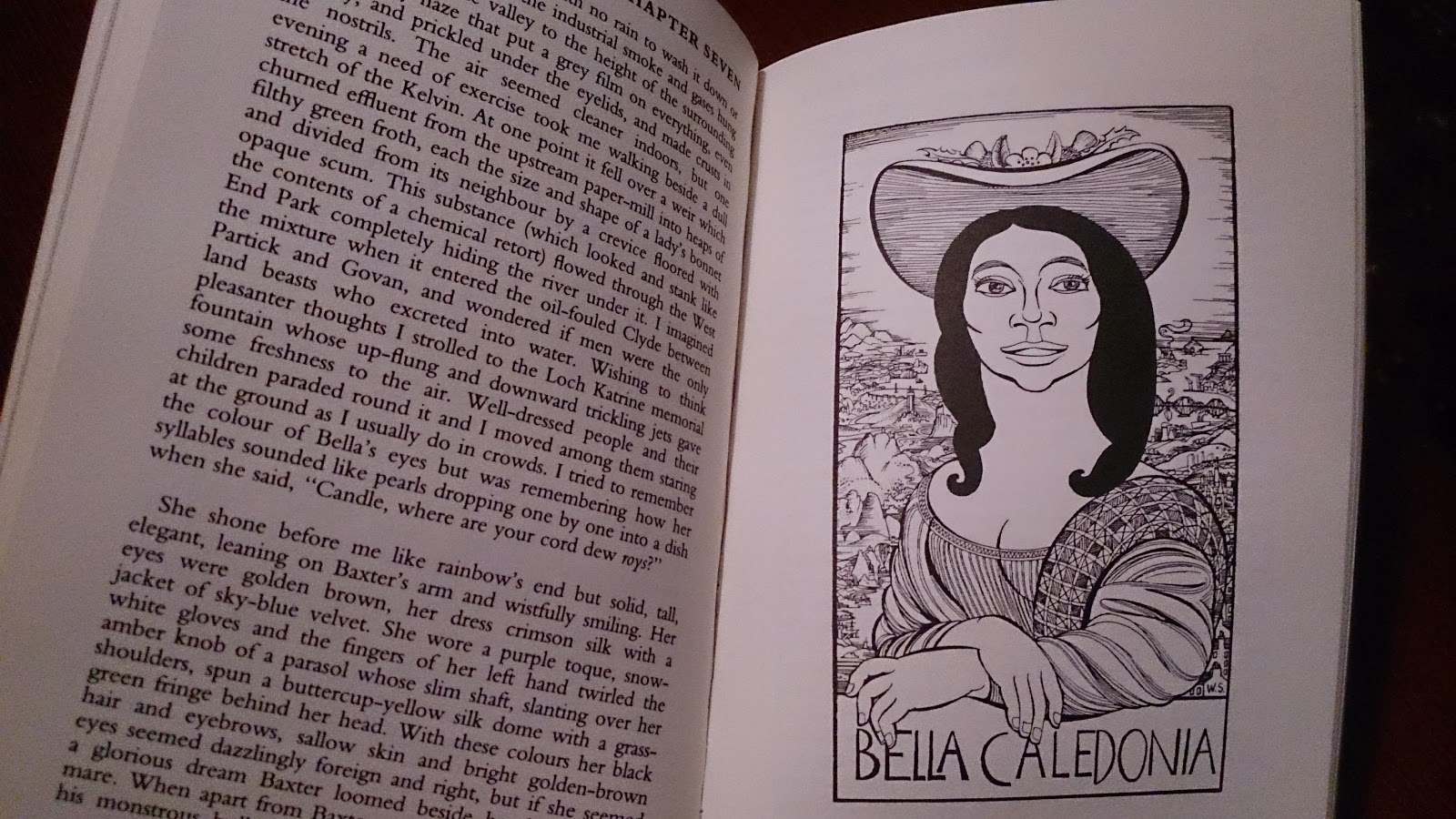
Characters and ideas are often remembered and reworked in other places, such as Bella Caledonia who is first seen in the book Poor Things in 1992. She also appears on the ceiling mural of Oran Mor, has become the symbol of an online magazine since 2007 and an illustration for the First Minister's Christmas card in 2011. The Christmas card artwork is now on display in Colin Beattie's Granny Gibbs pub in Whiteinch. The Hillhead illustration adorning the walls of the subway station on Byres Road is adapted from an illustration in the book Old Men In Love.

Bella Caledonia in Poor Things, 1992.
As he celebrates his 80th birthday this year, Alasdair Gray says in an interview on show at the Kelvingrove exhibition "Oh dear, I'm becoming popular in Glasgow. I never expected that in my lifetime."

To mark his birthday there is currently an "Alasdair Gray Season" running in Glasgow. At present there are exhibitions on at the Glasgow Print Studio in the Trongate (for free) and in the basement at Kelvingrove Art Gallery and Museum (for £5). Later there will be linked exhibitions within the Gallery of Modern Art and the Glasgow School of Art looking at his "Spheres of Influence".

The Glasgow Print Studio exhibition is titled "A Life In Print and Posters". This includes numerous old posters for plays and the like, which he has produced over the years at the Print Studio as well as showing draft versions of some of his prints to illustrate the process which he goes through. There are also early written pieces, produced by the Print Studio's old literary wing, Print Studio Press, such as his "The Comedy of The White Dog". Screenprints of illuminated poems which have more recently been on display here also line the walls but for me the highlight was seeing a series of new screenprints he has produced, based upon the artwork of his most famous book, Lanark. Some of these, the title pages of the four "books" of Lanark are versions of classic title pages from Versalius's anatomical book De Humani Corporis Fabrica, from Hobbes's Leviathon, from Bacon's Novum Organum and Raleigh's History of the World.  Each is given his individual twist, such as the Glasgow University logo appearing in one and James Kelman's face in another and these new versions are great to see (view here).

Lanark, the book, is now regarded as a Scottish classic. Published in 1981 it tells the parallel stories of Duncan Thaw in Glasgow, and of a young man called Lanark in a Glasgow-like town of Unthank, with Kafkaesque oddities and twists. I read and enjoyed it years ago now, but seeing the new versions of the prints has made me dust down my copy and give it a go again.

The exhibition in the basement space at Kelvingrove Art Gallery is titled "From The Personal to the Universal". Excellently curated by Sorcha Dallas who continue to represent Alasdair Gray, it is a retrospective of his work from his schoolboy art classes in Kelvingrove galleries, to the present day. As is often the case with many of his works, some are listed as unfinished as he often goes back and alters and colours old works. From his earliest works on show here he really grabs the attention. In the first room a piece from his student days in the Glasgow School of Art of the "cutty sark" episode in Tam O'Shanter show his already developing distinctive style.

A room of seemingly simple portraits belies the attention to small detail contained within them. In one, which is only shown as a photograph, of Scottish Nationalist and Socialist Bill Skinner in his Otago Street flat in 1968, if you look closely a fire can be seen outside his window. This is the old Kelvinbridge train station burning down, which I had only read about a week before. This attention to documenting detail was picked up on by Elspeth King when she commisioned him as "city recorder". Whilst curator of the People's Palace in Glasgow in the early 1970s she was aware that it contained no scenes of Glasgow or its people from its more recent past. There is great pleasure to be gained by spending some time looking at the detail he got into these drawings. Whether it is the ticket stubs collected from a typist's handbag when she was sketched on a break from work or the shop hoardings, crumbling buildings or a motorbike in the background of a drawing of Arcadia Street. Some of the best are of Glaswegians he knew and he documented their lives with great insight such as poet Tom Leonard, union leader Jimmy Reid both pictured with their families or of James Kelman, with his influential bookshelves behind him.

London Road Between Templeton's Carpet Factory and Monaco Bar, 1977 by Alasdair Gray
 Several of his own self portraits are seen here too, a familiar sight in many of his books, often with the artists' hand still drawing in the style of Escher's hands drawing each other.


There is a brief section on his mural painting here, with a recreation of his first mural commission. This was for the Scotland-USSR Friendship Society premises on Belmont Crescent and rather than ape the Socialist Realism style that you may have expected, he created a rather more dystopian vision in "Horrors of War", inspired by works of Durer and Brueghel. As a child I attended many functions in this building with my family, and cannot for the life of me recall ever seeing this mural before, but I do remember playing in the long garden that they had at the back of the building. The building has since been sold on and the mural is now underneath wallpaper apparently.
Part of the roof mural at Oran Mor by Alasdair Gray

Other murals however can be seen in the west end of Glasgow, such as mentioned above in the entrance to Hillhead underground station, outside the bar in the Western Baths Club, lining the walls of the Ubiquitous Chip stairwell and most famously adorning the roof and walls of Oran Mor's auditorium.

Floor mural at the Western Baths Club, Glasgow

Palacerigg Nature Reserve, Cumbernauld
If you aren't handy for the west end of Glasgow then you can see other murals out at the Greenbank Parish Church in Clarkston, Kirkfield Tavern near Lanark or in Cumbernauld on the walls of the exhibition centre of Palacerigg Nature Reserve (which is a grand wee day out if you've got children).

Alasdair Gray has spent years recording a version of Glasgow in words and pictures, so it is great to see Glasgow trying to return the compliment and I would encourage anyone who hasn't been to these exhibitions yet to go along and see them.

Monday, 12 May 2014

How Glasgow Flourished. Kelvingrove Art Gallery and Museum

How Glasgow Flourished  1714-1837. New temporary exhibition Apr-Aug 2014, Kelvingrove Art Gallery


Kelvingrove Art Gallery and Museum in the west end of Glasgow houses a great civic collection of artefacts and art. Before it opened in 1901 the city's art collection was on show in the McLellan Galleries on Sauchiehall Street, a lovely and (sadly) largely unused space. Since then it has has shared the Kelvingrove building with an eclectic and slightly random collection of stuff. There is everything from Egyptian mummies, to a Spitfire plane, paintings from Rembrandt to Salvador Dali's Christ of St John of the Cross.

As a child we came here often and when my first son was a toddler we seemed to wander the galleries on a weekly basis. After extensive refurbishment it re-opened in 2006 to general critical approval, but my warmth for it had faded a bit. I missed the dusty old cases of fossils, it seemed slightly dumbed down, the paintings didn't seem as well hung now. It was more obviously set up to earn a bit of money on the side, whereas in the past it felt like a precious gift which our benevolent, philanthropic forefathers left to us. I have just never visited it as much with my younger children, and rarely wander in on my own now. I don't feel the same connection to it. The cafe in the main hall breaks up the splendour a bit of this grand space and the new temporary exhibition area downstairs showed that making some money from the building seemed to be an essential function of the new version of the Arty Garties.

A common sight in Kelvingrove in recent years

The reason that I wrote my first blog here was in a fit of pique after a visit with my kids where, only a few years after the re-refurbishment, the exhibits all seemed neglected and in need of repair. The majority of the fun, new interactive exhibits were broken or shabby and the lack of ongoing investment in its maintenance was obvious. I was angry, as like many other Glaswegians who loved the old place I had chipped in some money towards the refit, with our names on display in the main hall. 

One thing the museum seemed to lack was any great connection to Glasgow, it could have been anyone's museum. There was the Mackintosh furniture and many a Scottish artist on show, but the room specifically about Glasgow was a curious hotch potch of exhibits. There was a big thing about Catholic/ Protestant sectarianism and the Old Firm, a section on alcoholism and domestic abuse and at the back of this same room a couple of broken machines about James Watt devising "horsepower". These things may all be aspects of the city, but for visitors meeting us for the first time, that's a confusing barrage of themes? A board in this room for people to add their own thoughts about Glasgow on a postcard was badly maintained and after a few weeks never seemed to have any cards or pencils to allow you to join in the fun. Did this reflect the feedback they were getting?

In recent weeks it is clear that there has been a realisation that this was not on. There has been a series of repairs and rooms throughout Kelvingrove Art Gallery which were getting a bit shabby and tired have been improved.


How Glasgow Flourished 

Presumably with the imminent arrival of the Commonwealth Games in Glasgow the temporary exhibition space downstairs has been given over to an exhibition dedicated to Glasgow itself. Titled "How Glasgow Flourished 1714-1837" it aims to tell the story of how Georgian Glasgow expanded and changed from quiet rural town, to great industrial city. A bonus is that it is FREE (is this a first for an exhibition down there?) which makes a pleasant change.

Entering the exhibition we are met with the great and the good of Glasgow's merchant classes. We have the "Tontine Heads" showing the links to the tobacco trade, information about the foundation of the Glasgow Chamber of Commerce and Allan Ramsay's excellent portrait of the Duke of Argyll (immortalised in a city centre street name). Andrew Cochrane, several times Lord Provost of the city is a more complicated character than you'd know from seeing his portrait here. No mention is made of his Virginia plantations or ownership of the King Street Sugarhouse. Nor is there any mention of the fact that he was a Hanoverian supporting Provost when Bonnie Prince Charlie and his 6000 strong army arrived in the city in 1745 demanding accommodation, food and clothing. This is a recurrent problem with the exhibition. It purports to tell 120 years of the history of the city but manages to completely remove it from any historical context or narrative. There is no sense of a city, of a world, changing through this period. Also apart from the wealthy merchants almost no real people intrude upon the displays, which is strangely at odds with Glasgow's current branding "People Make Glasgow".

Family History

In the publicity surrounding the displays they come back to the idea that
A recurring theme throughout the exhibition is family history, showing how you can make connections with your life and family to the history of this wonderful city, through our incredible museum and archives collections
I presume they are hoping that visitors coming to Glasgow to see the Commonwealth Games may linger because their ancestors originated here, before spreading to the far reaches of the Empire. Whilst you are here why not stay a while and seek out your ancestors?

That seems a logical enough premise, so throughout the exhibition we come back to one family in particular, the Glassfords. Are this mob the type of family we want to connect ourselves with? I've done a bit of family history research myself, and of my relatives living in the west of Scotland at that time none were "multimillionaire businessmen" as he is described, but they certainly helped Glasgow flourish. I know my link to several Georgian servants in Glasgow, 3 or 4 weavers, 2 labourers, a stonemason, a tinsmith, a miller, a draper's hawker, a joiner, a blacksmith and a ship's pilot.

It just feels a very old fashioned way to tell history, although instead of learning history through kings and queens we are here shown Glasgow's history through the life of the merchant classes. There are rooms of their portraits and recreated front rooms, hunting jackets, Chippendale furniture and punch bowls.

Instead of being met at the entrance by the buxom stone sphinxes "which may have been from the Shawfield mansion of millionaire merchant John Glassford" I would rather know who made them, which sculptor, craftsman (even my relative, the stonemason). Are visitors from the Commonwealth not more likely to be the descendants of Glaswegian factory workers, sailors or miners or even the descendants of slaves labouring for the Glassfords and their ilk in the plantations? Why do we have a Clydesdale National Park in Jamaica visitors from that island may be pondering. Did my ancestors' sweat generate the wealth we are being impressed with here?

Portraits of John Glassford's second wife and a daughter stand in the final room. Sad though it is that his wife died in childbirth, I'd also be fascinated to hear what happened to infant mortality rates in the Calton between 1714 and 1837. That could tell a story about who was flourishing as Glasgow industrialised.

Slavery

I have previously written about Glasgow's connections to the slave trade as it is a link that is rarely made it the history of the city which we tell ourselves. During the Commonwealth Games "The Empire Cafe" will specifically explore this area and as the city's wealth during the Georgian period was almost entirely founded on the work of slaves in Virginia and the Caribbean there is some acknowledgement of this in the exhibition. However I do really think it is a polite recognition of it, rather than any serious analysis. Whereas we have rooms showing us the style and opulence of the Tobacco Lords way of life, we have half of a glass case on the topic of slavery.

Slaves did all the work so get the right hand half of this
glass case devoted to them
The famous portrait of the Glassford family by Archibald McLauchlan which normally hangs in the People's Palace is on display here. Whilst there is comment beside the picture about the face of his third wife having been painted over that of his second wife, no mention is made of the black boy that can be seen standing behind this family in their 1768 Glasgow mansion. Other allusions to the plantations and the slave system are hinted at without being clearly explored. In the section on Glasgow industry we read about
Glasgow factories produced everyday necessities for plantation stores
On a section talking about the growing iron industry in Glasgow we can read that
Ships were laden with cargoes of nails, spades, shovels, picks and ploughs to produce more tobacco, sugar and cotton
You only need to think about that for a second to see that factories were growing, were profitting and becoming mechanised by providing materials for slave owners to use to earn greater profits for merchants in Glasgow who then invested in land, railways and new docks. I just think it is negligent to underplay the importance of slavery, or even the massive compensation payments to Scottish plantation owners when abolition came into effect, in the growth and industrialisation of Glasgow at this time.

At a time when Scotland's population was a fifth of what it is today, between 1750 and 1800, 15-20,000 Scots emigrated to the Caribbean where they worked at every level of the slave trade, as overseers, financiers, suppliers, bookkeepers and as slave plantation owners.

Industry

Appropriately there are sections on mining, iron working and weaving, but as elsewhere in the exhibition they seem strangely out of context or lacking in any chronological continuity. There is a painting of a Woodside mill, an area I know well and would find it impossible from the display here to imagine where in Woodside this used to sit. James Watt gets a mention (I have written previously about his time in Glasgow) but again you would be hard pressed to see how closely he was connected with Glasgow and the University from the exhibits here. Also one of the things my inner geek came along expecting to see, a model of his Newcomen engine, the steam engine that drove the industrial revolution, is not yet installed in the exhibition! Eh? 

The sections on the workers and daily life seem rather uninspiring and sadly there are inaccuracies here. There is a wee painting of a school at "Goat Burn". Why not give a bit more context and point out where the Goat Burn ran, near Partick (where the Goat pub stood until it was recently re-named)?

The sign talking about the Calton Weavers' strike and massacre has a small photo of Ken Currie's painting on the subject from the People's Palace, but bizarrely gets the date wrong. It states that it happened on 3rd September 1789, but in fact it was 2 years earlier in 1787, before even the French were revolting. For Glasgow's premier museum to make such a schoolboy error about an important event in the history of Glasgow's workers just seems to show a lack of care and attention.

The whole exhibition has some interesting stuff but just feels a bit thrown together. It's as if different people were asked "Right, you get together three rooms of stuff about the Tobacco Lords, you do a corner on weaving and you have that wee sideroom for 'other industries'. Now, what can we do with this 'Partick Drum'?"


Glasgow Stories

I am happy to accept any accusations that I am nit-picking. There was lots of great things on show here. I liked the old flyers for events in Glasgow Green at the Fair, the old maps such as of Garscube Estate and fantastic old paintings of Glasgow streetscapes. I just would have liked to see more connections to Glasgow today, more historical context and narrative. On only one occasion, at the exit, is an old print put beside a modern photo of a street. However the way it is done, with the old print looking south on Buchanan Street and the modern photo looking north-west, it makes them impossible to compare. In fact the photo used is the exact same, stock photo that is on display upstairs in the newly laid out "Glasgow Stories" room.

View of Glasgow and the Cathedral about 1840 by John Plimmer Houston
and the same view today. All the smoking chimneys and industry seem to have gone

I am happy to say that the new improved lay out for this room just off the main hall upstairs is a vast improvement on what went before. Upstairs I think they get right some of the things which are a bit lacking in the temporary exhibition downstairs. In a single room they now show pre-historic Glasgow, Victorian Glasgow, an old painting from the necropolis showing the smoking chimneys of industrial Glasgow, trade unionism, 10th century stonework from the cathedral and modern artists from the city.

Best of all, instead of all the guff about sectarianism we have a nice 1888 photo of Glasgow's finest football team, Partick Thistle. THAT is what visitors to our city should be getting told about. 

Partick Thistle team 1888-1889


Saturday, 2 November 2013

Rainy Day Indoor Distractions - Glasgow Exhibitions

House Style - Tramway

Lucy Skaer: Exit, Voice and Loyalty - Tramway

Release: The Koestler Exhibition for Scotland - Tramway

Jack Vettriano: A Retrospective - Kelvingrove Art Gallery

Roman Ondák: Some Thing - The Common Guild

Allan Ramsay: Portraits of the Enlightenment - Hunterian Art Gallery

Chris Johanson: Considering - The Modern Institute

Jeremy Deller: English Magic - The Modern Institute


So the weather is miserable in Glasgow this weekend, rivers of water running down the cold, grey streets. Yet again there is no Partick Thistle match on this Saturday afternoon and the weather has put me off casting an eye over a Juniors match, or even Albion Rovers vs Deveronvale in the Scottish Cup, which I half thought about for a couple of minutes. So what better distraction than a random stoat about some of the exhibitions on (indoors) in galleries around Glasgow this weekend.

Dragging the kids away from the warmth of the house we started at the Tramway, on the southside. The stuff on there is usually wacky enough to entertain the kids, even if the Hidden Garden out back was at risk of turning into a swamp today. In the first room we found House Style, a series of four short films commissions using material from the BFI institute archive. This has been plundered very effectively already by Public Service Broadcasting who are still touring with their album (Inform Educate Entertain). If you fancy trawling through this phenomenal archive, you can do it with a Glasgow library ticket at Bridgeton Library. The results on show here varied from the pompous (Travis Jeppesen's "I, An Object") to the entertaining and thought-provoking (Rob Kennedy's "What Are You Driving At?").

House Style - Tramway
Next door is a major exhibition by previous Turner Prize nominee, Lucy Skaer who plays with ideas of memory, representing or abstracting things from the real world. You enter via a recreation of the corridor she used to walk down on the way to her studio in New York. Afterwards these ideas are played out in film, print and sculpture - stretching from the worn steps of her childhood home to casts of pre-historic axeheads and images created from the Guardian newspaper's printing plates. My kids' favourite were the ceramics laid out on the floor of the exhibition space as a terracotta army.

Lucy Skaer - Tramway
Upstairs in the Tramway there is the return of the annual exhibition of artworks by inmates of Scotland's prisons, Release: The Koestler Exhibition for Scotland. This always presents an interesting and varied body of work including painting and drawings, sculpture, music, video and some excellent poetry.

The imagination and originality on display in the Tramway exhibitions was what we found completely absent in the basement of Kelvingrove Art Gallery, where Jack Vettriano: A Retrospective chunters on. So many of his images are very familiar from posters, tea towels and greetings cards but seeing room after room after room of them really brings home the banality of it all. They are also much smaller in the flesh than I expected. My 11 year old son, unbidden, asked "Why have all the ladies got hardly any clothes on?". Quite.  If you like the styling of Downtown Abbey, but think that the women are all a bit over-dressed, then this is the exhibition for you. The only painting which made me pause in front of it was a rather sheepish self-portrait. Beyond that I'd save your £5 and have a coffee and some scones upstairs.
An Allan Ramsay selfie
At the opposite end of the artistic spectrum, showing what it is possible to achieve when painting people, look no further than the Hunterian Art Gallery at Glasgow University. To mark the 300th anniversary of his birth, they have an exhibition of portraits by Allan Ramsay, entitled Portraits of the Enlightenment (I think that the Scottish National Gallery in Edinburgh also have an exhibition of his work on just now). Born in Edinburgh he travelled to London and Italy to learn his craft and became painter to the court of George III. The portraits on show here include a surprising number of women, painted as real and intelligent people with real stories to tell (and all of their clothes on) such as Flora MacDonald and Frances Boscawen. In that sense he also encapsulated the times, whether painting surgeon William Hunter, Jean-Jacques Rousseau or the Duke of Argyll. Each portrait makes you feel very much as if you are coming face to face with the real person, none moreso than in his self-portraits.
Roman Ondak
Still raining so it was time to head back towards town via Park Circus and The Common Guild. They have a free exhibition (and they often offer you tea and biscuits too) by Slovakian Roman Ondák there at present (titled "Some Thing"). Much like Lucy Skaer above, he plays with ideas of memory and interpreting reality as many of the pieces show paintings or drawing he did as a teenager 30 years ago, alongside (or interacting) with the original objects from the still life. We all enjoyed that one.

Then finally off to Parnie Street to The Modern Institute to see what they had on. Downstairs is a selection of paintings and constructions by American artist and musician Chris Johanson ("Considering"). Well, considering the fun, childlike style of it, I found it hard to get any humour or engagement with much of this stuff although I did quite like the flimsy structures down the middle of the room, Glasgow windows apparently.

What did keep me from dashing back into the deluge though was the small selection of stuff upstairs by Jeremy Deller ("English Magic"). Deller brought his inflatable, bouncy Stonehenge to Glasgow last year. The highlight here is the light hearted and shambolic "Procession", a film of a project he did through the streets of Manchester in 2009, a parade of the most odd, the most wonderful and the most normal local groups. All human life was there, from football mascots to "unrepentent smokers". Worth catching if you want to feel a warm glow. Like his Stonehenge bouncy castle, his stuff is fun and engaging, but has further depths, for example the simple signs on the wall presenting song lyrices in the style of fluorescent posters outside a church. Sean Ryder's words are funny seen like this, but you can also ponder whether musicians are taken as prophets, or whether churches extract the best lines from folk tales, presented full of portent, to tell a different story. Then heading home I kept going over other songs in my head, to pick out my texts. The best I managed was "Do the dog, not the donkey." Terry ch6 v1.

Sign by Jeremy Deller
 
In the end Albion Rovers won 1-0 and I did miss seeing a (Partick Thistle on loan player) Mark McGuigan goal there in Coatbridge. Ah, well. Another time.