I am not a big fan of Coldplay, but for some unfathomable reason my teenage son has taken a shine to them. So when he found out that they were playing in Glasgow he was keen for us to go along to see them. When I was his age I was dancing around my living room to the music of Stuart Goddard, better known as Adam Ant. As luck would have it both acts were playing in Glasgow within a few days of each other meaning we could both get to see our teenage idols this week. So a quick live review of Coldplay at Hampden and Adam Ant at the Glasgow Royal Concert Hall.
Adam Ant. Kings of the Wild Frontier Tour. Glasgow Royal Concert Hall. June 2016
Adam Ant was one of the first "pop stars" that I got really into when I was younger. My big cousins were a couple of years older than my brother and me. They would make us tapes of their favourite music and although we were never convinced by the early stuff from The Smiths that we were presented with, Madness and Adam Ant were two that got us hooked.
Adam and the Ants
My cousin was right in to Adam and the Ants, with posters of Adam Ant all over his bedroom walls, usually stripped to the waist, or dressed in armour. Despite the lewd nature of the lyrics in many of his songs, his biggest fans were teenagers who enjoyed the fun, the swagger, the dressing up and the silly dance moves in the videos. Any sauciness in his image and the words of his songs went completely over my head. It just looked like really good fun.
After the band's first album Dirk Wears White Socks failed to make any impact, they were dropped by their label and their then manager, Malcolm McLaren, persuaded a couple of band members to leave Adam and the Ants and join him in creating Bow Wow Wow. Undeterred, Mr Ant ploughed on and re-formed his band, with Marco Pirroni on guitar and two drummers driving the new distinctive style forwards. Kings of the Wild Frontier was their breakthrough album and that is being played in full on this tour. The title track reached number 1 in January 1981 and Dog Eat Dog and Antmusic were also hits from this album. I knew every track on this album word for word, as my cousin's recording of it was played endlessly by me and my brother. Unlike a CD or download you couldn't just skip a track so hearing it played in full for me tonight was a great throwback to the days when the whole organisation and sequence in an album mattered as much as the big hits.
Adam Ant. Kings of the Wild Frontier Tour
He arrived on stage with flouncy shirt, Hussars' jacket and pirate hat as you would hope. There were plenty in the audience trying a similar look, including the Apache war paint stripe across the face. What may have looked groovy in the mind's eye was not always successful in the flesh I am afraid to say. Mixed results - we'll leave it at that. On stage Adam was looking well, in front of a bass player and two guitarists (including Will Crewdson who currently plays with The Selecter) and, of course, two drummers. From the Kings of the Wild Frontier material Los Rancheros and Killer in the Home stood out. Once that was out of the way. He relaxed into the evening giving us another hour of all the old hits plus notable B-sides to the 7 inch singles that I used to own; Beat My Guest (Stand and Deliver), Christian D'Or (Prince Charming) and Press Darlings (Dog Eat Dog). Vive Le Rock is another favourite that was played with gusto.
Adam Ant, Glasgow 2016
Like Bruce Springsteen a couple of days earlier, I was disappointed he played a cover version in the encore (T Rex's Get It On) when it was his stuff that I was wanting to hear. The whole encore was played more rock music stylee than post-punk Antmusic style, which I could take or leave, but that's me just being picky.
He is an unpredictable character, but tonight had plenty of energy, loads of charisma and had the crowd on their feet from the first minute, despite it being in the rather staid surroundings of the Glasgow Concert Hall.
Coldplay. A Head Full Of Dreams Tour. Hampden Stadium. Glasgow. June 2016
I will confess from the outset that coming to see Coldplay perform a stadium concert was never going to be my idea of a great night out. My son however loves their music. When I was 14 years old I was starting to buy some singles myself. I could listen to my mum's Bruce Springsteen, Elvis Costello and The Specials albums or all of my dad's Tamla Motown stuff. My musical tastes today are still coloured by exposure to this stuff I suppose. My son isn't a fan of the post-rock and experimental stuff that I usually play at home (mainly to wind him up). Using Spotify and Youtube his tastes have lean towards listening to sweeping movie soundtrack scores and lots of Coldplay. This music for him is a kind or aural wallpaper, bubbling away in the background whilst he does other things. He was dead keen to see them perform in the flesh which is why we ended up in Hampden. The recent warm sunny weather was meant to change with thunderstorms and downpours predicted, which would have been entertaining, but the forecasts were wrong and we were treated to another warm, summery night.
Coldplay at Hampden Stadium, June 2016
Coldplay at Hampden Stadium, June 2016
When I was at university Coldplay had released the Parachutes album, which I liked, but it is the last piece of music by them that I have bought. Ever since then they seem to have brought out different versions of that same album, tweeked each time to make it more and more suited to playing in bigger venues. They now have a mighty back catalogue of anthemic hits with "Woo-hoo-woo" choruses and vapid ballads to fill a two-hour stadium set.
Coldplay at Hampden Stadium, June 2016
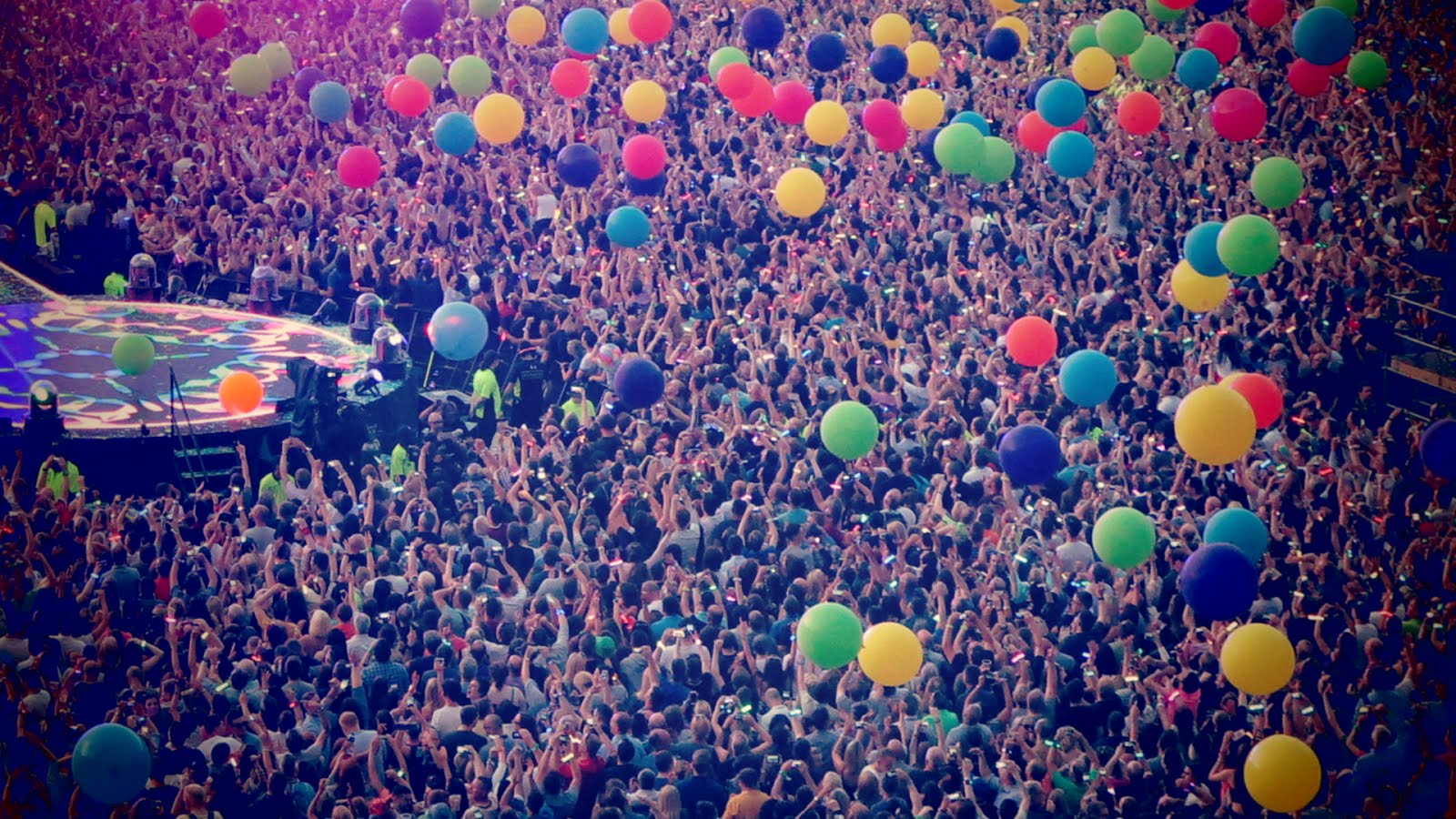
They are well practised at this now and do put on a helluva entertaining show. From the start they fired off the pyrotechnics and confetti canons. Everyone in the stadium was given illuminated wrist-bands to pulse away with appropriate colours for each song. Chris Martin admitted a few songs in that we were missing a lot of the lighting show they had rigged up, as we remained in the Scottish summer sunshine until near the end. We had balloons, fireworks, lasers and the whole crowd on the pitch and in the stands around Hampden were clearly buoyed by it all presenting an impressive singalong to every track.
Wee stage amongst the crowd, Coldplay at Hampden Stadium, June 2016
Despite the huge crowd Chris Martin is a dab hand at making it feel intimate, with wee mentions to King Tut's, a tear wiped away from his eye as the crowd out-sing him on Fix You and he works with the boundful energy of a big puppy between stages in the stadium. Tributes were paid to Muhammad Ali with a short video of the great man as we came into the song Everglow and later we were given Heroes in tribute to David Bowie. As they neared the end they took it down a level on a wee stage at the back of the stadium, finishing See You Soon with a chorus of The Proclaimers 500 Miles, which seemed a bit ill-conceived as he gave us the first ever rendition of that song which nobody could sing along to. Finishing off on the main stage again he sent everyone home happy with rousing renditions of A Sky Full Of Stars and Up & Up.
They do put on a very well produced and entertaining show, which the crowd lapped up. However hearing it live I found the music as vapid as it is in recordings. It is the first concert that I have been to when the artist thanks the audience for sticking with them "and putting up with all the shit that comes with being a Coldplay fan". He wants to be our friend, a big smiley, happy puppy. I prefer my rock stars to be daft or rebellious, unpredictable and inventive. I have always been more of a cat person than a dog person. My son disagrees. He thought it was the best thing he had ever seen, and who can argue with a satisfied customer.
Coldplay at Hampden Stadium, June 2016
Coldplay at Hampden Stadium, June 2016. The end
live review
live review, Glasgow, Coldplay, Hampden Stadium, June 2016. Adam Ant Glasgow Royal Concert Hall
Live Review: Bruce Springsteen - The River Tour. Hampden Park, Glasgow. June 2016
As a long time fan of Bruce Springsteen I would enjoy seeing him perform two hours of Christmas Carols but The River, his double album released 35 years ago, contains some of my all-time favourite songs. So I was delighted to find him bringing his "The River" tour to Glasgow. When the tour started in America, on stage Springsteen and the E Street Band worked their way sequentially through the twenty tracks of the album but, as is his wont, the performances are evolving and changing every night.
In Glasgow, as he came onto the Hampden stage at 6.45pm under a glorious sunny sky, he opened with the song I had been singing all day in anticipation of the concert, "Waitin' On A Sunny Day" (from 2002 album The Rising). Right from the off he was down at the front, working the crowd and soon dragged a 10 year old fan up onto the stage to sing along with him. She gave a spectacularly self-confident rendition of the song before giving him a hug and getting back down into the crowd.
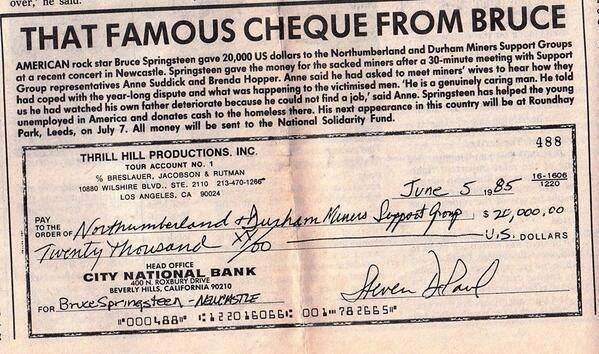
Keeping the upbeat mood he went into "Spirit In The Night" from the 1973 album Greetings From Ashbury Park, NJ, but which I first knew as the B-side to a 7 inch version of Born To Run that I have. This single was one of many that I bought from a rack in the newsagent across the road from my granny's house. These were old cast-offs from jukeboxes with the large hole in the middle, but often strange double-A side combinations. Like many people I worked my way backwards through Springsteen's catalogue, as I was only 2 years old when he released this album. My mother had bought Born In The USA when it was released in 1985, which were the first Springsteen songs that I heard. Touring the UK in 1985 he gave a donation to help the striking miners that year, which further endeared him to me. At that time I was making my first trips to record shops and started picking up second hand copies of his earlier albums.
In these days of Amazon and music downloads, record shops are few and far between. In the 1980s there were plenty of places to browse through racks and shelves of records, not just my granny's newsagent. I would spend many a Saturday starting at Dumbarton Road and working my way up to Great Western Road with a couple of friends, looking into umpteen record shops on the way. The first stop when I got off the number 9 bus in Partick was West End Records on Dumbarton Road. They also had a branch in Clydebank Shopping Centre and sold a lot of record company excess stock, often unfortunately with a punch hole clipped in the corner of the cover.
West End Records, Dumbarton Road Glasgow, not long before the whole block was demolished
After taking ownership of my mum's copy of Born In The USA it was in this shop that I picked up Springsteen's breakthrough album Born To Run from 1975, and later on progressed to The River. The River had come out in 1980 and was made by an artist caught between moody, downbeat storytelling songs and bright, rosy fist-pumping anthems. I didn't own many gatefold double albums then and spent many hours poring over the lyrics on the songs on it. The track The River was my favourite, but as a teenager I struggled to see why Mary and the singer in the song were so pessimistic and down about her getting pregnant and married at 19 years of age. 19, that was ancient! However, the image of this disillusioned pair dreamily thinking back to their teenage days of canoodling down by the river, wondering "Is a dream a lie that don't come true, or is it something worse?" appealed to me.
Bruce Springsteen and Steve Van Zandt
sing Two Hearts in Glasgow
In Hampden, four songs in we finally got to some songs from The River, the opening three tracks including Steve Van Zandt and Bruce duetting on Two Hearts. Drifting off of the setlist to take requests from the audience we got a storming performance of Rosalita and then Sandy from the 1973 album The Wild, the Innocent and the E Street Shuffle. This album of rambling storytelling songs I picked up in Realistic Records on Dowanhill Street. This second hand record shop opposite the Dowanhill Bar was where I found various gems over the years, including Big Country's The Crossing in all three sleeve colour variations and Eurythmics debut album In The Garden. Unless you got hold of the Guiness Book of Hit Singles it was harder to work out what albums and singles an artist actually had in the pre-internet age, so rummaging through record shops often turned up surprisng things.
Some of the Springsteen singles I've accumulated
In later years my amble northwards would divert from here to Music Mania at the bottom of Byres Road. Run by a Canadian with a dodgy moustache I picked up some complete rubbish like Bangs and Crashes by Go West. Then you could visit Woolworths if you were after chart singles, later Stephen Pastels record shop upstairs in John Smith's bookshop where Starbucks is now, before going into Echo nearer the top of Byres Road for more obscure stuff. The grumpy brothers that owned the shop (and also ran it as Listen in a previous incarnation) would always be happy to help. A wander up to Lost In Music in Ruthven Lane was good for older 7 inch singles and that is where I found Springsteen's My Hometown/ Santa Claus is Coming To Town classic disc.
Sad wee farewell letter from Lost In Music in Ruthven Lane
After three more tracks from The River, and an audience member's sign request for Lonesome Day, from the The Rising album, the music took a darker turn. Starting with Death To My Hometown from 2014's Wrecking Ball album before American Skin (41 Shots) and Murder Incorporated. These are two of my favourite Springsteen songs, American Skin in particular was a thrill to hear. Both are critical of gun violence in America, the former written in response to the police shooting in New York of an unarmed black man in 1999, killed when officers fired 41 shots at him. Murder Incorporated is about the normalisation of gun violence in society. Both songs are sadly more relevant to major problems in American society now, than even when they were written.
Taking requests from the audience we moved through I'm Goin' Down from Born In The USA to the excellent Johnny 99 from 1982 album Nebraska (one of my favourite albums) this time sung with a lively country and western twang. Despite the persisting bright sunshine we were into the more gloomy tracks from The River that I enjoy, with the title track and then Point Blank.
Late evening sunshine in Hampden Stadium, Glasgow
Other highlights for me in the main set were Because the Night, written by Springsteen in 1978 with Patti Smith and released by her as a single that year, Thunder Road from Born To Run and Badlands from 1978's Darkness on the Edge of Town.
A vigorous encore of barnstormers such as Born In The USA, Born To Run and the sad/happy Glory Days got the 55,000 crowd singing along to every song before a couple more audience members were plucked from the crowd to join him on stage in the Courtney Cox role for Dancing In The Dark, before Tenth Avenue Freeze-Out, which has now become a tribute to the absent Clarence Clements at Bruce Springsteen concerts.
As he did last time in Glasgow, he finished with The Isley Brothers song Shout, which got the crowd jumping and singing along, but I would have much rather had any one of a dozen Bruce Springsteen songs to send us home that we hadn't yet heard, rather than a song more associated with the teenage Lulu. Looking at the setlist.fm website, Bruce Springsteen has played this song 84 times in concerts. Which two bands do you think have performed it live more times than he has? (answers at the bottom of this page, Lulu not included as we are talking about the internet era here).
As the band left the stage we were sent home with a solo acoustic rendition from Springsteen of This Hard Land, taken from the Tracks album of unreleased tracks.
This was one of his best performances that I have seen, 34 songs in three and a half hours of non-stop music, holding a stadium crowd in the palm of his hand as usual. He is in no way running out of energy as the years go on, although with plans for a solo studio album next, this may be the last time for a while that he tours with the E Street Band. Tonight he ticked off about twenty of my favourite tracks, many of which I'd never seen live before, but as that still leaves me plenty more to try and catch next time he is in town.
There's plenty more music where that came from...
Q - Bruce Springsteen has performed "Shout" live in concert 84 times over the years according to setlist.fm. Which artists have sung it live more often?
A - Bon Jovi have sung it 214 times, and Green Day 221 times...apparently. live review Bruce Springsteen Glasgow concert Hampden
I spend most of my time as a spectator of sport in Glasgow at football matches, more specifically at Firhill watching Partick Thistle. With my team being out of action a few weekends in April with international matches on the go and Scottish Cup semi finals, I have been exploring the other sporting offerings in the city in the past few weeks. I took my children along to plenty of other sporting spectacles during the Commonwealth Games last year, but we never really stuck with any of them. Although my children go to swimming clubs, athletics and badminton clubs we rarely go to these sports as spectators. In recent weeks we have enjoyed some sporting imports with Braehead Clan ice hockey matches and Glasgow Rocks basketball. We took in some sports steeped in nostalgia with speedway at Glasgow Tigers and greyhound racing at Shawfield Stadium. On Friday night I was watching Glasgow Warriors rugby team at Scotstoun, before coming back to football the following day. I enjoy watching sport, pretty much any old sport (except maybe Formula 1). In the days when there was less wall to wall sport on television I would happily watch all that was available; horse racing, FA cup finals, the boat race or the wrestling on ITV. When Channel 4 came along that introduced me to American Football, kabaddi, the Tour de France and sumo wrestling. As a child watching live sport usually meant standing at roadsides cheering on my dad taking part in road races and marathons or being taken to see our local football teams in Maryhill; Partick Thistle or Maryhill Juniors. The sport which has hooked me as a spectator ever since is football. I have been going back to Firhill to support Partick Thistle since I was introduced to them by my parents in the late 1970s. I have enjoyed re-visiting some alternative Glasgow sports over the past few weeks, but football is the only one that I really feel any emotional attachment to when I watch it.
Football - the world's favourite sport
If there is one sport that is played in all corners of the globe it is football (or soccer if you are playing it in America). Away from the corrupt world of FIFA and its grasping rush to make as much money from the game as it can, viewing the world as "potential new markets", whatever country you are in you can stumble across groups of kids kicking some sort of ball about. It may now have to compete with other sports, with people watching at home on TV and with modern distractions for younger audiences, but it is still the most watched spectator sport on planet Earth. Whenever I am holiday I manage to drift off to locate the local football grounds. If it is out of season and there are no matches on, it still gives you an idea of how local people live and relax. You end up wandering around weird, out of the way residential streets. You read up the local club's history, often intertwined with stories of immigrants or local industries and you can learn about a town or a city in a slightly tangential way. In Greenland I learned about the challenges of internal travel in the country and trying to maintain football pitches in their weather. On holiday in Germany I got a feel for St. Pauli's slightly anarchic neighbourhood in Hamburg.
Crowd at a Greenlandic league match
FC St Pauli, Hamburg , Germany
In Greece I wandered around the down at heels ground of FC Aris with their colours reflecting the Byzantine history of the Thessaloniki area. I also visited the stadium of PAOK (Pan-Thessalonian Athletics Club of Constantinopolitans), whose history links back to their roots as a team of Greeks living and playing in Istanbul, before being deported to Greece in the population transfers that happened after World War 1 in the region. In Iceland we saw that the national stadium had more images of women players than men on show, and their nearby pitches had hundreds of children taking part, boys and girls playing together, in a national tournament. These facts may give some clues as to why this small country is soaring past Scotland in the international rankings. The Netherlands has a team named after the Telstar satellite, who play in a stadium sponsored by Tata Steel when we visited it. Who knew that Tata will continue steel production in their nearby, profit making businesses in the Netherlands after they close their British plants? All these things I have learnt on holiday, because of my mild obsession of tracking down local football teams when I am away.
FC Aris, Thessaloniki, Greece
PAOK at Toumba Stadium, Thessaloniki
My son hamming it up outside the Icelandic National Stadium
Telstar, a Dutch team named after a satellite and a stadium previously sponsored by Tata Steel
Driving to London last year my son was delighted when I stopped off in Milton Keynes to have a wee nosey at the MK Dons stadium, or in Halifax on the way back up to cast an eye over my grannys's childhood home, and nearby stadium of FC Halifax Town, The Shay.
Hampden Park
In Glasgow most people are aware that football has a bit of a divisive history, with most people expected to align themselves with either Rangers or Celtic. The absence of their poisonous rivalry has not been missed by everyone over recent seasons (despite what many Sky and BBC journalists claim), with Rangers working their way up through the lower leagues. However, for good or bad, Glasgow's two most well known teams will resume hostilities again in the 2016/17 season. In Glasgow, Celtic Park in Parkhead has a capacity of 60,000 and Ibrox Stadium is able to house over 50,000. Unable or unwilling, to disentangle football in Scotland from religious bigotry and the politics of Irish nationalism, the Scottish national team cannot realistically be seen to use either of these grounds. It is maybe worth noting that the crowd drawn to watch Scotland does not heavily rely on Old Firm fans anyway. So the Scotland team are based at Hampden Park in Mount Florida, giving Glasgow three 50,000 seater football stadiums. This has been home to Scotland's oldest senior football team, Queen's Park, in one form or another since 1873, six years after their foundation as a team. Although at one time 149,000 could squeeze in here to (try to) watch a match, since it was redeveloped as an all-seater stadium in the 1990s in can now accommodate around 52,000. Most weekends however it is still home to Queen's Park FC and their average home crowd of around 750 hardy souls.
Hampden Park, transformed into a serviceable
athletics arena during 2014 Commonwealth Games
Out with the athletics, and re-laying the
Hampden pitch. A not infrequent necessity
Though temporarily out of action for football recently, when it was refitted to accommodate athletics for the Commonwealth Games (quite successfully it has to be said) it has reverted back to being our national stadium. Personally I would happily demolish the whole place. Nowhere in the stadium is there a decent view of the football, the flatly banked former terraces leaving you miles away from the pitch and draining any atmosphere the crowd manages to whip up. Getting to and from matches is always a slog, with roads in the residential streets nearby gridlocked for hours before and after the matches. The only sense of history that can be gleaned from the place is in the wee football museum housed in the main stand. It manages the tricky task of being recently modernised and completely out of date.
(Cost of visiting Scottish Football museum - adult £8, children £3. Combined stadium tour and museum visit £12/£5)
Hampden Football Museum
So if you are not going to Ibrox, Parkhead or Hampden to take in some football in Glasgow, what other choices do you have?
Women's football
Although more and more women and girls are playing football, at higher levels
one team dominates in Scotland - Glasgow City FC. I do like the fact that they don't bother with the words "Ladies" or "Belles" or anything in their name. They are just Glasgow City FC. I have taken my children often to see them, more often when
they played at Petershill, but we still take in the occasional game at Airdrie's
Excelsior stadium where they are now based. The team are in discussion with
East Dumbartonshire council, who are planning to build a new community facility which will be the future home for the club. If this happens it will be the first time in the UK a
stadium has been built for a women's football team.
Formed in 1998 and
playing in bright orange, for many years Glasgow City have gone
unchallenged, as the rest of the women's game in Scotland has struggled to keep pace
with them. In 2012 they won the domestic treble, and won every league match
that season. In 2014 they suffered their first league defeat in over six years,
when Spartans got the better of them. They have consistently got into the last
32 of the European Champions League, being knocked out by Chelsea last year and
by PSG at the quarter final stage the year before. Other clubs are slowly
emerging and Glasgow City are regularly pushed by Hibernian in league and cup
matches these days. Celtic and Rangers are now also putting some effort into
their nascent women's teams. Partick Thistle Ladies' team have recently been formed and play in the SWFL Division 2 Central. To make the matches more competitive the
league has been re-arranged with two tiers now, Scottish Women's Premier League 1
and 2, each of eight teams. The league runs from March to October.
Glasgow City coming onto the pitch against Aberdeen
The Glasgow City team is
now coached by one time Aberdeen player Scott Booth, and features many Scottish and Irish
international players. Some familiar faces are Irish international Clare Shine and Julie Fleeting and Leanne Ross who have notched up over 200 appearances between them for Scotland. The Scotland Women's team are currently outshining the men's team, on the cusp of qualification for the European Championships.
Scott Booth on the touchline
At cup games, friendlies
against English opposition and Champions League matches there can be a decent
sized and lively crowd, with a large number of families and children present. However when I recently went to see them, on a cold Sunday afternoon in April 2016 when
Celtic and Rangers were playing a few miles away, there was a pretty low turnout
for a league match against Aberdeen. To get to the stand fans had to come up
the tunnel onto the pitch as there was no need to open the concourses of the
stand today, which was a bit unusual. Despite the match being rather one sided, City struggled to create
decent chances but eventually ran out 1-0 winners.
Glasgow City supporters
There is still a long way to go before there is a greater level of challenge for Glasgow City FC in the women's game. So far this season they are undefeated in the cup and league and have won their matches 14-0, 1-0, 1-0, 10-0, 1-0, 8-0, 4-2 (the first two goals they have conceded this season). At present I enjoy following Glasgow's top league team, which I am happy to say is neither Rangers nor Celtic. Also my daughter quite likes wearing the Glasgow City football top she has, always a good talking point on holiday.
Cost to watch Glasgow City - £5 for adults and free for
children. The bigger games can be entertaining and my children certainly enjoy coming
along. But on a quieter day like this you do feel a wee bit as if you are intruding on a
private affair.
Junior Football
Scottish Junior football
is not football for children, but since the 1880s is the name given to
non-league football in Scotland. The Scottish Junior Cup has been contested
since 1886, with an earlier version dating as far back as 1880. Many of the
Junior football teams have long histories and great local popularity. Local
derbies like Auchinleck Talbot v Cumnock or Arthurlie v Pollok can attract crowds
of well over 1000, but nowhere near the 76,000 who attended the Junior Cup Final in
1951. The biggest names in Junior football are the Ayrshire clubs, although
Glasgow has many, many teams and was previously a route for players aiming for
a professional career, whether it was Bertie Auld going from Maryhill Harp to
Celtic, or Bill Shankley starting off in the Glenbuck Cherrypickers. Nowadays
it often goes the other way. Most of the first 45 minutes watching a Juniors
match tends to be about leaning over to the person nearest you and saying
"Is he that annoying wee guy that used to play for St Mirren in the
1990s?" I don't really follow any particular Junior team and this year have pitched up at Yoker Athletic's Holm Park once to see a pre-season warm-up match for Partick Thistle and I went to one Renfrew Juniors match. However I quite fancy going down to Kilmarnock for the Junior Cup Final this year, due to my family's distant footballing links to that part of the world that I've written about previously.
Yoker Athletic v Partick Thistle, August 2015
Junior football has a reputation
for being one of the few sports where fights can start on the pitch and
spill over into the crowd, but it has a rich history. The history of Junior football teams is inextricably linked to the rise and fall of industries in Scotland. As new communities grew up around an industry, local teams sprung up, often several within a small area, like Ashfield and Glasgow Perthshire in Possil, with their grounds practically on the same block. This link between the health of a community and the health of its Junior football is nicely drawn in the recently published book Shankly's Village: The Extraordinary Life and Times of Glenbuck and it's Famous Sons by Adam Powly and Robert Gillan. Despite its illustrious history, neither the team, nor the village that Bill Shankly and many others started their football careers at still exist. I heartily recommend the book to you. This year the Junior Cup Final will be played on Sunday the 29th May, 4pm at Kilmarnock's Rugby Park. After Pollok overcame Hurlford last week in front of a crowd of 1600 people in the second semi-final, it will be contested between them and Beith.
Partick Thistle
I have mentioned above that my parents brainwashed me as a child by taking me to Partick Thistle matches when I was young. Whether it was an attempt to keep me away from the Old Firm, or just that old fashioned thing of supporting your local team, I don't know. I have been unable to reverse this early conditioning and been going to Firhill now for the best part of 40 years. Anyone with a bit of Thistle knowledge will see that this means that I have missed their 1971 league cup victory and had to endure the various ups, downs, downs and occasional ups since then as a result this.
Firhill Road, Maryhill. Glasgow
Younger people who follow big teams probably won't be aware of this, but football always used to be played at 3pm on a Saturday afternoon. Weird, huh? On a Saturday as a family we would just make the short walk to Firhill to see what was happening. At that time the reserve team would play at Firhill when the main team were playing away, so there was usually something to watch. Huddled up on the terracing behind the goal my mum would often prepare a picnic of sorts for us to eat at half-time - no "chewing gum! macaroon!" for us. As a teenager a few of us got into the habit of regularly going to the games together, often my brother, my cousin and my pal Alan who stayed up our flats. Then as a student once I had a car, away games became possible. I know that there are parts of Scotland that I would never have visited if Partick Thistle had not spent so many years yo-yoing up and down through the divisions. Maybe some Rangers fans have just taken their punishment on the chin and got on with enjoying getting to know Scotland a bit better.
Old entrance to the south terracing at Firhill Stadium.
There is much that I miss about the old atmosphere at matches, when opposing fans were separated on the terracing of the Firhill Shed by a fence and hurled abuse, pies and much else at each other across it. However it is easy to forget that the pantomime abuse went too far at times and I don't want to go back to the days of being chased down Maryhill Road under a hail of bricks. For many reasons all-seater stadiums were introduced, alcohol banned and closer police scrutiny were introduced.
As the name suggests Partick Thistle have not always played in Maryhill. I have previously written about their early grounds here and here if you have a burning desire to learn more. For much, much more comprehensive information on Partick Thisle, the early years follow the link to the website that carries that very name.
The old main stand at Firhill, where away fans are usually accommodated
Firhill Stadium panorama
The teams (and Kingsley) come out for Partick Thistle v Inverness CT
As we come to the end of the 2015/16 season Partick Thistle are almost safe for another season in the top division with Kilmarnock and Dundee United favourites to go down or face the play-offs. The fun in all that is that both these teams have previously had a hand in condemning us to the lower divisions. Ever the unpredictables however, no Partick Thistle supporter is believing we are there yet until we are mathematically safe. The problem is that with near bankruptcy in the past, the club have now taken the unusual step of running a club within its available budget. This causes the great difficulty of putting us at a disadvantage against clubs who have decided against this wacky principle. It is for reasons like this that it really becomes infuriating when clubs gain from a form of financial doping, but rarely throw their hands up and say "mea culpa". Maybe it's the Latin that puts them off.
Skyline of Glasgow's Westend from the stand at Firhill
As near as Thistle got to creating a chance in the first half
With a superior goal difference and a nine point gap at the start of this match it appears too many of the players are thinking about their summer holidays or their next career move. After harrying Inverness for the first 10 minutes Thistle drifted out of it and showed little determination or cohesion. As a result they allowed Inverness Caledonian Thistle to go into half time with a 1-0 lead.
Kids' teams on the pitch at half-time
Liam Lindsay watching a ball
As part of their aim at future financial stability Partick Thistle have spent time and effort on trying to develop younger players. With the addition of financial assistance from Chris and Colin Weir this has become part of the Thistle Weir Youth Academy and some of their young players were given the chance of a kick-about at half time. With efforts like this and free entry for children under 16, Partick Thistle are making a concerted effort to (literally?) grow future fans. Other efforts to raise the club profile this year have included free art giveaways to fans (see here for more info) and the creation of the world famous mascot, Kingsley. However all of that effort is harder to maintain with the potential drop in income that the club would face if relegated. So the biggest effort has to be on the pitch. Unfortunately for any young fans we were trying to impress today the team started badly in the first half and then tailed away in the second. Inverness Caley Thistle eventually finished comfortable 4-1 winners (I think that was the score, I was watching through my fingers at the end). With Kilmarnock having a convincing win over Hamilton we are rapidly losing our points and goal advantage over them.
Remains of a pie and Bovril. See it as an artistic metaphor for something
Today's match was a disappointment, but I would rather we stop watching football the way Sky Sports market it, as a series of blockbusters. I prefer to see today's match as an episode in a box set. Okay, the bad guy was on top at the end today, but I am already eagerly anticipating the next installment, when the wee guy might get his just reward. Once the season is over, I will sit down and reflect on it a bit. Then a few weeks later, even if I said "never again" after my favourite character was written out, I will be eagerly tuning in again for the next series.
American research a few years back has shown that football is the most unpredictable sport to watch, when compared to ice hockey, basketball, American Football and baseball. When analysing 100 years of data from the top English league they found that you were more likely to see an upset by an underdog in football than in these other sports. Their argument was that this is one thing which made it an exciting sport. Sadly they also found that upsets were happening less frequently in the most recent data. This seems to be a result of some clubs now being able to financially out-muscle their opponents.
If leagues and super-leagues are set up with the aim of helping the big teams at the expense of all the others, I would say that those big teams are in danger of killing the goose that is laying their golden eggs. In Scotland the league set up seems so skewed to the interests of a minority that the danger is fans lose interest and vote with their feet. Clubs like Partick Thistle struggle to compete in the current financial environment and they are trying to get stability by rooting themselves very much more in the local community at present and I would applaud them for that. There is also clearly a need for some meaningful way to introduce a form of fan ownership to football, to give fans a voice on the daft committees running the game in Scotland.
Other actions have inadvertently thrown a wet blanket on any enthusiasm football supporters try to whip up. Football teams seems to be unfairly singled out. It is hard not to see this as a prejudice against the people they draw their support from. The all-seater stadiums and alcohol bans you see at football are not in place at crowds I saw in recent weeks at speedway, basketball, ice hockey or rugby in Glasgow. On occasions when I have gone to watch football in England you are allowed to stand about and enjoy an alcoholic drink in the ground, everywhere except at your seat. I am not trying to say that football needs alcohol, but all the other sports I went to have been able to use bars as another way to draw people to the ground earlier and to generate income, important for clubs often living very much hand to mouth. The Offensive Behaviour at Football Act brought in by the Scottish government was intended to tackle sectarianism at football matches, but has had no effect in tackling this issue at the clubs where it is a problem. Why criminalise just football fans in law, why not just an "offensive behaviour act"?
Football can still throw up the occasional surprise. Occasionally a Greece wins the European Championship, or a Partick Thistle wins the Scottish League Cup. When I sit down to watch a match in which I have no great vested interest, unerringly I am cheering on the underdog within a few minutes. The great and the good of UEFA's vested interests may try to mould the shape of football to suit their narrative, but occasionally a team like Leicester City will defy the 5000-1 odds bookies were giving their chances at the start of the season. It's one in the eye for the big bullies, and like many others I will be cheering them on tomorrow against Manchester United. Then I will be back at Firhill, waiting with renewed optimism for our turn to have a big surprise season.
"All that I know most surely about morality and obligations, I owe to football."
- Albert Camus
Cost - Partick Thistle vs Inverness Caledonian Thistle adult £22, children free
The Commonwealth Games kick off in Glasgow in July 2014 and the deadline for the first batch of ticket applications is the 16th of September. Like many people I've put in a clutch of applications for me and my family and am waiting to see how many I've got before deciding whether to apply for some of the other sports on offer. It is an eccentric collection of sports that are in the Commonwealth Games, I guess the clue for that being the fact that these were originally the British Empire Games, but with countries participating including Jamaica, Australia, Canada, Kenya and Vanuatu there will be a host of top athletes on show.
Whatever tickets I get there will still be the marathon and the road cycling to be watched on the streets of Glasgow. The recent National Road Race Championships through the city streets showed what an entertaining spectacle these will be. Work is ongoing to get all the venues ready. As I'm running the Great Scottish Run half marathon in Glasgow in 4 weeks time the distances for my training runs of a Sunday morning are having to increase, and as I get easily bored, I devised a couple of wee 13 mile/ 20km routes around the Commonwealth Games venues to see what progress is being made on them. So if you want to run, cycle or walk around these places let me tell you what route I chose and what I saw.
Route 2. Scotstoun, Hampden and Ibrox, a 22km loop
Clyde Auditorium (Armadillo) and The Hydro
Yesterday I ran around some of the Commonwealth Games venues in Glasgow, and today I had a quick scout around the other Glasgow venues as I want to do another 13 mile training run next weekend as I get ready for the Great Scottish Run. I had decided to leave off the diving venue (Royal Commonwealth Pool, Edinburgh), the Mountain Bike Course on Cathkin Braes (although that appealed as it was where Benny Lynch went on his training runs) and also the Barry Buddon Shooting venue in Carnoustie.
SECC with BBC studios across the Clyde
So I started at the SECC where the Hydro, SECC and Armadillo will be hosting the Boxing, Netball, Judo, Wrestling, Weightlifting and Gymnastics during the Commonwealth Games. I then headed west along the Cydeside.
Glasgow Museum of Transport (and a big crane?)
Passing the new Transport Museum you only get a hint of the industry that used to fill the banks of the River Clyde with the cranes of Govan shipyards downstream from here. Heading down by the river along South Street, you'll soon pass the site of Partick Thistle Football Club's Meadowside ground from 1897-1908, on the opposite bank from Govan shipyards, now blocks of modern flats.
Govan Shipyards on the south bank of the Clyde, the Meadowside flats on the north
Other shadows of the shipbuilding days are soon seen in the "Harland Cottages" on South Street, bearing the name of the Harland& Wolff yard that used to run seven building berths in their yard in Govan. Turning right into Harland Street at about the 5km mark and going straight up through the side streets you'll soon come to what I knew as Scotstoun Showgrounds when I was younger. Although initially used for agricultural shows, by 1915 it already had an athletics track and grandstand here. Since those days it has had a modern running track laid and Scotstoun Stadium is used now by Glasgow Warriors Rugby team. Alongside that there are 5-aside football pitches, a swimming pool, a gym, squash and badminton courts.
Scotstoun Sports Centre
However Scotstoun is neither hosting the Badminton nor the Rugby 7s. The Squash will be played here during the Commonwealth Games, but not without some controversy. As well as using the 6 permanent squash courts, a temporary glass walled show court will be built for the games but afterwards will be dismantled and will not be available for Glasgow to host prestige squash tournaments in the future. The Table Tennis is also going to be on here, presumably being held in the area where the Badminton courts are.
Fossilised Crazy Golf in Victoria Park which will bamboozle the archaeologists of tomorrow
So from here it was time to head through neighbouring Victoria Park and get south of the river Clyde. As a teenager I was often in Victoria Park but the rowing boats and Crazy Golf that I used to play on are long gone. The fantastic Fossil Grove is still here and I think that it is mental that we don't, as a city make more noise about the fact that you can come and see 325 million year old fossilised tree stumps in the place that they once grew.
Clyde Tunnel Cyclepath
Once you've gone through the underpass at the expressway you can get into the Clyde Tunnel cyclepath from Dumbarton Road. Where the entrance of the Clyde Tunnel now sits was once home to Partick Thistle Football Club from 1885-1897, Inchview. If you are running or walking it doesn't matter which of the two pedestrian tunnels you go down, but if cycling you need to go with the flow of traffic. The cycle tunnel is about 1km long and isn't as scary as it used to be, with the controlled entry at each end, a fresh lick of paint inside recently added to brighten it up and it no longer even smells like a urinal.
Mrs Elder in Elder Park
Coming out in Govan you can head towards the shipyards and then veer south through Elder Park if you want to see one of only three women immortalised in statue in Glasgow. Here can be found Mrs Isabella Elder, who created the park to remember her shipbuilding husband. She was of a philanthropic bent and particularly supportive of the education of women. She bought North Park House on Queen Margaret Drive (which later became home of the BBC) and presented it to Queen Margaret's College to use for female medical education. Her statue is of its time and, despite her efforts, women knew their place in those days so the plaque at the base of the statue records her name as "Mrs John Elder". The other two statues of women in the city are Queen Victoria astride her horse in George Square and Dolores Ibarruri, 'La Passionara', with fists clenched in the air down by the Clydeside.
Ibrox Stadium, 11 km into this route
If you've found your way through the streets and industrial units around here you'll emerge at what I suspect will be one of the easiest venues to get tickets for during the Commonwealth Games, Ibrox Stadium, which will host a weekend of Rugby Sevens. With a capacity of 50,000 you would expect there will be tickets available for this although the world's major rugby nations will all be here for the tournament. It is a wee bit tricky to find your way through the side streets of Pollokshields to get from Ibrox to the last Commonwealth Games venue today, Hampden Stadium.
Hampden Bowling Club
If you cross Paisley Road West, there is a path that goes over the M8 then under the M77. You should then come out onto leafy Nithsdale Road and head left for a couple of kilometres, crossing Pollokshaws Road and heading up to "Scotland's National Stadium" as it now seems to be branded. I was always under the impression that it was primarily "home to Queens Park Football Club". No matter how you've got here you will undoubtedly have passed a couple of Bowling Clubs on the way, surely confirming that we must be in with a chance of a few medals here.
Hampden Park
Football will be banned for most of a year in Hampden as it prepares to host 8 days of Track and Field events and the Commonwealth Games closing ceremony. For this to happen there is still a track to be laid in Hampden, which will involve raising the area at the edge of the pitch and slightly reducing the capacity by taking out the front rows. With Usain Bolt declaring that a Commonwealth Games title is still one which he wants to get, to complete his collection, it could be that all eyes will be on Hampden during these days.
Terracing at Cathkin Park, once home to Third Lanark FC
I find it impossible to go for a run out this way without sticking my head in to see the sad sight that is Cathkin Park, once home of Third Lanark Football Club before their demise in 1967. Today the weed covered terracing waved in the wind like a ghostly crowd, oblivious to the man from the council in his wee lawnmower doing handbrake turns on the pitch whilst cutting the grass. From here it is a wee run down Aitkenhead Road then turn right and down Cathcart Road. You will pass the shell of the Alexander "Greek" Thomson designed Caledonia Road Church which stands empty and purposeless in a traffic island here, a remnant of the once mighty Gorbals. From here, cross over the Clyde and head back along the north bank of the river to get back to the start at the SECC.
22km or 13.5 miles, another wee route to vary my training for the Great Scottish Run in October.
Caledonia Road Church, by Alexander "Greek" Thomson