Glasgow International 2018. Festival of Contemporary Art
A quick first impressions review of some of the stuff that is on at the sprawling Glasgow International art festival in the city for the next two weeks. It is an absolute pleasure to have this kind of gala appear in the city every two years, and much of it feeds off of the community of people making art in Glasgow. In the space of a few hours I battered around over 30 different exhibitions at 18 different venues on my bike, and would have kept going if I hadn't needed to get home for my daughter getting in from school, and I still felt that I had barely scratched the surface.
Maybe by Urs Fischer
However, it must be said that a fair amount of the stuff on show this year is high in concept, low on execution. If it takes you longer to read the accompanying blurb than it does to ponder the work itself, that's not usually a good thing. Sometimes you need no explanation, such as with the fabulous pair of mechanical (and very life-like) snails crawling around the floor of the Modern Institute's Aird Lane space. "Maybe" by Urs Fischer makes you laugh, makes you linger and is beautifully executed. Another highlight for me is found in the main space on Osborne Street of the Modern Institute, given over to the powerful post-modernist images created by Duggie Fields.
Inside Oxford House
Less successful are the many exhibits at House For an Art Lover, the Oxford House and Stallan-Brand Architect Office beside the Sherriff Court, and the Savings Bank on Bridge Street. However even in these places it is at least a chance to get inside these beautiful and fascinating Glasgow buildings not always open to the public.
Toby Paterson's Pallisade on High Street
Nicolas Party's big purple head outside Aird Lane and Toby Paterson's "Pallisade" outside the old Linen Bank on High Street are colourful distractions, whilst Turner Prize winner Lubaina Himid's jolly dragon which stretches across the main hall in Kelvingrove Art Gallery looks like the kind of bland decoration you would find in a department store during some nondescript festival.
More head scratching ensued when we came across the combined efforts of eight artists in the Botanic Gardens glasshouse. I really did not feel that it explored either the "paradoxes relating to the interplay of global and local forces upon the communities and places of Glasgow" or the "heterotopic space containing its own oppositions; interior and exterior, nature and culture, global and local." Equally disappointing was Lauren Gault and Sarah Rose's "Sequins" floating in the Forth and Clyde Canal, resembling little more than the other detritus floating nearby.
In the Kibble Palace, Glasgow
One exhibition where it was productive to read the accompanying blurb was in the Briggait, where Montreal-based artist Nadia Myre had riffed on the once upon a time sizable Glasgow industry of clay tobacco pipe production. With old pipe stems fashioned into various other items it raised questions about colonialism and waste and was a rare instance of concept and execution coming together to create something memorable.
Soft Measures by Kapwani Kiwanga
Ciara Phillips's prints in Glasgow Print Studio were beautifully presented and fascinating to see, and also worth seeing were the sculptural creations of Kapwani Kiwanga at Tramway, lumps of granite suspended on curtains of fabric. Next door in the main hall at Tramway Mark Leckey had a solitary carved figure, a blown up version of an 18th century figurine, facing off against a video of his cavities being explored, all perfectly entertaining once your eyes had adjusted to the gloom.
Nobodaddy by Mark Leckey
Two highlights for me were the photography on show at the Hunterian Art Gallery at Glasgow University and that on show at SWG3. German photographer and film-maker Ulrike Ottinger has an extensive exhibition of bizarre and unsettling photographs, evoking cabaret acts and freak shows, on show alongside some of her films at the Hunterian. At SWG3 Hugo Scott's street photographs are full of humour and interesting characters, each one a short story. Also worth seeing at SWG3 were the sculpture in the main hall from Richard Wentworth and Victoria Miguel, and across the lane the creations and collages of punk designer Judy Blame.
A Roomful of Lovers by Richard Wentworth and Victoria Migual
The Gallery of Modern Art has a jumble of interesting ideas and images, nine artists collectively displayed under the name Cellular World, but it all feels rather disjointed. If you rummage about in the main hall there are some interesting bits and pieces among all the clutter, Joseph Buckley's concrete wall I found the most engaging.
Cellular World at GOMA
Finishing off my day at The Common Guild felt like a gentle palate cleanser after the barrage of stuff earlier in the day. A solo exhibition by German artist Katinka Bock, a collection of small, quiet, clay and, slowly oxidising, bronze sculptures.
There are two weeks to go, and at times it is a bit hard to sift out the wheat from the chaff, but there is surely something there for all tastes. Just keep looking.
I would argue though, that sport and sports venues are now providing sculptors with their most reliable source of employment. Although it can be easy to sneer at many of these as dead-eyed simulacra, I have a bit of a soft spot for them. A 2014 study found that in Scotland, it was Glasgow which had the highest density of sports-related statues. I tried to have a quick look around all the sporting statues that I could think of in Glasgow and nearby towns, and have listed them below, but first a few quick thoughts on the whole notion of sporting effigies.
Some of the statues outside Celtic Park, Glasgow
Public art has been with us since the first caveman decided to celebrate catching a mammoth by daubing its image on the walls of his house. Early art works for public consumption could be regarded as PR exercises. Whether you are a Roman emperor showing the public your square jaw, chiseled in marble, or the church, the Kings and the Queens of yore able to pay the top artists of the day to reveal to the world all of your glory.
Royal art, for art's sake
Statuary of the rich and famous adorned many Victorian streets, including Glasgow's George Square. But by then, standing alongside royalty and the landed gentry you had other heroes of the age. In George Square we have Queen Victoria, but also Robert Burns and Sir Walter Scott, inventor and engineer James Watt and chemist Thomas Graham. Glasgow has very few sculptures of real women (Queen Victoria, Lady Elder in Govan and Dolores Ibarurri/ La Pasionaria is it). There is currently a campaign to add to that number by funding a statue of Scottish political activist Mary Barbour. However since the last of Glasgow's female statues was erected in 1977, by comparison, there have been five football related statues of men put up in the city.
My holiday snaps of Ken Dodd in Liverpool...
...and Tommy Cooper in Caerphilly
Our modern day heroes being set in stone (or cast in bronze) are more likely to be entertainers and sportsmen (sorry, there are far fewer statues of sportswomen being built). Famous sons of Morecambe (Eric Morecambe), Liverpool (John Lennon, Ken Dodd) and Caerphilly (Tommy Cooper) are now becoming visitor attractions. In particular, creating sporting statues seems to be a growth industry, and on the whole, it is football leading the charge.
Scotland's greatest footballing work of art - Kingsley,
the Partick Thistle mascot designed by artist David Shrigley
Sporting statues - the good, the bad and the ugly.
Many sporting statues seem to be not dissimilar in their general appearance. They are most commonly bronze, life-sized, and life-like in appearance. Intentionally expressionist or abstract renditions are rare. Unimaginative, safe, bronze zombies are common.
The commonest option appears to be immortalising the sporting hero in a formal pose, usually standing with a bit of sports equipment handy to give you a clue to who it is. Alternatively they can be rendered in an action shot - running, jumping or sliding. If poorly executed however, this runs the risk of making someone remembered for being fluid, fast and elegant, instead look accidentally leaden and heavy. Thirdly, a famous image can be recreated in statue form - holding a trophy aloft, aping a famous celebration or a classic photographic image.
Many sporting statues are famous for bearing no resemblance to the intended subject; for being weird, for looking more like the bust at the end of that Lionel Richie video than the intended sporting hero. The recently unveiled bronze bust of Ronaldo at Madeira airport maybe wasn't what they had envisaged when they ordered it, but I'm sure that their airport is now better known throughout the world than it ever was before.
Christiano Ronaldo at Madeira Airport. So bad it's good.
You do not get any weirder in the world of sporting statues than Mohamed Al-Fayed's decision to put a statue of Michael Jackson outside Craven Cottage. Once Al-Fayed lost control of the club it was removed from there and transferred to the National Football Museum in Manchester, a move Al-Fayed blamed for Fulham's subsequent relegation.
Michael Jackson statue at Craven Cottage
One statue that managed to stumble into all the available pitfalls in undertaking such an enterprise was Southampton Football Club's attempts to render former player, manager and director Ted Bates in bronze. The first effort was so embarrassingly bad that it was rapidly removed, and at great expense replaced with a less imaginative version.
Ted Bates version 1.0 and version 2.0
Some statues can be divisive. On attending a game in Sunderland a couple of years ago I came across the exuberant statue of Bob Stokoe outside the ground. He was the Sunderland manager who in 1973 led the club to their fist FA Cup victory in 46 years, the first time a second division team had won the trophy. His spontaneous run down the pitch, in trilby and mac, is captured in this statue outside the Stadium of Light in Sunderland. Some people are not keen on it, but it made me raise a smile when I saw it, and I think it is great.
Bob Stokoe statue outside Sunderland's stadium
Whilst Bob Stokoe looks full of energy the statue below, which I came across outside Twickenham rugby stadium in London I found just odd looking. Nine metres high and costing £455,000 to complete it shows a rugby line-out in full flow. It may well be an accurate representation of a moment in the heat of a match, but static, frozen, stationary, with best will in the world I could only see that the guy at the bottom was parting his colleague's buttock cheeks to look for his lost keys or something.
The point that I am clumsily trying to make is that a statue that makes a connection with you does not need to be the greatest work of art in the world, and if it is alien to you (like me and rugby), you just might not get it.
Rugby line-out statue at Twickenham Stadium, London
Sport statues in Glasgow and the West of Scotland - Football
When it comes to representations of real sports stars, it is the Old Firm that lead the way in the west of Scotland, and in particular Celtic FC. They have now redesigned the approach to Celtic Park from London Road, creating a path where fans can pay to have their name on a paving stone, alongside statues of several of the clubs heroes. The latest addition to their collection of statues is Billy McNeill. 2017 marks the 50th anniversary of McNeill captaining Celtic to European Cup victory in 1967, and there he is, looking down London Road with the cup held aloft.
Billy McNeill statue at Celtic Park
Nearby stand three other prominent figures in Celtic's history (or one sits and two stand, to be completely accurate). Sculptor John McKenna, who created the Billy McNeil statue, is also the man responsible for the statue of Jock Stein up near the main entrance to Celtic Park, again holding the European Cup. John McKenna also created the bagpipe carrying statue of AC/DC's Bon Scott, which now stands in Kirriemuir.
To confirm a slight "Lisbon Lions" tendency among Celtic statues, standing on Jock Stein's left is Jimmy Johnstone who played in the 1967 final. The Jimmy Johnstone statue has been here three years longer than his manager, being completed in 2008. It was created by Kate Robinson. She is also responsible for the statue of two figures which overlooks the M8 motorway in North Lanarkshire - Woman Man Sun Moon and for another statue here at Celtic Park. In 2005 she completed Celtic's first statue, the seated figure of "Brother Walfrid". Brother Walfrid was the Marist priest who founded Celtic Football Club. Originally from Ireland, but working in the 1880s at the Sacred Heart School in Glasgow, he proposed setting up a football club in order to raise money for the impoverished residents of the east end of Glasgow. In the overcrowded housing of the area many lacked food and employment, both the longstanding residents of the area and the new immigrants from Ireland, who also had to deal with discrimination. The new club played its first game in 1888, funnily enough, against Rangers.
Statues of Brother Walfrid, Jock Stein and Jimmy Johnstone outside Celtic Park
Jimmy Johnstone has previously been voted as Celtic's most popular ever player, and that maybe explains why there is another statue of him nearby. Six or seven miles east of Celtic Park, in his home village of Viewpark, Uddingston, Jimmy Johnstone stands with fist raised aloft. This is another John McKenna statue and it is clear that neither sculptor depicting him could represent someone known as "Jinky" in a stationary pose, as both statues try to get a bit of his movement into them.
Jimmy Johnstone statue, Viewpark, Uddingston
Just five miles away from Jimmy Johnstone's plinth in Uddingston, in the grounds of Hamilton Palace Sports Ground stands Davie Cooper. Born in Hamilton, Davie Cooper started his playing career at Clydebank, but found fame as a winger with Rangers FC in the 1980s. In 1995 he died suddenly from a brain haemorrhage at the age of 39. I have to say I don't think the statue really does him justice. Although the face is a good likeness, the proportions look a wee bit off. At least he is staring out over the football pitches at the nearby sports centre, ready to lay on a pass. The sculptor for this one, Kenny MacKay, has several other familiar sculptures that you might know. These include Donald Dewar at the top of Buchanan Street, the golden "Light and Life" figure atop the old Co-op warehouse beside the Kingston Bridge, and he moulded the leafy metalwork on the outside of Princes Square (designed by Timorous Beasties).
Davie Cooper in Hamilton
The former Rangers captain John Greig is the other Rangers player who has a sculpture in the west of Scotland, although his is a far more sombre affair. Unveiled in 2001 as a memorial to the Ibrox disaster of 1971, he is depicted in a contemplative stance, with his left hand holding a football against his hip, and his head turned towards the direction of the entrance where many spectators died. A crush on the stairs here in the final minutes of a Rangers v Celtic match on January 2nd 1971 led to 66 people losing their lives, the youngest aged 9 years old, and 145 people being seriously injured. My uncle Ronnie and my uncle John were at the game together, each supporting different teams. They had left the match a few minutes before the end, and unaware of the later events they had headed off for a drink after the game. In the days before mobile phones let you track people down, their respective families were going crazy with worry until they rolled in later that night, oblivious to the disaster that had occurred at the match. Many other families did not have a similarly happy ending that night. Plaques on the plinth of the statue also commemorate those who lost their life in two other episodes at the stadium. Two people died on the same stairwell in 1961, and much earlier, twenty-five fans died during a Scotland v England game in 1902.
John Greig statue at Ibrox, commemorating the Ibrox disaster of 1971
Created by Andy Scott, it is a properly iconic statue. As a sculptor he has repeatedly demonstrated his ability to create great public art. Among his other popular works are the Heavy Horse beside the M8 near Easterhouse, and the fantastic Kelpies in Falkirk.
Despite Glasgow being the home of the Scotland national team, Partick Thistle, and Queens Park, that is it as far as footballing statues go in the city. Across Scotland there are a few other notable statues of footballers, such as a statue of Denis Law in Aberdeen and of a young, slim Jim Baxter in his home village of Hill O' Beath in Fife. Another destination oft visited by footballing tourists, particularly from Liverpool, is the village of Glenbuck in East Ayrshire, where a plaque marks it as the village that Bill Shankley came from.
Sport statues in Glasgow and the West of Scotland - Other Sports
There are not that many other commemorations of real athletes in this part of the world. Around Scotland we have boxer Dick McTaggart's statue in Dundee and racing driver Jim Clark in Kilmany, Fife. Golfers are represented by Ben Sayers in North Berwick, James Braid in Dalmahoy and Old Tom Morris at the Golf Museum in St Andrews. Runner Eric Liddell can be found in Edinburgh Old College and Hawick has motor cyclist Steve Hislop. However I was struggling to come up with many more in the west of Scotland, so I have been a bit loose with the definition of a sporty statue from hereon.
Clyde, the 2014 Glasgow Commonwealth Games mascot, in Partick library
The Commonwealth Games of 2014 which took place in Glasgow included a varied arts program alongside the sport. Much of it feels a wee bit temporary now, a couple of years after the event. Across the city numerous versions of the games' mascot "Clyde" were placed during the games, all differently decorated by Glasgow schoolchildren. Twenty-two of these have now been re-located to various council premises across the city. You may have one at your local library or swimming baths.
"Big G" Commonwealth Games logo
The logo of the games, a "Big G" structure that stood in George Square, can now be found in Glasgow Green. It is very much just a marketing logo. I am not sure it really holds a warm place in many people's hearts and I don't think it will age well.
Rugby player outside Govan fire station
Glasgow's eleven fire stations had sculptures erected in their grounds before the Commonwealth Games, representing the various sports in the games. These were built by prisoners in HMP Barlinnie and are still on display around the city.
Hockey player at Calton fire station
Pondering other sports that might be commemorated with a statue I could not think of any horse racing or greyhound statues in the city. There are a few notable equestrian statues in the city that it may be worth mentioning however. The horseback Duke of Wellington statue on Royal Exchange Square, permanently topped off with a traffic cone, has become almost a symbol of the city. Two other slightly odd horsey statues are worth mentioning.
Buffalo Bill statue in Dennistoun
For four months in late 1891 "Buffalo Bill" Cody ran his Wild West show, featuring Annie Oakley and many more, at the East End Exhibition Centre on Whitehill Street in Dennistoun, off of Duke Street. This statue was put up in 2006 by the housing developer that built the nearby flats that year.
Lobey Dosser statue on Woodlands Road
After several months of repairs (the statue gets repeatedly bent by people riding on it) the world's only two-legged equestrian statue is back in place on Woodlands Road, opposite West On The Corner, the former Halt Bar. Lobey Dosser, the sheriff of Calton Creek, was a character from Bud Neil's strip cartoon in the Evening Times newspaper from 1949 to 1956. Erected in 1992 by public subscription, the statue was created by Tony Morrow and Nick Gillon. Tony Morrow is also responsible for Dundee's statues of Desperate Dan and Minnie the Minx.
Running Clock by George Wylie
What about athletics? Definitely a sport which appears to be underrepresented in statue form. One bizarre statue which Glasgow used to house, beside Scotstoun Swimming Pool, was of tracksuit wearing marathon runner and all-round weirdo Jimmy Savile. When his activities came under investigation by the police, his statue was discreetly vanished.
Although not the complete athlete, George Wylie's "Running Clock" statue outside Buchanan Bus Station is worth a mention, as running for a bus is probably the peak of physical activity that many of us do. It is rare in recent years that the council have managed to get the four clocks at the top of it telling the same time, but when I photographed it today, they were all actually telling the correct time too (plus five minutes to make you catch your bus). Another running man nearby stands outside what is now called Buchanan House. Some offices of Transport Scotland are housed here in what was built in the 1960s as new headquarters for British Rail in Glasgow. British Rail commissioned the sculpture to symbolise the "power and virility" of rail travel(?). At the time of its unveiling, journalists used this daft premise to ask, if that was the case why the sculpture was not anatomically correct, genitals having been omitted. Called "Locomotion" the sculptor was Frank Cossell.
"Locomotion" statue in front of Buchanan House
There is one more athletic sculpture I came across which once stood hereabouts, on the roof canopy of Bishopbriggs Sports Centre apparently. This picture below is a photo belonging to Hugh Barrow, one time runner and rugby player, taken from "The Sporting Statues Project" website. They report that the statue was atop Bishopbriggs Sports Centre from 1973 to 1995, and is in storage now. Three statues of "The Runner" were made in 1933, cast from a new aluminium alloy called Sindal. Originally modeled on Clydesdale Harrier athlete Bobby Gray, it was made by John Longden, a Baillie in Clydebank, who worked at Tullis's Kilbowie Ironworks. Apparently a plaster version of the statue stood in Clydebank Library for decades, but no longer. I am intrigued by him apparently being painted in Partick Thistle colours, but I am guessing that the red and yellow is in fact meant to be West of Scotland Football Club's rugby colours. Does anyone remember this statue? Where is he now?
Although football casts a long shadow, there are many other sports played in Glasgow. I have written about being a spectator at some of these previously, but speedway, ice hockey, rugby and basketball have yet to throw up a character sufficiently prominent in the public consciousness to merit a statue.
One sport however in which Glasgow has managed to produce champions that could take on anyone in the world is boxing. However there are not yet any sculptural reminders of these wee men on the city streets. A quick search of the internet finds that in boxing there have been 12 Welsh world champions and in Wales there are four statues of boxers. England has had 70 world champions, and has six statues of boxers, with one of Henry Cooper also on the way. Northern Ireland has had 8 world champions, and has four boxing statues.
Depending on who you count, Scotland has had between 13 and 18 world champions and has only two statues. It was briefly mentioned above that Olympic and amateur champion Dick McTaggart has a statue in Dundee. The other Scottish boxing statue that I could find commemorates the life of Newmains boxer, James Murray. The Scottish bantamweight champion died from a bleed to the brain after his last fight in 1995, aged just 25 years. Alison Bell is the sculptor who created this statue of him that stands in the centre of Newmains in North Lanarkshire, gloves raised and wearing his champions belt. A reminder of the risks boxers take every time they go into the ring.
James Murray, boxer from Newmains
Any more statues on the way?
In the past week I have had news on my Twitter timeline about fundraising schemes to build statues in Glasgow for comedian Billy Connolly, campaigner Mary Barbour, and in his hometown of Saltcoats, "Lisbon Lion" Bobby Lennox. This latter one has John McKenna penciled in to create the statue, as he slowly works his way through the whole 1967 Celtic squad.
Benny Lynch training for a fight, photo possibly taken at Firhill Stadium
One campaign that I think has a lot of merit, and already has some momentum behind it, is the push to remember boxer Benny Lynch with a statue. Like many of the sportsmen named above, Benny Lynch grew up in a poor neighbourhood, in his case the Gorbals in Glasgow, and his boxing ability was what lifted him to become champion of the world. Thousands of people came to greet him at Glasgow's Central Station when he returned home as champion, and carried him shoulder high. I hope that either in the station, or near his Gorbals origin, we soon see a statue to Scotland's finest boxing champion. You can find out more about the campaign here, including how to contribute.
If anyone can think of any other sporting statues near Glasgow that I have omitted, or any glaring factual errors in what I have written above, please let me know in the comments below.
For more info on much of this see The Sporting Statues Project.
Saturday, 9 April 2016
Glasgow International 2016, a Festival of Contemporary Art
Yet again Glasgow International rolls into town, a two week festival of international contemporary art, which arrives here every second year. There are dozens of exhibitions and events on the go until April 25th, which does cause a bit of stress to a completist like me. However to maybe help you chose what to see I will give a quick review of the stuff I have managed to see in the first couple of days. One of the best things about Glasgow International is that it is all free.
West End
I started out at the Hunterian Art Gallery at the University of Glasgow. Apart from a small Glasgow International exhibition, there is an excellent exhibition upstairs here on the history and influence of comic books, including possibly the world's first comic book from 1825, The Glasgow Looking Glass.
Work by William Hunter, anatomist
Work by Damien Hirst, sort of artist
The theme of the exhibition here is to show "moments of mutual synergy" between science and art. What it does show is that the 18th century anatomical casts of a truncated pregnant women and illustrations from a 19th century textbook of histology are far superior works of art than Damien Hirst's Necromancer display cabinet.
Kelvin Hall , Glasgow
The Kelvin Hall is currently undergoing refurbishment before opening next year as the new home of the Hunterian Museum from Glasgow University. Whilst it is still a building site the foyer has been used during Glasgow International to house works by Helen Johnson and Claire Barclay. I'm afraid I was drawn as much by the chance to sneak a peek at the building wrk inside the building as by the artworks on show, but I was impressed by both.
A crumbling room in the Kelvin Hall
Both artists on display here used history as inspiration with painter Helen Johnson creating large canvases riffing on scenes from Ovid's Metamorphosis and reflecting on colonialism (this was the site if the Great Empire Exhibition), and upstairs Claire Barclay's elaborate sculptures reflect on the 1951 Exhibition of Industrial Power from the Kelvin Hall in 1951, but also from the annual carnival that used to be held here.
Upstairs on the balcony, opposite to the organ is a small, but interesting exhibition by Aaron Angel , who also has pieces withing the Botanic Gardens this year. These sculptures (The Death of Robin Hood) reflect pastoral crafts, but skillfully executed and tie in with a program of organ recitals within Kelvingrove.
Four sculptures by Aaron Angel in Kelvingrove Art Gallery
Kelvingrove pipe organ viewed through the sculpture
City Centre
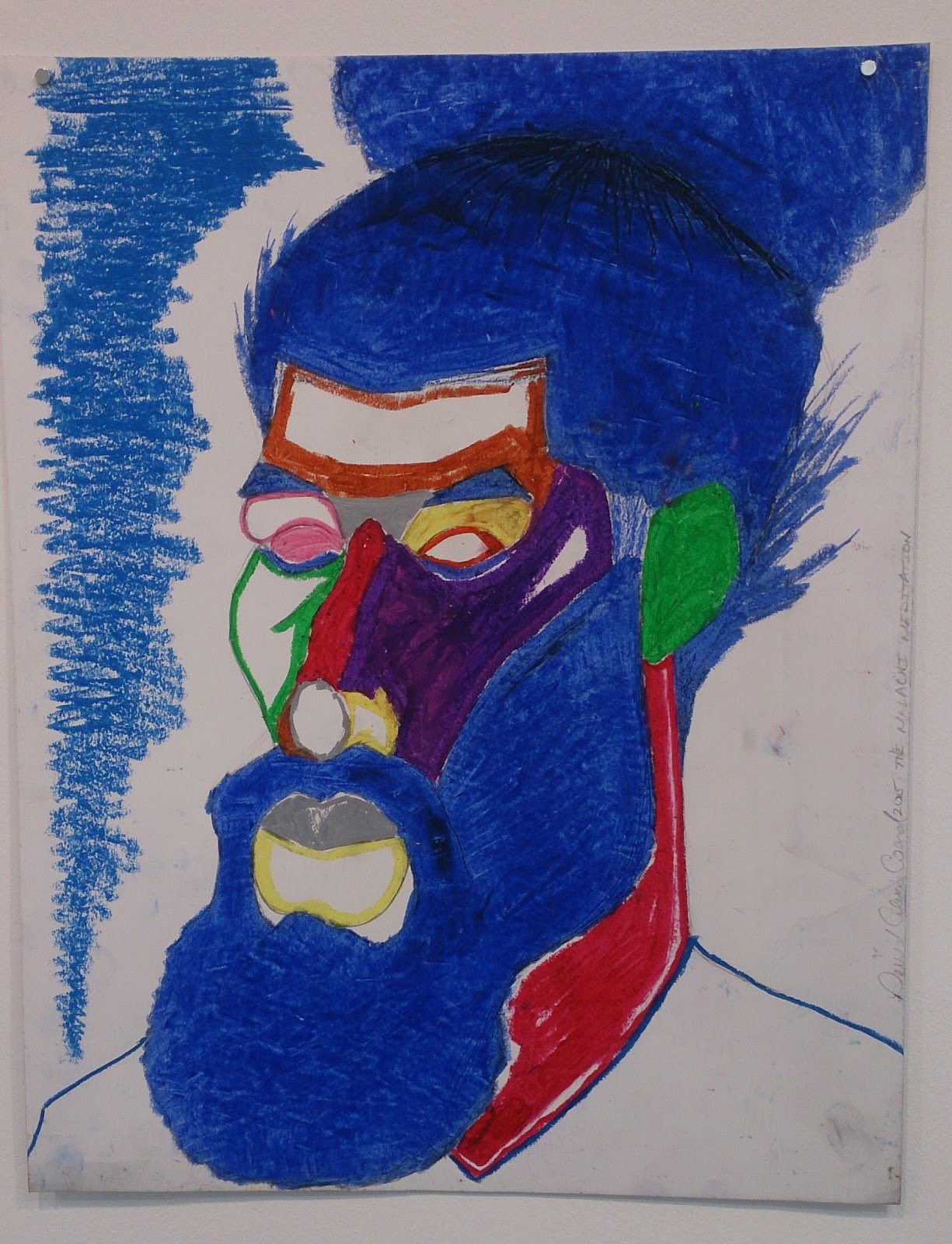
Trongate 103 is a hive of activity with Glasgow Print Studio, Transmission Gallery and Street Level Photoworks all holding exhibitions. Most eye catching is the stuff at Project Ability, an arts organisation supporting people with disabilities and mental health problems. They have a series of drawings by American artist Derrick Alexis Coard, imagined portraits of bearded African-American men. They leap off of the page with colour and vigour, really enjoyed seeing them.
Work by Derrick Alexis Coard in Project Ability
Further up High Street, in what is being called "Civic Room", a former British Linen Bank building in danger of vanishing unless it is looked after, is the work of Brazilian artist André Komatsu. In an early example of Victorian concrete an steel construction, he exhibits Disseminacao Concreta, a life sized clothed body of a man, made from concrete boulders. At the from of the building he also has a piece, Borders 1, on display. I really liked this concrete man, particularly in the shabby back room of this former bank, with the steel door of its safe behind his carcass. It is a lovely use the building
Former British Linen Bank, High Street Glasgow
Disseminacao Concreta by André Komatsu
At their Aird's Lane gallery the Modern Institute have a collapsed steel framework by Monica Sosnowska, modeled on a structure from an Eastern European scheme, with more twisted metal sculptures outside, whilst at their Parnie Street gallery a child-like talking desk critiques the world of art production and distribution. The work is by Joanne Tatham and Tom O'Sullivan and looks like the result of a weekend of brainstorming by the Ikea design team when someone sneaked LSD into their tea.
A Petition for an Enquiry into a Condition of Anxiety at the Modern Institute
Monica Sosnowska's work outside the Modern Institute, Aird's Lane
The main hall at the Briggait has a sculpture made of polythene sheets suspended from the ceiling by Heather Lander and Simon Harlow. This may be more impressive when seen at night when they have projections on them. Also in the Briggait are sculptures and drawings by Jock Mooney, which look set for a religious ceremony created by a comic book artist in the style of Frank Quitely.
Part of Jock Mooney's exhibition
There is more humour in the excellent exhibitions within the Mitchell Library. In the main hall Tamara Henderson's giant, totemic scarecrows inhabit this great big space. The gallery invigilator encouraged me to sit in the dilapidated car in the middle of the room to watch the video that goes along with it all. Upstairs in the Jeffrey Room, incongruously set amongst the shelves of leather bound books the works of Jacob Kerray and George Ziffo look like home made banners from a football match but riff on subjects such as racism and commercialiation. This was one of my personal favourites of my day.
Jacob Kerray and George Ziffo at the Mitchell Library
At the CCA Pilvi Takala has multiple video works on display looking back over ten years of work. They are humorous, silly and very engaging, such as trying to get into Disneyland dressed as Snow White, and being refused. I am not always a big fan of video artworks as I am too impatient at times but these are worth watching. Also there is a wall of posters for lost pigeons. Have you seen any of these birds? Some of these have been posted around Glasgow, haven't they, or am I imagining that?
Pilvi Takala
Within the Reid Building at Glasgow School of Art I really liked Serena Korda's suspended fungi, which are accompanied by musical chanting that you hear through headphones whilst walking around if there is not a live performance on the go. Her archival material in the room next door is fascinating too.
Serena Korda's Hold Fast, Stand Sure, I Scream a Revolution
I like the pop art inspired works by Emily Mae Smith on near St Enochs Square at Mary Mary Gallery. Bright, cheerful, but also with dark hints within them. I liked the marching broomsticks from Disney's Fantasia posed like Andy Warhol's gun-slinging Elvises. Pop culture reference overload.
Emily Mae Smith at Mary Mary Gallery
There is plenty to see in the Gallery of Modern Art too, with the main hall filled with sculptures, paintings and videos by Cosima von Bonin. She was born in Kenya and lives and works in Germany. Her works have lots of toy-like sea creatures and "Missy Misdemeanor, the vomiting white chick" who sits astride a huge pink rocket. Tessa Lynch's sculptures upstairs are interesting too and the blurb that goes with it talks about the "questionable existence of the female flaneur, or flaneuse". It is a funny idea to find questionable when the city is ideally set up just now for male and female flaneurs to wander aimlessly, stumbling across things and just observing people.
Sculpture by Cosima von Bonin at GOMA
Southside
House for an Art Lover, Bellahouston Park
A cluster of exhibitions sit in the "Artpark" buildings that sit alongside Charles Rennie Mackintosh's House For An Art Lover in Bellahouston Park. I didn't know this place existed and it has a fantastic permanent exhibition on the heritage, architecture and history of the are, including the shipyards which I spent most of my time here at to be honest. Gabriella Boyd and Marco Giordano fill one shed with engaging paintings and sculpture. For the other works here, I was more impressed with the buildings and gardens, where the hyacinths are just beginning to flower with their distinctive smell that you either love or loathe (*metaphor klaxon*).
Artpark at House for an Art Lover
Artpark at House for an Art Lover
Scotland Street School Museum, again an overwhelmingly impressive building by Charles Rennie Mackintosh, has a small exhibition in their ground floor gallery space next door to the cafe. This shows work from the varied career of Glasgow born artist Raoul Reynolds. I had never heard of this interesting character. He was born in 1882 and led a nomadic life between Glasgow and Marseilles, and died in New York in 1969. His father was a shipyard owner and his mother from a Marseilles manufacturing family. He was influenced by European avant-garde art movements but doesn't ever seem to have fitted in anywhere. His life story turns out to be more interesting than his work if I'm being honest, with hints of someone having more money than imagination. Perhaps I am just being over cynical.
Work by Raoul Reynolds at Scotland Street School
There are several major exhibitions on at the nearby Tramway, a group show including work by Alexandra Birken, Lawrence Lek, Sheila Hicks, Mika Rottenberg and Amie Siegel. The premse of the exhibition is to explore ideas around production, manufacture and history. Like the exhibitors in the Kelvin Hall the interactions with the building's history is part of that. Many of the spaces used in Glasgow for studio space and galleries are disused industrial spaces, such as this massive tram depot on the southside. Many of the works here are meant to be using that idea, but most of them weare video works and I didn't have the patience to sit through them. I admit I wasn't in the most receptive frame of mind after just being stopped by the Police on the way here for jumping a red light on my bike. At the subsequent set of lights (which were green) two pedestrians then just about bundled me off of my bike by not noticing me. I arrived at the Tramway in a peevish mood. However I was still a bit disappointed by it all. On a side note, could someone at the Tramway think about installing a few cycle racks in the vicinity, there aren't many easy places to chain up a bike nearby. Ta.
A sculpture made of coloured linen by Sheila Hicks at Tramway.
Also in the Southside, Glasgow graduate Josée Aubin Ouellette has a display of ergonomic soft sculptures on the floor of the pool at Govanhill Baths. You are encouraged to put on a pair of felt slippers and go down and loll about on these pieces. I preferred to nostalgically stare at the wooden changing cubicles lining the pool, remembering my childhood swims in Whiteinch Pool.
Govanhill Baths, Glasgow
Who knew that there was a Roller Disco in Kinning Park? (Oh.Well I didn't know). This is the scene for performances by Asparagus Piss Raindrop, the self proclaimed "crypto conceptual science fiction anti-climax band". I have seen them perform before at the Glasgow Tectonics festival and they usually tread a fine line between taking themselves very seriously and being very silly. I am not sure whch side of this line they've fallen this time but I liked the idea of them performing on roller skates to electronic music and live percussion and saxophone. It feels like an unsuccessful 1970s dystopian film that failed at the box office because of the poor special effects and I would not have been surprised to see a young Donald Sutherland with handlebar moustache appear amidst the chaos. Whilst five of them kept skating around and performing three others acted as a transvestite, a saxophonist and compere. You get the gist.
Asparagus Piss Raindrop at Roller Stop, Glasgow
Asparagus Piss Raindrop at Roller Stop, Glasgow
What else?
There is a fantastic amount on show all over the city, much more than I have mentioned here. I plan to head to the Glasgow Sculpture Studios and Glue Factory in the north of the city and to the David Dale Gallery in the east end. I also fancy going back again to see the works at the Art School, CCA and the Civic Room which were some of my highlights.