Showing posts with label sculpture. Show all posts

Thursday, 2 July 2020

The Progress of Science

The Progress of Science - a sculpture at Glasgow University Engineering Building
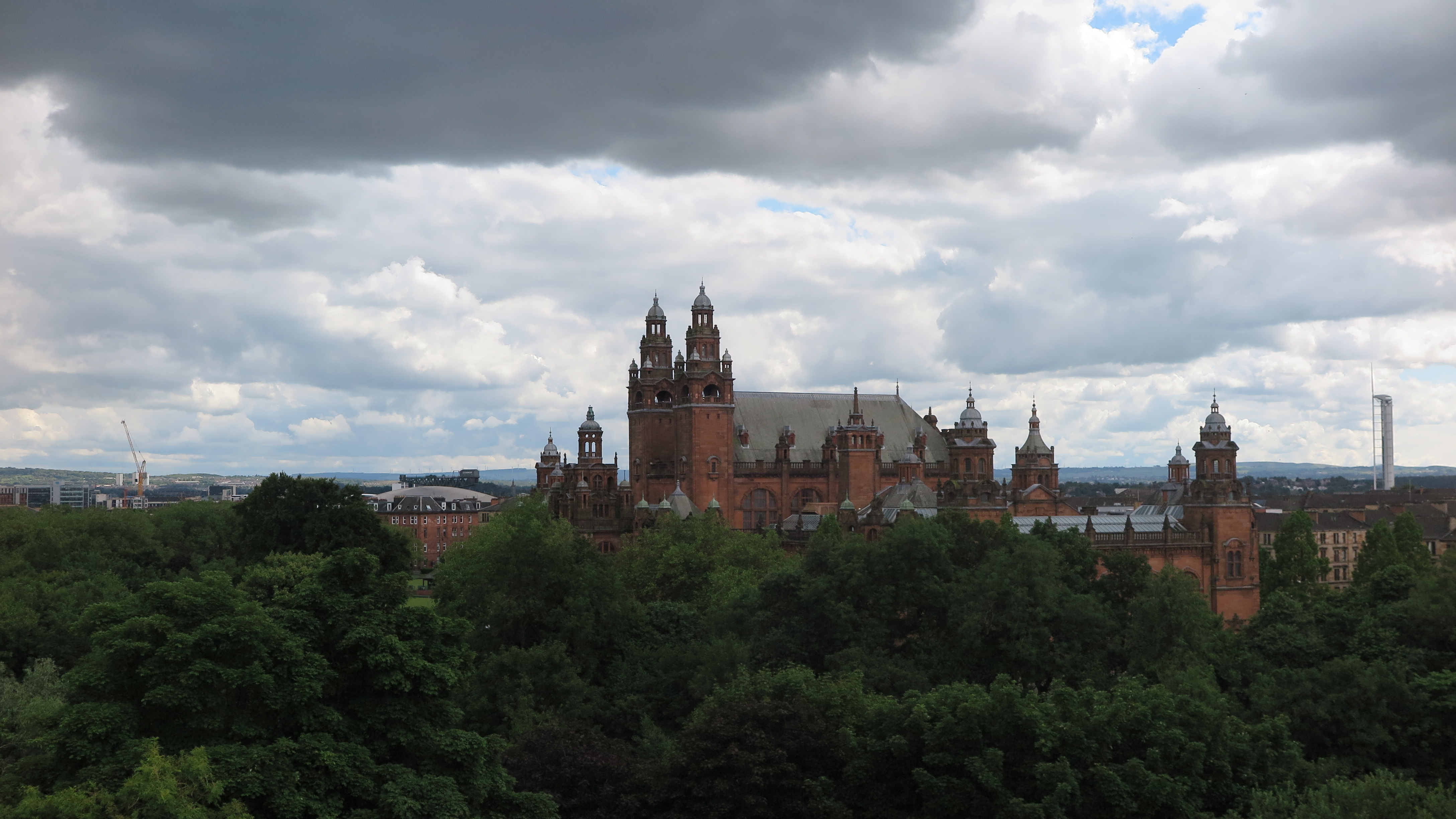

Views over Kelvingrove Park from University of Glasgow
During the recent coronavirus lockdown, like many people I have spent more evenings wandering around the streets of my hometown, and maybe paying attention to some details that had previously escaped my notice. Now 12 weeks in, I think I have now walked up and down each and every street, lane and park within a 5 mile radius of my house. One place I keep coming back to is the University of Glasgow building on Gilmorehill, either enjoying the views over Kelvingrove to the south, sheltering in the university cloisters, or just wandering about the various buildings. 

Western quadrangle, University of Glasgow
Cloisters, University of Glasgow

One of these buildings that I have looked at more closely than ever before is the James Watt Engineering Building. This sits just east of the main University building. The chemistry department was previously found here, but with the prevailing wind blowing from the west, their fumes were regularly being blown all over the main campus. So at the start of the 20th century the chemists were moved to new premises further to the west, leaving a prominent spot for the faculty of engineering to move in to.

I spent 7 years as a student at Glasgow University, and the James Watt Engineering Building was never one that I paid much attention to. Work started on it in 1899 and it was opened in 1901 by Lord Kelvin, to the north-east of the main Gilbert Scott building. Over time various extensions were added and between 1957-59 a further large extension was added, a functional, and rather non-descript building designed by architects Keppie, Henderson and Gleave. Its otherwise undecorated ashlar south-facing surface was decorated with a 30 foot high frieze carved in Portland stone. 

James Watt was born in Greenock in 1736 and was working as a mathematical instrument maker at Glasgow University on the High Street when he came up with the idea of his steam engine that would make his name. In recent times his name has been linked to the money his father made from rum, sugar and cotton produced by slaves on Caribbean estates. James Watt himself was also involved in a case of selling a slave boy to his new master in Scotland. More light has been cast on these facts in recent weeks as the spotlight from the Black Lives Matter movement spreads into previously overlooked aspects of our collective history. The "James Watt School of Engineering" at Glasgow University has been quick to flag up these issues on its website, whilst continuing to ally itself to the "innovative spirit of Watt".
James Watt (south) building in front of the main University of Glasgow building

The architects of this new building specified a relief sculpture of some kind should be an integral part of their design from the outset. The University authorities suggested that the subject of the sculpture should be "the development of engineering relative to the University". Their initial suggestion was for abstract shapes, inscribed with various important names and dates, "a unified composition of small units", rich in texture to match the Scott Gothic of the neighbouring University main building.

In the correspondence between the University authorities and the architect it is clear that the University quickly fear that none of their plans are being listened to and they complain that "the plaque is unlikely to seem a good £3000 worth", and that it does "nothing to tie the New to the Old as claimed." It would be fair to say that the building as a whole adds little to the beauty of the University of Glasgow campus, but it was the images on this frieze that caught my eye as I was walking past it today. 

James Watt building, south extension. Not the prettiest building on the university campus.

Eric Kennington - artist


A cursory look at the relief on the southern face of this building shows you that the finished sculpture bears very little comparison to the brief laid out by the architects. Entitled "The Progress of Science" it stands about 30 foot by 10 foot in size. Instead of describing the "development of engineering relative to the University" it in fact has only one scientist in it, who stands in Arabic robes, and lots of imagery from nature, religion and mythology. 
 
The Progress of Science, by Eric Kennington
The architects in their early reports to the University authorities described their plans for the sculpture and in their 1957 "Notes On Bas-Relief Sculptural Panel". With no explanation given, they recommended a "non-Scottish sculptor".They suggested Eric Kennington for the job, as the "British sculptor most likely to make an outstanding job of the panel."

In a letter to the architects from the assistant secretary to the University court, disquiet that the architects favoured Kennington to a Scottish sculptor, suggesting "What about Hew Lorimer or Benno Shotz?" Benno Shotz had recently completed a 15 foot high tablet on the side of the new chemistry building of Joseph Black, and Hew Lorimer was commissioned to sculpt the facade of the National Library of Scotland in Edinburgh. 

Joseph Black by Benno Schotz
In the end Kennington was given the commission for what was to be his final work. The work had to be completed by September 1959 for the official opening, and when Kennington took ill in June 1959 he headed back to England and his assistants, Eric Stanford and Archibald Robertson, who had been working alongside him for 2 months on the job, completed the sculpture. Kennington died, aged 72, before the work was completed.

Eric Kennington was born in 1888. After attending the Lambeth School of art he enlisted in 1914 and was injured while fighting on the Western Front. After 4 months in hospital he returned to France as a war artist. After the war he met T.E. Lawrence who had come to an exhibition of his paintings, and they became lifelong friends. In 1921 he traveled through Egypt, Palestine, Jordan, Lebanon and Syria drawing portraits or Arab subjects and many of these were used as illustrations in T.E. Lawrence's book The Seven Pillars of Wisdom. 

One of Kennington's illustrations from the 1935 edition of The Seven Pillars of Wisdom that belonged to my father-in-law
In 1935 he was one of T.E. Lawrence's pall bearers and sculpted the bust of Lawrence for his tomb. Throughout the 1920s and 30s he was increasingly working as a sculptor. During World War 2 he was again commissioned as a war artist, working mainly for the RAF. 
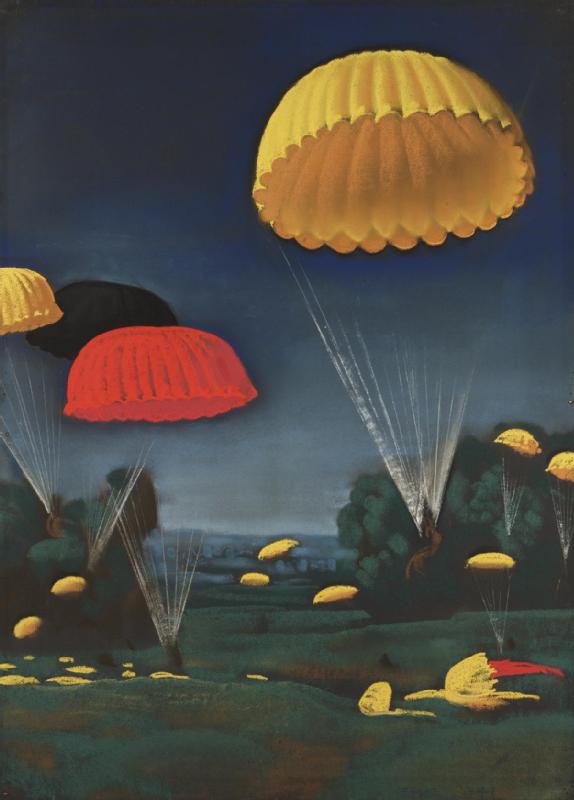
Parachutes, 1941, by Eric Kennington
After the war he continued to work and was elected as member of the Royal Academy. His sculpture for the University of Glasgow in 1959 was his last work. 

The Progress of Science

Top of Kennington's sculpture

The main features in his sculpture seem to have little connection to Glasgow, to science or to engineering. At the top stands Hermes, messenger to the Gods of Greece, with his winged feet, and his staff with entwined snakes about it in his right hand. As the Roman god Mercury he often carries his staff in the left hand, so I am going to stick with the Greek versions throughout. Also I suggest that a major source of ideas for the sculpture was Belgian scientist George Sarton. He is credited as largely being the founder of the discipline of the history of science. He wrote extensively on Greek scientists, such as in his book "Hellenistic Science and Culture in the Last Three Centuries BC". This book was published in 1955, just in time for any artist in 1957 who was looking for ideas for a work on the history of science to find inspiration.  

In this book he talks about one of the greatest scientists in the Greek world, Eratosthenes. Eratosthenes became chief librarian at Alexandria, he was known as a critic of Homer and he made some of the earliest calculations of the size of the Earth's circumference, and the tilt of the Earth's axis. He also wrote poetry, and Sarton quotes his Hermes as "his masterpiece. Such poems satisfied the scientific curiosity as well as the love of metrical words of the Ptolemic aristocracy." 

Beside Hermes can be found motifs from mythology and the natural world. Pegasus the winged horse, a swan, the sun with rays coming across towards an eagle, who seems to be bowing down. Above the eagle parachutes are falling, and Pegasus was the emblem of the newly formed British parachute regiment in the second world war. Is the eagle the German Reich succumbing to the British forces? A compass is found in the background here, and the word "PROGRESS".

Progress of Science, or memories of war?
To the left is found a kite (is this Benjamin Franklin's kite that he flew in a thunderstorm to experiment with electricity), and a quiver with an arrow (I can only guess that these belong to Artemis, goddess of hunting). A cloud of smoke adds to the mystery of this collection of items.

A quiver and a kite
Perhaps the clue is that Zeus, king of the Greek gods, and the god of thunder and the skies, stands in the middle here, ready to cast down a bolt of lightening, science explaining the mythology.

In the lower half of the panel the god Hephaestus stands at his anvil, below a volcano, with his other symbols, his hammer and tongs, in his hands. Hephaestus was the god of blacksmiths and metalworkers, forges, fire and volcanoes, artisans, stone masons and sculptors. Hephaestus epitomises George Sarton's life work, trying to combine the humanities and sciences. By creating a history of science he wanted to create a "new humanism". He felt that without science the humanities are incomplete, and without the arts, history, philosophy, religion that a life of science was empty. He looked for this in the world of ancient Greece, of Homer and in the medieval Arab world. Like Kennington he traveled around the Middle East as part of his work, learning Arabic as he sought to read original manuscripts of the Arab scholars.

Lower part of The Progress of Science
Carpenters' tools, farming implements, gears, chains and pulleys lie between the figures and below it all a boat that looks suspiciously like Noah's ark, floats on a sea filled with a whale and a shoal of fish. Other scientific instruments such as protractors, possibly an Archimedes screw, and a governor mechanism are dotted about. 

Also several words are seen. "PROGRESS", "PER MARE, PER TERRAS" (by land and sea - motto of the Institution of Engineers and Shipbuilders in Scotland), "SCIENTIA ET INGENIO" (motto of the Society of Civil Engineers), "DISCE DOCE" (learn, teach- motto of the Institution of Electrical Engineers). These mottoes hint that some of the symbols in the sculpture may be nods to the emblems of engineering societies - the swan way in fact be the crane from the Civil Engineers crest, the caduceus of Hermes, his staff, is found in the crest of the Electrical Engineers, as is the winged horse.

The one mystery that did have me scratching my head was the man on the left, standing atop some steps, his calipers measuring an orb of some description. Out of keeping with everyone else depicted he is in Arabic robes, a ghutrah or keffiyeh on his head, and a beard and moustache similar to those Kennington has drawn in his pictures for T.E. Lawrence's book, such as the portrait of Auda Abu Tayi above. This figure is the only one taken from history, and the only scientist depicted in the sculpture. 

The solitary scientist in the sculpture


Arabic scientist, but which one?
Again I have gone back to the writings of George Sarton to find out, as I suspect that Kennington found a lot to agree with in Sarton's book An Introduction to the History of Science. Over several volumes he had taken this from the time of Homer up to the 14th century by the time of his death in 1956. Like Kennington he traveled extensively in the Middle East in the 1920s as he investigated the area where many of our modern scientific ideas originated. As Professor Jim Al-Khalili points out in his book "Pathfinders. The Golden Age of Arabic Science" for 700 years the language of science was Arabic. Their scholars began translating the works of the Ancient Greek scientists and thinkers such as Euclid, Aristotle, Archimedes, and Ptolemy in the mid-8th century. They examined and improved some of these ideas with the technologies available in their time. 

The vocabulary of these ancient scientists survives in our English words, such as alkali, azimuth, alcohol, algebra, elixir, nadir, zenith, and alchemy. Ptolemy, the Greek mathematician and astronomer, wrote his Almagest, his theory on the movements and sizes of the planets and the sun. He laid out his ideas on celestial motions, his solar and lunar theories and catalogues the stars. His Almagest was translated into Arabic (and we still know it from its Arabic naming, 'The Great Book') and in the 9th century the caliph of Baghdad, Al-Ma'mun, commissioned a huge observatory to be built in Baghdad to allow his scientists to check Ptolemy's observations. With the necessary state funding behind them, a team of astronomers, mathematicians and geographers. They improved upon Ptolemy's observations and drew up charts of planetary motions and made more accurate estimates of the Earth's circumference. They also placed the Sun at the centre of the planets, with the Earth and other planets revolving around it. More accurate calculations of the Earth's circumference were made by Al-Biruni, using algebra to look to the distant horizon from the base and summit of a mountain. Born in Khiva in modern Uzbekistan, he was Persian, and wrote on physics, mathematics, anthropology, religious history, astronomy, and came up with te idea of dividing the hour into 60 minutes and seconds. His calculations on the circumference of the Earth are merely 1% out from modern measurements. Of the three giants of medieval science who all lived in the same era, Ibn al-Haytham who developed new theories of optics, Ibn Sina (Avicenna), the father of early modern medicine and al-Biruni, it is the latter who we see depicted by Eric Kennington with his calipers out, measuring the size of the Earth. In a book I suspect Kennington was reading due to their shared interest in the Middle East, George Sarton says in his Introduction to the History of Modern Science, the first half of the eleventh century was "the Age of al-Biruni".

We have here our scientist, al-Biruni, possibly

I think that this sculpture by Eric Kennington, his last work before his death, combines many elements of his life's work, his ideas and experiences. As a churchwarden in Checkendon, Oxfordshire he was a religious man and bible references can be seen in his work. He served as a war artist in both world wars and elements from that can be seen also, particularly his World War II experiences with the RAF. Parts of the sculpture try to connect the humanities and science, with classical references and the Greek god of sculptors prominently displayed. This is a theory explored by George Sarton, whose books were in circulation in the 1950s when the sculpture was conceived, developing a history of science, a similar task to that which Kennington was set. And finally we have the sole scientist portrayed in the piece being not a graduate of the Glasgow faculty of Engineering, nor a Copernicus, Einstein or Galileo but a man who would be little known to Westerners who had not spent time in the Middle East, or delved deep into the history of the Islamic world.

This therefore is my hypothesis of the motifs and characters portrayed on the sculpture of the Engineering building of the the University of Glasgow, based on my own observations and the limited evidence I have been able to find. I particularly must cite Roy MacKenzie's excellent book "Public Sculpture of Glasgow" (2002), which my mum picked up in a Brighton bookshop for £1. As with any scientific hypothesis please feel free to correct my mistakes with your own insights. 

I will leave the last words to al-Biruni, as he shakes his fist at those who would hide their own ignorance by mocking science and scientists, perhaps saying such things as "Britain has had enough of experts."
"The extremist among them would stamp the science as atheistic, and would proclaim that they lead people astray in order to make ignoramuses, like him, hate the sciences. For this will help him conceal his ignorance, and to open the door for the complete destruction of science and scientists."

Sunday, 15 March 2015

A Gorbals Tour, Glasgow

The Gorbals, Glasgow


The growth, demolition and rebuilding of the Gorbals in Glasgow is a troubled part of the city's history. During the 20th century the Gorbals was the beating heart of Glasgow. An area on the south bank of the River Clyde, near Glasgow city centre, the Gorbals became synonymous with poverty, overcrowding and the random violence of razor gangs made famous in the 1935 novel No Mean City.

The Gorbals started as a single street village to the south of a new bridge built in 1345 crossing the River Clyde. Five years later it housed a leper colony, dedicated to St. Ninian, for Glasgow's citizens. Merchant George Elphinstone feud the land from the church in 1579 and in 1650 the village was taken over by the City of Glasgow. At this time it consisted of thatched houses and its main industry was weaving. By 1771 the population had reached 3,500 and at this time Hutcheson's Hospital took ownership of the land to the east of the old village and developed it. The land to the west was sold by the Hutcheson trustees to James Laurie, who developed Laurieston to the west.

To the south three seams of coal were being exploited by the Govan Colliery, employing over 200 men and later the Govan Ironworks (Dixon's Blazes) was established alongside this. This then brought more industrialisation, railway lines and more people.

Carlton Place from the north bank of the River Clyde
Laurieston's development started in 1802 with the fashionable terraces that still look onto the river here. In the picture above of Carlton Place this building is now home to the Prince and Princess of Wales Hospice.

By 1930 the population of the Gorbals had risen to 90,000 people, served by 100 shops and 130 pubs. Little was done to maintain the decaying housing or to improve the overcrowding and poor sanitation. With one toilet to every three homes and a population density of 459 people per acre (modern suburbs have 30 people per acre) it was clear that something had to be done. It is generally accepted however that the plan chosen by Glasgow's city fathers was an abject failure. Their Comprehensive Development Area Plan in the early 1960s was brutal in its destruction of the old Gorbals tenements and the brutalist architecture chosen to replace it has since been largely demolished. Sir Basil Spence's Queen Elizabeth Square (or Hutchesontown C) became a byword for deprivation and neglect. Large swathes of slum clearances were left as empty gapsites for decades for a never built Glasgow ringroad, cutting communities off from each other. Those locals not rehoused locally in the 1960s and 1970s were dispersed to the new towns of East Kilbride and Cumbernauld or the Glasgow schemes such as Drumchapel, Castlemilk and Easterhouse.

For the last 15 years many of these 1960s and 1970s developments have been swept away. New Gorbals housing built with more imagination and on a human scale seems to be resuscitating this historic area.

My gran and grandad were born in the Gorbals. My mum, her brothers and sisters grew up on Crown Street before they were shipped out to the new scheme in Drumchapel. So I went out to have a wander about the Gorbals yesterday to see where they used to live.

Immigration


The Gorbals has always been home to many of Glasgow's new arrivals, both from Scotland and from abroad. My granny was born in 1915 in a flat on Gorbals Main Street. Her grandparents had come to Glasgow to look for work in the previous century from Ireland and from the Scottish Highlands, via Townhead and Partick on the way.

My grandad and his Hutchesontown classmates, some of them without shoes, about 1915

Her husband, my grandad, was born a few streets away at Sandyfaulds Street in Hutchestown. His grandparents had come to Glasgow to find work from Bo'ness (where they had worked in fishing) and from Kilbarchan (where they had been weavers). Glasgow was expanding rapidly in the 19th century with many impoverished people arriving from Ireland finding cheap accommodation and work in the Gorbals. Poverty and in some cases famine drove Italian immigration to Scotland in the latter half of the 19th century, particularly when a change in American policy reduced access to that destination.

The next wave of immigrants to arrive in the Gorbals were from Eastern Europe, mostly Jews escaping pogroms in Czarist Russia, Latvia, Lithuania and Estonia. Later Jews fleeing Nazi Germany arrived. In 1881 there were 225 Russians living in Scotland in total, by 1901 there were 5,000 mostly Russian Jews living in the Gorbals, and by 1939 10,000 Jews were living here. Difficulties accessing employment for these immigrants often led to them establishing their own businesses such as in catering trades, in clothing businesses or sales. From 1928 Glasgow had its own Jewish newspaper produced on Cavendish Street in the Gorbals and until they stopped printing it in 1992 my granny carried on getting the Jewish Echo regularly (latterly mainly to check the death notices for news of old friends).

My grandad in themiddle of the back row of the top photo with his friends
and at work in the middle of the front row

These photos above with my grandad include his friends Tony Verrechia, Alec Abraham, Ellis Bergson, Davie Sluglett, Nathan Zemell, Tony Caplan, Louie Freedman, Mo Sacklosky and he married a Donnelly of Irish descent. I think this shows how cosmopolitan a place the Gorbals was at the time.

Later many of the first Asians to arrive in Scotland settled in the Gorbals, some of them following the immigrant who had come before them in setting up businesses. Before the demolition of the old tenements throughout the 1970s there were 10,000 people of Asian origin living in the Gorbals and they too had started up their own newspaper, The Young Muslim. Like the Jewish community before them, this community moved outwards to other neighbouring areas with time.

Today even with the new housing stock being built, the Gorbals is still an area where many families live on low incomes and social housing has an important part to play in the regeneration of the area. Hopefully this will avoid the exploitation by slum landlords that some other nearby areas suffer from. New immigrants to Scotland are now settling here. Maybe that was why when I saw some bollards had been painted the "wet paint" sign was written in four languages, including Polish and French.

Carlton Place


I started my walk by crossing over the Carlton Suspension bridge, built in 1871, towards the graceful terraces of Carlton Court on the right which are now a hospice and Laurieston House on the left. James Laurie lived in the central house on the left hand terrace here. His plan to extend a gracious suburb southwards was never fully realised as the area became increasingly industrialised in that direction. 

Carlton Suspension Bridge and Carlton Place at the far end

Behind Carlton Place lies another of the rare older buildings in the Gorbals to survive. The building below was the former stables and warehouse of the Clyde Shipping Company from 1880, which had a smithy at the front. The central block would have had a goods hoist at the top of it to raise loads in through the doors on the floors below (now windows).

Carlton Court warehouse and stables

In contrast to that building and going onto Bridge Street is Cumbrae House. It was built in 1937 as a showroom for Cowen's Ideal Trading Stamp Company with its art deco design.


Bridge Street Station


Before Central Station became Glasgow's main station, trains from the Glasgow, Paisley and Greenock Railway terminated at Bridge Street Station in the Gorbals. The original station was replaced in 1890 by the Caledonian Railways building below. The four arches in the middle led into the booking hall. When you come into Glasgow from the south by train you can still see where the old platform stood at the back of the building. To the right of this building was the Station Hotel, now flats, then across the road northwards again stands the former Commercial Bank of Scotland. The gap site to the north of that building once housed the original Bridge Street Station built in 1841, which had grand Doric columns fronting it. The modern, rather functional, Bridge Street Subway station lies diagonally south-east of this building and was originally opened in 1896.

Building of the old Bridge Street train station
Across the road from the Laurieston pub on Bridge Street lies the building of the former Savings Bank of Glasgow built in 1888. With its marble columns at the front and an impressive domed roof inside, it was once home to a decent Greek restaurant as far as I remember, but looks all closed up now. The tenement at the corner has an impressive octagonal turret.
Former Savings Bank, Bridge Street 

Heading further south on Bridge Street (which becomes Eglinton Street) you would previously pass two old places of entertainment. First on your left you would pass the Coliseum, a music hall opened in 1905. It was converted to a cinema in 1925 and played the first "talkie" in Glasgow four years later, Al Jolson's The Jazz Singer. It closed in 1980 and the council bought it as part of their plans to cut a new ring road through the area. When this never came to anything the increasingly dilapidated hall re-opened as a bingo hall. The bingo closed in 2003 and six years later the Coliseum became another victim to one of those mysterious fires which destroy troublesome old Glasgow buildings and it was demolished.

Further on the lies The New Bedford cinema, now the O2 Academy, a 1932 art deco building which is in regular use again as a music venue.


Towards Eglington Toll


Continuing south past Cumberland Street and under a railway bridge you pass some four-storey flats with white harling. A plaque here marks the spot where Sir Hugh Robertson was born in 1874, composer, conductor, pacifist and founder of the Glasgow Orpheus Choir. 


Eglinton Toll, Glasgow in 1917 and 2015
If you carry on beyond the southern edges of the Gorbals, underneath the M74 extension which now cuts through here, you are in the area which once housed a cavalry barracks just off Eglinton Street. The cavalry from here were brought into the town centre to clear the streets of rioters in 1848 with "repeated charges". Later the site here housed the Poorhouse for Govan Parish. Eglinton Toll, once called St Andrew's Cross, is home to The Star Bar and, from 1922, the long gone Plaza Ballroom. Looking back northwards from here I took this photo to show how recognisable it still is from the picture of 100 years ago. The chimneys on the right at the St Andrew's Works are now gone although the rest of that building still stands, empty. It was built in 1899 as an electricity generating station and in 1937 was converted into a printing works. For me as a child it was always the thing that you saw on May Day marches towards Queen's Park that let you know you were coming to Victoria Road and were almost at the park.

St Andrew's Works, Glasgow

Gorbals Main Street and Gorbals Cross


From here I turned down Pollokshaws Road, passing the red sandstone building of the former Chalmers Free Church in the direction of the Brazen Head pub. Turning left into Cumberland Street you can find the entrance of another of the Gorbals train stations here. The elevated railway here was built between 1864-1867. This four platform station, originally called Eglinton Street Station, then later Cumberland Street Station was closed in the 1960s.
Cumberland Street Station
Just south of Cumberland Street a grid of tenement lined streets was swept away and replaced by the year 1973 with Stirlingfaulds Place. Two overbearing and unappealing 24-storey blocks with 552 flats stood here. Thirty-five years later, in 2008, they were demolished and now new flats are taking their place, modern three and four storey flats, built on a grid system, and on a human scale.


New housing replacing Stirlingfauld Place
Just east of the Stirlingfauld Place flats lies what remains of Gorbals Main Street. Only one lonely old tenement building still stands here at 162 Gorbals Street. This formerly housed a branch of the British Linen Bank Company and their logo can still be seen above the door. When my great grandad retired and left his flat at Gorbals Cross a hundred yards further north, he and my great-granny moved into this block. Every time that I pass it and see that it is still standing I feel my personal link to the Gorbals. Unfortunately I fear that it will eventually succumb to one of those mysterious Glasgow fires which happen in uncared for buildings. However I am hopeful that with new flats approaching it from the rear that it can be refurbished and saved for the future. 

162-166 Gorbals Street before redevelopment began

162-166 Gorbals Street, Glasgow in 1970s

162-166 Gorbals Street, Glasgow in 2015

British Linen Bank Company, Gorbals Street

Gorbals Street, looking north 1965 and 2015
Looking north up Gorbals Street from here towards the city centre today it is hard to imagine that this was once the commercial, thriving heart of this community before the wrecking balls were brought in. The changes that have taken place amount to vandalism. On the the left and right stood long rows of tenement flats and shops. The Gorbals Public Baths were on the left. How much more grand would the Citizen's Theatre be today if they had kept the colonnaded frontage of the Royal Princess's Theatre as well as its handsome auditorium? This theatre was built in 1878. The columns which you can see in the old photo were salvaged from the Union Bank on Ingram Street and moved here in 1878. The figures sculpted by Mossman for this new building atop the columns are of Shakespeare, Robert Burns and Four Muses. They were moved inside when the facade was demolished, along with the neighbouring tenements and Palace Theatre, in 1977. The Palace Theatre next door had been converted into a cinema in the 1930s and later into a bingo hall. The Citizens Theatre Company was founded in 1943 and based at first in the Old Athaeneum before moving to the Princess's Theatre in 1945. Working as a joiner in the Gorbals, my grandad sometimes helped build stage sets here.

Beyond that, Gorbals Cross was drawn up in 1872 following the contemporary Paris fashion with the buildings set at angles to create a diamond shaped plaza which had a drinking fountain and clock at the centre. The tenements at the north-west corner of Gorbals Cross were designed by Alexander 'Greek' Thomson.

In about 1910 my great-grandfather gave up the idea of joining the priesthood, married Isa MacPhee. He moved from Saltmarket to a flat at 89 Mains Street on Gorbals Cross. It was here that my granny was born 5 years later and it was from this flat that my great-grandad worked as a dentist, despite not having any formal dental qualifications. The 1921 Dental Act tried to regulate the profession. From that time he was allowed to formally be registered as a dentist having worked "for at least 5 of the last 7 years as a dental mechanic as the principal means of livelihood". My granny tells me that here he made gum shields for local boy Benny Lynch and that the Socialist John MacLean had held meetings in their front room at Gorbals Cross.

Gorbals Cross

Gorbals Cross, later image
Just north of Gorbals Cross stood a tenement on Muirhead Street, now beneath the Central Mosque building, where Allan Pinkerton was born in 1819. A cooper to trade and active Chartist he emigrated to America in 1843 where he was working with slavery abolitionists within a year. He soon set up his detective agency, with an eye for its logo, giving us the world's first private eyes.

Crown Street


Just east of Gorbals Main Street my grandad was working as a joiner and cabinetmaker when he married my granny in 1938 and they moved around the corner into Crown Street. This long street ran parallel to Govan Main Street but was swept away by the 1970s re-developments.

My grandad's Gorbals joinery business
Crown Street has now been rebuilt in the first step of the attempt to regenerate the Gorbals with a new street network and with tenement style housing. My grandparents lived at 182 Crown Street, which was on the west side between Clelland Street and Rutherglen Road. They lived above Massey's shop. Alexander Massey's first grocer's shop was opened on Crown Street in 1872 as competition to Sir Thomas Lipton and he had soon opened shops all over the country. Although Crown Street is no longer crossed by Clelland Street, by my guess this puts their old flat roughly where Gorbals Library now stands at 180 Crown Street.


Massey's shop on Crown Street, Gorbals, Glasgow

Crown Street, 2015, with Gorbals Library on the right

New Gorbals Park and the view north from here down Crown Street. 2015
Just around the corner from the southern end of Crown Street stand some of the most striking buildings in the new housing development. Opposite the Alexander 'Greek' Thomson designed Caledonia Road Church hangs a bronze sculpture by a group called Heisenberg, "The Gatekeeper". It is suspended above an illuminated photograph and is meant to represent the Gorbals being on the cusp between demolition and reconstruction. It has also become known as "the angel with the bleeding hand" after a crack in the bronze of her hand causes rainwater to seep out a reddish brown colour. Aluminium figures project above the doorways of these flats. Called "The Attendants" they are meant to represent "an emotional response to the diasporal flux of people through the area over the past 200 years". Unfortunately if I pass these buildings on the way to Hampden I just can't help seeing it as a dozen people being tortured by "strappado" suspension.

"The Gatekeeper" sculpture

"The Attendants"

Alexander 'Greek' Thomson's Caledonia Road Church


Across from these buildings at the foot of Cathcart Road stands the sad remains of the Alexander 'Greek' Thomson designed Caledonia Road Church. Built in 1856, along with a row of tenements running behind it, it is a building of international significance, now just an empty shell. It's Ionic columns stand like the Parthenon on top of a solid base, with a sturdy tower standing beside it. Sadly the Greek Thomson designed tenements behind it were demolished and still languish as a gap site. The church closed its doors in 1963 and was bought by Glasgow District Council. Two years later one of those mysterious Glasgow fires gutted the building, destroying Thomson's colourful interior and the building had to be partially demolished. That is how it still stands, high on the "buildings at risk" register.   
Before and after. Thomson's Caledonia Road Church
The former site of Southside Train Station lies opposite the church to the south. Since 2014 this has now become the "Caledonia Depot" and administrative headquarters of Firstbus.

Old weighbridge at Cathcart Road/ Laurieston Road junction and Firstbus depot

Southern Necropolis


Heading south from here and turning left along Caledonia Road you will soon come to the Southern Necropolis. The large empty wasteland to the west of the graveyard here was the site of Dixon's Blazes iron works and Govan Colliery. The coal fields here were "putting out 20,000 loads of coal per year" from 1713-1734. When William Dixon became the colliery manager he soon rose to become its owner and in 1801 took over control of Calder Iron and Coal Works. He created Glasgow's first ever railway here in 1811, a horse drawn cart initially taking coal to the short lived Glasgow Paisley Ardrossan canal at Port Eglinton. A railway pioneer, the extensive network of lines he developed to transport his coal and iron curtailed Laurie's plans to expand his Laurieston development. In the 19th century the furnaces here glowed day and night and the company continued to produce iron here until 1958.
The entrance to the Southern Necropolis caused me an existential crisis with signs saying "Welcome to the Southern Necropolis" alongside signs saying "Danger Keep Out". Presuming they actually meant "keep off" the crumbling gatehouse, built in 1848, I decided to enter. The Southern Necropolis has over 250,000 burials within it and replaced the older, overcrowded Gorbals burial ground which lies north of here. In 1841 children under 12 accounted for 57% of the burials and adults aged over 60 years only 2%. It contains the graves of many of the great and good of Victorian Glasgow. The city council has a heritage trail available with more information. There are here found the graves of Allan Glen who founded the school which bears his name lies here, Robert Paterson who manufactured Camp Coffee in Glasgow, Charles Wilson, the architect of Park Circus and "Wee Willie Whyte" a well known street musician who died in 1848. There is also the grave of Sir Thomas Lipton, who was born in 1848 on Crown Street. His parents were Irish immigrants who started running a shop selling ham, butter and eggs at 11 Crown Street. After spending several years at sea he returned to Glasgow and helped his parents run their shop before eventually setting up his own shops, which became a chain of stores throughout Britain. He became involved in importing tea from Sri Lanka/ Ceylon and the Lipton's brand of tea is known throughout the world. He became a multi-millionaire and bequeathed many of his yachting trophies and other items to the City of Glasgow, some of which are on display in Kelvingrove Museum. 
Tomb of Alexander 'Greek' Thomson
Alongside Charles Rennie Mackintosh, Glasgow's most renowned architect is undoubtedly Alexander Thomson (1817-1875). He is buried in the Southern Necropolis and as his gravestone had been lost to vandalism, it was replaced in 2006 with a tombstone of black, Irish granite which sits incongruously amongst all the old, weather-beaten headstones here. 

Southern Necropolis, Glasgow

The White Lady

One other gravestone worth passing is known as "The White Lady". Here lies John S Smith, carpet manufacturer, his wife Magdalene and their housekeeper Mary McNaughton. His wife and housekeeper were sheltering from the rain under an umbrella when they were returning from church in October 1933. They walked in front of a tram on Queens Drive and were both killed. It is alleged that the head of the veiled lady on the stone turns to follow you as you walk past, and glows gently at night.

Oatlands


Heading north towards the Clyde from the Southern Necropolis takes you through the area known as Oatlands, where housing redevelopment is well advanced, although not without some argument. The last of the old red sandstone tenements of this area have now been demolished in a controversial land deal.

Before you get to Oatlands you come to the former Fransciscan Friary and St Francis' Church in Hutchesontown. It has now been converted for use as a community, learning and arts centre. The Fransciscan Friars bought land in Hutchesontown here in 1868 and construction of the current church building was started in 1870. Although they probably want to keep quiet about it now, the building was officially opened in its new role in August 1998 by Bailie James Mutter and a certain Sir Jimmy Saville.
St Francis' Centre
The streets of the Oatlands development have many imaginative examples of public art scattered amongst them. One of my favourites is Gorbals Boys by Liz Peden, a sculpture re-creating a well know Oscar Marzaroli photograph taken in 1963.

Gorbals Boys by Liz Peden (and a modern day Gorbals boy)

Untitled (Girl with Rucksack) by Kenny Hunter
At the northern end of Oatlands the St Andrew's Suspension Bridge leads into Glasgow Green. When this bridge was completed in 1855 it replaced a ferry across the river for workers passing between Hutchesontown and Bridgeton. From 1885 the area of Oatlands near here was dominated by the massive United Co-operative Bakery building until it was demolished in the 1970s.

St Andrew's Suspension Bridge

Whisky, St Valentine's Bones and Benny Lynch


Heading back towards Ballater Street from here you will pass the Strathclyde Distillery which has been producing spirits here since 1928. Its smoking chimney just south of the river will be familiar to anyone who has passed through Glasgow Green. Glasgow's first (legal) distillery stood a couple of hundred yards from here in the Gorbals, underneath where the Sheriff Court now stands. William Menzies built it there after being granted Scotland's fourth licence to distill spirits in 1786.
Strathclyde Distillery, Gorbals
On the south side of Ballater Street near here is Blessed St John Duns Scotus Roman Catholic Church. Completed in 1975 this church shaped like the prow of a ship is now home to the Franciscans and is the only remaining Catholic church in the Gorbals. Like St Simon's church in Partick which continues to hold mass in Polish, they still maintain the tradition here of holding a monthly mass in Lithuaninan.

Bones of St Valentine in Glasgow church of Blessed St John Duns Scotus
South of the church the jagged roof of a former cotton mill, built in 1816-1821, towers over this area. In 1824 an industrial dispute here led to the shooting of two people on Ballater Street. Now called The Twomax Building it houses social work and healthboard services. A little sculpture of a cloud of smoke, by Rita McGurn and Russell Lamb, stands atop the chimney as a reminder of the previous industry here. 

Twomax Building, Gorbals
I have previously tried to retrace the footsteps of one of the Gorbals most famous residents, world flyweight boxing champion Benny Lynch. The son of Irish immigrants he was born in Ballater Street and lived and trained around this area for much of his career. He is remembered in the name of a short street here, Benny Lynch Court, but I think his achievements merit something a bit more than that, no?

Benny Lynch Court

Just south of Benny Lynch Court lies Gorbals Rose Garden, the former Gorbals Burial Ground. Some of the old headstones remain around the walls of this green space. Several have no words, just the tools of the trade of those buried below, such as a baker's crossed "peels", long shovels for lifting bread in the ovens, or a collier's picks. 

Old gravestones, Gorbals Burial Ground

Glasgow Central Mosque and the Sheriff Courthouse


Coming north-west towards the river from here you will pass the campus of Glasgow College of Nautical Studies, now a faculty of the City of Glasgow College. Carrying on in this direction brings you to two modern Gorbals buildings. The Sheriff Courthouse on Gorbals Street at the riverside was built between 1980-1986 and contains 21 courtrooms. It is apparently the second largest courthouse in Europe and deals with more minor offences, serious offences being dealt with just across the Clyde at the High Court.

Glasgow Sheriff Courthouse
Across Gorbals Street from the courthouse lies Glasgow's Central Mosque and Islamic Centre. Completed over 30 years ago now in 1984 its illuminated dome is a familiar sight in the riverside skyline of Glasgow. Walking past it today I was surprised how small it actually is. Given the large numbers of Muslims there are living in Glasgow now maybe some jealous glances are being cast towards the two large Gurdwaras that have recently been built in the city.


Leaving the Gorbals I walked back across the Clyde via Jamaica Bridge (or Glasgow Bridge to give it its proper name). Passing here you can see the granite piers on which once stood the old railway bridge into the original Gordon Street Station (now Central Station).


Artist Ian Hamilton Finlay has carved words on the Dalbeattie granite columns. It reads in Greek and English "All Greatness Stands Firm In The Storm", a version of a phrase from Plato's Republic.

Only time will tell if the destructive storm of 20th century developers managed to flatten the Gorbals. From walking about the area today it certainly looks like things are finally moving in the right direction. However the infrastructure is only ever part of the answer. The availability of jobs and opportunities for the people living there is going to be just as important for the new Gorbals to become a thriving community again. This was overlooked when Glasgow's peripheral schemes were laid out in the 1960s and hopefully lessons have been learned from that.