Monday, 11 November 2013

Reflections on Scottish Independence Inspired By James Connolly's Songbook


In Glasgow's Glad Cafe recently I attended an evening of music from Mat Callahan. He and fellow musicians have made a recording of some songs by and about James Connolly and were reprinting his book from 1907, "Songs Of Freedom". He talked of the lengths he had to go to in order to see a copy of it (afterwards Eddi Reader offered a copy she had) and gave a rendition of one of the songs printed in the original book, by Irishman Connell, "The Red Flag" but with a "Motown feel" to change it from the traditional dirge it has become. James Kelman had got involved when Mat was in Ireland and persuaded him to also visit the country of James Connolly's birth, Scotland, for two nights. It was a fantastic evening, with James Kelman in fine form, talking at length about the influence that Connolly had on Scottish socialists such as John MacLean.


As we approach our Scottish independence referendum it made me want to read a bit more about Connolly and why he took up arms for Irish independence from Britain. What did he think independence would achieve for Ireland? I asked my dad if he had anything on him. He said "I've got a few of his books. I used to have his Songbook, but I think I loaned it to someone and never got it back." (Aaaargh!) I consider myself not so much as an 'undecided' on the referendum question, but as a 'yet to be persuaded'. Too much nationalist language in general is about being better than others, whether it is the rest of the world, or a close neighbour. This is something that can only be negative and parochial. Nowhere in the current debate am I hearing about the ideals that we can aspire to in an independent country. Perhaps we could aim to be greener, more peaceable, more just, fairer. Liberty, egality, fraternity - that sort of thing.

Looking at the headlines on a newspaper website by searching the word 'independence' the lofty subjects include "would face greater security risk", "face tough choices on tax", "jobs fears" and "we're all doomed" (I made that last one up). It is almost as if a country of 5 million people is unheard of. People can apparently only succeed as a giant supermarket of a nation, there's no room for a worker's co-operative corner shop on these streets. Maybe one angle the 'Yes' campaign should emphasise is that becoming independent has not stopped Bosnia-Hercegovina getting to the World Cup finals in Brazil next year, and Croatia are also still in with a shout. But maybe this highlights part of the problem. Scotland has always been a wee bit of a separate country from England anyway whether in law, sport, education, history or perspective. None of these benefits other states may fight for can be so prominent in our debate as they may be in other parts of the world. So I think we need to hear about what Scots, given a blank canvas, think they could achieve. What virtues could our country aspire to?
James Connolly
James Connolly is known as a socialist and trade unionist who fought, and died for the Irish Nationalist cause. He is maybe more well known in Ireland than in the country he was born. In Dublin a statue of him stands outside Liberty Hall and he is remembered in the name of Connolly Station, whilst it is reported that all his life he spoke in a Scottish accent. He was truly an internationalist. He opposed the false divisions of people along lines of religion or gender, and the nationalism he fought for was not nationalism for nationalism's sake, but for the establishment of an "Irish Socialist Republic". As he said
"If you remove the English army tomorrow and hoist the green flag over Dublin Castle, unless you set about the organisation of the Socialist Republic your efforts would be in vain. England would still rule you. She would rule you through her capitalists, through her landlords, through her financiers, through the whole array of commercial and individualist institutions she has planted in this country and watered with the tears of our mothers and the blood of our martyrs. England would still rule you to your ruin, even while your lips offered hypocritical homage at the shrine of that Freedom whose cause you had betrayed."
He was born to Irish immigrant parents in the Cowgate of Edinburgh in 1868 where he was reportedly a fan of Hibernian football club. He left school aged 10 to start working, and aged 14 lied about his age to join the British army. The time he spent in the army in Ireland opened his eyes to the treatment of the Irish people at the hands of the British. He met his future wife here, Irish protestant Lillie Reynolds, and returned with her to Scotland in 1890 where he became active in trade unionism and the socialist movement. He was involved in the Independent Labour Party which Keir Hardie established in 1893. In 1895 he moved to Dublin where he founded the Irish Socialist Republican Party. After a speaking tour of America in 1902 he returned to Edinburgh and launched the Socialist Labour Party before emigrating to the USA for 6 years. Working initially as an insurance salesman, then in a Singer sewing machine factory in Newark, he became involved in the IWW (International Workers of the World or the "Wobblies") and became paid as the national organiser for the Socialist Party of America. He had established various socialist newspapers and was publishing his ideas in pamphlets and on speaking tours. Whilst in America he published "Songs for Freedom" in 1907 and the words of the songs clearly encapsulated his ideas. As he says in the introduction

"No revolutionary movement is complete without its poetical expression. If such a movement has caught hold of the imagination of the masses, they will seek a vent in song for the aspirations, the fears and hopes, the loves and hatreds engendered by the struggle. Until the movement is marked by joyous, defiant singing of revolutionary songs, it lacks one of the most distinctive marks of a popular revolutionary movement; it is a dogma of a few and not the faith of the multitude."
In 1910 he returned to Ireland and became involved with the Irish Transport and General Workers Union. The police brutality against workers in the 1913-14 Dublin 'lock-out' lead him to found a workers' militia, the Irish Citizens Army (ICA). He spoke out against the division of Ireland, wrote to warn Orangemen in Ulster from being blinded to the common cause they should have with the working people of Ireland, against their capitalist bosses "hiding their sweat shops behind orange flags". With regards to women he wrote that "of what use...[was the re-establishment of an Irish State]...if it does not embody the emancipation of womanhood". He saw the First World War as an imperialist war and campaigned against sending Irishmen abroad to fight. Today's conflicts around the world could be being referenced with these words
"If these men must die, would it not be better to die in their own country fighting for freedom for their own class, and for the abolition of war, than to go forth to strange countries and die slaughtering and slaughtered by their own brothers that tyrants and profiteers might live?"
In the rising in Dublin of Easter 1916, James Connolly and members of his ICA tried to make their stated aims a reality. Whilst Commandant of the Dublin Brigade at the GPO he was badly wounded in the fighting. He was one of the seven signatories of the 1916 Proclamation. Following the surrender he was arrested and at his court-martial again mentioned the role of women and the war in Europe,
"We succeeded in proving that Irishmen are ready to die endeavouring to win for Ireland those national rights which the British government has been asking them to die for in Belgium . . . I personally thank God that I have lived to see the day when thousands of Irish men and boys, and hundreds of Irish women and girls, were ready to affirm that truth and to seal it with their lives if necessary."
Sentenced to death he was taken to Kilmainham Goal, still seriously ill from his wounds, on a stretcher where he had to be tied to a chair to be shot.
My mother-in-law in the yard of a wet
Kilmainham Gaol
He had crystal clear aims for the nationalism for which he was fighting, something I have yet to hear in Scotland's current debate. His programme included a republic
"based upon public ownership by the Irish people of the land and instruments of production, distribution and exchange."
Also, there was to be nationalisation of the railways (and canals), abolition of private banks and government financed loans at cost price, graduated income tax, universal suffrage, establishment of a minimum wage, free maintenance for all children, free education up to higher university grades and public management of schools. What was the point of self-determination if it didn't provide a programme to benefit all of the ordinary citizens?

Prompted by James Kelman talking about him as though we were all familiar with his ideas, I recently sought out a book on an early Scottish Marxist called Willie Nairn. He was born in 1856 in Brechin, and aged 18 he gravitated to Glasgow where he worked as a labourer and stonebreaker. He lived in exciting times. Agitated by questions of land ownership in a country still reeling from the Highland clearances and by the ideas of the Paris Commune of 1871 he studied the writings of Marx and Engels in his evenings. The Communist Manifesto (first translated into English by Barrhead's Helen MacFarlane) and Das Kapital were hot off the presses when he first read them. As John MacLean later would, he spoke at meetings and in Cathedral Square and Glasgow Green trying to spread the ideas he found there. He was a founder member of one of Glasgow's first Socialist organisations, the Social Democratic Federation and active in the infant Cooperative movement. He was president of the St George Cooperative Society which stood at St George's Cross. Nothing is left of this building except for the statue of George and the dragon which once stood atop it, but now marks the junction beneath the Great Western Road flyover. Like Keir Hardie and James Connolly he spoke out against the Boer War and criticised the socialist leaders who could "out-jingo the jingoists" as they fell in behind the war bandwagon. In 1902 he died, aged 46. Despite his origins, the poverty and hardships he endured, he looked for a better way and tried to put it into effect.

My great-great uncle Robert
standing beside Keir Hardie
Early Scottish socialists often had a desire for Scottish independence. Keir Hardie is often quoted as an advocate of home rule for Scotland. He first stood for election, in 1888, as the "Labour and Home Rule" candidate but as Bob Holman points out in his biography of Hardie "this was to let the sizeable number of Irish residents in the constituency know where he stood on the question of home rule for Ireland". I have struggled to find any statements or writings by him on the issue of Scottish Home Rule. Later in 1888 Keir Hardie founded the Scottish Labour Party (not to be confused in ANY way with a party currently using that name), soon to merge with the Independent Labour Party he was to lead into parliament. In 1908 Hardie travelled to South Africa and was unusual in his day in condemning the treatment of blacks there. He also visited New Zealand, Australia and India on his tour. Writing in his book on India he writes about the Indians' desire for self government. He felt that the Indians had a right to self-determination, for their benefit and the benefit of future relations between Britain and India.
"Concerning political reforms, I am certain that no matter what is done for India there can be no real pacification, no allaying of discontent, no breaking down of the barrier rising between European and Asiatic, until the people of India have some effective form of self-government."
His book, which he wrote of his two months in India, is a fascinating read. The effort he goes to in order to meet people, to research facts and figures to support his arguments is just not something that you see in political analysis now. The fact that in the USA of the 1960s it was thought acceptable to segregate public transport on racial grounds seems even more bizarre than it was, when a Victorian mine worker from Holyton found it so obviously odd in the India of 1908.
"When I entered the train at Madras there were  two Indian gentlemen in the compartment. One of them rose as I entered and said: "Shall we move to another compartment, sir?" I stared at the gentleman and asked whether he had paid his fare.....Now I knew that in parts of America the colour line was strictly drawn, but I was not prepared for this kind of thing in India. Here, be it remembered, is a people who have inherited a civilisation which was old ere the West had begun to emerge from savagery." 
Again, like Connolly, Hardie was a man from a previous age who shaped his opinions through no narrow, parochial viewpoint. Hardie's colleague in The Scottish Labour Party it's president, Robert Cunninghame-Graham later founded the National Party of Scotland, forerunner to the Scottish Nationalist Party so there were other socialists at that time who did feel that Scottish home rule was an important issue of the time.

John MacLean took this idea and ran with it, calling for
"a Scottish Communist Republic as a first step towards World Communism with Glasgow as its headquarters."
No matter how many times I read over that statement, the only response I can think of is "Build a Scottish Communist Republic, and make Glasgow the centre of this world. Bloody brilliant. Think big - when do we begin?" He also issued a leaflet in 1920, 'All Hail! The Scottish Communist Republic' with echoes of Connolly's call for an "Irish Socialist Republic", in which he made his views clear.

"Scotland must again have Independence, but not to be ruled by traitor kings and chiefs, lawyers and politicians....The control must be in the hands of the workers only, male and female alike...".
10 days before his death in 1923 at the age of 44,  he wrote in his last political address that
"Before England is ready I am sure the next war will be on us. I therefore consider that Scotland's wisest policy is to declare for a republic in Scotland, so that the youths of Scotland will not be forced out to die for England's markets."
Sitting to write this and trying to find the views of these men, I struggled with my lack of knowledge about these thinkers from Scotland's recent history, and that is from someone brought up as a child in a politically active, trade unionist household. I could lay my hands on some of their writings I've bought from obscure online bookstores over the years or borrowed from relatives. Even then, what I could access in these days of the internet being the font of all knowledge, the amount of detail I could find was very limited. This is where the gap is in the current debate. It is a knowledge gap. We don't know about these working class people with sparkling, positive, idealistic ideas. We aren't taught about these men in school history, or of the tanks in George Square in 1919 or the UCS work-in. My granny, living in the Gorbals had seen and heard John MacLean, my great uncle was involved in the UCS work-in but they are dead now. The link to these words and ideas dies with that generation unless it is documented and today's children are shown what working people can and have achieved.

Why fight for a new state which will keep people as enslaved as the old state? That is a question that is not being heard in the current referendum. What sort of Scotland do you envisage in the future and how can we get there? 'That's no fair' is something we see as an unbeatable argument when we are schoolchildren. We should start with this fine axiom as adults too. Surely it is clear that the historical, socialist beliefs and feelings of our country should still be our guiding principles. Take Connolly's programme and start from there. Add in the maintenance of a free NHS, the scrapping of Trident and highlight the benefits of creating a country welcoming immigrants and I'd vote for that country. Free education and childcare, minimum wage and a graduated income tax (not tax breaks for the wealthy), nationalisation of essential services. Why not add democratic control of our rich energy resources too? Yes, hoist the Scottish flag over Edinburgh Castle, but not if we end up being run by the same capitalists, financiers, commercial institutions and individuals as before.

The politicians debating the referendum all look and sound like middle management people discussing how they'll run the office stationary fund better than the other mob. Come on, people.
Raise the level of the debate, as so far the politicians are grinding it down to their mundane level.  Think a bit bigger. Okay, you could regard a lot of what I've written above as complete pie in the sky. But if we aim for the pie, we might miss and land in the beans.

There are people trying to look forwards and see what benefits we could all gain with a vote for independence, such as the Radical Independence Campaign. The Jimmy Reid Foundation, named in honour of the union leader at the heart of the UCS work-in, launched their "Common Weal Project" with the aim of starting a debate about how Scotland could develop socially and economically with "mutuality and equity" as guiding principles. I agree that we should take advantage of this juncture to start from scratch. The question shouldn't be whether we want independence or not, but what type of society we want. If independence will be used to make a better society then I'd vote for it. If not, I really don't see the point.

Lenin famously said that for a revolution to occur required "mass action strong enough to break (or dislocate) the old government, which never, not even in a period of crisis, 'falls', if it is not toppled over”. I quite like the idea of jolting our political situation enough to dislocate our current politics.

A simple cairn in Pollokshaws is the only memorial we have in Glasgow to John MacLean. It reads
FAMOUS PIONEER OF WORKING CLASS EDUCATION
HE FORGED THE SCOTTISH LINK IN THE
GOLDEN CHAIN OF WORLD SOCIALISM
Start with this as a simple aspiration for a new nation and I think it would be off to a good start. Pioneer working class education and forge Scotland as a Socialist link in a worldwide chain.

Scotland is a small country. However people should try to think a bit bigger.

Saturday, 2 November 2013

Rainy Day Indoor Distractions - Glasgow Exhibitions

House Style - Tramway

Lucy Skaer: Exit, Voice and Loyalty - Tramway

Release: The Koestler Exhibition for Scotland - Tramway

Jack Vettriano: A Retrospective - Kelvingrove Art Gallery

Roman Ondák: Some Thing - The Common Guild

Allan Ramsay: Portraits of the Enlightenment - Hunterian Art Gallery

Chris Johanson: Considering - The Modern Institute

Jeremy Deller: English Magic - The Modern Institute


So the weather is miserable in Glasgow this weekend, rivers of water running down the cold, grey streets. Yet again there is no Partick Thistle match on this Saturday afternoon and the weather has put me off casting an eye over a Juniors match, or even Albion Rovers vs Deveronvale in the Scottish Cup, which I half thought about for a couple of minutes. So what better distraction than a random stoat about some of the exhibitions on (indoors) in galleries around Glasgow this weekend.

Dragging the kids away from the warmth of the house we started at the Tramway, on the southside. The stuff on there is usually wacky enough to entertain the kids, even if the Hidden Garden out back was at risk of turning into a swamp today. In the first room we found House Style, a series of four short films commissions using material from the BFI institute archive. This has been plundered very effectively already by Public Service Broadcasting who are still touring with their album (Inform Educate Entertain). If you fancy trawling through this phenomenal archive, you can do it with a Glasgow library ticket at Bridgeton Library. The results on show here varied from the pompous (Travis Jeppesen's "I, An Object") to the entertaining and thought-provoking (Rob Kennedy's "What Are You Driving At?").

House Style - Tramway
Next door is a major exhibition by previous Turner Prize nominee, Lucy Skaer who plays with ideas of memory, representing or abstracting things from the real world. You enter via a recreation of the corridor she used to walk down on the way to her studio in New York. Afterwards these ideas are played out in film, print and sculpture - stretching from the worn steps of her childhood home to casts of pre-historic axeheads and images created from the Guardian newspaper's printing plates. My kids' favourite were the ceramics laid out on the floor of the exhibition space as a terracotta army.

Lucy Skaer - Tramway
Upstairs in the Tramway there is the return of the annual exhibition of artworks by inmates of Scotland's prisons, Release: The Koestler Exhibition for Scotland. This always presents an interesting and varied body of work including painting and drawings, sculpture, music, video and some excellent poetry.

The imagination and originality on display in the Tramway exhibitions was what we found completely absent in the basement of Kelvingrove Art Gallery, where Jack Vettriano: A Retrospective chunters on. So many of his images are very familiar from posters, tea towels and greetings cards but seeing room after room after room of them really brings home the banality of it all. They are also much smaller in the flesh than I expected. My 11 year old son, unbidden, asked "Why have all the ladies got hardly any clothes on?". Quite.  If you like the styling of Downtown Abbey, but think that the women are all a bit over-dressed, then this is the exhibition for you. The only painting which made me pause in front of it was a rather sheepish self-portrait. Beyond that I'd save your £5 and have a coffee and some scones upstairs.
An Allan Ramsay selfie
At the opposite end of the artistic spectrum, showing what it is possible to achieve when painting people, look no further than the Hunterian Art Gallery at Glasgow University. To mark the 300th anniversary of his birth, they have an exhibition of portraits by Allan Ramsay, entitled Portraits of the Enlightenment (I think that the Scottish National Gallery in Edinburgh also have an exhibition of his work on just now). Born in Edinburgh he travelled to London and Italy to learn his craft and became painter to the court of George III. The portraits on show here include a surprising number of women, painted as real and intelligent people with real stories to tell (and all of their clothes on) such as Flora MacDonald and Frances Boscawen. In that sense he also encapsulated the times, whether painting surgeon William Hunter, Jean-Jacques Rousseau or the Duke of Argyll. Each portrait makes you feel very much as if you are coming face to face with the real person, none moreso than in his self-portraits.
Roman Ondak
Still raining so it was time to head back towards town via Park Circus and The Common Guild. They have a free exhibition (and they often offer you tea and biscuits too) by Slovakian Roman Ondák there at present (titled "Some Thing"). Much like Lucy Skaer above, he plays with ideas of memory and interpreting reality as many of the pieces show paintings or drawing he did as a teenager 30 years ago, alongside (or interacting) with the original objects from the still life. We all enjoyed that one.

Then finally off to Parnie Street to The Modern Institute to see what they had on. Downstairs is a selection of paintings and constructions by American artist and musician Chris Johanson ("Considering"). Well, considering the fun, childlike style of it, I found it hard to get any humour or engagement with much of this stuff although I did quite like the flimsy structures down the middle of the room, Glasgow windows apparently.

What did keep me from dashing back into the deluge though was the small selection of stuff upstairs by Jeremy Deller ("English Magic"). Deller brought his inflatable, bouncy Stonehenge to Glasgow last year. The highlight here is the light hearted and shambolic "Procession", a film of a project he did through the streets of Manchester in 2009, a parade of the most odd, the most wonderful and the most normal local groups. All human life was there, from football mascots to "unrepentent smokers". Worth catching if you want to feel a warm glow. Like his Stonehenge bouncy castle, his stuff is fun and engaging, but has further depths, for example the simple signs on the wall presenting song lyrices in the style of fluorescent posters outside a church. Sean Ryder's words are funny seen like this, but you can also ponder whether musicians are taken as prophets, or whether churches extract the best lines from folk tales, presented full of portent, to tell a different story. Then heading home I kept going over other songs in my head, to pick out my texts. The best I managed was "Do the dog, not the donkey." Terry ch6 v1.

Sign by Jeremy Deller
 
In the end Albion Rovers won 1-0 and I did miss seeing a (Partick Thistle on loan player) Mark McGuigan goal there in Coatbridge. Ah, well. Another time.

Tuesday, 22 October 2013

Theatre Review: A Play, a Pie and a Pint : Doras Dùinte (Closed Door)

When I've got a day off I regularly spend my lunchtime at Oran Mor enjoying a pie with gravy, a pint of Guiness and a 45 minute play (on Mondays for only £10). This week, after now having done a few hundred plays, was their first attempt to do one in Gaelic. This seemed appropriate as the Mòd was in Paisley (or Pàislig) last week and we were informed subtitles and animation would make it accessible to all.
My Scotch pie, though obviously
 not one from Oran Mor
Written by Catriona Lexy Campbell the play, Doras Dùinte (Closed Door), involved an agoraphobic woman in an isolated cottage looking for a lodger, who turns out to be not quite as he seems. The set up was fine, but after that the story made not a lot of sense, and the denouement seemed to come suddenly, was rather confused and inconclusive. At the end my reaction was "Eh?".

I had hoped to say that it was an unparallelled success, but it wasn't. The actors were speaking in Gaelic, as advertised, but the idea of having the subtitles (and then only every second or third line) projected behind the performers made no sense. As the actors were pretty static on stage, they obscured almost all of the lines for the audience. This meant you were no longer following them, but juking left and right trying to make out the odd word. Even then, I'm not sure I missed much of the plot.

Maybe if you speak Gaelic the whole story made more sense, but it seemed a bit half-finished. A work in progress maybe?

Live gig review : John Grant, ABC, Glasgow Oct 19th 2013

John Grant arrived in Glasgow this weekend touring after the release of his second solo album, Pale Green Ghosts. His first solo album, Queen of Denmark, featured backing by Midlake and as a result had a twangy, 70s vibe. The trumpets, strings and backing vocals at times made the album veer towards almost Carpenters feel. However the witty and biting lyrics held the attention such as in JC Hates Faggots, about his upbringing in a religious house, "I can't believe that I've considered taking my own life, cos I believed the lies about me were the truth".  If the album had a theme it was "Ach. Fuck it all." When I saw him performing it live, he dropped and destroyed his iMac on the way to the stage, but still turned in a captivating, confessional performance in the pleasant ambience of St Andrews In The Square.

Pale Green Ghosts had a different feel, produced in Iceland with Birgir Thórarinsson giving it sparse electronics. The sharp lyrics have more bite, and the theme this time seems to be a more specific "Fuck you!" to his ex-partner. The sound is more a dystonic disco vibe.

John Grant

The venue this time around was less intimate, at the ABC on Sauchiehall Street, but whereas he was only accompanied on keyboards when I saw him before, this time he had a 5-piece band to fill the bigger venue. The retro sounding synths were giving it laldy on "Sensitive New Age Guy" and he finished teh set with a barn-storming performance of "Queen of Denmark" before returning for a quieter encore. Really enjoyable show, he comes over much less dour in person than his lyrics would have you believe. Witty and entertaining.

Wednesday, 2 October 2013

Live Gig Review: Manics at Barrowlands, Oneohtrix Point Never at CCA

Manic Street Preachers, Glasgow Barrowlands, 29.9.2013

OneohtrixPoint Never, Centre for Contemporary Arts, Glasgow 1.10.2013


A couple of contrasting gig reviews this week. First up was the full-on, anthemic rock of the Manic Street Preachers at the Barrowlands, Glasgow. I've always had a soft spot for the Manics without ever particularly being a fan, they seem like a nice bunch, they've written some catchy tunes and they managed to get a song to number 1 about the International Brigades going off to fight Franco's Fascists in Spain - so fair play to them. If I was asked to list a few of their songs off the top of my head I'd get stuck after about four, but I was listening to some of their back catalogue before heading to this gig and could sing along to about twenty of their songs. I've been listening to their new album, Rewind The Film, a fair bit too. I like its world-weary vibe, with the strings and brass fitting in well alongside guest vocals from the likes of Richard Hawley. There are some great tracks on it, but 30-Year War with its "endless parade of old Etonian scum, line the front benches so what is to be done?" finishes it off nicely. I was wittering on recently about Dostoyevsky and Lenin taking things from Chernyshevsky's novel What Is To Be Done? Is this the Manics at it to? You wouldn't be surprised.

They have been coming regularly to The Barrowlands to perform, according to them this was their 11th gig at the venue, but it was the first time that I'd seen them. I went with my brother and cousin who have seen them umpteen times, yet keep coming back for more. They were there in The Garage, in King Tut's and now at the Barrowlands. If I was expecting a subdued meander through the new material then the opening bars of Motorcycle Emptiness had the crowd bouncing, hurling beer and set the tempo for most of the gig. There were quieter phases too. Some brass from an excellent trumpeter/saxophonist and a wee acoustic bit in the middle by James Dean Bradfield, which encompassed Big Country, Franki Valli and their own Everlasting. They managed to swing from that to the pogo-ing of Revol and Motown Junk seamlessly and I can see why people would come to see them again and again as they are proper showmen. They invited everyone back here in April. I'll probably pass, I think I've seen them now.


Has anyone ever seen Mark Thomas and James Dean Bradfield in the same room?
So after bouncing up and down in a sold out Barrowlands, it was time to stand with folded arms and indulge in some chin-stroking in the more sedate environs of the CCA for Oneohtrix Point Never. The name under which Daniel Lopatin performs I have always found annoyingly fussy. The son of Soviet immigrants to the USA, he hails from Massachusetts and is based in New York. His latest album of beeps, pings and samples is familiar from what has gone before, if maybe a bit more gentle, cheery and accessible. It is always interesting with this type of electronic music to see whether a performer just presses "play" on their iMac and pretends to be doing something important (eg Grimes), or performs and gives an audience something fresh (eg Fuck Buttons).

Before that we had Glasgow based filmmaker and Turner Prize nominee Luke Fowler & musician Richard Youngs. The former controlled drum machine and electronic jiggery-pokery whilst the latter played a Casio organ and provided falsetto vocals. The end result had a woozy 80s feel, like the Human League's Dare album smashed into a ZX Spectrum sound chip. (Example here)

Before Lopatin came on stage he seemed to set out his stall as wanting to hide from us. His decks were set off to on side of the stage, almost behind an amp, with a screen for projected graphics centre stage. Then he turned the smoke machine into overdrive, which unfortunately set off the fire alarms in the CCA. Whilst the lights stayed off and the siren sounded, nobody left the hall for 10 minutes as we all tried to work out if this was the start of his performance or not. Eventually we all trailed out, then back in once the smoke had cleared. Without the faintest of glances at the audience, shrugging of shoulders or witty aside he bent over his laptop and pressed play. So it was to be one of those performances.

I had feared from reading some interviews with him that he may be a bit dour, earnest and humourless and that was how it turned out. The computer generated visuals were banal and added nothing to the show. Lopatin barely seemed to be aware that we were in the room and hidden away in his corner he may well have been tweaking the volume control up and down for all I know. The music stands alone fine, particularly his earlier, more droning stuff, during which even he seemed to become a bit more animated but as a show it added nothing the studio-produced work. I wasn't the only one in the room untouched by his charms, but the cry from the crowd between tunes of "D'you dae weddings?" whooshed over his head.

I like the music he makes, and I'll carry on listening to it, but I suspect I've been to my last Oneohtrix Point Never gig. If he ever soundtracks a low budget 70s sci-fi film, that I'd go to see.

Tuesday, 24 September 2013

Maryhill is Wonderful (Walking Through Maryhill With Some Old Photos as a Guide)

I grew up in Maryhill in the 1970s and still live nearby. Every second weekend I return to see Partick Thistle play at Firhill. A current chant from the crowd  there is "Oh Maryhill, is wonderful..." so I went out and about this weekend in Maryhill to try to look at it afresh.
 
As I go jogging in the westend of Glasgow often I usually end up going along by the canal a couple of times a week and it was the arrival of the canal in 1790 that made Maryhill. Before the canal was built the owner of the Garbraid estate, Mary Hill (1730-1809) and her husband, Robert Graham of Dawsholm, made their money from the land but the arrival of the canal brought a new source of income. 

Until then a few small industries had been set up along the River Kelvin, which has mills documented on its banks from the 15th century. Many of their weirs are still apparent in the river today. Dawsholm paper mill was founded in 1783 and only closed down in the 1970s. Further downstream the V-shaped weir of Kelvindale's snuff and paper-making mill is still visible and in North Woodside the flint mill is partially preserved. It was still producing chemicals for the pottery industry into the 1950s although suffered damage during bombing in WW2. When I was younger the canal was full of shopping trolleys, washing machines and dumped cars, and we were pretty much banned from playing anywhere near it. In recent years it has been cleaned up and herons and cormorants are found fishing in it. It has re-opened to boats and makes for a pleasant walk, run or cycle route.

North Woodside flint mill on the River Kelvin
Housing was required for the navvies who built the canal. Other industries followed with the access the canal gave them. Afterwards the railway line built through to Helensburgh and the pipeline from Loch Katrine kept the work coming to Maryhill. The landowners insisted that the new village, which was initially know as Kelvindock or Drydock, be named after Mary Hill and the name stuck. At this time the centre of Maryhill was at the top of the Butney (Cowal Road I see it is called on maps) and this junction was "Maryhill Cross", right beside the dry dock boatyard at Kelvin Dock. Here puffers and barges were built and repaired. The yard lasted until 1949.


Kelvin Dock, the dry dock
In the old picture above an elegant tenement stands at Maryhill Cross. These and the tenements on the other side of Maryhill Road were all swept away in the 1960s, a pattern which was unfortunately repeated across Maryhill at the time.

Kelvin Dock, the pub
Across Maryhill Road from this part of the canal the Kelvin Dock pub has stood for many years,. Although all the tenements on this side of the road were knocked down over 40 years ago, the pub is still open. These next photos are from further up Maryhill Road, at the junction with Celtic Street, looking back to town.

Maryhill Road, at Celtic Street
A lot less has changed up here, although the churchyard behind the trees on the left now lies empty (once home to a commemorative plaque to George Millar, the Maryhill Martyr). This is another area that was damaged by bombing during the war, the area just behind St Mary's School. This school's other claim to fame is as the venue for my first appearance as goalie for Maryhill Primary School football team. I think we lost about 21-0 that day.

Forth and Clyde Canal, the Kelvin aqueduct
Where the canal crosses the River Kelvin there is the impressive 70 feet high aqueduct built to carry it. The aqueduct was so expensive that work on the canal ground to halt for years here and almost bankrupted the contractors building it. When completed in 1790 it was the largest aqueduct in Europe. I think it is a beautiful feat of engineering, whether you are looking up from the Kelvin or peering down from above. If you are confused by the train on the left of the old photo, then this photo in 1955 towards Dawsholm Gasworks (from the Mitchell Library website) might make things clearer.


Me in groovy 1970s dungarees walking over the Kelvin aqueduct,
many of the houses in the background are now demolished
Before heading further down Maryhill Road I'll take you up to the top of Gilshochill, to Viewmount Drive. In 1884 a new school opened here, apparently known as the "Gilshie", but to me it was always Maryhill Primary School. I went there from 1976-1981. In the old photograph below there are children clambering over the spiked railings to play. When I was at school here we would clamber onto that wall and "jump the dykes", landing on the roofs of the bin sheds in the back of the tenement gardens behind the school. The school has shut down now and after lying derelict for a while has been refurbished as flats.

Maryhill Primary School
In 1865 Maryhill had become an independent Police Burgh and by the time the new Maryhill Burgh Halls and adjoining Police Station opened in 1878 the centre of Maryhill was moving south. As the 1884 Ordnance Gazetteer of Scotland put it "Maryhill possesses in itself and its environs such strong attractions of scenery as draw many visitors from Glasgow, and exhibits for the most part a well-built, pleasant appearance".

It eventually became part of Glasgow in 1898.

Canal bridge on Maryhill Road just south of Sandbank Street
Just south of this bridge we would regularly come to Maryhill Library, where the day's newspapers would be available to read with a big wooden rod holding them in place. The elegant library building opened in 1905. It was one of sixteen built across the city with a donation of £100,000 from Andrew Carnegie at the turn of the century (another is the nearby Woodside Library on St George's Rd). I don't believe that they were all built with a separate "boys and girls" entrance like this one.

Maryhill Library
Across the road from here are the recently refurbished Maryhill Burgh Halls, with their 20 fantastic stained glass windows from 1870, documenting the differing local industries of Maryhill at that time. Worth sticking your head into, as there is loads of local historical information available here and a decent cafe. These photos below are from Maryhill Road, just south of the Burgh Halls (which can be seen poking out on the left), looking back up towards the library on the right.


Just down Maryhill Road from here is Maryhill Barracks, now the Wynford housing estate. It opened in 1872 and closed in the 1960s. It was home to the HLI (including, briefly, my grandfather during WW2) and after Rudolf Hess crash-landed in Scotland in 1941 he was briefly imprisoned here. From the original photograph here, looking up from the corner outside Tesco, really the only thing still standing is the barrack walls on the left. The Politician pub on the right hand side is about the only surviving building there. The building just after the tenement on the right was McLachlin's Castle Brewery, where the modern Police station sits now (the McLachlin brothers also owned the Castle Vaults pub which still sits down at St George's Cross.)


On Shakespeare Street here, behind the McDonald's and across from the Viking Bar, hides Ruchill Parish Church. Whilst the church itself is unremarkable, the church hall building beside it was designed by Charles Rennie Mackintosh. It is less obvious than the church he designed down the road at Queen's Cross, but once you know it is by him, you can see his style stamped all over it.


The canal is right beside the church here and was lined with assorted industries for almost 200 years after the canal opened. At this spot between the church and the canal was a cooperage. Across the canal were the MacLellan's Rubber Works and nearby was the Bryant and May factory (where Bluebell matches were made until 1981). To the left and right were iron foundries - Ruchill Iron Works, the Maryhill Iron Works and closer to Firhill Stadium, the Shaw & McInnes works which operated until 2001. Adding to the smog were the factory making lead based paints and Cassel's potassium cyanide and gold extracting works.

Ruchill Parish Church pokes up through the trees. On
the right of the canal McLellan's Rubber Works now gone
Forth and Clyde Canal today
If you follow the canal from here towards Firhill Stadium you will pass the site on the opposite bank of two glass factories, whose furnaces running 24 hours a day produced bottles, jars and plate glass. This earned the road behind them the name Murano Street after the famous Venetian glass-making island.

Bridge at the top of Firhill Road
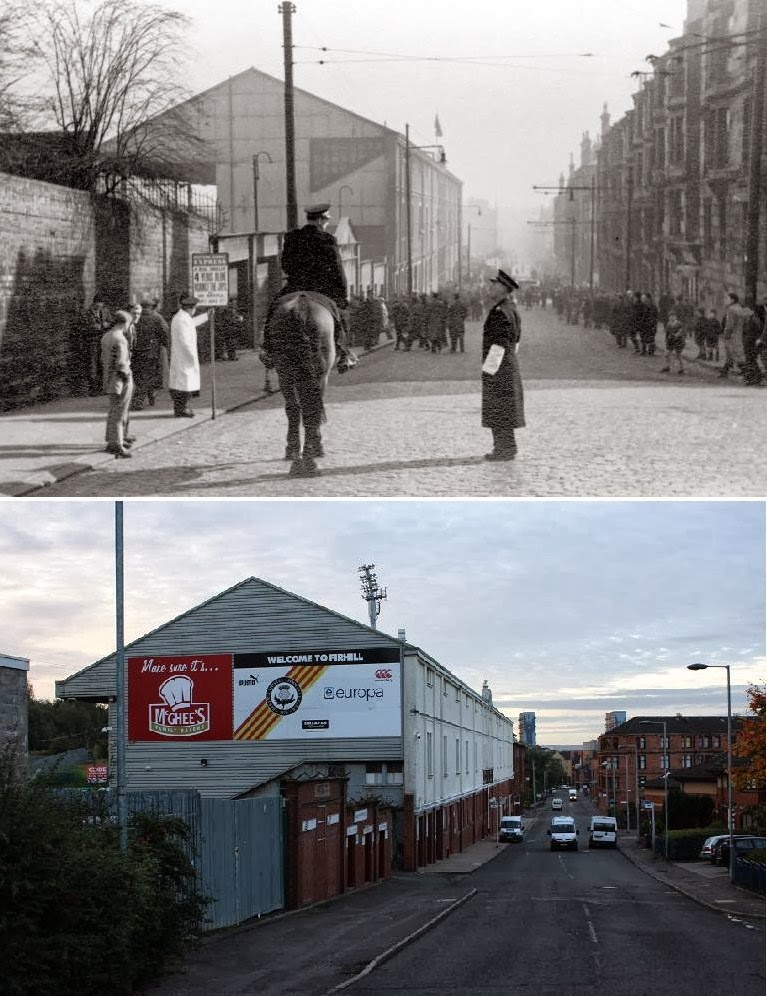
Just before you get to the Firhill Basin on the canal, where saw mills, chemical works and iron foundries used to load their wares, you pass under a bridge, which used to be a 'bascule bridge' over to Shaw and McInnes's Firhill Iron Works. These iron works, seen in the old photograph, were founded in 1846. Partick Thistle are a later addition to the area, arriving in their current stadium beside the Firhill Basin in 1908. In the picture below you can still see the rows of tenements opposite the stadium, all cleared away in the late 60s/ early 70s.

Looking down Firhill Road to Firhill Stadium
From Firhill it is only 50 yards to get to Queen's Cross, home of Jaconelli's Cafe and Queen's Cross Church. This is the only church built to Charles Rennie Mackintosh's designs and is now home to the Mackintosh Society. Built in 1897, inside and out it is stunningly modern and imaginative.
 
Stained glass window in Queen's Cross church
 

Looking up Maryhill Road at Queen's Cross
Looking up Maryhill Road only the buildings on the right hand side of the road have survived, but if you turn around and look to the gushet at Queens Cross itself then none of the fabulous buildings in the picture below have survived. The long curving tenement in this picture was the work of another famed Glasgow architect, Alexander 'Greek' Thomson. Built in 1875 the building comprised the two storey shop at the corner and the four storey tenement buildings down both streets. His nearest work to here still in existence are the "Sixty Steps" at Garriochmill Road.

Queen's Cross
The photo below is from further down Maryhill Road looking back up towards the cross when the road was lined by tenements, now long gone. Queens Cross church can be seen poking up at the top. 


Further down Maryhill Road looking into Raeberry Street below you can see that the tenements down the side streets have all been demolished too. Even the church halfway down on the right was knocked down and replaced by flats a few years ago.. The shop at the left hand corner here on Maryhill Road is DM Hoey, for all your menswear needs.


At the bottom of Maryhill Road is St George's Cross, where a statue of St George and the dragon now stands. This statue used to be atop the Co-op building here and was preserved when the building was flattened in 1985. Nearby the flyover at the end of Great Western Road heads into town. It is all but impossible to picture the way this junction used to be. The old photo below has Great Western Road off to the left, Maryhill Road going off up the middle and St George's Road off to the right. Maryhill Road no longer goes up in a straight line from the cross but emerges now behind the building advertising Waddells Sausages in the old photo, which is hidden behind the tree on the right of the lower picture.

St Georges Cross
Going back up Maryhill Road to where the fire station now is, it is surprising to look back at how well proportioned and handsome the road looked before it was decided to flatten most of this area. The block opposite in the old photo is all gone, except for the furthest away corner, another case of a pub surviving after everything else around has gone, on this occasion The Strathmore.


The next junction off to the right  is Bilsland Drive, which now goes straight across into Queen Margaret Drive but at the time of the photo below you can see that the tram had to snake left to go right before the junction was re-configured. 


Canal bridge on Bilsland Drive
So finally back up to one of the oldest buildings in Maryhill, The White House pub. This opened for business in the days of the canal's construction before 1790. When I stayed across the road from here it was still open as a pub, but after lying empty for years it has recently been refurbished. Funny how it is largely the pub buildings which have survived the wrecking ball.

The White House pub at Lock 21 of the Forth and Clyde Canal
There is no longer the same range of industries and employers in Maryhill that there was in the past. Like other areas of Glasgow it has been hamstrung by the mis-guided efforts of city planners in the 1960s and 70s. However there are new facilities being developed, such as the excellent Burgh Halls and housing improvements are clear to anyone walking along the canal today. Now all that Maryhill needs to be "wonderful" is the continued success of Partick Thistle Football Club, who remember Mary Hill in another song,

"I know a lassie, a bonnie, bonnie lassie...
...Mary fae Maryhill."

NB. I can heartily recommend that you have a rummage about in one of my favourite websites if you are still feeling nostalgic "OldGlasgowPubs.co.uk"

(These old pictures were largely found on the internet or the MItchell LIbrary. Please let me know if you feel that you hold copyright of any of these pictures as none was mentioned where I found them)

Friday, 13 September 2013

Dostoyevsky at the Citizens Theatre, Glasgow. Review

I need to start this by admitting that I'm a bit of a Dostoyevsky groupie. I first read Crime and Punishment as a teenager and was completely hooked from the start. I turned my back on your Bronte sisters and Jane Austens. For a few years I could see no further than Russian literature and worked my way through Lermontov, Goncharov, Gogol, Turgenev, Gorky and the rest, but mainly the works of Dostoyevsky. Emile Zola and Victor Hugo I allowed myself, treating them as honorary Russians as they also featured sufficient misery and gloom for my tastes.

Ever since then I keep returning to it again and again. Recently I've read Norwegian author Knut Hamsun purely because Gide called him a "Norwegian Dostoyevsky" (wrongly) and read Russian author Vyacheslav Pyetsukh's "The New Moscow Philosophy" because it was supposed to be a "reprise of Crime and Punishment". Again I ended up disappointed. So when I found out that the Citizens Theatre in Glasgow were putting on adaptions of two of Dostoyevsky's books I was delighted, if a little anxious about how that would work out.

When we were on holiday about 9 years ago in Moscow and St Petersburg I ended up, without planning to, turning it into a bit of a Fyodor Dostoyevsky tribute tour. I've got photographs of myself and my children standing in front of Dostoyevsky's statue outside the Lenin Library in Moscow. However it is when you are in St Petersburg that you realise that city is an ever present character in many of his books, none moreso than in Crime and Punishment. Having read the book a couple of times before arriving in the city I was surprised at how grand, clean and open the city was. 
The streets and taverns Raskolnikov inhabited in my mind should have been more like the narrow streets of the Victorian Gorbals, yet here we found wide canals and streets, solid, dignified looking buildings and there was light. Obviously I was visiting a modern city, tidied up for our times but it was hard to put the Raskolnikov of my imagination into these grand streets. His attic flat in the book is described as "under the very roof of a tall five storey building, more like a cupboard than a living room". The descriptions are so real that the flat has been identified at a street called Stolyarny per, a street I had to visit. The spot is now marked by a plaque of Dostoyevsky, climbing the aforementioned stairs. Again this looked like a bright, healthy, solid building more akin to a romantic garret than a claustrophobic hovel. In Dostoyevsky's day there were apparently 22 bars in this street, so maybe that, the tuberculosis and the more crowded living accommodation of his day needs borne in mind. He takes 730 steps from here to get to the pawnbroker's house where he commits his crime. Beside this block a wide canal looks delightful, but apparently at the time stank from the sewage tipped into it and in the book there is reference to suicides throwing themselves into these same canals. 
Again look at this picture I took of the block thought to be where the murder took place, just not what I'd imagined. He runs out of the pawnbrokers house and through a tunnel onto the street beside the canal, so the tunnel in the centre of this block is where I picture it happening now.
 
Pawnbroker premises in St Petersburg?
We retreated to a bar called "The Idiot", named after another of his novels, and I began to feel more the atmosphere of his times. Although the walls inside were white and clean and bookshelves lined them, the arched roof and pillars of this basement bar felt like the kind of tavern in which Raskolnikov might have met Marmeladov. Here we looked up some other Dostoyevsky themed things to see. In 1849 whilst a prisoner of the Tsar for taking part in revolutionary activities, Dostoyevsky was taken to Semyonovsky platz and faced a mock execution.
 
Pionerskaya Ploschad
Now called Pionerskaya Ploschad the square has no feel of an execution site and has all the detritus of a bustling city, but that is as it should be. Glasgow Green in my own city is a place we go to run about and play rather than go to see people being hanged nowadays. He was then taken to a Siberian labour camp where he lived alongside murderers and criminals who inspired his ideas for Crime and Punishment.
 
Dostoyevsky Museum on the first floor
The flat where he lived his later years, and died, is now a museum to the author. Here he wrote The Brothers Karamazov and when we visited the market outside gave a better idea of the bustling streets of the 1860s and 1870s St Petersburg. Nearby, facing Vladimir Cathedral stands a statue to the author and this was the last site I visited on my pilgrimage to Fyodor.

Dostoyevsky statue opposite Vladimir Cathedral, St Petersburg
The point I want to make is that you create a very clear picture in your head when reading a good book, particularly one that you love, of the characters and their environment. This isn't a bad thing, but it needn't necessarily be what the author imagined or any other reader pictures. For this reason when I saw that the Citizens Theatre were doing a production of Crime and Punishment I was delighted but approached it with some trepidation, fearing certain disappointment in seeing a version different from my own. However on re-reading it recently I try to imagine how you could stage it and I find new things in it again. When I first read it I remember his mother being old. Caring but a bit clueless. When I read it again I find that "although Mrs Raskolnikov was forty-three her face still preserved traces of its former beauty". Forty-three! Steady on, Fyodor, that's not exactly ancient! But this is important, Raskolnikov is a young man for whom forty-three is past it. He is full of confidence and ideas and fight. Full of anger. The long passages in the book where he debates with himself seem ideal for a theatrical staging. The detective, Porfiry, is a prototype Columbo who knows despite a lack of evidence who the murderer is, but badgers him into confessing. Some adaptions or re-imaginings work. Then again have you ever seen the 1958 film of The Brothers Karamazov with a young William Shatner playing the monk Alexei Karamazov? Every time he is on screen you expect him to raise an eyebrow and flip open his communicator. I am more hopeful for Richard Ayoade's imminent film adaption of The Double. Not all of his books I can imagine well on stage but the two on show at The Citzens I could certainly see working well. 

Dostoyevsky's actual desk in his actual apartment
As the Citizens were staging adaptions of two books I decided to see them in the order in which they were written. First up was Notes From The Underground, the inaugural production by The Visiting Company starring Samuel Keefe (who I recently saw in The Changeling at Oran Mor, playing a similar angular, nippy sweetie role) and Millie Turner. This is on in one of the Studio Theatre spaces and the dark, small room worked well for the story, even if my back still aches from the blooming seats they have in there. Immediately before writing Crime and Punishment Dostoyevsky penned Notes From The Underground, a short novel in which the author through the monologues of the anonymous narrator berates society. It starts "I am a sick man....I am an angry man. I am an unattractive man. I think there is something wrong with my liver." This bitter character also vents his spleen against the aged - "To go on living after forty is unseemly, disgusting, immoral!" He tells the story of his bleak meeting with former colleagues from school, and later a prostitute, "that 'damned' Liza". He wonders "which is better, a cheap happiness or lofty suffering?"

The character in the book is spiteful, isolated, vengeful, ashamed and weak. Not an easy role to play and expect sympathy from the audience, but Keefe does it with aplomb and shows the vulnerability and insecurities of this man. He may be making his "notes" with an iPad or mobile phone rather than pen and paper but, using much text from the original book, little updating is required to maintain his existential angst in our modern times. Feeling humiliated from above and powerless against his superiors, he turns around and takes his anger out on someone weaker than himself. The book was conceived by Dostoyevsky whilst imprisoned and the "grief and disintegration" he felt there is surely just as resonant in today's society. It is clear that the "Underground Man" wallows in lofty suffering rather than trying to enjoy cheap happiness. That is to be what Raskolnikov has in store for himself too. Notes From The Underground was written as a bitter rebuttal of Utopian Socialist Chernyshevsky's novel What Is To Be Done? Dostoyevsky disagreed with these ideas that mankind would achieve happiness by acting with enlightened self interest. This book (the title of which was later borrowed by Lenin as the title of a more practical "How to do revolutions" pamphlet) is prominent again in the production of Crime and Punishment.

This production of Crime and Punishment is co-produced by The Citizens, Liverpool Everyman and Playhouse and Royal Lyceum Theatre companies and written by Chris Hannan. The ten strong cast are always on stage, milling around or playing the accompanying music, giving a good atmosphere of the bustling city within the book. Adam Best plays Raskolnikov with all the hunger, anger and poverty required. His friend Razumikhin is played by the fabulous Obioma Ugoala in a way that would make anyone gratefully take him as their best friend. George Costigan plays Porfiry's Colombo role whilst avoiding the tics of Peter Falk as much as possible. A lot of detail from the first half of the book is crammed in, as Raskolnikov puts forward his case that the extraordinary human is above the law if he acts for the common good. The second half slows a little, and his eventual confession, shouted out in the street, is maybe more dramatic, but in the end less powerful than the chain of events which bring him to confess in the book. He heads to a place the author knew only too well, the Siberian prison camps. I really loved getting an excuse to dust off my old Dostoyevsky books. Reading them a decade on from last time I see new things in the books again, and they are as relevant to our times as any other. That was something that both plays managed to convey.

Raskolnikov/ Dostoyevsky may not always have been right, but he had an idea and set out to prove its worth. “To go wrong in one's own way is better then to go right in someone else's.”