Sunday, 21 April 2013

East End Entertainments In Glasgow.

Review of Outskirts Festival, Platform. Easterhouse and BFI Mediatheque, Bridgeton Olympia Library, Glasgow.

 
Last year's inaugural Outskirts Festival was a sell out. No surprise with popular acts such as Aidan Moffat, Vashti Bunyan and readings from the likes of William Letford that time around. This year the festival stuck more closely to its own goals as "a venue on the outer reaches of a major city ought to doff its cap to artists on the edge of their disciplines or those creative people who are simply too curious to stick to one artform". They had advertised it as "recommended for the whole family". So taking them at their word we headed to the Platform as a family. There were options to include food in the ticket price and price reductions available if you had "local links". I was going to claim this on the fact that a decade ago I had spent a year working in Easterhouse but in the end "local links" just meant having a Glasgow postcode. The venue is not one I'd been to before. It is part of the Bridge complex in Easterhouse, which also includes the swimming pool, library, John Wheatley college and plays host to Scotland's National Youth Theatre.

Olympia building at Bridgeton Cross
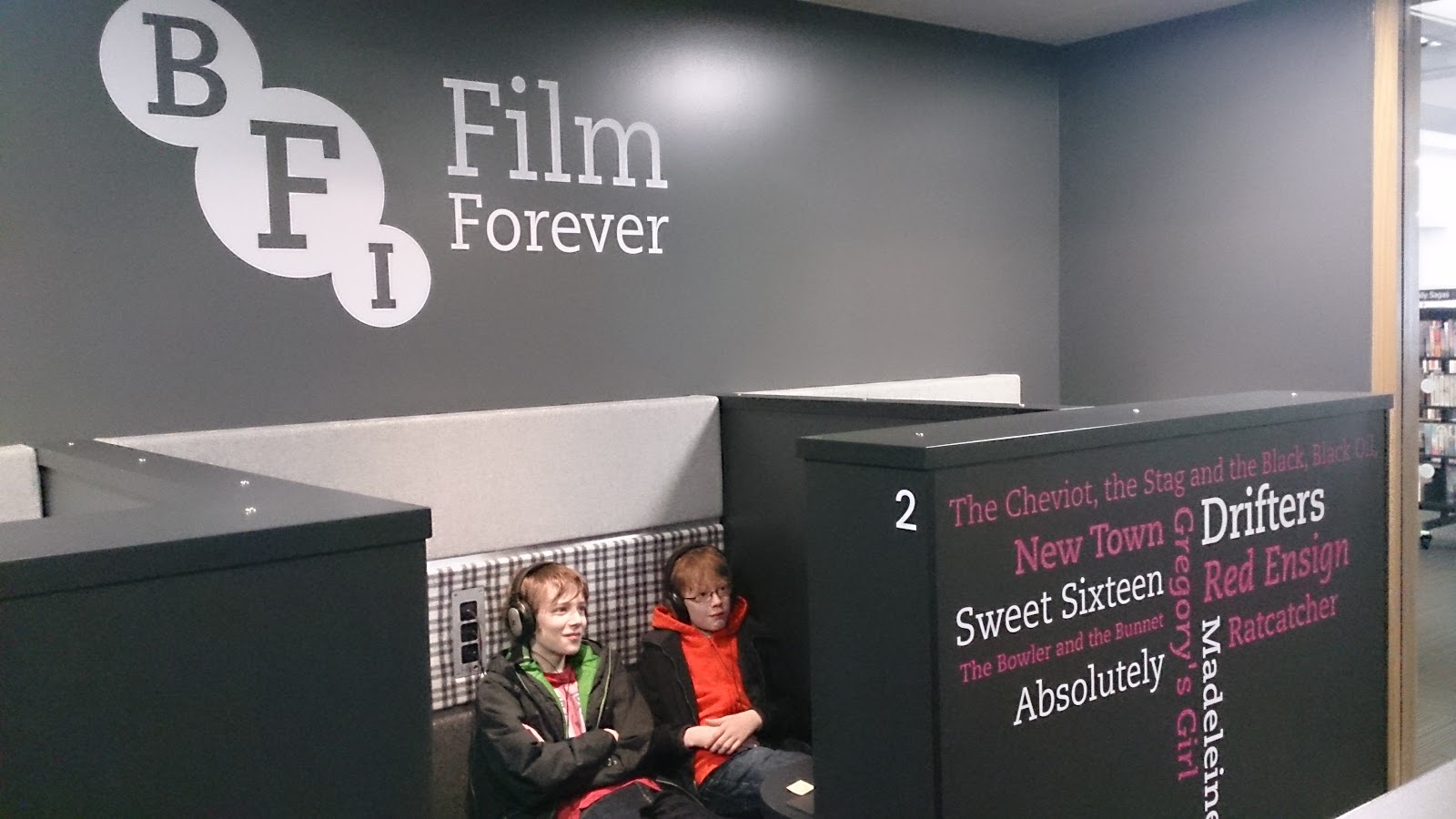
We decided to make a day of it in the east end and started at Bridgeton Library. This recently re-opened in the former Olympia cinema and music hall building right at Bridgeton Cross and includes Scotland's "first BFI Mediatheque". This is a film and television archive from Scottish Screen and the BFI. Armed with just your library ticket you access this at a computer screen in wee booths in a dedicated section of the library. The choice is so wide and varied the hard part is deciding where to start, whether you go for old 50s Horlicks adverts and documentaries about Glasgow shipbuilding or the first episode of TV show Swap Shop. There are films too, from Gregory's Girl to Great Expectations. We ended up dipping in and out of a lot of things but our collective favourites were footage of the 1908 London Olympics and watching Peter Cushing as Doctor Who in Dalek Invasion Earth 2150.

BFI Mediatheque, Bridgeton
We also wandered round the corner to a gallery which has been open for a couple of years in an industrial building here but which I only heard about when there was a feature on it in The Skinny this month. The David Dale Gallery was hosting an exhibition by Harry Meadley featuring some other Leeds based artists. You wouldn't stumble across the gallery by accident unless you had come here on purpose but it is certainly worth seeking out. After this we swung past the Modern Institute in Osborne Street which has an exhibition just now of paintings by Swiss artist Nicolas Party. From here we could pop around the corner to get a vegetarian lunch at Mono and join in the fun of Record Store Day, the day when lots of men with beards queue up at record shops to buy vinyl they don't want but hope to flog later on ebay. Mono were also running a bus to Easterhouse for the Outskirts Festival, so wiping the last falafel crumbs from the corners of our mouths we headed for it.
David Dale Gallery

Outskirts Festival

As I'm visiting Denmark and Holland during the summer I was drawn by the chance to hear Danish Frisk Frugt (it means fresh fruit apparently), and Dutch performer/ musician Jaap Blonk. A Hawk and a Hacksaw's Balkan-influenced folky music was also a draw and the chance to hear a reading from Rob Newman, once part of The Mary Whitehouse Experience. There were other more eclectic offerings promised to and performance art promised throughout the evening.
Florence To
Jaap Blonk set the tone giving us a sound poetry recital. I've been to lots of sound poetry performances and I'm not convinced that it brings anything more than the reading of words or the playing of music could to tell a story or express an emotion. This was the first time that I'd forced it upon my three children though and their less filtered opinions are always interesting. They found it bonkers but amusing, which is probably fair enough. He gave us a history of Sound Poetry, from early 20th Century Russian to Dutch members of the De Stijl movement. Between acts in one of the rooms Florence To played projections of geometric shapes onto white pyramids to a background of ambient electronic music. It was hypnotic stuff and the later performers got her to leave it on to add to their performances. Some of the other art on show was a bit hit or miss, although I did end up with a bag from the screenprinting Poster Club. In the main auditorium next up was "Sonata for a Man and a Boy" by Greg Sinclair and an excellent turn by young Bartek Bialucki. It was a performance involving movement, conversation and a cello lesson where the man's inner child and boy's adult interplay. It was gentle and engaging and warm and fuzzy without feeling the need to be dark or foreboding. A poetry reading by Ryan Van Winkle never quite hit the right note, whereas acapella singers Crying Lion, were note perfect and oddly one of my children's favourite performances with their olde England cider-appley sound.
 
We were disappointed that Rob Newman wasn't well, as we'd been quite keen to hear him, but Scottish writer Kirstin Innes stepped in for him, reading her tales of social dancing torture at school.
Frisk Frugt
Frisk Frugt's latest album got a rave review in The Quietus so I was looking forward to hearing them. Danish musician Anders Laug Meldgaard comes from a country where jazz is apparently not a bad word, but also a country where it has not been allowed to stagnate and has positive influences on the experimental, jazz-tinged sounds of Frisk Frugt. Driven on by his forceful percussionist who used a variety of bells, drums and chimes Anders moved from keyboard to mini-sax and his homemade organ put together from an array of swanee whistles and recorders. Their last piece was particularly impressive and beautifully put together, moving from chaos to order. This was definitely the highlight of my day. The evening was finished in style by A Hawk and a Hacksaw, the two-piece from Albuquerque, New Mexico rattling off their Balkan soaked tunes on violin and accordion. It was a foot-tappingly good performance but a bit unengaging for me. Central European folk music is not something I have a great handle on so it is hard for me to know where respectful imitation ends and original music making begins here. I think perhaps the setting didn't help this with the audience sat in the auditorium chairs looking down on the musicians. It was music that would be better heard sat around a fire with them or dancing in a village hall.
A Hawk and a Hacksaw
Overall it was a well organised, interestingly curated festival. The atmosphere was pleasant and the unusual settling with library book shelves you could browse between acts and a sports centre cafe serving bottled beer and paninis worked well. It didn't feel like it had imposed itself on the area either but tried to engage with it. When a group of local boys kept wanting into things they were invited in without anyone fussing over it. Even after they ran out from the sound poetry guffawing theatrically I later saw Jaap Blonk and one of the festival organisers talking to them in a hall trying to show them how he makes his loudest farting noises. Other kids who had wandered in seemed to be getting a chance to do some screenprinting. Good effort all round, but maybe needs to work on the publicity a bit next year as this felt a bit like a wee secret.
 

Friday, 12 April 2013

Wagner, Thorn and Morton Rolls Over?

Review of... BBC Scottish Symphony Orchestra, Wagner's Tristan and Isolde Act III, City Halls, Glasgow.

Tracey Thorn at Aye Write Festival, Glasgow.

...and a wee bit of Partick Thistle


I checked a dictionary definition for the word Wagnerian just there and it said "massive scale, drama and emotional intensity." I had expected to get that on Thursday night from the BBC Scottish Symphony Orchestra performing the third act of Wagner's Tristan and Isolde. However the description can be applied equally well to the football performances of Partick Thistle this week.

I turned up at the "Braidwood Motor Company Stadium" (recent winner in the world's worst stadium name tournament) in Livingston on Sunday for the Challenge Cup final against Queen of the South hoping to see Partick Thistle pick up their first cup trophy since 1971. The first 120 minutes were more tense than entertaining, with Thistle not managing to show what they can do. Then came the twist at the end which would be unrealistic melodrama in an opera. When Thistle won a dodgy penalty in the final minute of extra time we were confident that Aaron Muirhead would put it away to equalise and take it to penalties. However when it was saved, Muirhead was then red carded for sticking the head on Queens' player Higgins (who was basically asking for it). Then in injury time Kris Doolan's goal DID take it to penalties....where we finally did lose it. As a naturally "glass half empty" supporter I was then anxious about the virtual league decider three days later against Morton. I needn't have worried. An amazing crowd of almost 9000 people turned up at Firhill to watch a nervy but solid 1-0 win nudge Thistle nearer to the title and promotion.

After that it was maybe not surprising that I found Wagner's operatic finale a bit of an anti-climax. The BBC SSO conducted by Donald Runnicles have been performing the opera's three acts live to a Radio Three audience from Glasgow's City Halls over the past few months. I've enjoyed the first two acts and written about them here before (Act I, Act II). Wagner's operas are famously bombastic and famously long. However this rendition has now been running almost 7 months, which even for Wagner is far too long a period of time. As well as meaning that I've had to get a story refresher each time we arrive back at the halls, it has also meant that the singers have changed on several occasions, losing all sense of unity in the story telling and leading to quite marked variation in tone and atmosphere between acts. Some singers (such as Marcus Eiche's Kurvenal tonight) act the part, whilst others (particularly Robert Dean Smith's flaccid Tristan) meander through. In fact I wasn't even sure that he'd died as he skulked over to the side of the stage. There was no drama in the performance of this final act tonight, even Isolde's final aria before she dies felt perfunctory. The earlier piece of the night, Richard Strauss's Metamorphosen held my attention more, his mournful piece written in 1944 showing where modern classical music was headed with his marked counterpoint that the likes of Steve Reich would pick up and run with.  Maybe I had just been spoilt for melodrama by the football I'd witnessed this week.

More engaging and enlightening was my evening at the Aye Write Festival to see Tracey Thorn do a reading from her excellent memoir "Bedsit Disco Queen" and Q&A. I've always liked the music of the singer /songwriter from Everything But The Girl. Her recent solo albums, even her Christmas one from this year are well worth exploring too. I was at school when EBTG first found fame and I followed them more attentively after sharing a hotel with them at the 1985 World Festival of Youth and Students in Moscow. They were there to perform as part of Britain's cultural delegation, I was there as a kilt-wearing 14 year old delegate from the Glasgow West branch of Youth CND having a good time. Her reflections on this trip in the book were fascinating as she saw events from a different perspective from my recollections. She recalls the "clearly censored and nearly-mute translator-guides". I remember the translators spending their evenings drinking with the Scottish delegates, who kept slightly apart from the English group and my diary describes an 11-aside football match I took part in where Scotland played the Russian interpreters and "one Englishman who made up their numbers, and had to go to hospital with a broken leg". I hadn't dug out all my old photos, memorabilia and diary from that trip until I read Tracey's book mentioning it. I remember them performing in Moscow, along with reggae band "Misty In Roots" and Scottish folk singer Dick Gaughan, who kind of took me under his wing there. I remember Ben and Tracey running along the Hotel Cosmos corridor to their room a few doors down from me and the mileage I got from telling the cool girls at school that I'd seen them. Anyway, Tracey was kind enough to give a few minutes of her time to my reminiscences of that bizarre week tonight as I stood in line to get my book signed. It is a well written, intelligent book and well worth a read if you haven't come across it yet.

Tuesday, 9 April 2013

Partick Thistle Early Grounds

Firhill Stadium from the canal, March 2013
Previously I have written a blog of a short jog I had run around the sites of the old grounds of Partick Thistle Football Club. For a look at some information I came across on the old grounds whilst investigating this route please have a look at the earlier blog. Simon McKay added a comment to it that I had probably guessed wrongly on placing the Meadowside ground so near to the end of the River Kelvin. Partick Thistle played here from 1897 to 1908 in a ground which once held 16,000 people watching a match against Hibernian. In 1908 they moved to where they are still, in Maryhill, the ground partly surrounded by a bend in the Forth and Clyde Canal and the Firhill Basin that was once used for off-loading timber. I apologise in advance that this blog is a bit heavy on pictures because of the nature of it, so if reading this on a mobile, you were warned!
Firhill Stadium today
Last week on a trip through to Edinburgh with my children we popped into the National Library of Scotland and had a quick look at an exhibition about map makers Bartholomew. They had a Glasgow map on display labelled 1888, but it had Partick Thistle's stadium in Maryhill already in place, so was obviously a later map. This made me remember that I'd planned to have a look in the Glasgow Room in the Mitchell Library to see if I could find any old maps giving more clues to the location of Partick Thistle's Meadowside ground. I love guddling about in this room and I can easily lose track of time whilst in here, so I quickly got distracted looking at a lot of other stuff today. So here is a quick run through some of the old maps that I came across.

1876-1880 Overnewton Park

Somewhere just south of Dumbarton Road lies the site of Partick Thistle's earliest recorded home, Overnewton Park. On current maps Overnewton Square is as near as I can guess to where this used to lie. In this 1865 map "Overnewton" lies between Kelvinhaugh Road (now Haugh Road) and Kelvinhaugh Street. I stumbled across no maps with a pitch marked on them.

Overnewton 1865 map

1880-1883 Jordanvale Park

This ground lay just south of Dumbarton Road, beside what is now called Edzell Street (was called Hill Street) in Whiteinch. The pitch here was problematic and after 3 years they moved back westwards. The area was later used for a tram depot which can be seen on this 1898 map.
Jordanvale 1898 map

1883-1885 Muir Park

Muir Park now lies under the bottom of Gardner Street in Partick, but before the rising population made building tenement housing a profitable enterprise this area was laid out as Muir Park. On this map of 1861 you can see the West of Scotland Cricket ground on the left and the bowling green on what is now Fortrose Street which are both still there. The curling pond on Peel Street is now long gone. Thistle had their pitch at the lower end of Muir Park (between the P and A of Partick in this map).
Muir Park in 1861 map

1885-1897 Inchview

In 1885 Partick Thistle played their last game at Muir Park, against Partick FC, who were being wound up, and moved to their ground in Whiteinch - Inchview. This now lies roughly under the northern entrance to the Clyde Tunnel. In this map of 1896 "Inchview Athletic Ground" can be seen on the left hand edge, just south of Dumbarton Road.
Inchview in 1896 map


1897-1908 Meadowside

Meadowside shipyard, with Clyde off to the top.
In 1897, as one contemporary report put it "The Partick Thistle, urged no doubts by the encroachments of the avaricious building fiend, have decided to remove to larger fields and pastures more central". I had thought this was on the Clydeside near the mouth of the River Kelvin, with Thistle having to move for the building of a shipyard here. However my wife came across a reference in a Jules Verne book set in Glasgow ("The Blockade Runners") to the Meadowside shipyard, which was built here much earlier, in 1844. It even has a wee photo of this area, so I placed it wrongly in my earlier blog. In this picture above, the Kelvin is in the foreground, the Clyde heading upwards to the sea. The building in the centre is all that remains of this complex now and Partick Thistle built their ground on the grassy bit beside the Clyde just west of the shipyard. These maps below are a kind of before and after shot of Meadowside. The first is from 1892 and has ("1897 Football Ground Partick Thistle") added as an amendment. The second shows the ground and maybe explains why two boats were allegedly required to retrieve stray footballs from the Clyde on match days. This places the ground in a line straight south from what is now Sandy Road, under the two most eastern blocks of flats in the new Glasgow Harbour development. It was the building of the Meadowside Granary which required Thistle to find a new home.

Meadowside 1894
Meadowside map 1903

1908-Present Day, Firhill Stadium, Maryhill

When they had to move away from the land at Meadowside for industrial development on the Clydeside, a piece of land was procured in Maryhill, a pitch flattened out and a stand for 1600 people built. In the 1861 map what is now Firhill Road leads over Firhill Bridge to what looks like a farm called Firhill. Where the stadium would later be built lies an iron foundry, adjacent to the "timber basin".
Firhill 1861
By the 1898 maps the foundry has gone and the "Firhill" house has been replaced by Ruchill Park. On the north bank of the canal now lies "Firhill Iron Works" and "Firhill Saw Mills" as industrialisation moves on apace.
Firhill 1898
By the year 1921, when Partick Thistle won the Scottish Cup you can see the stadium on the maps. Earlier maps have just the main stand and indicate a rough slope for the terracing but by 1921 it looks more recognisable on the maps. Murano Street has been laid out now (named after Murano Glass Works in Venice as there were two large scale glass works on this street). Curiously what is now called Bonawe Street on the other side of Maryhill Road, was called Hampden Street in 1921, which seems appropriate that season (or not, as one pedant has pointed out Thistle won the Scottish Cup final that year played at Celtic Park).
Firhill 1921

 Anyway that was what I found in the Mitchell Library today. Please let me know if there are any glaring errors here and I'll put these pictures up on the Partick Thistle FC flickr page if you want to have a look at bigger versions.

Wednesday, 3 April 2013

Football History - Two Glasgow Exhibitions

The Scottish Football Museum, Hampden Stadium, Glasgow

More Than a Game, Kelvingrove Art Gallery and Museum, Glasgow


There are two opportunities at present to look at the history of football in exhibitions in Glasgow. Firstly there is the Scottish Football Museum which has had a space in Hampden Park ever since the stadium was redeveloped. Alternatively, at Kelvingrove Art Gallery until 18th Aug 2013 is an exhibition entitled "More Than a Game: How Scotland Shaped World Football".


Firstly I went with my children to the Hampden Museum, as we hadn't been for ages. It's £10 to see the museum and get the stadium tour, but children with Glasgow Kids' Cards are free (£5 otherwise). In the years that have passed since we were last there not a lot has changed. It starts off with a chronological look at the development of the game in Scotland, from the world's oldest international match between Scotland and England, played in Partick in 1872, to the foundation of the football league and it's development over the years. There are lots of nods to Scotland international teams, as is appropriate at the national stadium, particularly those that got to World Cup finals, with a model and video of Archie Gemmill's goal against the Netherlands, looking like something from a bygone era nowadays. It makes this solitary goal into a bit of a religious relic which is probably overstating its importance on the world stage. I think the film Trainspotting captured the moment more relevantly.


Much like Scotland reaching the World Cup, other things on show needed explained to my children as being before their time and entirely alien. For example, why exactly were there rows of "Inva-cars" along the touchline at most matches in the 70s? There is an awful lot on Rangers and Celtic here: photos of Terry Butcher, Ally McCoist's golden boot, Neil Lennon's shirt and various paintings of Celtic players. The "Hall of Fame" has a preponderance of Old Firm players too. Bertie Auld and Maurice Johnston were the only ones I spotted with a Partick Thistle link on my quick glance at the list, but then again I'm guessing it was their Rangers/ Celtic connections that got them listed here too, no? So we filled in a card to nominate a current Partick Thistle legend for this honour.
Chris 'Squiddy' Erskine's Hall of Fame Nomination
On looking at the Scottish Cup trophy, which is on permanent display here, I took what I saw on it as a good omen for the end of this season.
I'd like to see the First Division League table at the end of the 2012-13 season looking something like this, with Partick Thistle just one place above Morton. (If the picture isn't clear it says "Won by... No competition...Kilmarnock...Partick Thistle 1920-21...Morton 1921-22...Celtic...". In fact these were the first and last years that Partick Thistle and Morton have won the Scottish Cup).
Next up was the stadium tour. Considering that our group consisted of us being the only Glaswegians (and Partick Thistle fans to boot) plus families from Fraserburgh, Mauchline and Falkirk it was again depressingly centred on tales of Rangers and Celtic: which end they get for finals, which dressing rooms, which side of the tunnel they stand on. Please, Rangers and Celtic are not all that there is to Scottish football, and in fact most of the time they seem to be playing here against their will. The ground itself is the property of Queens Park Football Club of course of whom we heard precious little, and the tour guide's talk was out-dated by the fact that the old firm teams are 3 leagues apart at present and Rangers will only be visiting Hampden on league business for a while yet.
 
Warm-up area, Hampden Stadium
The tour itself is good though and was the favourite part of the visit for my children. You get into the referees' rooms and the dressing rooms, which to be honest were a wee bit wiffy from the Scotland and Wales teams occupying them 48 hours earlier. The astroturf indoor warm-up area allows everyone to have a quick kickabout. Then you get to walk out through the tunnel onto the pitch and pretend you are being greeted by the Hampden roar. A good time was had by all.
 
 
As the exhibition on at Kelvingrove is being organised by the Scottish Football Museum I wasn't sure if there was just going to be a lot of duplication. However from the leaflet promoting it it is clear that promisingly it aims to have a broader reach than just the Old Firm. There are talks running alongside it on topics such as women's football, the world's first black international footballer (Scotland's captain in 1881, Andrew Watson), Third Lanark, Queen's Park and from a Mr Robert Reid at Woodside Library on the 8th of June "The Story of Partick Thistle Football Club".
Entrance to the Kelvingrove exhibition
Like all the visiting exhibitions at Kelvingrove there is an entry fee of £5, but children under 16 are free. The normal Kelvingrove organ recitals were meant to have a footballing slant  with such classics as "Ally's Tartan Army" being performed, but at the time of writing a "technical issue" means that this isn't happening yet (I think it's just that technically this isn't actually music).
A nice touch was the entry ticket being a reproduction of the tickets for the world's first "International Foot-Ball Match" in 1872 at the West of Scotland Cricket Ground in Partick.


The exhibition itself is far more engaging than the one at Hampden and does make a better connection with the social history of football clubs' origins, particularly in the parts around the Third Lanark army regiment or the leather workers in Partick making 20 Tomlinson T-panel footballs a week. Also the early history of football in Scotland, including a leather football from the 1540s and early records of women's football are good. Although the exhibition is titled "How Scotland Shaped World Football" this doesn't really feature prominently in the exhibits, but a touchscreen tells the stories of Scots immigrants bringing football to all the corners of the Empire and beyond.  A lot of this is expanded upon in the interesting wee guide booklet.

I quite liked seeing the square wooden goalposts taken from Hampden which St Etienne fans blame for their not winning the 1976 European Cup Final due to their shape.

Otherwise the football parts are more predictable, but interesting none the less with films on the Real Madrid cup final at Hampden, the Busby Babes and various old Scottish international matches. Also the paean to great Scottish managers doesn't have any surprises, but what is glossed over is that Scotland once lead the way in many areas of football development, but we have now been left behind looking at museum exhibits of our former glories.
 
As a Partick Thistle fan I cannot stop myself looking out for any references to my team, and much as at Hampden (where a copy of the old fanzine "Sick In The Basin" is on show) here it was just in relation to our supporters with a couple on supporters club membership books on display.
My children were kept engaged throughout this exhibition with video touchscreens challenging you to be the referee, a virtual football video game projected on the floor, dressing up boxes and a brass rubbing bit with club badges.
"Can you see what it is yet?"
After that there is the obligatory exit through the gift shop, which has a Subbuteo table set up, which almost got me buying it anew, but I settled for the Partick Thistle coloured "The Jags" sweets instead, which I was delighted to see appeared to be outselling all of the others. Well, we were in the west end of Glasgow after all. 

Monday, 1 April 2013

Chas 'n' Dave. ABC, Glasgow. March 2013

I ended up at a gig last night that I'd been looking forward to for a while, Chas 'n' Dave at the ABC in Glasgow. Light-hearted, pub singalong "rockney" singers Charles Hodges and Dave Peacock have been doing their thing for over three decades, their first chart success being "Gertcha!" in 1979. A further seven chart hits followed. Before that they'd played as session musicians for various acts from Labi Siffre to Jerry Lee Lewis and Gene Vincent. In 2009 they announced that they were retiring as a band, but as is the way with these things, a mere two years later and they were touring again. Who can blame them? The ABC is a decent sized venue and it was mobbed. The crowd were in a party mood (eg pissed) and amazingly seemed to know most of the words to most of the songs, so a lively singalong ensued.

Big crowd for Chas 'n' Dave in Glasgow
My excuse for being here? I was 10 years old when Tottenham Hotspur won the FA Cup in 1980 and then again the following year. They were exotic and exciting with Ossy Ardiles and Ricky Villa scoring great goals so became my English team. This was helped by my mum's cockney friend being a big fan and sending us Spurs' calendars, etc. So I had my Spurs kit on at PE and could sing along to great big daft songs about them by Chas 'n' Dave. Then you had other crowd pleasers for any child of the time such as "Rabbit" and "Snooker Loopy". What's not to like?

They are a pretty low maintenance outfit. 69 year old 'Chas' on the piano, his 67 year old partner 'Dave' on bass and one of their son's on drums. They peppered their set with their hits, seemingly randomly deciding upon the fillers as they went along. They really are relics of a bygone era. Songs about London girls darning your socks or not caring about life's stresses because "I got my beer in the sideboard" really aren't going to bother the charts these days.

Anyway, I've seen them now, so I'll give it a miss when they do the next "farewell" tour. My only disappointment was they didn't do the Spurs songs! So if they do a Spurs tour next time, that is something I would buy a ticket for.

Saturday, 23 March 2013

Serial Killers and Mad Doctors

Driving Manuel, at Oran Mor by Denise Mina

Harry Hill, Sausage Time, King's Theatre, Glasgow


Just a quick review of two shows that I've been to this week in Glasgow which maybe highlights the rather random and scatter gun way that I decide what to go and see.

I often end up going to Oran Mor for a lunchtime "Play, a Pie and a Pint" on my day off from work and one of the best plays that I've seen there was by author Denise Mina ("A Drunk Woman Looks At The Thistle"). Also, you've got to acknowledge that she is a person with some taste, making one of the characters in the book Garnethill a Partick Thistle fan (although if memory serves he didn't survive until the end).

I think if she were writing that book today though, after we've just stuffed Livingston FC 6-1, she would have to change a couple of lines from this paragraph. "Partick Thistle FC, known as The Jags, is one of the few Glasgow football teams not associated with either side of the Protestant/Catholic sectarian divide. Their fans are known locally for their passive but exceptional eccentricity and the team are known nationally for being crap". I digress.

Denise Mina had another play on this week, Driving Manuel. The play centres on the true story of Peter Manuel, a serial killer in Glasgow of the 1950's and his bizarre meeting one evening with a relative of three of his victims, William Watt, who the Police of the day believed was responsible for the crimes. It is an intriguing story but it seemed mis-cast with Andy Gray as the malevolent killer, more famed for his hammy comedy acting. At times lines were played for laughs, whilst we were at other times presented with the horrific violence of his crimes. The mood was therefore rather uneven and it felt more like a work in progress that the finished article.

The Glasgow Comedy Festival is in town just now, so when we had the chance of a baby-sitter on Friday night it was a case of seeing who was performing that evening and giving it a go. This had the added bonus of us not having to endure the pain of watching the Scotland team in action against Wales. We plumped for Harry Hill off of the telly, touring just now with his new live show, Sausage Time. I have to say there weren't many belly laughs, but it was spectacularly bonkers in the best traditions of meaningless nonsense such as Vic and Bob and the like specialise in. How exactly do you start off training to be a doctor then end up trying to play James Bond tunes on a trombone, drinking a bucket of water whilst bouncing up and down in a paddling pool? You do feel for the poor souls dragged on stage for these things, who are on a hiding to nothing, but when one of them is a scientist who works on kitchen sinks it almost sounds as if he was a planted Harry Hill character.

As it turns out we made the right choice for our evening's entertainment with Scotland losing 1-2 in the end. That, at least, was predictable.

Sunday, 10 March 2013

Review. Steve Reich in Glasgow, March 2013

One of the most influential composers of the 20th century, Steve Reich is now 76 years old and still as busy as ever in the 21st century by all accounts. Last year Bang on a Can and the London Sinfonietta performed some of his music in Glasgow as part of the "Minimal" series at Glasgow Royal Concert Hall. Now 12 months later the man himself was in town to perform a weekend of his music. His name is usually associated with minimalism, the use of tape loops, field recordings, repetition and hypnotic rhythms which often move apart and come together again and their were plenty of fine examples of this over the weekend.

The Saturday night concert promised a "full night of Reich, including a performance by the man himself". With two intervals and 4 hours to cover pieces from 1967's "My Name Is" to the recently commissioned "Radio Rewrite", premiered last week in London, a full night was definitely provided.

The first part of the evening  was performances by Powerplant with Joby Burgess. He is a percussionist who has often worked with experimental electronic artists and previously recorded versions of Steve Reich's work, which formed the core of his set here. However he didn't get off to the best start as his attempts to record audience members saying "My Name Is..." was thwarted by his computer crashing. Steve Reich managed to do it in the 60s with a tape machine, but the computerised version flopped. I also thought it was a bold move for a man called "Joby" to ask a Glasgow audience "What is your name?" but nobody turned the question back to him. With a 10 minute pause whilst they farted about with their computer one irritated chap tried to start a slow hand clap, but got nowhere as someone at the back of the hall replied to him in the style of Steve Reich's "Clapping Music" which was due up later. The version of "Electric Counterpoint" using his xylosynth, a halfway house between a xylophone and a synthesiser worked well and for someone my age awoke memories of "Little Fluffy Clouds" by the Orb which sampled Reich's original guitar version of the piece. Where the xylosynth really came into its own was on Graham Firkin's "Chain of Command" using samples of speeches of Donald Rumsfeld and George Bush looping like the droned music played in Guantanamo to wear down prisoners. It is very much a "Oh, I'd like to play with that"-type of instrument.

Next Steve Reich himself, peaked cap as ever, came onstage with percussionist David Hockings to perform "Clapping Music" before taking his seat back in the hall to watch the rest of the performances. It was interesting looking back at performances of the same piece on YouTube. When performed tonight, although the rhythm is the same, the softer clapping of a 76 year old man changes the sound and force of it all. "Electric Counterpoint" was performed again, this time with the guitar playing of Mats Bergstrom, which held the attention throughout playing live over the recorded sounds of him playing the other 10 guitar parts. Then 5 members of the London Sinfonietta played "2x5", which I had seen last year and was frankly disappointed with it. This performance was much sparkier and more lively, and steered away from classically trained musicians trying to be funky. However as a piece of music, I still find it drags a bit and this maybe reflects my ambivalence to electric guitars more than anything else.

During the interval Steve Reich was signing autographs and chatting to audience members. He seemed unfazed by being asked to sign someone's stookie (or plaster cast if you're not from round here). The queue of people waiting for signatures showed the same childish excitement in their faces that my 10 year old son had shown earlier today when he got his match programme signed by Partick Thistle's Chris Erskine. There can't be many modern composers that get this rock star treatment. Next up was the newly commissioned piece "Radio Rewrite" which he wrote based loosely on the Radiohead songs "Everything in its Right Place" and "Jigsaw Falling Into Place". I was hard pushed to discern any Radiohead in there, but I don't really know these songs well enough but it ebbed and flowed, fast and slow, through them and was one of the highlights of the evening. For a finale 12 musicians from the London Sinfonietta played "Double Sextet", two sextets of piano, vibraphone, flute, clarinet, violin and cello playing against each other. This was the real high spot of the night for me, an excellent performance of a superb piece.
 
The second part of the weekend started with a talk from Steve Reich in the concert hall's auditorium. I hoped he would expand upon the mad-sounding removal firm that he mentioned in a recent interview that he used to run with Philip Glass. However before that, big Joby was back to try again to perform "My Name Is" which was defeated by technical glitches last night. Firstly we cleared up the fact that his name is pronounced to rhyme with Toby, and the piece itself was worth making the effort to create, the effect of accents and technology making it a very lively work, the throbbing rhythms of peoples voices and names being looped.

The highlight of the weekend was the talk from Steve Reich. The clarity, sincerity and honesty of what he had to say was refreshing. His enthusiasm for African rhythms and music shone through and his desire that people find joy and ecstasy in his music was heartfelt. The insights gained from hearing him talk with such keenness and oomph will send me back listening to his music with new ears. WTC 9/11 in particular I'm keen to seek out and I'll be listening to "Different Trains" again with new perspectives.

I didn't have long to wait for the first opportunity to listen to his music performed again as rattling along next up was a performance of "Variations for vibes, pianos and strings" in the foyer with the National Youth Orchestra of Scotland and the London Sinfonietta.

The Colin Currie Group then took to the stage with "Drumming". The grand praise heaped upon them earlier by the composer was well deserved. I've heard this piece in recordings before but was blown away hearing it performed live. Your ears pick up the altering beats more easily than your eyes can discern any changes in the blurring sticks of the percussionists. By the time that there were nine musicians on the marimbas the hall was echoing to their droning bell sounds. I'd taken my kids along for this part and despite their normal reaction to music which I enjoy being "hmmmm" they too did really enjoy the performance.

It was a invigorating end to a fascinating weekend.