Showing posts with label Culross. Show all posts

Sunday, 8 March 2020

Glasgow to Culross - Part 3. Falkirk to Culross

At the end of last year I spent a few weekends running The Fife Pilgrim Way, a new long distance footpath from Culross to St Andrews. I enjoyed the challenge, particularly as it took me away from running my usual jogging routes in Glasgow again and again. So this year, to explore the rest of Central Scotland I plan to complete my run across Scotland, from the Ayrshire coast to the Fife coast at St Andrews.

This middle section takes me from the River Clyde in Glasgow to Culross on the banks of the River Forth.

Falkirk to Culross


Glasgow to Culross - Part 3 - Falkirk to Culross


Falkirk to Grangemouth


Falkirk is a more historically important part of Scotland than you might imagine if, like me, you only ever come here on away days to watch lower league football. 2000 years ago the eastern end of the Antonine Wall passed through the spot where the town now sits, the northernmost extent of the Roman Empire in Britain. However, after a couple of decades the Romans decided that there was nothing here for them and they retreated back to Hadrian's Wall.

A millennium later The Battle of Falkirk in 1298 was a major defeat for the Scottish forces led by William Wallace, when Edward Longshanks came north again and this time hammered the Scots.

In the 1700s Falkirk was home to one of the largest cattle markets in Scotland, but 100 years later it was as an industrial town that it grew in importance. At the junction of the Forth and Clyde Canal and the Union Canal, its good transport links led to the development of many industries, particularly iron foundries, like the Carron Ironworks which used local iron ore and coke derived from local coal. By 1814 this was the largest ironworks in Europe, employing 2000 people. It had produced James Watt's first steam engine, and cannons deployed by Wellington at the Battle of Waterloo. This created great growth in the town, but by the 20th century, the decline in the local industries led to a decline in the town.

I ran here from Glasgow along the canal, so decided to follow the canal to its end when I arrived back in town today. After passing the Falkirk Wheel which connects it to the Union Canal, the Forth and Clyde Canal heads towards its eastern sea lock at Grangemouth and the River Carron.

Callendar House, Falkirk
Callendar Lake, in Callendar Park, Falkirk
Arriving back at Falkirk High train station I ran down through Callendar Park as a fine winter's morning was dawning. Callendar House here dates back to the 14th century, but was re-modelled in the style of a French chateau in the 19th century. A ditch of the Antonine Wall cuts through the grounds near to the house.  

Having initially headed off on a wild goose chase up the verge of a B-Road that didn't have a pavement, I eventually got back onto safer ground near Falkirk Stadium. To me this seems brand new, but Falkirk Football Club have been playing here now since 2004, when Brockville, their home since 1885, was demolished and the land sold. To be honest, if it hadn't been demolished, it looked like it was going to fall down by then, after decades of neglect. Falkirk where denied promotion to the SPL in 2003 due to their stadium not meeting the top league's (ever changing) criteria, which forced the move. Nine million pounds from Morrisons, who built a supermarket on the land, probably helped sweeten the move (not sure how reliable this figure is, but if Wikipedia says it, it must be true). 

Falkirk Stadium early in the morning
The area between Falkirk Stadium and the River Carron was redeveloped as part of the Forth and Clyde Canal regeneration. When the canal was re-opened in 2001, a new lock into the River Carron had to be devised as the former route of the canal where it entered the river at Grangemouth docks had been obliterated by roads and housing. The new lock was less then ideal at either low or high tide on the River Carron and as part of a project to improve the area a new connection to the River Carron was devised and a park with cafes, walkways and play areas was created. The Helix Park was the end result, its most recognisable feature being the much loved Kelpies

The Kelpies at Falkirk
The 100 foot tall sculptures recall the heavy horses that used to pull barges along the canal, but kelpies are also shape-shifting spirits associated with water in Scottish folk tales. These malevolent creatures would lure you towards them, either in the form of a horse or a young woman. Once you were in their grip you would be pulled to your death below the water. 

The Kelpies were created by Glasgow based sculptor Andy Scott. His other familiar works include the John Greig statue at Ibrox, the heavy horse near to Easterhouse by the side of the M8 that welcomes you into Glasgow, the four armed woman (Arria) near the M80 at Cumbernauld and the new sculpture of Charles Rennie Mackintosh sitting atop one of his distinctive chairs in Anderston. 

Lock gate between the Kelpies marina and the River Carron
The Kelpies
As you can see from the picture of the lock gate above at the River Carron, at low tide on the river the drop is too great. However at high tide, there is little space to allow any boats to pass under the M9 and other bridges on the River Carron. A short stretch of canal was cut parallel to the river to take boats further downstream to avoid this problem. Along this stretch The Charlotte Dundas Heritage Trail tells the story of the Grangemouth boatyard, where the early steamboat Charlotte Dundas was built. 

Kelpies seen from the new stretch of canal after it passes under the M9 motorway

Grangemouth to Kincardine


Grangemouth grew up around the docks that were here, but now the main employer is the Ineos refinery and petrochemical plant. The chimneys, cooling towers and gas flares here, usually shrouded in steam, are a distinctive feature of this part of the world, visible from miles around. I was talking once to a guide at Culross, the historic and scenic village across the River Forth from Grangemouth, about what he thought of the dystopian vision across the water. He made me look at it anew, as he delighted in its lights and steam, showing that the area could still provide skilled jobs for local people, and that we weren't stuck in the past here, becoming a heritage curio.

Grangemouth refinery 
He is right, but this type of industry is itself now becoming something of the past, like the coal mines that once were seen all across the central belt. They have all now completely vanished. In a world of climate change we need to move away from relying on fossil fuels, and create new technologies and industries. Government investment in order for us to get from where we are now, to where we need to be still seems to be pie in the sky despite the evidence of our own eyes that climate change is having an effect on our world already.

River Carron, west of Grangemouth
As the canal heads down towards the Grangemouth refinery, I headed north across the River Carron and on towards the Kincardine Bridge. This area of land has tidal wetlands down by the river and can be home to flocks of birds, like the many geese that I scared into the air today as I ran through here. Two horses gave me a disinterested glance, briefly looking like a Kelpies tribute act.

/
Kelpies or horses
Skinflats has got to be one of the best/worst names for a village in Scotland. Anyone who has driven across the Kincardine Bridge will know the name from the road signs pointing it out before you cross the bridge. Purely to satisfy my curiosity I took a short detour through the village before following the old paths down in the direction of the River Forth. Formerly a mining village, the pits have all now gone. However about 300 people still live here, amongst farmland and wetlands, with views across to Grangemouth. By the waterfront much work has recently been undertaken on what is now an RSPB reserve to recreate saline lagoons. This makes a perfect environment for certain terns, avocets and plovers and is a spot where numerous rare waterbirds can be found.  

Skinflats
Grangemouth seen behind an old farm building at Skinflats
Path towards the River Forth
Not wanting to get too bogged down in the mud I headed northwards towards the bridges again, zig-zagging along various paths. As Grangemouth's chimneys faded into the distance, the tower of Longannet Power Station on the other side of the river came into view. Longannet was the last coal-fired power station in Scotland. When it opened in 1970 it was the largest coal-fired power station in Europe, and it operated until 2016. The site has now been ear-marked to become a train manufacturing factory, which is expected to open in 2023.

Grangemouth
Looking across farms and the River Forth towards Longannet
Longannet and Grangemouth on either sides of the River Forth
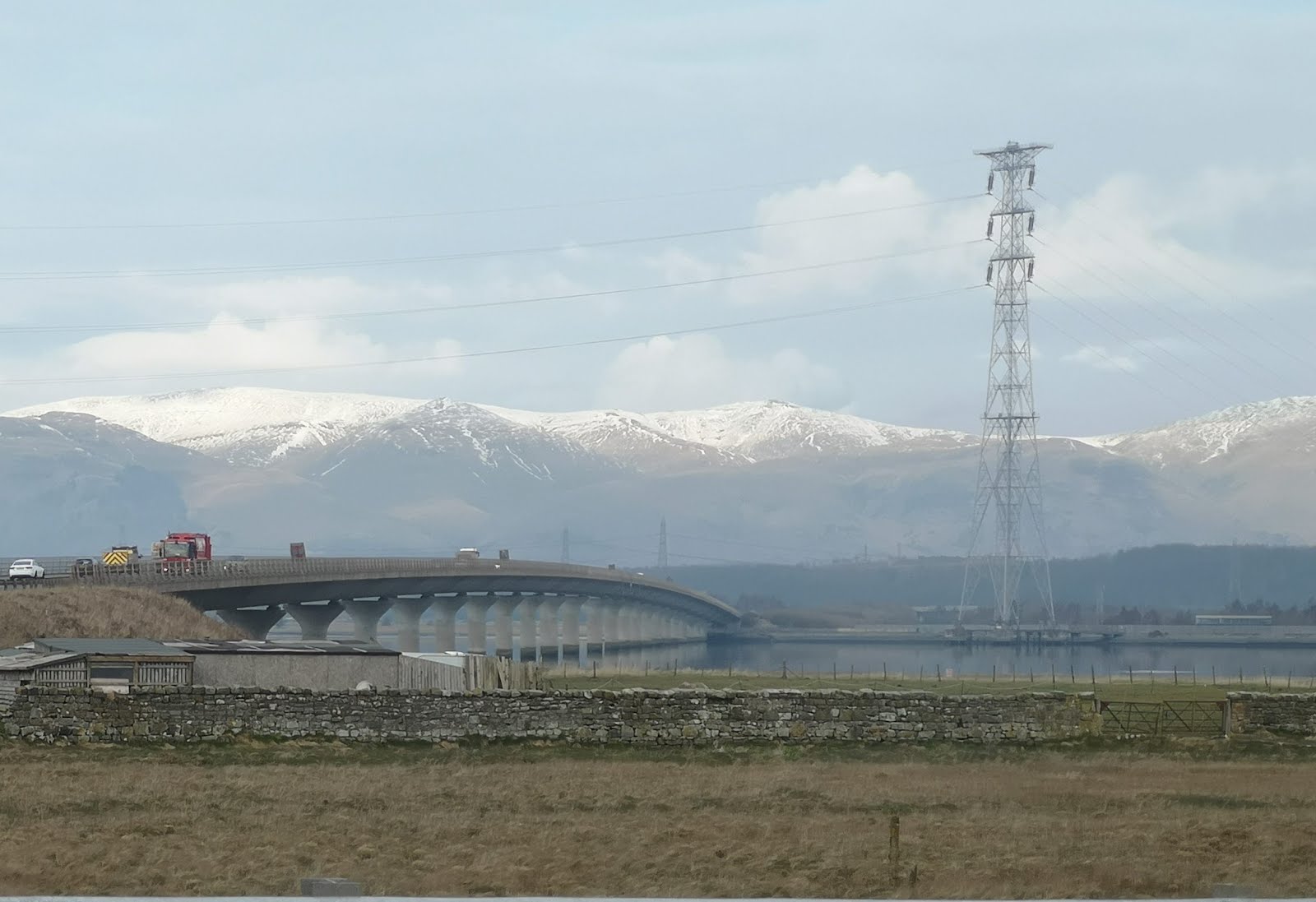
Two bridges now cross the River Forth at Kincardine. The original Kincardine Bridge was opened in 1936, thirty years before the Forth Road Bridge at Queensferry. A central pivoting section could be swung round to allow ships to pass up river to the port at Alloa, but this has not functioned since 1988. Due to increased traffic and congestion, a new bridge across the river was built here, and opened in 2008. The Clackmannanshire Bridge is in the curious position of the north approaches being in Clackmannanshire, the span of the bridge in Fife, and the southern approaches being in Falkirk council area. 
Clackmanannshire Bridge with snow-topped Ochil Hills beyond, March 2020
Central pontoon on the Kincardine Bridge, looking downriver
Kincardine Bridge over the River Forth

Kincardine to Culross


After running across the bridge I had a quick stoat about Kincardine, basically because it is a town that I often drive past but have never stopped in. It has a surprisingly old feel to it, despite being sliced up by a century of major roads being cut through the town. The town itself dates back 500 years and was at one time a fairly substantial port, with ferries frequently used by drovers taking their cattle to market in Falkirk. At low tide the old jetty and the skeletons of some old wooden boats were visible in the mud. 

Kincardine Bridge from the slipway in Kincardine
The rotting hulls of old wooden boats in the mud at Kincartdine
As I wanted to visit the old Tulliallan Kirkyard I popped into Marco's Kitchen, a cafe at the bottom of Kirk Street, where the key and guidebook to the graveyard are kept. Tulliallan Old Parish Church was built in 1675 and replaced in 1832 by a new church on another site, leaving the old kirkyard and church building like a time capsule. The local history group have made a great job of restoring the gravestones and maintaining the churchyard and their website is a treasure trove of information on the beautifully carved gravestones to be found here. Many of them have emblems of the occupation of the deceased carved on the stone, everything from painters and coal miners to farriers, sailors, tailors and foresters. 

Marco's Kitchen, Kincardine

Old Tulliallan kirkyard
From 1767 a gravestone with an anchor, a weaver's shuttle, carding comb and stretchers, an hourglass, crossed bones and skull
A woodcutter chopping down a tree, 1787, with the motto "As the tree falls so must it ly."
Shield with pendants, lances and crossed flags. "Erected in memory of William Greig. Died 16th November 1805 aged 32." (A soldier/sailor it is believed that he may have died from injuries sustained at the Battle of Trafalgar, 21st Oct 1805)
Having remembered to drop off the key again, I was able to join the Fife Coastal Path and run along the last part of today's route to Culross while avoiding the roads. The path goes past Longannet Power Station just outside Kincardine before winding its way to Culross. 

Fife Coastal Path at Kincardine
Longannet Power Station
Coming into Culross means that I have now joined up to my route from a couple of months ago, when I started at Culross, to run towards St Andrews. As it was such a lovely day I wandered out to the end of the pier at Culross, facing towards Bo'ness on the other side of the Forth. "Do not throw stone" the message reads to prevent people chucking bits of the old pier into the river. The end of the pier at Culross looks across the River Forth to Bo'ness where my great-great-great-great-great grandfather was born in 1751. Three generations of nautical trades later my great-great granny, Agnes Donaldson, headed west and married a stonemason in Rothesay.

Culross pier
Before lunch in one of the town's cafes I wandered back up the hill to Culross Abbey. In the abbey the Bruce family burial vault contains the ostentatious monument to Sir George Bruce, who died in 1625, the former resident of Culross Palace at the bottom of the hill. This includes marble carvings of his eight children piously praying by his tomb. On a wall in the tomb is a curious plaque to another Bruce. It records that the heart of Lord Edward, Lord Bruce of Kinloss, has been deposited here. He died fighting "a bloody duel" in 1613 with the Earl of Dorset, near Bergen in Holland, "in which country the combatants had repaired, the one from England, the other from Paris, for the determined purpose of deciding their quarrel with the sword."

Memorial to Edward, Lord Bruce of Kinloss
Monument to Sir George Bruce, in Culross
So I have now enjoyed running from Glasgow to Culross, and from Culross to St Andrews. Now I think it is time to turn west, and head from Glasgow to the Ayrshire coast

Wednesday, 23 October 2019

Fife Pilgrim Way - Part 1A - Culross to Dunfermline

Fife Pilgrim Way - Part 1A


After the success of the Fife Coastal Path, opened in 2002, a new long distance walking path has been created in Fife. The Fife Pilgrim Way opened in 2019. It follows a 64 mile (104km) route that medieval pilgrims would have taken from North Queensferry or from Culross, via Dunfermline Abbey and onwards to St Andrews.

By connecting existing paths, upgrading others and creating some new tracks the Fife Pilgrim Way can be used as a sign-posted route for day-trips around Fife, or could be taken on as a relaxing walk over several days. I have divided it up into several short runs which I plan to undertake over the Autumn and Winter months of 2019. The route goes through some of Fife's medieval and religious sites, but inevitably also passes many of the industrial sites from the days when coal was king in this part of the world.

Culross to Dunfermline


Since at least AD 965 until St Andrews Cathedral was destroyed in the Reformation in 1559, people came across to Fife to make a pilgrimage to see relics of St Andrew in the town that took his name. Many of these travelers would have arrived at North Queensferry, but the Fife Pilgrim Way gives you a choice of following the route from there, or from Culross, to Dunfermline. As a Glaswegian, I started from the town where the patron saint of my hometown, St Mungo, was born. Culross

17th century house in Culross, with the Greek inscription "God provides and will provide" above the window
Culross was once the fourth largest port in Scotland, trading with the Low Countries and Scandinavia. Rich coal seams under the Forth and a monopoly on 16th century Scottish iron girdle pan manufacture (eh?) created its wealth. However the town's origins were as a religious centre. The ruins of a Cistercian abbey founded in 1217 still stand on the hillside above the waterfront, with a 19th century church in one corner of this area. However its religious roots go back to St Serf who established a community here about 500 years earlier in the era of early Celtic Christianity. 

Saint Serf


As his life story was written down half a millennium after his death, and was rather designed to add to his prestige, it is impossible to separate fact from fiction in his story. What is certainly true is that he was born in Alexandria in Egypt, crossed the Alps, later went to Rome and became Pope and arrived in Scotland to do missionary work. Throwing his staff across the River Forth, it landed among prickly bushes in what is now Culross, where miraculous fruit trees sprouted and he set up a monastery at this spot. He later debated with the devil in a cave at Dysart, turned water into wine and slayed a dragon with his staff. Alternatively, he may have been a Gaelic speaking monk with associations in the Ochil Hills who established several religious settlements here and hereabouts, but most notably at Culross, or Cuileann Ros, the holly point/promontory. 

Culross Abbey
Stained glass window in Culross Abbey Church, with St Serf and St Kentigern

Saint Mungo/ Saint Kentigern


Kentigern, also known by his nickname Mungo, possibly derived from the Gaelic Mo Choë, taken to mean "My Dear". He was believed to have been taught by St Serf. The illegitimate son of pagan royalty his mother, Teneu (later St Enoch), was washed ashore at Culross and taken in by the monastery where Kentigern was raised. He later traveled west to the banks of the River Clyde to spread his religious teachings. The spot where he established his first church may be where Glasgow cathedral now stands nearly 1500 years later.

Culross pier
Before starting the route I took the chance to have a quick look about the picture postcard pretty village of Culross. The village as it stands today is largely the 17th century appearance. The town was being threatened with demolition in the 1930s when the National Trust for Scotland bought the whole village and slowly restored the crumbling buildings. The contrast between the village, which has been used repeatedly as a film and TV set (it seems that half of Outlander is filmed here), and the petro-chemical plant at Grangemouth across the River Forth is striking. The coal fired power station at Longannet just a couple of miles east of the village no longer has a permanent plume of smoke billowing from it after it closed in 2016. You have to wonder how much of a future Grangemouth has if Scotland is to achieve its net-zero carbon emissions by 2045.

Grangemouth petro-chemical works on the south bank of the Forth
Longannet power station near Culross, now closed but soon to become a train making factory
As well as being a centre of monastic communities, Fife also has a history of religious leaders pursuing women for supposed witchcraft. Although we may be familiar with witchcraft trials in Salem in Massachusetts, Scotland also persecuted many people for this "crime", mostly women. Between 1563 and 1736 more than 3800 men and women were documented as being accused of witchcraft, with at least two thirds of these people executed. Fife was a particular hotbed of witch trials. In the 1640s the General Assembly of the Church of Scotland passed several acts "for the suppression of witches" and many women were imprisoned, executed or even lynched in Inverkeithing, Pittenweem, Kirkcaldy and St Andrews over this era. In Culross the Townhouse which sits on the main street with its distinctive clock tower was the place where the court sat. Women accused of witchcraft were allegedly held prisoner in the tower awaiting trial (the ground floor rooms were more usually used as the cells here. 

Culross Townhouse
"The study" at Culross market place
The medieval Mercat Cross
Views across the Culross chimneys to Grangemouth
The Fife Pilgrim Way starts from the west car park in Culross and follows the Fife Coastal Path for a couple of miles, zig-zagging across the train line here and passing behind the Torry Bay Local Nature Reserve. The remains of Preston Island salt pans lie off to your right. 


King Coal

Before going any further I must mention one thing that I did NOT see between Culross and Dunfermline - evidence of the area's coal mining. The empty shell of Longannet is the only clue that there ever was a coal industry here, but in its heyday a century ago 20,000 miners were employed in producing 10,000,000 tons of coal per year. The first coal burnt in Fife was literally sticking out of the ground, pushed up by geological pressures. It could also be howked out from the sides of glens and valleys where it was often exposed. The first recorded authorisation to dig for coal was in 1291 when the Abbot of Dunfermline was granted permission to extract coal from Pittencrieff Glen. Until the Reformation the monasteries controlled coal extraction, but afterwards the landowners could profit from it. Near Culross in the 16th century coal was mined from under the Forth from an artificial island. The Moat Pit was abandonded when it flooded after being swamped in a storm in 1625. 

Preston Island was reclaimed from the Forth in the 1800s and mines started for coal to sell on, and to fire the salt pans here, evaporating water to produce a valuable commodity, a common industry along both sides of the Forth here at that time in places where coal could be easily accessed. By the 1850s the industry itself evaporated in the face of cheap salt imports.

Valleyfield, just east of Culross, was the home to the Valleyfield pit, opened by the Fife Coal Board in 1908. It was well known for high methane levels, or "firedamp" which was actually pumped out to supply public gas. In October 1939 an underground explosion here left 35 men dead, the worst ever pit disaster in Fife. A statue stands in High Valleyfield to commemorate those who died. When I was running the route I was unable to find it as it is not flagged up anywhere, but if you want to visit it, it stands at the junction of Woodhead Street and Valleyfield Avenue in Valleyfield. Valleyfield was still producing coal until 1978 when the pit was closed. At that time the workings connected under the Forth to pits at Bo'ness, west to the Longannet works and east to the Torry mine, which opened in 1950. Unbelievably a further 17 miners lost their lives at Valleyfield between 1942 and 1978, highlighting what a dangerous profession mining remained.

Torryburn


At Torryburn, where the Fife Coastal Path turns right along the coast, the Pilgrim Way carries on along the main road through the town. You soon pass an old phone box, which although no longer in use the box has been adopted and maintained by the local community.


Torryburn
One 18th century resident of Torryburn recently made news headlines. Lilias Adie died in prison in 1704 while awaiting trial for witchcraft. She is believed to have admitted under torture to having a "tryst with the devil". She faced being burned at the stake and her burial site by the shore at Torryburn is the only known grave in Scotland of a woman accused of witchcraft. As such plans are being drawn up to mark the spot, as a memorial to Lilias and the thousands of other women persecuted as supposed witches. Torryburn Church, built in 1800 has an interesting collection of much older gravestones in the churchyard, many illustrating the trades of the deceased. Many of these date from the time of the first church on this site, built in 1616.

One of the nearby Tuilyies standing stones

A slight detour to the north could have taken in the Tuilyies standing stones that lie beside the A985 nearby, showing that centuries before weaving and coal mining brought people here, it was a sacred Bronze Age site. 

Torryburn Church
Gravestone at Torryburn

Cairneyhill


Following the signposted route along paths and pavements leads you into Cairneyhill, a former weavers village. The main road will take you across "conscience bridge" over the Torry Burn. Allegedly the bridge gets its name from a murderer who was caught here, confessed his crime and hanged himself. After Cairneyhill the path veers off to the left then turns right towards Dunfermline. The first views  of Dunfermline Abbey lie ahead.


Row of cottages passed on leaving Cairneyhill
The path towards Dunfermline, the Abbey in the distance
The path as it approaches the edge of Dunfermline

Dunfermline


Dunfermline was made into a royal residence by King Malcolm III. After Malcolm's father, Duncan, was killed by Macbeth, he fled to England at the court of Edward the Confessor. He returned north after 17 years and after the death of Macbeth and his stepson Lulach, became king of Scotland around 1058. He moved the royal residence to Dunfermline, which remained a royal residence for the monarchs of Scotland for hundreds of years.

Steam train sitting in Pittencreiff Park, Dunfermline
It was Malcolm's second wife, Margaret of Wessex, who changed the face of religious practice in Scotland, and in Dunfermline this can be see in the remains of the Benedictine Dunfermline Abbey that she established. The abbey is at the heart of Dunfermline's "heritage quarter". The abbey itself became the burial ground of many kings and queens of Scotland, most notably King Robert the Bruce (although his heart is buried in Melrose). Much of the ancient abbey is in ruins but is well worth a visit. The Dunfermline Abbey Church was built here in 1820 and is still an active church. It's distinctive "KING ROBERT THE BRUCE" stonework at the top of the tower is a decidedly modern-looking adornment for a place of worship.

Dunfermline abbey church
The nave of the former abbey 
Dunfermline abbey 


On a sunnier day, early this summer

Dunfermline heritage quarter

Standing on the former site of Queen Margaret/ Saint Margaret's tomb which became a shrine, looking towards the "Abbot's House"
As well as monks and royalty, Dunfermline was also home to one of the 19th century's wealthiest men. Andrew Carnegie was born in 1835, in a weaver's cottage which still stands in the town as a museum to him. His father was a handloom weaver and as work fell away to the rapidly industrialising industry, Andrew was aged 13 when his family emigrated to America. From humble beginnings he made his fortune in the steel industry, and made his name with philanthropy. With a mixture of his family's Chartist and Presbyterian beliefs he truly seemed to live his life by the famous quote attributed to him, that "The man who dies thus rich, dies disgraced.". During his lifetime he gave away approximately 90% of his wealth. His money built 3000 libraries around the world (including most of Glasgow's Victorian libraries that I first borrowed books from), music halls, educational buildings, the Carnegie Trust fund to be shared by the 4 Scottish universities, and even a vast telescope in America. In Dunfermline he built baths, libraries and bought Pittencrieff Park and endowed it to his hometown, with funds to maintain it and ensure it was free for all to use (he had been banned from entering it as a child by an official due to his family's political views). I have not been able to discover if Carnegie's philanthropy extended to the wages and working conditions he gave his employees, the people who made him his billions, but we can only hope so.

Carnegie's birthplace museum

Carnegie's birthplace museum

Fife Pilgrim Way - Part 1B

From Dunfermline the Fife Pilgrim Way heads north towards Kelty, but first I am going to go back to the alternative start, at North Queensferry, and pick up the story of Saint Margaret...


Fife Pilgrim Way Links

  • Part 3 - Lochore to Markinch - Lochgelly to Lochore, then through Kinglassie and along the River Leven to Leslie, Glenrothes and Markinch