Showing posts with label Sonica. Show all posts

Sunday, 29 October 2017

Sonic-a 2017 Review

Review: Sonic-a 2017. The Glasgow Music Festival "For the Visually Minded".

Curated by Cryptic.


Sonic-a is always a highlight of the calendar for me in Glasgow. The biennial festival is a mash-up of music, performance and visual arts that always turns up some real gems. This year it brings together artists from around the world for 11 days in the city across a variety of venues. The full programme is available from their website, with many family-friendly distractions among the varied films, performances and installations. 

AquaSonic, Tramway 26-28th October 2017


AquaSonic. Photo from their website
The concert in the Tramway which I saw on the opening night of Sonic-a was quite spectacularly breath-taking. Five Danish musicians from Between Music sang and played their specially constructed and tuned instruments, submerged in huge tanks of water. If the premise sounds weird, the execution of it was phenomenal, one of the most entertaining and enchanting pieces of theatre I have seen. I was there with my 10 year old daughter, whose mind was buzzing about it afterwards, and her enjoyment was contagious. 

On a dark stage eerie sounds start to emerge with clever illumination of the tanks then revealing where the sounds are being made. The musicians bobbed to the surface to gulp breathes of air, then went under to continue their performance. Alongside recognisable violins and percussion instruments - singing bowls, gongs, triangles and a darboukha - were beautiful, custom-built instruments, such as a rotacorda, a hydraulophone and an elegant crystallophone. The singing varied from amplified voices on the surface of the water to a peculiar technique of underwater singing which managed to avoid expelling any air. Added to the background drips, plops and bubbles a mysterious sound was created which sounded like Bjork and Sigur Ros in a dialogue with mermaids and whales. 

During the hour long performance the visual and aural spectacle was mixed up at times, with the performers fading into the darkness whilst they blew bubbles into mic-ed up pillars of water at the front of the stage, or hidden behind an unexpected downpour from the sprinklers overhead. Despite all the earnest intent, it looked like a lot of fun and thoroughly deserved the standing ovation the sizable audience gave it at the end.

AquaSonic - singing and playing the hydraulophone. Photo from their website


Govanhill Baths - 
Buzz Aldrin Syndrome, The Extended Tension, Chijikinkutsu, Phase Transition.


Govanhill Baths, Glasgow
Several years ago, against the wishes of the local community, Glasgow city council closed Govanhill swimming baths. Since then locals have been campaigning for its repair and re-opening, whilst running it as a local arts and culture venue. Every nook and cranny of the building is being utilised at present for four installations as part of Sonic-a. 

Upstairs, among the cubicles where the old slipper baths still sit, Japanese artist Nelo Akamatsu has installed a delicate sound installation, Chijikikutsu. Magnetised needles float in glasses of water around dotted all the upper floor. Walking quietly around the ghostly abandonment of the cubicles, many still filled with assorted detritus, the gentle tinkle of needles tapping against the glass as electric currents create magnetic fields creates a fascinating atmosphere. I reminded me of my recent trips walking through some of Glasgow's closed railway tunnels, where the only sounds are the gentle drip of water which are hard to place in the darkness.

Part of Chijikikutsu by Nelo Akamatsu
The two swimming pool halls have been fitted out with noisier exhibits. Manuel Rocha Iturube from Mexico has strung up two electric guitars above the empty pool. The Extended Tension speaks of metaphorical tensions in 20th century music and performers, but basically it is a lot of fun just walking about and getting to twang an electric guitar in an empty swimming pool (if you are tall enough to reach them, I would have had them lower down). 

In the other pool Kathy Hinde presents Phase Transition which  has funnels of ice melting under lamps. As the water drips onto metal trays below the sound is amplified and echoes around the room, driving turntables as they go. It is  hypnotic sight, in a Heath Robinson kind of way. I had heard of French scientist Joseph Fourier, born in 1768, but had little notion of what he achieved. As well as developing theories on the behaviour of sound waves, he also came up with the climate change theory which we now know as the Greenhouse Effect - a perfect person for a contemporary sound artist to create works on.

The extended Tension, by Manuel Rocha Iturube
Buzz Aldrin Syndrome by Quentin Euverte and Florimond Dupont from France, looks like a steampunk off-licence, with assorted bottles of murky liquids suspended from rusty scaffolding poles whilst unrecognisable music from old sci-fi films is amplified around the room. Peculiar, if rather humdrum.

Buzz Aldrin Effect

CCA, Glasgow - ZZZZZZZZZ, Singularity, Nearer Future


As well as hosting talks and performances, the CCA on Sauchiehall Street also has a couple of installations and a VR film on the go in their cinema space.

ZZZZZZZZZ
ZZZZZZZZZ by Manuel Rocha Iturube has a turntable sitting alone on an old chair, with the vinyl record playing the repetitive sounds of snoring. The blurb accompanying it makes great play on the tension between the irregular snoring and solidity of the chair, comparing snoring to the tides and the sea, but anyone who has nodded off in a chair will know that the lack of tension between the two is more of an issue. I mustered a yawn.

In the darkened theatre space of CCA Heather Lander's Nearer Future is running, an hypnotic 3D projection of abstract shapes accompanied by Robert Bentall's ambient sounds, Telian. The music has Scottish tinges to it, though played on a Swedish nyckelharpa apparently, and the vector graphics of the visuals at times gave the appearance of the viewer trying to fly through the vector graphics of an 80s video game. 

Singularity is another audio-visual work, viewed on a TV screen with headphones worn, by Norwegian Solveig Settemsdal, and Kathy Hinde, who also has a work on show at Govanhill. Accompanied by the slowly building music from a string quartet we watch an extreme close up of an abstract white shape worming its way into a black space. The 10 minute loop is playful and intriguing, without ever bursting into life.

CCA Glasgow - Collisions by Lynette Wallworth
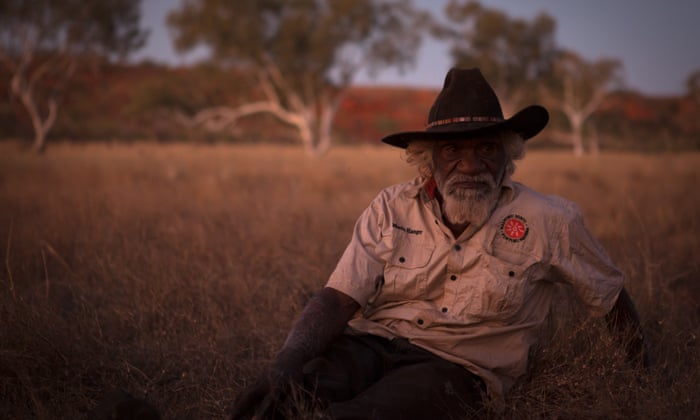

Martu elder Nyarri Nyarri Morgan
Of all the works on show at the CCA, the most interesting is the film Collisions by Lynette Wallworth. The Australian artist and filmaker has filmed the story of indigenous elder Nyarri Nyarri Morgan of the Martu tribe of remote Western Australia. Filmed in 360 degrees you don a VR headset and headphones to hear the story of this man, immersed in his environment and able to look around at his world. We hear about his first dealings with Western culture in the 1960s when, without explanation, he was an unwitting witness to atomic bomb tests. It is a preposterous story and heard in his words, in this way, very powerful, particularly the closing scenes of him "mosaic burning", clearing the scrub to prevent the country catching fire. Quiet music from Nick Cave, Warren Ellis and Max Richter adds to the piece. It is not a story I had heard before, and I still have it turning over in my head.

Titan: A Crane is a Bridge, Michael Begg. Clydebank


Titan Crane, Clydebank, late October 2017
With pieces in swimming pools, swirling vortexes of water on installations at The Lighthouse and musicians playing music in fish-tanks, water is a recurring theme this year. One other waterside musical extravaganza was happening 150 foot above the former basin of the John Brown shipyards. Although many of us would still prefer to hear the music of hammer on steel, building great ships down here, those days are gone.


The Titan Crane is all that remains of the shipyards in Clydebank, the land cleared and awaiting redevelopment. The shipyard that built the Lusitania, the Queen Mary, HMS Hood and the QE2 finally closed in 2001. My great-uncle Andy worked in the yards as an engineer, as a teenager when the workers celebrated the news of the end of the First World War, on night shifts through the Clydebank blitz and in my pram as a baby I joined him and his colleagues on the UCS demonstrations, when the workers fought to keep the yards open in 1971.


I find it now a sadly forlorn place, a complete contrast to its former glory. The Titan Crane opens through the summer months for visitors to ascend and hear about the crane and the yards, but otherwise recognition of the works that built the town are sorely lacking in Clydebank.

Sound artist and experimental composer Michael Begg was commissioned by Cryptic to produce a work using the crane as his starting point. He has turned it into a giant musical instrument, a colossal version of the instrument invented by Soviet physicist Lev Sergeyevich Termin, a theremin by the Clyde.

Wheelhouse of the Titan Crane, Clydebank
Once the elevator takes you to the top you can see the electronic wires and strings on the upper platform contributing to the sound, but within the wheelhouse, where the giant coils of steel ropes sit. The ambient and gentle sounds here for me were frankly overwhelmed by the beauty of this engineering creation, and the views we were lucky enough to enjoy on a clear and frosty late October day in the west of Scotland. I did not feel any sense of peaceful calm, we were not atop a mountain, despite the prayer flags, but in someone's place of work, whilst all around was desolate wasteland.

Prayer flags wired up to the sound installation

Views east over Clydebank College to Glasgow, with the River Cart flowing into the Clyde


  • Sonic-a runs until November 5th 2017 in many venues across Glasgow


Thursday, 15 November 2012

Sonica, Glasgow 2012

Review of events I've been to this week in Sonica 2012, Glasgow


The inaugural Sonica festival is running in Glasgow from 8th-18th of November across various venues, produced by Cryptic. Subtitled "sonic art for the visually minded" it tries to provide an opportunity to showcase work from Glasgow and across the world which doesn't normally fit easily onto a gallery wall. Now, I have always had a leaning towards music which resembles vacuum cleaners in dust cans falling down a lift shaft, so I was hoping to find lots to intrigue and entertain me in Sonica.

The programme is imaginative and varied. Some of it is aimed specifically at children (such as Sonic Dreams). Others have a seemingly childish simplicity that would appeal to anyone, such as Kathy Hinde's kinetic sculpture, Piano Migrations, in the foyer of the Scottish Music Centre. It is a hypnotic sight as wee birds projected onto the strings of an up-ended piano cause motors to twitch and pluck the strings as the birds tweet about its workings, like a John Cage work brought to life.

Piano Migrations
Over at the Traway a more dramatic kinetic sculpture is on show from Korean artist Mookyoung Shin. Our Contemporaries is in a darkened room where dozens of perspex hands rest on desks. As each hand is illuminated in turn the impatient fingers drum on the desk with a repetitive tapping. It is a sight worth seeing, but hearing it is part of the whole dreamy atmosphere too that slowly builds. I was there with my kids, who felt it was like the drumming that The Master used in hypnotising the human race in an episode of Doctor Who. Very impressive in scale and execution.

Our Contemporaries
More was on show over at the CCA. Luke Fowler worked with Jean-Luc Guionnet's to produce his film All Divided Selves about RD Laing and is a current Turner Prize nominee. I won't be able to see the film they've made together for Sonica, which is on this Friday night. However I was able to go and see Pilgrimage from Scattered Points, about Cornelius Cardew's Scratch Orchestra on at the CCA throughout the festival. The "musicians" and composers on film are all so very earnest and sincere in their enterprises, whether dropping marbles onto a drum skin, scraping rocks across the floor or in the final sequence debating whether their self-expression in this music is enough to express their political ideas of the world. I like their earnestness.
Extended Play
Upstairs at the CCA is the fantastically atmospheric and thought provoking Extended Play by Janeck Schaefer. Three groups of old-fashioned record players in a darkened room with red spotlights play separately the violin, cello and piano parts of a piece of music taken from a Polish folk song. As you walk around them you cause the record players to slow and stop, constantly changing the music. The blurb describes it as "a triptych for the child survivors of war and conflict" and started from the idea of 'Jodoform', music played by the BBC during WW2 to pass messages to the Polish Underground. It does make you ponder as you wander, reflect, think about the effect you have on the room. I liked it a lot.

Along the corridor from it is another outing for Aidan Moffat and FOUND's "sound installation" #UNRAVEL, more stripped down than when I last saw it at Glasgow International 2012, but the idea is the same. You pick singles from someone's collection and unpick the story of their life from the monologues they trigger off. With the headphones on this time, rather than standing back in awe at the mechanical instruments as I did last time, I was more able to take in the stories being told.

Remember Me by Claudia Molitor is being performed in the lovely setting of the Charles Rennie Mackintosh designed Scotland Street School Museum. We are gathered outside the room and lead in to find her dressed like one of the Greek priestesses who light the Olympic flame watching a projected film to the sounds of water falling and discordant strings. Then we are taken next door and about 20 of us watched her performance around an old white writing desk. She talks of the imagined phone call between the female operatic heroines Dido and Eurydice and "their good friend Cinderella" whilst taking objects from the drawers and projecting films onto it and herself. It made me think back to the fun I had as a child rummaging in the jam-packed drawers of my granny's old "bureau" which was full of the most random stuff. We were dismissed one by one at the end by words whispered privately in our ear by the elfin performer. "Remember me?", I think I will. Bonkers, but good bonkers. I headed over to the Tramway hoping for more of the same.
I made a quick dash over to the Tramway to see Bluebeard, again based upon opera, Bartok's Bluebeard's Castle, but described as "state of the art opera for the digital age", produced and performed by the "33 1/3 collective", a collaboration of Dutch artists. The story of Bartok's opera has Bluebeard's new wife insisting he opens the seven castle doors, revealing various dark secrets. In this staging bizarre and spectacular images are projected onto a large cube in the centre of a darkened hall whilst music and singing/ chanting rings out. Some images and sounds are startling, like the coins spinning onto the floor as the treasure room is opened, whilst in others the artists come onstage to interact with them, such as apparently sweeping corpses onto a stretcher. I have never seen anything like this before. Absolutely stunning, although the visuals overwhelmed the music a bit.

Between shows at the Tramway I played with Tim Cooper's Dora, a computer programme set up in the foyer where your typed in thoughts are translated into electronic music, of sorts.

Tales of Magical Realism - Part 2 (and my allocated number)
The best show of the night for me I'd saved until last. "Tales of Magical Realism - Part 2" by Sven Werner. Part 1 was apparently done at Cryptic Nights, the previous incarnation of this festival and both are based on his film Oculista and featuring musician Graeme Miller. The description in the programme didn't give many clues to what was in store for us. Initially our group were led outside and up a fire exit at the back of the building to enter a hall where three musicians were playing at the far end, whilst a ballerina performed in the middle of the hall. It takes a while to realise the dancer is bound by a line of twine to a weight on a pulley. We are measured and given a raffle ticket on arrival, and every 5 minutes the doors at the far end opened, a bell rings and three of our ticket numbers are called forward. After an eye examination akin to Deckard's V-K test and a serenade in German, the three are lead away to another room. Meanwhile the musicians and ballerina start up again as we shuffle about in the room, keeping out of her way. Down a corridor we enter another room of the installation, where music and spoken word through headphones we are given tell us a mysterious story. We are guided to look through an array of Heath Robinson contraptions, sort of zoetrope machines. The last stage of the story entails a one in three chance of you ending up on a penny farthing to power a dynamo to illuminate the end of the story. The whole thing was a joy, a vaudevillian version of Blade Runner, re-imagined by a Victorian Tom Waits. The surreal nature of it all was added to by the fact that I knew the guy on guitar, having worked with him about 15 years ago. Very strange.
Overall Sonica was full to bursting with the type of music, performance and sonic arts that I absolutely love. The reduced prices for advanced booking and 3 for 2 offers meant I was able to see loads of stuff in the festival and I hope to find it returning next year.