Showing posts with label Counterflows. Show all posts

Sunday, 9 April 2017

Counterflows 2017 - Festival review.

Counterflows Festival. Glasgow. April 2017


Over several years now Counterflows has established itself as a regular event on a crowded calendar of music and performance in Glasgow. Showcasing experimental, marginal and DIY music from all around the world the number of performances this year which were sold out in advance shows that there is a healthy audience for this music in the city. In part that is due to the efforts of curators Alasdair Campbell and Fielding Hope and the many other people involved in organising the weekend, whose obvious enthusiasm for what they are doing holds the whole thing together. 

This year, for their sixth edition, the music was as varied and eclectic as the venues used to host the events. Over four days we visited Glasgow University Chapel, The Centre for Contemporary Arts, The Glad Cafe,  Garnethill Multicultural Community Centre, Glasgow School of Art, Langside Halls and Queens Park Bowling Club. That's before we even get to a performance at the Laurieston Arches, just across from where my great-grandparents lived in the Gorbals. Going between places of learning, community halls and contemporary art spaces is a good metaphor for the success of the festival, where performers are always part of the audience. Sociable, entertaining and always an education.

Day 1 - Thursday 6th April 2017


University of Glasgow chapel
The opening concert of the festival this year was in the old chapel of Glasgow University. The high space here was filled with birdsong as the five performers of Pancrace Project started their performance. Using everything from the church organ, to Uillian pipes, "piano paysage" (the belly of a piano) and Hurgy toys (which looked like hurdy gurdys) the spectacle was as integral as the sound created. It was nice to hear the organ given a good work out, as sometimes I have attended contemporary music concerts involving a church organ, where the aim seems to be to get as little sound out of it as possible when really what everyone wants to hear is Bach's Toccata and Fugue in D minor. 

Pancrace Project
Their performance may have benefited from some trimming, but in part this was my impatience to get to the second performer of the night, Japanese composer and percussionist Midori Takada. She held us spell-bound from the moment she entered the hall, proceeding up the chancel of the chapel accompanied by her chimes as she stalked through a passage of cymbals. Whether giving an extended solo on the gong, playing marimba or on the drums her performance was hypnotic and utterly captivating. With echoes of the music of Steve Reich often in my mind, her performance itself was really like nothing I had seen before. Unique.


Day 2 Friday 7th April

Carnatic music is a form of Indian classical music from Southern India. Usually accompanied by the drone of a tambura the music goes back hundreds of years and is associated with Hindu worship. Last year the festival ended with the Carnatic Music Ensemble and this year there is a deeper exploration of this form of music. This included traditional musicians working alone and with contemporary artists to produce new music. Mark Fell's electronic piece at the CCA based on the rhythms of Carnatic music was enjoyable but the best parts of the performance were when the Indian musicians were playing their own combination of improvised and composed music, accompanied by the rhythmic drumming of Mysore Vadirajmore on his mridangam.

A Carnatic Paradigm
A short walk round to Garnethill followed, always nice to come back here for the cheap bar prices, where Sue Tompkins was first on the stage which faces the wall of Chinese dragon heads high on the wall opposite.

Garnethill Multicultural Community Centre
A visual and sound artist she merges borders between concrete poetry, visual and performance arts. Flicking through the pages of a magazine she emits phrases and snatches of song in a rhythmic manner whilst bouncing about on stage. The nearest thing to it I have seen is Dutch performance artist Jaap Blonk. I enjoyed seeing him perform whilst my kids nervously snorted in derision and that was the kind of mixed reactions the audience gave Sue Tompkins.


American musician and composer Ashley Paul is the featured artist of this year's festival and her first performance of the weekend was phenomenally good. Accompanied by Stevie Jones and an ensemble of musicians of percussion, keyboard, double bass, tuba, saxophone and clarinet it felt improvised but looked tightly composed. A remarkably impressive collective effort. Her floaty singing and energetic musicianship on saxophone and electric guitar was engrossing and reminded me of Julia Holter's performances but with more jazz, more texture and energy. I look forwards to seeing more performances by her over the coming days.

Ashley Paul Ensemble

Day 3 Saturday 8th April

There were many events over and above those which I am writing about here, late into the evenings and on Saturday afternoon, but sadly I was not able to see everything. As I was working at Firhill on Saturday I was not able to see Takahiro Kawaguchi and Utah Kawasaki or attend several of the talks and films on show that afternoon. However as compensation I did get to see Partick Thistle reach the top six of the Scottish Premiership for the first time in a few decades so, swings and roundabouts.

Glasgow Art School
I was able to get to Glasgow School of Art to see the "anti-performance" by Farmers Manual, an electronic and visual arts group from Vienna. This is very much my cup of tea, three guys messing around on laptops and a room filled with pings, buzzes and drones. How much is live and how much is just pre-loaded in their laptops is very much up for debate, like any club DJ nowadays, either labouring away mixing or alternatively twiddling the screen brightness control on his laptop whilst the music plays on.

Glorias Navales performing
Away from the Art School and back to the faded comfort of the Garnethill Community Centre for a quite different performance. Glorias Navales gave a beautifully unpolished performance, a group of Chilean musicians that had the whole room tapping their feet along to the tunes. Their name suggesting the Chilean anniversary of a glorious naval victories, with imagery projected behind them of Chilean ships, Chinese Socialist Realism and Pinochet's coup recalled Chile's turbulent history. With one of the musicians sporting a t-shirt with Victor Jara's face across the front, a folk singer tortured and killed by the Chilean junta, I was taken back to my childhood. My parents had friends who, as Communists, had been forced to flee Chile after the coup and had come to live in Glasgow. I had totally forgotten that I have held onto the small Chilean flag I had been given by them, but I've dug it out now after speaking to one of the musicians about his hero, Victor Jara. My parents used to often play an album of Jara's songs by a group called Inti-Illimani, who lived in exile in Germany as they were touring Europe at the time of the coup, when their music became banned. A warm and intriguing performance by Glorias Navales.

Les Filles de Illighadad
Moving across the globe the next stop-off was Niger. Les Filles de Illighadad are from the Alabak region where they sing and play their Tuareg music. Starting with the melancholic sounding voices of Fatou Seidi Ghalia and Alamnou Akrouni accompanied by tende drum and the wonder that is a gourd water drum, weaving complicated rhythms. For the the second half they donned electric guitars for a more familiar, dreamy Tuareg sound, the music being shaken up by being performed by scarf wearing women, smiling, laughing and enjoying their performance.


Day 4 Sunday 9th April

In Langside Hall in the late afternoon Svitlana Nianio from Ukraine was performing. Svitlana Nianio and her band played twinkly synths accompanied by the percussive sounds of an electric guitar, constrained at times by having a polythene bag weaved under the strings. Above this Svitlana's haunting vocals rose, making each song sound like a dark, cautionary nursery rhyme. Not many smiles were cracked on stage, their music-making a very serious business. Or maybe that was because she had to play in the chill of an April afternoon in Glasgow, in a council hall where the heating system wasn't working.

Mark Vernon in Queens Park Bowling Club
Up and over Queens Park to the next venue, Queens Park Bowling Club. I accidentally indulged in some orienteering as I headed in error to the council bowling greens in the park, before I found my way to the venue. Glasgow's Mark Vernon opened with a perfectly incongruous deck of cables, laptop and cassette players beneath the names of decades of bowling champions. His mixing of field recordings and found sounds from old tapes bought in a Portuguese market was delightful start to the evening.

Ashley Paul was back on stage, this time with German based electronic artist Rashad Becker. From Ashley Paul's squealing sax and bowed and bashed electric guitar, to Rashad's thrumming, dystonic sounds it was an energetic and woozy sonic sparring session.

Langside Hall
Hoping that some heating had been located, we returned to Langside Halls to be sent home warm by the uplifting music of Mark Ernestus' Ndagga Rhythm Force. A collaboration between German dub-techno musician Mark Ernestus and a group of Senegalese musicians, they had the hall bouncing from the start. No band this weekend made a more chic entrance on stage, as the musicians came on one at a time, many wearing big shades in the dark hall. Once all six musicians (four of them on percussion) were on stage, singer Mbene Diatta Seck and dancer Fatou Wore Mboup took centre stage and got everyone dancing. Their acrobatic dancer on stage and dancing into the audience was a real crowd-pleaser.


Another exhausting and entertaining four day weekend from the Counterflows organisers Yet again they managed to bring enthralling and disparate musicians from all corners of the globe to Scotland. They seem to be growing the audience, with bigger halls used and many gigs sold out. If you haven't attended any of the shows over recent years, I would heartily recommend looking out for the 2018 version.


Monday, 11 April 2016

Counterflows Music Festival, Glasgow. April 2016

Review of Counterflows Festival, Glasgow. April 2016


I do enjoy the Counterflows Festival when it arrives in Glasgow. This is now the fifth year of this celebration of marginal, underground and experimental music. In previous years I have mentioned how prominent female musicians are in these fields, and this was almost a theme of the weekend festival this year, with talks on the subject this year. As before it is pulled together by Alasdair Campbell and Fielding Hope, who heads up Cafe Oto in London, as hands on as ever in running the show this year in Glasgow.

The festival ran from Thursday night, 7th April, in the University of Glasgow chapel, through events at the CCA, Nice 'N' Sleazy, The Art School, Garnethill Multicultural Centre, The Glad Cafe and Langside Halls on Sunday night. 

First up on Thursday night was Irish multi-instrumentalist Aine O'Dwyer performing at the church organ in Glasgow University Chapel. With the organ perched up on a minstrels' gallery in the University Chapel it provides little visual spectacle despite the size and grandeur of the organ. In your imagination you expect to hear a church organ blasting out Bach's Toccata and Fugue in D Minor or at least a bit of Bowie's Life on Mars, so the slowly building drones we get tonight starts off disappointing but builds up into a contemplative piece that evokes the atmosphere of the space it is in. 
Mythos of Violins in Glasgow University Chapel
She was followed in the cavernous chapel by Laura Cannell and Angharad Davies playing "Mythos of Violins" with Scottish fiddler Aidan O'Rourke. A commission which evokes a sense of place, I was interested to read that in creating the piece the musicians visited St Peter's Seminary in Cardross, which I had the chance to see last week. Playing three solo pieces from different places within the building initially. They then played the final piece together, walking down through the church from the altar, where the war memorial dominates, a more elegiac and melancholic piece. It was pleasant, but in a bit of a similar tone for the whole evening.

Zeena Parkins
The featured artist of the weekend, Zeena Parkins, opened proceedings on Friday night at the CCA, accompanied by her band, Green Dome. This was an ongoing project  "Lace", with improvisers on harp, drums and percussion/ electronics playing a score made of a fragment of lace. It was a brilliant piece and followed by Zeena leading a nine piece band of musicians in a meandering, and cleverly put together piece. It was interesting hearing what she could do with the harp, making it exciting and giving it many voices. A refreshing listen after being a bit disappointed with the performance in Glasgow recently of the lauded harpist Joanna Newsom.

Percussion instrument, and score of lace fragments from Zeena Parkins
Next the audience trooped around the corner to Garnethill to see Australia's Hour House (Mark Leacy and Sam Kenna), followed by Astor and Graham Lambkin but I had bailed by then. I ran off to The Poetry Club to see the legendary dub poet Linton Kwesi Johnson, who was performing there. As it turns out "I've had to put up with that 'dub poet' thing for years". The term he prefers is reggae poetry, a response to the established genre of blues poetry. I am a huge fan of his poems, which are at their best when heard in his own voice. Highly political and barbed, they describe the experience of Afro-Caribbeans in Britain. It was an electrifying performance. I've only ever heard his words on record before now, where they have a musical accompaniment. Hearing him read "Sonny's Lettah" live, an account of the racist brutality of Thatcher's Britain, was a rare treat.


There was a lot else on in Glasgow this weekend. The Poetry Club event on Froday night was under the Glasgow International umbrella, a city wide arts festival. On Saturday visited various exhibitions ongoing as part of that and stumbled across people marking annual International Roma Day in Govanhill. This is a commemorative event and awareness day, to highlight the Nazi persecution of Roma peoples. Govanhill in Glasgow now has a large Roma population, and they were marking the day with other members of the Govanhill community.

Local children get ready to parade in Govanhill for International Roma Day
Counterflow events got going at CCA, where Lithuanian duo Weld Mignon interwove electronic sounds, recorded voices and a prepared grand piano in an entertaining and imaginative way. This was followed by glorious solo performance from pianist and improviser Pat Thomas. When he plays piano, he plays it 'forte', at times crashing down on the keys, at other times working away at the innards like a mechanic under the hood of a car. 

Across at Nice 'N' Sleazy for the late gigs the volume was turned up even higher. Brazilian trio Chelpa Ferro kicked things off with a session of electronic noise and guitar scrambling, one of my highlights of the weekend, though I do regret not picking up a pair of earplugs before standing in front of the speaker at the front of the stage.
Spanish group Billy Bao look the part as a noise rock group, playing here as two drummers and a lead singer/guitarist. I have spent more than a few evenings watching my cousin and her husband play in their various punk/crust/grindcore bands so was expecting 30 minutes of sustained drumming and screeching guitar in the style they kicked off with. However they bamboozled our expectations with prolonged silences, the stage intermittently illuminated and plunged into darkness and recordings of swing/pop melodies interrupting their set. The angsty musings of the lead singer making it one of the strangest performances you might come across. Just for clarification, they are from Bilbao in Spain, their name comes from this and not from their Glasgow footballing allegiance.

New York based experimental hip-hop artist Sensational finished the evening here, the type of eclectic and varied evening that makes Counterflows so special.


Sunday evening finds us on the Southside, home of the lovely Glad Cafe. Four piece Glasgow based art-pop collective Still House Plants, kicked off the evening proceedings. They have also been performing in Glasgow International, which kicked off in the city this weekend.  Danish saxophonist Mette Rasmussen then took to the stage (or took to the floor as she wandered about in front of the stage whilst playing), firstly free jazz tinged improvisation, then accompanying Zeena Parkins playing her electric harp, which when flossed violently with a wire makes some incredible sounds.

Zeena Parkins on harp and Mette Rasmussen on saxophone at the Glad Cafe
The finale of the weekend was across the road in Langside Halls, starting with Zanzibar-based multi-instrumentalist Mohamed Issa Haji Matona, who brought multiple instruments, accompanied by Aine O'Dwyer with vocals and harp. It was a lovely, atmospheric set, and I would have happily heard much more of the evocative African sounds Matona got from his violin.

Matona, tuning up in the stairwell at Langside Halls
We finished off in contemplative mood with a Carnatic Music Ensemble playing the music of southern India. It is not a musical style I know anything about, but it is hundreds of years old and relies on a combination of improvisation and composition, with the voice being a strong component of it all. Here we had four musicians leading a very full house in Langside Halls in a perfect finale to a diverse, eclectic and entertaining four day festival of music.  


Monday, 7 April 2014

Counterflows Festival 2014, Glasgow

Review of Counterflows Festival, Glasgow, April 2014

The biennial Glasgow International festival started this weekend in the city, a festival of contemporary art. Running alongside it this weekend was Counterflows, a weekend of contemporary and experimental music performances. Lots of copies of The Wire magazine were rolled up into the shoulder bags of chin-stroking, bearded men as they headed out to this over the weekend. In fact, contrary to this stereotype, it was nice to see a good mixture of people in the audience and on stage, with the prominence of women in the forefront of the experimental music scene obvious from the start.

Space Lady at Garnethill
It kicked off on Friday night in the Garnethill Multicultural Centre with The Space Lady. Not someone I'd heard of before but this isn't surprising as she hasn't played in Europe until now, usually being found over the past 30 years busking for hours either in Boston or San Francisco with her Casio organ. I was ready to be a bit cynical by a middle aged woman at a Casio organ wearing a plastic winged helmet with a flashing red light atop it. However within one song I was won over by her gentle singing and mastery of the full range of Casio special effects. A one off, and a good opening act. 48 hours later she'd be playing a set in Queens Park. 

Ai Aso is a Japanese singer and songwriter and purveyor of floaty, folky, psychedelic pop music who I'd been looking forward to seeing after hearing her album 'Lone'. However she was so floaty and quiet at times that we were craning to hear when songs ended, whilst the bar staff risked drowning her out it they opened a beer for anyone. In one song she had men rushing into their shoulder bags for their ear plugs as she whispered alongside raucous guitar feedback. If Death Metal has a polar opposite we were witnessing it.

Maja Borg's visuals accompany Ela Orleans
Ela Orleans is someone I am more familiar with, most recently when she supported Julia Holter in Glasgow. Originally from Poland, the Glasgow based musician, describes her output as "movies for ears". Her recently re-issued album Tumult In The Clouds is worth seeking out (here). Tonight she was playing with Maja Borg, Swedish artist and filmmaker. Ela Orleans created the roundest sound of the first part of the evening, excellent as ever, with visuals provided by Maya Borg, who finished the set off with a spoken word piece over one of her films. 

Akio Onda's set up
Next we trailed across the road to the intriguing venue of the underground car park below Fleming House. This has been commandeered by Glasgow International as an exhibition space, dressed up as a swimming pool. Tonight it was a perfect venue for two Japanese musicians/ sound artists - Aki Onda and Akio Suzuki. Akio Suzuki played field recordings from a train station on a Sony Walkman and manipulated the sound whilst the older of the two (Akio Suzuki) went for a more physical approach, dropping nails into a metal bucket, hammering them into a plank of wood, then playing the percussion instrument he'd created. There were a lot of echoes of Marginal Consort's Glasgow gig from 2008 in the entertaining mix of music and performance which fitted the venue perfectly. 
Aki Onda and Akio Suzuki
Next up was a short stroll around to the CCA (Centre for Contemporary Arts) for the next course. Luke Fowler is an artist who works in Glasgow with film and sound and he has worked alongside Richard Youngs when I've seen him before. 
Mika Vainio, Lee Paterson and Luke Fowler
Tonight he was performing with Finnish industrial/ electronic musician Mika Vainio (whose album Fe₃O₄ - Magnetite I picked up once at random as I liked the title) and Lee Patterson, who has a history of amplifying sound from objects as diverse as Epsom salts and burning peanuts. The three silent men hunched over their respective electrical boxes of tricks in the darkened room were quite captivating. Ranging from violent drones to quiet electronic clicks they finished grandly with the highly amplified clicks and pops of a small conflagration Lee Patterson got going on his table. (60 second snippet below).


At a suitably late hour Joe McPhee took centre stage, one of the main attractions of the festival weekend. He was back on stage several times over the weekend, blowing the roof off in the closing concert on Sunday night. 

I didn't manage to take in all of the delights on offer on Saturday 5th April as there was the small matter of me wanting to enjoy the visit of Heart of Midlothian Football Club to Maryhill that afternoon. However I think the shockingly bad performance of Partick Thistle maybe made me less receptive than I might have been to the evening performances at the CCA. The programme was less varied than elsewhere in the festival with four duets all striking a similar tone. 

Sound poetry, sqwaking and screeching has always left me cold, so Cara Tolmie dancing about in the darkened room shouting "Ah, aaah, ooh, ooh, eeh" was never really going to be my thing, entertaining as it was for a few minutes. Paul Abbot's unaccompanied drumming was absolutely riveting. Controlled and aggressive. The latter half of the performance with him lying inside the bass drum reading gibberish whilst Cara dismantled the drum kit felt a bit of an anti-climax. The performance was impressive but the words felt meaningless.

Australian drummer Will Guthrie and Portugal's David Maranha were up next. Their first piece had Maranha playing keyboard as electric guitar complete with lots of feedback, accompanied by crescendo-ing drums. Their second piece had more interesting texture. They were met with polite, rather than uproarious applause.

Ghedalia Tazartes and Maya Dunietz received a warmer reception. Unlike the earlier shouts of Cara Tolmie, their chanting and singing had a much more evocative, captivating feel. Backed by an electronic soundtrack, drones and their own combination of prayer bells, whistles, mouth organs and chimes it brought to mind religious chants and funereal ululations. Maya Dunietz was back on the last night at the Glad Cafe introducing us to the music of Emahoy Maryam Guebrou, an Ethiopian nun, composer and pianist. 


John Butcher on saxophone with Mark Sanders were up last but their piece "Tarab Cuts" felt like a work in progress.
Roedelius and Schneider
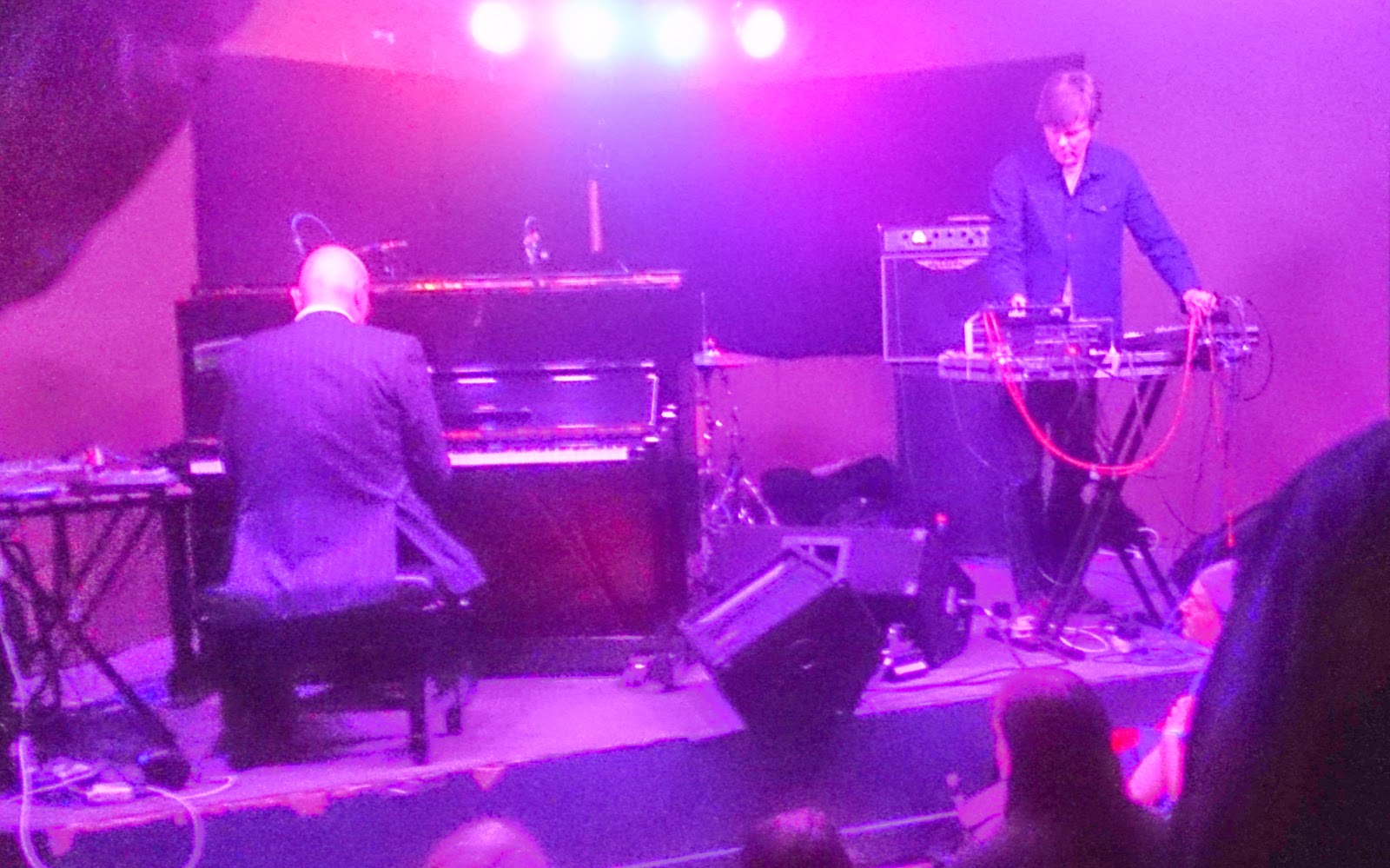
Sunday night's finale at the Glad Cafe was a tour de force. Joachim Roedelius and Stefan Schneider performed on acoustic piano, accompanied by various electronic clicks, hisses and manipulation to great effect, the gentle piano playing contrasting sharply with the accompaniment.

Joe McPhee
Joe McPhee, the 75 year old American composer, musician, improviser and free jazz multi-instrumentalist gave a barn-storming performance to bring things to a close. I have never been a great jazz aficionado, working my way through some of the classics and enduring jazz bands in the Three Judges of an occasional Sunday afternoon. However if more jazz sounded like the Joe McPhee trio I'd have been paying it more attention. As well as the man himself out front on saxophone, Steve Noble on drums and John Edwards on double bass brought sounds out of their instruments that I've never heard before. An absolutely mesmerising performance. Next onstage was Swedish saxophonist and improviser Mats Gustaffson playing as a duet with McPhee. His was again a gripping performance, quieter and at times enjoyably odd. His saxophone, come trombone, come swanee whistle was a sight to behold, as was his masterclass in circular breathing. Next up he brought out a large bass saxophone to play against Joe McPhee in the style of a ship's foghorn, before the evening came to a close with a bigger ensemble.

It was a well put together festival of some high quality and diverse musicians. Credit is due to all those who organised it and kept things running smoothly through some busy line-ups. It was also good to see such healthy crowds coming to hear this stuff and maybe promoters should notice that there is a bigger audience out there for this music than they maybe realise.