Showing posts with label Charles Rennie Mackintosh. Show all posts

Friday, 29 January 2021

Charles Rennie Mackintosh Half Marathon

With the days blurring into each other in yet another Covid-19 induced lockdown, the motivation to go for a cycle, a run or a walk in these Winter evenings can be hard to find sometimes. However, I know that after I get home from work it will be the best way to clear my head and relax. Trying to exercise near to home during our current lockdown does inevitably mean that you go walking or running over the same routes again and again. I am a bit tired of jazzing up my long Sunday run by maybe running around the Subway stations clockwise instead of anti-clockwise, or going out to Clydebank along the Yoker cyclepath, and back along the canal instead of doing it in the other direction (which for some reason feels as if it is more downhill). 

So a new week, and a new 13 mile route. A half marathon around the creations of Glasgow's most renowned architect, artist and designer, Charles Rennie Mackintosh. 

Charles Rennie Mackintosh


Charles Rennie Mackintosh
Charles Rennie Mackintosh was born in 1868 at 70 Parson Street in Townhead, Glasgow, a flat which would now roughly lie underneath the on-ramp to the M8 at the top of Castle Street. His father was a policeman, and later chief clerk in the City of Glasgow Police. 

From 1880 to 1883 he went to Allan Glen's School where he began learning architectural and technical drawing, then from 1883 he studied part time for 10 years at Glasgow School of Art, while starting an internship under architect John Hutchison. In Glasgow of the 1880s there was a building boom as industry flourished and the population grew, with the city rapidly expanding. In around 1889 Mackintosh started working for architects Honeyman & Keppie, later becoming a partner in the company. He worked with them until 1913.

In 1900 Mackintosh married designer and artist Margaret MacDonald and they worked together on many projects, creating their distinctive ideas, that would later become synonymous with the term "Glasgow Style".

Many of the buildings designed by Mackintosh are now treasured museum pieces, looked after for us all to enjoy, such as Hill House in Helensburgh, by the National Trust for Scotland. Some are still private residences such as Windy Hill in Kilmacolm. In Glasgow many of his buildings are still in regular use, though not many for their original purpose. His masterpiece in the city however, the Glasgow School of Art "Mackintosh building", is a miserable sight as the current custodians of it have managed to see it burnt down not once, but twice in the past 10 years. To paraphrase Oscar Wilde, to lose it once may be regarded as a misfortune: to do it twice looks like carelessness.

So starting off on Byres Road I headed up to Maryhill to start my tour of Charles Rennie Mackintosh's Glasgow buildings. It has been pointed out to me on Twitter that I missed some of his handiwork here at the start. Some Mackintosh flourishes can be seen on the old BBC building on Queen Margaret Drive. The former Queen Margaret College building had an extension designed by John Keppie in 1890, with Mackintosh assisting.

Ruchill Church Hall

Finished in 1899 as a Mission Hall for the Free Church of Scotland, Ruchill Church Hall stands on Shakespeare Street, now overshadowed by the later church building alongside it, and overlooking a drive-in McDonalds. When it re-opens take the chance to go in to their wee cafe to admire this simple, functional but handsome space.

Ruchill Church Hall, Glasgow

Ruchill Church Hall, Glasgow

Ruchill Church Hall, Glasgow


Queen's Cross Church

Now home to the Charles Rennie Mackintosh Society, the Queen's Cross Church is the Mackintosh building that see most frequently, passing it every time I head to Firhill Stadium behind it. Opened in 1899 Mackintosh managed to smuggle in some stylish flourishes in the necessarily simple design for the Free Church. Inside the timber-lined barrel-vaulted ceiling makes me feel like I am in a ship whenever I am at any events in here and the unembellished stained glass heart in the window above the pulpit draws up your eyes. From the outside I always think it looks more like a castle than a church.

Queen's Cross Church, Glasgow

Queen's Cross Church, Glasgow about 12 months ago at a gig

Queen's Cross Church, Glasgow

Queen's Cross Church, Glasgow

Queen's Cross Church, Glasgow


Glasgow School of Art


Glasgow School of Art
When the Mackintosh building at the Glasgow School of Art opened in 1909 it heralded a new style of 20th century architecture. Inside and out it was beautiful, functional and practical and widely regarded at Charles Rennie Mackintosh's masterpiece. A devastating fire broke out in 2014, and reports at the time suggested a lack of fire protection in the building contributed to the blaze. As restoration work was nearing completion a more extensive fire in March 2020 gutted the art school building, and neighbouring buildings on Sauchiehall Street. The fire investigation has been long delayed and accusations have been laid at the door of the Art School management board for inadequately planning for these eventualities. 

Glasgow School of Art in former times


Glasgow Art Club


At 185 Bath Street the unassuming friontage below conceals a surprising interior designed by Charles Rennie Mackintosh. In 1893 when the Glasgow Art Club commissioned Honeyman & Keppie to transform two adjacent townhouses into their new clubhouse. The 23 year old Mackintosh drew up many of the plans for the interior detail, including the glorious frieze in the main gallery. It is all closed up just now, and peering through the glass only reveals some delicate carving on the entry door, but if you see their annual exhibitions advertised, take the chance to step inside and have a look. 

Glasgow Art Club

Glasgow Art Club

Entrance to Glasgow Art Club, founded 1867


Willow Tea Rooms


Miss Cranston's Tea Rooms on Sauchiehall Street opened in 1903 and after designing parts of other tea rooms in the city, this time he was responsible for the exterior, interior, decor and furnishings, alongside his wife Margaret MacDonald. The Willow Tea Rooms as they came to be known were a great success. After a couple of decades of becoming rather shabby, with the tea rooms accessed through a jewellers shop on the ground floor, the Willow Tea Rooms have been extensively restored and had not long re-opened prior to the Covid induced lockdowns. Hopefully there will still be a few shops left open on Sauchiehall Street in the future to draw customers back to this wee gem of a building when it gets to open its doors again. 

Willow Tea Rooms, Sauchiehall Street

Willow Tea Rooms, Sauchiehall Street


Willow Tea Rooms, Sauchiehall Street


Martyrs' School


Heading east we come to Parson Street, where Mackintosh was born, and Martyrs' School. If you head here via the footpath from east of Buchanan Bus Station, that weaves through the high flats, there are a couple of memorials to local boy Charles Rennie Mackintosh. Commissioned in 1895, and built to accommodate 1000 pupils, Mackintosh had to stick to the authorities' design conventions for new schools, such as symmetry and separate entrances for boys and girls. You can still find some of his typical designs in the roof ventilators and around the windows. The building is not open to the public. 

Martyrs' School, Glasgow

Martyrs' School, Glasgow

Martyrs' School, Glasgow

(The completists wishing to take in every Mackintosh related building in the city may want to head 3 miles north here to walk past a villa on 140 Balgrayhill Road that Mackintosh seems to have designed for his cousin in 1890. However, I will leave that for another day. I headed next to the Necropolis.)


Gravestone, Glasgow Necropolis


An unassuming gravestone in the Glasgow Necropolis is an early piece of work by Charles Rennie Mackintosh. It marks the grave of Alexander McCall, for 18 years police chief of Glasgow, who died in 1888. He was in effect the boss of Mackintosh's father for many years. The gravestone is in the lower graveyard of the Necropolis, facing towards the Tennent's Wellpark Brewery. 

The Lighthouse/ Former Glasgow Herald Building


The Herald Building on Mitchell Street was one of Charles Rennie Mackintosh's early public commissions. Built as a warehouse behind the Glasgow Herald printing office, its most distinctive feature is the water tower, designed to hold an 8000 litre tank of water to protect the building from fire. In 1999 it was remodelled interiorly and opened as The Lighthouse, a centre for architecture and design, with a gift shop, cafe and exhibition spaces. The Mackintosh gallery here is free to access, as is the stairwell to the top of the water tower. If you prefer an easier option there are fantastic views over the city available from the viewing room in the other tower that is serviced by a lift. The best views of the building can be had from the top floor of the NCP carpark across the road. 
 
The Lighthouse, Glasgow

Carved details on the sandstone doorway jostle for attention with modern clutter

The Lighthouse, Glasgow from across the street

Pre-lockdown views from the top of the water tower


Former Daily Record Building/ Stereo

Designed by Mackintosh in 1900, the former Daily Record printing works can be found hidden up Renfield Lane. Hard to spot as the lane is so narrow, but looking up you see the unusual features of this hidden building, with its white glazed tiles and art deco styling. Unfortunately the fantastic Stereo bar/ cafe/ venue located in the ground floor and basement here is closed at present, but will again hopefully soon be home to crowded gigs.

Former Daily Record building, Renfield Lane

Former Daily Record building, Renfield Lane

Former Daily Record building, Renfield Lane

Just around the corner from here, as I head south towards the river, can be found the less impressive side of Glasgow's Charles Rennie Mackintosh tourist honeypot. Just because you put a Mackintosh font on your building and a Margaret MacDonald style rose above the door, it does not make your building a Charles Rennie Mackintosh building, as the Rennie Mackintosh Hotel ably demonstrates. 


Scotland Street School


My daughter has mixed memories of a school trip here as one of the people acting as a mean Victorian teacher was overdoing it a bit and reduced one poor child to tears. Not sure that was a great idea. Usually open as a "museum of education" with period classrooms and related exhibitions, Scotland Street School is obviously closed at present during lockdown. However I see that plans are afoot to possibly open a nursery within the building in the future. 

Designed between 1903 and 1906 it was Mackintosh's last major commission in Glasgow, and he created a building that is both functional and handsome. The impressive glass towers at the stairwells mean that the interior is flooded with light and his typical flourishes can be found in the stonework and vents. Designed for 1250 pupils, urban redevelopment destroyed a lot of the local housing by ploughing the M8 motorway through this part of town,. The school roll had fallen to 100 in the 1970s and the school was closed in 1979. 

Scotland Street School, Glasgow

Scotland Street School, Glasgow

"School Board of Glasgow"

Infants' entrance at Scotland Street School, Glasgow


House for an Art Lover


Situated in Bellahouston Park, The House for an Art Lover was opened in 1996, a full 95 years after Charles Rennie Mackintosh designed it. His plans for this building were submitted to a German design magazine in 1901 as entry to a competition to design a "Haus Eines Kunstfreundes". He worked with his wife Margaret MacDonald on the project. The building in Bellahouston Park is therefore not quite the real thing, as it wasn't a fully worked up architectural plan that Mackintosh had created, but it is as near as you can get. It is available for hire as an events space and has a small cafe, gift shop and gallery. 
 
House for an Art Lover, Glasgow

House for an Art Lover, Glasgow


Kelvingrove Art Gallery and Museum


To make my walking/running/cycling loop an actual loop, I headed back across the Clyde at The Science Centre and headed back in the direction of Byres Road. But two further stops first. 

Kelvingrove Art Gallery and Museum now has a gallery on the ground floor dedicated to "Charles Rennie Mackintosh and the Glasgow Style" with a collection of furniture, jewellery, glass, interiors and textiles by Mackintosh and his contemporaries. 

Kelvingrove Art Gallery and Museum, Glasgow

Kelvingrove Art Gallery and Museum, 
 on a frosty January morning


The Mackintosh House


From 1906 until 1914 Charles Rennie Mackintosh and Margaret Macdonald lived in a terraced house at at 78 Southpark Terrace, which was demolished in the 1960s and replaced by a university building. The interiors have been reassembled in Glasgow University's Hunterian Museum, in a concrete replica of Mackintosh's house, roughly one block back from where the house would have stood. Inside the house layout is recreated, with all his own furniture and decoration. His beautiful, bright bedroom here makes it hard to believe that you are standing within a Victorian terraced house in Glasgow. 

The Mackintosh House, Glasgow

The Mackintosh House, Glasgow

In 1914 Mackintosh and Margaret MacDonald moved to rural Suffolk, working increasingly as a watercolourist. During World War 1 he was briefly arrested as a possible spy, and fell out of love with Suffolk, moving to London. In 1923 they moved to Port Vendres in the south of France. Within 5 years they had to return to London due to his ill health, and he died of cancer in 1928, aged 60 years old. His style and imagination are unique, a blend of diverse influences pulled together to create something new. He's one of those people you wish you could go back and tell them how loved their work is a century after it was created. 
Charles Rennie Mackintosh (now wearing a face mask) on a mural above the Clutha Bar


Friday, 20 March 2020

Coast to Coast. Johnstone to Greenock

Running Coast to Coast - Johnstone to Greenock


Over the space of several weekend runs, I have been trying to jog across Scotland, a proper cross-country run. Having now run from Glasgow, across to Falkirk, then into Fife at Kincardine, via Dunfermline and Glenrothes to St Andrews, it seemed only fair to turn my face the other way and head for the Ayrshire coast. Much of this has taken me through places that I have rarely spent much time, so it has given me a chance to find out more of the local history along the way.

I have got as far as Johnstone now, just west of Paisley, and to stay off the roads as much as possible, decided to run along the national cycle path to Greenock, then Gourock, before finishing off down the Ayr Coastal Path as far as Largs.

Johnstone to Bridge of Weir


Cycle path at the outskirts of Linwood
I caught a morning train from Glasgow Central to Johnstone to pick up from my last run. My route took me out of Johnstone and along the southern edge of Linwood. Like many towns around this area Linwood grew with the arrival of cotton and flax mills in the 18th century. In the 20th century it became synonymous with car production, and with one car in particular: the Hillman Imp. These were produced at the custom built factory in Linwood from the early 1960s. The first Imp off the production line can be seen at the Riverside Museum in Glasgow (with the escalating Covid-19 situation I haven't been in to check it out, with the museum closed until further notice). The Hillman Avenger, and later the Talbot Sunbeam were also produced here. When Peugeot took over the company, all production was moved elsewhere, and in 1981 the plant shut down. As The Proclaimers sang, it was "Linwood no more." Mass unemployment greatly damaged the town, and redevelopment was slow.

The Hillman Imp. Made in Linwood
Leaving Linwood the cycle path to Gourock passes Brookfield, a small village which used to be home to Merchiston Hospital, but is now a growing estate of new housing.

Kilbarchan lies a mile southwest of here, where my great-great-great grandad on my mother's side lived in the 1840s, a silk hand loom weaver on Shuttle Street at the time. His home was a couple of doors down from the National Trust's Weavers Cottage, which is fitted out with a loom from that period. This was when hand looms were at their peak and there were 900 in the village at that time, usually a handloom filling the lower floor with the living quarters above. Handloom weaving declined with the arrival of power looms in factories, and the Industrial revolution. His son, my great-great grandfather moved to Greenock, where I am headed today, where he worked as a boat ranger.  On my father's side my great-x8 grandfather was farming at Auchinames just beyond Kilbarchan in the 1650s. 

River Gryffe, viewed from a bridge at Bridge of Weir
The path soon comes to the sleepy town of Bridge of Weir. It was early in the morning when I ran through it, so maybe it doesn't always look so drowsy, but I'd be surprised. As I know someone called Alan from Bridge of Weir, in my mind I think of it as Bridge of Allan, and Bridge of Weir as the douce town outside Stirling (which everyone else calls Bridge of Allan). I know I am wrong, but I can't disentangle my brain on this.

Bridge of Weir...or is it Allan?
As the name suggests, Bridge of Weir's origins are due to it being a crossing point on a river, the River Gryffe. Ranfurly Castle was built in 1440 nearby and there was a salmon weir here on the river connected to the estate. Small sections of castle wall still stand to the west of the town, on the grounds of Ranulfy Castle Golf Course. The bridge at Bridge of Weir was built around 1770, and stood until it was demolished and replaced in 1964. The road between Greenock and Paisley always crossed the river at this point, and in the 18th century increased traffic led to a larger road being built, and a bridge to replace the former crossing. Bridge over the weir, lets call this place Bridge of Weir. Imaginative.

Leather has been produced here since the 1770s, and still is today. When the benches of the House of Commons and the House of Lords were re-upholstered in 1989, it was with Bridge of Weir leather. They have also produced leather for upholstering high end cars, from the DeLorean to the Maclaren F1. The path I am on follows the former train line between Kilmacolm and Paisley and is dotted with various sculptures to distract you along the way. This old train as you pass Bridge of Weir was one of my favourites.


Bridge of Weir to Kilmacolm

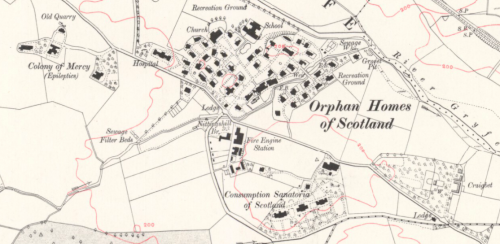
Quarriers Village
As the path carried on in the direction Kilmacolm, I took a diversion off to the left to have a quick nosey around Quarriers Village. Glasgow shoe maker and philanthropist William Quarrier set up a village here in 1876 for "orphaned and abandoned children". He wanted to create a community for young people, in well-built homes, with religious instruction, schooling and work training integral parts of his plan. Over time there were 40 cottages, a schoolhouse, church, workshops and a training ship to school people for naval careers. Emigration at the time was seen by William Quarrier as a way to give the children a new life, and although questions have been raised since about the consent children could give, 7000 children from Quarriers Village were sent to Canada between the 1870s and 1938, often starting off work as farm labourers.

Cottages in Quarriers Village
Buildings of Quarriers Village
Although the houses are now private residencies, a small residential epilepsy centre still operated from here until 2013, when it was moved to Glasgow, still funded by the social care charity which takes its name from founder William Quarrier. A TB sanitorium was also built on this site. Although the houses of the village were grand and the principles upon which it was founded were undeniably benevolent, it is an incongruous place unlike anything else around about, and feels like it could be the setting for a particularly Presbyterian John Wyndham novel.


Statues on the cycle path
Back on the cycle path we pass another of the statues on the route. Known locally as "the soldiers" this is "The Lost Roman Legion" by David Kemp, who works with recycled materials, a nod to the Roman history of this area. South of the Antonine Wall, which ended at Old Kilpatrick on the north bank of the River Clyde there is local evidence of the Roman presence with the Lurg Moor Fortlet on a hill above Greenock. While this sculpture maybe suggests the lost Roman Ninth Legion, which was believed to be wiped out on a march into Caledonia, they appear to be carrying the standard of the Seventeenth Legion who were wiped out at the Battle of Teutoburg in modern day Germany, so a well and truly lost legion.

Next I came to Kilmacolm, which the Telegraph likes to describe as "Scotland's millionaire heartland". It can safely be described as well-to-do, and Kilmacolm used to return the only Conservative cooncillor in Inverclyde Council, in the days before boundary changes and the single transferable vote system robbed them of that claim to fame. There has been settlements here since prehistoric times and it has a long history as a religious centre, named after a church (or Gaelic cill) of Columba that was found here some 1500 years ago. Legend has it that St Columba and St Mungo met at this spot in the 6th century.

The reason that I took a detour into Kilmacolm was to take a quick look at Windy Hill, a detached house in the village that was designed by Charles Rennie Mackintosh and built in 1901. After the railway arrived in the 1870s, Kilmacolm had rapidly grown as a place for wealthy professionals who commuted to Glasgow to live in. With views over the Gryffe Valley, Windy Hill stands at the top of a steep hill and is still a private residence. Although it is a large house, with seven bedrooms, it actually looks bizarrely small among all the mansions of Kilmacolm, and is rather dwarfed by the pseudo-baronial building next door. It was Mackintosh's first building where he used rough-casting on the exterior, and it provided inspiration for his later designs for Hill House in Helensburgh, and House For An Art Lover in Glasgow.

Windy Hill, Kilmacolm
Mackintosh's designs for the house
Windy Hill, Kilmacolm

Kilmacolm to Greenock


Having satisfied my curiosity over a Mackintosh building I had never seen before in the flesh, it was onwards across the open countryside towards Port Glasgow and the River Clyde. 

Farmland between Kilmacolm and Port Glasgow
I took the direct route down the hill towards the Clyde from the cycle path, which continues above Port Glasgow in the direction of Gourock. This was because I was wanting to see The Bogle Stane, in Boglestone. The housing scheme here was very familiar to me, as if I was running through the scheme in Glenrothes where my wife grew up which has the exact same houses. Who knew where Mackintosh's experiments in rough-casting and design would end up?

Upper Port Glasgow
Dragged from Loch Long, 15km away, by a glacier during the last Ice Age, the Bogle Stane stands at the top of Clune Brae, a mere shadow of its former self. About 3m across and only a meter high, this whinstone used to stand about 4m tall.

The Bogle Stone (or what's left of it after the church intervened)
Bogles are ghosts, and the Bogle Stone used to be a favourite haunt for a particular ghost who would jump out at unsuspecting people passing between Kilmacolm and Port Glasgow (one old story about it can be found here). Frustrated at this pagan nonsense a former minister of the area apparently blew up the stone with dynamite, and broke much of it down to be used for making curling stones and dykes.

At the bottom of the hill, Newark Castle sits on the banks of the River Clyde. Having spent a couple of centuries hidden away by the many shipyards on this part of the Clyde it now stands revealed, beside the only remaining shipyard on the lower Clyde. The "new wark" (the new building work) on the Maxwell estate here in the 1400's was the first castle on this spot, remodelled in the 1590s. So it's old. When you live in a modern city like Glasgow just up the road, you forget that there are these old castles here, and in Dumbarton, and in Mugdock Park, etc. on your doorstep, and that the layers of Scottish history are hiding under your nose. It is a castle full of fascinating stories, and interesting nooks and crannies, a lovely doocot and great views over the Clyde. Worth visiting if you are passing by (although its closed just now).

Ferguson Marine shipyard next door is a sorry tale. Having gone into administration in a dispute over two CalMac ferries, the yard is now owned by the government, but the two ships languish while plans for what is to become of them seem to be sadly lacking. It is a thoroughly depressing sight. The first shipbuilders in Port Glasgow were founded in 1780. Business was good after the demand for ships increased with the loss of the American colonies and the wars with Napoleon. Eventually the whole of the Clydeside from here to the centre of Greenock was a continuous chain of shipyards. The early yards built wooden ships, and the remains of the tree ponds, where tree-length logs were stored in the water to season and preserve the wood until it was required, can be seen stretching to the east of Newark Castle.

The unfinished hybrid CalMac ferry in Ferguson Marine's yard
Before it diversified into shipbuilding, Port Glasgow had been created as a port for Glasgow. As Glasgow grew in importance and influence in the late 1600s the problem of the shallow waters of the River Clyde became more acute. Greenock docks had been used to unload ships, and cargo could then be transferred to smaller ships which could come upstream. Various disputes led to the merchants of Glasgow arranging the purchase of 18 acres of land near to Newark Castle from then laird, Sir George Maxwell, in order to build their own docks. This rapidly became Port Glasgow and quickly grew in size. Scotland's first dry dock was built here in 1762, designed by local boy James Watt.

Meanwhile the big neighbour up the river continued to "build the Clyde". By building hundreds jetties from both banks, to make the central channel scour the riverbed  with faster flowing water, and by dredging ever since, a river deep enough to allow larger ships upstream was created. Now the "Clyde built Glasgow".

All the nautical activity in Port Glasgow led to other industries growing up alongside. From the 18th century until the mid 1970 the rope works in Port Glasgow were a major employer, and their handsome building has now been made into flats. I am sure I can remember being driven in my grandad's car to Largs or Arran, and having the different smells of Port Glasgow (from the rope works) and then on to the sweeter smell of the sugar refineries of Greenock. Did rope works have a distinct smell? Am I just making this up?

Gourock Ropeworks
Port Glasgow town centre. Even in the sunlight it is hard to make this building look anything other than functional
A nod to the maritime past of the town, this sculpture "Endeavour" of a ship's prow cutting through the waves by Malcolm Robertson is found by the main road through town
The Comet was one of the early ships built in Port Glasgow, the engine of which can now be found in the Science Museum in London, as it was the first commercially successful steamboat service in Europe. One unique feature of the PS (paddle steamer) Comet is that the inventor of the improved steam engine, James Watt, traveled on her as an old man, coming back to his hometown of Greenck from Glasgow, and taking in the full trip to Rothesay. Sir Walter Scott also sailed on the PS Comet. Henry Bell, hotel owner from Helensburgh, ordered the ship built in 1811 and ran a service for passengers from Glasgow to Greenock and Helensburgh. It started a flurry of steam boat services on the Clyde that took people from Glasgow "doon the watter" for the next 200 years, the PS Waverley the only one still in service.
Replica of PS Comet
A replica of the Comet was built in 1962 by shipyard apprentices, and sailed successfully from Greenock to Helensburgh. It is now quietly rotting away in the Port Glasgow town centre. At Port Glasgow a sharp bend in the navigable channel up the Clyde is marked by the Perch lighthouse. So I used that to navigate my way down the coast towards Greenock, a couple of miles west from Port Glasgow. 

Perch lighthose at Port Glasgow
Former warehouses and Titan crane at Greenock
For some reason the name Greenock seems to be impossible to pronounce properly by English broadcasters. Basically it is pronounced as "green" then "ock". Pretty easy. However, those more familiar with Greenwich insist on making it "gren-ock". As a safe anchorage on the Clyde, Greenock grew up in the 1600s as a fishing village. As the village expanded, merchants in Glasgow began using it as a port, until disputes drove them to build their own port. Greenock became known for sugar refining for over 200 years. Originally the raw ingredients came from slave colonies in the Caribbean, but later from elsewhere. It became a prosperous town, and that is reflected in the many handsome Victorian buildings in the town centre. The last Tate and Lyle refinery closed in 1997 and the caramel smell that used to hang over the town has now gone. Many of the warehouses remain giving a hint at the bustle that there used to be about the town, but like Port Glasgow, high unemployment in the late twentieth century followed the closure of many of the towns industries.

As I ran along the A8 on my way to Greenock Central Station, I passed by Cappielow, the stadium where Greenock Morton FC have played since 1879. As a Partick Thistle fan I have endured many a wet afternoon on the western terraces here, which seem to have been designed to collect 6 inches of rainwater about your ankles if it rains, and it usually does.

It is a stadium that I enjoy visiting though, it has a shabby charm, and I will be sorry if they ever modernise it to 20th century standards. Today when I ran past it was a sad sight, locked up indefinitely while Scotland starts shutting down in order to ride out the Covid-19 storm.

Cappielow, March 2020
Morton v Partick Thistle, August 2019
(I would say "in happier times" but Morton won 3-2)
I had arrived in Greenock, foot sore and weary after taking more diversions than planned. Next time out I would try to carry on down the Clyde coast to Weymss Bay.