Showing posts with label BBCSSO. Show all posts

Friday, 12 May 2017

Tectonics Glasgow 2017

Tectonics Glasgow, May 2017. Review


For the fifth Glasgow outing of the Tectonics music festival all its familiar elements of experimentation, improvisation and collaboration were on display. Female composers and performers were to the fore this year, with the ever reliable BBC Scotland Symphony Orchestra and conductor Ilan Volkov the glue holding the whole weekend together.

The Old Fruitmarket, Glasgow
Whilst most of Glasgow lay about in glorious sunshine, decent crowds were drawn into the cool darkness of the Old Fruitmarket to see jazz musician and composer Roscoe Mitchell, who would bookend the festival, kick things off. Resplendent in some fantastic green knitwear and sunglasses despite the gloom of the Fruitmarket he wheezed and parped his saxophone like some exuberant snake charmer to get us started. They were followed by artist Luke Fowler and musician and composer John Chantler squatting in the centre of the room over a jumble of cables and string instruments creating fantastic electronic drones and distorted sounds. 

Luke Fowler and John Chandler
Next up we were through to the City Halls where New York musicians Yarn/Wire, a quartet of two percussionists and two pianists who started on conventional instruments to perform a piece by Andrew MacIntosh, before gravitating to bowed wine glasses and cymbals. Twitchy samples, shaken foliage, kitchen utensils and coloured beads agitated on drums were required for Thomas Meadowcroft's "Walkman Antiquarian". Their playing throughout, and across the weekend was crisp, clear and precise. If you want four musicians to fit a kitchen for you I would go for them - neat, particular and perfectly measured.

Back into the main concert hall and members of the BBC SSO combined with Yarn/Wire to play François-Bernard Mâche's "Kassandra", a tight performance conducted by Volkov combining the musicians with recorded voices and natural sounds. A strident babble of diverse voices. The first piece of the weekend from composer Linda Caitlin Smith, "Wilderness", was sweetly mellifluous before cellist Lori Goldston's composition for amplified cello and orchestra. A darker, more forceful piece and a good contrast to what had gone before.


My personal highlight of the weekend was the collaboration between Australian trio The Necks and the complete BBC SSO being guided in an extended piece of improvised playing by the energy of conductor Ilan Volkov. With The Necks front of stage, performing away, Volkov looked to be composing live with the orchestra, as he waved his hands and sculpted sounds, much as Tony Stark does with his VR computer system in the Iron Man movies. It was phenomenally beautiful, and a reflection of the close working over many years between Volkov and the orchestra.

Triangulum brought the evening to a close in the Old Fruitmarket featuring Julia Holter, Catherine Lamb and Laura Steenberge. A gentle, and slightly anti-climactic end to the day.


Sunday started with many of the musicians from the festival performing on the floor of the Old Fruitmarket Eddie Prévost's 'Spirals'. With members of Yarn/Wire, The Necks, Triangulum and others playing whilst dressed in gold lamé tabbards, the tone for the second day was established.

Two more pieces by Linda Caitlin Smith were performed in the main concert hall. First the baroque and melancholic 'Ricercar' performed by solo cellist Alison Mcgillivaray, followed by Yarn/Wire on two marimba and two grand pianos playing the more halting, laconic, and haunting 'Morandi'.
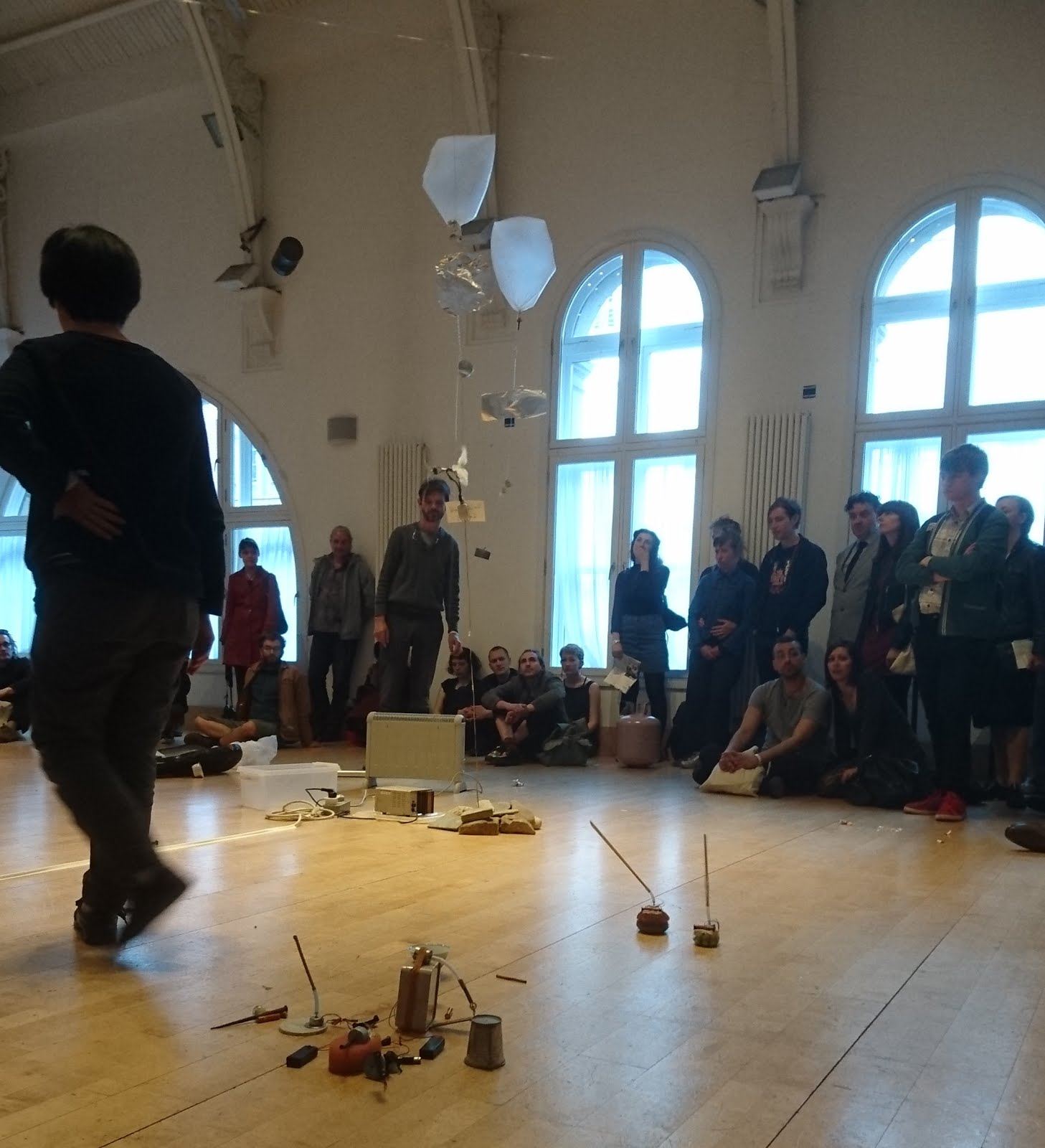
Pierre Berthet and Rie Nakajima
Across the weekend Pierre Berthet and Rie Nakajima had an installation on display in the building's recital room, where they gave occasional performances, animating their assorted creations. Gently diverting but never amounting to more than the sum of its little parts.

James Saunders and Tim Parkinson gave us two entertaining pieces ('in which one thing depends on another' and 'songs') which played with word association, a variety of dropping, plopping and banging of everyday objects and tabletops, accompanied by vocal ejaculations.

After these carefully written and choreographed pieces Ash Reid's piece of agitprop theatre in the Old Fruitmarket felt a bit self-indulgent and shambolic. A tighter piece, 'Felt Events' by Ilana Halperin and Raymond MacDonald featuring further contributions from the musicians of The Necks, brought a jazz cafe feel to a piece reflecting on volcanoes and earthquakes. Tectonics, you might say. Tut Vu Vu were a noisy wake up call to the audience after all that, with distorted, fluorescent guitars and electronic beeps and sqwaks.

The closing concert squeezed in six more performances starting with Shiori Usui's 'from scratch', a piece of music based on her experiences of eczema (which was making me feel itchy). Lawrence Dunn's 'Ambling, waking' followed in the City Halls, with more from Linda Caitlin Smith, James Saunders and Roscoe Mitchell bringing the weekend to a close.

Always an enjoyable way to spend a weekend, the whole thing this year felt less fresh than in previous years. Much of the music was similarly toned 1960s and 1970s pieces, and with many of the same musicians playing across the weekend it ended up with a familiar tone over the two days. There just seemed to be less chaos - more chin stroking this year and less drama.

Sunday, 1 March 2015

BBC Scottish Symphony Orchestra. City Halls, Glasgow 28 Feb 2015

BBC SSO, Hear and Now. City Halls, Glasgow. Live review.


The BBC Scottish Symphony Orchestra play a varied palette of music. They have become proficient interpreters of modern classical music and again this month were recording music for Radio 3's Saturday late-night new music thread, Hear and Now. Modern classical music doesn't seem to shift tickets as well as a night of Beethoven but these Hear and Now concerts for radio transmission are free and I'm always amazed that more people wouldn't just give it a go. 

Tonight the orchestra were led by German composer and conductor Matthias Pintscher. The finale was to be a piece by French composer and polymath Pierre Boulez to mark his 90th birthday. Before that the first half of the programme lent heavily on the conductors tastes and colleagues. First up was a composition by Serbian Marko Nikodijevic, "Cvetic, Kucica.../La Lugubre Gondola". This was based upon Liszt's piano piece, inspired by Venetian funeral gondolas. The title, "little flower, little house" in Serbian, dedicates the piece to the death of a 5 year old girl found dead in the back of of sunken lorry. Thoughts of this solemn tale, mentioned in the programme notes, rather overwhelmed the mournful music, which ebbed and flowed. 

Next was a piece by our conductor's former teacher Manfred Trojahn, "Herbstmusik/Sinfonischer Satz". This takes ideas from Sibelius's Fifth Symphony the programme notes tells us and I liked it a lot. For me it felt like tumbling down rather dark and tempestuous rapids of a river before our head pops above water in the stiller waters downstream. 

Next was a piece by young Slovenian composer, Vito Zuraj. "Hawk-eye( horn concerto)". Whether we were evoking the eye of a hawk zooming in on some prey or the modern computer aided tennis ball tracking system was ambiguous. It was a very visual piece however, from zooming in and out with the opening strings rising and falling to the parping French horn played by Saar Berger. However the image it created in my mind's eye was really of an elephant trying to chase a pesky fly. With the violins largely played ukulele-style and them getting out all the comedy instruments from the percussionists toy box it felt like a light-hearted soundtrack to the Eastern European cartoons I watched on BBC2 in my youth. 

If the first half was a very visual spectacle, the second half was more a pleasure for the ears. Pierre Boulez will always be thought of by me as the inspiration for Private Eye's music correspondent Lunchtime O'Boulez. I wasn't familiar with his music and "...explosante-fixe..." has led me to seek out some more. This particular piece was written as a requiem for a flautist friend of the composer. This piece combined electronic elements alongside traditional musicians. We had 22 musicians on stage divided into strings, brass and woodwind with a flautist standing in front of each third, the stage looking like half of a Trivial Pursuit piece. In the auditorium was another performer working the live electronics. The electronic elements chimed perfectly with the musicians, tonally and in volume, moreso than I have ever seen before when these are combined. It all hung together coherently and was quite hypnotic and delicate. 

Another fascinating evening of things which were all new to me, a fantastic orchestra and a beautiful setting. Why aren't these great FREE concerts playing to bigger crowds?

Monday, 12 May 2014

Tectonics Festival Glasgow, 2014

Review Tectonics Festival, Glasgow, May 2014


The Tectonics Festival returned to Glasgow for a second year this weekend. Originally devised by conductor Ilan Volkov with the Icelandic Symphony Orchestra in Rekyavik, he brought it to Glasgow last year. Since then it has grown arms and legs and been a platform for local and international, experimental and modern classical music in Adelaide, Tel Aviv and this year, New York.

BBC Scottish Symphony Orchestra

The programme this year did not jump out at me the way it did last year. I don't think I was alone in finding this, as audience numbers, although decent, seemed a wee bit down on last year's. I wasn't really familiar with any of the composers being performed. However, Volkov with his previous Tectonics programme and the free "Hear and Now" concerts which he still performs with the BBC SSO for Radio 3, is always a reliable guide. This meant that I was happy to be led by his reliable judgement. The Glasgow based BBC Scottish Symphony Orchestra have surely became one of the world's foremost interpreters of modern classical music. This weekend they were again given the opportunity to perform musical notation which at times can have more in common with a child's drawing book than a traditional orchestral score.

I wasn't able to attend the opening concert at St Andrew's in the Square, featuring many of the artists and composers who'd be performing across the weekend. With Bill Wells, Thurston Moore, Takehisa Kosugi and Richard Youngs amongst others on show, I was sorry to miss it.

Saturday night started with the BBC SSO, led by Volkov, performing French-born American composer, Christian Wolff's Ordinary Matter (version for two orchestras). Visually and aurally it was an interesting proposition as the counterpoint ebbed and flowed between the orchestra, split down the centre of the stage and led by separate conductors. It was slow, creeping and creaking. A high point was the to-ing and fro-ing between the pizzicato violin on the left and harp on the right.

A new BBC commission "'d love to turn by John Oswald was next up, a lighter affair. At times it was familiar, almost bursting into The Beatles "A Day In The Life" at one point, but with more assault on the piano strings in the style of Tom and Jerry. It ended with a moment of coitus interruptus, as the two percussionists raised their cymbals, then failed to climax.

The falling and rising strings of David Behrman's How We Got Here was a gentler affair, being swept away by Georg Friedrich Hass's more grandiose pieces following it. These were the highlights of the evening, with droning strings and brass, full of bombast in the Concerto Grosso No.2 for ensemble and orchestra. This was followed by his Saxaphone Concerto, with Swiss saxophonist Marcus Weiss playing in front of the dark tones of the full orchestra with his baritone sax.

Sarah Kenchington's Sounds From The Farmyard

In the interval we were ushered to the recital room where beautiful Heath Robinson style instruments constructed by Sarah Kenchington awaited our input. As shy Britons we gamely pottered about with them, deigning not to speak to one another or work together (the pipes were never going to work until someone decided to work the bellows). As the evening wore on people were more willing to give it a go. I couldn't help thinking that a bunch of kids would have made more "Sounds From The Farmyard" from it.

Muscles of Joy in The Fruitmaket

Set up next on the floor of The Fruitmarket were Muscles of Joy, a Glasgow band who I've seen before, supporting Tuneyards in Oran Mor. As before I found them interesting if a bit unengaging. They did highlight the gap in genders though as many of the performers, like them, were women whilst most of the pieces played over the weekend were composed or conducted by men. Perhaps it is a generational thing, as there were, particularly on the Sunday, several compositions by younger women.

Four men stare into a piano (whilst performing Behrman'sWavetrain

Back to City Halls where Icelandic composer/performer outfit S.L.Á.T.U.R. took us through Christian Wolff's Metal and Breath (where they either made noises with bits of metal...or their breath). Then Wolff's piece For One, Two or Three People was performed quietly by Wolff, Behrman and Kosugi. Their deferential respect for each other stole some dynamism from the piece. David Behrman's Wavetrain was excellent though, where Wolff, Behrman and Kosugi were joined by Volkov to place pick-ups on the strings of the prepared grand piano and play with the feedback.

Feedback was the watchword in The Fruitmarket for the late concert. Thurston Moore (off of Sonic Youth) wrestled with his guitar whilst Dylan Nyoukis provided accompanying noise and voice. I was amused to see the contrast between someone's child happily playing about to the noise produced and the older attendant from the halls standing behind the musicians with eyebrows more scornfully raised.  There are links appearing here, as Sonic Youth at times played the music of Christian Wolff . Scottish musician Gordon Sharp finished off the evening with his band Cindytalk.

Sunday's programme ran from 3pm until 10.30pm. One problem with this, as on Saturday, is that the performances are fairly constant. Obviously you can dip in and out of things, but I'm always afraid that I'll miss something special. Although the Merchant City is awash with bars and restaurants, there ain't no sandwich bars, cafes or fast food outlets on the weekend which makes getting food quickly an issue. As I'm diabetic, planning when to take my meals and insulin maybe means I'm a bit more obsessed with this than most people, but City Halls has no catering so maybe having a "street food" stall, music themed cafe or meal breaks in the programme could be considered in future outings? Some people came along with sandwiches but I opted to eat first and therefore missed Usurper in The Fruitmarket (who were apparently inviting us "to join them for an early tea".

SLÁTUR and their electronic score

I did catch the end of S.L.Á.T.U.R.'s performance, where their musical notation on the screens recalled the video game "Guitar Hero". The audience watched for their clapping or stomping cues. Two orchestral performances by composers from this outfit will be on show in  Glasgow in October. This highlights the fact that Tectonics is a platform for living, working composers. With its younger than average audience for "classical" music, sitting in a concert hall, pint of lager in hand, it is an idea I think is worthy of praise.

The next 90 minutes were of varied vocal/ choral music. Vocal ensemble EXAUDI, led by founder James Weeks, sang six varied pieces, three of them by Wolff. The main thing to shine through from this was the virtuoso performance of the singers in performing these, at times, challenging pieces. Leaving the hall, more cacophonous voices greeted us in the foyer as members of the Glasgow Chamber Choir and Glasgow University Chapel Choir performed James Weeks's piece, Radical Road (accompanied by pots and pans of gravel and clacking stones).

Next it was time for the BBC SSO to dust off their instruments again with music from two British composers, James Clapperton and Michael Finnissy. Catherine Lamb's "Expand" and "Saturate" from a longer work were excellent and reminded me of the soundtrack score for "Under The Skin" by Mica Levi. They both had some echoes in the final piece in this section. A new BBC commision, A Thin Tree by Austrian composer Klaus Lang, it had a lovely timbre (see what I did there?), which grew and stretched. A lovely piece, utilising the full orchestra.


Takehisa Kosugi's set up

Next we had one of the highlights of the weekend as 76 year old Japanese musician Takehisa Kosugi, once of Taj Mahal Travellers collective. He hunched over a table of electrical odds and ends in the darkened Fruitmarket and produced 30 minutes of electronic noise and interference with light sensitive switches making this improvisation entertainment for the eyes and ears. A treat which showed up some of the other music across the weekend for its lack of ambition.

Volkov and the BBC SSO in The Fruitmarket

Finally the musicians of the BBC Scottish Symphony Orchestra arranged themselves around the Fruitmarket Hall for the closing concert. It was great to see Richard Youngs, who had his guitar on the rack on stage here, take on something of this scale. With electronic sounds, guitar feedback and drums on stage, the strings were arranged around the Fruitmarket hall were the audience milled, brass on the balcony and Volkov conducted from a platform in the midst of it all. An appropriately eclectic performance to finish the evening.


Another enjoyable weekend, lots of composers here to hear their music performed and talk to the audiences. The earth maybe didn't move for me quite as much as it did at last year's Tectonics but some fabulous musicians performing for three nights in some fantastic venues. A real treat and I look forward to it's return next year.

Saturday, 10 November 2012

George Wyllie vs Rembrandt, Aidan Moffat vs Wagner

George Wyllie vs Rembrandt, Aidan Moffat vs Wagner

Review of George Wyllie Retrospective Exhibition, Rembrandt and the Passion, Aidan Moffat at Cottiers, Wagner- Tristan and Isolde Act 2 BBCSSO


There were two opportunities this week for me to compare internationally acclaimed masters in their field against uniquely Scottish national treasures in the same disciplines.

I often forget about the Hunterian Art Gallery at Glasgow University but the posters advertising their Rembrandt exhibition, "Rembrandt and the Passion", brought me along this week. I'm no religious authority but that is the second Passion themed thing I've seen this winter, and even I know this would chime better at Easter.


Last time I was in here there were clearly a few leaks in the roof and the layout was looking a bit tired, but I was delighted to see that it has all been renovated and re-hung. All of my favourite paintings are still there and JD Ferguson's Les Eus, Joan Eardley's paintings and their unique array of Whistler's are all allowed to shine. If you've not been in a while, go and stick your head through Paolozzi's doors and have a look. The temporary exhibition upstairs is built around the gallery's "Entombment Sketch" by Rembrandt, a wee picture I'm familiar with as it has hung in the Gallery forever. However it does merit the extra attention it gets in this exhibition, hung alongside some of his other paintings (including his "Entombment of Christ" painting on loan from Munich), etchings and works of other artists of the Passion story. It is all very interesting, but £5 entry was a bit steep considering it is usually free to see it on its own.

George Wyllie scul?tures

In the main hall at the Mitchell Library just now is a retrospective of the work of George Wyllie, who died earlier this year aged 90. If you don't think you know his stuff then think back to the huge 'paper boat' floated down the Clyde or the straw locomotive that was hung from the Finnieston crane in 1987 and then burnt (a model of it and a box of the ashes are on show here). He is a David Shrigley, with a blowtorch. 

Model for The Straw Locomotive

At present there is a large question mark hanging from the Finnieston crane in tribute to the man, who described himself as a "Scul?tor". His work was often playful and fun, but usually had a political edge or carried a message about Glasgow's declining industrial hinterlands. His family have brought together a great selection of his work from early paintings to major sculptures for this exhibition, titled "In Pursuit of the Question Mark".
I've always liked his stuff and his "Just In Case" giant nappy pin sculpture that sits at the former site of Rottenrow Maternity Hospital always raises a smile in me when I pass it. Hopefully this exhibition will inspire someone to fix the clocks in his running man sculpture outside Buchanan Bus Station. I'll definitely be back to see this exhibition again, which is free and on until February 2013 and I'll bring my kids, who will love it.
 
Saying that, however, on balance I'd give this one 2-3 to Rembrandt. Despite Wyllie having the home advantage, the big man from the Netherlands just wins here thanks to his superior technique.


This week I also had the chance to compare and contrast the music of Aidan Moffat and Bill Wells in Cottiers on Wednesday night with that of Wagner's Tristan and Isolde performed by the BBC Scottish Symphony Orchestra at the City Halls on Thursday. This really was a Champions League clash of techniques, the Scottish underdogs playing their homely tunes against Teutonic efficiency, complex chromaticism and one of the finest orchestras in the country.

Bill Wells and Aidan Moffat
Rick Redbeard, lead singer of The Phantom Band in folkish guise, strumming his acoustic guitar opened and has a solo album out next year. Next up was Aidan Moffat and Bill Wells, who won the inaugural Scottish Album of the Year award in June for "Everything’s Getting Older", a mixture of spoken word pieces, alcohol sodden songs and a quintessentially Scottish glumness. I last saw them perform songs from the album at a gig in Paisley and now about 18 months later it was nice to see how the live arrangements have evolved. Bill was at piano, with a trumpeter up front and Aidan on drums, vocals and bits and bobs. The 10 minutes on the album from "The Copper Top" through to the brutish "Glasgow Jubilee" are some of my favourite minutes of music and it was good to hear those tracks again. He promised a cover version tonight and although he seemed sorely tempted by an audience request for Chas ‘n’ Dave’s "Ain’t No Pleasing You" he settled for Black Heart by girl group Stooshe instead. If you follow Aidan’s drunken MTV music reviews on twitter you’ll know that this type of pop trash is what he loves at 4am. There were also outings for some tracks that they thought "too cheery" to make the album. He is always an entertaining performer and I think I’d enjoy hearing him read a shopping list over Bill Wells’s mournful piano and the muted trumpet, but the wee tales he tells of mundane ordinariness are great.

AL Kennedy and bluebottle address those who arrived early
By contrast the following night I was out to see Act 2 of Wagner’s Tristan and Isolde, a concert performance over three evenings of the opera, being performed by the BBCSSO. First on stage was author AL Kennedy. I like her Scottish dourness, love her books and she gave an interesting talk, bizarrely interrupted by a persistent bluebottle that landed on her mic and politely listened to the last 5 minutes. I really wonder what the Radio 3 audience would have made of her stopping mid-sentence to utter such things as "Go away, I don’t want to kill you". Presumably they were able to edit these bits out. I had enjoyed the first Act a few weeks ago and it had ended on a cliff hanger. The music and orchestra were fantastic, I particularly liked the bit where Tristan and Isolde meet to the crashing music of a thunderstorm rather than to sounds suggesting joyful love lies ahead. As before, it takes a strong voice to carry out to the audience with the orchestra right at your back rather than in the pit, and there were some cast changes from Act 1 which made for an odd continuity. Nina Stemme's Isolde was released from the Sinex she had to resort to a couple of times on the last outing and was strong and impressive. Her new Brangane, Jane Irwin, had a fantastic voice and presence. Our new Tristan, Robert Dean Smith, however was a shadow of the Tristan from Act 1. Not only did he dress more prissily than everyone else, in his tails and white bow tie, he sang more prissily too, not having the volume to carry his words over the orchestra. So he made an unconvincing subject for Isolde's passion. Peter Rose entered as King Mark towards the end and his booming baritone was full of pathos. Because they are singing, not acting, we were left with a cliff hanger again as Tristan sings "On guard, Melot" and the act ends (you don't get to see him throw aside his sword and allow Melot to severely wound him). So I'm looking forward to Act 3, and as each act lasts 75-90 minutes I can see why it merits this type of treatment, and again focusing on the music of Wagner is enjoyable. However the next act is in April, which does seem a wee bit far away.

So I'd give this one as a surprise victory for the plucky Scottish underdogs who took full advantage of playing in front of a home crowd. The German played a solid game, but couldn't deliver that knockout blow. Aidan Moffat and Bill Wells 3-1 Wagner.

This was all a convoluted metaphor to allow me to shoehorn in a mention of Scotland's football match of the week. No, not Celtic's impressive 2-1 victory over Barcelona, but Partick Thistle's storming dismantling of their main promotion rivals, Dunfermline, this afternoon. 5-1 it ended and Dunfermline were lucky that was all we scored. It was a great game, a great crowd of over 5200 and a wee suspicion is circulating around Firhill that we are looking bloody good this year. Next home game is in 2 weeks, vs Livingston on the 24th November. If you haven't seen them this year, drag yourself along.