Wednesday, 16 July 2014

Greek Football League Teams in Thessaloniki

In recent years when we are on holiday I've taken my running shoes along, and if my kids have had the audacity to have a long lie some mornings, I'll take myself off for a wee run about town. If you are only in town for a few days I think that you can get under the skin of a city a bit if you head off the beaten track and go where the locals go. As a follower of Partick Thistle Football Club, if you were visiting my city I think you could do worse than seek out the football league grounds here to see a bit of Glasgow (to save you the bother of finding a map, I've done it for you). Last year these morning runs took me to the backstreets around the grounds of St Pauli in Germany and to AZ, FC Groningen and Telstar in the Netherlands.

Greek football


Athens viewed from the Acropolis
As a Grecophile I like to keep an eye on a couple of twitter feeds which have news on Greek football, although they are as interested in Greeks playing in foreign leagues as they are in their own domestic league. This year I was in Greece whilst their national team had a decent run in the World Cup. Unfortunately whilst we were in Athens they were eliminated by Costa Rica. The Greek league itself is rather stifled as a competitive league by the dominance of the "big clubs" from Athens.

Panathinaikos and Olympiakos logo
Club badges of Panathinaikos and Olympiacos
Within the past 21 years Olympiacos have won the league 16 times, Panathinaikos 4 times and AEK Athens only once. 1988 was the last year that a team from outwith Athens won the league (in Scotland the last time the league was won by someone outwith the Glasgow "Old Firm" was even longer ago, 1985 when Aberdeen won).
Club badge of AEK Athens
The Greek league has a pyramid system, with the top "Superleague" composed of 18 teams who play 34 games in a season, with 3 teams relegated to the "Football League" below. The upper leagues compete for the Greek Cup, and the multiple lower leagues, which become regional the further down you go, competing for the Greek Amateur Cup. The league system is currently ranked 12th by UEFA (11 places ahead of the Scottish League) giving them 2 Champions League places. 

In European competition their greatest moment came in 1971 when Panathinaikos were defeated in the European Cup final at Wembley by Ajax. The great Ferenc Puskás was the manager at the time, and the Panathinaikos supporting father of a Greek friend has told me about following his team to London that day. More recently in the Champions League era, Greek teams have twice made it to the quarter finals and once to the semi-final.

Thessaloniki


My plan had been to get up and jog about the grounds in Athens early one morning when we were there. However, British Airways scuppered this plan by stranding our luggage at Heathrow Airport for 4 days, by which time we had moved on from Athens. So once I had got my running shoes back, we had arrived in the second city of Greece, Thessaloniki (Thessalonica).

Roman arch and rotunda (which later became a mosque and then a church) in Thessaloniki.

This port city in Macedonia, northern Greece, has a population of almost 800,000 people. Thessaloniki was founded almost 2500 years ago by King Cassander of Macedon, who married Alexander the Great's half-sister Thessalonike. It became the capital of the Greek provinces in Roman times under Emperor Galerius and Saint Paul came to the city in 49AD and produced his "Letters to the Thessalonians".

Thessaloniki viewed from the Byzantine and Ottoman-era fortress walls

Later it became the second wealthiest city of the Byzantine empire. From the 15th century it was under Ottoman rule for around 500 years, about 100 years longer than southern Greece was. In 1881 it was the birthplace of Kemal Ataturk, the first president of Turkey. The 20th century started with the Balkan Wars in the region. Then in 1917 a huge swathe of the old city was destroyed by a great fire. After the First World War the break up of the Ottoman Empire led to the city becoming Greek again, with a massive "population exchange" occurring between Greece and Turkey. 

Holocaust Memorial by the waterfront, Thessaloniki
Bombed by the Italians and then occupied by the Germans in the Second World War, over 50,000 Jewish residents of the city were deported to their deaths by the Nazis.

Now the city's port is becoming a major hub for trade in Southeastern Europe. Thessaloniki is home to two of Greece's largest universities and as a result has a relatively young population, which means it has an excellent variety of tavernas, restaurants and bars to choose from. The large shopping streets in the city centre can snarl up with traffic during the day and the city is currently building an underground train system, although when I was there last week this appeared to have ground to a halt over uncovered archaelogical finds in the middle of Egnatio Street.

Sunset over the port at Thessaloniki

Like the rest of Greece people have been badly affected by the economic crisis, with youth unemployment levels being very high in the city. However on visiting the city again this year after a gap of almost 20 years I found it as lively, as handsome and as friendly as ever. Okay, I'll admit I'm biased as I spent some time here as a student and have many Greek friends in the area, but I do think it is a city that more people should look into visiting. It is becoming easier as from the UK, Easyjet fly to Thessaloniki airport from Manchester, BA from Gatwick and Ryanair from Stansted.

Night view of Thessaloniki for the upper town (Ano Poli).

Football in Thessaloniki


As is the case in Spain, many Greek football teams are part of a multi-sport club which share a common identity and facilities. The three main football teams in Thessaloniki are Aris FC, Iraklis FC and PAOK. All three were founding members of the Greek football league in 1927-28. Unfortunately their associated sports clubs appear to be having more success than their football teams recently. Basketball is big in Greece. Aris BC dominated the Greek basketball league for a decade and won the European Cup Winners Cup at that time. Once in the 1990s I arrived at Thessaloniki airport at the same time as a new signing for them, to find an airport full of chanting basketball fans greeting him. Iraklis BC won the inaugural basketball league championship in Greece, and their volleyball team have been crowned European champions before.

Iraklis FC

The badge of Iraklis FC 1908

The oldest of the football teams is Iraklis FC. Founded in 1908, whilst the city was still under Ottoman rule as the "Ottoman Greek Association of Thessaloniki, Hercules" they play in the blue and white of the Greek national flag and have Hercules resting on his club on their badge.


Financial chaos at the club over the last 10 years has led to relegation and bankruptcy, but at present they appear to be getting back on track after a merger with the smaller Pontioi Katerinis club. The new club goes under various names, such as PAE Iraklis 1908 but in most respects is a continuation of the old club. They will start the 2014-15 season in the Football League, the second tier of Greek football.

Their home ground is the impressive Kaftanzogliou Stadium, which was renovated for the 2004 Athens Olympic Games.

Kaftanzogliou Stadium, home of Iraklis
It has a capacity of almost 28,000 and is a frequently used athletics arena, with a running track separating the fans from the pitch. On the morning that I was there a group of young army cadets appeared to be using the athletics track of the stadium, whilst a more middle aged selection of joggers were using the adjacent sports field for training.

Aris FC

Club badge of Aris FC
About 3.5km away from Kaftanzogliou stadium lies Aris FC. Founded in 1914, the club is named after Ares, the god of war. The club badge features a seated image of the god "resting, always on guard to fight if necessary" as the club put it. Until this season they were in the Superleague, but after finishing last in the 2013-14 season they have been relegated to the Football League.

Kleanthis Vikelidis Stadium, home of Aris.
An average home crowd last year of just over 7,000 made their way to the 20,000 capacity Kleanthis Vikelidis Stadium. Their colours are yellow and black, recalling the Byzantine colours of old Thessaloniki which can still be found on the two-headed eagle flags at many Greek Orthodox churches in the city. About 10 years ago financial difficulties led to the creation of the Aris Members' Association, giving fan control of the club.

When I ran past their ground I have to say it looked decidedly shabby after visiting their near neighbours, but with the current lack of cash it seems this is where they stay for now.

PAOK

Club badge of PAOK

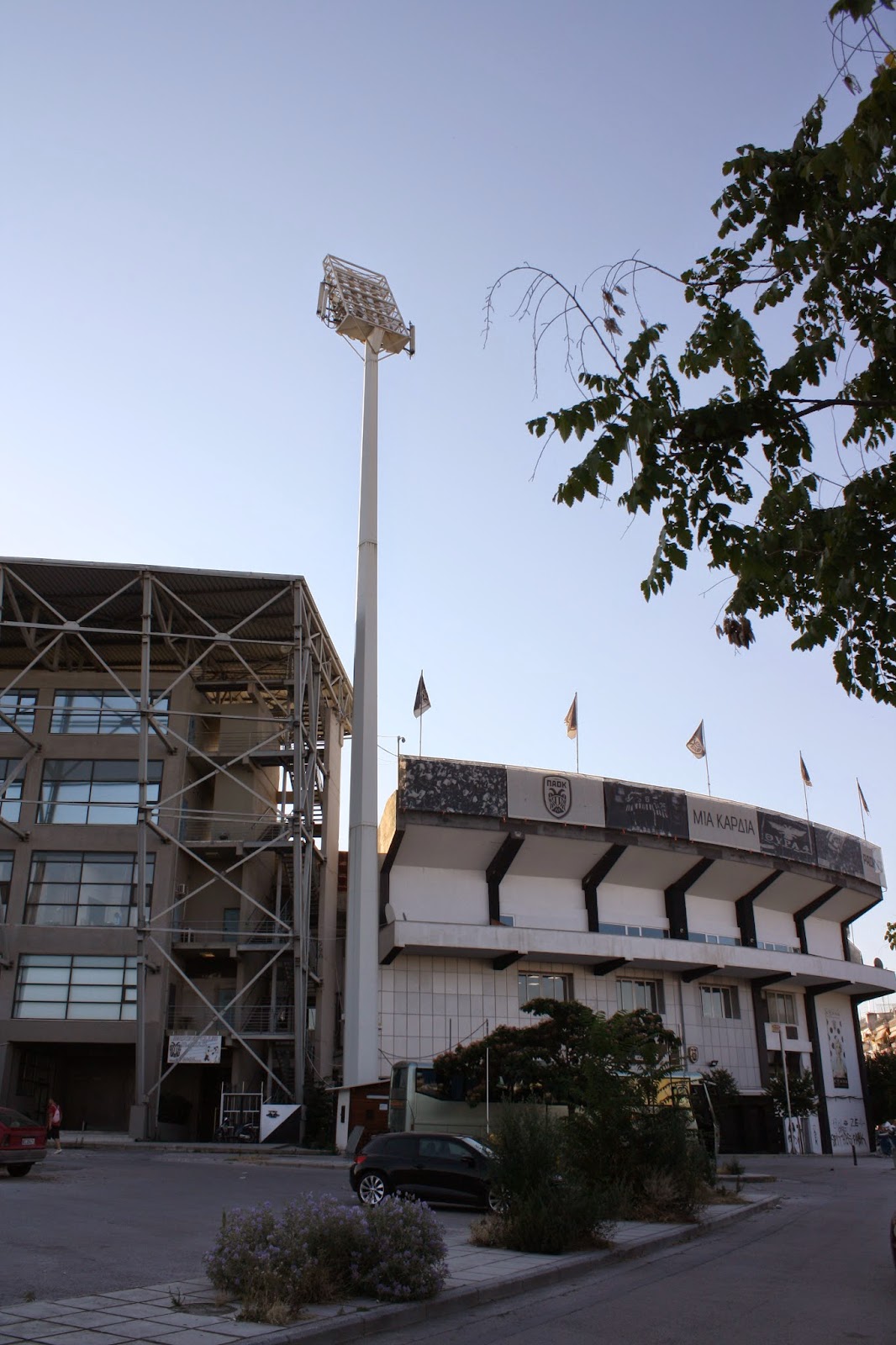
Lying almost halfway between these two grounds (making it an easy circuit to get around all three grounds in one morning run) is found PAOK Football Club at Toumba Stadium.

PAOK in recent times have been the most successful of the Thessaloniki teams, and for the 2014-15 season will be the only city team in the Superleague. Founded in 1926 the name (roughly) stands for Pan-Thessalonian Athletics Club of Constantinopolitans. As the name suggests football is not the only sport at the club. They also have basketball, cycling, handball, volleyball, athletics, wrestling, hockey, weightlifting, swimming and water polo clubs. Playing in black and white stripes their badge is (like AEK Athens) the two-headed eagle. This and the name hark back to the club's roots as Hermes Sports Club, in a Greek community of Istanbul, founded in 1877. The post-war emigration of Greeks to Thessaloniki brought the club to the town under its new name.

In what is becoming a recurrent story here, the club came close to financial ruin 10 years ago, but appears to have stabilised and continues to work towards paying off previous debts. This includes the stated aim of recruiting more players through their academies than from expensive foreign imports. Old club favourite, and native of the city, Dimitris Salpingidis returned as club captain recently after being sold to Panathinaikos in 2006 in a bid by the club to raise cash.

Toumba Stadium, home to PAOK
(The "mia kardia" sign means "one heart" I think)

Last season they finished second in the league. The teams which finish 2nd to 5th in the league play-off for the remaining European places. They lost out to Panathinaikos for Greece's second Champions League place, with Olympiacos taking the other Champions League berth. This means that they will join the Europa League at the play-off round in 2014-15. The stadium capacity is 28,000 and the average home gate last year was just over 13,000.


It took me a while to click that the graffiti proclaiming "IRA" on various walls in the city is presumably from the fans of Iraklis. PAOK and ARIS graffiti was also much in evidence, usually followed by the gate number where the loyal fans who made their scrawl gather, for example Gate 4 is where the largest group of PAOK fans gather. As a boy who grew up in Glasgow of the 1970s and 80s, after seeing IRA daubed on various walls I had initially expected to turn a corner to find UDA, FTP or FTQ across the next wall.

Visiting these grounds in Thessaloniki, the funny thing was that you could just about throw a blanket over the three of them. It is clear that the financial difficulties football clubs have faced in Scotland are just as apparent in Greece, and the solution being sought of bringing through young players to the first team is here also seen as the solution. Two parts in place in the Greek league structure have been suggested as solutions for Scottish problems. They have a pyramid system in place, and a larger top league, where teams play each other only twice. Two automatic relegation places and a play-off for the team in the third bottom slot mean there is a churn of teams to the lower leagues. Due to successes in previous years in Europe, the champions go straight into the Champions League group stage, whilst the next four teams have a play-off of 3 home and 3 away games to decide who gets the last Champions League slot and who slots into the which of the 3 Europa Cup slots Greece has. In recent years this has meant that once Olympiacos have won the league, other teams still have something to play for.

One thing is clear, the Greek national team seems to be over-achieving when you look at it compared to the Scotland team (or the England team for that matter). There are many more Greeks playing successfully in foreign leagues than there are Scots doing the same. Whether the league set up, youth development or just pragmatic management of the international team is responsible, surely we can learn something from them. Since they first appeared at a major championship in Euro 1980 they are now regular qualifiers for the Euros and World Cups. Crowned Euro 2004 champions, the Germans knocked them out at the quarter final stage in Euro 2012 and in this summer's World Cup in Brazil, despite their acknowledged  lack of superstar players, they still made it to the knockout stage.

Whether it is for football, history, nightlife or archaeology, I recommend that you wander the streets of Thessaloniki sometime soon.

Monday, 23 June 2014

Glasgow Commonwealth Games Venues - update

Last September I jogged a couple of routes around the Commonwealth Games venues as they were being made ready for the competition arriving in town. You can see what I found here and here. That was 9 months ago ad with the games starting next month it has clear that there has been a lot of changes since then. One thing which is noticeable in Glasgow is that all the fence painting, grass cutting, gap site tidying and road line painting that has been annoyingly neglected by the council for several years has been hastily sorted out as the city gets itself "dressed" for the expected arrival of visitors to the events. The council have described this as "getting the house tidy for visitors arriving" but I am kind of in the habit of keeping my house tidy for myself and fellow residents. Perhaps they could think about that. By all accounts the venues are coming together on time (if not exactly on budget).

George Square Glasgow
George Square has been fitted out with a giant Commonwealth Games logo, which seems to attract a steady stream of tourists with their cameras. When I passed it in a taxi around midnight the other night it also had a gaggle of late night revelers sitting atop it, so I do hope it has been built to withstand a bit of rough and tumble. Just beside it the council have erected another of their big tents in George Square. I really do not understand why they do this. George Square can present a dramatic open vista for visitors and lunchtime office workers, a public civic space which is endlessly obscured beneath commercial ventures and funfairs. The current building is to be a Commonwealth Games Superstore, but with all the numerous empty shops in the city centre and the planned event space on Glasgow Green I really struggle to see what benefits there are to the city in shoving this ugly temporary building in this position.

City Chambers at George Square obscured by a big shop
Another part of the city which has been dressed up for the games is the Kelvingrove bandstand. This 90 year old structure had fallen into disrepair but a successful campaign to raise the funds for renovation has led to it re-opening last month after refurbishment. During the games there will be regular cultural events held here, from concerts by Belle and Sebastian to screenings of Gregory's Girl. I was there last week at the Glasgow Mela and it was lovely to be again sitting in its amphitheatre enjoying the music and dancing.

Kelvingrove Bandstand
The bandstand is in Kelvingrove Park, beside Kelvingrove Art Galleries and Museum and the site of the lawn bowls competition in the Commonwealth Games. The city is full bowls clubs (this was my attempt to find as many as I could within a couple of miles of my front door) and this is presumably one event it was easy to shift tickets for. They have refurbished the greens which have stood for many years beside the Art Gallery building and are now installing temporary stands, although you can still access the greens and play on them free of charge at present if you so desire.


Fencing and temporary stands being put in place at Kelvingrove bowls venue
 The stands mean that the usual access road on Kelvin Way to the Art Galleries car park is closed, and it can now be accessed via Dumbarton Road.

Despite the Scotstoun Sports Campus being the home to Glasgow Warriors rugby team and the Scottish National Badminton Academy, neither the rugby 7s nor the badminton events are being held here. However the table tennis and squash competitions will take place here. The use of a temporary structure to house the squash show courts has proven controversial, criticised for the lack of "legacy", not leaving Glasgow with a venue to host international competitions in future. This temporary building which has landed on the main astroturf football pitch at Scotstoun, is huge. There has also been the rebuilding of six permanent squash courts at Scotstoun which will still be left behind after the games, but this does seem like an expensive missed opportunity.


Temporary structure at Scotstoun, opposite the badminton academy

Scotstoun Sports Campus

On my previous blog, when I visited Scotstoun I had taken a misty-eyed photo of the old crazy golf course in Victoria Park, just beside Scotstoun Showgrounds. In September this was all crumbling, nostalgic and quaint. Now, as part of Glasgow "tidying the house" it has been bulldozed and landscaped. Limmy may note that some of the fences here have actually been painted and diggers were in giving the run down playpark a bit of a facelift today.


Victoria Park, site of the crazy golf event c.1978

Next I ran through the Clyde Tunnel to visit the site of the Rugby Sevens competition, Ibrox Stadium. Presumably the financially straitened football club that resides here must feel that they've won a watch being able to rent out the old place, built in 1899, over the summer. It is a venue which is going to need little more than a swap of the goalposts and a bit of line painting inside. Outside today there were construction workers erecting security fencing around the place, whether as protection for the Ibrox board members or for the Commonwealth Games wasn't entirely clear. 


Ibrox Staduim, Glasgow

Back across the river and you pass some newly laid out roads between Ibrox and the BBC and STV buildings, there is also the new Premier Inn on the Clydeside here, open in time for the summer. There are cultural events being held on the Quayside at the Science Centre and organised by the BBC here, but across the river Clyde we come to the next sporting venues. Described on the Games website as the SECC Precinct we have the The Scottish Exhibition and Conference Centre, the Hydro and the "Armadillo" - Clyde Auditorium. This area will host the gymnastics, netball, weight-lifting, boxing, judo and wrestling. The media centre for the Games will be based here and I presume the white tents being built in the car park is the site for this. Like other venues it is in the process of getting ringed in security fencing, which has narrowed down the part of the pavement that I regularly jog along to get down to the Clydeside. 

The Scottish Exhibition and Conference Centre (SECC)

The Scottish Exhibition and Conference Centre (SECC) and new fencing emerging

The Armadillo (Clyde Auditorium) and SSE Hydro buildings

The Hydro is a 13,000 capacity arena which opened in September 2013 and has seen continuous use with concerts and the like ever since. Last night Eric Clapton was playing there, but only managed half a show before storming off in the huff apparently.

Another huddle of venues is to be found in the east end of the city. Glasgow Green is to host a variety of cultural events, opening and closing ceremony parties, as well as start and finish lines for the marathon, cycling time trial and cycling road races.Fences are at present being erected on the Green around the People's Palace area as they get ready. At the eastern end of Glasgow Green lies the Glasgow National Hockey Centre, two synthetic pitches built specifically for the Games and now the headquarters for Scottish Hockey. In the picture below it is now surrounded in fencing and more resembles a building site at present than anything else.

National Hockey Centre, Glasgow
Running around here today it is clear that there has been a lot of landscaping and turfing going on. Shabby gap sites which have been tolerated by the city council for decades are being smartened up.
Tidied up gap site near Glasgow Cross

Turfing and landscping at Dalmarnock train station

Celtic Park will host the Games Opening Ceremony on 23rd July 2014. The home of Celtic Football team since 1892. It was curiously picked by the SPFL as the venue for their opening game of the new football season on the 9th of August between Celtic and Partick Thistle. Predictably Celtic have decided it is too early to get the pitch ready for football. So this game has been postponed, which seems an avoidable hassle for Partick Thistle fans like me. The approach road to Celtic Park has a had a long overdue facelift, becoming the Celtic Way, it would appear.

Celtic Park
Across the road from Celtic Park is the new Chris Hoy Velodrome and Emirates Arena. This will host the track cycling and badminton events. I have been to see the UK Championships badminton tournament here and when Scottish competitors were playing a great atmosphere was generated.

Athletes' Village fenced in

The athlete's village is also alongside here, creating housing in an area which has been for decades a bit of a post-industrial wasteland. This hasn't gone without controversy as some people were unhappy with the forced evictions and demolitions that occurred here, and the security fencing being erected is causing access difficulties for many local residents. However I think most people will agree that this infrastructure investment will be one of the positive results from the Games. I worry though that we are making the same mistakes as previous generations in building houses first without creating employment or schools and corner shops for the future residents. Unemployment rates in the east end of Glasgow are as high as anywhere in the UK and I don't see any thought of "legacy" employment or training for the locals. We can't all work in the retail parks and new leisure facilities out here.

Fleets of cars within the Athletes' Village get ready

The last venue in the east end is Tollcross Swimming Pool, which has always been Glasgow's 50 meter pool. Money has gone into upgrading the facilities here but like many of the other venues it is currently being surrounded in a ring of steel and resembles a building site again.

Tollcross Swimming Pool

Other venues I didn't visit on my wee runs this weekend are the mountain bike trails on Cathkin Braes just south of Glasgow, Strathclyde Park where the triathlon will be held, the Edinburgh swimming pool where the diving will be held and outside the cities there is the Barry Buddon shooting centre in Carnoustie. The road signs are up warning of the traffic hassles and parking restrictions on the way, but I think most Glaswegians are excited about the Games starting and ready to show off our city. It's meant to be fun, after all.
City centre mural, Glasgow

Saturday, 21 June 2014

World Refugee Day Concert, Glasgow 2014.

Young Fathers, Skipinnish and Balkanarama.

Live concert review. Old Fruitmarket, Glasgow. June 2014.


Refugee Week in June is a festival across the UK of educational, cultural and arts events to encourage understanding between communities and celebrate the contribution of refugees to life in the UK. In Scotland this is co-ordinated by the Scottish Refugee Council and the British Red Cross, who both had stalls at the event tonight. The Scottish Refugee Council have for 30 years been campaigning for and supporting refugees in our country. Particularly in the year when Glasgow is welcoming visitors from around the world to the Commonwealth Games, the aim of the events was to show the variety and vibrancy of different cultures and people living in Scotland. The full programme for the week is available online here.


For the third year in a row they hosted on UN World Refugee Day a concert in the Old Fruitmarket in Glasgow. If they were trying to demonstrate the eclectic musical voices in Scotland, I think that they managed.


First up was Balkanarama, an occasional Glasgow and Edinburgh club night. They played pre-recorded Balkan flavoured tunes before a live performance by a Klezmer band gave us some Eastern European Jewish dancing music, and people were dancing.

Scottish Gaelic and Ceildh music band Skipinnish then tried to keep everyone dancing. With a mixture of "Gay Gordons" and "Strip the Willow" dances filling the hall at the Fruitmarket and Gaelic and Scottish songs they succeeded. The crowd at the concert was as eclectic as the music with people from all corners of the globe giving the dancing a go, reflecting the increasingly diverse make-up of Glasgow's population these days. They also introduced one song with a reference to the Highland Clearances 200 years ago, when Scots fled their country as their homes were burned down behind them.

Young Fathers at The Fruitmarket, Glasgow

Finally, Edinburgh based hip-hop trio Young Fathers were up. This was who I had come to see after not being able to attend their recent album launch in Stereo. Their latest album, Dead, released on the Los Angeles based Anticon label, has been earning rave reviews and they neatly encapsulate the idea behind Refugee Day. Of the three of them, Alloysious Massaquoi was born in Liberia, arriving in Edinburgh aged 4. Born in Edinburgh to Nigerian parents, Kayus Bankole, has also lived in Nigeria and Maryland before returning to Scotland. Alongside them is Graham 'G' Hastings from Drylaw in Edinburgh. This mish-mash of backgrounds comes out in their sound which has echoes of Massive Attack, Shabazz Palaces and Roots Manuva going on. With the three of them out front singing, rapping and flailing about they were a charismatic force, accompanied by an energetic drummer and backing music. Their songs have great stories going on, fractured families and intriguing images eg "Got me feeling Presbyterian but inside I'm still Liberian/ Never find Peace, the war is too pretty". That combined with their dancing, a cross between Ian Curtis and Wile E Coyote-style arms flapping as he falls off a cliff, makes them worth seeing live. Not once did they mention that the night before they had just been awarded the prize for Scotland's Album of The Year. Well deserved, but I'd have been crowing about that. They were happy to say that they were honoured to be at this refugee event instead.

Modest hip hop performers? Now that gives away their Scottish origins.

Wednesday, 4 June 2014

Ben Ledi Hill Race, May 2014


My Introduction to Scottish Hill Running


I started running around the streets of Glasgow a couple of years ago in an effort to get a bit fitter. I like to apply for races every few months to give me something to aim at and make sure that I don't tail off in the training. This has largely been road races and I have done numerous 10K races, the Great North Run on Tyneside, Edinburgh's 13km "Kilomathon", last year's Glasgow Great Scottish Run half marathon and most recently The Great Edinburgh Run around a handsome 10 mile course.

I've always enjoyed a day spent out on a Scottish hillside and thought I wasn't too bad at the kinda hurpling down part of any walk up a Munro. After someone bought me Richard Askwith's excellent book on Fell running ("Feet In The Clouds") I fancied a break from the monotony of going around the same Glasgow streets, with a wee run up a hill or two. I bought Susie Allison's "Scottish Trail Running" book to get some ideas for off-road routes and soon learned that, particularly in wet weather, a pair of more knobbly-soled "trail shoes" was a good investment.

So this had taken me around Mugdock Park, up parts of the West Highland Way, to Bar Hill Roman fort near Croy, along the North Esk River in Edzell and up and down hills in the Trossachs. I thought I was ready now to apply for a couple of hill races and found some on the Scottish Hill Racing website. The run up and down Ben Ledi appealed to me as it was a mountain not too far from me in Glasgow (a Corbett just 120ft shy of being a Munro) which I'd never been up before. The 10km race route looked fine as a distance I knew I could easily manage.

Above the clouds on Conic Hill

One problem is that working full time and with three young kids I can't really drive off to the countryside too often to get much practice on decent sized hills. I managed a couple of trips to jog up and down Conic Hill on Loch Lomondside, on the West Highland Way path. The next best thing was trying to do loops round the hill on Gardner Street near my house a couple of times a week. The problem with this, which I later discovered, is that dragging yourself to the top and then giving your legs a wee rest on the descent is not really the same as the 30-40 minute continuous uphill slog of going up a mountain.

Gardner Street, Partick.
Glasgow hill running
As the race day approached I was more nervous than I had been for a while before a race. I really didn't know what I was letting myself in for. Also I have diabetes and some types of sustained exercise has a bigger effect on my blood sugars than others, so this would be my first experiment in glycaemic management on the hills, without the roadside spectators and their proffered jelly babies. I still remember my hypo at the top of Ben Nevis where I abused my friends for trying to give me a Mars bar because "I'm a f****g diabetic, I can't eat that crap".

I always carry enough glucose tablets to get me through a race. I know that after 1 hour of running I need to take about 40g of glucose tablets or sweets. Last year in the Glasgow half marathon their 30 minute delay at the start blew all my running/ insulin timings out and I needed much more than this, giving my final race time a serious kicking that day. So I had to carry my glucometer and sufficient Mars bars and sweets for all eventualities. Once I knew that I needed a wee rucksack I chucked in a map and cagoule in case the weather changed at the top.

Car park for Ben Ledi race
 When the day arrived the organisation was excellent. There was clear signage telling you where to go, a field had been set aside for competitors cars and the route itself was clearly flagged out, making my sensible map-carrying ultimately unnecessary (better to Be Prepared I'd still say). The weather was also co-operating, guaranteeing excellent views from the top. At the start I also bumped into Prasad Prasad, whose name I recognised as a regular winner of hill races up and down Scotland. He and everyone else warming up looked much more as if they knew what they were doing, with many running club T-shirts on display from various corners of Scotland. Also for someone like me used to more mass participation road races, the field of 40 or so runners was smaller than I was used to. It also meant that there was a serious risk of me coming last.

Start line with Ben Ledi summit in the distance

Starting on the forestry roads I was holding my own, going along the type of roads I was used to. A short uphill run through the forest paths was then followed by a gentle downhill kilometer on the forestry roads again, unfortunately meaning having to regain these uphill meters again.

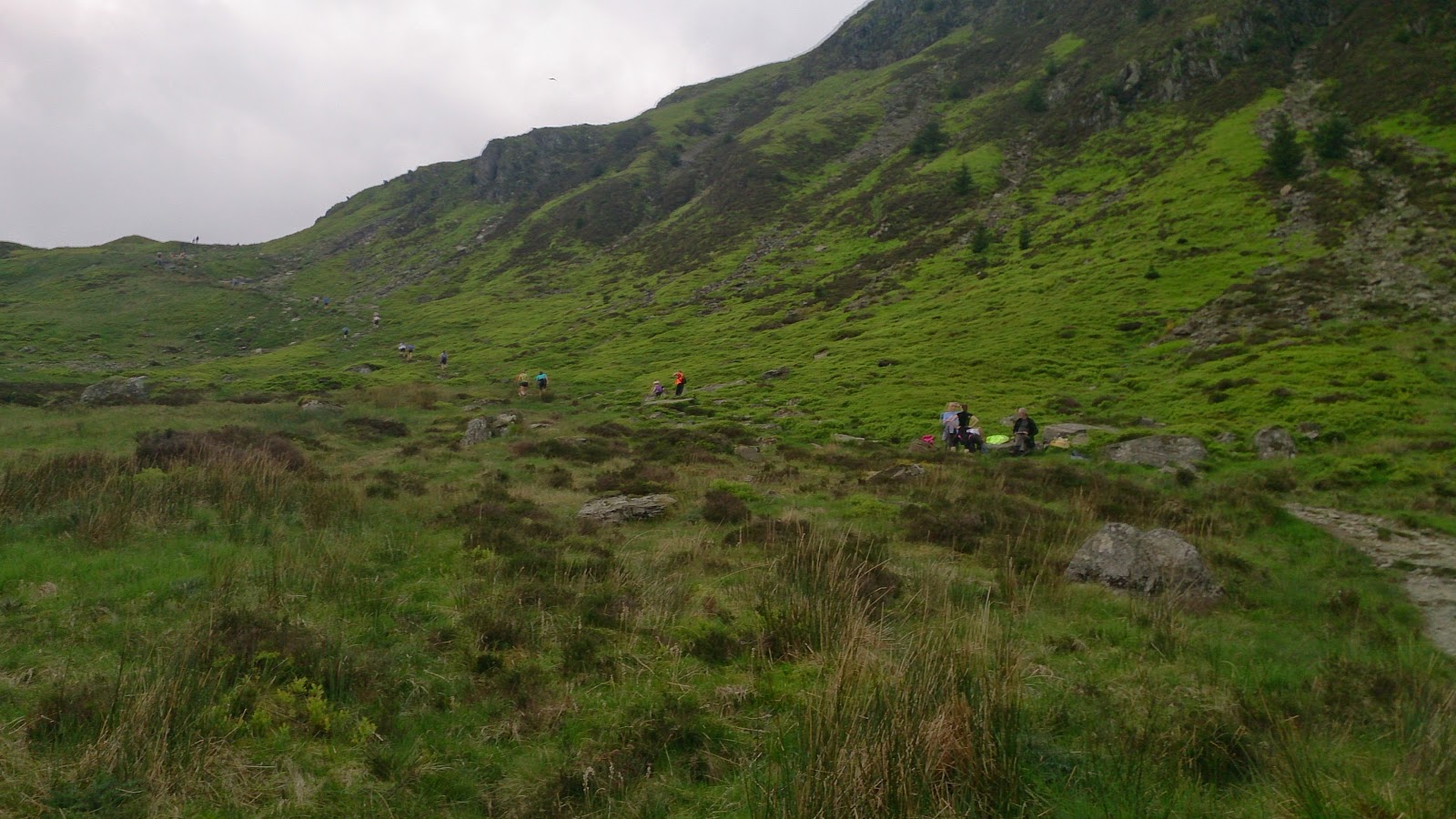
Then the path turned right onto the open hillside and kept going gradually uphill from here to the summit. On this narrower path it was impossible to pass anyone and we all shuffled along at the same tempo. Soon we were all almost at a fast walk/ clamber. Although initially I was managing to break back into a jog on the flatter bits it was soon obvious that a forced march was more the order of the day. Although I was passing hillwalkers regularly I could see that the other runners were beginning to leave me behind.


Other runners becoming dots on the path ahead of me

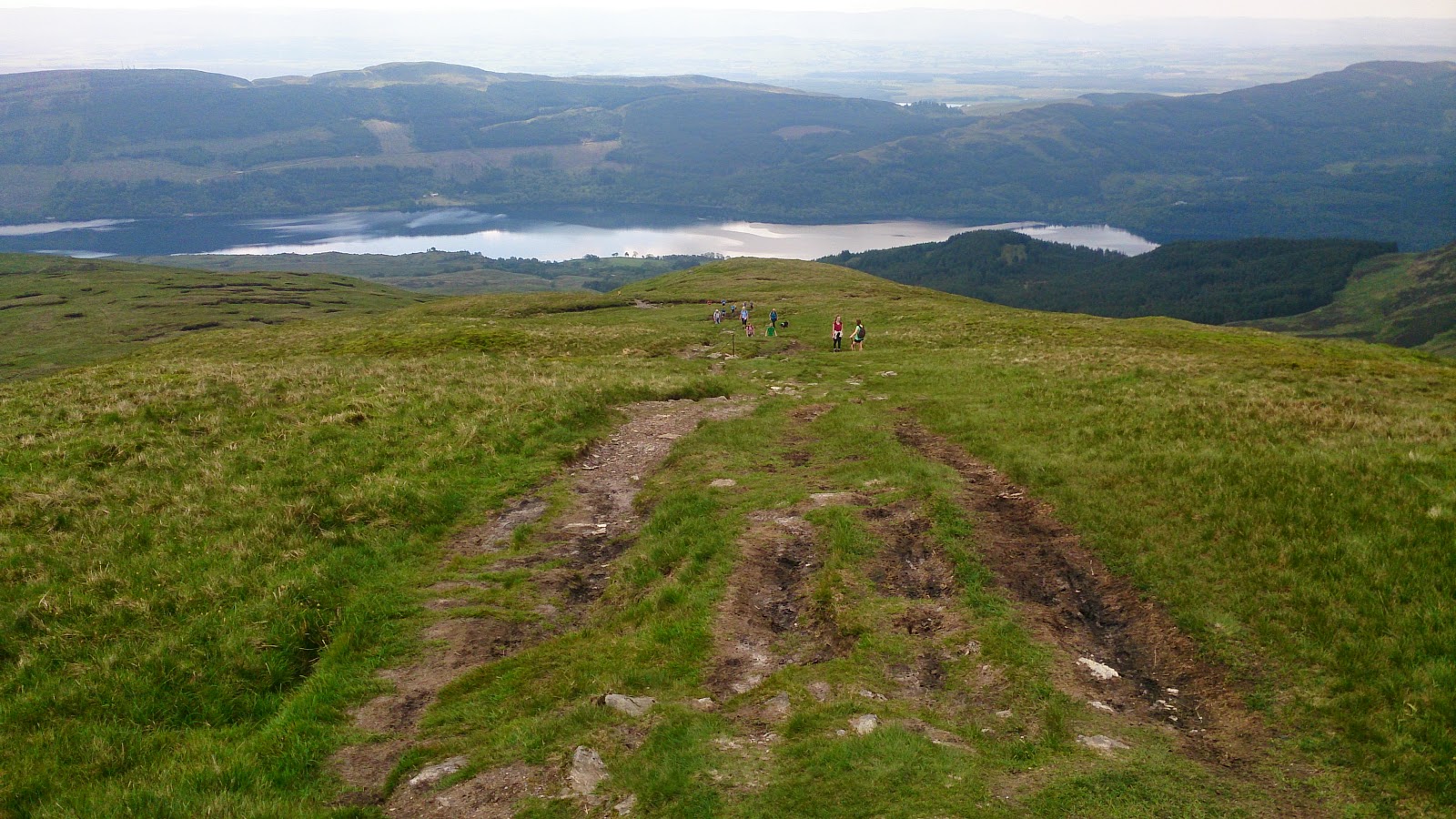
Looking back down the path towards Loch Venechar
After a couple of false summits I reached the top. My thighs were aching by now but I was still able to enjoy the glorious views. From here on a clear day like today you can see down to Loch Katrine and over to Ben Lomond, Ben Lawers, Stuc a' Chroin and Ben Vorlich.

View from Ben Ledi summit to Loch Lubnaig
I thought that I was not bad at descending and here would get my chance to reel in those that had got ahead of me but as I came over the top the runners which I had sight of a few seconds earlier appeared to have vanished, leaving only a line of fluorescent flags outlining the route for me to follow. I had checked my blood glucose a few times on the way up to see how this type of running affected my diabetes and it wasn't any different to running on the flat, with 40g of glucose tablets being necessary after an hour and seeing me safely to a finishing blood glucose of 6.5mmol/L. (If you are interested in these things 11.5mmol at the start, falling to 10.2 after 30 minutes, 4.2mmol at the summit - one packet Lucozade glucose tablets - 6.5mmol at the end).

Start the descent. Glorious views and flags showing the way
It was a relief to be stressing different muscles in my legs and I enjoyed the descent. As it came down into Stank Glen there were some boggy patches, but mostly an obvious gravel path. My plan to save a bit in my legs to catch people on the way down didn't quite work as one person came past me halfway down, and another caught me almost on the line. The last kilometer was back on the forestry roads and meant I could pick up the pace here.
Descending into Stank Glen
My best 10km time is at 42 minutes, recently I've been nearer 50 minutes and I managed this 10.5km route up and down Ben Ledi in 90 minutes. The last time that I saw Prasad Prasad was at the start line and predictably enough he won the race, in a time of about 57 minutes. In road races I can usually finish just inside the top third, here I was safely in the bottom third. However I had a great day out, everyone was very encouraging, friendly and supportive and I am already looking for another hill to run up.

Profile and route from Runkeeper.com

It would be remiss of me not to mention the nearby excellent Mhor 84 Motel at Kingshouse, Balquhidder where I had a lovely lunch after I finished.

I have the Glasgow Men's 10K in a week's time (lovely and flat), so after that I'll plan the next one. I would train differently though. If I cannot get onto more hills in training I'd try to have a weekly session on the stairmaster thing in the gym to get my quads a bit more used to it.

However no tick bites, no sprained ankles, lovely weather, gorgeous scenery.

Perfect.