Sunday, 1 September 2013

Partick Thistle Away Days - Paisley

31st August 2013. St Mirren 1 - 2 Partick Thistle


Being less than a year old when Partick Thistle won the Scottish League Cup in 1971 it was a while before I got to see them win anything. Mine is a team which you follow more in hope than in expectation. This made the league title triumph last year all the more special. Part of our reward for finally emerging from the First Division is the chance to get away from playing the same old teams year on year, ad nauseam. Some old rivalries are re-visited, such as with St Mirren this weekend. It feels like a meeting with distant cousins that you haven't seen for a decade but immediately fall into the same old conversations you were having back then. St Mirren have followed a similar up and down history to Partick Thistle and their League Cup success of last year was a rare high for the team and manager Danny Lennon.
 
The last time that I was in St Mirren's old ground at Love Street was in 2002. Danny Lennon was captain of the Thistle team that day I think, with Alan Archibald and Scott Paterson playing alongside him. Today they would all be in opposing dug-outs. Derek Fleming scored the second goal that day, breaking his leg in the process, but securing our promotion and exacting revenge on the team who had relegated us here six years earlier. That match was marked by my wife wearing a soggy Scotch pie whilst we drank curry flavoured champagne on the way home. When Thistle's first goal went in somebody's pie was launched high into the air as we all leapt to our feet. It came down with sufficient force to kind of explode on landing on my wife's head, being mushy enough to give her hair the full hot oil and mutton beauty treatment. Planning ahead we had a bottle of bubbly with us in case promotion was secured and had picked up some polystyrene cups from a local shop in case we had the chance to drink it. Unbeknown to us these appeared to have been stored beside the shop's spices and carried a pungent curried aroma which they flavoured our celebratory drink with. Curried champagne, you should try it.
 
Since that day St Mirren had gone and got themselves a new stadium, so there was the added pleasure of ticking off another ground I had never been in before on today's visit. As I had ran the Paisley Life 10K last weekend through the streets of the town I had a wee idea where I was going this weekend as the race route went around the abbey and then out past St Mirren Park, the 8,000 capacity ground the team have been playing for the past four years. 1500 people ran the race that day and we brought that plus an extra 100 to town with our usual decent travelling support.
 

When we slumped down through the divisions in the late nineties I kept going along to games despite, I think, going for 2 years without catching a Partick Thistle victory. Part of the draw at that time for me was the strange wee towns I got to see. It is unlikely I would have visited Forfar, Methil or Arbroath in those years if it wasn't for the sake of following my team around the country. I do hope that some of The Rangers fans doggedly watching their team through the lower leagues manage to enjoy the experience and maybe reconnect with what football means to some of the people in these places. Even if it is just the excuse to wander into a local boozer that you wouldn't normally go near, wearing the football scarf of an visitor gives you permission to come in and usually triggers off some random conversation with a complete stranger. I usually like pitching up a couple of hours early and having a wee stot about beforehand to get a feel for the place or pretend I'm a tourist just arrived from outer space to see what they'd make of my country.

Despite Paisley being only a few train stops away I have never really spent much time in it since Arnotts shut down and my granny had no reason to be driven here. When I was previously addicted to tracing my family tree it all led down in this direction, I can trace them back to farmland just south of Paisley in the 1640s. Then over the next few hundred years like many people in this part of the world at that time, weaving became their trade, before their descendants followed the heavy industries into Glasgow. With my children in tow for the football at 3pm I arrived nice and early in Paisley and looked around the Paisley Museum. We didn't have time today to look around the Coats Observatory which is part of it, Scotland's oldest public observatory. It was gifted to the town by the Coats family who made their fortune in the silk thread and weaving industry the town was famous for throughout the world. Less impressive than the Paisley pattern and Paisley shwls on show is Buddy the moth-eaten lion, sufficiently famous in these parts to justify the balloons on sale in the shop announcing that "Buddy the lion is back in Paisley!"

Following the weaving thread (gerrit?) we headed to Sma' Shot Cottage, an old weavers cottage in the town which shows you living conditions and looms from the times before the industrialisation of weaving, when people worked at their own looms at home, like my ancestors in nearby Kilbarchan. Amongst the olde worlde stuff on show I liked the jeelie pan lying on the floor, because we had picked a lot of berries recently up the road at East Yonderton Farm and made jam using one identical to this, which used to belong to my wife's great-granny. The volunteers working there were falling over themselves to tell us all about the history of the place and that of the Sma' Shot strike of 1856. The guide was a pains to tell us that the annual Paisley Sma' Shot day that marks the anniversary of the strike is not commemorating the gifting of the fee by the bosses as the local paper apparently claimed last year, but to mark the efforts of the strikers who forced it out of them. The "Sma' Shot" was a hidden thread that held the delicate work of these Paisley weavers together. Despite the thread being an essential component of their work, as it was hidden it was felt that this thread didn't merit payment. With rebellion in the air across Europe at that time the weavers had the full force of the law brought against them and were taken to court. A member of the Coats family, who were not exactly impartial observers in the dispute, was on the jury of the case and apparently pushed for compromise at that late stage and they were awarded their payment.

As it is celebrating its 850th anniversary this year we also stuck our heads into Paisley Abbey. It was established in 1163 on the site of an old Celtic church founded 600 hundred years earlier by St Mirin. It is thought to be where local Renfrewshire lad William Wallace was educated by the monks of the abbey. It wasn't until 1877 that St Mirin got round to founding a local football team in his name to keep the local weavers distracted when they weren't at work or church.

The abbey has undergone restoration work in recent years and new gargoyles were commissioned as part of this. Amongst some of the wackier ones can be seen an Alien style monster emerging from the side of the abbey in the style of one emerging from John Hurt's stomach. Briefly peering through the windows of the home of  "the weaver poet" Robert Tannahill en route, we walked up to St Mirren's new ground. There was a fantastic crowd behind the goal at the Thistle end for the match (BBC highlilghts available here to viewers in the UK), although our players tried to pick off a few with their pre-match shooting practice. About a dozen stray shots were blasted at us and one unfortunate ricochet caught a more elderly fan on the back of the head knocking him down the stairs where his fall was broken by another. Patched up by the St Andrew's ambulance first-aiders he was thankfully able to watch the match, but we had a measure of where Thistle's shots would be aimed for the first 80 minutes of the match. If points were awarded in this league for passing and possession I am pretty sure we'd have a European place in the bag by Christmas. Unfortunately it is goals that points get awarded for and that proved more elusive for us. Thistle shouts for a penalty went unheeded by Willie Collum as Baird was bundled over in the box and clear chances were in short supply at the goal under us in the first half. Against the run of play St Mirren scored after 50 minutes when a cross from the corner was turned in at the near post. Thistle just kept playing football though. Pass, pass, pass our familiar mantra from last season. Eventually after a wee back-heel from Craigen I think, Higginbotham swept it into the net from the edge of the box and two minutes later Forbes's left foot turned defeat into victory. Every point this season could be important but these were 3 points I thoroughly enjoyed watching us get. Unfortunately for Danny Lennon, despite his recent League Cup success this means his position is now under pressure and St Mirren are only kept off the bottom of the league by Hearts and their 15 point deduction.
 
With that I'll leave you with Robert Tannahill's words, maybe he is thinking of St Mirren with these lines.
 
On A Crabbed Old Maid.
Here slaethorn Mary's hurcheon bouk
Resigns its fretful bristles:
And is she dead? No—reader, look,
Her grave 's o'ergrown wi' thistles.


Our own olde worlde jeelie pan in action last month 

Friday, 30 August 2013

David Byrne and St. Vincent, Glasgow Royal Concert Hall

David Byrne's Talking Heads must surely have appealed to everyone who like me was 13 or 14 when "Road To Nowhere" was released. As well as the catchy tune, their use of these new-fangled video things was pretty unique and memorable. They were at their peak before I was actively buying records or going to concerts, so I was a Johnny-come-lately to David Byrne's output. I have though bought much of what he has been doing over the past 20 years, including stuff like his "Young Adam" soundtrack and his excellent book from last year "How Music Works". So I jumped at the chance of seeing Mr Byrne performing at Glasgow Royal Concert Hall this week.


As well as coming over as effortlessly cool and groovy he is, of course, essentially Scottish (these two facts are not unrelated). Born in Dumbarton his family emigrated to America when he was only 2 years old, but we know that he was back in the mother country last night, even if he was too serene to make any mention of it. Whatever reason we were there for he had a full house at the Glasgow Royal Concert Hall. The current album he is touring with is "Love This Giant" a collaboration with St. Vincent (Annie Clark). Her last album, Strange Mercy, is worth looking up if you haven't come across it already. Love This Giant is a complicated collection with slick production and lots of brass, so I was intrigued to see how they'd do this live. As it turns out they did it with slick production and lots of brass. He wanted you to sit and watch, so started with an announcement asking people to take photos if they wanted but not to watch the show through "a device", blocking everyone else's view - a request greeted with a heartfelt round of applause. (I'm fed up watching a band between a wee cluster of the people's phone screens).


Exhibition of brass instruments?

As you'd expect from someone with an eye for the visual effect as much as the aural (remember the big suit?) the whole show was carefully arranged and choreographed. For 2 hours the fantastic 8 piece brass section danced, marched and manoeuvred around the stage between the jerky robotic dancing of Annie Clark and the affected dad-dancing of David Byrne. Her guitar playing was warm and precise and the whole show has obviously been worked on and rehearsed for many an hour to end up looking this effortless. The brass sounded funky and jazzy but not ever cheesy. I love a bit of brass, and despite having been to many a Ska gig over the years have never seen a brass section as classy as this. (If only I hadn't stopped the trumpet lessons at school after 2 years, that could have been me up there!)

It was good to get a smattering of the solo material from both of them in amongst almost all the tracks of their joint album. St. Vincent's "Cheerleader" and his "Lazy" were stand outs. Talking Heads' "Wild, Wild Life" also featured, which apparently he hasn't performed live until doing this tour despite releasing it in 1986. The crowd of the venerable Concert Hall were on their feet for the encores which included "Burning Down The House" and finished with "Road To Nowhere" snaking around the stage with a brass band conga.

A great show and great performances all round.

Sunday, 25 August 2013

Edinburgh. This Looks A Bit Like Alexei Sayle

Banksy: The Room In The Elephant. Pleasance Courtyard

Edinburgh Art Festival

Alexei Sayle. The Stand Comedy Club

Marcus Brigstoke, "Je m'accuse - I am Marcus". Assembly Hall


Brief reviews from my second trip through from Glasgow to the Edinburgh Fringe this year. I wanted to see some comedians this time, but as they don't wake up until the afternoon there was time to squeeze in some other stuff first.

We started off by going to see the exhibition on Mary, Queen of Scots at the National Museum of Scotland. It is an absolutely fascinating collection of stuff and the story of her life reads like a ludicrous Hollywood plot. I know the history of a nation is not the same as the history of its kings and queens but it is a story worth hearing. I've been inspired to try to find out more as it is a period of European history that ties me in knots. John Knox seems to have been a constant thorn in her side. As well as her Catholicism he wasn't big on female monarchs either apparently. A proper ray of sunshine he seems to have been.


Whilst promoting his film "Exit Through The Gift Shop" in LA in 2011, graffiti artist Banksy got chatting to a homeless man who had been living in a disused water tank. With his permission wrote "This looks a bit like an elephant" on the side of it. Cue rapacious grasping for ownership of a Banksy work (which the artist refused to authenticate) and Tachowa Covington was made homeless. Here Gary Beadle off of Eastenders plays the man who had made his home in the tank for the 7 years before meeting Banksy (as Titus Coventry here). The story asked lots of questions about what makes art 'art' without really giving any answers. Gary Beadle's was a gripping one-man turn, as he debated issues with the toy rat he had for company (a recurring Banksy motif) and Bristolian music from Portishead and Massive Attack occasionally broke in. However in a surreal twist at the end we were introduced to the man himself, Tachowa Covington. He is over from LA and saw the show for the first time himself today. A lovely twist that slaps you in the face with the fact that this is a real life being recounted. The man himself had dressed up in a purple kilt and a fedora to mark the occasion. You can only hope that he manages to get some personal benefit from the play, to help him get what he wants in life. Shame we never got to hear his thoughts on it and I hope some journalists are all over him tonight to hear his tale.

After that we had time to dash about some of the exhibitions which are part of the Edinburgh Art Festival. One of the best is in the ever-reliable Fruitmarket Gallery where there is an exhibition of paintings, photography and sculpture by Gabriel Orozco, Thinking In Circles, in which the geometric motif is played out in a variety of ways. The centrepiece is a painting called The Eye of Go. This I liked as I have read a couple of Japanese novels and a manga which feature the game of Go, played with black and white discs. GO is also the artist's initials and a verb which opens up a variety of meanings. (D'you see what he's did there?). If you look at them long enough you start to see Mickey Mouse too.

The Eye of Go, Gabriel Orozco
There has been a lot of love for the Peter Doig exhibition on at the Scottish National Gallery, No Foreign Lands. The Scottish-born artist, little known in his own country, has lived extensively in Trinidad and this exhibition features works painted over the past 13 years since he returned there. The scale and vibrancy of the paintings is more remarkable in the flesh than in any of the reproductions of his paintings which I had seen in the papers before I went along to see it. Often there is a sun-bleached, dreamy quality to them. I liked the colour and composition whilst my wife was unimpressed with his draughtsmanship. Then again I quite like the primitive works of French painter 'Douanier' Rousseau whilst she hates them.

Keeping the Mary Queen of Scots theme going we had time to have a quick pint in the Queens Arms before wandering on via the Open Eye Gallery who have a interesting show of Alberto Morrocco's early works and sketches on show. I'm personally not a big fan of a lot of his later work but his skill shone through in these. I particularly liked the pen and ink sketch of a drunk man falling asleep on the train. Around the corner in the National Portrait Gallery on Queen Street, there is a temporary exhibition of new work by someone else who can definitely draw. Ken Currie's work is painterly, skillful and full of atmosphere. To be honest seeing these made me re-appraise my opinion of Peter Doig's stuff we'd seen earlier as these paintings had so much more to them on many levels.

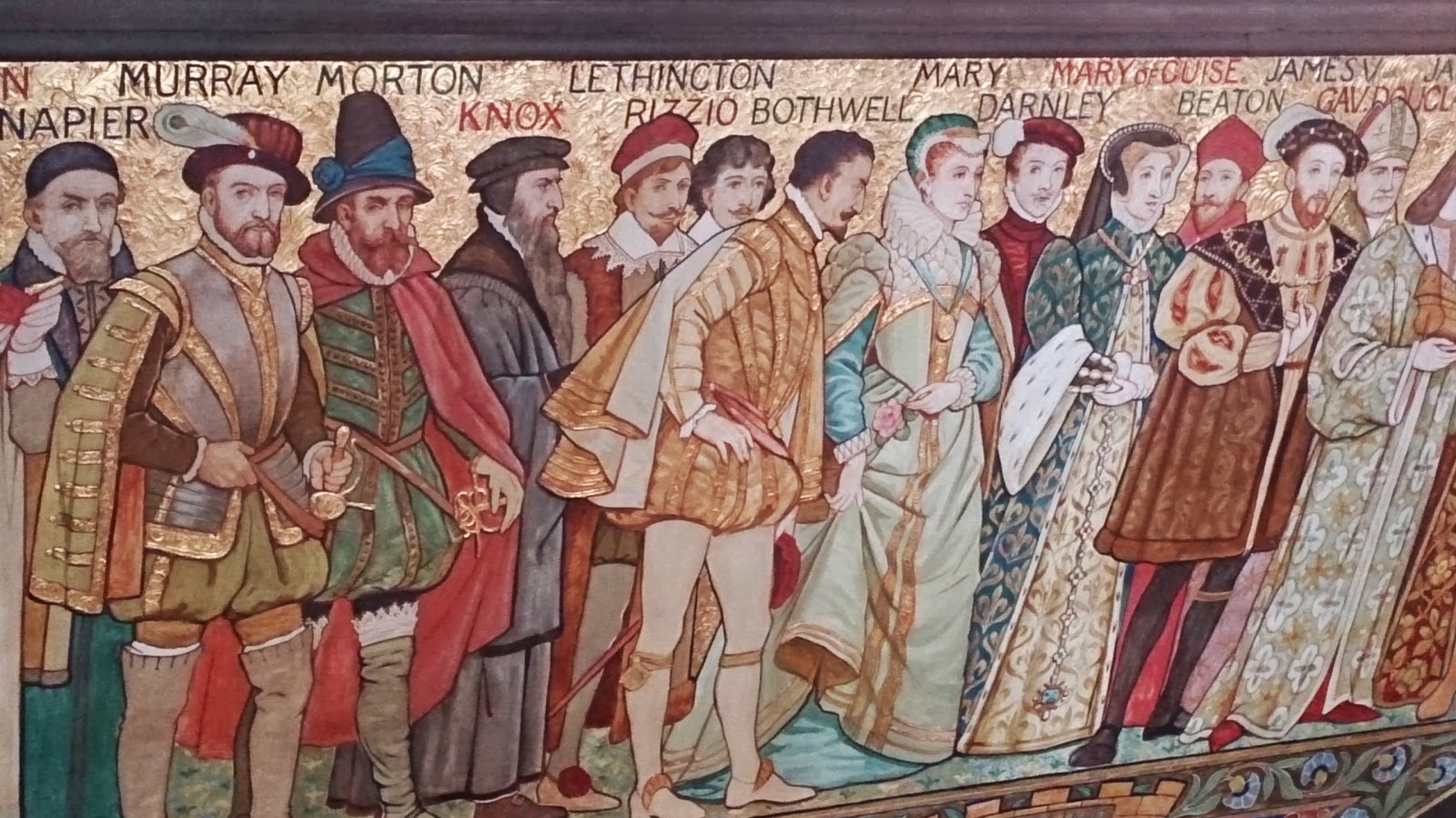
John Knox scowls at Mary Queen of Scots in the Portrait Gallery
Running upstairs past the mural featuring Mary, Queen of Scots (once you start noticing her she's everywhere) we went to see the Man Ray photographs, a fascinating collection of people captured by his camera. The Fleece to Fibre exhibition in Dovecote Galleries is worth looking in at, if for nothing more than the spectacular photograph portraits of the sheep. I also liked Rachel MacLean's slightly mental exhibition on at Edinburgh Printmakers, I Heart Scotland. A bizarre spectacle, as if the souvenirs from a tacky tourist shop have come alive in her photomontages but done with a great sense of humour. Her Lion and the Unicorn film maybe shows where the independence debate should be going instead of the current petty sniping we have to endure.
Alexei Sayle doesn't stand still when doing stand up
So as the galleries closed their doors it was obvious that the comedians were waking up. We had passed Jerry Sadowitz, Tim Vine and John Lloyd in the streets but we weren't here for them. Alexei Sayle is a comedy legend as far as I'm concerned. He first entered my consciousness as the shouty, angry landlord and various random, mental members of the Balowskis family in the Young Ones TV show, before going on to have his own TV series of monologues and rants. One time member of the Communist Party, actor in Indiana Jones and the Last Crusade and if you haven't read any of his novels then you are missing a treat. I shouldn't forget "Hello John, Got a New Motor" either as it appears to be one thing he reports that people still expect him to do. As the original compere of the London Comedy Store he was present at the birth of "alternative comedy" but hasn't done stand up himself for about 16 years. As you'd hope, he is a bit vitriolic about the current banal level of observational comedy and also pillories the current upper class stranglehold of media, the arts and government. Apart from the fact that he had something to say, he was also laugh out loud funny whilst saying it.

We were given a free firework display from the Tattoo whilst we waited to get into the Assembly Halls on the Mound, where we were greeted by a statue of John Knox as we made our way in, snarling over the temporary bar set up here. Is it the piece which he wrote called "The First Blast of the Trumpet Against the Monstrous Regiment of Women" that they commemorate here with this statue or some other achievement of his?

Marcus Brigstocke is the omnipresent voice of liberal ire on Radio 4 comedy programming at present. He seems to have had a couple of shows on in Edinburgh this year, and 2 days into a three week run here he tells us that he tore his achilles whilst jiggling about on stage. He has soldiered on and starts by saying he'd decided not to do any political stuff this year. So instead we got rather banal observational stuff. His tales of his boarding school and the scary working class people he met on the oil rigs felt a bit hollow after Alexei's sharper stuff earlier. I like Marcus Brigstocke and he seems a very nice chap. However I recognise the childhood world with the local Communist Party branch having meetings in your front room and eating all your biscuits more than I recognise the traumas of being a fat boy in boarding school.

Maybe by this time I'd had enough of the tipsy Edinburgh rugger types pushing into the queues or the plummy Morningside diners vacuous conversations at the table beside us for dinner ("But we're just not rich enough to pay the Gift Aid prices, are we dear?"). Time for the midnight train home to Glasgow where people either re-enacted Morocco's head-nodding drunken nap or blethered aimlessly to strangers.

I have only really started in the past couple of years making the effort to head east along the M8 for the festival. Obviously it is a hugely successful enterprise for the city, but I just wish they would make it feel a bit more inclusive. I know that in recent years they have consciously targeted those living in Glasgow's G12 area for ticket sales. I just wish that they'd make a bit more effort to attract those living in G15 and G34 as well. I like Edinburgh, but you can have it back now that the Fringe and Festivals are coming to an end.

Wednesday, 14 August 2013

Death and the Poet

Review: The Events by David Greig, Traverse Theatre

Review: The Poet Speaks, Philip Glass and Patti Smith, Edinburgh Playhouse


I took my first Edinburgh festivals trip along the M8 this year to take in Patti Smith and Philip Glass, but before that managed to squeeze in a visit to the Traverse to see David Greig's new play. On a late summer evening Edinburgh was looking very handsome I have to say.

Edinburgh
The Events deals with the aftermath of a mass shooting, where a survivor, played by Neve McIntosh looks for answers to the inevitable question - "Why?". There appears to be an understandable searching for a reason after these events (I'll use his word), people asking "why did it happen?", desperate to understand, to find some meaning in a pointless act. On Channel 4 just now the drama "Southcliffe" follows the lives of the perpetrator and the victims of a mass shooting in a fictional English market town. However when we get specific in this fiction, the close up attention to the detail of their lives in this TV drama, it begins to feel unreal, manipulative and fake as many real people have gone through these terrible incidents in the real world in their own individual ways. You end up thinking "that pub looks too busy" or "would you really say something like that?". You cannot help but think that the feelings that people affected do experience are unique to them and just unimaginable to someone who is not them. I'll watch Southcliffe to the end but it seems unsure what story it is trying to tell.

Rather bizarrely David Greig took a trip to visit Norway, researching the aftermath of the Anders Breivik shootings whilst writing the stage adaptation of Charlie and the Chocolate Factory. This led to some alarming (and incorrect) reports that he was writing a musical of the events which occurred in Utoya that day. What he did write was this play, The Events, which is showing just now at the Edinburgh Fringe before transferring to London. It does feature singing, but in the form of local choirs playing a Greek chorus to the story. The Events used similar devices to Southcliffe with flashbacks and different characters, played with gusto by Rudi Dharmalingham, flitting in and out. However the story here was more focused than the TV drama and the amateur choristers gave a stumbling feeling of real life to it all. The play worked well whilst walking a tight-rope of the sensitivities around the issues raised within it.

As Allen Ginsberg said in Father Death Blues,
Suffering is what was born
Ignorance made me forlorn
Tearful truths I cannot scorn
 
The many faces of Neve McIntosh
One last aside. Neve McIntosh's twitter profile reads "Actress and part time Lizard Queen!!!!". Is she at risk of being typecast? One minute she's tortured, guilt-ridden, lesbian vicar, Claire. Next she's Victorian sword-wielding, crime-fighting, lesbian Silurian, Madame Vastra who she plays in Doctor Who. Well, maybe not.

The other performance I'd specifically wanted to see in Edinburgh tonight was Philip Glass and Patti Smith's "The Poet Speaks", an evening in tribute to Beat Generation poet Allen Ginsberg. He died in 1997 and was a friend to them both. They've been doing these evenings together for a while now and it was the concept rather than any of three constituent parts (Glass, Smith and Ginsberg) that drew me to this show. The work of Philip Glass I have enjoyed without ever feeling particularly engaged by it, since I first heard it in Glasgow in 1990 (1000 Airplanes on the Roof - the projected backdrops is about all that I remember from that night). The "Beat Generation" is no more my generation than the flappers and Anita Loos were the generation of Ginsberg, Kerouac and William Burroughs. Their work has never grabbed me particularly and I find their books a bit self-obsessed.

Likewise, Patti Smith I think you either get or you don't get and I'd probably put myself in the latter camp (in much the same way that I "don't get" Jim Morrison). I struggle to see her as the "Godmother of Punk" that she is sometimes painted as. I like "Because The Night" as a Bruce Springsteen song rather than as a Patti Smith song and wouldn't be surprised to hear "People Have The Power" on a soap powder advert. It just doesn't seem to have any fire in its belly, the way a Gil Scott-Heron song or poem just does. My personal perception of her is more of a rather humourless, self-important individual who was in the right place at the right time to be part of a scene which on the whole generally leaves me a bit cold.

Patti Smith and Philip Glass

So I came to the Edinburgh Playhouse, which was filled to capacity, hoping to be proven wrong. Despite Ginsberg looking down on us from the projected photographs of the backdrop this was mainly about Patti Smith and Philip Glass. The meaningless, shamanistic ramblings of the shooter in The Events were rejected by Claire's choir for the gibberish that they were. Patti Smith however is someone who still appears happy to embrace the shamanistic affectations and eastern mysticism. She started the evening with her own poems which meandered through vague Earth-mother and Buddhist tropes (Notes to the Future, The Blue Thangka) whilst Philip Glass accompanied her on piano. Ginsberg's Witchita Vortex Sutra had more bite to it. She then read some of her favourite poems from Robert Louis Stevenson's A Child's Garden of Verses. Never can The Land of Nod have been read with such portentous earnestness. It ends with the line "The curious music that I hear" echoed in the line "Some strange music draws me in" in the verse of her song Dancing Barefoot which she followed it with. She repeated this trick with two other RLS poems (eg Looking-Glass River leading to her singing Pissing In A River with some gusto). Dedicating John Lennon's Beautiful Boy to Kate and William's wee George was a bit "yeuch". What was striking was the rhythm and pace Stevenson's poesy demonstrated in contrast to the earlier free verse.

Allen Ginsberg
More rhythmic again was Philip Glass who came back for an impressive run through excerpts from Metamorphosis and Etudes. Then Ginsberg's poems got a look in again towards the end with a rendition of the touching poem Aunt Rose and the strident anaphora marching out in Footnote to Howl and On Cremation of Chogyam Trungpa. The night was finished off with Tony Shanihan on guitar, Philip Glass on piano and Patti Smith singing her soft rock anthem People Have The Power, definitely a bit of a curio.

She certainly has a stage presence, but her serious, humourless, declamatory style (even when reading children's poems) I found a bit wearing.

Monday, 29 July 2013

1995–96 Scottish Premier Division - Panini album

A Jagscast blog last week, before our opening SPFL Premiership (honestly, is that what it's called?) fixture against Dundee United has looked back at previous encounters between the two teams. Top of their list was the relegation play-off at the end of the 1995-96 season, when Dundee United beat us over two legs to join Dunfermline in the top league, whilst we joined Falkirk on the way down. For us this was the start of a financial collapse that almost saw the end of the club and a slump to the lower end of the third tier over the next couple of years.


With my nostalgia for those heady days awoken by that blog I went rummaging in the garage to see what I could find to remind me of those times. I was pleased to find an old Panini sticker album of that season and I thought I'd share some of the Thistle treasures I found within. One thing I'd say is that it wasn't a great year for goalkeepers' strips.

So, to the Partick Thistle page....oh, that's who started as manager that year after Lambie and Gerry Collins had ben enticed to join Falkirk (and were promptly relegated for their troubles).


Murdo MacLeod - manager
So what about the squad then? I shall just put all the photographs up without comment and you can see how it compares to the current squad.

 
Each team section is finished off by the rather exaggerated claim of the players "in action". Here are the Thistle players "in action", which also displays that year's honking away top to all those grumbling about this year's uninspiring effort. As usual there is one of my pet hates as we end up being called "Partick". To anyone reading this who doesn't know, we have never been "Partick", stick to Thistle or Partick Thistle please.

 
To be honest, Thistle's photographs are not too bad, except for Nicky Walker's jersey. So I had a wee flick through to see who else with Thistle connections was in the album. Here are a few for you.


On the Hearts page there is someone who should have been Scotland's No. 1, positioned above someone who shouldn't have been allowed near the national team.


Finally here are a few random pictures to remind us all what a collection of global superstars Scotland's top league can foster, as we get ready to rejoin it.

Darren Jackson - not the greatest photograph
Alex McLeish - not the greatest manager
Billy Dodds - not the greatest pundit
So that's enough nostalgia. Here's hoping that 2013/14 is remembered with greater fondness than 1995/96.

Sunday, 28 July 2013

Sighthill Stone Circle - Rock Music

It's always a treat to see Mogwai perform. The post-rock band have been ploughing their own furrow for almost two decades now and their fabulous soundtrack album for the French TV series Les Revenants/The Returned seems to be winning them new followers and appreciation. Listening to their albums you sometimes forget the impact that their live performances have, shifting from low key tranquil passages to crashing white noise that feels like getting punched in the chest. They've had a busy couple of weeks as they performed their soundtrack to Douglas Gordon and Philippe Parreno's film Zidane live in Manchester, London and Glasgow over the past fortnight. Alongside that frontman Stuart Braithwaite has been busy organising a gig and doing the round of newspaper interviews to raise publicity and funds for the campaign to save the Sighthill Stone Circle.
Looking west from Sighthill stone circle
Designed by Duncan Lunan, the astronomically aligned stone circle was erected in 1979 in an imaginative use of the government's Job Creation Scheme and was immediately criticised by Margaret Thatcher on her arrival in power. To this end it was never properly landscaped or completed and has always been a wee forgotten corner of Glasgow. Stuart Braithwaite (of Mogwai) is the son of John Braithwaite, technical supervisor to the project. Glasgow City Council recently announced plans to remove the circle as part of their application for the World Youth Games 2018, as part of a housing project. However as their application has failed, uncertainty surrounds the future plans for the area and there is growing support for investing in maintaining the green space around the circle properly and refurbishing Sighthill Park with the stone circle as its focus, completed to the original plans.


But before seeing Stuart playing solo at the Sighthill Stone Circle gig we had the chance to see Mogwai perform last weekend in Glasgow. The venue at 220 Broomielaw caused a bit of head scratching but turning up on the night revealed that it was indeed the gap site down by the Clyde where the stage had been set up outdoors. Fortunately in a rare outbreak of summer they had picked a balmy evening and as the sun went down behind the neighbouring buildings Mogwai came onstage to perform the Zidane soundtrack live with the film projected behind them. I am a big fan of documentary films but this portrait of the footballer Zinedine Zidane plays out more like a drama with the rising music of Mogwai telling the story. It is quite hypnotic as we watch a Spanish league match but with the 17 cameras all focused on Zidane in real time. He broods, he frowns, he seems peripheral and in his own wee bubble whilst we read occasional subtitled thoughts from him on what goes through his head during a game, he paws the ground like a racehorse. As if someone scripted the whole thing, after initially going behind he lays on a fantastic pass for one of Real's two goals, emotionless throughout. When an unexpected smile breaks across his face it feels like high drama, then a minute later he needlessly punches someone and is sent off. It is quite hypnotic but I hadn't realised until seeing it live how much the music is the narrator of the drama. The final ear splitting crescendo left me waiting and waiting for Zidane's final, explosive act. The whole thing manages to convey the drama that is found in even the most mundane of football matches, and was made shortly before Zidane's crazy headbutt of Materazzi in the world cup final, showing that the film makers managed to capture something of the man.


Emma Pollock
Six days later a fantastic line up of musicians performed at Easterhouse's Platform for the Sighthill Stone Circle cause. As my priority that Saturday afternoon was Partick Thistle's return to Firhill after the summer break (a nil-nil draw against AEL Limassol which didn't quite carry the same drama as Zidane's match) we missed Aidan Moffat's opening set and I think Duncan Lunan spoke about the circle too. However we were there to catch Graeme Ronald in RememberRemember guise, fighting against the noise from the bar with his looping tunes. After his first album I wondered how much mileage there was in this and then he came out with the fantastic "The Quickening" album, combining great music and a possible reference to one of my favourite films. So I await his next move with interest. Next up was Eugene Kelly, once of The Vaselines doing his guitar and mouthie thing, before we were back across into the smaller hall for the exceptional Emma Pollock. (Is it just me that sees Shirley Henderson and Emma Pollock as twins seperated at birth?) The one-time Delgado performed solo and then backed by 75% of the Cairn String Quartet. Her new material sounded good, particularly her song for Strathbungo, "Marchtown".
 
Stuart Braithwaite
Then we had Stuart Braithwaite and it was great to hear some of the Mogwai material stripped down to just his singing and guitar, such as CODY. The highlights were from the more soulful, gospel end of the spectrum such as "What Are They Doing In Heaven Today?" which is a perfect fit on the "Les Revenants" soundtrack. Seeing him doing these songs in this way you can see the strange roots of Mogwai's music in these southern gospel and blues tunes. Next up was the winner of this year's Scottish Album of the Year award, RM Hubbert doing his thing on guitar but singing some of his new material too. He also reprised two tracks off of his last album accompanied first by Emma Pollock for Half Light and then in a finishing "battle of the bearded SAY award winners", by Aidan Moffat for Car Song.
  
Aidan Moffat and RM Hubbert
Kilsyth shoe-gazers The Twilight Sad brought proceedings to a close. As you can see it was a feast of fine tunes and I think they sold themselves short by charging only £6 for the tickets. So if you are wanting to find out more about the Sighthill Stone Circle, sign the petition or get involved in the consultation, have a look at their website. Even better go and have a look at the circle itself and imagine what could be done to sort it out rather than demolishing it. If for no other reason than for the fact that it wound up Margaret Thatcher, take a minute to find out about it. Surely that is a good enough reason for preserving it?
 

Sighthill Stone Circle looking east

Thursday, 18 July 2013

Cycling, the Obree Way

Reflections on cycling in the UK after hearing Graeme Obree tonight


David Millar on Byres Road, Glasgow last month. More of my pictures here
The British national Road Race Championships passed through Glasgow last month, a dry run for the Commonwealth Games road race event next year. The amazing thing was that in both the men's and women's events the field was lead by athletes familiar to most of us watching in the impressive crowds at the side of the road. I used to love watching the Tour de France when Channel 4 started showing it. In those days the only British cyclist that I knew was Robert Millar. He appealed to me because he was Scottish, won the King of the Mountains and was a bit prickly, which is no bad thing. Beyond that, unless you were in a cycling club or subscribed to Cycling News you'd be largely oblivious to what cycling went on for the rest of the year. Now that Mark Cavendish, Nicole Cooke, Chris Hoy, Victoria Pendleton, Bradley Wiggins and their ilk have achieved great success, are we now a nation of cycling enthusiasts? We might like watching it, but a holiday trip this month across the Netherlands, Germany and Denmark has shown me clearly that we are not a nation which cycles.
 
This week it is 20 years since Graeme Obree broke the long-standing one hour cycling record. To mark the anniversary he talked about his attempt last night, with Dougie Vipond as host, in Glasgow's Oran Mor. Although he is building up to an attempt at the "human-powered vehicle" land speed record and has a book out soon on his training methods he wasn't here tonight to sell or promote anything, but just to talk about his achievements in 1993. And he can talk. One question could lead to a long tale about his home-spun training regimes, bike construction or the haphazard plans for the day of his attempt which would all sound far-fetched if it weren't for the fact that it was all true. The snippets shown from a French documentary attested to that. Although he did split hairs with some versions of events in the film of his autobiography, The Flying Scotsman starring Jonny Lee Miller, again he attested to the veracity of parts of the story which sound like Hollywood invention. After using a different bike on his "manager's" advice and feeling buffeted by the circus around his record attempt he missed it by a few hundred meters. Despite feeling at rock bottom, as his hire of the velodrome was for 24 hours he persuaded everyone to return at 8am the next morning. After drinking litres of water through the night to keep him wakening regularly to stretch out his aching muscles he was ready to try again. After some cornflakes and a litre of water at the start (he is dismissive of a lot of the nonsense from advertisers of sports' nutrition and energy drinks) he got on his homemade bike "Old Faithful" and took the 1 hour record by 445m in the aerodynamic crouch position he devised himself. Largely unsupported he got the record through grim determination despite crushing debts, whilst trying to provide for his young family. It is easy to think of him as a super-specialist but he was British road champion, set time trial records and wore the rainbow jersey of world champion in 1993 and 1995, knocking Chris Boardman into third in 1993 and Stuart O'Grady into that position in 1995. That was the level he was at, but he is clear that his 24 hour career as a member of a professional road racing team ended when he made it known that he wouldn't take performance enhancing drugs, which he was made aware were a requirement in many teams of the day.

Dougie Vipond hosts an evening with Graeme Obree
He managed to achieve what he did by having ability and determination. He was willing to put in the hours and burst a gut in training. It's not just the notorious washing machine bearings that led to his achievements. He is a humble, normal west of Scotland man who doesn't blow his own trumpet and has had a turbulent time with his well publicised mental health problems. However he is clearly one of Scotland's most driven and talented sportsmen and sometimes that is forgotten in the thumbnail sketches of him.
 
One point I found interesting was his response when asked if he was disappointed Chris Boardman broke his record soon afterwards (he quickly won it back). He said that he was delighted for him, and that after experiencing the "gutter moment" of just failing himself, he wouldn't wish that on another. Obree seems mainly to be racing against himself.
 

Why cycle?

The answer to this question really depends on who you ask. Graeme Obree has never had a car and as a child getting a bike meant that his "world got 16 times bigger". He felt that as he could travel four times as fast, he could now go four times as far in all directions.

For me, I cycle to get from A to B in town in a way that gets me a wee bit of exercise too. I'm no regular cyclist but I do go out on my bike reasonably often. Whereas the fashion here is for super-light hybrid bikes with suspension and carbon fibre frames I've always been more inclined towards a cheap workaday bike so I that won't despair when it is inevitably stolen. I have friends that have taken it much more seriously and where are they now (oh yeah, working in a bike shop).
 
However cycling in the city in Britain does not feel safe. Every week tales of cyclists killed on the roads are in the news. In the last three weeks three cyclists have been killed in London and sadly in today's news a teenage cyclist has been killed in Scotland. The countries with the highest injury and fatality rates for cyclists are the USA and UK, both countries with very low rates of cycling. The countries with the highest rates of "kilometres cycled per inhabitant per day" are the Netherlands and Denmark, which also have the lowest rates of injury and deaths to cyclists. So which came first? Are people safer when more are cycling or do safer roads make more people cycle?
 
The reason I've been pondering this is that I've just returned from a trip through Denmark, Germany and the Netherlands. I was really struck by the amount of people on their bikes in all three countries and it turns out that they are the countries with the highest rates of cycling. In kilometres of cycling per day per inhabitant Netherlands leads at 2.5km per person per day, then Denmark at 1.6km and Germany (and Belgium) at 0.9km. Britain comes in at a feeble 0.2km per inhabitant per day with the USA half of that.

Company bikes at the Lego factory in Billund, Denmark
 
In the countries which I was in this summer (in my car I'm afraid) I realised at the first roundabout that I came to when I got off of the ferry that I had to pay particular attention to the cyclists. As well as protected, separate lanes along the roads, they had a distinct lane on the roundabout and cars must give way to them. Crossing the road in Denmark I soon got the hang of looking left to cross the cycle path before getting to the road (sorry to the cyclists who patiently tinkled their bells at me to teach me I was on their bit). The Danes have allocated space and free carrying of bikes on trains. You can even borrow a bike with trailer from IKEA to get your flatpacks home.
Holiday snap in Lubeck, Germany with
random old woman on bike
In Germany it took me a few days to realise I had to get off the pink bit of the pavement where cyclists bombed up and down safely away from the cars (but not from the dumb tourists - sorry). 80% of Germans own a bike and since 2002 the government has been putting money into getting people out of their cars. As in Denmark people don't wear helmets but they do obey the rules of the road. I was amazed to see cyclists stopping at red traffic lights on big empty roads where clearly no cars were coming. Where everyone sticks to the rules of the road I can imagine cars are happier to give way to bikes at junctions when bikes patiently await cars when it's their turn. Many German side streets where I was staying in Hamburg were one-way streets for cars, but signs indicated that bikes could use them in either direction.
 
If I was pleasantly surprised at how many people were cycling in Germany and Denmark, the Netherlands makes them look like amateurs. The streets are swarming with cyclists. Again usually in protected lanes and with nobody wearing a helmet. Going out for an early morning jog I was amazed at the amount of people carrying their children on various racks, seats and boxes attached to their bikes to drop them off at nursery. Old men and women tootle about on their bikes like everyone else, the train stations are surrounded by bike parks for commuters and even the roundabouts in children's swing parks are designed to train them from a young age.
Training toddlers to cycle with a roundabout in a Dutch swingpark
One day it was raining everyone still was on their bikes, either in their waterproofs or cycling along their protected lanes whilst carrying an umbrella in one hand. The fact that there's barely a hill in the country surely helps but the streets are designed firstly for bikes, then cars. Some small roads I drove down, too narrow for two lanes and cycle paths, had a cycle path at each side and one lane in the middle for cars going in opposite directions to share. Compare that to Glasgow's pathetic pretence at cycle paths which if they are painted on roads are often covered in parked cars.
Multi-storey bike park outside Amsterdam station
 

Would society benefit if more people cycled?

Unequivocally, yes. According to Sustrans, on average, cyclists live two years longer than non-cyclists, they breathe in LESS traffic pollution than car drivers and 2kg of carbon emissions are saved by every short journey done on bike rather than car. Every car off the road reduces congestion for everyone parking is generally free, you often arrive quicker by bike than by car and you get a wee workout for your heart and lungs too.
 
From what I've seen on holiday the government has to take the lead and build protected lanes for cyclists. There will be a debate in Parliament on cycling in September and British Cycling is asking people to write to their MP to get them to participate and move cycling up the political agenda. Green MSP Alison Johnstone is trying to raise the issue in the Scottish Parliament, proposing a more substantial infrastructure spend. This is clearly where it has to start. My three kids can all cycle and although I was out on the streets at their age on my Raleigh Arena I'd be terrified to let them go out without me accompanying them I am sad to say. So I am happy to support these campaigns which aim to copy a model that has already been shown to work in Europe.
 
In this instance there really is no need to re-invent the wheel.