Sunday, 28 October 2012

Sir Chris Hoy Velodrome and Commonwealth Arena

 
Sir Chris Hoy Velodrome, Glasgow
Just a quickie to say that I was at the Scottish National Track Cycling Championships today so that I could have a wee nosey around the new Sir Chris Hoy Velodrome which has popped up in the east end of Glasgow opposite Celtic Park. This is part of the infrastructure being built for the Commonwealth Games in 2014. I was really impressed with the whole set up, the building, the neighbouring arena where the Glasgow Rocks basketball team are playing now, the car parking. Even the facilities were decent enough with a wee sports shop, cafe, loads of toilets and wine and beer available from the kiosks if that's what you fancy.
Outside the new "Emirates Arena"
Amazingly enough this is the first ever Scottish Track Championships held under a roof, the old Meadowbank Velodrome being outdoors. This has been a three day event, the morning we went along was really just an excuse to see the track in action but the events that were on were entertaining. There was loads of car parking, though admittedly it was very quiet when we were there, and lots of people were in using the various sport facilities and gyms.
 

Our seats were near the finish line
"And the winner is...eh?"
 
I went wandering about the stadium and when you look down from the top of the slope at the cyclists below you, it is a fair old height. There were a few rubber tyre marks down the slope suggesting that we maybe missed a couple of crashes yesterday. That would have hurt.
 
I'm standing above the highest point of the slope here, the cyclist is leaning towards horizontal
I also had a quick run about to look into the sports arena part. I understood that it was going to have an indoor athletics track sunken into the floor which could be raised at the press of a button. This made me think of the swimming pool scene in "It's a Wonderful Life". It turns out, when you think about it, only the curved ends of the track need to move up and down (obviously).
 
Athletics hall
All in all I think it looks fantastic, and when you see it you realise why the Kelvin Hall arena was a bit past it for athletics events. I hope that the people of the east end of Glasgow get every opportunity and encouragement to use these facilities.
 

Friday, 19 October 2012

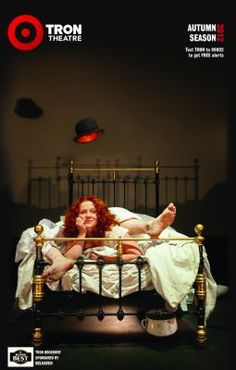
James Joyce's Ulysses, Tron Theatre. Glasgow

I thought that James Joyce's book Ulysses was universally known, the archetypal difficult read, a stream of consciousness over 800 pages. Certainly on visiting Dublin you are confronted with a veritable Ulysses industry of guided tours of places mentioned in the pages as Leopold Bloom wanders the streets over the 24 hours of the book. However, I mentioned to a big Irishman I know that I was going to see the play of the book last night, currently on at the Tron Theatre and was met with a blank stare. So I am glad that Andy Arnold decided to do a full production of the stage version penned by Irish writer Dermot Bulger several years ago, to force this unique book back into our consciousness. I've read the book once about 20 years ago and from memory struggled to give my wife an outline of the story before we went to the play, but I was amazed how many of the scenes and even some of the lines ("History is a nightmare from which I am trying to awake") came back to me as the story unrolled. I enjoyed the book when I read it. It is surpisingly playful, lewd, imaginative and at times melancholy. Putting the thoughts of the characters down on the page was a new and different idea at the time, but we are now more familiar with it via Kafka, through Jack Kerouac, Bret Easton Ellis to James Kelman, and Will Self's Booker prize nominated book of this year, Umbrella. Usually I like this style of writing, sometimes not. It depends whether the characters have anything interesting or worth hearing going through their mind, doesn't it? I could read Kelman's book happily one after another, and it was Ulysses really that introduced me to this type of writing I suppose. Reading Ulysses I wasn't really aware of the allusions to episodes from the Odysseus, as the Greek hero makes his way home to Penelope and his son Telemachus. I don't think that I knew the Odysseus well enough to get any of that, but now that we've all seen "O Brother, Where Art Thou?" playing the same trick I get it now. Before going to see it last night it was the theme tune of the classy 80s cartoon Ulysses 31 that was on an endless loop in my head, but now that I've seen the play, it is Joyce's version that I'm thinking about now.
 
I don't know the book well enough to compare book to play, but as a play I think the staging of it captures the feel and atmosphere of the book very well indeed. The stage version makes a good decision playing up the sorrowful thread of Stephen Daedalus, the surrogate son character, haunted by guilt around his mother's death whilst Leopold Bloom stews melacholically over the death of his son Rory as an infant. It moves along with pace, whilst containing many quotations from the book and moving from one episode to another smoothly.

It was clearly going to be a challenge to get the book into a 2 hour piece of theatre, but they do phenomenally well cramming as many episodes and scenes from the book onto the stage. The action all takes place on one beautiful set of an Edwardian office/ home/ bar, with Molly's big brass bed centre stage. The 8 actors are back and forward as different characters which can be a bit jumbled and confusing at times, but I liked the loose, jumbled, swarming nature as the paths of characters cross and collide throughout the day. Jean-Paul Van Cauwelaert as Leopold Bloom is impeccably played and full of pathos, whilst Muirean Kelly’s unfaithful Molly Bloom holds the attention completely when she is on stage, particularly in the final piece as she contemplates her life and their relationship.

I've plucked the book off my shelf now, blown off the dust and am looking forward to reading it again with fresh insight. Funny thing is I just finished reading Murakami's 1Q84 which clocks in at 426,000 whereas Ulysses is a tiddler at only 265,000.

Tuesday, 9 October 2012

Famous George Square Statues To Be Removed....eh, What Famous Statues?

Plans to redevelop George Square have caused controversy.

Do you even know what is there just now?


I was interested to read all the debate in the Herald newspaper letters pages after it was announced last week that the "famous statues" from George Square are being "temporarily" removed for renovation ahead of a planned revamp of the square. Again on Radio Scotland news today they spoke above the removal of the "famous statues". It has not yet been decided whether the square should be a site for events and meetings, a place of cafes and entertainment or a grassy area to meet up in. That all depends on who comes up with the best plans from the forthcoming tendering process. One thing is clear however, something has got to change. I went along today to George Square with a more critical eye than usual after reading these reports. Over the years I've sat on the benches having a Greggs sandwich, I've attended a demonstrations, concerts and a speech by Nelson Mandela, I've started races from the square and fed the pigeons but never really stood back and looked at it, the way you would on arriving in a city's main square overseas on holiday. Even looking at the red tarmac on a crisp autumnal morning like today through rose-tinted spectacles you'd have to acknowledge that it's a bit shabby.


George Square, Glasgow. Today.
There are two questions that the debate in the newspapers has been asking.
  1. Should the statues stay or go?
  2. What should the future George Square be like?
I quite liked the suggestion that the statues should be moved to more relevant locations about the city and not just kept in place for the sake of nostalgia. Also it is easily forgotten that the statues of the square and Glasgow in general have been moved around like chess pieces since the day the first one was erected. For example the statue of David Livingstone in Cathedral Square was moved there in 1959 from George Square. There are twelve statues in George Square. Seriously, how many of them can you remember? Off the top of your head how many of them do you know the subject and their relevance to Glasgow? Stop and think about it just now before you read on. In the meantime here is a photo of me aged about 8 months old enjoying the good olde days in George Square when there were more grassy bits to lounge about on. This was me on a summer's day when an Indian sailor on leave in the city thought my wee family looked sweet and took a photo of us and posted it back to my hippy parents. Strange, but true.

George Square, summer 1971
Before going for a look at them I was able to name from memory three of the statues; Robert Peel, Robert Burns and Sir Walter Scott in the middle. I think I'll give myself a half point for remembering the cenotaph structure also. Co-incidentally somebody last week bought me a wee gift from a Brighton bookshop for £1, a lovely book called 'Public Sculpture of Glasgow' by Ray McKenzie. So I decided to go and see which statues the council is planning to remove and see what I could find out about them from my new book. Funnily enough I pitched up on the day that some lorries arrived to start putting up the neon statues of the Christmas decorations, seeing as it is now the 8th of October.

Christmas decorations arriving in front of the Cenotaph at George Square today

1. The Cenotaph

There are no plans to remove or renovate the cenotaph. Reading my new book I see that the site for this caused some controversy at the time of its construction as it was felt it blocked the view of and from the City Chambers. However, built in 1924 to a design by Glasgow architect John James Burnet it was felt to be "hallowed ground" as the site where soldiers were recruited and from where they departed to the war and where they took the salute on their return home. It is worth noting that statues in other locations around the square were moved around in 1924 to accommodate it, namely those of Queen Victoria, Prince Albert and Gladstone. Looking at it today its effect as a statue is pretty diminished by the fact that it now appears to be surrounded in Leylandii and shrubbery which obscures a lot of it. Also the front of it is fenced off stopping you from having a proper look at it. If it is to be a permanent feature of the square it surely has to be made a feature of the square, rather than camouflaged as it is at present.
Lions of the cenotaph emerging from a forest

2. Sir Walter Scott

 Although the Scott Monument on Edinburgh's Princes Street is more well known, it came 10 years after the world's first public monument to the internationally famous author of Rob Roy, Ivanhoe and Waverly. Scott died in 1832 and 6 years later this statue by John Greenshields on a column by David Rhind was erected in the centre of the square. Although it is fare to say that he has almost no specific connection to Glasgow, he was and is one of the world's most widely read authors and an inspiration for many. He is maybe blamed a wee bit these days with playing a big part in inventing the shortbread tin, tartan tourist-stereotype of Scotland, but nobody would argue that Scott is a Scot of renown. The 'monument committee' was formed less than a month after his death to create a "means of inspiring others to emulate that great and glorious man". The Glasgow Herald in 1838 noted that the column was "too long for its girth, and more like a good walking stick than anything else". I'd have to agree - you can't see the statue from anywhere in George Square really, can you? From as early as 1924 it has been suggested that it be shifted to a site more appropriate to its scale, and that it raises Scott too high above Robert Burns's lowly statue in an inappropriate manner. There is a myth that the sculptor, Greenshields, flung himself to his death from the top on realising the plaid was over the wrong shoulder. This isn't true as Greenshields designed it then died two years before its completion by John Ritchie. Also Scott is meant to have his plaid over the right shoulder to show he's a native of the Borders, rather than a Highlandman.
Scott's statue. Too tall?

3. Sir John Moore


If you had to guess which statue is the oldest in George Square take 3 points if you said Sir John Moore, who was the first person immortalised as a statue in George Square. He was a Glaswegian, born in the Trongate who served with the Duke of Hamilton in America and also fought in the Mediterranean, the West Indies, Ireland, Egypt and Holland. He earned a reputation for training infantrymen and fought Napolean in the peninsular war, where he defeated the French army in the Battle of Corunna, but died of his wounds. Unveiled 10 years later in 1819 this bronze statue was made by John Flaxman. The statue was cast from bronze salvaged from cannon "captured or surplus at the end of the Napoleonic Wars".  The locals didn't like their green, where they hung their washing, becoming a space for public monuments so it was often vandalised and attempts apparently made to topple it in its early days. Originally he held a sword in his left hand, which is missing now.

4. James Watt

The next statute to be put up in George Square was that of the inventor and engineer James Watt. Born in Greenock he is most famed as the designer of an efficient steam engine which revolutionised industry and remembered in the unit of mechanical and electrical power. He also worked on designing the Forth and Clyde Canal. The statue by Francis Leggatt Chantrey has him seated 'in a contemplative mood, with compasses in the right hand and a scroll lying on the knee, on which is described the model of a steam engine'. Four other versions of this statue were made in marble by Chantrey, one of which was once in Westminister Abbey and now sits in the Hunterian Museum at Glasgow University. Nobody surely would argue with James Watt's relevance to Glasgow and importance on the world stage.
James Watt 'in a contemplative mood'

5 and 6. Queen Victoria and Prince Albert

Victoria and Albert
Although they stand  as a pair at the western end of George Square at present, these equestrian statutes have moved about a bit. Queen Victoria's was made first and stood in St Vincent Place from 1854 before arriving in George Square in 1866. So it's a youthful Queen Victoria sitting side-saddle on her horse with an imperial sceptre in her hand. She does look a bit like a queenly chess piece with that crown on her head. The friezes around the base depict her visit to Glasgow in 1849. Sealed within a cavity in the plinth is also a time capsule, a bottle containing documents from the visit and newspapers of the day. Both statues were done by Carlo Marochetti, whose famous statue of the Duke of Wellington outside the Gallery of Modern Art in Glasgow is now an iconic image of the city, as it is usually permanently adorned with a traffic cone. Wellington's statue was already on display in Glasgow and several contemporary articles on the new Queen Victoria statue compared it unfavourably with what had gone before, saying she looked too small and insufficiently imposing.
Prince Albert's statue was unveiled in 1866, five years after his death, and at that time Queen Victoria's statue was moved to bring the pair to George Square, positioning them east and west of Sir Walter Scott at the centre. At this time the city council's investigations found that they in fact owned the square and not the local residents who thought until that time that they did and had objected to the imposition of all this statuary. So the council took the opportunity to re-develop it and laid it out in 1866 pretty much as it still is to this day.
 
From their position in 1866 their majesties trotted westwards a few yards 58 years later when the cenotaph was built. Albert also has a bottle of contemporary memorabilia hermetically sealed within the base of his statue which depicts Education, Industry, Agriculture, Commerce and the Fine Arts on the friezes of the base. Although it was proposed by Alexander 'Greek' Thomson that a statue be erected in Kelvingrove Park to commemorate Albert after his death in a building 'similar to the Temple of Theseus in Athens', once Queen Victoria was consulted she suggested an equestrian statue by Marochetti and that was the end of that. Although it may be regarded as rather uninspiring to modern tastes, Victoria seems to have liked it and had a replica placed in Windsor Park.

7. James Oswald

The son of a wealthy landowner and merchant, James Oswald of Auchincruive was a liberal politician twice elected as an MP for Glasgow. Erected in 1856 in Sandyford Place this statue was moved to George Square in 1875. Why? By then Robert Peel, his political opponent, had a statue in the more prestigious square and Oswald's family and supporters petitioned the council to get him upgraded. Again it is by Carlo Marochetti, but was unusual in representing him in contemporary clothing. Apparently it was known for decades as "the man with the hat" and children would while away the hours in the days before they had Playstations trying to throw stones into his hat. I like the story that Neil Munro invited Joseph Conrad to try to get a stone into the hat whilst they were dining in a nearby hotel to become "an honorary Glaswegian". After a few goes he succeeded and they returned to their dinner.

8. Sir Robert Peel

Sculpted by John Mossman this statue of Sir Robert Peel was erected in George Square in 1859. This is one of the ones which has always made me go "Eh?". Like most people I know him as an English politician responsible for establishing the Police force in London, "the Peelers" or "Bobbies" as nobody now calls them. Born near Bury he became leader of the Conservative Party, Home Secretary and was twice Prime Minister. It seems that shortly after his death a statue was proposed to acknowledge that he had "conferred great benefit on his country". The choice of a local artist for a large public commission in Glasgow was a first at the time and it was Mossman's first statue in bronze.

9. Field Marshal Lord Clyde


Born Colin McLiver in Glasgow in 1792 and educated at the High School of Glasgow he joined the army aged 15, serving under John Moore in the Peninsular War (see no.3 above). He had risen to the rank of Field Marshall by the time of the Crimean War and commanded the "Thin Red Line" of the Black Watch at the Battle of Balaclava. By 1857 he was Commander-in-Chief of the Indian Army during the Mutiny. 'Old Careful' may not have had the greatest nickname in the world, but he was popular with Queen Victoria and made Lord Clyde in 1858. The statue, by John Henry Foley of London, has him with pith helmet, telescope in left hand resting on a palm tree fresh from his exploits in India. It required a slight reshuffling of statues in the square with John Moore nudging up a bit. This lead to an outcry in the letters page of the Glasgow Herald. Does that sound familiar?

10. Thomas Graham

Back to the sciences now for the next statue to arrive in George Square. William Brodie's statue to Thomas Graham sits in the south east corner. Born in Glasgow, he studied Chemistry in Edinburgh before teaching in Glasgow (where David Livingstone was his student). He then moved to the Chair of Chemistry at University College, London where he carried on his researches, the best known being "Graham's Law" on the diffusion of gases. He is seated in contemplation as is James Watt at the other southern corner and Lord Kelvin in Kelvingrove Park. Presumably men of science sit and ponder a lot whilst soldiers stand and thrust.

11. Robert Burns

Scotland's national bard should need no introduction. If religious sculptures are excluded, the only people with more statues to them around the world than Robert Burns are Queen Victoria and Christopher Columbus. However it was 1877 before George Square was graced with one, 81 years after his death. He is represented by George Edwin Ewing and Francis Leslie here as a 'superior Scottish peasant' with his 'broad Kilmarnock bonnet' crushed under his right elbow and a 'wee crimson tipped flower' in his left hand whilst in 'an easy and graceful attitude of poetic contemplation'. There are panels from three of his poems on the pedestal. Unlike any of the other statues here, Burns's unique popularity meant that it was funded in a quite different way, with subscriptions from around 40,000 people of a shilling each to reach the required fund of around £2000. A local artist was given the task of creating the work of a figure who had by this time achieved mythical status and he based it largely upon Alexander Nasmyth's famous oil painting. A crowd of over 30,000 people were in George Square on the date of the bard's birthday in 1877 to witness the unveiling.
 
Robert Burns displaying his easy and
 graceful attitude of poetic contemplation,
despite the 'bird lime'

12. Thomas Campbell

The poet, political commentator and historian Thomas Campbell was born in Glasgow in 1777 and although maybe less known now, was Glasgow's most popular poet of his day. In later years he became involved in founding the University of London and he is buried Poets' Corner at Westminster Abbey. His statue was proposed because it was felt to be an important omission in the city that needed rectifying, and Mossman's statue was erected in the year of the 100th anniversary of his birth.

13. William Gladstone

 
Liverpool born politician, William Gladstone, was Prime Minister of Britain four times. He was awarded the Freedom of the City of Glasgow in 1879, and like Robert Peel before him, he was also Lord Rector of Glasgow University. It is the robes of Glasgow University that he is depicted in by William Hamo Thornycroft in this sculpture which was unveiled in 1902. After his death in 1898 several British cities swiftly responded by commissioning sculptures of Gladstone. In this one the sculptor has apparently tactfully made it appear he has his index finger tucked between the pages of his book, to disguise the disfigured remains of his finger which resulted from a shooting accident. One of the panel reliefs on the side of the pedestal has him addressing parliament, the other has him 'engaged in his favourite recreation of tree felling'. That's the way to be remembered, eh? It was originally placed opposite the doors of the City Chambers and moved to its current location to accommodate the cenotaph.

So, what next?

The point is fairly self-evident once you actually look at them, that the current collection of statues reflects the fashions and tastes of the time they were commissioned. There is no overall plan and the square was adjusted and tweeked as required. It looks rather like a collection of Victorian graveyard statuary really. So I am now, on reflection, happy to accept that the lay out of the George Square is not set in stone and could be radically improved. The problem is that nobody trusts the City Council to do it properly. The roads at either end could easily be blocked off to make it more pedestrianised, the parking around the sides of the square could also be covered over to expand its width to make a grander public space.
 
The statues could be better accommodated elsewhere. Create a poets corner in Queens Park with Sir Walter Scott, Robert Burns and Thomas Campbell. Move the scientists alongside Glasgow University in Kelvingrove Park with Lord Kelvin. Queen Victoria to Victoria Park or a promenade of politicians in Glasgow Green?
 
So what to put in their place? A "jet d'eau" was a feature of the square before Sir Walter took its place, but the council don't have a great reputation for maintaining fountains as the on/off nature of the one in Kelvingrove attests, although the Dalton Fountain in Glasgow Green seems to be still working since its renovation. What about jets of water as they have in the courtyard of Somerset House in London? This seems ever popular and feature annually as big pictures, with children running through them, in newspapers to let you know whenever a hot day has occured. Any plan will inevitably have a source of income built into it these days I fear, so there won't just be green spaces planted for people to picnic in, so any catering facilities or bars need to be decent and to be maintained rather than a selection of caravans like you get at the Christmas fair in George Square.
 
What about commissioning new public art in the city which continually produces outstanding Turner Prize-winning artists, but has very little of their stuff on public display? You could move the "La Pasionaria" statue up from the Clydeside to stand alongside the cenotaph to commemorate the Glaswegian volunteers who joined the anti-Fascist forces in the Spanish Civil War. A statue of John MacLean could commemorate the Red Clydesiders, or something to mark the site in George Square where strikers raised a red flag in 1919, believing revolution was imminent, before the soldiers arrived from outside the city as the government feared they couldn't trust the local regiments?
 
Here are three examples of public sculpture from the streets of Glasgow showing what can happen.
 
Donald Dewar on Buchanan Street by Kenny MacKay
Broken specks and the look of a tired administrator was
probably not what they had in mind to inspire others

George Wylie's"Maternity", on the site of the former Rottenrow
 Maternity Hospital. It seems to capture the humour of the
city and the nostalgia for the site perfectly

King William III (King Billy), used to sit at Glasgow Cross. Built in 1734, the city's oldest sculpture, and with a bizarre articulated tail which sways in the wind. Possibly his role as a focal point for certain groups meansthat he is kept discretely in gardens near Cathedral Square, rather than a more prominent position. 
 
Whatever the outcome of the deliberations on George Square it MUST remain a public square where people have rallied, danced, met and played for generations.


Sunday, 7 October 2012

Shonen Knife and BMX Bandits, Oran Mor

Shonen Knife, BMX Bandits, cool poster.
A quick check to see what was on in Glasgow tonight to entertain me on my birthday found that it either Chris Isaak at the Royal Concert Hall, Disney on Ice at Braehead or Shonen Knife at Oran Mor. So with that to choose from it was up the top of Byres Road to see Osaka's best all-girl punk/rock/ pop band. Small Gang did a brave performance to an empty room with that ever popular 7pm stage time. For a change they got on with it and didn't just "harumph" for 45 minutes. The three piece from London I think between them maybe have some Goodbye Mr Mackenzie, Bloc Party and Nirvana records in their cupboards. They sounded more original and were at their best when singing over more drone-y guitars and had some solid drumming throughout.

Next up, Bellshill's finest (if we ignore the Soup Dragons, the Vaselines, Teenage Fanclub and most of Mogwai) BMX Bandits. Duglas T Stewart is still there up in front, with a line-up which has ebbed and flowed over the years. I think that last time I saw him perform it was after the River Detectives at a freebie thing in Kelvingrove Park a decade or two ago. However 20 years ago they toured with Shonen Knife, making tonight a kind of reunion gig. Noted as the band Oasis were supporting when they first toured the UK, they also famously had Kurt Cobain as a fan apparently. Whilst Kurt and Oasis are long gone, BMX Bandits still trundle on with their pleasant indie pop they've been doing since 1985. They opened with Serious Drugs and then carried on with their songs which could all be imagined with wee tweety cartoon birds circling the stage whilst Duglas or Rachel Allison sung. Nice, but he is not quite the 60s French teenage chanteur he imagines. I liked his Big Bird t-shirt but is it an anti-Romney dig, or just him showing how 'kooky' he is?

BMX Bandits
Anyway by the end of their set there were a few people smiling and swaying along merrily at the front. I'm just a bit too cynical to believe that someone can be jolly like that without being either a weirdo or a fraud.
Japan has a unique skill of producing smiley, plastic pop with enthusiasm and sincerity. As soon as Shonen Knife come on stage you know it is going to be good. With two smiling, head banging guitarists in pink and orange A-line dresses out front of stage and the similarly attired drummer behind them Shonen Knife are a fantastic live act. The sometime Ramones cover band are in the UK promoting their 19th or 20th album, Pop Tune, which as the name suggests has some brighter, cheery pop on it than some of their more rock efforts. From the new album they played the cover track and Osaka Rock City with as much bounce and head banging as the rest of the set. Giggling like schoolgirls after slipping and falling over in the opening number, it was a sure footed performance after that, highlighting the fact that they've been playing for years now in one form or another. Everyone on stage was nice enough to give it big "I love being in Glasgow, I love Glasgow bands", which always goes down well, but the audience were eating out of their hands from the off.
Shonen Knife
For a birthday night out they were perfect, bouncy fun, even if their chat hints at weird shadows on their psyche - "I am very ashamed, to sing about love, so I prefer to sing a song about a Rubber Band, a very useful item, to wrap up potato chips or bag of cookies"

Good honest cookies, not in the least bit affected kookiness. Loved it

Sunday, 30 September 2012

Cone Gatherers and Holy Motors (as I Couldn't Get to the Football)

The Cone Gatherers, Theatre Royal. Holy Motors, Glasgow Film Theatre


As I was working this Saturday morning and couldn't make it to Kirkcaldy to see Partick Thistle tackle Raith Rovers, I decided to avoid being glued to my phone for twitter updates from @ThistleTweet by seeing what else was on in Glasgow. After a quick dash into town I made it in time for the matinee performance at the Theatre Royal of The Cone Gatherers by Aberdeen Performing Arts. As I had got the subway into town this is an excuse for me to post my photo of Alasdair Gray's fantastic mural at Hillhead station, which I got to have more of a look at this time as Nicola Sturgeon wasn't standing in the way after cutting the ribbon to open the station.

Nicola Sturgeon looking studious for the TV cameras
last week at Hillhead Subway station mural
The Cone Gatherers by Robin Jenkins is a "classic" of Scottish literature and I think a common text for Higher English students, but I hadn't read it until last year when I was given it as a birthday present. The author was a conscientious objector during WW2 and was directed to work for the Forestry Commission, an obvious source of inspiration for the book. Set during the war, two brothers are sent to an large estate to gather cones to replant forests being cut down for the war effort. Like George and Lennie from 'Of Mice and Men', older brother Neil tries to protect his simple-minded brother Calum from the evil in the world and the attitudes of others. Their arrival unveils the prejudices and class division of the world they inhabit. The play, written by Peter Arnott, looked great. The set design of projections of a forest onto thin ropes hanging down on the stage worked really well and was very immersive. However I found the story very episodic, as if they had tried to squeeze every scene from what is quite a slim book into the play. When they couldn't quite manage this they had a chorus walking across stage explaining bits that could more effectively have been given to a character as dialogue. Some things can be more powerful when they are suggested, or off stage, rather than shown, such as Duror's wife, who appeared like a Hammer Horror monster. There was the unecessary confusion of where the songs, or dance moves fitted into the, at other times, straight storytelling. The chopping and changing of techniques rather meant scenes such as the dramatic crescendo to the deer hunt became quite muddled. The actors playing Calum (Ben Winger), Neil (John Kielty) and Duror (Tom McGovern) did well, and the idea of showing Duror's aggression at Calum's strangeness echoing Hitler's fascism worked well. However Calum, Neil and Duror never seemed to get enough material to work with to have any real depth to them.

I enjoyed it, but had hoped for a little more insight and a bit less re-telling of the book scene by scene. It is always a bit weird coming out of the theatre or cinema and it's still daylight so as Partick Thistle were losing 1-0 at this point I decided to scuttle off back into the dark after a quick bite to eat in the CCA which has a fine pine of Williams Draught beer on the go for £2.80 a pint. So I scuttled back into the dark by going to the GFT to see Holy Motors by French director Leos Carax.


Holy Motors is completely bonkers. It is the opposite to what I had been to see earlier where a play tried to tell a book's story page by page, when theatre can do more than that. Cinema can do more than tell a straight story too. You spend time here trying to see the link between the different scenarios of the film and discern a message, but it just works as a fantastic bit of cinema washing over you. The director starts by getting out of bed, pushing through a wall decorated as a forest (today's theme) and emerging into a cinema which is maybe full of an audience of dead people. Then we follow Denis Lavant, who looks fantastically worn out, through Paris in a limo as he dons different costumes and make up to act out various "appointments" across the day. These are like confusing episodes of "Quantum Leap" where the angel figure doesn't really have a purpose in the scenes he undertakes, other than just the act of doing what he has been scripted to do. At times bizarre, surreal, full of pathos or hallucinatory and for real cinemaphiles these appointments I am sure are full of various references and nods to the history of cinema, ending up like a scene from Cars as the limo ends the day at its garage. Just when you think it's getting a bit weird Kylie turns up.

Excellent stuff all round. I would encourage anyone who gets the chance to go see it. I suspect people will either love it or hate it, it's a hard film to be ambivalent about. Anyway, by this point Partick Thistle had equalised with a Doolan goal in injury time through in Fife. STILL unbeaten after 7 league games, but only just. Can we start thinking about the "promotion" word yet???

Friday, 28 September 2012

Wagner. A Review of a Big Opera in Small Pieces

BBC Scottish Symphony Orchestra perform Wagner's Tristan and Isolde (Act 1)


I go to see the opera, usually Scottish Opera at the Theatre Royal in Glasgow, about once a year. Part of the appeal is the grand costumes, the acting, the staging, the wee ice cream tub at the interval (and also it is a night out where I am at the younger end of the audience spectrum for a change). Sometimes opera feels like a Lloyd Webber musical sung in a foreign language, as you wait for Bizet or Puccini's big hit tune to come along. There is a lot of the cast talking through the story to background music between the hits. Wagner I think is more about the musical piece throughout, the music tells the story and sets the tone, and for that he is credited with giving direction and ideas to a lot of 20th Century music.
I've sat through a Wagner opera in full once, years ago, a performance of The Mastersingers of Nuremberg. I remember the grand costumes and sets, and I remember it being long, but I couldn't hum you any of the tunes. I've also seen a concert performance of an opera only once before, when Scottish Opera did Georges Bizet's Pearl Fishers in a big hall in Govan 15-odd years ago. Stripped away from the usual operatic paraphernalia the music comes to the centre of the stage. This was the case last night when I went to see the BBC Scottish Symphony Orchestra perform Wagner's Tristan and Isolde, with chief conductor Donald Runnicles, who reminded me of a well fed David Essex. If done in the full it takes over 5 hours, so for this they've broken it into easily digestible chunks, performing each of the three acts on a separate night, with an accompanying piece of music to highlight some of the themes or inspired by Wagner's music.
Tonight we had Rachmaninov's The Isle of the Dead, a musical poem inspired by seeing a painting by Bocklin of Charon apparently rowing a coffin out to the island of Ponza. The ebbing and flowing of the sound was incredibly evocative and watching the conductor and musicians rise and fall to the music as the storm rose then tailed off I was almost feeling seasick. The big crescendo of the storm was great to hear, and when an orchestra is going full pelt at you it really is an impressive sight and sound. I always feel sorry for the percussionists on these occasions, the one playing the cymbals sat patiently throughout, stood up, did her mighty crash then sat down again. More cymbals Sergei, that'd be my only change, make her work for her money.

After that the sea bound Act 1 of Tristan and Isolde was a calmer affair, to begin with. It's the everyday story of boy meets girl, boy kills girl's fiance, then sends his head on a spike to Ireland, gets his wounds tended by the girl's magic potions and steals her away to be married to his king whilst they both hide their love for each other. Girl arranges maid to give them both deadly tonic but maid swaps it for love juice. Boy and girl swig back their unspoken suicide pact to find birds tweeting overhead as they realise their love for each other. The orchestra clashes and horns blast as they arrive in Cornwall. Surely this is the only piece of theatre that ends with a fantastic crescendo whilst a chorus cries "Hail Cornwall. Hail Cornwall".
Watching the concert performance you are more aware of the music and with the singers centre stage, almost amongst the instruments, at times their singing risks being overwhelmed by the music. Isolde, soprano Nina Stemme, was clearly struggling with a bit of a cold (I haven't seen an opera singer need to take Sinex and pills mid-performance before), but she managed to sing out as clear as a bell over the orchestra. Of the four main singers in Act 1 she was the one who continued to act her piece to get the turmoil of the story told with her voice and expression, not just singing it out. The gentle music builds to a "what happens next?" finale and I had to buy a ticket for Acts 2 and 3 when I got home as it was a great night out. I've read that this is a trick of the music that Wagner writes, building anticipation. It's called "harmonic suspension" apparently, but without knowing that was happening, the orchestra tonight were able to convey it. The Rachmaninov for me was especially good and something that I'd never heard before. A great wee bonus to the main event.
City Halls, Glasgow
I like the City Halls too, I think it's a great concert venue, with good acoustics and sightlines throughout. It also makes me remember the various trade union demonstrations that used to end here, where I'd get to run about and play on the balcony whilst the speeches went on. It's all much smarter nowadays.

I'm reading Haruki Murakami's big 1,000 page tome at the moment, 1Q84, and co-incidentally got to the end of Book 1 out of 3 last night, before seeing Act 1 of Wagner's 3. At the start of book 2 a character quotes from Chekov his famous line about not introducing a gun to Act 1 unless you are going to use it in Act 3, so I fear for the future of Tristan and Isolde and don't fancy their chances of making it to the end of Act 3 now that they've already talked of life threatening wounds and deadly potions. For that matter in the book I don't much fancy Aomame or Tengo's chances of making it to page 1,000. However, in both cases, all will be revealed and in both cases I'm looking forward to finding out.


Saturday, 22 September 2012

What To Do Near Glasgow When You Get Some Unexpected Autumn Sunshine?

The Forth and Clyde Canal ("the Nollie"), Whitelee Windfarm, Eaglesham and David Livingstone Centre, Blantyre.


This summer has been miserable and wet in Glasgow, usually at its worst whenever the children have been off from school, so it was an unexpected treat to wake up this September weekend to find an unfamiliar yellow thing in the sky. There was no sign of the feared armageddon either after meteors or satellites had been spotted last night descending to Earth in the skies over Scotland last night. If you were up and about early today in Glasgow you will know that although it was beautifully sunny, it was also cold and frosty. This made it a gorgeous morning for an early run and I ended up getting carried away and going on much further than I'd planned as I was so enjoying running through the mist rising up from the Forth and Clyde Canal (or "the Nollie" as it is called locally).

Locks on the Forth and Clyde Canal at Maryhill
Not wanting to waste the chance of going out with the children without 5 layers of waterproof clothing we packed a picnic and headed down Eaglesham way to visit Whitelee Windfarm, Europe's largest windfarm which you can see to the south of Glasgow from most high vantage points. Although this may not seem the most obvious day trip, it has miles of good paths for walking or cycling amongst the dozens of turbines and from up on Eaglesham Moor there you can see Ailsa Craig and Arran in one direction, Glasgow and the Campsie Hills in the other. So what is the WW2 connection between Eaglesham Moor and Maryhill (specifically the barracks at the Wyndford that I was running past earlier)? Keep reading for an answer...

Ailsa Craig visible on the horizon at Whitelee Windfarm
There is also a smart wee visitor centre run by the Glasgow Science Centre, with some hands-on stuff for children and a decent cafe. Today for the school holidays they also had a collection of owls casually sitting about, accepting the attentions of excited children. The scale of the turbines and the size of the windfarm are hard to take in until you are walking amongst them. I think that the turbines are fantastic things and I can happily wander here for hours. Anyway, in the days before there were wind turbines here, on May 10, 1941, Rudolf Hess landed on Eaglesham moor, apparently coming to meet the Duke of Hamilton. He was held prisoner in Maryhill Barracks for his trouble.

My daughter chasing a flock of sheep at Whitelee Windfarm
Looking around for some other nearby visitor attraction to entertain the weans with whilst there was still no rain on a weekend day we settled on a visit to the David Livingstone Centre at Blantyre.


David Livingstone Centre
This is a National Trust run place, a museum telling the life story of Blantyre's most famous son; doctor, missionary, explorer - David Livingstone. He certainly lead a remarkable life, starting off working in the local mill and living in a single room in the mill owned tenement building the museum is now housed in until he went to University in his twenties. Although his life story is viewed through rose-tinted spectacles here as an anti-slavery campaigner, it is hard to separate this from the fact that he was trying to extend British trade routes into the heart of Africa and seeking to convert the locals to his faith.
Dr Livingstone's arm, I presume
I quite like dusty, old-fashioned museums so enjoyed this a lot and although it must be over 25 years since I was last here, it was all very familiar. One thing that stuck in my mind from my childhood visit I was pleased to see was still there. In a glass case containing Livingstone's old medical equipment, is a cast of his arm bone, badly broken when he was mauled by a lion. As well as the fact that the lion attack story is a good one, I remember as a child wondering how they managed to get a cast of his arm bone. It shows, I think, that even in his own time his body parts were being treated like saintly relics. The lion story also caught the imagination of one of the 20th century's greatest film makers, Ray Harryhaussen, whose stop-motion animation brought to life films such as the Sinbad films and Clash of the Titans. There is a large statue in the grounds here of the lion attacking Livingstone and his party, in Ray Harryhaussen's unmistakable style. Why, you may ask?
Ray Harryhaussen's statue of David Livingston and the lion attack
3pm, Saturday. Firhill. Pie, Bovril
and some brown sauce
Well, Harryhaussen is married to David Livingstone's great-grand daughter. Strange, but true!

There was still time to head back up to Glasgow to see the mighty Partick Thistle stay top of the First Division with their sixth consecutive league win, this time a narrow 2-1 win over Cowdenbeath. Strange, but true! Jackie McNamara continues to do it.