Showing posts with label Tron theatre. Show all posts

Sunday, 22 October 2017

Dostoyevsky's Brothers Karamazov. Tron Theatre, Glasgow.


Review: Dostoyevsky's Brothers Karamazov. Tron Theatre, Glasgow. October 2017


Just writing down the date at the heading of this piece, "October 2017", is a reminder that this month marks the centenary of the October Revolution. One hundred years ago the workers and peasants of Russia, led by the Bolsheviks, overthrew the Tsarist state and established the "dictatorship of the proletariat".  Though he died in 1881, Fyodor Dostoyevsky's works demonstrate the tumult of ideas and debate that were going on in 19th century Russia. I find it surprising that there has been very little reflection or analysis in the arts or media about the events in Russia of that time. 

With that in mind I came to see the Tron Theatre Company revive the 1981 dramatisation of Dostoyevsky's most famous book, The Brothers Karamazov. Dostoyevsky's final novel is often thought of as his masterpiece, a lifetime of thought distilled into 900 pages of psychological angst. The author's own life was no less dramatic than his novels. His early belief in utopian socialism, led to the terror of a mock execution, then banishment to Siberia. He returned to society with his religious beliefs reinforced and his characters often try, often fail, to live the nihilistic or pious ideals that many people of his time believed or feigned. He was also deeply affected by epilepsy, a condition practically untreatable in his time, that often gave him a feeling of profuse calm before a seizure, but then left him drained for weeks afterwards. Epileptics often feature in his stories, most notably Prince Myshkin in The Idiot. In Karamazov the seizures of the fourth, illegitimate brother, Smerdyakov, feature prominently.

The other three Brothers Karamazov (Dmitry, Ivan and Alyosha) have all been neglected by their depraved, wealthy father. Ivan is a revolutionary intellectual whose nihilistic belief, like Raskolnikov, that there is no God and "all is permitted" is tested when someone takes him at his word. Alyosha is a pious, Christ-like figure, who follows the religious teachings of the elderly monk Zosima and tries to put his Christian love into practice. Dmitry is a passionate and hedonistic man, who competes with his father for the love of Grushenka. When their father is murdered, circumstantial evidence points the finger of blame at Dmitry. 

I have written before about Dostoyevsky, and I love reading his meaty books. However Karamazov is not one of my favourites. As ever Dostoyevsky sets out the debate between different ideals before you and gives equal weight to all sides. In this instance few readers get to the end of the book and feel, like the narrator, that Alyosha is the hero of the story. I was inevitably rooting for Ivan, who is driven slowly mad by the guilt he feels for advocating free choice to others. 

So how do you cram 900 pages on the moral disintegration of society into a 2 hour play with four actors? 


On a stark stage, with an earthen floor, the four actors perform as the brothers, taking it in turns to don a fur coat or cloak to become their father Fyodor Karamazov, the devil, Zosima or the Grand Inquisitor of Ivan's poem. Whether the stage is meant to represent a crucible or a gladiatorial arena the performers do at times struggle to clamber clumsily around it, and the long speeches used to convey the arguments from the book are also handled incredibly clumsily. As they launch into another lengthy elucidation of a theory, it comes over like a child reading a poem learned verbatim at school. All the words are there, but the meaning and emotion is lost. 

The performers try their hardest. Thierry Mabonga as Dmitry has an energy that would make you want to spend time in his company, Tom England's Alyosha is a suitably young naive. Sean Biggerstaff makes the most of Ivan's inner turmoil, whilst Mark Brailsford's hammy Smerdyakov leans too much towards caricature to carry any of the malevolence of the book's character. Act 1 is heavy going at times, and there were several people in the audience around us who did not bother with the second half, which was a shame, as things picked up in Act 2. The courtroom scenes allow the arguments of the story to be made in a less contrived manner. The occasional a cappella singing was rather more dystonic than was maybe intended, and did not create any atmosphere of a Russian Orthodox polyphonic chanting, but rather jarred. 

Dostoyevsky can be successfully brought to the stage, as the Citizens Theatre showed with last year's Crime and Punishment. This Brothers Karamazov as it is performed here, does not wrestle with any of the ideas or philosophy in the novel. The parricide could be presented as the people overthrowing the Tsar or any other dictator and dealing with the consequences. Or you could focus on Ivan, who has dreamy ideals of being able to do whatever he wants, but then is faced with someone acting upon these ideals. The resonances of these notions in the October Revolution, or in nationalist debates in Europe can easily be found, but not in this rendering of the story. The actors don't convey any meaning in their long, expositional speeches, they just batter through the words in the script. Maybe taken at a slower pace, the same script read over an extra hour, it would have room to breathe, but perhaps I am clutching at straws. Sean Biggerstaff has played alongside Alan Rickman in several of the Harry Potter films, and it was Alan Rickman who played Ivan in the original 1981 production. This thought did leave me feeling rather envious of those who saw the play back then.

Saturday, 13 May 2017

Daphne Oram's Wonderful World of Sound. Tron Theatre. Review

Daphne Oram's Wonderful World of Sound. Tron Theatre, Glasgow. May 2017


The theme of the Tron Theatre's May Festo season this year is "work inspired by experiments in music and sound". Surely nobody exemplifies that more than Daphne Oram, pioneer of electronic music.

Daphne Oram's Wonderful World Of Sound by Blood Of The Young
She is known as the founder of the BBC Radiophonic Workshop and was its first studio manager, but left after a year, frustrated by the lack of creative freedom she had in her role, and the stifled by BBC attitudes. She set up her own studio and continued electronic composition, commercial work, concrete experiments and created sounds using her Oramics "drawn sound" machine. This machine, a proto-synthesiser, and her ideas that it would let people with no musical training create sounds and music is nowadays an everyday part of music making. Whereas now a simple synthesiser, loop pedal or app can allow anyone to make electronic music, in order to make these sounds in her day she first had to construct the machinery, which is now housed in the Science Museum, London. The video below gives you a glimpse of her machine in action.


The play Daphne Oram's Wonderful World of Sound is on at the Tron Theatre in Glasgow this week before touring. It is produced by Glasgow based company Blood of the Young and was written by their artistic director, Paul Brotherston alongside Isobel McArthur, who also plays Daphne Oram in the play. Appropriately it mixes acting with music, live scored by musician and sound artist Anneke Kampman. She was previously part of Scottish band Conquering Animal Sounds, and also performed at the Tectonics music festival in Glasgow in 2016. The music and sound effects here create a perfect atmosphere for the actors to inhabit.

Agnes Oram at work
Daphne Oram's character steps out from the play to narrate her life story to us, in plummy Jeeves and Wooster tones, which if you listen to any recordings of her talking about her music is a pretty good impersonation of her actual voice. The contemporary photographs of her working resemble a mad scientist dwarfed by banks of machines, and it is her curiosity and desire to experiment and create something with her music that shines through in the play. Surrounded by patronising, tweed-clad BBC types and institutional sexism she strives to innovate and be creative. The ensemble cast and clever set designs take us from her family home, through the BBC years to her rural retirement. She was a unique force, whether creating sci-fi sound effects, Anchor butter adverts or developing her own Oramics theories on sound and it is great to see her life recorded here so splendidly. The ensemble cast mix physical theatre with humour. Isobel McArthur's Daphne Oram is driven and enthusiastic, with clouds always on the horizon as she strives to plough her own furrow.

Daphne Oram died in 2003, at the age of 77, but her legacy seems to be growing with time, with women often to the fore in experimental music and sound art a new award was this week announced. The Daphne Oram Award will celebrate women innovators in sound and music.

Friday, 27 January 2017

Karine Polwart. Wind Resistance. Celtic Connection 2017

Karine Polwart. Wind Resistance. Tron Theatre, January 2017. Review


Karine Polwart's Wind Resistance was first performed at the Edinburgh International Festival last year, and now finds its way to Glasgow as part of this year's Celtic Connections festival.
I had tried and failed to get tickets for it last year so was pleased to see it being revived.

Written and performed by Karine Polwart, with input from David Greig and directed by Wils Wilson, Wind Resistance is a mixture of story-telling, folklore, traditional, and original songs all woven together around the musicality of Karine Polwart's voice. Twenty four hours on I am still digesting all that it contained.

The starting point is Fala Moor in Midlothian, close to where Karine Polwart lives. From describing the vista that opens up in front of you there, to crouching down and inspecting the smallest moss over the course of 90 minutes she explores the inter-connectedness of land, people and society. The mixture of personal memories and the story of a couple who lived 100 years earlier on a farm close to where Karine Polwart now lives give a humane heart to the piece. The songs give the whole story a feeling that we are sitting around a campfire on the hillside hearing secrets and tales in the oral tradition, passed on to us.

The skein of pink footed geese that arrive on the moor in autumn from Greenland are the visible proof of the benefits we can all gain by sharing the load. I laughed as that led us into an excuse to recall the Aberdeen's 1983 European Cup Winners' Cup winning team, as then manager Alex Ferguson is a big fan of that metaphor. Karine's enthusiasm for that team was shared by non-Old Firm supporting classmates of mine in 1983 who started following Aberdeen and Dundee United around that time (I stuck with Partick Thistle - whose laughing now?).

It is also a story about womanhood and childbirth that manages to avoid any tired "mother Earth" tropes. The warnings about the current atomisation of the health service are clear. It is a humane piece and focused on the benefits we all get from society pulling together, looking after our wild sites and each other. Like the geese I was lucky enough to be in Greenland recently, where the effects of global warming are visible in front of your eyes, and not acting is clearly no longer an option.

A timely warning against isolation and individualism. If you get the opportunity to see it, I would encourage you to grab it (and take a hankie).


Wednesday, 26 October 2016

Mark Thomas - The Red Shed.

Mark Thomas - The Red Shed. Tron Theatre, Glasgow. October 2106. Review


A stage show about a Labour Club in Yorkshire? Strange as it may seem Mark Thomas's skill as a story-teller and performer makes this unlikely topic an enjoyable and moving tribute to neglected working class history.

Mark Thomas outside The Red Shed in Wakefield
Photo by Tracey Moberly from Mark Thomas website
The Red Shed is a 47 foot long red wooden shed in Wakefield, a working people's club which celebrated it's 50th anniversary earlier this year. Mark Thomas first went there as a drama student from a Yorkshire college and has returned many times since. When planning a celebration of the club's 50th anniversary Mark had recalled how he credited his activism with the 1980s miners' strike with his political awakening. In interviews he has recounted joining a miners' march back to work, with local school children singing to them as they headed down the street. Is this just a story that he has made real by repetition or, as nobody else can recall it is he mis-remembering it, making it true by repetition?

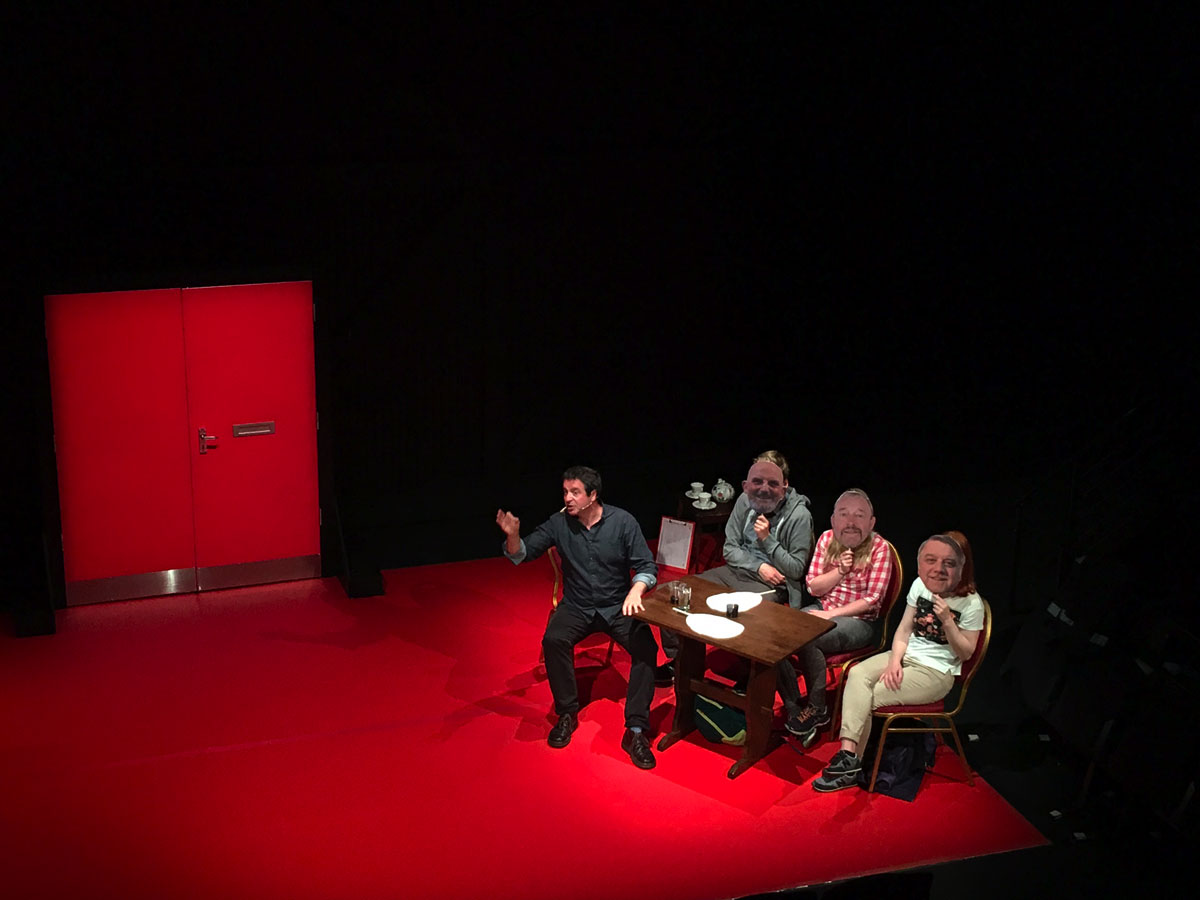
Before the performance Mark approached several members of the audience, looking for volunteers to join him on stage. I declined I'm afraid, and you can make your own allegory there about people either choosing to become actively involved in political action or preferring to be supportive, inactive voyeurs in our civic age. He introduces us to many of the stalwarts who have helped run the place, and the campaigns organised from there. The six audience volunteers hold up masks to act as the participants in this story.


In investigating the veracity of his early memory, we explore the untold histories of working people. I found this a meaty, moving and angry piece of theatre. He is an engaging raconteur. If you are going to put yourself forward as one of his volunteers on the night I would suggest a wee visit to the bathroom before you start, as certainly one of the players on stage on our night appeared to have maybe overdone it a bit at the bar before getting up there.

One reason that I write this blog, particularly the sections on local Glasgow history, is because there are huge swathes of information and stories out there that we poorly recall. There are stories that my granny used to tell me about, stories of immigrants arriving in our city, periods of unemployment and struggle, things worthy of celebrating, remembering and learning from. If we don't get to remember the past we will go along allowing the same mistakes to be made. History isn't created by the actions of kings and queens, but by ordinary men and women.

Saturday, 11 October 2014

Theatre Review: Checkov's Three Sisters, Adapted by John Byrne. Tron Theatre, Glasgow

Theatre Review: Checkov's Three Sisters, Adapted by John Byrne. Tron Theatre, Glasgow


As I'm a big fan of Russian literature I'll be back at the Tron Theatre soon to see a version of Gogol's The Gamblers, but this week they are showing Anton Chekov's Three Sisters, adapted by Paisley born artist and playwright John Byrne.


He too clearly has an affection for Russian works, having previously written versions of Checkov's Cherry Orchard and Uncle Vanya. Although there are several sly references in this version to the play's Russian origins, Byrne's Three Sisters are stuck squarely in the provincial world of 1960's Dunoon. They are pining for London and this perfectly recreates the ennui and petty parochialism the original family felt when stuck 1000s of miles away from Moscow. The sisters and their ineffectual brother, played by Jonathon Watson, feel superior to the locals culturally and intellectually and struggle to find a role in life. With John Byrne you get the whole package, play and designs and it was nice to see his costume designs on the corridor walls at the interval.

John Byrne's costume designs

When I was a youth, in the 1980s, I only ever went to Dunoon to take part in demonstrations at the American Navy submarine base. A quiet seaside town, the British navy started a submarine base at Dunoon in the Second World War, but the town became a true garrison town when the Americans arrived in 1961. After 30 years they left and on a visit to Dunoon recently it did look rather like its best years were behind it. As a protester I always preferred a jaunt to Dunoon rather than Faslane, as the former demonstrations were held nearer the town and you could always get a wee go at the Shows. At Faslane it meant getting a lift up to the base in someone's Lada from the station at Helensburgh.

Another person who may have been nostalgic for old Dunoon is Sylvester McCoy. The seventh Doctor Who plays the doctor; in this as old family friend Dr MacGillivery. The actor was born in Dunoon in 1943 and seems to be having fun playing the eccentric character, even getting the chance to show off his spoon playing skills (see it here in "Time and the Rani").

Putting the play in this time and place works well, with a handy nearby supply of military characters, led by the ever watchable Andy Clark. The sisters play out their respective loves, frustrations and losses, their dreams of getting to the far off, remembered, cosmopolitan idyll slowly die. The red haired sisters played by Jessica Hardwick, Muireann Kelly and Sally Reid feel bonded (unlike Jessica Hardwick's distractingly strange ginger wig). I spent a wee while with Jonathon Watson on stage trying to guess which Scottish footballing character he was trying to be (Bertie Vogts I decided). His Wemyss Bay beau is played with gusto by Louise McCarthy and Stephen Clyde plays the damaged, unsettling and destructive sailor Maloney.

Many of the common themes of Russian literature of the time are played out here. People with aspirations for greater things tied down as bureaucrats away from influence, the upper classes trying to find their role in a changing world and the querulous and demanding lower orders refusing to accept their place in the world. It's all that misery that keeps me coming back to Russian literature.

The play runs for another week in Glasgow before transferring to Edinburgh.

#review

Friday, 19 October 2012

James Joyce's Ulysses, Tron Theatre. Glasgow

I thought that James Joyce's book Ulysses was universally known, the archetypal difficult read, a stream of consciousness over 800 pages. Certainly on visiting Dublin you are confronted with a veritable Ulysses industry of guided tours of places mentioned in the pages as Leopold Bloom wanders the streets over the 24 hours of the book. However, I mentioned to a big Irishman I know that I was going to see the play of the book last night, currently on at the Tron Theatre and was met with a blank stare. So I am glad that Andy Arnold decided to do a full production of the stage version penned by Irish writer Dermot Bulger several years ago, to force this unique book back into our consciousness. I've read the book once about 20 years ago and from memory struggled to give my wife an outline of the story before we went to the play, but I was amazed how many of the scenes and even some of the lines ("History is a nightmare from which I am trying to awake") came back to me as the story unrolled. I enjoyed the book when I read it. It is surpisingly playful, lewd, imaginative and at times melancholy. Putting the thoughts of the characters down on the page was a new and different idea at the time, but we are now more familiar with it via Kafka, through Jack Kerouac, Bret Easton Ellis to James Kelman, and Will Self's Booker prize nominated book of this year, Umbrella. Usually I like this style of writing, sometimes not. It depends whether the characters have anything interesting or worth hearing going through their mind, doesn't it? I could read Kelman's book happily one after another, and it was Ulysses really that introduced me to this type of writing I suppose. Reading Ulysses I wasn't really aware of the allusions to episodes from the Odysseus, as the Greek hero makes his way home to Penelope and his son Telemachus. I don't think that I knew the Odysseus well enough to get any of that, but now that we've all seen "O Brother, Where Art Thou?" playing the same trick I get it now. Before going to see it last night it was the theme tune of the classy 80s cartoon Ulysses 31 that was on an endless loop in my head, but now that I've seen the play, it is Joyce's version that I'm thinking about now.
 
I don't know the book well enough to compare book to play, but as a play I think the staging of it captures the feel and atmosphere of the book very well indeed. The stage version makes a good decision playing up the sorrowful thread of Stephen Daedalus, the surrogate son character, haunted by guilt around his mother's death whilst Leopold Bloom stews melacholically over the death of his son Rory as an infant. It moves along with pace, whilst containing many quotations from the book and moving from one episode to another smoothly.

It was clearly going to be a challenge to get the book into a 2 hour piece of theatre, but they do phenomenally well cramming as many episodes and scenes from the book onto the stage. The action all takes place on one beautiful set of an Edwardian office/ home/ bar, with Molly's big brass bed centre stage. The 8 actors are back and forward as different characters which can be a bit jumbled and confusing at times, but I liked the loose, jumbled, swarming nature as the paths of characters cross and collide throughout the day. Jean-Paul Van Cauwelaert as Leopold Bloom is impeccably played and full of pathos, whilst Muirean Kelly’s unfaithful Molly Bloom holds the attention completely when she is on stage, particularly in the final piece as she contemplates her life and their relationship.

I've plucked the book off my shelf now, blown off the dust and am looking forward to reading it again with fresh insight. Funny thing is I just finished reading Murakami's 1Q84 which clocks in at 426,000 whereas Ulysses is a tiddler at only 265,000.