Showing posts with label Edinburgh. Show all posts

Saturday, 19 August 2017

Edinburgh. One Day at the Festivals.

Edinburgh Festival Reviews


Every year I try to have a quick run around as much as I can in a day at the Edinburgh festivals. Every year I underestimate how long it will take me to get from venue to venue when the pavements are all choc-a-bloc with people dragging wheelie suitcases or trying to hand out flyers. So as usual I tried to squeeze in too much.

Here are some quick reviews of the shows that I managed to catch, in case you are planning to take in a couple.

Thoughtful


Issues of refugees are being discussed in several shows at the Fringe this year. The Sleeper (by Henry C. Krempels in a pokey space in the top floor of the Jury's Inn Hotel) starts with the testimony of real Syrian refugees. An Englishwoman on an overnight train across Europe returns from the bathroom to find "a pair of eyes" in her couchette. Reporting it to a world-weary staff member on the train he asks her to decide if she wants him to deal with it. They replay the confrontation, to see what choices we can all make in such a situation. The person who seems powerless to determine her fate is Amena, whose voice we struggle to listen to in all this (well played by Aya Daghem with a startled air of confusion). A quick wake up call to your brain in its 10.30am slot in the fringe programme. (Their shows have a later 11.40am time for the remainder of the run).

Angry 


It is difficult doing a stand-up show at noon, when your more sobre audience requires a bit more work to loosen them up, but Eleanor Morton at The Stand gives it a good go. In a show titled Angry Young Woman, she is angry about most things. Particular ire is aimed at the everyday sexism in our world which, funnily enough, female comedians (or comediennes if you prefer) are exposed to on and off stage. It would be good to see more of her, but as TV panel shows already meet their one woman per show quota, you probably won't.

Also apparently very angry is Lucy Porter, with her show Choose Your Battles at the Pleasance Courtyard. However it is the middle-class rage of losing the keys for the Volvo that is the subject of her show. Where Eleanor Morton was earlier talking about faking it by going about on public transport with a yoga mat prominently displayed under her arm, Lucy Porter was talking about her yoga classes. All a bit cosy.

Classy


The one name that jumped out at me when I saw the programme for this year's Edinburgh International Book Festival, was James Kelman's. With a new collection of short stories released this month (That Was A Shiver available now - go buy it at your local bookshops). He was on top form, and I was delighted that instead of reading from his new book he decided to talk to us about his thoughts on literature in general and the position of artists in Scotland today. TV's Brian Taylor was a good host, reflecting on his university studies of Descartes as they talked. Kelman talked about his own learning, starting from the Realism of Zola and moving on to Camus, Kafka, Kierkegaard, Dostoyevsky, Pushkin, and so it goes on. A curious mind exploring his world, and finding his voice in trying to express the subjective experience of his characters. Nobody else in Scottish (or British) literature comes close to this existential ventriloquism. Good painters start by first observing people and the world around them, and Kelman is a master of his art because of his ability to observe, and to listen, to people.

I bought a ticket for The Flying Lovers of Vitebsk as it is based on paintings I like by Marc Chagall, who often pictures himself and his wife floating over the town. Thinking of Chagall's paintings gives me terrible flashbacks, as my then 2 year old daughter all but managed to crash straight through a 10 foot painting of his when we visited the Musée National Marc Chagall. Thankfully no damage was done to either her or the painting. The play, by Kneehigh theatre company, is a two-header with Marc Antolin as Chagall and Audrey Brisson as his wife Bella, accompanied by two musicians. The fantastic choreography and Marc Antolin's floppy-haired physical similarity to Chagall does make the paintings appear before your eyes. Clever stagecraft throughout manages to carry a love story and a turbulent historical period, without distracting from the storytelling. A lovely way to spend an hour and a half.

Over the Town 1918 by Marc Chagall


Topical


Written by Sabrina Mahfouz (whose essay was one of the stand out's in the excellent book The Good Immigrant) and Hollie McNish, the play Offside benefits from the poetry that both writers excel at, with a rhythm and beat to the script that matches the muscular physicality of the story. On stage Daphne Kouma, Tanya-Loretta Dee and Jessica Butcher tell the real stories of Emma Clarke, a black footballer who played for Scotland in the 1890s and of Lily Parr from the 1920s. Flicking back and forwards to the current day the play tackles issues of prejudice, sexism, mental health, intrusive journalism, body image matters and more, but manages to stay on track by having a story that you want to follow weaving through all of this. The melodrama that real football can generate sometimes translates badly to film or theatre, but my problem  was that Emma Clarke's life sounds so interesting that I wanted to hear more about her, playing in Glasgow in the 1890s, than the imagined England players of the modern phase of the play. If it's true drama that you area after, the Scottish Women's Premier League is about to kick off again after a short hiatus for the Euros there. Glasgow City FC's next home game is against Hamilton Accies on Sunday 3rd September.

Goalkeeper Emma Clarke, in the back row here of Mrs Graham's XI in 1895


Oddity


Described as an "experimental opera" and written by Roddy Bottum, keyboardist with Faith No More, I found Sasquatch: The Opera a lot of fun. As a rock-opera the live music from Bottum himself on keyboards, accompanied by electronic beats, timpani drums and brass was very impressive, and far more dramatic than the story playing out in front of the musicians. I did not ever expect to see an opera where a drug-addled hill-billy family con tourists with their fake Sasquatch, before the chained up daughter of the family flees into the woods and falls in love with the real beast, who it turns out is a real pussycat with a falsetto voice. The surprising chorus working the forest meth lab in the second half of the story help hunt down the beast and...well you can go and see it if you want to find out what happens. Bass-baritone singer Joe Chappel should have his own show on at the fringe whilst he is here, as he has a great voice. It's a strange hotchpotch of ideas and maybe needs stronger direction and better acting to knock the story into shape, but if you want entertained you should see it now in case it gets the rough edges knocked off of it.


Stuffy


Part of the official Edinburgh International Festival, Had We Never, Robert Burns: Chains and Slavery, was a late night concert performed in the Scottish National Portrait Gallery. The museum currently has two fascinating exhibits that offer a dialogue between Robert Burns's idealised character as demonstrated by the white marble statue of him in the main hall here, and the truer, more flawed character, who was on the verge of heading to Jamaica to work on the plantations before his poetry took off. Douglas Gordon has copied the white marble statue, in black marble, and as a literal iconoclast, has thrown its broken parts onto the hall floor at the feet of Burns. Graham Fagen has a video installation of reggae singer Ghetto Priest singing a new version of Burns's The Slave's Lament  by composer Sally Beamish.

Reflecting on these works an evening of Burns's poems and songs was promised, with new works by Jackie Kay and a live performance by Ghetto Priest and musicians from the Scottish Ensemble. It was a terribly Edinburgh affair, stilted and old fashioned. Instead of trying to see Burns differently much of it was based around old fashioned, churchy performances of Burns's works from bass singer Brian Bannatyne-Scott and counter-tenor David James. Away from the Caribbean angle, the international works were a bit dry. I like Avro Part's version of My heart is in the Highland's but like much of his work it feels very religious and churchy. I know the Shostakovich Burns stuff in Russian as I heard many earnest renditions of them at the Scotland-USSR Friendship Society, but again that took me to the late 1970s/ early 1980s. Jackie Kay brought fresher moments with her playful poems on Douglas Gordon's sculpture and on Burns, such as Resume The Plough, where she spoke of Burns getting "Awa frae polite society/ And Edinburgh literary soirees". I bet she was thinking the same thing. I have never been to a Jackie Kay reading which wasn't filled with laughter and applause and I have never, ever heard such a fussy rendition of A Man's A Man, in which I seemed to be the only person wanting to join in. All in all it was a very strange programme.

I was maybe getting a bit tired by midnight when it finished, but I was now ready to go back to Glasgow, where audiences are a bit more bawdy.

Sunday, 6 August 2017

Greek by Mark-Anthony Turnage. Scottish Opera at Edinburgh International Festival 2017

Review - Greek by Mark-Anthony Turnage.
Scottish Opera and Opera Ventures at Edinburgh International Festival 2017


Hibernian vs Partick Thistle. Incest patricide and plague


Two years ago I combined an afternoon at a Partick Thistle away game in the capital, with an evening at the Edinburgh Festival. Unfortunately that day a 3-0 defeat by Hearts was what preceded an evening of Greek tragedy, with Juliette Binoche as Antigone. Much as the heroes of Greek plays often fail to learn the lessons of their ancestors, I optimistically tried to combine a trip to Easter Road to see Partick Thistle open their season with a match against Hibs, with another Greek tragedy in the evening. The day started much as it did two years ago, with a 3-1 Partick Thistle defeat setting a dark mood for the evening's entertainment. 

Hibernian 3-1 Partick Thistle
The Greek stories persist because they are good stories. They also give us a prism with which to examine our current world. This year at the Edinburgh Festival alongside Mark-Anthony Turnage's Opera, Zinnie Harris's re-telling of The Oresteia, which I saw (and loved) last year, in on show (Oresteia: This Restless House review). 

In Greek mythology Antigone is the daughter of Oedipus, her tragic fate set in motion by the history of her father's actions. Tonight we were going to hear about the deeds of the father. Mark-Anthony Turnage's Greek is an opera of Steven Berkoff's play of that name, which re-staged the Oedipus myth in the east end of London in the 1980s. 

Oedipus in Greek mythology, was left on a hillside to die by his father, King Laius, to prevent a prophecy that he would grow up to kill his father and marry his mother. Found and raised as their own by King Polybus and Queen Merope he hears the prophecy of what he is fated to do, from the Delphic oracle, and not knowing his real parentage flees Thebes to avoid his fate. In the classic example of  the Scot's phrase "whit's fir ye'll no go by ye" he ends up unknowingly killing his father, marrying Queen Jocasta his mother, and bringing a plague upon the lands by his actions. Discovering the truth he rips out his eyes and lives on forever in the strange mind of Sigmund Freud who believed we all want to emulate Oedipus' complex family dynamics.

The cast of Greek
Scottish Opera have recently become very competent at modern, smaller scale productions, such as their excellent The Devil Inside. Greek has a cast of four artists playing several roles and an orchestra of 18 or 19 musicians, yet it still packs a mighty punch. The co-production with Opera Ventures uses a bare, revolving stage set onto which imaginative projections give a stark, and when necessary, humourous atmosphere to the whole performance. The costumes, often requiring a quick turnover, also give it a distinctive, consistent and crisp feel. Taken from Berkoff's play, it is a story set not among Greek kings and queens, but working class families in Thatcher's dystopian Britain. Coming here straight from Easter Road, the opening scene greeted me with the rhythmic chanting onstage of Arsenal fans in an London pub. Alarmed by the racist chants of his father and his parents' belief in a fairground fortune-teller's alarming prophecy, shell-suited Eddy leaves home. 

Alex Otterburn as Eddy
The cast of Susan Bullock, Andrew Shore, Allison Cook and "Scottish Opera Emerging Artist" Alex Otterburn as Eddy were excellent throughout, both in singing and in the extravagant acting required of their parts. The words are sharp and witty throughout, with much dark humour at times. As London descends into riots and plague (the play was written whilst AIDS was running out of control) Eddy kills a cafe owner in a fight and marries his wife, before inevitably finding out at the end when his parents arrive years later that his true origins mean he has unknowingly fulfilled the prophecy. Oedipus pleaded to be excused his actions because he was unaware of what he was doing. Now Eddy knows what he has done, should the shame destroy everything he has? 

The orchestra keep the story moving along, with brassy jazz sounds at times, and a cacophony of percussion, with truncheons and riot shields at other moments. The 1980s setting feels unfortunately contemporary in a Tory led Britain fermenting division along racist lines and between those that have and have not. Are people responsible for their actions when they know not what they are doing? 

It was nice to see Steven Berkoff on stage at the end to take the plaudits from the audience, alongside Mark-Anthony Turnage and the cast and crew.

A thoroughly enjoyable night out, and I find it bizarre that the audience for this type of thing remains elusive. Opera has got to tear down its elitist image to make people aware of the imaginative and entertaining material it can provide. After a second night at the Edinburgh Festival, Greek will be coming to Glasgow in February 2018. I am planning to go see it again. 

Edinburgh skyline as we head home to Glasgow

Friday, 9 September 2016

The Suppliant Women by Aeschylus


The Suppliant Women by Aeschylus


I have previously written about how much I enjoy seeing the works of ancient Greece in our theatres when I wrote about the National Theatre of Scotland re-working The Oresteia by Aeschylus earlier this year at the Citizens Theatre. The resonances in the modern world of these works first performed 2500 years ago are crystal clear. Barely five months later and Aeschylus is soon to be back on the stage in Scotland with The Suppliant Women being performed at the Lyceum Theatre in October 2016.

"Aeschylus. Translation & Lexicon"
The old edition of Aeschylus translations which I have at home starts with a quote on the frontispiece from an earlier translator. In a preface to his 1824 translation of Aeschylus' Agamemnon, John Symmons, complaining about the challenges he faced wrote...
"The times, customs, religion and manners are changed; words which vibrated to the ear, and went straight to the heart, of an Athenian, causing a thrill through their crowded theatres, are known to us only by the dim light of lexicons, context, and glossaries; and even when understood, we search in vain for corresponding expressions in or own language."
Knowing that I was definitely planning to go and see the new version of The Suppliant Women at the Lyceum Theatre by David Greig I read through Aeschylus' words today. One thing that jumps off the page from the off is the fact that the "the times, customs, religions and manners" do not seem to have changed so much.

The Suppliants is the first, and only surviving part, of a tetralogy of plays telling the tale of the Danaides. These 50 women, the daughters of Danaus, leave their home near Syria and flee across the Mediterranean Sea in boats and land in Greece. They are being pursued by 50 sons of their uncle Aegyptus who wish to force them to marry. When they arrive in Greece they seek asylum in Argos. King Pelasgus is reluctant to take them in but puts it to his people who welcome them warmly. As a Herald from Aegyptus arrives to drag them away, King Pelasgus threatens the Herald and takes the women into his city.

The Supplicants by Aeschylus
The echoes in our world of today barely need spelled out, but let me do just that. There are many translations and editions of the story but I am quoting from the one that I have. This was a kind gift to my wife from an old family friend many years ago; a 19th century edition of 2500 year old plays, given to a 14 year old.

Unusually for a Greek play the chorus play a part as characters in the story, here made up of the 50 women fleeing their homeland. In the opening lines they tell of their journey.
"wafted here in ships having set sail from the mouths of the Nile.....having left the divine land bordering on Syria, we fled."
Refugees arriving in Lesbos
If this scenario is unsettling in its familiarity, the language that the chorus use to describe those whom they are fleeing is similarly disquieting in its modern echoes.
"...the male-abounding insolent swarm, sprung from Aegyptus..."
Whilst he was British Prime Minister, David Cameron was accused of dehumanising migrants by describing those trying to get to Britain to seek a new life as "a swarm of people coming across the Mediterranean". This type of language, relating to insects rather than people, was then quickly picked up and used again in subsequent days by Nigel Farage, and the Daily Mail and The Express newspapers. Comparisons were drawn between the way The Daily Mail described refugees coming to Britain today to the inflammatory and irresponsible way it described Jews fleeing Nazism as "pouring into" Britain from Germany in its pages in 1938.

Daily Mail newspaper articles in 2015 and 1938
The women hope that the local gods have been kind to them by allowing them calm waters to cross the sea and they humbly plea for help from Jove at his altar, suppliant, laying boughs here.
"...fearing my friends, if there is any one who cares about this flight of ours...But there is even to those who fly from war afflicted an altar, a defence..."
...a "surer defence than a tower" they hope. They invoke Apollo, a god who like them was "once exiled" from heaven. King Pelasgus arrives, suspicious of their foreign appearance.
"Of what country is this band that we address, not Grecian in its garb, delicately clothed in barbaric robes and many folds of dress...you are more like to Libyan women"
Syrian women arriving in Greece
When they make their case for help Pelasgus is torn between the possible consequences whichever way he acts; fearful of bringing danger upon his city or the shame of not welcoming strangers.
"...lest at any time the people shall say, if perchance any thing fall out not such as we desire to happen, honouring strangers you have destroyed the city."
When the women threaten to hang themselves from the temple walls, King Pelasgus puts it to the people of the city, who vote wholeheartedly to accept the women, and threaten exile for those that do not.


King Pelasgus asks them to leave their suppliant boughs at the temple "as a sign of their trouble." To me this phrase just made me think of the piles of (often useless) life-jackets lying on beaches in Lesbos, the modern sign of the troubles today's refugees have faced. Bound to people and clutched by people making perilous crossings, more in hope than expectation that they will bring some safety.

Life jackets on a beach in Lesbos, Greece
The Herald of Aegyptus' sons arrives to demand their return. In fear the women call out about the fate they fear awaits them in their homeland.
"There await us draggings, draggings and stabbings, bloody deadly cutting off of heads."
King Pelasgus dispatches the Herald sent from their pursuers, demanding he show respect for the gods and the will of his people. He offers the homes of his city to take in the women. They enter the city walls and safety, but know that they cannot tell what fate lies ahead for them. They are in the hands of the gods. Their father, Danaus, cautions them.
"But every one bears a ready evil tongue against a stranger, and to speak slander is an easy thing."
I was going to put a photograph of Nigel Farage here to illustrate the point, but instead an image of refugees trapped at a camp near the northern border of Greece. Here they face further hardship, suspicion and help seems in short supply. A modern chorus whose voices seem to be going unheard.


In last week's newspapers Scottish local authorities were being praised for welcoming their 1000th Syrian refugee to the country, a third of the total which the UK has accepted. However in Greece, a country struggling with a crippled economy, 856,723 refugees arrived in 2015, like The Suppliant Women, by sea. The attitudes and fears of the rulers and people of ancient Argos are playing out there on a daily basis. The scale of the situation is difficult to grasp.

In modern Greece the ancient, crumbling walls of Argos still sit atop a hill in the Peloponnese, but in the time of Aeschylus the audience would know them well, the city where the women sought help. Like the words of Aeschylus, these ruins still speak to us today, and his words speak with an alarming authority, a comment on recent events in the Mediterranean.

The walls of Ancient Argos, atop a hill in Greece today
The spectacle of Ancient Greek theatre is lost to us, as are many of the major works. Things go badly for the Danaides in the next stage of the story, but we will never know how Aeschylus told this part of their tale. 

Theatre of Dionysus, Athens, where Aeschylus' plays were often performed

With the original in mind, obviously the piece of theatre being created at the Lyceum Theatre will use this as a springboard for a novel work. Re-uniting writer David Greig, director Ramin Gray and composer John Browne who worked together to produce The Events, it would appear a nod to the music of Greek theatre is being planned. So it is with great anticipation that I aim to make a birthday trip to Edinburgh to see the work of Aeschylus on stage again.

Tickets are available at the Lyceum website (but do seem to be going fast).


Sunday, 23 August 2015

48 Hours at Edinburgh Festivals 2015

Edinburgh Festival Reviews 2015


Like most Glaswegians I am vaguely aware of Edinburgh as a thing, and spend most of the year oblivious to what it is up to. However, in August each year this becomes impossible as the Edinburgh Festivals draw the London media, the combined population of every Oxbridge Drama Soc and 1000s of visitors to the city on a daily basis. This year I had the chance to spend a day off work in Auld Reekie, and take in some of the festival attractions. On Friday I managed to see two concerts from the Edinburgh International Festival, two plays from the Fringe and several exhibitions from the Edinburgh Art Festival. To help me remember what I actually did, I'll knock up a quick review of what I saw. Not only was this a good chance for me to overdose on some culture and entertainment, but as I was using some friends' unused complimentary tickets and gallery passes, I saved myself over £100. Much as that was pleasing for me, it does flag up one of the problems here at the festival, that not everyone gets to join in.


One highlight of this year's Edinburgh International Festival is the new stage adaptation of Alasdair Gray's classic book, Lanark. I caught one of the preview performances in Glasgow (review here) before it transferred to Edinburgh's Royal Lyceum Theatre. After its run in Edinburgh it will return to Glasgow's Citizens Theatre in September, where the tickets are about half the price of the Edinburgh ones. There will also be discounts for those living in the Gorbals and concessions for the unemployed reducing the price of the best seats in the house to £2. I mention this only to highlight the point that ticket prices do not need to be as prohibitively expensive as many appear to be in Edinburgh, where even a student doing an hour's monologue about cheese can expect to charge £12 a go.


Exhibitions


A frequently used device in some of Alasdair Gray's art is the drawing hand of the artist appearing in the work. I was thinking of this whilst seeing the same idea used to such great effect at the wonderful MC Escher exhibition at the Scottish National Gallery of Modern Art, "The Amazing World of MC Escher". They have pulled together a fantastic quantity of his works, from the very familiar, to his early etchings and sketches of Islamic tiles, flat Dutch fields and the Alhambra Palace that you can recognise in his later material. Seeing them in the flesh, instead of in reproduction, you can appreciate the effort and attention to detail that went into producing his work. Also his skill as a craftsman shines through. 

A cancelled etching plate created by MC Escher

I also had the chance to swing past Jupiter Artland, a slowly growing sculpture park of modern art on the outskirts of Edinburgh where I was mesmerised by Tara Donovan's exhibition. Her large sculptures made from Slinkies, plastic cups and the material used to make helium balloons (Mylar) are beautiful. 

Untitled (Mylar) by Tara Donovan

St Mary's Cathedral, Edinburgh
On a more personal level I found the exhibition about the men who served on the boats of the Arctic Convoys during the second world war interesting. The men shown here received the Ushkanov Medal in 2014 for their efforts to try to supply the Russian people. The exhibition itself, in the beautiful St Mary's Cathedral, of photographs and small tapestries inspired by their stories is a bit sparse, but fascinating information about their lives is explored in more detail in the accompanying booklet.

My own interest in hearing about this was because my gran's brother died at sea during the war, off of the coast of Norway (I've written about him here). I now have the Arctic Star which my great uncle was awarded after his death, and I could recognise this medal, amongst others, on the chests of the men in the photographs here.

Arctic Star medal of Donald Bailey

The works from the official Edinburgh Art Festival are scattered throughout Edinburgh and most can be reached by a quick walk around the city centre. Charles Avery's work Tree no. 5 (from the Jadindagadendar) greets you in Waverley Station as you get off of the train from Glasgow. A wee bit harder to find, but worth seeking out is Holoturian by Ariel Guzik. This is in Trinity Apse, a disused church off of the Royal Mile which I can remember coming to when we came through to the Edinburgh Miners' Gala, in the days when it was the brass rubbing centre. Now the space is filled with Ariel Guzik's nautical drawings, collected material, whale sounds and his submersible. The mirror below it reflects the depth of the church tower. 

Ariel Guzak's Holoturian
At Gladstone's Land on the Royal Mile Hanna Tuulikki performs a vocal duet, SING SIGN:a close duet with Daniel Padden on film, and at other times live further down the hill. I am a fan of her work and loved the recent piece she created, "Away With The Birds" (a version of which is now online as an interactive website). The commissions from the Art Festival have taken Italo Calvino's book "Invisible Cities" as inspiration under the theme The Improbable City. This is captured nicely here by the performers, on a two-screen film installation singing a composition based on the strange topography of the medieval closes leading off of the Royal Mile. I was never sure if the seagulls and car engines I could hear in the background were outside this ancient room, in the street, or were part of the film, which all added to a sense of place.

Other exhibitions under the umbrella of the Art Festival include Phyllida Barlow's set at the Fruitmarket Gallery, a work on a disorientating scale. I was a bit disappointed by Here Comes Everybody, an exhibition by kennardphillips at the Stills Gallery which is less finely honed than some of their other work (google kennardphillips, if you don't know the name, you'll recognise their work).

More biting photographic work was on show in the foyer of the Scottish Parliament with the World Press Photo exhibition. This could really have come with some warnings about the graphic nature of some of the content, particularly photos from the Ukrainian conflict and the downed MH17 Malaysian aircraft. A sharp reminder of the powerful storytelling ability of good photojournalism.

A small part of Phyllida Barlow's set

Within the Scottish National Gallery I found the works of 18th century Swiss artist Jean-Etienne Liotard a bit underwhelming. He is not an artist I had ever heard of but his hyper-realism style drew my attention from his wacky self-portrait used on the publicity for the exhibition. The exhibition, largely of court portraiture, doesn't seem to merit the £9 you are charged to view it.

More photography is on show at the Scottish National Gallery, £11 for "Bailey's Stardust" seemed a bit steep and if we had come as a family to these two exhibitions instead of me coming alone using someone else's free pass, this would have been a ludicrously expensive visit. This is a David Bailey retrospective with over 250 photos from over 50 years of work. His early work from 1960's East End London is the most engaging material, where the characters pictured do seem to sparkle. His later court portraiture of the great, the good and the fashionable of the swinging sixties I felt no connection to. Maybe you had to be there.

Royal Mile during the Edinburgh Festival

Music


Musically my day started with Scottish percussionist Colin Currie and friends at the Queen's Hall.

I have seen Colin Currie play several times before, usually his interpretations of Steve Reich's work, and Reich's "Quartet for Two Vibraphones and Two Pianos" was one of the pieces performed here. Before that we had John Adams's Hallelujah Junction, played on two pianos and nicely echoing Reich's style it reveals the piano as the percussion instrument it is in this crisp performance. Both pieces fizzed with jazz-tinged energy. The second half opened with a warm, solo piece for marimba by Norwegian composer Rolf Wallin and ended with Bartok's Sonata for Two Percussion and Piano feeling strangely muted in comparison. It was a great way to spend two hours, even if the highlight of my day was accosting Nobel prize-winning physicist Professor Peter Higgs at the interval. If anybody knows what "star struck" literally means, it is this unassuming man whose achievements I would rather see proclaimed in exhibitions on Princes Street than the images currently there. After texting my science-mad son that I had spotted him, he was dead keen that I get an autograph of one of his heroes. I am grateful to Professor Higgs for tolerating my interruption to his day in the charming manner he did. As my son continues to harbour ambitions to study physics himself this wee memento will mean a lot to him. 

My day finished off with a concert by celebrated Chinese pianist Lang Lang at the Usher Hall. Like many of his performances at the festival this year this concert was sold out. His traditionalist piano repertoire, playing Bach, Tchaikovsky and Chopin this evening, isn't the type of thing I'd normally come to see (as I said above, some of these tickets ended up with me when others weren't able to attend) however it was an entertaining evening, if not exactly the most dramatic performance I have ever seen. For two hours alone at the piano he had the audience eating out of his hand. He began with Tchaikovsky's The Seasons, twelve short pieces Tchaikovsky wrote for the amateur pianist evoking each of the twelve months. I got a bit lost through the year and struggled to get a feel of which seasons were passing. Bach's lively Italian Concertos received "whoops" and applause from the audience for an energetic performance. A Chinese journalist was asking me at the interval if I thought he brought an "Eastern" rather than "Western" interpretation to the music, but I could only offer that he brought a "Lang Lang" interpretation to it, not wanting to say that it was Harpo Marx I was thinking of at times as he pointed, gurned and emoted. The second half, consisting of Chopin Scherzos, was performed with skill and bravura, but didn't give me the warmth and enjoyment I'd felt from the performances earlier in the day. Also particular audience members whom I was sat near were insufferable.

Theatre


In the afternoon my random Fringe choices brought me to Assembly Roxy to see an hour of Dylan Thomas: The Man, The Myth. Narrated by Thomas's grand-daughter Hannah Ellis and performed with Guy Masterton's mellifluous tones, we learned about Hannah trying to find out about the grandfather she never met, and whom I never really knew beyond the image of the drinker poet. What came out most strongly from this was the strength and character of his powerful wife, Caitlin Macnamara, and as I left I passed by Blackwell's bookshop and picked up a copy of some of Thomas's poems. Bizarrely, although I've read all of his prose fiction I've never really given his poetry a go. I also didn't realise how autobiographical many of his writings were until hearing this performance.

Echoes, a play by one-time Spitting Image writer, Henry Naylor, is performed at the Gilded Balloon by Felicty Houlebrooke and Filipa Braganca. They play two 17 year-old women from Ipswich who, separated by over 100 years, go to Afghanistan and Syria to marry and to do their perceived Christian/Muslim duty. The parallels become apparent once we learn that British women were needed to go and marry British soldiers, out in the east fighting for the Empire and trade. As their overlapping monologues unfold we see history repeating itself and gain some insight into the hopes, expectations and disillusionment of both women. It was a fascinating idea, well acted and well told.

Hearts 3-0 Partick Thistle. Tynecastle, 22nd August 2015

On Saturday I was back in Edinburgh with the hottest ticket in town. A sell out crowd filled Tynecastle to see Hearts play Partick Thistle in the SPFL match of the day. Sadly Thistle didn't turn up and Hearts had a straight-forwards 3-0 victory. After this I was in the mood for some uplifting theatre, but as we had tickets for Antigone, we settled for Greek tragedy instead.

I do like the ancient Greek plays, and always try to catch them whenever a version comes around. I have seen some really memorable adaptions of Sophocles and Euripides works, particularly I'm thinking of Theatre Babel's productions of Medea and Elektra. More recently I enjoyed a very traditional performance of Antigone by Strathclyde Theatre Group. My earliest exposure to Antigone was as assistant stage manager at the Knightswood Secondary School Drama Club when our teacher had us perform it for the school. A trifle ambitious I feel in retrospect.

The production at the Edinburgh Festival had already played at the Barbican Theatre in London and featured Juliette Binoche in the lead role. A new translation by Canadian writer Anne Carson and directed by Ivo van Hove, this was a mouthwatering prospect. The thing about Antigone is its ongoing relevance and the fact that it can be so open to interpretation. After the two brothers of Antigone on opposing sides of a civil war die in battle, King Creon decrees that one will be buried with honour, the body of the other left on the battlefield for the birds and wild dogs to eat. Antigone cannot countenance this and defies her uncle, the king, to bury her brother with the dignity she feels everyone deserves. From here we can decide whether obedience to our rulers must come first, trumping family, tradition, personal beliefs, or not. "Either you are with us, or you are with the terrorists" as George W. Bush put it. The programme notes suggest that the Ukranian conflict was an inspiration behind this production, the bodies from the shot down MH17 flight lying ungathered between the opposing forces. We could alternatively think about refugees with this play, or even the Greek economic crisis. Do we obey EU rules above all as Creon may, or act as responsible, feeling human beings as Antigone does? If any of these ideas were floating about, it was the case that they decided against exploring them in this production. Antigone does not seem to have a moral or solid reason for her actions as Juliette Binoche plays her like a rather stroppy teenager. The stripped down setting and modern dress drains a lot of the melodrama of the play, the ending feels underplayed, losing so much impact. The amplified voices of the cast sometimes make it hard to identify who has spoken. The phenomenal story at the heart of it all survives, despite some clunky modern phrases that don't fit well, but it all feels like a missed opportunity. It was good, but it didn't seem to say anything or speak to us.

This was all that I managed to squeeze in with my 2 days at the other end of the M8 motorway. There is another week to run and a thousand other things out there to see and do that I didn't get the chance to. Many of the exhibitions will run on for longer or tour to other places.  Book festivals, comedy, political theatre...aargh, too much choice.

Typical Edinburgh scene during festival.
A man plays a didgeridoo in Princes Street Gardens,
ignored by everybody including the seagulls


Sunday, 25 August 2013

Edinburgh. This Looks A Bit Like Alexei Sayle

Banksy: The Room In The Elephant. Pleasance Courtyard

Edinburgh Art Festival

Alexei Sayle. The Stand Comedy Club

Marcus Brigstoke, "Je m'accuse - I am Marcus". Assembly Hall


Brief reviews from my second trip through from Glasgow to the Edinburgh Fringe this year. I wanted to see some comedians this time, but as they don't wake up until the afternoon there was time to squeeze in some other stuff first.

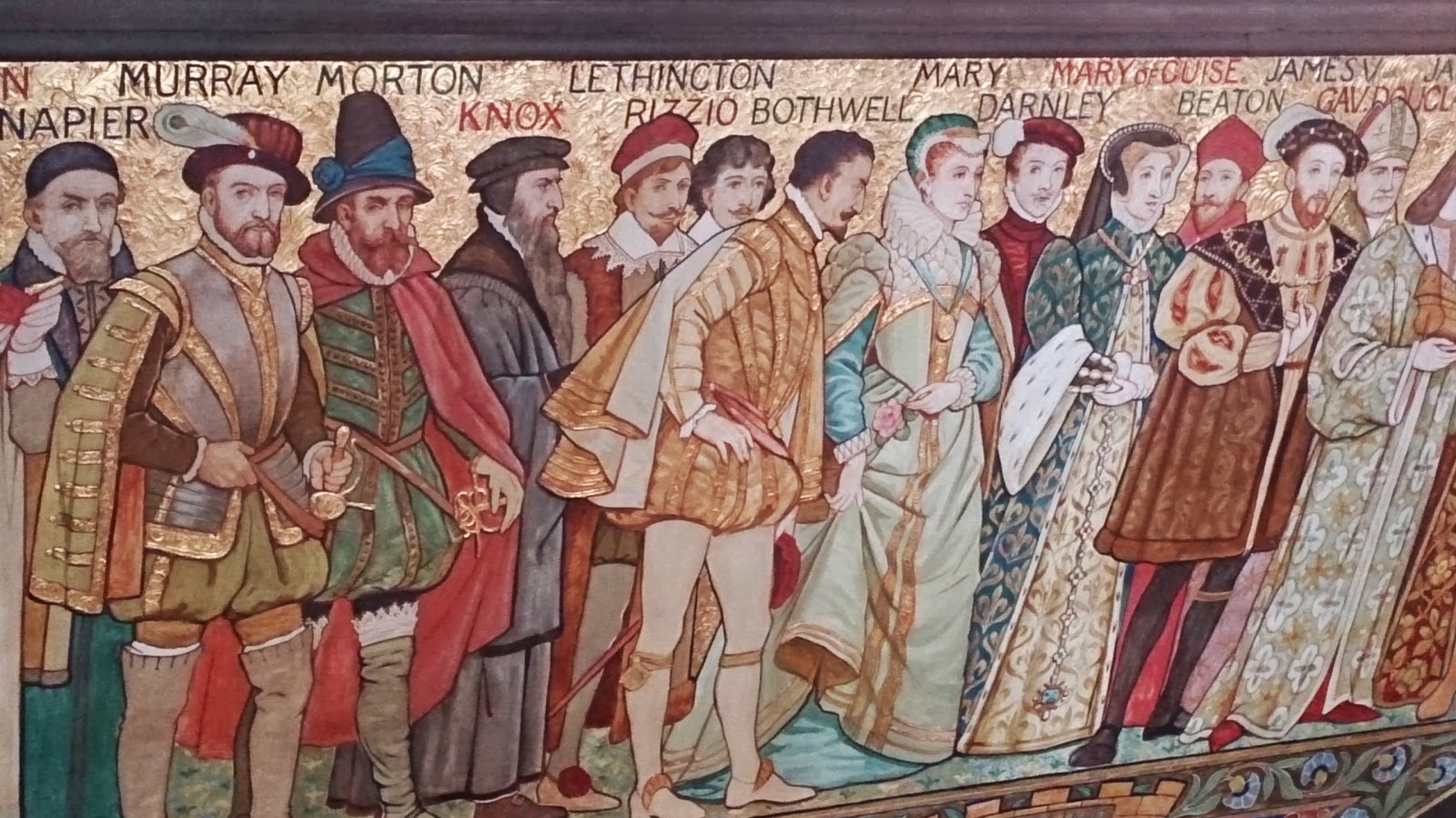
We started off by going to see the exhibition on Mary, Queen of Scots at the National Museum of Scotland. It is an absolutely fascinating collection of stuff and the story of her life reads like a ludicrous Hollywood plot. I know the history of a nation is not the same as the history of its kings and queens but it is a story worth hearing. I've been inspired to try to find out more as it is a period of European history that ties me in knots. John Knox seems to have been a constant thorn in her side. As well as her Catholicism he wasn't big on female monarchs either apparently. A proper ray of sunshine he seems to have been.


Whilst promoting his film "Exit Through The Gift Shop" in LA in 2011, graffiti artist Banksy got chatting to a homeless man who had been living in a disused water tank. With his permission wrote "This looks a bit like an elephant" on the side of it. Cue rapacious grasping for ownership of a Banksy work (which the artist refused to authenticate) and Tachowa Covington was made homeless. Here Gary Beadle off of Eastenders plays the man who had made his home in the tank for the 7 years before meeting Banksy (as Titus Coventry here). The story asked lots of questions about what makes art 'art' without really giving any answers. Gary Beadle's was a gripping one-man turn, as he debated issues with the toy rat he had for company (a recurring Banksy motif) and Bristolian music from Portishead and Massive Attack occasionally broke in. However in a surreal twist at the end we were introduced to the man himself, Tachowa Covington. He is over from LA and saw the show for the first time himself today. A lovely twist that slaps you in the face with the fact that this is a real life being recounted. The man himself had dressed up in a purple kilt and a fedora to mark the occasion. You can only hope that he manages to get some personal benefit from the play, to help him get what he wants in life. Shame we never got to hear his thoughts on it and I hope some journalists are all over him tonight to hear his tale.

After that we had time to dash about some of the exhibitions which are part of the Edinburgh Art Festival. One of the best is in the ever-reliable Fruitmarket Gallery where there is an exhibition of paintings, photography and sculpture by Gabriel Orozco, Thinking In Circles, in which the geometric motif is played out in a variety of ways. The centrepiece is a painting called The Eye of Go. This I liked as I have read a couple of Japanese novels and a manga which feature the game of Go, played with black and white discs. GO is also the artist's initials and a verb which opens up a variety of meanings. (D'you see what he's did there?). If you look at them long enough you start to see Mickey Mouse too.

The Eye of Go, Gabriel Orozco
There has been a lot of love for the Peter Doig exhibition on at the Scottish National Gallery, No Foreign Lands. The Scottish-born artist, little known in his own country, has lived extensively in Trinidad and this exhibition features works painted over the past 13 years since he returned there. The scale and vibrancy of the paintings is more remarkable in the flesh than in any of the reproductions of his paintings which I had seen in the papers before I went along to see it. Often there is a sun-bleached, dreamy quality to them. I liked the colour and composition whilst my wife was unimpressed with his draughtsmanship. Then again I quite like the primitive works of French painter 'Douanier' Rousseau whilst she hates them.

Keeping the Mary Queen of Scots theme going we had time to have a quick pint in the Queens Arms before wandering on via the Open Eye Gallery who have a interesting show of Alberto Morrocco's early works and sketches on show. I'm personally not a big fan of a lot of his later work but his skill shone through in these. I particularly liked the pen and ink sketch of a drunk man falling asleep on the train. Around the corner in the National Portrait Gallery on Queen Street, there is a temporary exhibition of new work by someone else who can definitely draw. Ken Currie's work is painterly, skillful and full of atmosphere. To be honest seeing these made me re-appraise my opinion of Peter Doig's stuff we'd seen earlier as these paintings had so much more to them on many levels.

John Knox scowls at Mary Queen of Scots in the Portrait Gallery
Running upstairs past the mural featuring Mary, Queen of Scots (once you start noticing her she's everywhere) we went to see the Man Ray photographs, a fascinating collection of people captured by his camera. The Fleece to Fibre exhibition in Dovecote Galleries is worth looking in at, if for nothing more than the spectacular photograph portraits of the sheep. I also liked Rachel MacLean's slightly mental exhibition on at Edinburgh Printmakers, I Heart Scotland. A bizarre spectacle, as if the souvenirs from a tacky tourist shop have come alive in her photomontages but done with a great sense of humour. Her Lion and the Unicorn film maybe shows where the independence debate should be going instead of the current petty sniping we have to endure.
Alexei Sayle doesn't stand still when doing stand up
So as the galleries closed their doors it was obvious that the comedians were waking up. We had passed Jerry Sadowitz, Tim Vine and John Lloyd in the streets but we weren't here for them. Alexei Sayle is a comedy legend as far as I'm concerned. He first entered my consciousness as the shouty, angry landlord and various random, mental members of the Balowskis family in the Young Ones TV show, before going on to have his own TV series of monologues and rants. One time member of the Communist Party, actor in Indiana Jones and the Last Crusade and if you haven't read any of his novels then you are missing a treat. I shouldn't forget "Hello John, Got a New Motor" either as it appears to be one thing he reports that people still expect him to do. As the original compere of the London Comedy Store he was present at the birth of "alternative comedy" but hasn't done stand up himself for about 16 years. As you'd hope, he is a bit vitriolic about the current banal level of observational comedy and also pillories the current upper class stranglehold of media, the arts and government. Apart from the fact that he had something to say, he was also laugh out loud funny whilst saying it.

We were given a free firework display from the Tattoo whilst we waited to get into the Assembly Halls on the Mound, where we were greeted by a statue of John Knox as we made our way in, snarling over the temporary bar set up here. Is it the piece which he wrote called "The First Blast of the Trumpet Against the Monstrous Regiment of Women" that they commemorate here with this statue or some other achievement of his?

Marcus Brigstocke is the omnipresent voice of liberal ire on Radio 4 comedy programming at present. He seems to have had a couple of shows on in Edinburgh this year, and 2 days into a three week run here he tells us that he tore his achilles whilst jiggling about on stage. He has soldiered on and starts by saying he'd decided not to do any political stuff this year. So instead we got rather banal observational stuff. His tales of his boarding school and the scary working class people he met on the oil rigs felt a bit hollow after Alexei's sharper stuff earlier. I like Marcus Brigstocke and he seems a very nice chap. However I recognise the childhood world with the local Communist Party branch having meetings in your front room and eating all your biscuits more than I recognise the traumas of being a fat boy in boarding school.

Maybe by this time I'd had enough of the tipsy Edinburgh rugger types pushing into the queues or the plummy Morningside diners vacuous conversations at the table beside us for dinner ("But we're just not rich enough to pay the Gift Aid prices, are we dear?"). Time for the midnight train home to Glasgow where people either re-enacted Morocco's head-nodding drunken nap or blethered aimlessly to strangers.

I have only really started in the past couple of years making the effort to head east along the M8 for the festival. Obviously it is a hugely successful enterprise for the city, but I just wish they would make it feel a bit more inclusive. I know that in recent years they have consciously targeted those living in Glasgow's G12 area for ticket sales. I just wish that they'd make a bit more effort to attract those living in G15 and G34 as well. I like Edinburgh, but you can have it back now that the Fringe and Festivals are coming to an end.

Wednesday, 14 August 2013

Death and the Poet

Review: The Events by David Greig, Traverse Theatre

Review: The Poet Speaks, Philip Glass and Patti Smith, Edinburgh Playhouse


I took my first Edinburgh festivals trip along the M8 this year to take in Patti Smith and Philip Glass, but before that managed to squeeze in a visit to the Traverse to see David Greig's new play. On a late summer evening Edinburgh was looking very handsome I have to say.

Edinburgh
The Events deals with the aftermath of a mass shooting, where a survivor, played by Neve McIntosh looks for answers to the inevitable question - "Why?". There appears to be an understandable searching for a reason after these events (I'll use his word), people asking "why did it happen?", desperate to understand, to find some meaning in a pointless act. On Channel 4 just now the drama "Southcliffe" follows the lives of the perpetrator and the victims of a mass shooting in a fictional English market town. However when we get specific in this fiction, the close up attention to the detail of their lives in this TV drama, it begins to feel unreal, manipulative and fake as many real people have gone through these terrible incidents in the real world in their own individual ways. You end up thinking "that pub looks too busy" or "would you really say something like that?". You cannot help but think that the feelings that people affected do experience are unique to them and just unimaginable to someone who is not them. I'll watch Southcliffe to the end but it seems unsure what story it is trying to tell.

Rather bizarrely David Greig took a trip to visit Norway, researching the aftermath of the Anders Breivik shootings whilst writing the stage adaptation of Charlie and the Chocolate Factory. This led to some alarming (and incorrect) reports that he was writing a musical of the events which occurred in Utoya that day. What he did write was this play, The Events, which is showing just now at the Edinburgh Fringe before transferring to London. It does feature singing, but in the form of local choirs playing a Greek chorus to the story. The Events used similar devices to Southcliffe with flashbacks and different characters, played with gusto by Rudi Dharmalingham, flitting in and out. However the story here was more focused than the TV drama and the amateur choristers gave a stumbling feeling of real life to it all. The play worked well whilst walking a tight-rope of the sensitivities around the issues raised within it.

As Allen Ginsberg said in Father Death Blues,
Suffering is what was born
Ignorance made me forlorn
Tearful truths I cannot scorn
 
The many faces of Neve McIntosh
One last aside. Neve McIntosh's twitter profile reads "Actress and part time Lizard Queen!!!!". Is she at risk of being typecast? One minute she's tortured, guilt-ridden, lesbian vicar, Claire. Next she's Victorian sword-wielding, crime-fighting, lesbian Silurian, Madame Vastra who she plays in Doctor Who. Well, maybe not.

The other performance I'd specifically wanted to see in Edinburgh tonight was Philip Glass and Patti Smith's "The Poet Speaks", an evening in tribute to Beat Generation poet Allen Ginsberg. He died in 1997 and was a friend to them both. They've been doing these evenings together for a while now and it was the concept rather than any of three constituent parts (Glass, Smith and Ginsberg) that drew me to this show. The work of Philip Glass I have enjoyed without ever feeling particularly engaged by it, since I first heard it in Glasgow in 1990 (1000 Airplanes on the Roof - the projected backdrops is about all that I remember from that night). The "Beat Generation" is no more my generation than the flappers and Anita Loos were the generation of Ginsberg, Kerouac and William Burroughs. Their work has never grabbed me particularly and I find their books a bit self-obsessed.

Likewise, Patti Smith I think you either get or you don't get and I'd probably put myself in the latter camp (in much the same way that I "don't get" Jim Morrison). I struggle to see her as the "Godmother of Punk" that she is sometimes painted as. I like "Because The Night" as a Bruce Springsteen song rather than as a Patti Smith song and wouldn't be surprised to hear "People Have The Power" on a soap powder advert. It just doesn't seem to have any fire in its belly, the way a Gil Scott-Heron song or poem just does. My personal perception of her is more of a rather humourless, self-important individual who was in the right place at the right time to be part of a scene which on the whole generally leaves me a bit cold.

Patti Smith and Philip Glass

So I came to the Edinburgh Playhouse, which was filled to capacity, hoping to be proven wrong. Despite Ginsberg looking down on us from the projected photographs of the backdrop this was mainly about Patti Smith and Philip Glass. The meaningless, shamanistic ramblings of the shooter in The Events were rejected by Claire's choir for the gibberish that they were. Patti Smith however is someone who still appears happy to embrace the shamanistic affectations and eastern mysticism. She started the evening with her own poems which meandered through vague Earth-mother and Buddhist tropes (Notes to the Future, The Blue Thangka) whilst Philip Glass accompanied her on piano. Ginsberg's Witchita Vortex Sutra had more bite to it. She then read some of her favourite poems from Robert Louis Stevenson's A Child's Garden of Verses. Never can The Land of Nod have been read with such portentous earnestness. It ends with the line "The curious music that I hear" echoed in the line "Some strange music draws me in" in the verse of her song Dancing Barefoot which she followed it with. She repeated this trick with two other RLS poems (eg Looking-Glass River leading to her singing Pissing In A River with some gusto). Dedicating John Lennon's Beautiful Boy to Kate and William's wee George was a bit "yeuch". What was striking was the rhythm and pace Stevenson's poesy demonstrated in contrast to the earlier free verse.

Allen Ginsberg
More rhythmic again was Philip Glass who came back for an impressive run through excerpts from Metamorphosis and Etudes. Then Ginsberg's poems got a look in again towards the end with a rendition of the touching poem Aunt Rose and the strident anaphora marching out in Footnote to Howl and On Cremation of Chogyam Trungpa. The night was finished off with Tony Shanihan on guitar, Philip Glass on piano and Patti Smith singing her soft rock anthem People Have The Power, definitely a bit of a curio.

She certainly has a stage presence, but her serious, humourless, declamatory style (even when reading children's poems) I found a bit wearing.