Showing posts with label City Halls. Show all posts

Saturday, 3 February 2018

Celtic Connections 2018. Live review

Julie Fowlis, Live Review. City Halls, Glasgow.
Max Richter, Live Review. Glasgow Royal Concert Hall. 

Celtic Connectios 2018. The 25th anniversary edition.

Julie Fowlis, City Halls, Glasgow. Celtic Connections. January 20th 2018

Of all the stand out shows at this year's Celtic Connections music festival in Glasgow, a big pile of them were all on the same night. Julie Fowlis's sold out solo show at Glasgow City Halls was the one I plumped for, and it was a good choice. On stage she was accompanied by fiddlers Duncan Chisolm and Patsy Reid, bass, two guitarists (including husband Eamon Doorley) and various harmonium and keyboards from Celtic Connections director Donald Shaw. Much of the set drew from the new album, Alternum, from opening piece Òran an Ròin (Seal's Song) to Cearcall mun Ghealaich in the encore, and was a mixture of old, old songs and new. 

With no percussion, the singing provided much of the rhythm, the back and forth that often creates a connection to the world of the singer in Gaelic songs. Bright and breezy throughout Julie Fowlis led from the front, introducing us to the story of one song with a cautionary "because it is happening in a Gaelic song, we know it won't end well."

Going out of her comfort zone, one song was given to us in English (or "the other language"), a version of "Go Your Way", whilst another was taken into Gaelic ("Blackbird" by The Beatles.) When I have seen Julie Fowlis before, it is when she gets out the whistle that the audience are getting ready to tap their feet, and it was the same again here, and I had completely forgotten that she is an excellent bagpipe player too, until the pipes appear as a finale. There were several young children in the audience, I thought drawn there in the hope of hearing the soundtrack songs from the Disney movie "Brave". I was wrong, the wee super-fan sitting behind me sang along in perfect Gaelic to every song in the set. A warm and smile filled evening's entertainment.

Max Richter Ensemble : Three Worlds. Glasgow Royal Concert Hall. Celtic Connections. January 23rd 2018.

With his increasing involvement in soundtracks, modern classical composer Max Richter seems busier than ever. The concert he performed at Celtic Connections harked back to a ballet score he produced for Royal Ballet's Woolf Works, a triptych of works choreographed by Wayne MacGregor in 2015. The recently released recording based on this music was brought to the Glasgow Concert Hall by Max Richter and the Scottish Chamber Orchestra tonight, though much of the orchestra were hidden behind the banks of keyboards, pianos and celesta that Richter played at front of stage. 

Virginia Woolf's books, Mrs Dalloway, Orlando and The Waves were the inspiration for the three pieces of music performed here. I am not a great fan of her books, but the recording of her voice that introduced the first piece was electrifying. The music that followed was melodic, with the violins and piano ebbing and flowing, but ultimately going nowhere, so pretty much like the book. Orlando was introduced as an other-worldly tale and the music representing it was more dynamic, with pizzicato strings and synthesizers leading to an impressive cello solo. The music felt quite cinematic, like a Philip Glass piece from 40 years ago, but was no poorer for that. The unimpressive flashing LED light show was a pointless distraction. Gillian Anderson's recorded voice reading Virginia Woolf's poignant suicide note led us into the final piece, where solo soprano voice of Grace Davidson made the whole thing more like a requiem.

The music was not quite muscular enough to fill the venue, but pleasant and graceful none the less. An encore of On The Nature of Daylight was enough to please the screaming super-fans at the front in a congenial, rather than barn-storming, evening of music.

Friday, 12 May 2017

Tectonics Glasgow 2017

Tectonics Glasgow, May 2017. Review


For the fifth Glasgow outing of the Tectonics music festival all its familiar elements of experimentation, improvisation and collaboration were on display. Female composers and performers were to the fore this year, with the ever reliable BBC Scotland Symphony Orchestra and conductor Ilan Volkov the glue holding the whole weekend together.

The Old Fruitmarket, Glasgow
Whilst most of Glasgow lay about in glorious sunshine, decent crowds were drawn into the cool darkness of the Old Fruitmarket to see jazz musician and composer Roscoe Mitchell, who would bookend the festival, kick things off. Resplendent in some fantastic green knitwear and sunglasses despite the gloom of the Fruitmarket he wheezed and parped his saxophone like some exuberant snake charmer to get us started. They were followed by artist Luke Fowler and musician and composer John Chantler squatting in the centre of the room over a jumble of cables and string instruments creating fantastic electronic drones and distorted sounds. 

Luke Fowler and John Chandler
Next up we were through to the City Halls where New York musicians Yarn/Wire, a quartet of two percussionists and two pianists who started on conventional instruments to perform a piece by Andrew MacIntosh, before gravitating to bowed wine glasses and cymbals. Twitchy samples, shaken foliage, kitchen utensils and coloured beads agitated on drums were required for Thomas Meadowcroft's "Walkman Antiquarian". Their playing throughout, and across the weekend was crisp, clear and precise. If you want four musicians to fit a kitchen for you I would go for them - neat, particular and perfectly measured.

Back into the main concert hall and members of the BBC SSO combined with Yarn/Wire to play François-Bernard Mâche's "Kassandra", a tight performance conducted by Volkov combining the musicians with recorded voices and natural sounds. A strident babble of diverse voices. The first piece of the weekend from composer Linda Caitlin Smith, "Wilderness", was sweetly mellifluous before cellist Lori Goldston's composition for amplified cello and orchestra. A darker, more forceful piece and a good contrast to what had gone before.


My personal highlight of the weekend was the collaboration between Australian trio The Necks and the complete BBC SSO being guided in an extended piece of improvised playing by the energy of conductor Ilan Volkov. With The Necks front of stage, performing away, Volkov looked to be composing live with the orchestra, as he waved his hands and sculpted sounds, much as Tony Stark does with his VR computer system in the Iron Man movies. It was phenomenally beautiful, and a reflection of the close working over many years between Volkov and the orchestra.

Triangulum brought the evening to a close in the Old Fruitmarket featuring Julia Holter, Catherine Lamb and Laura Steenberge. A gentle, and slightly anti-climactic end to the day.


Sunday started with many of the musicians from the festival performing on the floor of the Old Fruitmarket Eddie Prévost's 'Spirals'. With members of Yarn/Wire, The Necks, Triangulum and others playing whilst dressed in gold lamé tabbards, the tone for the second day was established.

Two more pieces by Linda Caitlin Smith were performed in the main concert hall. First the baroque and melancholic 'Ricercar' performed by solo cellist Alison Mcgillivaray, followed by Yarn/Wire on two marimba and two grand pianos playing the more halting, laconic, and haunting 'Morandi'.

Pierre Berthet and Rie Nakajima
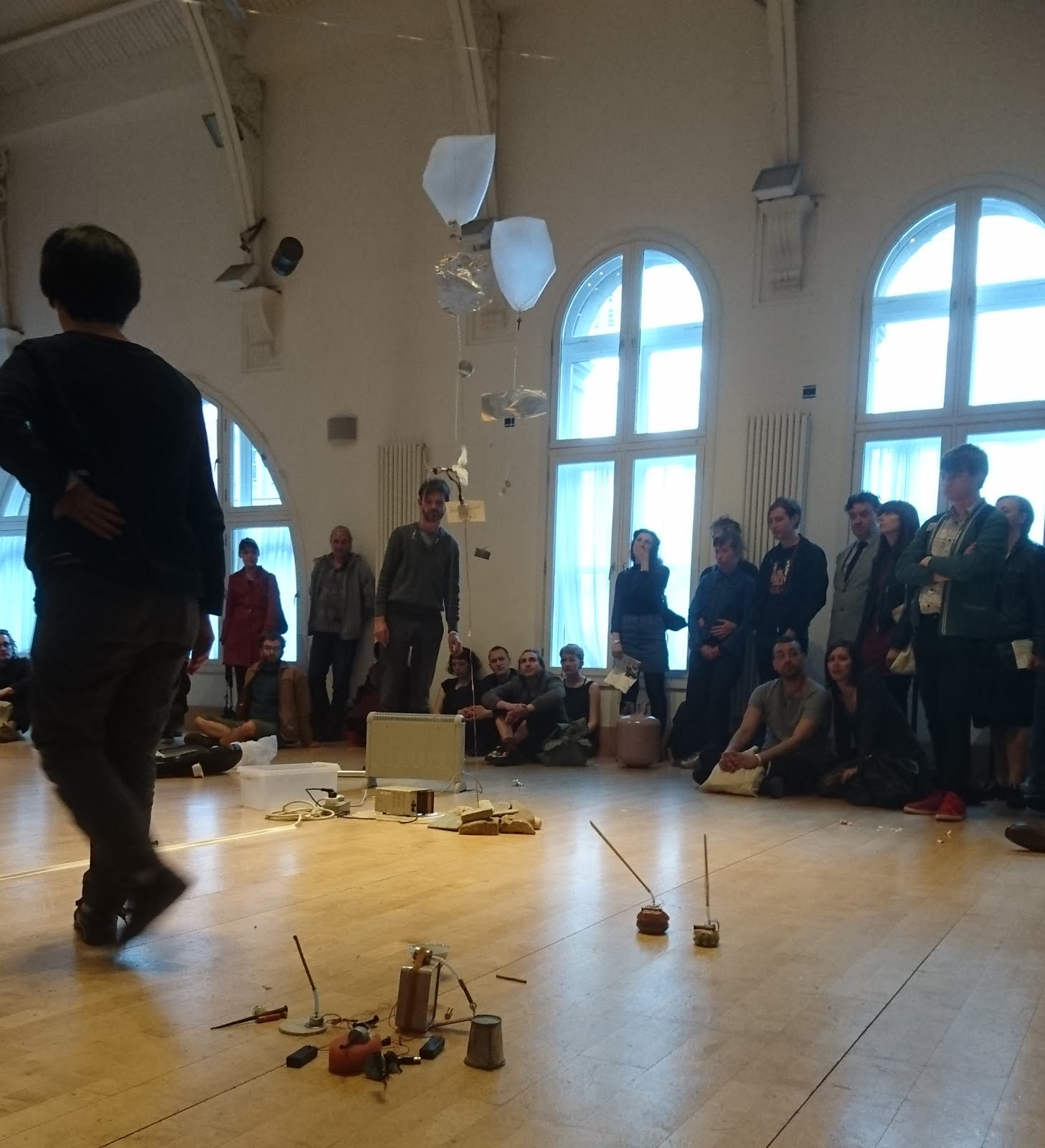
Across the weekend Pierre Berthet and Rie Nakajima had an installation on display in the building's recital room, where they gave occasional performances, animating their assorted creations. Gently diverting but never amounting to more than the sum of its little parts.

James Saunders and Tim Parkinson gave us two entertaining pieces ('in which one thing depends on another' and 'songs') which played with word association, a variety of dropping, plopping and banging of everyday objects and tabletops, accompanied by vocal ejaculations.

After these carefully written and choreographed pieces Ash Reid's piece of agitprop theatre in the Old Fruitmarket felt a bit self-indulgent and shambolic. A tighter piece, 'Felt Events' by Ilana Halperin and Raymond MacDonald featuring further contributions from the musicians of The Necks, brought a jazz cafe feel to a piece reflecting on volcanoes and earthquakes. Tectonics, you might say. Tut Vu Vu were a noisy wake up call to the audience after all that, with distorted, fluorescent guitars and electronic beeps and sqwaks.

The closing concert squeezed in six more performances starting with Shiori Usui's 'from scratch', a piece of music based on her experiences of eczema (which was making me feel itchy). Lawrence Dunn's 'Ambling, waking' followed in the City Halls, with more from Linda Caitlin Smith, James Saunders and Roscoe Mitchell bringing the weekend to a close.

Always an enjoyable way to spend a weekend, the whole thing this year felt less fresh than in previous years. Much of the music was similarly toned 1960s and 1970s pieces, and with many of the same musicians playing across the weekend it ended up with a familiar tone over the two days. There just seemed to be less chaos - more chin stroking this year and less drama.

Monday, 9 May 2016

Tectonics Festival, Glasgow 2016

Tectonics Festival, Glasgow 2016


The Tectonics Festival started life in Iceland, and has been playing in Glasgow for several years now under the leadership of conductor Ilan Volkov. As in previous years the BBC Scottish Symphony Orchestra are at the heart of the Tectonics performances, but are accompanied over the weekend in the Old Fruitmarket and Glasgow City Halls by a parade of modern classical and experimental musicians, composers and performers. Tectonics has now become a brand, with their diverse festivals of new music performed now in New York, Adelaide, Reykjavik, Tel Aviv as well as Glasgow's annual shindig.


Saturday May 7th 2016

As in previous years, the interconnected venues of the Old Fruitmarket and City Halls were fully exploited, with performances ebbing and flowing between spaces and on many occasions designed with the space in mind.  Over the weekend pianist and improviser John Tilbury was present, marking his 80th birthday earlier this year. He opened proceedings in the main hall, playing piano on Annea Lockwood's Jitterbug, a quiet piece based on underwater recordings, with the musicians interpreting a score consisting of photographs of patterned rocks. A typically leftfield and experimental piece for Tectonics. This was followed by an engaging piano duo from John Tilbury and Sebastian Lexer, starting with Unintended Piano Music, a tribute to Cornelius Cardew, before they improvised back and forth. A low key start to a festival which has "MAKE SOME NOISE" proclaimed on its posters and on the wristbands we are all wearing.

Ane Unquietatioun
Heading into the darkened space of the Old Fruitmarket the volume picked up a bit with Ane Unquietatioun, a collaboration with modern folk singer Alasdair Roberts, Trembling Bells drummer Alex Neilson and improviser and multi-instrumentalist Ivor Kallin on viola and squawking vocals. They produced an intriguing blend of Scottish folk and free jazz.

Angela Rawlings and Rebecca Bruton (Moss Moss Not Moss) engaged in a melodic, Socratic vocal dialogue on a pedestal in the centre of the hall. Between performances Annea Lockwood's installation A Sound Map of the Housatonic River played in the Recital Room, a soothing hour of field recordings.

A Sound Map of the Housatonic River
As we entered the evening the BBC Scottish Symphony Orchestra got their first outing, starting out spread around the Fruitmarket hall playing a "spatial piece" by Catherine Kontz, taking its name from the hall, echoing the calls of market vendors. It was hard for me not to think about the "Fresh strawberries, fresh" opening calls of Who will buy? from Oliver Twist (as a child this was my song at family parties).

Four further orchestral pieces in the Grand Hall were more noteworthy for the spaces and noiselessness between the music than for soaring drama. At times some felt like a series of short pieces of incidental music from an ITV series. Concealed Unity by Jessika Kenney and Eyvind Kang, which had members of the orchestra and the Glasgow Chamber Choir dotted about above and behind the audience on the balcony of the hall, was the most memorable.

BBC SSO on stage and on the balcony for Concealed Unity
Back into the Old Fruitmarket for the late gig brought the most intriguing performances of the day. Andy Moor of Dutch outfits The Ex and Dog Faced Hermans was joined by Wilf Plum, Jer Reid and Neil Davidson on guitars and drums and Anne-James Chatton with a monotone, French vocal, taking us through a cycle of songs based on Dante's Inferno. They gave us a classy performance and a classy sound.

Andy Moor and company

Sunday May 8th 2016


On an unusually sunny Glaswegian day, we started off day 2 in the cool dark of the Old Fruitmarket again. Jon Rose is a violinist, but definitely not in the traditional fashion. With Palimpolin he gave us a gripping, virtuoso performance showing the astonishing sounds a violin can be made to produce. Spotlit in the dark at the other end of the Fruitmarket hall we then had Labyrinthine by Jane Dickson, an abstracted operatic piece for two voices (Lucy Duncombe and Anneke Kampman) above an electronic drone. At times it sounded like a Gothic children's playground, as they jumped and sang for short periods with looped vocals. It was hypnotic and atmospheric in the inky blackness of the Fruitmarket.

More concentration and effort was required of the audience next in the Grand Hall for Michael Pisaro's Lucretius Melody, based on The Nature of Things, a work of Roman poet and philosopher Titus Lucretius Carus. With voice, viola and guitars it felt quite medieval in tone, serene and unhurried. After this Alvin Curran was next up to shake the cobwebs away.

Musique Sans Frontieres starts in the foyer
Alvin Curran directing his piece in the Fruitmarket
Kirkintilloch Brass Band rise to the challenge
The distinctive skirl of three bagpipers started Alvin Curran's work, Musique Sans Frontieres, in the foyer. Accompanied by saxophonists and Alvin Curran on a shofar or horn the audience were led through the building and into the Fruitmarket where brass, woodwind sections and a choir were awaiting us. The next phase started with the crashing drums on the balcony, the music swinging from chaos to order under the guiding hand of the composer. The chorists and musicians mingled with the audience, throwing frying pans to the floor as they went before we were led by them back to the Grand Hall where the full BBC SSO took over on stage giving us a lustrous and warm end to the piece. Of particular note were the solo violinists of the BBC SSO, particularly the fiddling finale. Also the Glasgow Chamber Choir and the Kirkintilloch Brass Band who were involved gave a sterling performance and rose to the challenge of the work.

BBC SSO on stage at the Grand Hall, City Halls, Glasgow
 A hard act to follow, but Alwynne Pritchard's piece Rockaby, had enough theatricality to manage it. Blurring the boundaries between music and drama, elaborately costumed and accompanied by the orchestra and an extensive table of sound effects it was inspired by the Samuel Beckett one-woman play of the same title. Michael Pisaro's fields have ears finished events in the Grand Hall on a tame note, with the orchestra subdued and quiet. John Tilbury performed the suppressed piano solo above rustling paper and tickled cymbals. It left a feeling of anxious anticipation with its exploration of the sound of silence and space reminiscent of John Cage, but rather deflated the earlier energy in the room.

David Fennessy's Hirta Rounds
The closing concert in the Fruitmarket was as eclectic and diverse as you would hope. David Fennessey's 16 musicians playing strings had part of the audience kettled between them as they passed the melody back and forth. Then we had the "yoiking" of Ánde Somby, animalistic chants from the Sami people that definitely showed the hand of Alasdair Campbell in curating the weekend.

Ándy Somby
The finale was one of my favourite pieces of the whole weekend and I would happily have listened to more of Nate Young's electronic noodling in front of an ensemble of 12 BBC SSO musicians, performing Mario Diaz de Leon's Standard Deviance One. To the end Ilan Volkov was on stage conducting this last piece with the energy and enthusiasm he shows all the time in curating and organising these events. When he is not on stage he is amongst the audience helping give these Tectonics festivals their unstuffy and relaxed atmosphere. The venue helps too, as do all the staff working in it, and this year the spaces were exploited fully by the composers.

I am glad to say that the dates are already pencilled in for next year's festival in Glasgow in May 2017, and this year's festival will be available on the BBC Radio 3 Hear and Now programme and on the BBC iPlayer.


Sunday, 1 March 2015

BBC Scottish Symphony Orchestra. City Halls, Glasgow 28 Feb 2015

BBC SSO, Hear and Now. City Halls, Glasgow. Live review.


The BBC Scottish Symphony Orchestra play a varied palette of music. They have become proficient interpreters of modern classical music and again this month were recording music for Radio 3's Saturday late-night new music thread, Hear and Now. Modern classical music doesn't seem to shift tickets as well as a night of Beethoven but these Hear and Now concerts for radio transmission are free and I'm always amazed that more people wouldn't just give it a go. 

Tonight the orchestra were led by German composer and conductor Matthias Pintscher. The finale was to be a piece by French composer and polymath Pierre Boulez to mark his 90th birthday. Before that the first half of the programme lent heavily on the conductors tastes and colleagues. First up was a composition by Serbian Marko Nikodijevic, "Cvetic, Kucica.../La Lugubre Gondola". This was based upon Liszt's piano piece, inspired by Venetian funeral gondolas. The title, "little flower, little house" in Serbian, dedicates the piece to the death of a 5 year old girl found dead in the back of of sunken lorry. Thoughts of this solemn tale, mentioned in the programme notes, rather overwhelmed the mournful music, which ebbed and flowed. 

Next was a piece by our conductor's former teacher Manfred Trojahn, "Herbstmusik/Sinfonischer Satz". This takes ideas from Sibelius's Fifth Symphony the programme notes tells us and I liked it a lot. For me it felt like tumbling down rather dark and tempestuous rapids of a river before our head pops above water in the stiller waters downstream. 

Next was a piece by young Slovenian composer, Vito Zuraj. "Hawk-eye( horn concerto)". Whether we were evoking the eye of a hawk zooming in on some prey or the modern computer aided tennis ball tracking system was ambiguous. It was a very visual piece however, from zooming in and out with the opening strings rising and falling to the parping French horn played by Saar Berger. However the image it created in my mind's eye was really of an elephant trying to chase a pesky fly. With the violins largely played ukulele-style and them getting out all the comedy instruments from the percussionists toy box it felt like a light-hearted soundtrack to the Eastern European cartoons I watched on BBC2 in my youth. 

If the first half was a very visual spectacle, the second half was more a pleasure for the ears. Pierre Boulez will always be thought of by me as the inspiration for Private Eye's music correspondent Lunchtime O'Boulez. I wasn't familiar with his music and "...explosante-fixe..." has led me to seek out some more. This particular piece was written as a requiem for a flautist friend of the composer. This piece combined electronic elements alongside traditional musicians. We had 22 musicians on stage divided into strings, brass and woodwind with a flautist standing in front of each third, the stage looking like half of a Trivial Pursuit piece. In the auditorium was another performer working the live electronics. The electronic elements chimed perfectly with the musicians, tonally and in volume, moreso than I have ever seen before when these are combined. It all hung together coherently and was quite hypnotic and delicate. 

Another fascinating evening of things which were all new to me, a fantastic orchestra and a beautiful setting. Why aren't these great FREE concerts playing to bigger crowds?

Friday, 28 September 2012

Wagner. A Review of a Big Opera in Small Pieces

BBC Scottish Symphony Orchestra perform Wagner's Tristan and Isolde (Act 1)


I go to see the opera, usually Scottish Opera at the Theatre Royal in Glasgow, about once a year. Part of the appeal is the grand costumes, the acting, the staging, the wee ice cream tub at the interval (and also it is a night out where I am at the younger end of the audience spectrum for a change). Sometimes opera feels like a Lloyd Webber musical sung in a foreign language, as you wait for Bizet or Puccini's big hit tune to come along. There is a lot of the cast talking through the story to background music between the hits. Wagner I think is more about the musical piece throughout, the music tells the story and sets the tone, and for that he is credited with giving direction and ideas to a lot of 20th Century music.
I've sat through a Wagner opera in full once, years ago, a performance of The Mastersingers of Nuremberg. I remember the grand costumes and sets, and I remember it being long, but I couldn't hum you any of the tunes. I've also seen a concert performance of an opera only once before, when Scottish Opera did Georges Bizet's Pearl Fishers in a big hall in Govan 15-odd years ago. Stripped away from the usual operatic paraphernalia the music comes to the centre of the stage. This was the case last night when I went to see the BBC Scottish Symphony Orchestra perform Wagner's Tristan and Isolde, with chief conductor Donald Runnicles, who reminded me of a well fed David Essex. If done in the full it takes over 5 hours, so for this they've broken it into easily digestible chunks, performing each of the three acts on a separate night, with an accompanying piece of music to highlight some of the themes or inspired by Wagner's music.
Tonight we had Rachmaninov's The Isle of the Dead, a musical poem inspired by seeing a painting by Bocklin of Charon apparently rowing a coffin out to the island of Ponza. The ebbing and flowing of the sound was incredibly evocative and watching the conductor and musicians rise and fall to the music as the storm rose then tailed off I was almost feeling seasick. The big crescendo of the storm was great to hear, and when an orchestra is going full pelt at you it really is an impressive sight and sound. I always feel sorry for the percussionists on these occasions, the one playing the cymbals sat patiently throughout, stood up, did her mighty crash then sat down again. More cymbals Sergei, that'd be my only change, make her work for her money.

After that the sea bound Act 1 of Tristan and Isolde was a calmer affair, to begin with. It's the everyday story of boy meets girl, boy kills girl's fiance, then sends his head on a spike to Ireland, gets his wounds tended by the girl's magic potions and steals her away to be married to his king whilst they both hide their love for each other. Girl arranges maid to give them both deadly tonic but maid swaps it for love juice. Boy and girl swig back their unspoken suicide pact to find birds tweeting overhead as they realise their love for each other. The orchestra clashes and horns blast as they arrive in Cornwall. Surely this is the only piece of theatre that ends with a fantastic crescendo whilst a chorus cries "Hail Cornwall. Hail Cornwall".
Watching the concert performance you are more aware of the music and with the singers centre stage, almost amongst the instruments, at times their singing risks being overwhelmed by the music. Isolde, soprano Nina Stemme, was clearly struggling with a bit of a cold (I haven't seen an opera singer need to take Sinex and pills mid-performance before), but she managed to sing out as clear as a bell over the orchestra. Of the four main singers in Act 1 she was the one who continued to act her piece to get the turmoil of the story told with her voice and expression, not just singing it out. The gentle music builds to a "what happens next?" finale and I had to buy a ticket for Acts 2 and 3 when I got home as it was a great night out. I've read that this is a trick of the music that Wagner writes, building anticipation. It's called "harmonic suspension" apparently, but without knowing that was happening, the orchestra tonight were able to convey it. The Rachmaninov for me was especially good and something that I'd never heard before. A great wee bonus to the main event.
City Halls, Glasgow
I like the City Halls too, I think it's a great concert venue, with good acoustics and sightlines throughout. It also makes me remember the various trade union demonstrations that used to end here, where I'd get to run about and play on the balcony whilst the speeches went on. It's all much smarter nowadays.

I'm reading Haruki Murakami's big 1,000 page tome at the moment, 1Q84, and co-incidentally got to the end of Book 1 out of 3 last night, before seeing Act 1 of Wagner's 3. At the start of book 2 a character quotes from Chekov his famous line about not introducing a gun to Act 1 unless you are going to use it in Act 3, so I fear for the future of Tristan and Isolde and don't fancy their chances of making it to the end of Act 3 now that they've already talked of life threatening wounds and deadly potions. For that matter in the book I don't much fancy Aomame or Tengo's chances of making it to page 1,000. However, in both cases, all will be revealed and in both cases I'm looking forward to finding out.