Showing posts with label Tectonics. Show all posts

Friday, 12 May 2017

Tectonics Glasgow 2017

Tectonics Glasgow, May 2017. Review


For the fifth Glasgow outing of the Tectonics music festival all its familiar elements of experimentation, improvisation and collaboration were on display. Female composers and performers were to the fore this year, with the ever reliable BBC Scotland Symphony Orchestra and conductor Ilan Volkov the glue holding the whole weekend together.

The Old Fruitmarket, Glasgow
Whilst most of Glasgow lay about in glorious sunshine, decent crowds were drawn into the cool darkness of the Old Fruitmarket to see jazz musician and composer Roscoe Mitchell, who would bookend the festival, kick things off. Resplendent in some fantastic green knitwear and sunglasses despite the gloom of the Fruitmarket he wheezed and parped his saxophone like some exuberant snake charmer to get us started. They were followed by artist Luke Fowler and musician and composer John Chantler squatting in the centre of the room over a jumble of cables and string instruments creating fantastic electronic drones and distorted sounds. 

Luke Fowler and John Chandler
Next up we were through to the City Halls where New York musicians Yarn/Wire, a quartet of two percussionists and two pianists who started on conventional instruments to perform a piece by Andrew MacIntosh, before gravitating to bowed wine glasses and cymbals. Twitchy samples, shaken foliage, kitchen utensils and coloured beads agitated on drums were required for Thomas Meadowcroft's "Walkman Antiquarian". Their playing throughout, and across the weekend was crisp, clear and precise. If you want four musicians to fit a kitchen for you I would go for them - neat, particular and perfectly measured.

Back into the main concert hall and members of the BBC SSO combined with Yarn/Wire to play François-Bernard Mâche's "Kassandra", a tight performance conducted by Volkov combining the musicians with recorded voices and natural sounds. A strident babble of diverse voices. The first piece of the weekend from composer Linda Caitlin Smith, "Wilderness", was sweetly mellifluous before cellist Lori Goldston's composition for amplified cello and orchestra. A darker, more forceful piece and a good contrast to what had gone before.


My personal highlight of the weekend was the collaboration between Australian trio The Necks and the complete BBC SSO being guided in an extended piece of improvised playing by the energy of conductor Ilan Volkov. With The Necks front of stage, performing away, Volkov looked to be composing live with the orchestra, as he waved his hands and sculpted sounds, much as Tony Stark does with his VR computer system in the Iron Man movies. It was phenomenally beautiful, and a reflection of the close working over many years between Volkov and the orchestra.

Triangulum brought the evening to a close in the Old Fruitmarket featuring Julia Holter, Catherine Lamb and Laura Steenberge. A gentle, and slightly anti-climactic end to the day.


Sunday started with many of the musicians from the festival performing on the floor of the Old Fruitmarket Eddie Prévost's 'Spirals'. With members of Yarn/Wire, The Necks, Triangulum and others playing whilst dressed in gold lamé tabbards, the tone for the second day was established.

Two more pieces by Linda Caitlin Smith were performed in the main concert hall. First the baroque and melancholic 'Ricercar' performed by solo cellist Alison Mcgillivaray, followed by Yarn/Wire on two marimba and two grand pianos playing the more halting, laconic, and haunting 'Morandi'.
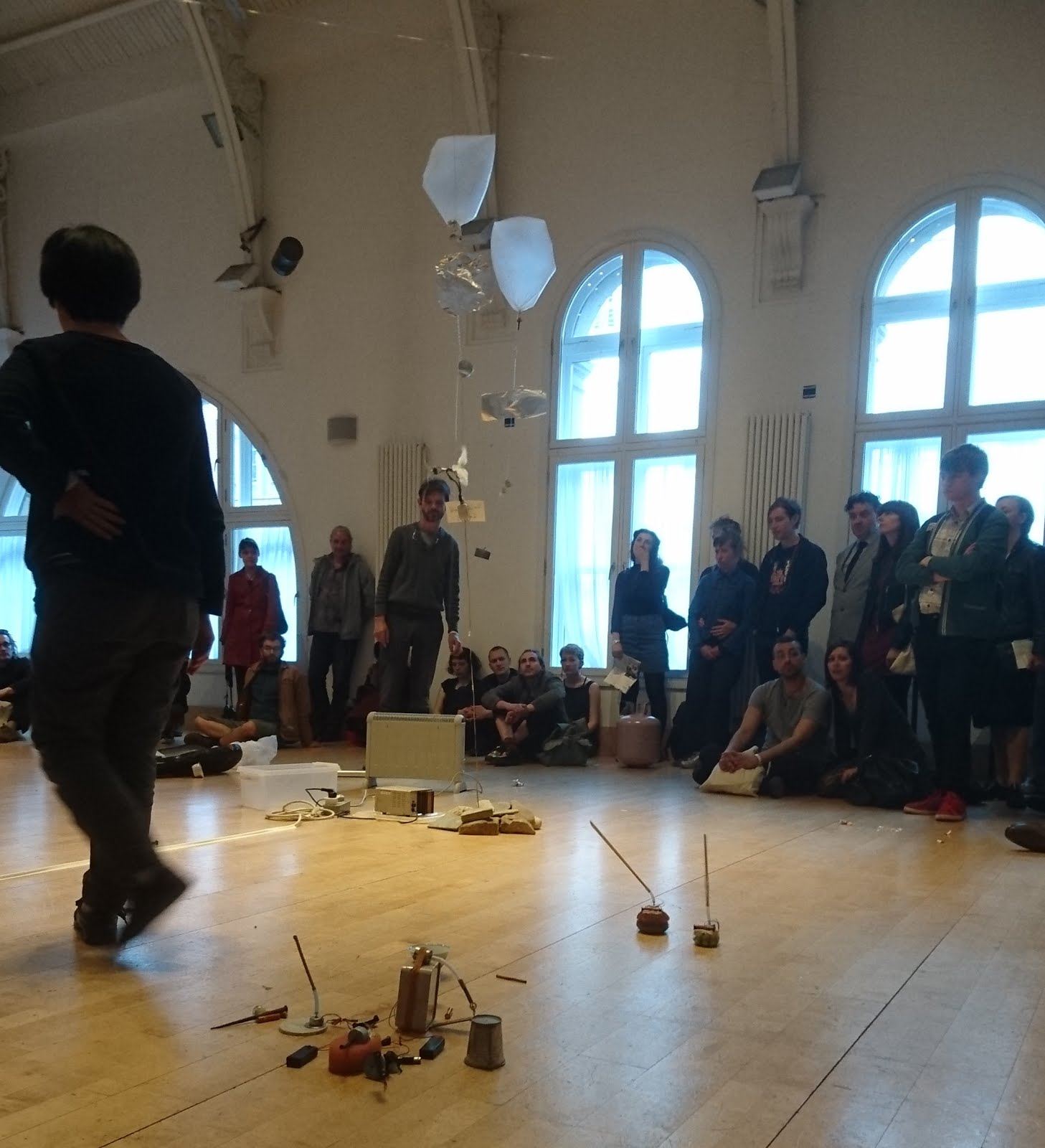
Pierre Berthet and Rie Nakajima
Across the weekend Pierre Berthet and Rie Nakajima had an installation on display in the building's recital room, where they gave occasional performances, animating their assorted creations. Gently diverting but never amounting to more than the sum of its little parts.

James Saunders and Tim Parkinson gave us two entertaining pieces ('in which one thing depends on another' and 'songs') which played with word association, a variety of dropping, plopping and banging of everyday objects and tabletops, accompanied by vocal ejaculations.

After these carefully written and choreographed pieces Ash Reid's piece of agitprop theatre in the Old Fruitmarket felt a bit self-indulgent and shambolic. A tighter piece, 'Felt Events' by Ilana Halperin and Raymond MacDonald featuring further contributions from the musicians of The Necks, brought a jazz cafe feel to a piece reflecting on volcanoes and earthquakes. Tectonics, you might say. Tut Vu Vu were a noisy wake up call to the audience after all that, with distorted, fluorescent guitars and electronic beeps and sqwaks.

The closing concert squeezed in six more performances starting with Shiori Usui's 'from scratch', a piece of music based on her experiences of eczema (which was making me feel itchy). Lawrence Dunn's 'Ambling, waking' followed in the City Halls, with more from Linda Caitlin Smith, James Saunders and Roscoe Mitchell bringing the weekend to a close.

Always an enjoyable way to spend a weekend, the whole thing this year felt less fresh than in previous years. Much of the music was similarly toned 1960s and 1970s pieces, and with many of the same musicians playing across the weekend it ended up with a familiar tone over the two days. There just seemed to be less chaos - more chin stroking this year and less drama.

Monday, 9 May 2016

Tectonics Festival, Glasgow 2016

Tectonics Festival, Glasgow 2016


The Tectonics Festival started life in Iceland, and has been playing in Glasgow for several years now under the leadership of conductor Ilan Volkov. As in previous years the BBC Scottish Symphony Orchestra are at the heart of the Tectonics performances, but are accompanied over the weekend in the Old Fruitmarket and Glasgow City Halls by a parade of modern classical and experimental musicians, composers and performers. Tectonics has now become a brand, with their diverse festivals of new music performed now in New York, Adelaide, Reykjavik, Tel Aviv as well as Glasgow's annual shindig.


Saturday May 7th 2016

As in previous years, the interconnected venues of the Old Fruitmarket and City Halls were fully exploited, with performances ebbing and flowing between spaces and on many occasions designed with the space in mind.  Over the weekend pianist and improviser John Tilbury was present, marking his 80th birthday earlier this year. He opened proceedings in the main hall, playing piano on Annea Lockwood's Jitterbug, a quiet piece based on underwater recordings, with the musicians interpreting a score consisting of photographs of patterned rocks. A typically leftfield and experimental piece for Tectonics. This was followed by an engaging piano duo from John Tilbury and Sebastian Lexer, starting with Unintended Piano Music, a tribute to Cornelius Cardew, before they improvised back and forth. A low key start to a festival which has "MAKE SOME NOISE" proclaimed on its posters and on the wristbands we are all wearing.

Ane Unquietatioun
Heading into the darkened space of the Old Fruitmarket the volume picked up a bit with Ane Unquietatioun, a collaboration with modern folk singer Alasdair Roberts, Trembling Bells drummer Alex Neilson and improviser and multi-instrumentalist Ivor Kallin on viola and squawking vocals. They produced an intriguing blend of Scottish folk and free jazz.

Angela Rawlings and Rebecca Bruton (Moss Moss Not Moss) engaged in a melodic, Socratic vocal dialogue on a pedestal in the centre of the hall. Between performances Annea Lockwood's installation A Sound Map of the Housatonic River played in the Recital Room, a soothing hour of field recordings.

A Sound Map of the Housatonic River
As we entered the evening the BBC Scottish Symphony Orchestra got their first outing, starting out spread around the Fruitmarket hall playing a "spatial piece" by Catherine Kontz, taking its name from the hall, echoing the calls of market vendors. It was hard for me not to think about the "Fresh strawberries, fresh" opening calls of Who will buy? from Oliver Twist (as a child this was my song at family parties).

Four further orchestral pieces in the Grand Hall were more noteworthy for the spaces and noiselessness between the music than for soaring drama. At times some felt like a series of short pieces of incidental music from an ITV series. Concealed Unity by Jessika Kenney and Eyvind Kang, which had members of the orchestra and the Glasgow Chamber Choir dotted about above and behind the audience on the balcony of the hall, was the most memorable.

BBC SSO on stage and on the balcony for Concealed Unity
Back into the Old Fruitmarket for the late gig brought the most intriguing performances of the day. Andy Moor of Dutch outfits The Ex and Dog Faced Hermans was joined by Wilf Plum, Jer Reid and Neil Davidson on guitars and drums and Anne-James Chatton with a monotone, French vocal, taking us through a cycle of songs based on Dante's Inferno. They gave us a classy performance and a classy sound.

Andy Moor and company

Sunday May 8th 2016


On an unusually sunny Glaswegian day, we started off day 2 in the cool dark of the Old Fruitmarket again. Jon Rose is a violinist, but definitely not in the traditional fashion. With Palimpolin he gave us a gripping, virtuoso performance showing the astonishing sounds a violin can be made to produce. Spotlit in the dark at the other end of the Fruitmarket hall we then had Labyrinthine by Jane Dickson, an abstracted operatic piece for two voices (Lucy Duncombe and Anneke Kampman) above an electronic drone. At times it sounded like a Gothic children's playground, as they jumped and sang for short periods with looped vocals. It was hypnotic and atmospheric in the inky blackness of the Fruitmarket.

More concentration and effort was required of the audience next in the Grand Hall for Michael Pisaro's Lucretius Melody, based on The Nature of Things, a work of Roman poet and philosopher Titus Lucretius Carus. With voice, viola and guitars it felt quite medieval in tone, serene and unhurried. After this Alvin Curran was next up to shake the cobwebs away.

Musique Sans Frontieres starts in the foyer
Alvin Curran directing his piece in the Fruitmarket
Kirkintilloch Brass Band rise to the challenge
The distinctive skirl of three bagpipers started Alvin Curran's work, Musique Sans Frontieres, in the foyer. Accompanied by saxophonists and Alvin Curran on a shofar or horn the audience were led through the building and into the Fruitmarket where brass, woodwind sections and a choir were awaiting us. The next phase started with the crashing drums on the balcony, the music swinging from chaos to order under the guiding hand of the composer. The chorists and musicians mingled with the audience, throwing frying pans to the floor as they went before we were led by them back to the Grand Hall where the full BBC SSO took over on stage giving us a lustrous and warm end to the piece. Of particular note were the solo violinists of the BBC SSO, particularly the fiddling finale. Also the Glasgow Chamber Choir and the Kirkintilloch Brass Band who were involved gave a sterling performance and rose to the challenge of the work.

BBC SSO on stage at the Grand Hall, City Halls, Glasgow
 A hard act to follow, but Alwynne Pritchard's piece Rockaby, had enough theatricality to manage it. Blurring the boundaries between music and drama, elaborately costumed and accompanied by the orchestra and an extensive table of sound effects it was inspired by the Samuel Beckett one-woman play of the same title. Michael Pisaro's fields have ears finished events in the Grand Hall on a tame note, with the orchestra subdued and quiet. John Tilbury performed the suppressed piano solo above rustling paper and tickled cymbals. It left a feeling of anxious anticipation with its exploration of the sound of silence and space reminiscent of John Cage, but rather deflated the earlier energy in the room.

David Fennessy's Hirta Rounds
The closing concert in the Fruitmarket was as eclectic and diverse as you would hope. David Fennessey's 16 musicians playing strings had part of the audience kettled between them as they passed the melody back and forth. Then we had the "yoiking" of Ánde Somby, animalistic chants from the Sami people that definitely showed the hand of Alasdair Campbell in curating the weekend.

Ándy Somby
The finale was one of my favourite pieces of the whole weekend and I would happily have listened to more of Nate Young's electronic noodling in front of an ensemble of 12 BBC SSO musicians, performing Mario Diaz de Leon's Standard Deviance One. To the end Ilan Volkov was on stage conducting this last piece with the energy and enthusiasm he shows all the time in curating and organising these events. When he is not on stage he is amongst the audience helping give these Tectonics festivals their unstuffy and relaxed atmosphere. The venue helps too, as do all the staff working in it, and this year the spaces were exploited fully by the composers.

I am glad to say that the dates are already pencilled in for next year's festival in Glasgow in May 2017, and this year's festival will be available on the BBC Radio 3 Hear and Now programme and on the BBC iPlayer.


Monday, 4 May 2015

May Music in Glasgow. Tectonics and Minimal 2015 Review

Review : Minimal Glasgow 2015, Tectonics 2015 Glasgow


If you have flicked through the pages of the excellent new book "Dear Green Sounds - Glasgow's Music Through Time and Buildings" you will know that Glasgow has a long history of being an enthusiastic creator and audience for live music. In 2008 Glasgow was named one of nine UNESCO Music Cities and ever since the days of the "Glasgow's Miles Better Campaign" the city has tried to re-position itself as a cultural rather than an industrial hub. 

It seemed that this May Day weekend there were multiple entertainments fighting for our attention, and I just fear that as a result attendances at some of them may have suffered a wee bit. In the Venn diagram of musical tastes the overlapping set of people interested in modern classical music, jangley indie-pop and experimental new music contains maybe only a handful of people. However I was one of those people so could not attend all the Glasgow music festivals on the go this May Day weekend that I fancied. We had three days of Minimal 2015 at the Concert Hall, three days of the Tectonics Festival in the Fruitmarket and City Halls and Live at Glasgow playing at various venues around Sauchiehall Street on Sunday. Add to that the fact that Take That were playing 5 nights in the city, Partick Thistle were at home to St Mirren on Saturday and the Glasgow Open House art festival was on this weekend there were almost too many choices on offer. (I thought that the Rugby Sevens were on all weekend in Scotstoun too, but that is next weekend - not that I was planning to go to that, but I suppose some people do as it is already sold out). I have certainly spoken to a few people who fancied attending some of the above, but could not decide between the various offerings or just couldn't afford it.

Minimal Glasgow 2015 - Philip Glass, Music in 12 Parts


Glasgow Royal Concert Hall has been running a series of Minimalist music concerts for 5 years now and this year they had attracted two of the world's foremost modern classical composers. First up was Philip Glass on Friday night. This is the third time that I have been lucky enough to see him perform (1 and 2), and it was by far the most intense performance. Now 78 years old, he performed his 1975 piece "Music in 12 Parts" with the seven piece Philip Glass Ensemble. Glass, from Baltimore, and is most associated with the term minimalism which he dislikes, preferring to describe himself as a composer of "music with repetitive structures". Nowhere is that more clear than in this composition. The 12 parts of roughly 20 minutes each, can be played singly or in any order but tonight we were given the rare chance to hear the whole piece from start to finish, divided into four hour long sections with an hour long "dinner break" in the middle meaning the performance lasted from 6pm until after 11pm with both the musicians and the audience showing rapt concentration throughout. 

Philip Glass Ensemble in Glasgow


On stage three musicians, including Glass, played electric organs throughout whilst the other three musicians alternated between flutes and saxophones with a solo female vocalist the final part of the jigsaw. With a burbling, repetitive structure, small changes over time grow and shift giving it a gripping, mesmeric quality. Over the piece I found my thoughts drifting off occasionally, being drawn back into the room with a change in the rhythm or tone. It reminded me of an overnight train journey that I once took across Europe, with the constant soundtrack of the train on the track and the countryside out of the window slowly changing, almost imperceptibly, over time. A hugely enjoyable night. 

Tectonics Glasgow 2015

Part of Goodeipal's
performance
Having seen Philip Glass on Friday and having seen Partick Thistle see off St Mirren on Saturday afternoon, I was belatedly able to join the Tectonics Festival down in the City Halls on Saturday night. This is the third edition of this music festival in Glasgow, with Tectonics events also on the go from Iceland to Australia, curated by conductor Ilan Volkov. With the BBC Scottish Symphony Orchestra (BBC SSO) at the heart of it, this is a festival of contemporary classical music, new commissions, experimental performers and improvisers. Or to put it another way "that weird shit" as a friend said to me yesterday. Unfortunately I wasn't able to catch any of the performances by French composer Éliane Radigue, 83-year old pioneer of electronic music. I did get to dip in and out of Danish/ Faroese artist Goodiepal's weekend long performance which involved lectures, electronic music and some pipe playing whilst his colleague wandered about blowing into a conch. 

The main concert featured the excellent and adaptable BBC SSO in the main hall performing five pieces. In the first half the most interesting piece was one written by Paul Newland, Angus Macphee. This is about a South Uist crofter who served in the Faroe Islands in WW2 and then was transferred to a psychiatric hospital in Inverness, where he remained largely silent and created woven pieces from found objects. It was an interesting and nuanced piece with many a pregnant pause. In the second half there was a nocturne by John Croft (...che notturno canta insonne) which felt like a very restless night sitting up waiting for someone to arrive home. The concert was finished off with a lovely cello concerto by Cassandra Miller, with soloist Charles Curtis. The lead cello sawed steadily at two notes whilst the orchestra swirled around him, the brass almost verging on a Mariachi sound at times. It was interesting hearing the cello as the solid backbone of the piece until we got to the last page when it let loose a brief lament. 

The late evening concert was a mixed bag of electronic manipulation, bangs and crashes in the Fruitmarket.

Minimal Glasgow 2015 - Steve Reich

Now 78 years old, Steve Reich was back in Glasgow with a new piece he had written for the Colin Currie Group (two years ago he was in town to watch them perform Drumming). First up he and Colin Currie were interviewed on stage and Reich was urbane and relaxed as ever. He is clearly a demanding critic of performances of his music, but it is nice to see that when audience questioners over-analyse his music, he responds with a flat "no, I don't think so" attitude.

Steve Reich and Colin Currie interviewed on stage 

The first piece performed was Music for Pieces of Wood (1973), a rhythmical piece played on five wooden claves and then Quartet, performed by two pianos and two vibraphones. In his talk beforehand Reich had talked about the process of creating this complex piece and how it has been refined by the performers to complete what we heard today.


The highlight came in the second half with the Colin Currie Group performing Music for 18 Musicians. With a steady, energetic pulse of the four pianos, the xylophones, marimbas and metallophone, seeing it performed live was fascinating as the musicians swapped positions and themselves ebbed and flowed across the stage with the music. A visual and aural spectacle that left me with a warm smile as we headed out into a cold, wet Glasgow evening. 

Tectonics Glasgow 2015

Having sacrificed an afternoon of Tectonic entertainments to see Steve Reich, we headed back down to City Halls to catch the evening concerts there. The BBC SSO were on impeccable form again as they struggled with the jerks and twiches of Peter Ablinger's "QUARTZ for high orchestra". The premise of this piece irritated me at a pedantic level as the orchestra were recreating the "sonically different" individual beats which a pre-recorded quartz watch made. However as the whole point of a quartz timepiece is that the crystal oscillator of a quartz watch creates an extremely precise frequency of signal. We were really listening to the different sounds of the watch mechanism next up the line. So not "quartz" at all, but more a chop, chop, plink, plonk Psycho shower scene pastiche.

Enno Poppe's Altbau was a more satisfying cacophony, which fell into a more melodic second movement. The second half of the concert was made up with a brooding, slow piece by Christopher Fox, Topophony, with harpist Rhodri Davies completing the composition with improvised accompaniment.

Finally we were through to the Fruitmarket, always a lovely venue for the closing concert of strangulated brass and mellifluous glass. Robin Hayward and Hild Sofie Tafjord played tuba and French horn to each other in the style many free-jazz musicians play saxophone, with a halting, choked action. Personally as someone with a love of Jamaican ska, when I see a brass instrument I prefer to hear it blow the roof off. The final performance was a treat, Daniel Padden's Glass Hundreds. Members of the orchestra were accompanied by performers getting a note from running their fingers around the rim of glasses of water. Their impressive finale of making music from blowing across the the tops of bottles whilst gulping down the contents to change the note was a suitably entertaining way to finish the weekend.

Instruments ready in the Fruitmarket
for the closing concert of Tectonics 2015
Both the Minimal series of concerts and Tectonics plan to return to Glasgow next year. As they both use Glasgow Life venues I am sure it is not impossible to try to avoid them arriving in town on the same weekend.

NB - Ticket prices

Partick Thistle vs St Mirren £22
Tectonics weekend pass £24, day ticket £16
Steve Reich or Philip Glass ticket £20-25
Live at Glasgow pass £23
Rugby Sevens weekend pass £50, day ticket £30
Take That £60-£90!

Monday, 12 May 2014

Tectonics Festival Glasgow, 2014

Review Tectonics Festival, Glasgow, May 2014


The Tectonics Festival returned to Glasgow for a second year this weekend. Originally devised by conductor Ilan Volkov with the Icelandic Symphony Orchestra in Rekyavik, he brought it to Glasgow last year. Since then it has grown arms and legs and been a platform for local and international, experimental and modern classical music in Adelaide, Tel Aviv and this year, New York.

BBC Scottish Symphony Orchestra

The programme this year did not jump out at me the way it did last year. I don't think I was alone in finding this, as audience numbers, although decent, seemed a wee bit down on last year's. I wasn't really familiar with any of the composers being performed. However, Volkov with his previous Tectonics programme and the free "Hear and Now" concerts which he still performs with the BBC SSO for Radio 3, is always a reliable guide. This meant that I was happy to be led by his reliable judgement. The Glasgow based BBC Scottish Symphony Orchestra have surely became one of the world's foremost interpreters of modern classical music. This weekend they were again given the opportunity to perform musical notation which at times can have more in common with a child's drawing book than a traditional orchestral score.

I wasn't able to attend the opening concert at St Andrew's in the Square, featuring many of the artists and composers who'd be performing across the weekend. With Bill Wells, Thurston Moore, Takehisa Kosugi and Richard Youngs amongst others on show, I was sorry to miss it.

Saturday night started with the BBC SSO, led by Volkov, performing French-born American composer, Christian Wolff's Ordinary Matter (version for two orchestras). Visually and aurally it was an interesting proposition as the counterpoint ebbed and flowed between the orchestra, split down the centre of the stage and led by separate conductors. It was slow, creeping and creaking. A high point was the to-ing and fro-ing between the pizzicato violin on the left and harp on the right.

A new BBC commission "'d love to turn by John Oswald was next up, a lighter affair. At times it was familiar, almost bursting into The Beatles "A Day In The Life" at one point, but with more assault on the piano strings in the style of Tom and Jerry. It ended with a moment of coitus interruptus, as the two percussionists raised their cymbals, then failed to climax.

The falling and rising strings of David Behrman's How We Got Here was a gentler affair, being swept away by Georg Friedrich Hass's more grandiose pieces following it. These were the highlights of the evening, with droning strings and brass, full of bombast in the Concerto Grosso No.2 for ensemble and orchestra. This was followed by his Saxaphone Concerto, with Swiss saxophonist Marcus Weiss playing in front of the dark tones of the full orchestra with his baritone sax.

Sarah Kenchington's Sounds From The Farmyard

In the interval we were ushered to the recital room where beautiful Heath Robinson style instruments constructed by Sarah Kenchington awaited our input. As shy Britons we gamely pottered about with them, deigning not to speak to one another or work together (the pipes were never going to work until someone decided to work the bellows). As the evening wore on people were more willing to give it a go. I couldn't help thinking that a bunch of kids would have made more "Sounds From The Farmyard" from it.

Muscles of Joy in The Fruitmaket

Set up next on the floor of The Fruitmarket were Muscles of Joy, a Glasgow band who I've seen before, supporting Tuneyards in Oran Mor. As before I found them interesting if a bit unengaging. They did highlight the gap in genders though as many of the performers, like them, were women whilst most of the pieces played over the weekend were composed or conducted by men. Perhaps it is a generational thing, as there were, particularly on the Sunday, several compositions by younger women.

Four men stare into a piano (whilst performing Behrman'sWavetrain

Back to City Halls where Icelandic composer/performer outfit S.L.Á.T.U.R. took us through Christian Wolff's Metal and Breath (where they either made noises with bits of metal...or their breath). Then Wolff's piece For One, Two or Three People was performed quietly by Wolff, Behrman and Kosugi. Their deferential respect for each other stole some dynamism from the piece. David Behrman's Wavetrain was excellent though, where Wolff, Behrman and Kosugi were joined by Volkov to place pick-ups on the strings of the prepared grand piano and play with the feedback.

Feedback was the watchword in The Fruitmarket for the late concert. Thurston Moore (off of Sonic Youth) wrestled with his guitar whilst Dylan Nyoukis provided accompanying noise and voice. I was amused to see the contrast between someone's child happily playing about to the noise produced and the older attendant from the halls standing behind the musicians with eyebrows more scornfully raised.  There are links appearing here, as Sonic Youth at times played the music of Christian Wolff . Scottish musician Gordon Sharp finished off the evening with his band Cindytalk.

Sunday's programme ran from 3pm until 10.30pm. One problem with this, as on Saturday, is that the performances are fairly constant. Obviously you can dip in and out of things, but I'm always afraid that I'll miss something special. Although the Merchant City is awash with bars and restaurants, there ain't no sandwich bars, cafes or fast food outlets on the weekend which makes getting food quickly an issue. As I'm diabetic, planning when to take my meals and insulin maybe means I'm a bit more obsessed with this than most people, but City Halls has no catering so maybe having a "street food" stall, music themed cafe or meal breaks in the programme could be considered in future outings? Some people came along with sandwiches but I opted to eat first and therefore missed Usurper in The Fruitmarket (who were apparently inviting us "to join them for an early tea".

SLÁTUR and their electronic score

I did catch the end of S.L.Á.T.U.R.'s performance, where their musical notation on the screens recalled the video game "Guitar Hero". The audience watched for their clapping or stomping cues. Two orchestral performances by composers from this outfit will be on show in  Glasgow in October. This highlights the fact that Tectonics is a platform for living, working composers. With its younger than average audience for "classical" music, sitting in a concert hall, pint of lager in hand, it is an idea I think is worthy of praise.

The next 90 minutes were of varied vocal/ choral music. Vocal ensemble EXAUDI, led by founder James Weeks, sang six varied pieces, three of them by Wolff. The main thing to shine through from this was the virtuoso performance of the singers in performing these, at times, challenging pieces. Leaving the hall, more cacophonous voices greeted us in the foyer as members of the Glasgow Chamber Choir and Glasgow University Chapel Choir performed James Weeks's piece, Radical Road (accompanied by pots and pans of gravel and clacking stones).

Next it was time for the BBC SSO to dust off their instruments again with music from two British composers, James Clapperton and Michael Finnissy. Catherine Lamb's "Expand" and "Saturate" from a longer work were excellent and reminded me of the soundtrack score for "Under The Skin" by Mica Levi. They both had some echoes in the final piece in this section. A new BBC commision, A Thin Tree by Austrian composer Klaus Lang, it had a lovely timbre (see what I did there?), which grew and stretched. A lovely piece, utilising the full orchestra.


Takehisa Kosugi's set up

Next we had one of the highlights of the weekend as 76 year old Japanese musician Takehisa Kosugi, once of Taj Mahal Travellers collective. He hunched over a table of electrical odds and ends in the darkened Fruitmarket and produced 30 minutes of electronic noise and interference with light sensitive switches making this improvisation entertainment for the eyes and ears. A treat which showed up some of the other music across the weekend for its lack of ambition.

Volkov and the BBC SSO in The Fruitmarket

Finally the musicians of the BBC Scottish Symphony Orchestra arranged themselves around the Fruitmarket Hall for the closing concert. It was great to see Richard Youngs, who had his guitar on the rack on stage here, take on something of this scale. With electronic sounds, guitar feedback and drums on stage, the strings were arranged around the Fruitmarket hall were the audience milled, brass on the balcony and Volkov conducted from a platform in the midst of it all. An appropriately eclectic performance to finish the evening.


Another enjoyable weekend, lots of composers here to hear their music performed and talk to the audiences. The earth maybe didn't move for me quite as much as it did at last year's Tectonics but some fabulous musicians performing for three nights in some fantastic venues. A real treat and I look forward to it's return next year.

Monday, 13 May 2013

Tectonics Music Festival, Glasgow

Live concert review


Conductor Ilan Volkov started the annual Tectonics Festival in Iceland last year, and this year also brings it to Glasgow. Although few of the musicians played both events, the ethos was the same at the two sites, mixing musicians and composers from different backgrounds to see what happens. The whole event was carefully curated by Volkov, with many of his own favourites included. A major focus of the weekend was to present works by American composer of experimental music, Alvin Lucier, who both performed and had an installation on show at the City Halls.

Tectonics beer mats

Not many weekends of classical music start with the audience being given wristbands to wear and with branded beer mats. Day 1 opened with a BBC commission by David Fennessy (Prologue, Silver Are The Tears Of The Moon), a work inspired by Werner Herzog's diaries apparently. It started with a dramatic blast of strings then slid along nicely, keeping the 5 percussionists of the orchestra busy until they were helped out when about 20 of the orchestra joined them on they wee percussive frog things that the One World Shop sells. It was a lively start before Morton Feldman's piece Cello and Orchestra slowed things down. Creeping along and creepy it felt like incidental music to a tense scene in a horror film. A problem I have with a lot of modern classical music is that really the only place you are frequently exposed to it is in soundtracks, so it's hard not to make those connections. Next up we had the first piece by Alvin Lucier, Exploration of the House. The orchestra played short snatches of Beethoven which were recorded and looped back into the hall, and that recorded and looped again. It became increasingly muddy, with distortion and feedback, increasingly droning and abstracted in a way specific to the room and the time. Maybe you end up with a version of the piece akin to how the increasingly deaf Beethoven heard his works. After the interval the composers (Charles Ross and Frank Denyer) were more bearded, so chin stroking was more the order of the day for their pieces The Ventriloquist (in which the composer conducted his improvisers by using a sandbox, some water, seaweed and shells) and The Colours of Jellyfish, which was very delicate, floaty and hard to nail down, a bit like a jellyfish I suppose. (Remind me to tell you my story about accidentally swimming into a sea full of millions of baby jellyfish that had just spawned.)

BBC Scottish Symphony Orchestra
Things were already over-running as we all shuffled next door into the beautiful venue of the Old Fruitmarket which was soon reverberating to Hanna Tuulikki's piece Voice of the Birds/ Guth na eóin Her distinctive voice (which can be heard here or on cd with Two Wings) lead a choir of female singers mixing Gaelic folk song with bird song from field recordings echoed by the singers. I do love her voice and the whole thing was also visually beautiful. I'd look out for more of that.

Next up in the main hall were Romanian born husband and wife double act Iancu Dumitrescu and Ana-Maria Avram who "represent the Hyper-Spectral trend in contemporary avant-garde music" I believe. They presented and conducted three pieces of their own work, involving prepared pianos, sheets of metal, drone-merchant Stephen O'Malley on electric guitar and computer generated noises (which they both faffed about with a bit in a slightly irritating way). Their demeanour and their music both lacked any humour or levity.

My own personal supergroup -Stuart, Hildur and Aidan's Group

With much that had gone on already over-running there had been a lot of dashing from one act to the next without pausing. So it was good to get back to the Old Fruitmarket and find that the bar in there was now open as we entered the more relaxed "late gig". Stephen Pastel was doing a DJ set (which didn't include any Kenickie - its an old grudge that my brother carries against him). Then Scotland's national treasure Aidan Moffat, Mogwai's Stuart Braithwaite and Iceland's Hildur Gudnadottir took the stage. Hildur Gudnadottir was one of the main attractions for me this weekend, as I loved her solo album Leyfdu Ljosinu from last year but here she was background cello-ing for Aidan's words and drumming and Stuart's archetypal guitar playing. Then we had Oren Ambarchi leading an arrangement of Knots by James Rushford. This was the first time that I felt the noise warning signs around the venue were justified, as excellent drumming from Joe Talia, fought against Ambarchi's bizarre guitar and feedback playing. The strings and horns of the BBC SSO including Volkov and Hildur Gudnadottir were almost inaudible behind it. It was droning magnificence and virtuoso playing, although I did go home with a touch of tinnitus I think. I've often seen people try to juxtapose electric guitars against classical line-ups. They can compliment each other, but they never seen to meld together, one always seems to overwhelm the other. Tonight the guitarist won.


Day 2. The second day started with a performance piece by the fragrantly named "anti-band" Asparagus Piss Raindrop. I may have missed some of the narrative as I arrived late. However it ended with 4 people dressed in fluorescent headbands wrestling for a table of drums whilst a hooded man, in the style of Abu Ghraib, rattled his chains against cymbals. You get the gist.

Asparagus Piss Raindrop
To the grand hall where four pieces by Alvin Lucier were performed. Some had an air of being physics or acoustics demonstrations. We had Anton Lukoszevieze on cello evoking resonance from a variety of amplified vases, then Frank Denyer playing a meditative piece on the piano accompanied by "slow sweep pure wave oscillators", creating throbbing interference as the tones crossed. #next we had Bird and Person Dyning, electric birdcalls creating feedback through speakers whilst Lucier stalked the hall with microphone to alter it. If the first half was interesting, the second half was excellent. First there was the newly commissioned Criss Cross for two electric guitars and pure wave Oscillators.

Stephen O'Malley and Oren Ambarchi

Here Stephen O'Malley and Oren Ambarchi sat across stage from each other and had an electric guitar-tuning face off. O'Malley is a founding member of doom metal, earth shattering noise merchants Sunn O)), whose live performances are notorious for the volume levels. This was much more subtle, and again a physics lesson as the guitar tuning got them to a similar frequency and created a tremulous beat in the room. My favourite part was the acoustics lesson added by a police car passing the hall at the start of their piece, with it's sirens giving us the full doppler effect. It really seemed appropriately timed by our local constabulary and fitted the piece just fine.

Lucier's finale was a cracker. Short pieces from The Beatles' Strawberry Fields Forever were played on the grand piano then replayed via an amplified teapot. Lucier himself studiously attended to his score, all professorial and serious with his half-moon specs as he lifted the teapot lid up and down to vary the volume of the familiar tune. You can say all you want about what this tells us about space, confines and rooms, but it was highly entertaining too.
Alvin Lucier's installation includes oscillators and ping pong balls
The next orchestral performance brought new works by Chiyoko Szlavnics and Martin Suckling. The former started with an electronic tone which was then echoed by the orchestra with a dystonic and melancholic feel. Martin Suckling's piece, Release,started with a dramatic blast from the whole orchestra, which they then repeated and distorted, before starting again. I liked this one a lot and it was reminiscent of the looping Gudnadottir or even Andrew Bird do as individuals, but here done with a whole orchestra.

It was the chance to see Hildur Gudnadottir perform that made me get a ticket for the weekend and she was up next in the Fruitmarket. Sitting alone centre stage with her cello and her laptop, atmospherically lit she appeared all vulnerable. She told us a sad tale of missing home and of a friend who recently lost one of her twins and she dedicated the piece to the child. Full of concentration she then built up the looping tune for voice and cello that is Allow the Light. Perfect setting for a lovely piece and I hope she takes good memories home from my city of Glasgow.

There was no rest for the entertained as we were marched back to the hall for the closing concert, more world premier, BBC commissioned pieces. The whole orchestra were back out of their box for John de Simone's new piece Geek. I had dashed to the hall today from taking a dozen children to the (bloody brilliant) Star Trek Into Darkness earlier and there was plenty of the tropes of John Barry and John Williams on show here. A big piece for a big orchestra from a big man, it was played at full throttle and was a lot of fun. Finally, the orchestra played a new concerto by Dumitrescu for orchestra and electric guitar, played by Stephen O'Malley, Elan and Permanence. The percussionists were very much to the fore and we finally got to hear them play the two big tombola things which had been on stage all weekend. In this episode of the battle between guitar and orchestra the orchestra won but they came closer to blending the two.

Stephen O'Malley and the BBC SSO
It has been a fascinating weekend of interesting and varied music. One thing which it has been good to see was that there were decent attendances throughout, and I hope that this means Tectonics can become an annual event. The musicians throughout were flawless in their playing, technically everything ran smoothly and was well organised.

Loved it.