Showing posts with label religion. Show all posts

Sunday, 26 August 2018

Saint Mungo, Saint Kentigern, Saint Enoch and Glasgow.

Two new murals in Glasgow city centre have been getting a lot of attention. These modern depictions of Saint Mungo and his mother, Saint Enoch, have been painted by Glasgow-based Australian street artist Smug on High Street and nearby George Street. This new perspective on two saints associated with the city made me seek out the stories behind these characters.

Murals of a mother and child, and a man contemplating a bird...or is it St Enoch and St Mungo?


Saint Mungo, Patron Saint of Glasgow.


Glasgow bus shelter
Here is the bird that never flew,
here is the tree that never grew, 
here is the bell that never rang,
here is the fish that never swam.
The Glasgow coat of arms in one form or another is dotted about all over the city - from adorning the sides of Victorian bridges to modern bus shelters. The salmon with a ring in its mouth, the tree, the bell and the bird all tell stories of the city's patron saint, Saint Mungo. Almost 1500 years ago he established his church just north of the River Clyde, and over time the city of Glasgow built up around this site. The words of Glasgow's motto "Let Glasgow Flourish" come from one of his early sermons, more fully rendered as "Let Glasgow flourish by the preaching of the word."

Glasgow coat of arms in a stained glass window at Glasgow Cathedral
Also known as Kentigern, Mungo was the nickname he was given as a child when under the tutelage of Saint Serf, in Fife. "Mungo" derives from the Gaelic Mo Choƫ, taken to mean "My Dear". I think you would agree that this is a more affectionate name than Kentigern, which means "high lord".

Glasgow coat of arms adorning a bin
In medieval times Kentigern was venerated as the local saint, with pilgrimages regularly undertaken to his tomb, which still lies in the crypt of Glasgow Cathedral. His death in the early years of the 7th century is recorded in contemporary records (the Welsh Annals) but what is known about his life comes from two 12th century biographies. The mixture of fable and truth in these tellings is therefore hard to unpick, but still informs us of how people in that time wanted to picture their saint.

More recently we have a contemporary imagining of Saint Mungo, in a mural painted on the side of a tenement on High Street in Glasgow, facing up towards the cathedral where his tomb lies. This tells us how we want to imagine the legendary founding father of the city, with Mungo seen as an ordinary man, a bit bedraggled, maybe even a homeless man, benignly smiling down on the robin from one of his stories. The discrete halo behind his head tells us of his saintly nature.

Saint Enoch


To know Saint Mungo's story, you need to go back to his mother, Teneu. In the 6th century, when Scotland was a collection of disparate fiefdoms, she was daughter of King Lleuddun or Loth, who may have given his name to the Lothians where he lived. Loth also appears in Arthurian legends as the father of Sir Gawain. There are very few ancient hill forts in Scotland where we know who lived on them, but Traprain Law in Lothian is one of them. It was home to King Loth, and his daughter, Teneu.

There are different stories of her life, but a recurrent tale is that of her rape by Welsh prince Owain. When she discovers that she is pregnant, her father punishes her, the victim of this crime, and sentences her to death. She is hurled down the cliffs at Traprain Law, the hill fort in East Lothian where they lived.

Miraculously she is found to have survived, and is exiled, cast adrift in a coracle upon the River Forth. She washes up in Fife, where she is taken in by the community of Saint Serf at Culross. It is here that her son Kentigern was born, and given the nickname of Mungo, my dear one or beloved one, by Saint Serf.

Serf lived in the first half of the 6th century, and stories of his life stretch from his being the pope for seven years, to him killing a dragon with his staff in the town of Dunning. He is widely credited with establishing the religious community in Culross (pronounced Coo-riss), a picturesque town still made up of many 17th and 18th century buildings with their distinctive crow-step gables.

Culross, Fife
Teneu and Kentigern grew up here, with Kentigern studying under Serf, and some of the miracles that feature in the Glasgow coat of arms took place during his childhood here. 
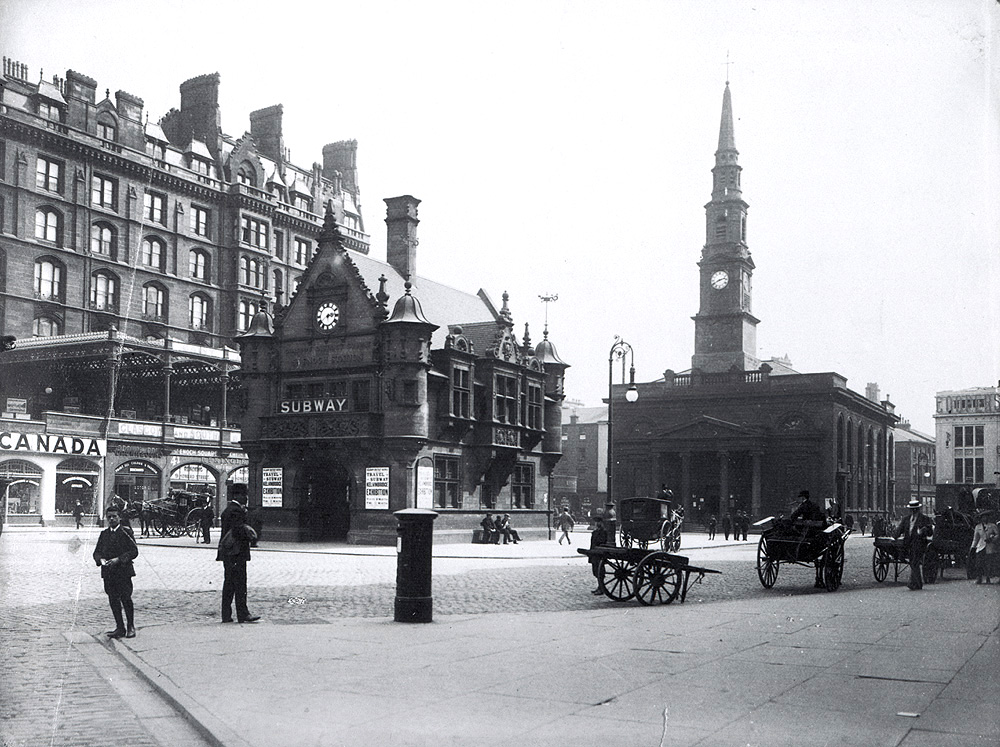
St Enoch's church beside St Enoch's hotel and station, early 20th century
Later venerated as a saint, Saint Teneu's name became corrupted as Saint Enoch. In medieval times there was apparently a chapel near to her supposed burial place at modern day St Enoch's Square. The later St Enoch's church pictured above was demolished in the early 20th century. Where the grand St Enoch's station and hotel once stood, there now stands the bland St Enoch's shopping centre. I'm sure it's how she would have wanted to be remembered.

St Enoch shopping centre
The mural of St Enoch, in modern garb, which has now been painted on the side of a tenement on George Street has won a lot of love. She is feeding or comforting young Kentigern, whilst a robin looks on. Robins have a lot of tales told about them in folklore, and early Christian beliefs. Some tales tell of the robin getting its red breast from drops of blood spilled from Jesus as the bird tried to remove the thorns from his crown from harming him. The robin was seen as a storm-cloud bird in Norse times, associated with Thor. In Celtic folklore, harming a robin was bad luck, and any injury to a robin, would soon befall the one committing it. Robins also feature in the miracles performed by Saint Mungo.

Mural of St Enoch, by Smug

Saint Mungo


Mural of Saint Mungo on High Street, Glasgow
By the age of 25 Kentigern/Mungo had finished his training with Serf in Culross. Christianity was a new religion for the people of Scotland, with early missionaries Saint Ninian and Columba spreading the word. He set out on his missionary work along the banks of the River Clyde. The story of his life goes that his first task was to go to the house of Fergus, a holy man who lived at Kernach. Fergus died the night that Mungo arrived, and respecting the man's last wishes he took his body by a cart hitched to two wild bulls, to be buried at a place called Cathures that had previously been consecrated by Ninian. 

The hearse of Fergus, on the roof of the Blacader Aisle in Glasgow Cathedral, which once housed a shrine to Fergus
Here in about 550AD, in a green place beside the Molendinar Burn, which Mungo referred to as "glas cau" or green valley he established his church. The site today is where Glasgow Cathedral still stands, and the burn is also still there, though culverted underneath Wishart Street, behind the cathedral. 

Glasgow Cathedral
Mungo preached here for 13 years, before being driven out by the pagan King Morken of Strathclyde. He then traveled to Cumbria and Wales. When King Morken was overthrown by King Rhydderch Hael of Strathclyde, Mungo was invited back to Glasgow and appointed Archbishop of Strathclyde. His church became the centre of a growing community that would eventually become the city of Glasgow.

Tomb of St Mungo in the crypt of Glasgow Cathedral
To be declared a saint, miracles have to be uncovered in your life. Later bishops keen to declare the sanctity of their founding father told the stories of Mungo that we know from the city's coat of arms.

The bird that never flew - St Serf had tamed a pet robin, and it was killed by some of Mungo's classmates who tried to blame its demise on him. As he took it in his hands, and prayed over the robin, it came back to life and flew to St Serf. As Karine Polwart put it, robins are symbolically "the birds that mind hearth and family" so I am glad that we've a wee robin as part of our city's story.

The tree that never grew - One night Mungo was left in charge of the holy fire in the monastery at Culross. Once he had fallen asleep, his jealous fellow students put out the fire to get him into trouble. On waking, he broke off some cold branches of a hazel tree, and praying over them they burst into flame.

The bell that never rang - The bell was one used by Mungo, possibly given to him by the pope. A handbell was commonly used in Celtic churches to call people to prayer. In 1450 John Stewart, the first Lord Provost of Glasgow left an endowment for a "St Mungo's bell" to be purchased, and rung through the city for people to pray for him. This bell was rung out for over 100 years afterwards, and although it no longer exists, a replacement bought in 1641 can be seen in the city's People's Palace.

The fish that never swam - If you could accept the burning hazel branch and the robin resuscitation, you will like this one. The ring in the fish's mouth was a gift from King Rhydderch Hael to his wife Queen Languoreth. She gave it to a knight, and the king suspecteded she was being unfaithful. On a hunting party he took the ring from the knight whilst he slept and threw it into the River Clyde. Returning home the king demanded the ring from his wife, threatening her with execution if she could not produce it. The queen sought it from the knight, who did not know where it was. She then confessed all to Mungo. Mungo sent one of his monks to fish in the Clyde, and the first salmon pulled out of the river was found to have the ring in its mouth, which was returned to the queen. It's a good story, so good in fact that it has been recycled in the life of Saint Asaph. It also bears a lot of similarities to the plot used by Alexander Dumas, where he has his Three Musketeers rush to London to retrieve the diamond studs which Queen Anne of France has given to her lover the Duke of Buckingham, to show her king that she still has them. 

Mural of Saint Mungo by Smug on High Street, Glasgow

Versions of Mungo 


In the early days of the church in Glasgow, the tomb of Saint Mungo and associated relics attracted many pilgrims. They were seeking salvation and cures, and in return they provided funds for the growing church. Glasgow Cathedral was one of very few medieval cathedrals in Scotland to survive the Reformation, and it has continued as a Protestant church to this day. This means that the Catholic saints and relics are not part of the worship in the cathedral. The tomb of Saint Mungo is therefore rather downplayed in the cathedral today, a modern tapestry thrown over it and a plain cross on top. Also a slightly dour information board beside it avoids glorifying any fake prophets. 
"...many pilgrims followed a stage-managed route to get here....Their offerings helped to swell church funds and the cathedral developed around the tomb. Stories about St Mungo are largely the creation of enthusiastic biographers in the 1100s. Important saints were promoted by the church to bolster the faith of believers. Mungo's legendary deeds were exploited during the early days of Alba, the unified Scottish kingdom in th elate 9th century. This was repeated, 500 years later, to reinforce the identity of the Scottish church after the Wars of Independence."
So within the cathedral we are cautioned to be wary of religion being used for political or economic purposes. As if! 

In fairness Mungo's miracles, do seem slightly mundane in the grand scheme of things, more like conjurers tricks. Not for him the glory of curing the blind and infirm. Although the deeds of St Mungo and St Enoch are generally only vaguely known about, the coat of arms of the city has been used for centuries. The thrusting, modern, industrial Glasgow could show outsiders its coat of arms, linking it back to an origin story many centuries before. 

Coat of arms on Glasgow Royal Concert Hall
Glasgow Royal Concert Hall opened in 1990, and has one of the largest of Glasgow's many coats of arms for public consumption. The tree, the fish and the bird link Glasgow to a green and leafy past. The motto, "Let Glasgow Flourish" seems to have a slightly different meaning when clipped of its "...by the preaching of the word." Instead of requiring religious duty to grow the city, it becomes a more declamatory. Stop holding us back, let Glasgow flourish.

Kelvinbridge, Glasgow
A version of the coat of arms used by the University of Glasgow
The University of Glasgow was established in 1451 as part of the cathedral complex on High Street, and uses a version of the city's coat of arms. The university mace and an open book compliment the tree, the bird, the bell and the fish. 

The new murals of Enoch and Mungo are a surprise as they do not show the old history, but give us a modern day mother and child, a modern day middle-aged, and bearded man. The robin and the halos give clues as to who they are, but these founders of Glasgow are average, ordinary people. I quite like this version of the Glasgow story.


Sunday, 20 September 2015

Religious Sites of Glasgow. Doors Open Day 2015

Glasgow Doors Open Day, 2015


The annual "Doors Open Day" in Glasgow has been running for 26 years now. Organised by the Glasgow Buildings Preservation Trust it aims to celebrate the architecture, history and people of the city by public talks, walks and open access to many buildings normal closed to the public. This year, endeavouring to see some buildings which I haven't previously visited I seem to have ended up going to several religious buildings for a change. Despite these buildings being such prominent parts of the city skyline I had never before been inside the Glasgow Central Mosque, the 'Greek' Thomson designed St Vincent Street Church or the Catholic St Andrew's Cathedral down by the Clyde. So this is what I saw, arranged for no particular reason chronologically by their religion's origins. Religious bigotry and sectarianism has an ugly history in the west of Scotland, and I have avoided taking any interest in religion, so I apologise in advance for any wild factual inaccuracies in what follows.

Tallits, Jewish prayer shawls


Judaism


Garnethill Synagogue, Glasgow
Judaism is usually dated back to the times of the Biblical patriarchs Abraham, Isaac and Jacob, over 3000 years ago. Widespread throughout Europe in the modern era, the earliest records of Jewish people in Scotland come from the 1600s. The first openly Jewish graduate of the University of Glasgow was Levi Myers in 1787, forty-eight years after the earliest university graduate in Scotland, Jakob de Castro Sarmento qualified in medicine from Aberdeen in 1739.  The first person buried within the newly laid out Glasgow Necropolis was Joseph Levi, a quill merchant who died of cholera in 1832. This was because the Jewish community of the city contributed to the fundraising when the necropolis was being created, and a Jewish section was designed within it. In the early twentieth century larger numbers of Jewish immigrants arrived in Glasgow, escaping persecution in Europe and Russia. Like the Irish and Italian immigrants to Glasgow they lived in large numbers in the Gorbals area of the city. Glasgow's first synagogue apparently dates from 1823, on High Street. It moved several times before finding a permanent home in Garnethill in 1879 in Scotland's first purpose-built synagogue.

The words carved in Hebrew above the door are from Deuteronomy and translate as "God alone let him, and there was no strange God with him". I am not sure how the calculation works, but apparently the numerical value of the Hebrew letters used in this verse adds up to the date of the foundation of the building.

Inside the Garnethill Synagogue, Glasgow
So, donning the yarmulke I was given at the door to cover my head, I stepped inside. It is strange that I have visited synagogues before on holiday, but never actually been in one in Glasgow. It contains a strange mixture of familiar Victorian Glasgow architecture mixed with exotic extras, evident straight away from the floor tiles in the entrance hallway.

Floor tiles
Downstairs there was an interesting Scottish Jewish Archive Centre, where a group of local Muslim women were having their numerous questions answered.

Catholicism


The Christian church can be dated back to the followers of Jesus Christ and the term 'Catholic' was used from about 110AD. After the East-West schism of 1054 the Eastern church became known as "Orthodox" and followers of the Bishop of Rome "Catholic". In Glasgow St Mungo is said to have founded his church in the 7th century at the site of the Glasgow Cathedral on Castle Street. From the 12th century this was the seat of the bishop of Glasgow and became an archdiocese of the Catholic Church in 1492. In the late 16th century Glasgow Cathedral was one of the few churches which was not destroyed during the Scottish Reformation and passed into use as a Protestant church. The current Catholic Cathedral of Glasgow, St Andrew's Cathedral, was designed in 1814 by James Gillespie Graham. It lies in the city centre on the north bank of the River Clyde, almost overwhelmed by a modern day cathedral of commerce, the St Enoch's Shopping Centre, which sits behind it. Saint Enoch was a saint of medieval Glasgow, the mother of Saint Mungo (or Kentigern as he is also known).

Saint Andrew's Cathedral, Glasgow
From the time of the Scottish Reformation in 1560 until the Roman Catholic Relief Act of 1791, which restored the freedom of worship, Roman Catholics in Glasgow had to worship covertly.  With industrialisation in the city and increasing numbers of Catholics arriving in Glasgow from the Highlands and from Ireland it was decided to build a church for their use. The Catholic church to St Andrew was completed at this site on Clyde Street in 1816. This was not a trouble-free construction, with saboteurs damaging the nascent building at night in the early stages, requiring guards to be employed to protect the construction site initially.

Interior of Saint Andrew's Cathedral, Glasgow
A major renovation project was undertaken between 2009-2011 with new artwork commissioned and the construction of a cloister memorial garden to Italian Scots who died aboard the Arandora Star. This ship was torpedoed and sunk in 1940 whilst carrying "enemy aliens" during the war. Of the 734 Italians on board, 486 died.

As well as St Mungo establishing his church on Castle Street in Glasgow of the 7th century, St Constantine had arrived maybe 100 years earlier, about 500AD, and established a wooden church at Govan. With Glasgow only a small town at this time, Govan was a completely separate hamlet for centuries. The first Govan church was built beside a ceremonial hill and sacred well. The people here were Britons, different from their neighbouring Picts and Scots and Govan means "little hill" in their language. Ironically the hill in Govan no longer exists, as it was flattened in making the industrial Govan we know from the 20th century, to make space for the sheds of the Harland and Wolff shipbuilding company. The kingdom of the Clyde Britons was controlled from Dumbarton (Dun Breatann meaning "fort of the Britons") and was a powerful kingdom in the British Isles after defeating the Scots of Dalraida. In 756 the combined Picts and Nothumbrians ford the Clyde at Govan and defeat the Britons at Dumbarton. The early church in Govan is at the site of what is now called Govan Old Parish Church. Although I have previously read about the Govan Stones, I had never gone to see them before. The church is home to many famous early medieval stones, carved between the 9th and 11th century. One of the earliest is a beautiful stone sarcophagus from around 850AD, carved from a single block of stone.

Carving on the Govan Sarcophagus

Norse Paganism


After a four month siege in 870AD Vikings destroyed the fortress at Dumbarton. The king of the Britons is killed. A new king is appointed and moves up river, becoming based at Govan and a new name appears for the kingdom, "king of the Britons of Srath ClĆŗade (Strathclyde)". The other stones found in Govan Old Parish Church come from the period 900-1100AD.

Five carved Norse "Hogback" stones in Old Gorbals Parish Church
These include carved recumbent stones, free-standing crosses and Norse 'hogbacks'. The hogback stones are usually associated with Viking settlement and suggest that over this period high status Vikings were living in this area. Although Vikings had their own pagan beliefs, in Denmark and Sweden they converted largely to Christianity in the 11th and 12th century. To which gods the Vikings of Govan prayed may never be known.

The 'sun stone'
Around 1000AD the kings of Strathclyde have their palace across the river Clyde in Partick, but worship in the old church of St Constantine at Govan, and use the hill to the east of the church for ceremonial purposes. Their royal graves are in the churchyard at Govan. Around 1050 King David I conquers the kingdom of Strathclyde and takes it into his Scottish kingdom. The importance of Govan fades as he bases religious activity in the cathedral in Glasgow. The royal lands at Partick are taken over by the bishops of Glasgow. Over 500 years the village of Govan grows up around Govan Cross. A new church is built and the gravestones from this time show the trades of the contemporary local residents.

Gravestone in Govan churchyard. Date looks like 1690
After the Scottish Reformation of the 16th century the church here became run as a Protestant church. The village of Govan continued to get bigger and in 1864 was made into a Burgh, with its own administration. Soon the church was felt to be too small for its needs and was replaced with the current building, constructed between 1884-1888. Over the next 50 years Govan continues to boom and grow with the arrival of shipbuilding. The growing town was annexed to Glasgow in 1912. In the same year Harland and Wolff buy three small shipyards and flatten the Doomster Hill to build their slipways and huge worksheds.

Current Old Govan Parish Church
A notable minister of the Govan Old Parish Church from 1930 was Rev George MacLeod. Disillusioned with post-war Britain after the first World War and concerned over social inequality in Scotland he became a Socialist and an active member of the Peace Pledge Union. He resigned his position in Govan in 1938 and set up the Iona Community.


Former fitting out basin of Harland and Wolff,
across the Clyde from the current Museum of Transport


Islam


Muslims follow the Islamic faith, a monotheistic Abrahamic faith which originated in Arabia. The Qur'an is the holy book for Muslims, which was revealed to the prophet Muhammed over 23 years by the angel Gabriel. Muhammed lived from about 570AD - 632AD.

Although many more may have been undocumented, the first Muslim known to live in Scotland was a medical student from Bombay, Wazir Beg, in Edinburgh in 1858. Manufacturing and trade in Glasgow meant that many Muslims arrived in the city working as lascars or sailors. Records from the Glasgow Sailors Home on the Broomielaw from 1903 show that at that time nearly a third of the 5500 boarders were Muslim lascars. Immigrants from South East Asia, particularly Pakistan, in the late 20th century increased the Scottish Muslim population to about 1.4% of the population by 2011. More recent immigrants from Africa, Afghanistan and the Balkans have added to the diversity of this population. The first purpose built mosque in Glasgow opened its doors in 1984.

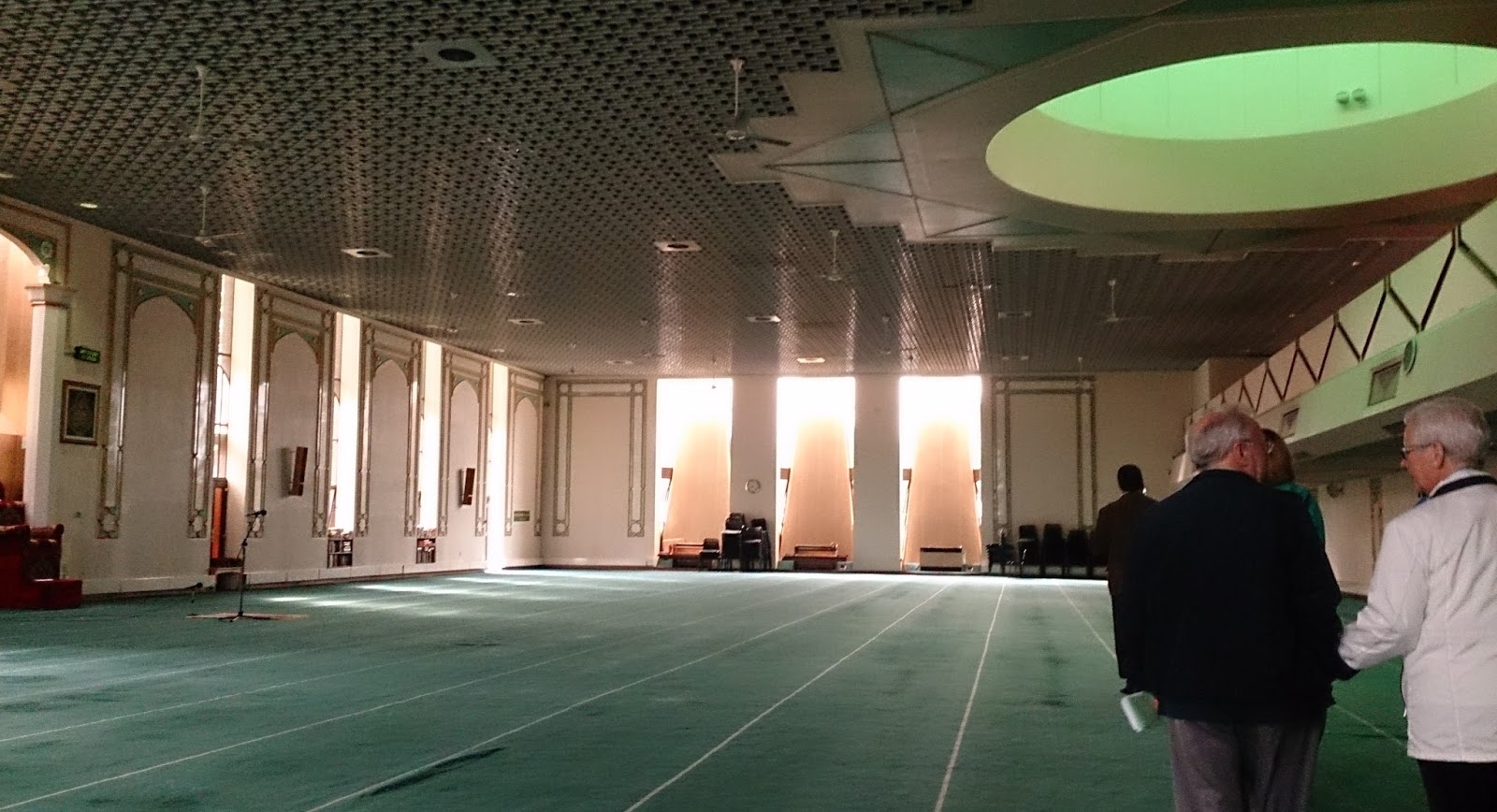
Glasgow Central Mosque
I have visited some of the smaller mosques of Glasgow before but this was my first visit to the Glasgow Central Mosque, just south of the River Clyde at the edge of the Gorbals. It is one of the most recognisable buildings in the city with its dome illuminated at night and its prominent minaret. The majority of early Muslim immigrants to Glasgow, like the Irish, Jews and Italians before them, lived in the Gorbals area of the city where the mosque was later built. The main hall can accommodate 2,500 people at prayer and will be busy later this week with Eid marking the end of the Hajj.

Inside Glasgow Central Mosque

Taken on a tour of the building, with its adjacent community centre, our Malcolm X quoting guide was at pains repeatedly to clarify misconceptions about Islam. It is clear that some Muslims can feel at times there are constant media reports of their perceived role in all the problems round the world, causing misunderstanding and fear. When he talked about the un-Islamic actions of those fighting their fellow Muslims in Syria just now, it was hard not to see echoes of this in accusations down through the centuries within several other religions. It seems to me that most wars and battles fought in the name of a religion tend to be about power, resources and land once you break it down rather than a battle of ideals. This is the same whether talking about ISIS in the Middle East, the Christian Crusades, the Rough Wooing of Mary Queen of Scots, King Billy and the Battle of The Boyne, the Israeli-Palestinian conflict, the Troubles in Northern Ireland... Take your pick.

Not remembered in the current portrayal of Islam are the contributions Muslim thinkers have given to the world, particularly in science, medicine and mathematics. You only need to think about the origins of the words algorithm, algebra and alchemy to see where they originated.

Protestantism


The Christian church in Scotland means many different things to different people. The Church of Scotland website has an "Historical Directory To Glasgow Presbytery" listing the changes in parishes and churches over the years in the city and it runs to 360 pages if you have an interest in this. The roots of the Church of Scotland date back to the Scottish Reformation of 1560, led amongst others by John Knox, whose statue looks out over Glasgow from a pillar atop the Necropolis behind Glasgow Catherdral. He established a Protestant church on Calvinist principles.

Glasgow Cathedral
Glasgow Cathedral is one of the few medieval churches that survived the Reformation and the current building dates back to the 12th century, allegedly on the site where St Mungo (a.k.a. St Kentigern) built his church in the 7th century. If you want to get an impression of how close it came to being destroyed during the Reformation look at the bullet riddled door in the Sacristy from this time. It was saved because the organised trades of the city took up arms to defend it from the mob intent on bringing it down. The defenders outnumbered the attackers and it survived, "cleansed of its Catholic trappings". The University of Glasgow was founded at this site too, within the precinct of the cathedral in 1451, before later moving west in the city. 
St Vincent Street Church, Glasgow
In contrast to the austere, gothic medieval cathedral, the Glasgow City Free Church have their home in one of the most grand and beautiful creations of famous Glasgow architect Alexander "Greek" Thomson. At the time he rejected the popular Gothic Revival style of many of his contemporary architects, getting his inspiration from Greek Classical styles. Built in 1859 for the former United Presbyterian Church of Scotland, the St Vincent Street Church is currently used by a congregation of the Free Church of Scotland. It is the only one of the three churches Thomson designed which is still in tact.

Interior of St Vincent Street Church, Glasgow
Here you can see the interior which he designed for it too, full of light and space. the decorative motifs inside are more flamboyant than would normally be acceptable in a Presbyterian church. It is so sad to see the empty shell of the Greek Thomson designed Caledonia Road Church sitting in the Gorbals, with its interior destroyed by fire in the 1960s.


Another church that I visited on the Doors Open Day was also commissioned by the Free Church using an innovative Glasgow architect. In 1896 the Free Church of St Matthew, Glasgow commissioned a new church and hall from architects Honeyman and Keppie. The job was allocated to their young, talented, trainee architect Charles Rennie Mackintosh.

Architectural drawings for the Queens Cross Church
Following the beliefs of their religion the design had to be simple, yet Mackintosh managed to handle this beautifully, producing a distinctive, charming, warm and functional building. Queens Cross Church is one I pass whenever I head to see Partick Thistle, whose ground lies just behind the church. Built between 1898 and 1899 it was the only church he designed.
The nave of the Queens Cross Church, Glasgow
 In 1929 the Free Church was reunited with the Church of Scotland, which took over ownership of the Queens Cross church. In 1976 with a declining congregation, the church merged with Ruchill Church and vacated the building, which has become the headquarters of the Charles Rennie Mackintosh Society.

Mackintosh designed pulpit in Queens Cross Church
In this building Mackintosh designed the interior artwork and fittings too, right down to the communion table, alms dishes and armchairs. His distinctive designs can be seen on the wood carvings of the pulpit.


Sikhism


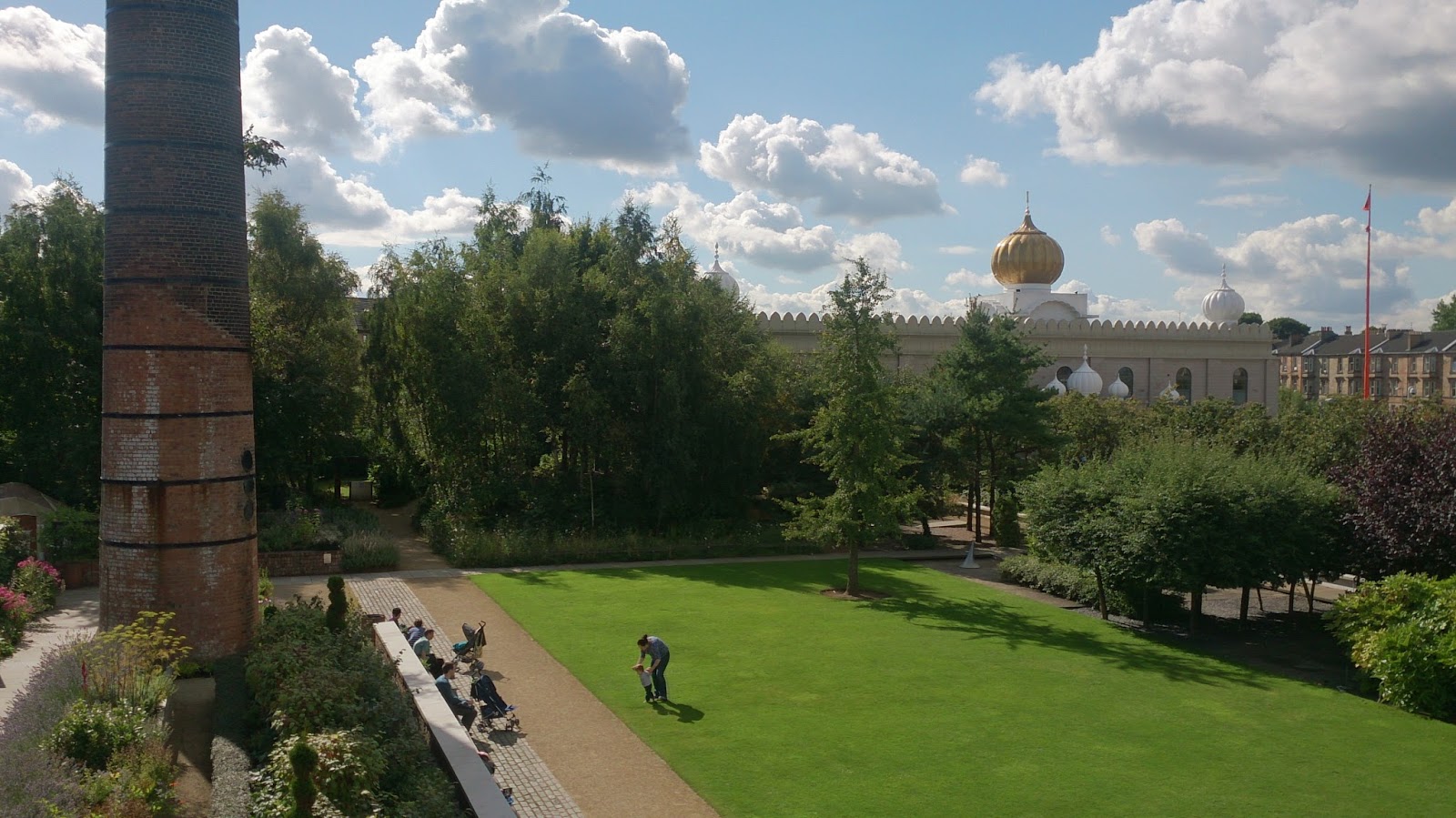
Topped with their golden domes, there have been two distinctive new additions to the Glasgow skyline in recent years. The first purpose-build Sikh Gurdwara in Scotland opened its doors in 2013, in Polloksheilds beside the Tramway. Another new Gurdwara will also soon be opening soon in Glasgow on Berkeley Street, opposite the Henry Wood Halls. 

Glasgow Gurdwara on Albert Drive, behind the Tramway's 'Hidden Garden'
Sikhism was founded in the Punjab region of India in the 15th century. It is based on the teachings of Guru Nanak (the first Guru) and the ten successive Sikh Gurus. Now the book of Sikh scripture is the Guru and is treated with great respect. The first documented Sikhs living in Scotland are from 1854 in Perthshire. Sikhs date the first Glaswegian Sikhs to the 1920s when a Gurdwara was established in South Portland Street. Further immigration in the later 20th century means that Sikhs now make up 0.2% of the Scottish population, with the largest population being in Glasgow. In the synagogue I had my head covered, in the mosque I had taken my shoes off to enter the prayer hall. Here my head was covered and shoes off to enter the Gurdwara. Our young guide told us with obvious enthusiasm about Sikhism and the Gurdwara and encouraged us to visit the free food kitchen, or Langar, an important part of any Gurdwara.

Hinduism


Although their place of celebration was not open during the Doors Open Day, it seems only fair to also mention the Glasgow Hindu Mandir. Hinduism contains a broad range of philosophies and religious cultures and has many deities. It dates to the 6th century BCE and is the religion followed by the majority of people in India and Nepal. The majority of Hindus in Scotland arrived in the second half of the 20th century, many escaping Idi Amin's Uganda in the 1970s. Hindus now make up 0.3% of the Scottish population. I have previously been in the Hindu Mandir Glasgow building at Belle Place, near Kelvingrove Park, for a wedding which was a very laid back, friendly and colourful event. Unfortunately you will have to make do with a photo of the outside which I took when I passed it on my bike today.

Hindu Mandir Glasgow
Summary

In Glasgow I think we are now getting away from the days when the first question a stranger (or someone interviewing you for a job) asked was "what school did you go to?" to work out if you were a Catholic or a Protestant. However we are far from being a city that can preach to anyone about religious tolerance. I sadly think that we are defining people more and more by religion. There is talk of the Muslim population or Jewish community. Religion is only one aspect of a people's culture. I am not a great fan of defining people or a population by their religious views and each religion has a spectrum of differing perspectives and beliefs. Scottish Christians can be a member of the Roman Catholic, Scottish Episcopal, Free Church, United Free Church, Church of Scotland, Free Presbyterian Church, Associated Free Presbyterian Church or the Reformed Presbyterian Church of Scotland. That's just our local ones. People living in the same street, or working in the same factory have much more in common with each other than do a businessman and a shop worker of the same religion.

A lot of people, particularly immigrants, feel a cultural link and connection with a religion. The rituals and celebrations their parents and grandparents enjoyed. I am an atheist but still enjoy rolling eggs down a hill with my children at Easter. I understand the symbolism of it and remember doing it as a child with my own parents, but I don't define myself as a Christian. The diversity of religious institutions in Glasgow that I have visited this weekend just reflects the diversity of Glasgow's immigrants over centuries. From Norsemen to Lithuanians, people from the Punjab and Sri Lanka, Scottish Highlanders, Italians and Irish.

I know it sounds corny to end this way but I agree with the city's current slogan that "People Make Glasgow" and I religion is a small part of the culture of those people, if they wish. So I finished my day in Dowanhill Church, built in 1865. I admired the work of the artist Daniel Cottier who designed its interior, the craftsmen that erected the building and those restoring it. I then had a nice pint of beer and some lunch and wondered if the day will come when all the places I saw today will become museums, theatres, community centres, restaurants and bars.
Cottiers Bar and Theatre, Glasgow