Showing posts with label street art. Show all posts

Sunday, 26 August 2018

Saint Mungo, Saint Kentigern, Saint Enoch and Glasgow.

Two new murals in Glasgow city centre have been getting a lot of attention. These modern depictions of Saint Mungo and his mother, Saint Enoch, have been painted by Glasgow-based Australian street artist Smug on High Street and nearby George Street. This new perspective on two saints associated with the city made me seek out the stories behind these characters.

Murals of a mother and child, and a man contemplating a bird...or is it St Enoch and St Mungo?


Saint Mungo, Patron Saint of Glasgow.


Glasgow bus shelter
Here is the bird that never flew,
here is the tree that never grew, 
here is the bell that never rang,
here is the fish that never swam.
The Glasgow coat of arms in one form or another is dotted about all over the city - from adorning the sides of Victorian bridges to modern bus shelters. The salmon with a ring in its mouth, the tree, the bell and the bird all tell stories of the city's patron saint, Saint Mungo. Almost 1500 years ago he established his church just north of the River Clyde, and over time the city of Glasgow built up around this site. The words of Glasgow's motto "Let Glasgow Flourish" come from one of his early sermons, more fully rendered as "Let Glasgow flourish by the preaching of the word."

Glasgow coat of arms in a stained glass window at Glasgow Cathedral
Also known as Kentigern, Mungo was the nickname he was given as a child when under the tutelage of Saint Serf, in Fife. "Mungo" derives from the Gaelic Mo Choƫ, taken to mean "My Dear". I think you would agree that this is a more affectionate name than Kentigern, which means "high lord".

Glasgow coat of arms adorning a bin
In medieval times Kentigern was venerated as the local saint, with pilgrimages regularly undertaken to his tomb, which still lies in the crypt of Glasgow Cathedral. His death in the early years of the 7th century is recorded in contemporary records (the Welsh Annals) but what is known about his life comes from two 12th century biographies. The mixture of fable and truth in these tellings is therefore hard to unpick, but still informs us of how people in that time wanted to picture their saint.

More recently we have a contemporary imagining of Saint Mungo, in a mural painted on the side of a tenement on High Street in Glasgow, facing up towards the cathedral where his tomb lies. This tells us how we want to imagine the legendary founding father of the city, with Mungo seen as an ordinary man, a bit bedraggled, maybe even a homeless man, benignly smiling down on the robin from one of his stories. The discrete halo behind his head tells us of his saintly nature.

Saint Enoch


To know Saint Mungo's story, you need to go back to his mother, Teneu. In the 6th century, when Scotland was a collection of disparate fiefdoms, she was daughter of King Lleuddun or Loth, who may have given his name to the Lothians where he lived. Loth also appears in Arthurian legends as the father of Sir Gawain. There are very few ancient hill forts in Scotland where we know who lived on them, but Traprain Law in Lothian is one of them. It was home to King Loth, and his daughter, Teneu.

There are different stories of her life, but a recurrent tale is that of her rape by Welsh prince Owain. When she discovers that she is pregnant, her father punishes her, the victim of this crime, and sentences her to death. She is hurled down the cliffs at Traprain Law, the hill fort in East Lothian where they lived.

Miraculously she is found to have survived, and is exiled, cast adrift in a coracle upon the River Forth. She washes up in Fife, where she is taken in by the community of Saint Serf at Culross. It is here that her son Kentigern was born, and given the nickname of Mungo, my dear one or beloved one, by Saint Serf.

Serf lived in the first half of the 6th century, and stories of his life stretch from his being the pope for seven years, to him killing a dragon with his staff in the town of Dunning. He is widely credited with establishing the religious community in Culross (pronounced Coo-riss), a picturesque town still made up of many 17th and 18th century buildings with their distinctive crow-step gables.

Culross, Fife
Teneu and Kentigern grew up here, with Kentigern studying under Serf, and some of the miracles that feature in the Glasgow coat of arms took place during his childhood here. 
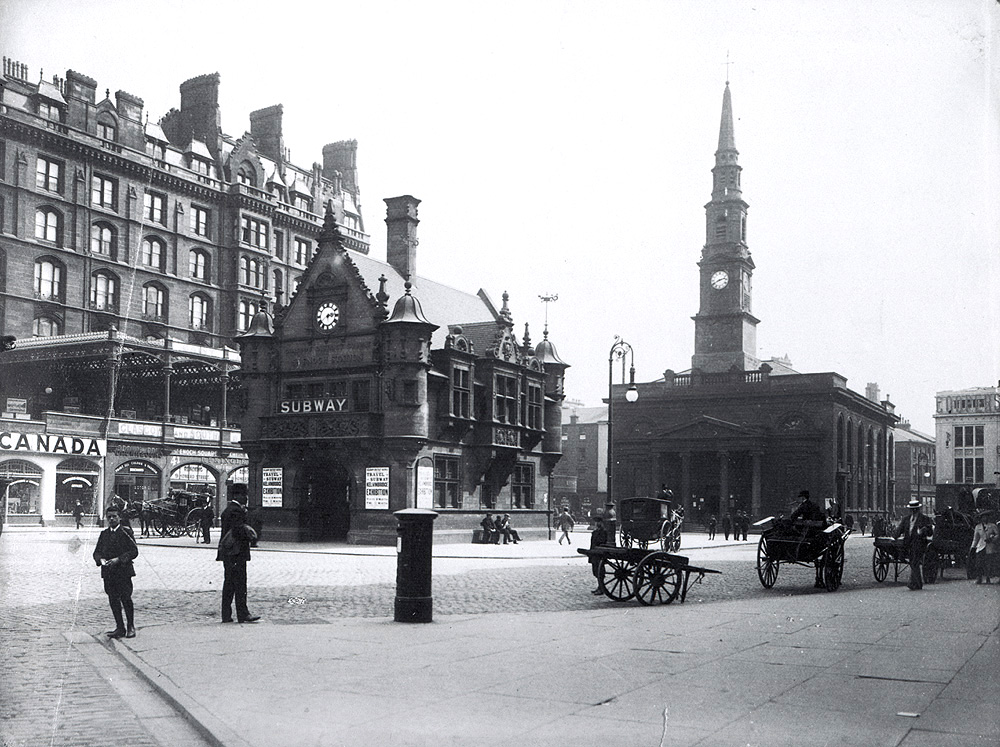
St Enoch's church beside St Enoch's hotel and station, early 20th century
Later venerated as a saint, Saint Teneu's name became corrupted as Saint Enoch. In medieval times there was apparently a chapel near to her supposed burial place at modern day St Enoch's Square. The later St Enoch's church pictured above was demolished in the early 20th century. Where the grand St Enoch's station and hotel once stood, there now stands the bland St Enoch's shopping centre. I'm sure it's how she would have wanted to be remembered.

St Enoch shopping centre
The mural of St Enoch, in modern garb, which has now been painted on the side of a tenement on George Street has won a lot of love. She is feeding or comforting young Kentigern, whilst a robin looks on. Robins have a lot of tales told about them in folklore, and early Christian beliefs. Some tales tell of the robin getting its red breast from drops of blood spilled from Jesus as the bird tried to remove the thorns from his crown from harming him. The robin was seen as a storm-cloud bird in Norse times, associated with Thor. In Celtic folklore, harming a robin was bad luck, and any injury to a robin, would soon befall the one committing it. Robins also feature in the miracles performed by Saint Mungo.

Mural of St Enoch, by Smug

Saint Mungo


Mural of Saint Mungo on High Street, Glasgow
By the age of 25 Kentigern/Mungo had finished his training with Serf in Culross. Christianity was a new religion for the people of Scotland, with early missionaries Saint Ninian and Columba spreading the word. He set out on his missionary work along the banks of the River Clyde. The story of his life goes that his first task was to go to the house of Fergus, a holy man who lived at Kernach. Fergus died the night that Mungo arrived, and respecting the man's last wishes he took his body by a cart hitched to two wild bulls, to be buried at a place called Cathures that had previously been consecrated by Ninian. 

The hearse of Fergus, on the roof of the Blacader Aisle in Glasgow Cathedral, which once housed a shrine to Fergus
Here in about 550AD, in a green place beside the Molendinar Burn, which Mungo referred to as "glas cau" or green valley he established his church. The site today is where Glasgow Cathedral still stands, and the burn is also still there, though culverted underneath Wishart Street, behind the cathedral. 

Glasgow Cathedral
Mungo preached here for 13 years, before being driven out by the pagan King Morken of Strathclyde. He then traveled to Cumbria and Wales. When King Morken was overthrown by King Rhydderch Hael of Strathclyde, Mungo was invited back to Glasgow and appointed Archbishop of Strathclyde. His church became the centre of a growing community that would eventually become the city of Glasgow.

Tomb of St Mungo in the crypt of Glasgow Cathedral
To be declared a saint, miracles have to be uncovered in your life. Later bishops keen to declare the sanctity of their founding father told the stories of Mungo that we know from the city's coat of arms.

The bird that never flew - St Serf had tamed a pet robin, and it was killed by some of Mungo's classmates who tried to blame its demise on him. As he took it in his hands, and prayed over the robin, it came back to life and flew to St Serf. As Karine Polwart put it, robins are symbolically "the birds that mind hearth and family" so I am glad that we've a wee robin as part of our city's story.

The tree that never grew - One night Mungo was left in charge of the holy fire in the monastery at Culross. Once he had fallen asleep, his jealous fellow students put out the fire to get him into trouble. On waking, he broke off some cold branches of a hazel tree, and praying over them they burst into flame.

The bell that never rang - The bell was one used by Mungo, possibly given to him by the pope. A handbell was commonly used in Celtic churches to call people to prayer. In 1450 John Stewart, the first Lord Provost of Glasgow left an endowment for a "St Mungo's bell" to be purchased, and rung through the city for people to pray for him. This bell was rung out for over 100 years afterwards, and although it no longer exists, a replacement bought in 1641 can be seen in the city's People's Palace.

The fish that never swam - If you could accept the burning hazel branch and the robin resuscitation, you will like this one. The ring in the fish's mouth was a gift from King Rhydderch Hael to his wife Queen Languoreth. She gave it to a knight, and the king suspecteded she was being unfaithful. On a hunting party he took the ring from the knight whilst he slept and threw it into the River Clyde. Returning home the king demanded the ring from his wife, threatening her with execution if she could not produce it. The queen sought it from the knight, who did not know where it was. She then confessed all to Mungo. Mungo sent one of his monks to fish in the Clyde, and the first salmon pulled out of the river was found to have the ring in its mouth, which was returned to the queen. It's a good story, so good in fact that it has been recycled in the life of Saint Asaph. It also bears a lot of similarities to the plot used by Alexander Dumas, where he has his Three Musketeers rush to London to retrieve the diamond studs which Queen Anne of France has given to her lover the Duke of Buckingham, to show her king that she still has them. 

Mural of Saint Mungo by Smug on High Street, Glasgow

Versions of Mungo 


In the early days of the church in Glasgow, the tomb of Saint Mungo and associated relics attracted many pilgrims. They were seeking salvation and cures, and in return they provided funds for the growing church. Glasgow Cathedral was one of very few medieval cathedrals in Scotland to survive the Reformation, and it has continued as a Protestant church to this day. This means that the Catholic saints and relics are not part of the worship in the cathedral. The tomb of Saint Mungo is therefore rather downplayed in the cathedral today, a modern tapestry thrown over it and a plain cross on top. Also a slightly dour information board beside it avoids glorifying any fake prophets. 
"...many pilgrims followed a stage-managed route to get here....Their offerings helped to swell church funds and the cathedral developed around the tomb. Stories about St Mungo are largely the creation of enthusiastic biographers in the 1100s. Important saints were promoted by the church to bolster the faith of believers. Mungo's legendary deeds were exploited during the early days of Alba, the unified Scottish kingdom in th elate 9th century. This was repeated, 500 years later, to reinforce the identity of the Scottish church after the Wars of Independence."
So within the cathedral we are cautioned to be wary of religion being used for political or economic purposes. As if! 

In fairness Mungo's miracles, do seem slightly mundane in the grand scheme of things, more like conjurers tricks. Not for him the glory of curing the blind and infirm. Although the deeds of St Mungo and St Enoch are generally only vaguely known about, the coat of arms of the city has been used for centuries. The thrusting, modern, industrial Glasgow could show outsiders its coat of arms, linking it back to an origin story many centuries before. 

Coat of arms on Glasgow Royal Concert Hall
Glasgow Royal Concert Hall opened in 1990, and has one of the largest of Glasgow's many coats of arms for public consumption. The tree, the fish and the bird link Glasgow to a green and leafy past. The motto, "Let Glasgow Flourish" seems to have a slightly different meaning when clipped of its "...by the preaching of the word." Instead of requiring religious duty to grow the city, it becomes a more declamatory. Stop holding us back, let Glasgow flourish.

Kelvinbridge, Glasgow
A version of the coat of arms used by the University of Glasgow
The University of Glasgow was established in 1451 as part of the cathedral complex on High Street, and uses a version of the city's coat of arms. The university mace and an open book compliment the tree, the bird, the bell and the fish. 

The new murals of Enoch and Mungo are a surprise as they do not show the old history, but give us a modern day mother and child, a modern day middle-aged, and bearded man. The robin and the halos give clues as to who they are, but these founders of Glasgow are average, ordinary people. I quite like this version of the Glasgow story.


Friday, 26 February 2016

Street Art. Glasgow Murals Update

In a previous blogpost I had tried to document as many Glasgow murals as I could, but managed to miss a fare few. Also since then there have been many spectacular new additions. I have therefore gone back and amended my old blog to bring it up to date. Follow this link to see what you are missing.


Monday, 24 November 2014

Street Art - Glasgow Murals (with 23.2.2016 update)

Partick Thistle faced Aberdeen this weekend in the SPFL match of the day. This was the first chance for many Thistle fans to see the new mural which has been commissioned from Rogue One on the wall behind the city end of the ground. Very impressive it is too, although you may have been unable to get the full impact of it as despite going to all the effort of organising this, the club continued to allow cars to park in front of the wall, rather lessening the effect I would suggest.

I used this as an excuse to think up a 10 mile running route for myself this weekend, trying to go via as many murals and street art as I could recall on the way around.

I came up with a lot more than I thought I would  but I am sure that I have forgotten many others, as although these often raise a smile as you pass them they are largely unremarked upon. One problem I have with some of this stuff is that it can be a bit nice, a bit safe. The idea of street art is surely that is often reacting against things, it is temporary and spontaneous, whereas much of the stuff in Glasgow has been commissioned by the city council and even features in a city centre walking tour leaflet. The Belfast murals these ain't.

Anyway I started my run at Partick Cross and went up Hyndland Road, Cleveden Road and then up the Butney to get to Maryhill Road. A couple of grubby gable ends here have been brightened up by murals painted by Rogue One (Bobby McNamara) and Ejek.

These were commissioned by Maryhill and Summerston Community Council and I am a big fan of the wee Scottie dog looking at the bee. 

The light isn't great in these pictures, but it was an early winter morning, the sun wasn't really risen and the rain was hosing down, so don't blame me.


I headed down Maryhill Road next to see a mural done by Scottish artist Elph for the In Common Project for the Commonwealth Games. This is on the gable end facing East Park children's school. It is meant to contain lots of nods to local Maryhill things such as the canal, Charles Rennie Mackintosh's church and the multi-cultural nature of modern day Maryhill. 


It also records the annual taxi outing for children to Troon.


Maryhill has a history of murals on walls, possibly due to the brutal slum clearances of the 1970s in the area that left many a gable end on show. As a youth walking home from Maryhill the mural of the smiling sun would face you on Northpark Street. The mural is still there, if partly obscured by the modern flats in front of it.
In this old aerial shot of Firhill you can see the mural in the top right corner on Northpark Street
The only sunshine which I saw today
Anyway, the thing which got me started on this wild goose chase was next on my route. Rogue One has been doing a mural on the outside wall of Firhill at the city end. When I took these pictures it was almost finished and is an impressive bit of work. I'm sure many a photo will be taken beside it in the weeks to come (if the cars that park here on matchdays are directed somewhere else).


Carrying on down Maryhill Road you next come to Maryhill Community Central Hall which has had a mural on its wall since it was done for Glasgow's year as European Capital of Culture in 1990. 

Running through Georges Cross towards Cowcaddens I had to give an honorable mention to the exercise in perspective which has resided under the M8 flyover here for many years. I've never been sure if it is meant to signify anything or was just done by a student at the nearby art school having a long lunch break. Tips for graffitis artists - if you want it to last, paint it away from the elements in an underpass. This was certainly the case with the "NO SDP" graffiti which was under the expressway flyover at the Thornwood roundabout and lasted longer than the party itself did (I won't say who put it there, will I mother?).


Onwards a wee bit at another underpass, this time to Cowcaddens subway station there is another mural by Rogue One, a clever one playing with shadow puppets.


Heading then towards Strathclyde University's buildings in the city centre there are now murals every which way that you turn. First on Cathedral Street there is another of the murals commisioned for the Commonwealth Games, this one on the side of the City of Glasgow College building was done by New Zealand artsist Askew One.

Then down on various buildings in Strathclyde University are numerous murals now.

This one of a lecture hall is by Rogue One and Ejek, a sare most of the other three pictures here. One is of the nautical training equipment that I think is on the roof of one of the university buildings.


Running through the University I came to the car park on Ingram Street where a profusion of Scottish wildlife is visible through the cracked walls of the Fruitmarket/ City Halls building. These are some of my favourites, done by Smug I believe. 


In this one it seems that the squirrel and fox are debating
who gets to eat the woman getting out of her car
Several gable ends were adorned with sportsmen and women for the 2014 Commonwealth Games and this one below in the Merchant City of a badminton player painted by Australian Guido Van Helten.

From here I ran down to the Clydeside past another hoarding brightened up by Rogue One...


And back around the corner into Mitchell Lane where Glasgow-based Australian Sam Bates (aka Smug) has painted this huge woman, about to pick up the bins(?).

Back down Mitchell Lane at the Argyle Street end is a floating taxi (Reg. no. Rogue One).


Nearby on the Clydeside under the Caledonia Railway Bridge at the Broomielaw are Five Faces, replacing the previous less than impressive sportsmen that adorned the pillars here.


Continuing along the Broomielaw I'd like to give an honourable mention to Victor Paris bathrooms, whose leaky bathroom advert has stood on the gable end near the Kingston Bridge for many a year and fits in with this theme.

Under the Kingston Bridge are a bunch of photogenic swimmers, painted by Smug, which featured frequently in the BBC's Commonwealth Games coverage.


Next, as I continue to wend my way westwards, a quick mention to the lane where SWG3 hides which has many noteworthy daubings on the walls.


Back along the Expressway pedestrian path you come to the underpass to the transport museum where a collection of old vehicles get you in th emood for the delights that await you inside the building, surely the only piece of graffiti to feature a mobilty scooter and a formula 1 car side by side (by Smug).


Coming to the end of my loop now, and up through Partick train station past three more Commonwealth Games murals by Guido Van Helten. This time giant netball players, hockey players and skelly-eyed rugby players. Special mention goes to the spectacular trompe l'oeil of an open lane at Merkland Street Furnishers which was here long before the Conmmonwealth Games.


As I head back towards Partick Cross, just time to squeeze in one more, on the gable end of a Patruick Housing Association building on Purdon Street, just around the corner from John Purdon's graveyard. This mural by Australian Fintan Magee, features a kneeling woman holding a Brisbane house floating in a boat. This was a rather random Commonwealth Games commission also.


Anyway that brought my Saturday morning run back to Partick Cross (and I ended up making it 11 miles by zig-zagging in town so much). This means I could either sit out in the garden at Siempre coffee shop at Kelvinhall subway station and admire their graffitti artist illustrated walls, or wander around to the graffiti adorned Gallus pub at the bottom of Church Street.

Isn't it all very sweet?


Update 26th Feb 2016

Since I wrote this blogpost 15 months ago there have been several new mural additions to the Glasgow cityscape. Also several people flagged up murals that I'd overlooked first time around. So to make sure that you don't miss any I went on a wee run this morning to try to catch them all. My route took me through Charing Cross then along the Clydeside and up High Street. Then zig-zagging through the city centre I headed up to Springburn and back home through Maryhill. 

Klingatron Crocodile at Charing Cross
James Klinge has been working as Klingatron for 12 years. At the pedestrian overpass at Charing Cross he has painted a crocodile, with old brickwork contributing to his scaly back. More hyper-realism wildlife from Klingatron below on the Clydeside at Custom House Quay. There used to be a Tiger beer inspired prowling tiger on this wall, but it has been replaced by this snarling headshot.

Tiger at Custom House Quay by Klingatron
One of the most eye-catching new murals in Glasgow is on the wall surrounding the Clutha Vaults pub on Stockwell Street. In 2013 ten people died when a police helicopter crashed down onto the roof of the pub on a busy Friday night. The bar was crowded, with many in attendance to hear popular Glasgow ska band Esperanza. In July 2015 the bar re-opened and the new mural surrounding it shows many of the faces of people who have drank here, played music here or just hung about in this part of town. 

Clutha Bar mural, Glasgow
The mural was created by Rogue One, Ejek and Art Pistol. The faces include Spike Milligan, who visited the bar after the second World War when he toured with the Bill Hall Trio. Musicians Billy Connolly, Gerry Rafferty, Alex Harvey and Frank Zappa also feature alongside trade Unionist Jimmy Reid and looking over his shoulder is musician John Martyn. With the Citizens Theatre just across the bridge from here on the other side of the Clyde it is no surprise that actors who have played there such as Glenda Jackson, Rupert Everett and David Hayman have also found their way to The Clutha Bar.

Mural at Clutha Bar, Stockwell Street
On the other wall there is the familiar face of Stan Laurel, who in his early days performed at the nearby Britannia Panopticon Music Hall. His father managed the Metropole Theatre across the road from the Clutha pub. Born in Lancashire Stan Laurel moved as a child to Glasgow with his parents and finished his schooling in Rutherglen Academy. After taking to the stage in his early days in Glasgow, he later joined the Fred Karno troupe of actors and traveled with them to America in the same ship that took Charlie Chaplin. 

Also on this wall is the image of Mary Barbour, a Scottish Socialist, who with Helen Crawfurd and many other women launched the Govan Rent Strikes in 1915 against exploitative landlords. A campaign is trying to raise funds for a statue to commemorate Mary Barbour and her actions. 

The man in the beret is safe-cracker Johnny Ramensky, who apparently stopped in the Clutha Bar on his way to the High Court a few times. Whilst in Peterhead Prison he was taken on as a commando in 1943 and his explosive skills used in several sabotage missions in North Africa, Germany and Italy. Woody Guthrie looking over his shoulder there is alleged to have sang in the bar during his brief time here during the Second World War. Billy Bragg resurrected Woody Guthrie's song "Scotch Hills" that he wrote on "leaving old Glasgow" when he played the ABC a few years ago.

Benny Lynch was thought to have stayed at one time above the Clutha Bar. I am a huge fan of Benny Lynch, Scotland's first world boxing champion and think the mural is a great tribute to the man. There is a campaign to have a statue built in the city to remember him. I have previously written about Benny Lynch and if you want to find out more about him please have a look here. 

Benny Lynch
Just around the corner from here, up a lane on the Trongate is a Spaceman by Ali Wyllie adding a splash of colour here. 

Spaceman by Ali Wyllie/ Recoat
One of the most spectacular new murals is at the top of High Street, not far from the cathedral. The location gives a clue to the story in the image itself. St Mungo is the patron saint, and founding father, of Glasgow. The Glasgow coat of arms with the tree, the bell, the bird and the fish with a ring in its mouth represents stories in the life of St Mungo. St Mungo's old master, St Serf had a tame robin which was accidentally killed by some of his followers, who blamed St Mungo. Mungo took the bird in his hands and praying over it it came back to life. So here you have, in modern day guise, this story told by the mural, with the figure of the man with a halo behind him. Another spectacular work by Glasgow based, Australian artist called Smug. 
High Street mural, Glasgow, by artist Smug

The work by Smug is scattered all through the city, and once you start spotting it, you can see it everywhere, such as under this staircase beside Kelvinbridge subway station. This looks like a relative of the squirrel he painted on Ingram Street (see above). 

Smug squirrel and skull
As I zig-zagged through town I passed this panda on Gordon Lane, just outside The Lighthouse building, another work by Klingatron. 

Panda on Gordon Lane
Just up Mitchell Lane from their floating taxi, Rogue One and Art Pistol have created this image of "Wind Power", with a dandelion clock blowing mini wind turbines. Then along at John Street there is another work by Rogue One, his Hip Hop marionettes. 

Rogue One mural, Wind Power

Next I took a turn up towards Springburn, in particular to Cowlairs. This mural was harder to locate than I thought, with its back turned to the main road. Just off Keppochhill Road, looking south towards Sighthill Cemetery from Endrick Street this fantastic depection of a steam train powering up the Cowlairs incline is one of my favourites. Another work by Rogue One, this remembers the Cowlairs railway works which produced locomotives, carriages and trains here from 1842 to 1968. Cowlairs also produced 200,000 bearing shells for Rolls Royce Merlin engines during the Second World War. Like the nearby St Rollox Railway Works nothing now remains of this industry and when these jobs left town, nothing locally replaced them. 

I also particularly liked this one here, as in Alasdair Gray's Lanark the main character, Duncan Thaw, goes slowly mad whilst painting an elaborate mural in a church in Cowlairs.

Cowlairs Incline mural, by Rogue One
Next, as I headed homewards I passed a couple of older murals that I missed first time around. First up in Possil at the top of Saracen Street there is a mural to commemorate the lost indsutries here, which I wrote about recently. When I came down Maryhill Road previously looking for murals I caught the one on the northern wall of Maryhill Community Central Halls, but completely forgot about the one on the southern wall. The phoenix rising from the flames represents the Phoenix Ironworks which used to occupy a site on Garscube Road, but also Maryhill rising again from the ashes of industrial decline and demolition. (Insert Partick Thistle reference here)

Phoenix on Maryhill Road
Seen through the back window of Hillhead Library, this mural is on the back wall of The Western Baths Club, on Burgh Lane (reflecting the fact that the library sits on the site of the old Hillhead Burgh Halls site). It is by Leo, and features the baths building itself.

Back of the Western Baths Club, near Byres Road
I know that there are plenty of others that I may have missed, and many new ones will appear. Keep looking up and look out for them.