With the days blurring into each other in yet another Covid-19 induced lockdown, the motivation to go for a cycle, a run or a walk in these Winter evenings can be hard to find sometimes. However, I know that after I get home from work it will be the best way to clear my head and relax. Trying to exercise near to home during our current lockdown does inevitably mean that you go walking or running over the same routes again and again. I am a bit tired of jazzing up my long Sunday run by maybe running around the Subway stations clockwise instead of anti-clockwise, or going out to Clydebank along the Yoker cyclepath, and back along the canal instead of doing it in the other direction (which for some reason feels as if it is more downhill).
So a new week, and a new 13 mile route. A half marathon around the creations of Glasgow's most renowned architect, artist and designer, Charles Rennie Mackintosh.
Charles Rennie Mackintosh
 |
| Charles Rennie Mackintosh |
Charles Rennie Mackintosh was born in 1868 at 70 Parson Street in Townhead, Glasgow, a flat which would now roughly lie underneath the on-ramp to the M8 at the top of Castle Street. His father was a policeman, and later chief clerk in the City of Glasgow Police.
From 1880 to 1883 he went to Allan Glen's School where he began learning architectural and technical drawing, then from 1883
he studied part time for 10 years at
Glasgow School of Art, while starting an internship under
architect John Hutchison. In Glasgow of the 1880s there was a building boom as industry flourished and the population grew, with the city rapidly expanding. In around 1889 Mackintosh started working for architects
Honeyman & Keppie, later becoming a partner in the company. He worked with them until 1913.
In 1900 Mackintosh married designer and artist
Margaret MacDonald and they worked together on many projects, creating their distinctive ideas, that would later become synonymous with the term "Glasgow Style".
Many of the buildings designed by Mackintosh are now treasured museum pieces, looked after for us all to enjoy, such as Hill House in Helensburgh, by the National Trust for Scotland. Some are still private residences such as Windy Hill in Kilmacolm. In Glasgow many of his buildings are still in regular use, though not many for their original purpose. His masterpiece in the city however, the Glasgow School of Art "Mackintosh building", is a miserable sight as the current custodians of it have managed to see it burnt down not once, but twice in the past 10 years. To paraphrase Oscar Wilde, to lose it once may be regarded as a misfortune: to do it twice looks like carelessness.
So starting off on Byres Road I headed up to Maryhill to start my tour of Charles Rennie Mackintosh's Glasgow buildings. It has been pointed out to me on Twitter that I missed some of his handiwork here at the start. Some Mackintosh flourishes can be seen on the old BBC building on Queen Margaret Drive. The former Queen Margaret College building had an extension designed by John Keppie in 1890, with Mackintosh assisting.
Ruchill Church Hall
Finished in 1899 as a Mission Hall for the Free Church of Scotland, Ruchill Church Hall stands on Shakespeare Street, now overshadowed by the later church building alongside it, and overlooking a drive-in McDonalds. When it re-opens take the chance to go in to their wee cafe to admire this simple, functional but handsome space.
 |
| Ruchill Church Hall, Glasgow |
 |
| Ruchill Church Hall, Glasgow |
 |
| Ruchill Church Hall, Glasgow |
Queen's Cross Church
Now home to the Charles Rennie Mackintosh Society, the Queen's Cross Church is the Mackintosh building that see most frequently, passing it every time I head to Firhill Stadium behind it. Opened in 1899 Mackintosh managed to smuggle in some stylish flourishes in the necessarily simple design for the Free Church. Inside the timber-lined barrel-vaulted ceiling makes me feel like I am in a ship whenever I am at any events in here and the unembellished stained glass heart in the window above the pulpit draws up your eyes. From the outside I always think it looks more like a castle than a church.
 |
| Queen's Cross Church, Glasgow |
 |
| Queen's Cross Church, Glasgow about 12 months ago at a gig |
 |
| Queen's Cross Church, Glasgow |
 |
| Queen's Cross Church, Glasgow |
 |
| Queen's Cross Church, Glasgow |
Glasgow School of Art
 |
| Glasgow School of Art |
When the Mackintosh building at the Glasgow School of Art opened in 1909 it heralded a new style of 20th century architecture. Inside and out it was beautiful, functional and practical and widely regarded at Charles Rennie Mackintosh's masterpiece. A devastating fire broke out in 2014, and reports at the time suggested a lack of fire protection in the building contributed to the blaze. As restoration work was nearing completion a more extensive fire in March 2020 gutted the art school building, and neighbouring buildings on Sauchiehall Street. The
fire investigation has been long delayed and accusations have been laid at the door of the Art School management board for inadequately planning for these eventualities.
 |
| Glasgow School of Art in former times |
Glasgow Art Club
At 185 Bath Street the unassuming friontage below conceals a surprising interior designed by Charles Rennie Mackintosh. In 1893 when the
Glasgow Art Club commissioned Honeyman & Keppie to transform two adjacent townhouses into their new clubhouse. The 23 year old Mackintosh drew up many of the plans for the interior detail, including the glorious frieze in the main gallery. It is all closed up just now, and peering through the glass only reveals some delicate carving on the entry door, but if you see their annual exhibitions advertised, take the chance to step inside and have a look.
 |
| Glasgow Art Club |
 |
| Glasgow Art Club |
 |
| Entrance to Glasgow Art Club, founded 1867 |
Willow Tea Rooms
Miss Cranston's Tea Rooms on Sauchiehall Street opened in 1903 and after designing parts of other tea rooms in the city, this time he was responsible for the exterior, interior, decor and furnishings, alongside his wife Margaret MacDonald. The
Willow Tea Rooms as they came to be known were a great success. After a couple of decades of becoming rather shabby, with the tea rooms accessed through a jewellers shop on the ground floor, the Willow Tea Rooms have been extensively restored and had not long re-opened prior to the Covid induced lockdowns. Hopefully there will still be a few shops left open on Sauchiehall Street in the future to draw customers back to this wee gem of a building when it gets to open its doors again.
 |
| Willow Tea Rooms, Sauchiehall Street |
 |
Willow Tea Rooms, Sauchiehall Street
|
 |
Willow Tea Rooms, Sauchiehall Street
|
Martyrs' School
Heading east we come to Parson Street, where Mackintosh was born, and
Martyrs' School. If you head here via the footpath from east of Buchanan Bus Station, that weaves through the high flats, there are a couple of memorials to local boy Charles Rennie Mackintosh. Commissioned in 1895, and built to accommodate 1000 pupils, Mackintosh had to stick to the authorities' design conventions for new schools, such as symmetry and separate entrances for boys and girls. You can still find some of his typical designs in the roof ventilators and around the windows. The building is not open to the public.
 |
| Martyrs' School, Glasgow |
 |
| Martyrs' School, Glasgow |
 |
| Martyrs' School, Glasgow |
(The completists wishing to take in every Mackintosh related building in the city may want to head 3 miles north here to walk past a villa on 140 Balgrayhill Road that Mackintosh seems to have designed for his cousin in 1890. However, I will leave that for another day. I headed next to the Necropolis.)
Gravestone, Glasgow Necropolis
An unassuming gravestone in the Glasgow Necropolis is an early piece of work by Charles Rennie Mackintosh. It marks the grave of Alexander McCall, for 18 years police chief of Glasgow, who died in 1888. He was in effect the boss of Mackintosh's father for many years. The gravestone is in the lower graveyard of the Necropolis, facing towards the Tennent's Wellpark Brewery.
The Lighthouse/ Former Glasgow Herald Building
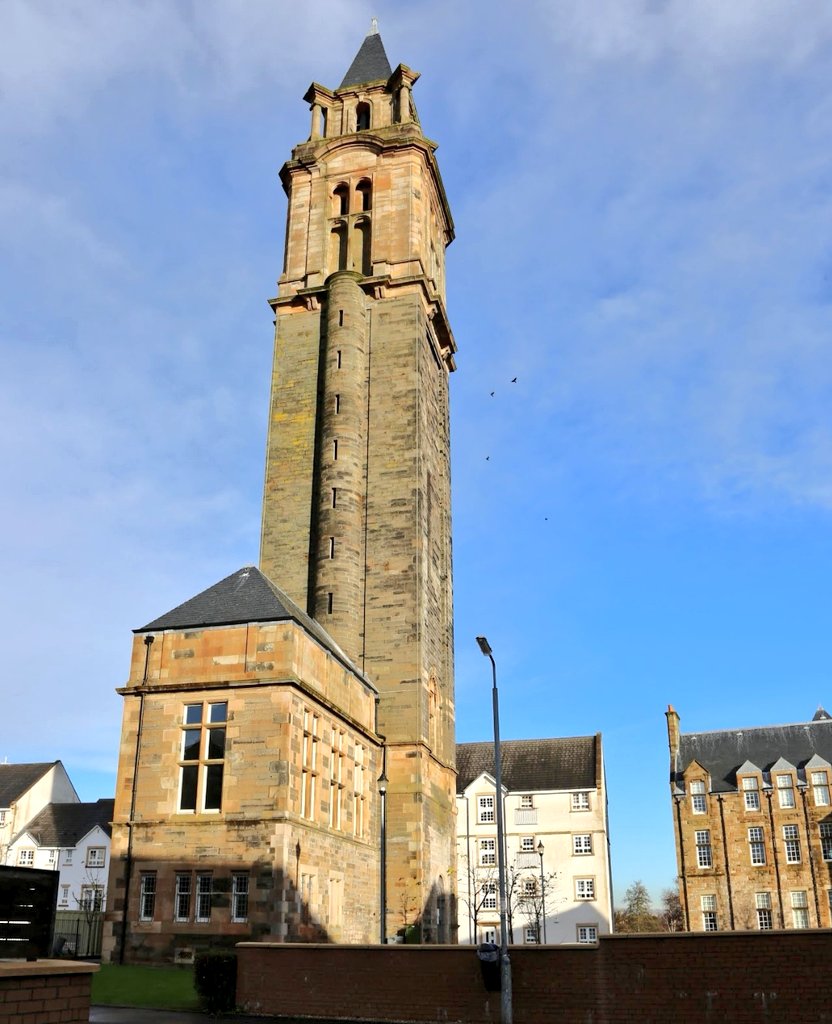
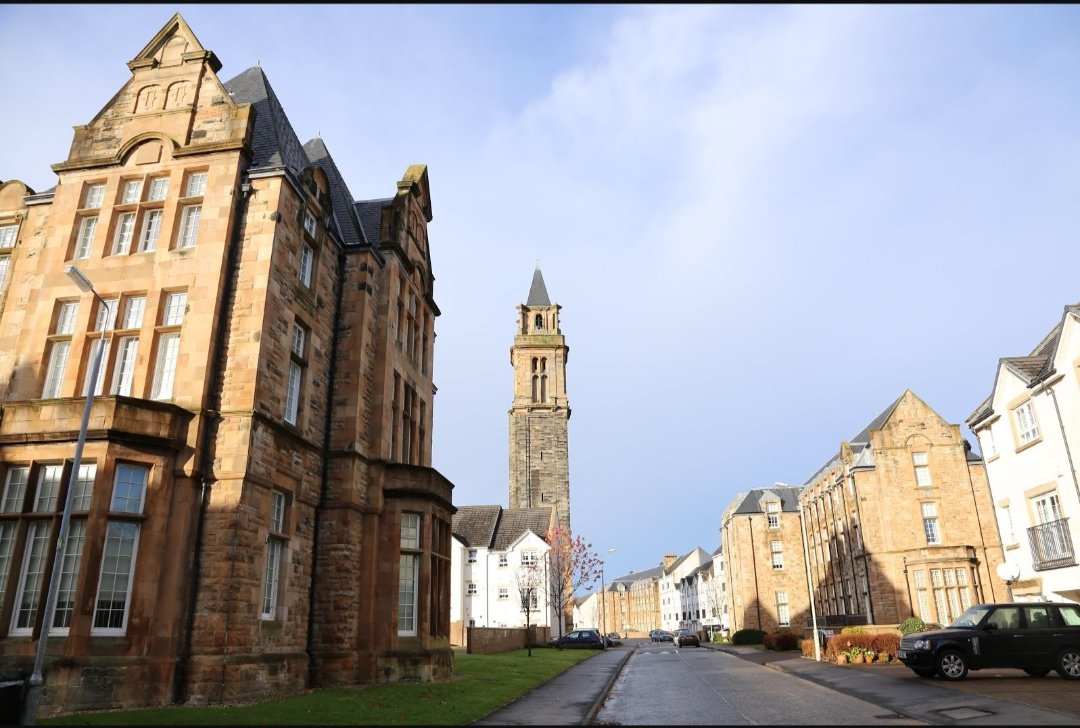
The Herald Building on Mitchell Street was one of Charles Rennie Mackintosh's early public commissions. Built as a warehouse behind the Glasgow Herald printing office, its most distinctive feature is the water tower, designed to hold an 8000 litre tank of water to protect the building from fire. In 1999 it was remodelled interiorly and opened as The Lighthouse, a centre for architecture and design, with a gift shop, cafe and exhibition spaces. The Mackintosh gallery here is free to access, as is the stairwell to the top of the water tower. If you prefer an easier option there are fantastic views over the city available from the viewing room in the other tower that is serviced by a lift. The best views of the building can be had from the top floor of the NCP carpark across the road.
 |
| The Lighthouse, Glasgow |
 |
| Carved details on the sandstone doorway jostle for attention with modern clutter |
 |
| The Lighthouse, Glasgow from across the street |
 |
| Pre-lockdown views from the top of the water tower |
Former Daily Record Building/ Stereo
Designed by Mackintosh in 1900, the former Daily Record printing works can be found hidden up Renfield Lane. Hard to spot as the lane is so narrow, but looking up you see the unusual features of this hidden building, with its white glazed tiles and art deco styling. Unfortunately the fantastic Stereo bar/ cafe/ venue located in the ground floor and basement here is closed at present, but will again hopefully soon be home to crowded gigs.
 |
| Former Daily Record building, Renfield Lane |
 |
Former Daily Record building, Renfield Lane
|
 |
Former Daily Record building, Renfield Lane
|
Just around the corner from here, as I head south towards the river, can be found the less impressive side of Glasgow's Charles Rennie Mackintosh tourist honeypot. Just because you put a Mackintosh font on your building and a Margaret MacDonald style rose above the door, it does not make your building a Charles Rennie Mackintosh building, as the Rennie Mackintosh Hotel ably demonstrates.
Scotland Street School
My daughter has mixed memories of a school trip here as one of the people acting as a mean Victorian teacher was overdoing it a bit and reduced one poor child to tears. Not sure that was a great idea. Usually open as a "museum of education" with period classrooms and related exhibitions,
Scotland Street School is obviously closed at present during lockdown. However I see that plans are afoot to possibly
open a nursery within the building in the future.
Designed between 1903 and 1906 it was Mackintosh's last major commission in Glasgow, and he created a building that is both functional and handsome. The impressive glass towers at the stairwells mean that the interior is flooded with light and his typical flourishes can be found in the stonework and vents. Designed for 1250 pupils, urban redevelopment destroyed a lot of the local housing by ploughing the M8 motorway through this part of town,. The school roll had fallen to 100 in the 1970s and the school was closed in 1979.
 |
| Scotland Street School, Glasgow |
 |
| Scotland Street School, Glasgow |
 |
| "School Board of Glasgow" |
 |
| Infants' entrance at Scotland Street School, Glasgow |
House for an Art Lover
Situated in Bellahouston Park,
The House for an Art Lover was opened in 1996, a full 95 years after Charles Rennie Mackintosh designed it. His plans for this building were submitted to a German design magazine in 1901 as entry to a competition to design a "Haus Eines Kunstfreundes". He worked with his wife Margaret MacDonald on the project. The building in Bellahouston Park is therefore not quite the real thing, as it wasn't a fully worked up architectural plan that Mackintosh had created, but it is as near as you can get. It is available for hire as an events space and has a small cafe, gift shop and gallery.
 |
| House for an Art Lover, Glasgow |
 |
| House for an Art Lover, Glasgow |
Kelvingrove Art Gallery and Museum
To make my walking/running/cycling loop an actual loop, I headed back across the Clyde at The Science Centre and headed back in the direction of Byres Road. But two further stops first.
Kelvingrove Art Gallery and Museum now has a gallery on the ground floor dedicated to "Charles Rennie Mackintosh and the Glasgow Style" with a collection of furniture, jewellery, glass, interiors and textiles by Mackintosh and his contemporaries.
 |
| Kelvingrove Art Gallery and Museum, Glasgow |
 |
Kelvingrove Art Gallery and Museum,
on a frosty January morning |
The Mackintosh House
From 1906 until 1914 Charles Rennie Mackintosh and Margaret Macdonald lived in a terraced house at at 78 Southpark Terrace, which was demolished in the 1960s and replaced by a university building. The interiors have been reassembled in
Glasgow University's Hunterian Museum, in a concrete replica of Mackintosh's house, roughly one block back from where the house would have stood. Inside the house layout is recreated, with all his own furniture and decoration. His beautiful, bright bedroom here makes it hard to believe that you are standing within a Victorian terraced house in Glasgow.
 |
| The Mackintosh House, Glasgow |
 |
| The Mackintosh House, Glasgow |
In 1914 Mackintosh and Margaret MacDonald moved to rural Suffolk, working increasingly as a watercolourist. During World War 1 he was briefly arrested as a possible spy, and fell out of love with Suffolk, moving to London. In 1923 they moved to Port Vendres in the south of France. Within 5 years they had to return to London due to his ill health, and he died of cancer in 1928, aged 60 years old. His style and imagination are unique, a blend of diverse influences pulled together to create something new. He's one of those people you wish you could go back and tell them how loved their work is a century after it was created.
 |
| Charles Rennie Mackintosh (now wearing a face mask) on a mural above the Clutha Bar |


:format(jpeg):mode_rgb():quality(90)/discogs-images/R-1378941-1351085484-4367.jpeg.jpg)