Monday, 11 April 2016

Counterflows Music Festival, Glasgow. April 2016

Review of Counterflows Festival, Glasgow. April 2016


I do enjoy the Counterflows Festival when it arrives in Glasgow. This is now the fifth year of this celebration of marginal, underground and experimental music. In previous years I have mentioned how prominent female musicians are in these fields, and this was almost a theme of the weekend festival this year, with talks on the subject this year. As before it is pulled together by Alasdair Campbell and Fielding Hope, who heads up Cafe Oto in London, as hands on as ever in running the show this year in Glasgow.

The festival ran from Thursday night, 7th April, in the University of Glasgow chapel, through events at the CCA, Nice 'N' SleazyThe Art School, Garnethill Multicultural Centre, The Glad Cafe and Langside Halls on Sunday night. 

First up on Thursday night was Irish multi-instrumentalist Aine O'Dwyer performing at the church organ in Glasgow University Chapel. With the organ perched up on a minstrels' gallery in the University Chapel it provides little visual spectacle despite the size and grandeur of the organ. In your imagination you expect to hear a church organ blasting out Bach's Toccata and Fugue in D Minor or at least a bit of Bowie's Life on Mars, so the slowly building drones we get tonight starts off disappointing but builds up into a contemplative piece that evokes the atmosphere of the space it is in. 
Mythos of Violins in Glasgow University Chapel
She was followed in the cavernous chapel by Laura Cannell and Angharad Davies playing "Mythos of Violins" with Scottish fiddler Aidan O'Rourke. A commission which evokes a sense of place, I was interested to read that in creating the piece the musicians visited St Peter's Seminary in Cardross, which I had the chance to see last week. Playing three solo pieces from different places within the building initially. They then played the final piece together, walking down through the church from the altar, where the war memorial dominates, a more elegiac and melancholic piece. It was pleasant, but in a bit of a similar tone for the whole evening.

Zeena Parkins
The featured artist of the weekend, Zeena Parkins, opened proceedings on Friday night at the CCA, accompanied by her band, Green Dome. This was an ongoing project  "Lace", with improvisers on harp, drums and percussion/ electronics playing a score made of a fragment of lace. It was a brilliant piece and followed by Zeena leading a nine piece band of musicians in a meandering, and cleverly put together piece. It was interesting hearing what she could do with the harp, making it exciting and giving it many voices. A refreshing listen after being a bit disappointed with the performance in Glasgow recently of the lauded harpist Joanna Newsom.

Percussion instrument, and score of lace fragments from Zeena Parkins
Next the audience trooped around the corner to Garnethill to see Australia's Hour House (Mark Leacy and Sam Kenna), followed by Astor and Graham Lambkin but I had bailed by then. I ran off to The Poetry Club to see the legendary dub poet Linton Kwesi Johnson, who was performing there. As it turns out "I've had to put up with that 'dub poet' thing for years". The term he prefers is reggae poetry, a response to the established genre of blues poetry. I am a huge fan of his poems, which are at their best when heard in his own voice. Highly political and barbed, they describe the experience of Afro-Caribbeans in Britain. It was an electrifying performance. I've only ever heard his words on record before now, where they have a musical accompaniment. Hearing him read "Sonny's Lettah" live, an account of the racist brutality of Thatcher's Britain, was a rare treat.


There was a lot else on in Glasgow this weekend. The Poetry Club event on Froday night was under the Glasgow International umbrella, a city wide arts festival. On Saturday visited various exhibitions ongoing as part of that and stumbled across people marking annual International Roma Day in Govanhill. This is a commemorative event and awareness day, to highlight the Nazi persecution of Roma peoples. Govanhill in Glasgow now has a large Roma population, and they were marking the day with other members of the Govanhill community.

Local children get ready to parade in Govanhill for International Roma Day
Counterflow events got going at CCA, where Lithuanian duo Weld Mignon interwove electronic sounds, recorded voices and a prepared grand piano in an entertaining and imaginative way. This was followed by glorious solo performance from pianist and improviser Pat Thomas. When he plays piano, he plays it 'forte', at times crashing down on the keys, at other times working away at the innards like a mechanic under the hood of a car. 

Across at Nice 'N' Sleazy for the late gigs the volume was turned up even higher. Brazilian trio Chelpa Ferro kicked things off with a session of electronic noise and guitar scrambling, one of my highlights of the weekend, though I do regret not picking up a pair of earplugs before standing in front of the speaker at the front of the stage.
Spanish group Billy Bao look the part as a noise rock group, playing here as two drummers and a lead singer/guitarist. I have spent more than a few evenings watching my cousin and her husband play in their various punk/crust/grindcore bands so was expecting 30 minutes of sustained drumming and screeching guitar in the style they kicked off with. However they bamboozled our expectations with prolonged silences, the stage intermittently illuminated and plunged into darkness and recordings of swing/pop melodies interrupting their set. The angsty musings of the lead singer making it one of the strangest performances you might come across. Just for clarification, they are from Bilbao in Spain, their name comes from this and not from their Glasgow footballing allegiance.

New York based experimental hip-hop artist Sensational finished the evening here, the type of eclectic and varied evening that makes Counterflows so special.


Sunday evening finds us on the Southside, home of the lovely Glad Cafe. Four piece Glasgow based art-pop collective Still House Plants, kicked off the evening proceedings. They have also been performing in Glasgow International, which kicked off in the city this weekend.  Danish saxophonist Mette Rasmussen then took to the stage (or took to the floor as she wandered about in front of the stage whilst playing), firstly free jazz tinged improvisation, then accompanying Zeena Parkins playing her electric harp, which when flossed violently with a wire makes some incredible sounds.

Zeena Parkins on harp and Mette Rasmussen on saxophone at the Glad Cafe
The finale of the weekend was across the road in Langside Halls, starting with Zanzibar-based multi-instrumentalist Mohamed Issa Haji Matona, who brought multiple instruments, accompanied by Aine O'Dwyer with vocals and harp. It was a lovely, atmospheric set, and I would have happily heard much more of the evocative African sounds Matona got from his violin.

Matona, tuning up in the stairwell at Langside Halls
We finished off in contemplative mood with a Carnatic Music Ensemble playing the music of southern India. It is not a musical style I know anything about, but it is hundreds of years old and relies on a combination of improvisation and composition, with the voice being a strong component of it all. Here we had four musicians leading a very full house in Langside Halls in a perfect finale to a diverse, eclectic and entertaining four day festival of music.  


Saturday, 9 April 2016

Glasgow International 2016, a Festival of Contemporary Art


Yet again Glasgow International rolls into town, a two week festival of international contemporary art, which arrives here every second year. There are dozens of exhibitions and events on the go until April 25th, which does cause a bit of stress to a completist like me. However to maybe help you chose what to see I will give a quick review of the stuff I have managed to see in the first couple of days. One of the best things about Glasgow International is that it is all free.

West End

I started out at the Hunterian Art Gallery at the University of Glasgow. Apart from a small Glasgow International exhibition, there is an excellent exhibition upstairs here on the history and influence of comic books, including possibly the world's first comic book from 1825, The Glasgow Looking Glass.

Work by William Hunter, anatomist
Work by Damien Hirst, sort of artist

The theme of the exhibition here is to show "moments of mutual synergy" between science and art. What it does show is that the 18th century anatomical casts of a truncated pregnant women and illustrations from a 19th century textbook of histology are far superior works of art than Damien Hirst's Necromancer display cabinet.

Kelvin Hall , Glasgow
The Kelvin Hall is currently undergoing refurbishment before opening next year as the new home of the Hunterian Museum from Glasgow University. Whilst it is still a building site the foyer has been used during Glasgow International to house works by Helen Johnson and Claire Barclay. I'm afraid I was drawn as much by the chance to sneak a peek at the building wrk inside the building as by the artworks on show, but I was impressed by both.
A crumbling room in the Kelvin Hall
Both artists on display here used history as inspiration with painter Helen Johnson creating large canvases riffing on scenes from Ovid's Metamorphosis and reflecting on colonialism (this was the site if the Great Empire Exhibition), and upstairs Claire Barclay's elaborate sculptures reflect on the 1951 Exhibition of Industrial Power from the Kelvin Hall in 1951, but also from the annual carnival that used to be held here.
Claire Barclay's sculptures at the Kelvin Hall
Across the road from the Kelvin Hall, Kelvingrove Art Gallery and Museum was built for the Glasgow International Exhibition of 1901.
Kelvingrove Art Gallery and Museum, Glasgow
Upstairs on the balcony, opposite to the organ is a small, but interesting exhibition by Aaron Angel , who also has pieces withing the Botanic Gardens this year. These sculptures (The Death of Robin Hood) reflect pastoral crafts, but skillfully executed and tie in with a program of organ recitals within Kelvingrove.
Four sculptures by Aaron Angel in Kelvingrove Art Gallery
Kelvingrove pipe organ viewed through the sculpture

City Centre

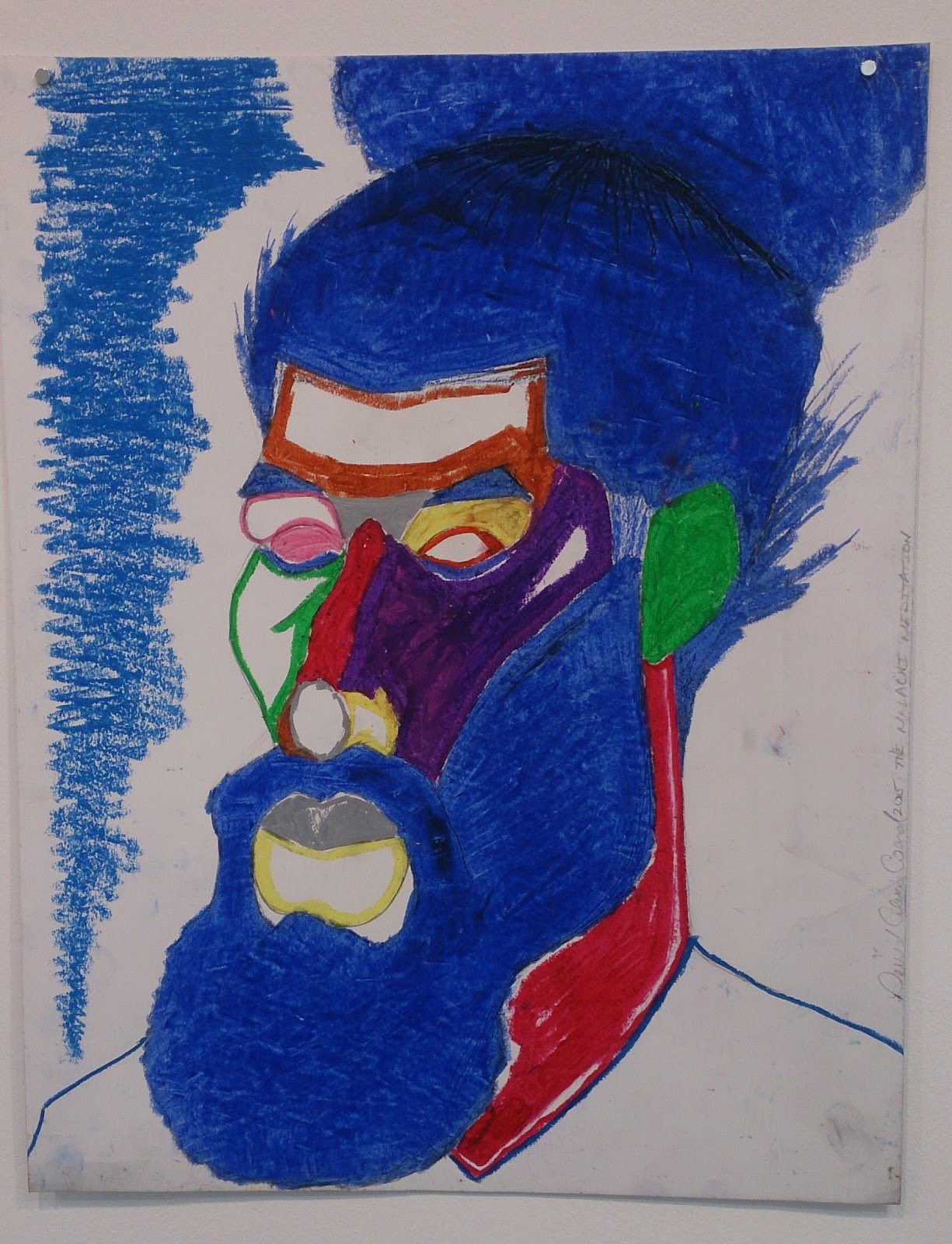
Trongate 103 is a hive of activity with Glasgow Print Studio, Transmission Gallery and Street Level Photoworks all holding exhibitions. Most eye catching is the stuff at Project Ability, an arts organisation supporting people with disabilities and mental health problems. They have a series of drawings by American artist Derrick Alexis Coard, imagined portraits of bearded African-American men. They leap off of the page with colour and vigour, really enjoyed seeing them. 

Work by Derrick Alexis Coard in Project Ability
Further up High Street, in what is being called "Civic Room", a former British Linen Bank building in danger of vanishing unless it is looked after, is the work of Brazilian artist AndrĂ© Komatsu. In an early example of Victorian concrete an steel construction, he exhibits Disseminacao Concreta, a life sized clothed body of a man, made from concrete boulders. At the from of the building he also has a piece, Borders 1, on display.  I really liked this concrete man, particularly in the shabby back room of this former bank, with the steel door of its safe behind his carcass. It is a lovely use the building

Former British Linen Bank, High Street Glasgow
Disseminacao Concreta by André Komatsu
At their Aird's Lane gallery the Modern Institute have a collapsed steel framework by Monica Sosnowska, modeled on a structure from an Eastern European scheme, with more twisted metal sculptures outside, whilst at their Parnie Street gallery a child-like talking desk critiques the world of art production and distribution. The work is by Joanne Tatham and Tom O'Sullivan and looks like the result of a weekend of brainstorming by the Ikea design team when someone sneaked LSD into their tea.
A Petition for an Enquiry into a Condition of Anxiety at the Modern Institute
Monica Sosnowska's work outside the Modern Institute, Aird's Lane
The main hall at the Briggait has a sculpture made of polythene sheets suspended from the ceiling by Heather Lander and Simon Harlow. This may be more impressive when seen at night when they have projections on them. Also in the Briggait are sculptures and drawings by Jock Mooney, which look set for a religious ceremony created by a comic book artist in the style of Frank Quitely.

Part of Jock Mooney's exhibition
There is more humour in the excellent exhibitions within the Mitchell Library. In the main hall Tamara Henderson's giant, totemic scarecrows inhabit this great big space. The gallery invigilator encouraged me to sit in the dilapidated car in the middle of the room to watch the video that goes along with it all. Upstairs in the Jeffrey Room, incongruously set amongst the shelves of leather bound books the works of Jacob Kerray and George Ziffo look like home made banners from a football match but riff on subjects such as racism and commercialiation. This was one of my personal favourites of my day.

Jacob Kerray and George Ziffo at the Mitchell Library
At the CCA Pilvi Takala has multiple video works on display looking back over ten years of work. They are humorous, silly and very engaging, such as trying to get into Disneyland dressed as Snow White, and being refused. I am not always a big fan of video artworks as I am too impatient at times but these are worth watching. Also there is a wall of posters for lost pigeons. Have you seen any of these birds? Some of these have been posted around Glasgow, haven't they, or am I imagining that?

Pilvi Takala
Within the Reid Building at Glasgow School of Art I really liked Serena Korda's suspended fungi, which are accompanied by musical chanting that you hear through headphones whilst walking around if there is not a live performance on the go. Her archival material in the room next door is fascinating too.
Serena Korda's Hold Fast, Stand Sure, I Scream a Revolution
I like the pop art inspired works by Emily Mae Smith on near St Enochs Square at Mary Mary Gallery. Bright, cheerful, but also with dark hints within them. I liked the marching broomsticks from Disney's Fantasia posed like Andy Warhol's gun-slinging Elvises. Pop culture reference overload. 


Emily Mae Smith at Mary Mary Gallery
There is plenty to see in the Gallery of Modern Art too, with the main hall filled with sculptures, paintings and videos by Cosima von Bonin. She was born in Kenya and lives and works in Germany. Her works have lots of toy-like sea creatures and "Missy Misdemeanor, the vomiting white chick" who sits astride a huge pink rocket. Tessa Lynch's sculptures upstairs are interesting too and the blurb that goes with it talks about the "questionable existence of the female flaneur, or flaneuse". It is a funny idea to find questionable when the city is ideally set up just now for male and female flaneurs to wander aimlessly, stumbling across things and just observing people. 


Sculpture by Cosima von Bonin at GOMA

Southside

House for an Art Lover, Bellahouston Park
A cluster of exhibitions sit in the "Artpark" buildings that sit alongside Charles Rennie Mackintosh's House For An Art Lover in Bellahouston Park. I didn't know this place existed and it has a fantastic permanent exhibition on the heritage, architecture and history of the are, including the shipyards which I spent most of my time here at to be honest. Gabriella Boyd and Marco Giordano fill one shed with engaging paintings and sculpture. For the other works here, I was more impressed with the buildings and gardens, where the hyacinths are just beginning to flower with their distinctive smell that you either love or loathe (*metaphor klaxon*).

Artpark at House for an Art Lover

Artpark at House for an Art Lover
Scotland Street School Museum, again an overwhelmingly impressive building by Charles Rennie Mackintosh, has a small exhibition in their ground floor gallery space next door to the cafe. This shows work from the varied career of Glasgow born artist Raoul Reynolds. I had never heard of this interesting character. He was born in 1882 and led a nomadic life between Glasgow and Marseilles, and died in New York in 1969. His father was a shipyard owner and his mother from a Marseilles manufacturing family. He was influenced by European avant-garde art movements but doesn't ever seem to have fitted in anywhere. His life story turns out to be more interesting than his work if I'm being honest, with hints of someone having more money than imagination. Perhaps I am just being over cynical. 

Work by Raoul Reynolds at Scotland Street School
There are several major exhibitions on at the nearby Tramway, a group show including work by Alexandra Birken, Lawrence Lek, Sheila Hicks, Mika Rottenberg and Amie Siegel. The premse of the exhibition is to explore ideas around production, manufacture and history. Like the exhibitors in the Kelvin Hall the interactions with the building's history is part of that. Many of the spaces used in Glasgow for studio space and galleries are disused industrial spaces, such as this massive tram depot on the southside. Many of the works here are meant to be using that idea, but most of them weare video works and I didn't have the patience to sit through them. I admit I wasn't in the most receptive frame of mind after just being stopped by the Police on the way here for jumping a red light on my bike. At the subsequent set of lights (which were green) two pedestrians then just about bundled me off of my bike by not noticing me. I arrived at the Tramway in a peevish mood. However I was still a bit disappointed by it all. On a side note, could someone at the Tramway think about installing a few cycle racks in the vicinity, there aren't many easy places to chain up a bike nearby. Ta.

A sculpture made of coloured linen by Sheila Hicks at Tramway.
 Also in the Southside, Glasgow graduate JosĂ©e Aubin Ouellette has a display of ergonomic soft sculptures on the floor of the pool at Govanhill Baths. You are encouraged to put on a pair of felt slippers and go down and loll about on these pieces. I preferred to nostalgically stare at the wooden changing cubicles lining the pool, remembering my childhood swims in Whiteinch Pool. 
Govanhill Baths, Glasgow
Who knew that there was a Roller Disco in Kinning Park? (Oh.Well I didn't know). This is the scene for performances by Asparagus Piss Raindrop, the self proclaimed "crypto conceptual science fiction anti-climax band". I have seen them perform before at the Glasgow Tectonics festival and they usually tread a fine line between taking themselves very seriously and being very silly. I am not sure whch side of this line they've fallen this time but I liked the idea of them performing on roller skates to electronic music and live percussion and saxophone. It feels like an unsuccessful 1970s dystopian film that failed at the box office because of the poor special effects and I would not have been surprised to see a young Donald Sutherland with handlebar moustache appear amidst the chaos. Whilst five of them kept skating around and performing three others acted as a transvestite, a saxophonist and compere. You get the gist.

Asparagus Piss Raindrop at Roller Stop, Glasgow

Asparagus Piss Raindrop at Roller Stop, Glasgow

What else?

There is a fantastic amount on show all over the city, much more than I have mentioned here. I plan to head to the Glasgow Sculpture Studios and Glue Factory in the north of the city and to the David Dale Gallery in the east end. I also fancy going back again to see the works at the Art School, CCA and the Civic Room which were some of my highlights.

Sunday, 3 April 2016

Glasgow Spectator Sports, Part 2. Greyhounds and Speedway

It is 18 months now since the 2014 Commonwealth Games finished in Glasgow. By most accounts the games were a spectacular success, with all of the sports on display getting great crowds attending from Glaswegians. At any sporting event now it seems obligatory to talk of what "legacy" the games have left behind, there is even a Legacy 2014 website extolling all the benefits the games brought to the city. Did it encourage people to be more active, seek out new sports to watch or participate in? I'm not sure.

During the games I certainly went to see sports that I had never paid to watch before, but realise that, by and large, my spectating has largely fallen back to following Partick Thistle week in week out. My children still enjoy going to their assorted badminton, athletics and swimming clubs but we have not been spectators at any of these sports in the city since the games. The football league having a weekend break for the international matches meant that I was looking for other entertainment last weekend. This made me think about what other sporting excitement people of Glasgow find in their spare time, so I will try a few different sports and see if there is anywhere in town that can match Firhill for thrills.

Last week I took my children to the ice hockey. This week we tried speedway.

Greyhound Racing and Speedway


As the history of greyhound racing and speedway in Glasgow are so closely linked I will briefly look over both of these sports, which at one time were new and innovative, but both now evoke bygone ages.

The origin of greyhound racing lies in hare coursing, and to try and make it a spectator sport a London venue devised a mechanical hare to lead the dogs along a straight track as far back as 1876. When a Californian track developed a mechanical hare going around an oval track in 1912 the sport of greyhound racing took off. Glasgow's first greyhound track was set up in Carntyne in 1927, on a site which has been derelict for decades just north of the Forge Shopping Centre, recently redeveloped for housing.

After Wester Carntyne in 1927 came the White City Stadium and Albion Stadium near Ibrox a year later, then Shawfield put a dog track in place in 1932. Between 1948 and 1954 there was greyhound racing at Partick Thistle's Firhill Stadium. From 1928 many of these venues would introduce "dirt track" motorcycle racing on other nights of the week to boost incomes. Speedway, as it became known, as it requires a similar venue, has therefore always been associated with greyhound tracks. 

Shawfield Stadium on the banks of the Clyde is the only greyhound track in Glasgow still going. Shawfield was initially laid out as a trotting track, for horses. Football was first played at the stadium in the 1870s. Thistle FC were an Oatlands team and an early member of the Football League. They folded in 1895, only surviving in the record books as giving Partick Thistle FC their highest ever league win, a 13-1 drubbing at Firhill Stadium in the Scottish League Division Two. Clyde FC moved to Shawfield in 1898 and it was their home for another 88 years. The biggest crowds at the stadium were, for football, the 52,000 who came to see Clyde v Rangers in 1908 or, in other sport, the 40,000 who came to see local boy Benny Lynch beat Peter Kane in 1937 to defend his boxing world title. 

Shawfield Stadium
The Greyhound Racing Association owned Shawfield and planned to sell off the stadium to be developed as a supermarket. They moved Clyde FC out in 1986, who eventually settled in their unhappy Cumbernauld home. When the plans fell through GRA sold it to new owners who took in new tenants, the Glasgow Tigers speedway team who were based here until 1998. Since then it has only housed the greyhounds.

The dogs are paraded before the race at Shawfield Greyhounds
Every Friday and Saturday night the races start about 8pm, with the doors open an hour earlier. There are a couple of bars and a wee restaurant within the stadium, which is a good venue for birthday parties and the like. My children think that the snack bar here does the best chips in town. I don't go often to Shawfield, but every time that I do go I think of my grandad and great uncle Andy, who lived nearby in the Gorbals and made occasional trips to the dogs here in the 1930s. My grandad's tip to bet on the black dog, or trap 5 seems as random and as valid as any other technique.

A normal night will see about ten races, one every 15 minutes or so. Most races are handicaps with the dogs given a staggered start and ending at the finish line below the main stand. Once the dogs are paraded in front of the crowd you have your last chance to back a winner before they are placed in the traps. Like horse racing the point of going to the dogs is to have a flutter, and as with any betting you should only start off with the amount that you are prepared to lose on the night in your pocket, then stop. I'll wager that nobody has ever got rich betting on dogs. You can either place your bet at the various tote windows around the ground, or at the cluster of private bookies alongside the track, who may offer better odds.

The greyhound traps at Shawfield Stadium 
Betting options are a straight "win", usually minimum stake £1, a "forecast" - predicting first and second in the correct order (minimum stake usually 50p) or a "trio" - predicting first, second, third in the correct order (minimum stake 25p but the odds and returns are obviously much higher). You can place a "reverse forecast" selecting two dogs to finish first and second in any order (two bets at 50p, so minimum cost £1) or a "trio - all ways" predicting 3 dogs to come in the first three positions in any order (six bets at 25p, so £1.50 minimum stake). 

My daughter overlooking the finish line at Shawfield. She's only here for the chips
It's a good night out if there is a crowd of you, but attendances recently seem a bit smaller than they used to be. There has been some concerns raised about the welfare of dogs kept for racing, particularly what happens to them after their racing days are over. If you do have a big win maybe you would consider donating some of it to the Scottish Greyhound Sanctuary or the Greyhound Awareness League. The retired dogs make great pets and we have a friend who adopted a greyhound, a well loved member of their family now.

Cost - Entry to Shawfield Greyhounds is £6 for adults and free for children under 16. Most of the cost thereafter depends on how much you decide that you want to bet. For me it is just as much fun when you have £1 riding on it as £10

Speedway


Glasgow now only has one venue where speedway can be seen, Saracen Park or "Peugeot Ashfield Stadium" in Possil. This stadium was opened in 1937 and is home to Ashfield Football Club, who still play their home matches on the pitch in the centre of the track here. On Sunday afternoons however this is home to the Glasgow Tigers. The Tigers started out in 1946, but have only been based at Ashfield since 1999. Before that they have called various tracks home. White City Stadium in the 1940s, on and off through to the 1960s. Hampden Park from 1969 to 1972, then Cliftonhill Stadium in Coatbridge for four years, spells in Blantyre and Workington, before arriving at Shawfield Stadium in 1988. This was home for most of ten years before they settled in their current home.

White City Stadium, Glasgow, opposite Bellahouston Park,
with the Albion Stadium between it and  Ibrox Stadium
White City Stadium used to lie north of Bellahouston Park on the opposite side of Paisley Road West. It was finally demolished in 1972 to make way for the M8 and Govan Police Station. It was part of a chain which had greyhound and speedway venues in Manchester, Newcastle, Hull, Nottingham, Cardiff and London. In Glasgow the White City stadium initially had a grass dog track on the outside with a cinder speedway track inside it. There are some great pictures of it on the "Defunct Speedway Tracks" website.

Signs point the way to the Tiger's stadium
On the day we came to see the Glasgow Tigers in April 2016, the season had just begun and we were drawn by the chance to see them race against their rivals from the other end of the M8, Edinburgh Monarchs. The Monarchs are a team which dates back to 1928 and their existence has been as nomadic, and at times precarious, as their Glasgow rivals. Like ice hockey, this isn't a sport that started its life in the UK and many of the UK based teams are largely made up of riders from overseas. In the case of the Tigers this includes Australia, Finland, Argentina and England. 

Glasgow Tigers home stadium
The season starts in April and runs through until October with the Glasgow Tigers usually playing on Sunday afternoons at 3pm. There are 13 teams in the league, playing each other home and away over the season with play-offs at the end of the season for the top six teams, plus various cup and knock out competitions. Today's match was a league cup fixture, with Edinburgh the stronger team on last year's form. This was the first time I had come to see speedway, but the programme and compere easily guided me through the rules. As I am usually spending my Saturday afternoons watching Partick Thistle, the compere was a familiar face to me, with Michael Max providing matchday care to the Firhill crowd on Saturdays and the Tigers' fans the next day.

Michael Max keeps us right, alongside start marshal Hugh McNeilly,
assistant start marshal Heather McNeilly and team manager Stewart Dickson
Entertaining children is a big part of the afternoon here and before the racing started we were introduced to Roary the mascot and a parade of the teams on a flatbed truck before the racing starts at 3pm. Some fans turn up earlier, the doors open at 1pm, to look around the pit areas if that's your thing. The Tigers' name gives plenty of scope for tiger themed songs - "Tiger Feet", "Eye of the Tiger", and Katy Perry's "Roar" all featuring prominently. Every four or five races the track needs brushed and other entertainments are laid on, such as trying to throw a ball in Roary's bin and a children's race against the mascot. It is also a chance to grab some food, or get a drink at the bar.

Roary the mascot
"That's neat, that's neat, that's neat, that's neat....I really love your tiger feet"
Glasgow Tigers team introduced to the crowd
Spectators can stand around the outside of the oval track, or for an extra £1 per person, get a seat in the stand beside the start/finish line. There were 15 races in total, with four riders in each race going flat out for four laps. In each race the home team pair wear red or blue helmet colours and the visitors wear white or yellow. Points are awarded depending on finishing position, 3 points for first place, 2 for second and 1 for third. Nothing for being fourth or not finishing. If you are trailing by more than 10 points at certain stages, you can chose a rider to win double points in the next race, so there are various tactical shenanigans too. 
  
The starting tape goes up, and they're off
 It is fast and furious and not without crashes. In the first race, with Glasgow's Nike Lunna taking a good early lead, the race had to be stopped after a Monarchs' rider crashed into the safety barrier. The rider was uninjured (although the safety barrier wasn't) and Lunna was unlucky to lose the restarted race. Even when a race looks done and dusted, mechanical problems can change everything. Tigers' Ben Barker seemed home and dry in the 14th race when his chain came off and he had to push his bike across the line to take one point. At the end of the day it didn't matter and Glasgow Tigers were comfortable winners by 56-37 to win the derby match.

Spectators get close to the action
Danny Ayres of Glasgow Tigers and Max Clegg of Edinburgh Monarchs

A Monarchs' rider comes off his bike and accepts a lift back to the pits
Fernando Garcia is pleased to win a race for the Glasgow Tigers
Drifting around the banked bends
The pits behind the crowd, and an old Police phone box for the team manager?
Crossing the finish line
Overnight rain meant that the track was on the muddy side. As a result of this, finishing fourth in a race meant that a quick sponge-down would be required. The same was true for those standing along the home straight, who ended up caked in mud by the end of the day. However that, plus the smell of the burning fuel and the noise of the engines is part of the attraction surely. The racing can be very exciting, with plenty of nip and tuck. My children had a great time, I quickly got right into it. We will all definitely be back here again, especially if they promise to keep beating Edinburgh as soundly as that.

Mud splattered crowd

Cost - Adults £17.50 each and children £1 under 11 years old and £6 for 12-16 year olds. So two adults and two children £42 plus £1 each to get a seat in the stand rather than just standing.

Next week.....?