Gareth Dickson. Kathryn Joseph. The Mackintosh Church,
Queen’s Cross. 24th January
Rachel Sermanni. John Grant. Glasgow Royal Concert Hall. 26th January
Celtic Connections started out as a festival to get bums on
seats at the concert hall during the lean winter months after Christmas. It has
now grown to become one of Glasgow’s busiest periods of music performance. I am not entirely sure what it is trying to be. It is frequently hard to
see any coherent theme or any Celtic connections with the acts. Nevertheless it
brings an eclectic range of musicians to the city and there are always some memorable performances.
Kathryn Joseph
The festival seems to be spilling out into more and more venues too
and it was the venue as much as the musicians that drew me to get a ticket for
Kathryn Joseph’s gig at the Charles Rennie Mackintosh designed church at
Queen’s Cross. As this building sits just in front of Partick Thistle’s Firhill
Stadium I pass it every couple of weeks and it is easy to overlook its
charms. The only church which Mackintosh built was begun in 1898, commissioned
by the Free Church. This meant it had to be a simple design, but Mackintosh
smuggled in lots of clever features and ideas into the building. The sell out
crowd for this gig was an echo of the congregation of 820 people that used
to squeeze in here every Sunday.
Kathryn Joseph in the Mackintosh Church
First up was guitarist Gareth Dickson, who has oft taken the
stage with Vashti Bunyan. Playing acoustic guitar whilst accompanying himself amongst reverb and delay pedals, he created a floaty atmosphere suited to the church
hall atmosphere. Lovely to listen to.
Aberdonian Kathryn Joseph is also a musician who is best
listened to. I know that sounds trite, but last time I saw her was in another
converted church, at an all day festival in Oran Mor. On that occasion the
noisy rabble of people chatting at the bar all but drowned out her voice,
despite RM Hubbert getting up to tell them to “Shut the fuck up!”. She had just
won the Scottish Album of the Year award for Bones You Have Thrown Me and Blood
I Have Spilled, a delicate collection of songs, where many a barb hides in the
lyrics. She sings and plays piano, whilst musical partner Marcus Mackay takes
percussion. The fact that they share a bottle of red wine between them on stage
whilst they play seems perfectly in keeping with the music; civilised and
convivial. Joseph held your attention, as she sat side on at the piano, keeping
eye contact with the audience. Her mesmeric voice rose to fill the
barrel-vaulted roof of the church. An engrossed crowd were held rapt in
attention from the opening song, The Bird, almost unaware of the ache in their backsides from sitting on the wooden pews all evening with only a can of San Pelligrino juice from the alcohol-free bar as
sustenance.
John Grant
A physical and musical contrast was provided two nights
later in the Glasgow Royal Concert Hall by John Grant, bringing his lumbering
frame, gruff baritone and electro-soul-funk thing to town. This is the third
time that I have seen him perform now in Glasgow, from an intimate gig in St Andrews in the Square,
then the O2 ABC in 2013 and now a sell out night in the concert hall. I am starting to feel like a bit of a John Grant groupie. When I was on holiday in Iceland last year I dragged my family to the wee cafe in Reykjavik that features on the front cover of John Grant's previous album (Mokka Kaffi to be precise - I can heartily recommend it). Unfortunately whilst there I started berating a big German who had jumped the queue, only to find him sat beside me on an uncomfortable flight the next day.
The bridge at Carrbridge, a place worth visiting if you've never been
First up was Carrbridge’s
“chick with a guitar” Rachel Sermanni. It was a subdued and
melancholy set she performed with her band. It would be nice to hear what she
can do if she really cut loose and added some vitriol to her singing, but instead she finished
on a gentle lullaby.
John Grant at Glasgow Royal Concert Hall
John Grant performs
with a band of musicians plucked from Iceland and Coventry (meaning that The Specials got a mention- yeah!). In front of a guitarist, bass, drums (played by ex-Banshee, Budgie) and keyboard, he alternates between vocals,
playing keyboards himself and dancing like a bear wakening from
hibernation. He came on stage to the introduction from his latest album, Grey Tickles, Black Pressure, a rendition from Corinthians ("Love is patient, love is kind. It does not envy, it does not boast..."). Much of the set comes from this album, but dips back into Queen of Denmark a fair bit and Pale Green Ghosts (there was also a rendition of an old Czars song Drug). Between tracks he is a veritable chatterbox, even demonstrating his local knowledge to complain about the weather being really "dreichy" in Glasgow. He is a master of many languages but his Scots' vernacular needs a bit more work. He was bemused trying to work out his "Celtic connection", concluding that it is because he is called John William Grant. That'll do. Disappointing is a track on the new album that I like a lot, partly because of Tracey Thorn's vocals on it, here given a live makeover with Mr Grant and the keyboard player singing together. The smart alec lyrics and arch tone of that song is the kind of twist that makes him an interesting character. He always comes over as a person you could happily spend all night talking to ("The genitive case in German, it's true, is something I'm quite partial to. Rachmaninov, Scriabin, Prokofiev, Dostoyevsky, Bulgakov, Vysotsky and Lev...All these things they're just disappointing compared to you").
As before there is a disco-tinged middle third to the gig, before we settle down for quieter stuff at the keyboard to end. Always chipper, always tinged with melancholy and always good company.
An adaption of "The Bottle Imp" story in Classics Illustrated
The author of Treasure Island and Dr Jekyll and Mr Hyde wrote the short story "The Bottle Imp" whilst living in Samoa, firstly for a Polynesian audience. Written in English it was first seen in a Samoan translation in 1891, published two years later in English in the collectionIslands' Nights Entertainments. The original story, featuring an Hawaiian sailor who buys a bottle containing an evil imp, has been adapted by author Louise Welsh, who wrote the libretto (opera text) for this production. The music is by Scottish composer Stuart MacRae, a contemporary score which is as jarring and unsettling as the story it tells, a good fit.
Louise Welsh as an author can tell tales which start off in a familiar world, then quickly develop into a dystopian Gothic horror. Her last book that I read, A Lovely Way To Burn, has the host of a TV shopping channel heading out on a date at the start, and wandering through a post-apocalyptic world of a viral pandemic by the end.
The Devil Inside is performed with a 14 piece ensemble of musicians (partly a practical imperative as the opera will be touring venues of various size after being performed in Glasgow). Stevenson's story has been brought into the modern world. A cast of four performers (plus an almost ninja-like stage crew) tell the story. Ben McAteer and Nicholas Sharratt are young men trekking through mountains when they shelter in a mansion. It is home to a troubled old man (Steven Page) who tells them he got his fortune from an imp in a bottle, which can grant your every wish. However there is a price to pay. If you die in possession of the bottle your soul is condemned to eternal damnation, and the bottle can only be passed on by being sold for less than you paid for it. The price is getting low already and starts to fall further.
A simple but effective staging uses shadow theatre. This can conjure up a contemporary world, with the modern cityscape of the young man's wished for property empire, whilst recalling the Gothic terror of the shadowy figure from the film Nosferatu.
Count Orlok from Nosferatu
The story batters along and the acting by all on stage is excellent. Any happiness gained through the imp in the bottle is tarnished by it, and when one of the young men finds love with Catherine, played by Rachel Kelly, illness threatens to ruin their happiness. Clever changes like this from the leprosy Stevenson's sailor developed in the original story all work well in this telling. Temptation brings them to seek out the bottle imp again. The story and acting conveys the addiction of those using the bottle, despite the harmful effects that they see (cf. alcohol, drugs, gambling). It affects all of them in different ways which reflects their personalities and a Rorschach inkblot hangs over them, a test used to assess personality traits.
I sometimes struggle a bit with operas sung in English, it just sounds more musical to my ear when you are not listening to the meaning of the words, and just let them wash over you as sounds. So this text, sung in English obviously, has that problem for me. At times it felt like a good play that they were singing to each other. However as the story moved on the music and atmosphere became more immersive and the ambiguities in the ending which the story has been given, gave it a great punchy finale.
Well played, well written. Imaginative and absorbing. I was left thinking it through after going home, greedy for more.
Partick Thistle's reputation as the most artistic football team in Scotland got a boost this year with the arrival of our new mascot Kingsley, designed by artist David Shrigley. Although it is a lazy cliché to deride Partick Thistle as the team for BBC luvvies and students to follow, I think that they are the perfect team to combine art and football. From Kris Doolan's cultured left foot to artist-created free giveaways, Partick Thistle are bringing artistry to our corner of Maryhill.
"All the marvels of science and the gains of culture belong to the nation as a whole (and in particular to Partick Thistle fans)" - Vladimir Lenin 1918
Glasgow and Art
It is often noted that one way in which Glasgow has adapted to the loss of much of its previously monumental manufacturing industry is with a flourishing arts scene. It is now 25 years since Glasgow became the 1990 European City of Culture, following Athens, Florence, Amsterdam, Berlin and Paris to the title. At the time there were some voices, such as James Kelman and others organised as "Workers City", opposing the re-branding of Glasgow as a "merchants' city". Many felt local, and particularly workers' voices weren't being heard in this jamboree.
Glasgow's motto of 25 years ago and Partick Thistle's
Kingsley mascot of today, created by artist David Shrigley
Since then Glasgow has built a genuine reputation as a creative place to live and work for writers, comedians, artists, musicians, actors, comic book writers and other creative types. Visual art is an area where Glasgow has produced many of the most prominent artists working in Britain today, and for many years has made the annual Turner Prize, which was presented this year in the city, a virtual who's who of Glaswegian artists. Since 2006 Glasgow School of Art has produced five Turner Prize winners and 30% of the nominees. However much of this seems to have been achieved through the efforts of individuals rather than by any major outside support or funding.
Glasgow artist Jim Lambie, creator of Barrowland Park.
Apparently no relation to John Lambie of Partick Thistle
Common Weal and Art
Many people involved in the creative arts in Scotland were very prominent during the recent independence referendum debate, such as through the National Collective, often offering a less party-political, less partisan voice. They were generally trying to make people think about what type of Scotland they imagined they wanted to live in. The Common Weal organisation also emerged during the referendum campaign, and they continue to campaign. Their stated goals include achieving social and economic equality in our country and promoting a vibrant community and cultural life. They hope to encourage debate in the forthcoming Scottish parliamentary elections to be about positive ideas and concrete plans, rather than the often playground "he-said-she-said" debate we are at risk of getting. To this end they have recently published a short "Book of Ideas". This contains 101 ideas that they believe could shape Scotland's future in a positive way. As well as ideas in areas such as taxation, deconsumerisation and land ownership, they include ideas such as allowing fan ownership of football clubs (also a policy of the Scottish Green Party).
As the arts and culture enrich our lives they suggest ways to support the production of art and to support artists. Too often art is viewed as elitist, or something purely to make profits, to be drive by the market. As well as creating more art, they also want to generate more audiences, by introducing people to galleries, getting schoolchildren go to theatres and concert halls often, so that we all know our way around these places. I think we all gain from this, whether it is by finding out that you enjoy speedway racing at Ashfield, paintings by Whistler in the Hunterian Gallery, an open mic spot in the basement of a local pub or free tickets to a concert by the BBC Scottish Symphony Orchestra. Unless you know how to join in, and can afford it, you won't get the chance. It is really the main reason that I started writing a blog (such as this one recently on local galleries), because there is loads of good stuff out there that people would love but they don't always know how to access it.
Adrian Wisniewski designed poster for Common Weal
Partick Thistle, Art and Me
Inevitably Partick Thistle Football Club are sometimes described as Glasgow's "other club", as they are regularly overshadowed by the ugly sisters that they share the city with. However, I am not a fan of that term as it does a disservice to Queen's Park FC and Clyde FC. When I started going to watch football regularly these two teams, along with Partick Thistle, were the opposition for Rangers and Celtic in, among other things, the annual Glasgow Cup.
Programme from 1991 Glasgow Cup final
Being different in a city where many fans have very partisan loyalties to their team, Partick Thistle have often been portrayed as the "Glasgow alternative". With the proximity of Firhill Stadium to Glasgow University and the old BBC premises, a perennial joke of satirists (such as the Paisley Panda) has been to mock Thistle for having a big following of luvvies and students. With a nod to the absence of religious sectarianism at Firhill it has also been said by someone that Thistle "were the atheist's team. You couldn't believe in God and support Partick Thistle".
In the late 1970s when I lived in Maryhill and was at primary school, my brother and me got taken along to Firhill by my parents and we have continued going ever since, through all the ups and downs that has entailed. We also got taken to Kelvingrove Art Galleries regularly and to other galleries, and again I have kept on going back ever since. In the 1970s my mum was working in the cafe at the Third Eye Centre (now the CCA). Due to their laid back attitude as employers, summer holiday child care problems were solved by my brother and me getting to run about in the Third Eye Centre all day (we helped out refilling the coffee filter machine occasionally and got a wage packet of 50p per week). This made it a normal place we just played in, my brother kicking rows of sawdust about one day which had been laid out in one of the galleries, not realising that it was a carefully crafted work of art (we sorted it out, nobody noticed). If you know that it is alright when you are aged seven to not like a rotting bunch of bananas in a long wooden box (another exhibit that sticks in my mind), then you realise that when you are forty it is still alright to turn your nose up at stuff that you don't like. I just think more people need to get the chance to see more art, to see what they do and don't like.
One of my children has become a big fan of street art, often found giggling over a book of Banksy's work that we have. Another favourite book of his is one by David Shrigley, whose cranky humour appeals to him. On holiday in Paris a few years ago after we spotted some street art by local boy "Invader" on a wall there, we spent most of the rest of our trip trying to spot more of his stuff. It became quite competitive after a while. Basically it is all around you, if you get to notice it.
What about art and football? I was too young to bear witness to the artistry of Alan Hansen's nascent career in Maryhill, the 1971 League Cup winners or Alan Rough's perms. The first person that to me linked the words "artist" and "football" was probably Bobby Law. There are many great examples of football and art merging. You could maybe think of Roy of The Rovers, films such as Gregory's Girl, Ian MacMillan becoming "poet in residence" at Barnsley FC. What about Willie Rodger's great footballing linocuts?
Penalty by Willie Rodger
A memorable coming together of football and art is found in the film by Glasgow-born Turner Prize winning artist Douglas Gordon, Zidane. Filmed in real time with all the cameras focused on the French superstar and with a soundtrack by the superb Mogwai, the film shows that 90 minutes of football can have all the drama of a Shakespearean play. On a memorable evening two years ago the band performed the score live at an outdoor showing of the film in Glasgow. Football and art, clearly natural bedfellows.
Zinedine Zidane, Douglas Gordon and Mogwai's Stuart Braithwaite
Partick Thistle and Art
At the start of this season Partick Thistle Football Club caught most people by surprise when they announced that Partick Thistle fan and artist David Shrigley had introduced US investment firm Kingsford Capital Management to his local team. Kingsford Capital's manager, Mike Wilkins is a supporter of modern art and a fan of David Shrigley's work. This led to him commissioning Shrigley to design a new company logo for Kingsford Capital which, with his sponsorship of the team, became Thistle's new mascot. One important thing this deal brought to the club was money. But alongside that, when the mascot which David Shrigley designed was unveiled, Partick Thistle became a twitter sensation overnight. We had more media attention that week than in the previous 12 months, such as this article in the Guardian newspaper and news features around the globe.
Kingsley and Partick Thistle fans in the Guardian newspaper
Partick Thistle's finances have always been shaky to say the least, but the imaginative way that they have worked with a local artist (of international renown) has shown the positive results that can come from art and culture working alongside other sectors of society. A big part of the successful cultural atmosphere of the city has been artists in different fields collaborating with each other, and Kingsley is the kind of thing that you can end up with. The Kingsley mascot is only one of several artistic connections made by Partick Thistle this year.
Rogue One
In the close season the brick wall behind the city end of the ground was given a fresh lick of paint by Glasgow graffiti artist Rogue One. I have written about some of his work in the city before, and since painting this at Firhill he has been busy completing the murals outside the re-opened Clutha Bar, among other things. I like "street art", as it tends to be called, and it has gained a higher prominence with the popularity of Banksy and his ilk. It is public art, and it takes art away from the buying and selling end of things (unless you are Banksy, as people rip bits of wall apart which he has daubed on, to sell on for thousands of pounds). A person gets paid for doing their work, we end up with a bit of, transient, public art. Everybody wins.
Mural by Rogue One at Firhill
Commissioning an artist to paint a gable-end is not a new idea. Here is a short clip of John Byrne talking to STV in 1974 about the mural he painted on a wall in Crawford Street in Partick (on a now demolished building). You don't see interviewers and interviewees smoking together on TV very often these days, do you?
Whether you like a particular mural or not, it is up there for everyone to see and everyone can have an opinion.
David Shrigley
David Shrigley came to Glasgow to study at Glasgow School of Art in 1988. Whilst in the city, like the sensible chap he is, he started following Partick Thistle which is the reason that I get to write this piece today. He has in his time painted, drawn, produced designs for festival T-shirts, pop videos, newspaper cartoons, sculpture, photography and made much music. His 2014 album with Falkirk's Malcolm Middleton, Words and Music, is one of the most entertainingly foul-mouthed pieces of music that you will hear. (Middleton's 2007 album Brighter Beat has a photograph by David Shrigley on the cover).
David Shrigley and a Really Good thumbs up
In 2013 he was a Turner Prize finalist and his sculpture, Really Good, a giant thumbs up, will soon grace the empty fourth plinth in Trafalgar Square. With the design for Kingsley he is clearly at the top of his game.
David Shrigley's comment on twitter on the evening
that the UK parliament voted to bomb Syria
(Updated 6.4.2016 - The fifth artist created free giveaway of the season at Firhill was given away last night to the first 2000 home fans attending the Partick Thistle vs Dundee United match last night. This time it was the turn of Kingsley creater David Shrigley with a variation on the sports big foam hand with the "number one" pointing finger. Based on his forthcoming 10 foot tall Really Good extended thumbs up he gave us a big yellow foam thumbs up, to wave in appreciation of Kris Doolan's fantastic match winning goal. As it turned out they also doubled up as quite handy for doing the big thumbs down at some of the Dundee United play.
David Shrigley's foam thumbs up for Thistle, modeled
by players Tomás Cerny and Ryan Edwards
With the letters PTFC tattooed across the knuckles of the fist, it is another welcome addition to my kids' burgeoning Partick Thistle art collection.)
My daughter enjoying her professional footballer look,
with tattoo sleeve and David Shrigley foam hand
Barry McGee
When Kingsford Capital arrived as sponsors at Partick Thistle they promised a series of limited edition, artist created giveaways. The first of these came at our home game in October against Dundee United. Mike Wilkins of Kingsford Capital had commissioned American graffiti artist and painter Barry McGee to create a design for 2000 footballs, which were handed out to fans as they came into the ground.
Free Barry McGee balls at Firhill
Barry McGee artwork meets Glasgow pies
These were immediately used exactly as the creator must have imagined, either worn as a hat or as a handy dish for a Saturday afternoon pie. Barry McGee started off in San Francisco as a graffiti artist but his work can now be found in many galleries, and did once adorn a design for Adidas trainers. He has also exhibited at the prestigious Venice Biennale, which led to his street art gaining in value and being largely scavenged from walls. A quick search on the internet reveals that he has previously filled galleries with abstract murals of patterned tiled designs and returns often to painting a series of downtrodden looking, cartoonish characters.
Barry McGee exhibition
These features are what made it onto the footballs that were handed out at Firhill, largely in our red, yellow and black colours. After putting a photo of the ball that I collected that day on Twitter I was twice asked online if I would sell it, but as my children have enjoyed kicking it about in the park, I think I will hang onto it.
One of Barry McGee's balls
Jon Rubin
In a further link up with Kingsford Capital, Pittsburgh-based artist Jon Rubin has designed a scarf, which was to be given away to fans at our December game against Motherwell. When the rain led to the postponement of that game, the 2000 scarves will now be handed out before the home game against Ross County.
Partick Thistle players Freddie Frans and
David Amoo show off the Jon Rubin designed scarves
Jon Rubin's works have largely been public pieces, but he is also a professor at Carnegie Mellon University. He was one of the creators of "Conflict Kitchen" in Pittsburgh, a take-away which only serves food from countries in conflict with America, focusing on one country at a time. Their website says that they are selling the food of Iran at present, but it looks like they will be moving on to Syria soon. A concept which unfortunately offers plenty of options for culinary variety. He has previously set up a radio station in an abandoned neighbourhood, playing only the sound of an extinct bird (which to be fair sounds right up my street). He is quoted on the Thistle website as saying
"I’m a huge sports fan myself, so I was excited to be asked to participate. After doing a lot of research, Partick Thistle is the exact type of team that I tend to root for—the scrappy underdog punching above their weight."
On one side it proclaims "We Are Thistle", the reverse of his scarf has the bemusing "You don't know who you are" in bold red and yellow. Rubin apparently came across an online audio archive of Thistle fans chanting this. The existential confusion of it appealed to him.
Ironically, as our coverage in results websites, newspapers and television this year has consisted of an endless succession of wrongly identified players or Thistle being called "Partick", it is clear that many covering football are just not making any effort to actually find out who WE are. Very bloody frustrating.
Jonathon Monk
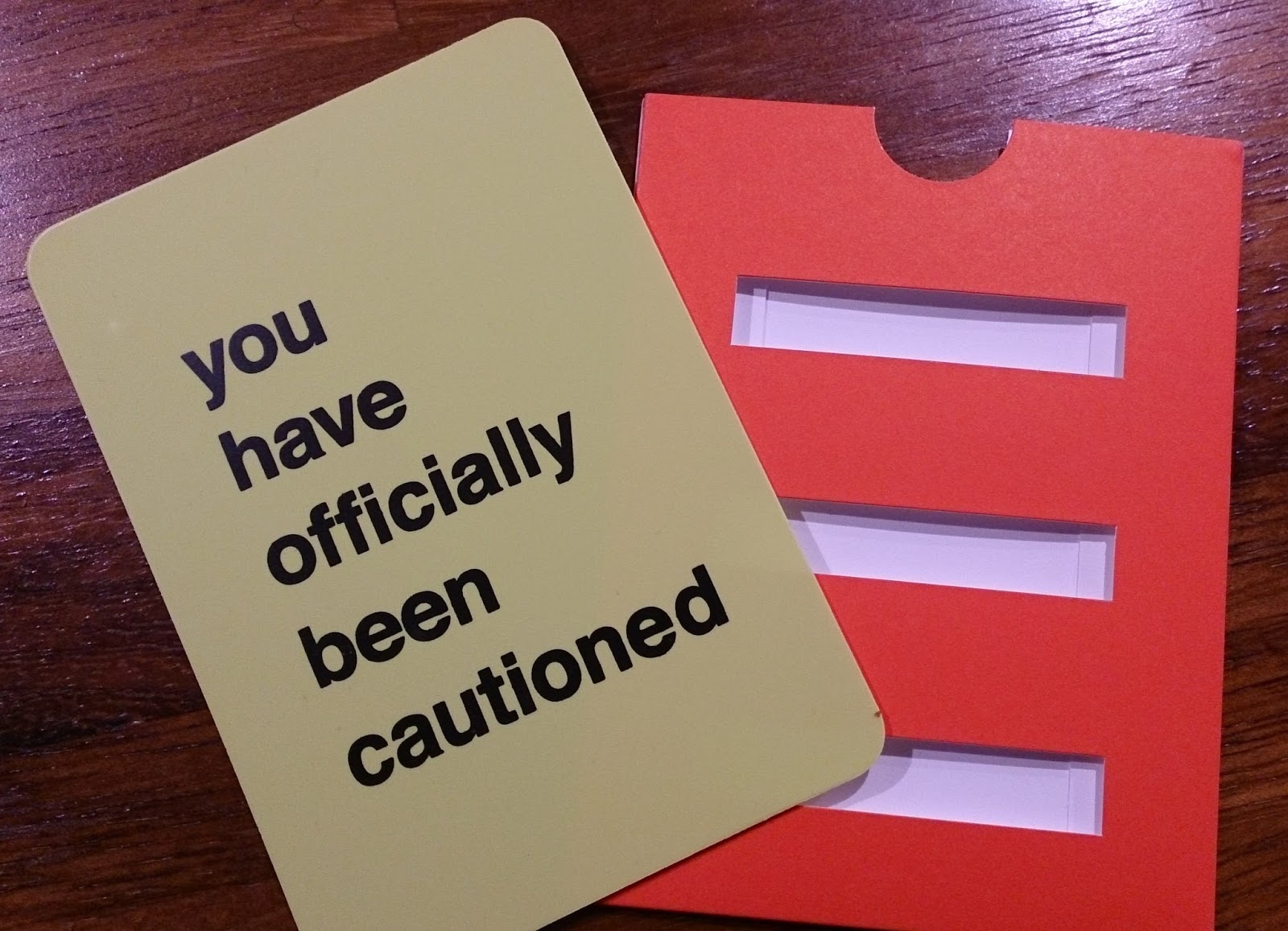
Update 3.2.16. At the re-arranged Partick Thistle vs Motherwell game last night the next in the Kingsford Capital Management sponsored art giveaways was handed out. I feel we are labouring the football theme here now as Jonathon Monk produced 2000 yellow cards to give out, housed in a red sleeve to give it that Thistle jersey look. The message on the back was clear
"It should be used in situations both on and off the pitch where you wish to advise others: A line has been crossed and caution is advised."
Those in the Jackie Husband Stand at Firhill for the match that followed got plenty of opportunity to wield our yellow cards at the ref. He dispensed them liberally to four Thistle players in the first half before being a wee bit reluctant to keep going with the cards with a couple of Motherwell's persistent offenders. Reminders were forthcoming from the stands.
Jonathon Monk designed Yellow Card
Jonathon Monk studied at Glasgow School of Art for a while and (prudently) in interviews states that he attended Firhill on occasion whilst here. Now based in Germany he works as a conceptual artist, which in essence can mean that the idea behind a piece of art is more important than the finished object. Jonathon Monk, consider yourself officially cautioned.
Kota Ezawa
Intended to be issued at the game against Aberdeen on February 19th, the next giveaway was distributed at the St Johnstone match on Tuesday night, 23rd February. The artist's work being presented to the Firhill faithful took the shape of a cushion. Kota Ezawa was born in Cologne in 1969, a German/Japanese artist who now lives and works in San Francisco. He uses images from popular culture, film, photographs and art history in his digital animations, collages, drawings and light boxes. Here, for example, is one of his video works, with the Beatles performing California Uber Alles
For Partick Thistle he has produced a cushion with an image based on Hokusai's 1830 woodblock print "Great Wave Off Kanagawa" on one side, a Thistle fan pictured holding it aloft on the reverse, in mid-Mexican wave pose.
Kota Ezawa designed cushions
As well as being a comfy addition to your seat, he states that he took inspiration from Glasgow's seafaring past, and the "Mexican wave" of sports fans around the globe.
"a German/Japanese artist living in America takes on a Japanese artist's print which can be used to energise a Scottish team made up of players from the United Kingdom, Sierra Leone, Guinea, Belgium, Ghana and the Czech Republic using a cheer called the Mexican Wave."
A statement of footballing internationalism, and a nice cushion to take home for your garden chair or caravan. Kota Ezawa seemed to have created a popular one here and the crowd gave the cushions all a wave for the photographer just before kick off, which will be an image I think will be worth seeing. With Thistle turning in a storming performance to beat St Johnstone 2-0 on the night, this is quickly going to be known as the "two-goal cushion".
An art collector at Firhill picks up his cushion, pie and Bovril
Martin Parr
Last home game of the season and last artist created giveaway from Partick Thistle. Until this point the five matches where free artworks were handed out netted Partick Thistle five clean sheets, five victories and fifteen points. With nothing to play for except pride on the last day of the season, that winning art run came to an end with a 2-2 draw against Hamilton Academicals on Saturday 14th May.
Partick Thistle team photo, by Martin Parr
Photographer and photojournalist Martin Parr is known for photographs that show the reality of many common situations, seeing people in their true environment. His photographs can document familiar corners of the modern world sometimes not noticed. He recently published a book with 30 years worth of photographs of himself taken at street photographers and photo booths from around the world, the kind of thing that you might see on holiday. The results are funny and slightly grotesque at the same time.
Instead of the traditional, clean cut team photo he has them set out in formation, standing in front of the shabbier old turnstiles. Nice to see the "Home Support" behind them though. Most impressive of all he seems to have got the players and coaches ready to do...the time warp....again....
I do like a bit of photography. I enjoy updating this blog as a way to foist some of my snaps off on the world. So it is nice to see the different perspective a non-sports photographer saw on his trip to Maryhill, and also to get a print by Martin Parr.
Team photo, 1991-92 edition
Art for art's sake
To me it seems that Partick Thistle and art are a good fit, but then again I would say that art is a good fit with all aspects of life. Unfortunately the Scottish Government do not see art budgets as a priority and arts organisations will face significant cuts as a result of last year's Scottish Budget. These cuts run the risk of making art in Scotland more elitist and less of a career opportunity for those who cannot fund themselves. On top of this, with the cuts to council budgets, it is a sure thing that more cuts to local organisations are going to come on top of those already announced. Regardless of this, art of one form or another either on or off of the field, will continue to flourish at Firhill. Now that they have given out artist produced scarves and footballs I am scratching my head to think what free giveaways could be offered next season (if there are to be any more). Maybe we need a Thistle bonnet, with some sort of message on it?
As Christmas approaches and we dust off Dickens's book A Christmas Carol for another read, I was left reflecting on what the arrangements in Glasgow were with regards to the workhouse, or as they were more commonly called in Scotland, the Poorhouse or Poor's Houses. Dickens wrote A Christmas Carol in 1843 and in it the themes he often comes back to are to the fore, particularly the need to provide for children in poverty, and the risks of them lacking education and falling into a life of crime. When the Ghost of Christmas Present shows Scrooge the two children huddled beneath his robe he tells him
"The boy is Ignorance. This girl is Want. Beware them both, and all of their degree, but most of all beware this boy, for on his brow I see that written which is Doom, unless the writing be erased"
The ghost throws back Scrooge's own words at him, as he earlier had ignored or failed to see the suffering of his fellow man. When he asks the ghost if they have no resources or refuge the ghost replies
" 'Are there no prisons' said the spirit turning on him for the last time with his own words. 'Are there no workhouses' "
The Deserving and Undeserving Poor
With Scotland having a separate legal system from the rest of the UK, our arrangements were slightly different from those of the Dickensian workhouses of London and Manchester. Some of the earliest Scottish Laws on poor relief were focused on a theme which the Conservative Party of today still seems to be putting at the centre of their policies, dividing people into the deserving and undeserving poor. A 1424 Act of the Scottish Parliament distinguished between able-bodied beggars and those not physically able to work for their living. The latter could be given a token by authorities allowing them to beg, whilst those deemed to be able-bodied beggars could be arrested and given 40 days to find work or face imprisonment. This seems rather chillingly like Ian Duncan Smith's benefits regime.
The liability of each parish to look after their "deserving poor" was made more formal in an Act of 1535. At this time Glasgow was a town of only 3000 people. Each parish had to now make collections to support their own elderly and infirm poor residents. The 1579 Act For The Punischment of Strang and Idle Beggars, and Reliefe of the Pure and Impotent and a further Act 20 years later shifted responsibility for poor relief to the churches. They could raise money from donations, collections, fees and rents and support those deemed powerless to help themselves. The "aged, impotent and pure people should have lodging and abiding places". The "strong beggars and their bairns" should be employed in "common work". The children of beggars could be taken by land-owners to do unpaid work until the age of 18 for girls and 24 for boys. Unpaid work in return for meagre support was a tool used later in the poorhouses too, and again, sadly, has been revived in our current system.
Town's Hospital and Poorhouse
By 1672 the idea of forcing the poor to work in order to live was stiffened with an Act which made magistrates build "correction houses" or workhouses where beggars could be detained and made to work. The Act of Union of 1707 joins Scotland to England but the Scottish legal system remains separate from the English system. Glasgow now had a population of around 15,000 people and was mainly centred around the High Street and cathedral area. In 1726 Daniel Defoe visited the city and described it as
"The cleanest and best-built city in Britain."
At this time 400 students were attending the University of Glasgow on the High Street, a university which was almost 300 years old by this time. In 1756 James Watt would be working here when he develped his ideas for the steam engine. During this period Tennents open a new brewery in the city, the Foulis brothers begin printing here and John Smith's bookshop opens. In 1731 it is decided that a workhouse is to be founded in the city. Known as the Town's Hospital and Poorhouse it was built on the north bank of the River Clyde, near to where Ropework Lane meets Clyde Street today. St Andrews Cathedral was built at a site west of it in 1816.
The Town's Hospital and Poorhouse in Glasgow was sited
just to the right of St Andrews Cathedral in this photo
Map from the 1700s showing location of the Town's Hospital on the Clydeside (click to expand)
Managed by directors representing in equal parts the local church parishes, the Trades Guild, the Merchants Guild and the elected town council it was designed to "aliment and educate upwards of 152 men, widows and orphans of the city". An infirmary block was later added at the rear with basement accommodation "for lunatics". A year after opening there were 60 old people and 91 children living here.
Town's Hospital, Glasgow
A later director of the Town's Hospital, Robert McNair, is credited with trying to improve the lot of the "insane folk" accommodated here. After he had raised the funding, a new "Glasgow Asylum for Lunatics" was built from 1810 and opened four years later. An 1888 book on Glasgow medical institutions reports that
"the heart of this good man was touched by the wretched condition of the insane folk, who at the beginning of the century, whatever their social condition, were kept in "the cells" at the Poorhouse at the banks of the Clyde; and, as improvement of the cells was impossible, he determined to procure for them better care and treatment elsewhere"
1845 Scottish Poor Law Act
A Commission of Enquiry established in 1843 into the poor relief system in Scotland found that relief organised at a parish level was being provided mainly to the ill, the physically and mentally infirm and the elderly. This report led to the 1845 Scottish Poor Law Act which maintained this organisational arrangement and introduced a new tier of supervision. Unlike the act in England, in Scotland the act allowed that relief could be given as cash or in kind. A poorhouse could be set up to shelter the sick and destitute, but those deemed able-bodied were excluded. After the new Act of 1845 provision of poor relief in Glasgow was divided into four parishes: City, Barony, Govan and Gorbals.
City
In 1841 the Glasgow Asylum for Lunatics was requiring more space, no longer able to expand in the rapidly growing city. They chose a new site, three miles west of the city, and built a new hospital which opened in 1843 as the Royal Asylum at Gartnavel. This consisted of "two separate houses, for the higher and lower class of patients respectively".
The Town's Hospital on the Clydeside was closed in 1845 and the city poorhouse was relocated to the vacated Glasgow Asylum building in the city centre. This became known as The Glasgow City Poorhouse (although as is always the way, it was also known to many still as the Town's Hospital). This meant that the City Poorhouse now had 1500 beds and was one of the largest institutions in Britain. Although it offered food and shelter for those with nowhere else to go, living conditions were maintained at a level that discouraged all but the most desperate. Anyone with living family was expected to seek support from them firstly. Males and females were separated, children were separated from their parents. Reports in the 1880s criticised the poor sanitation and the overcrowding at the institution. One report found that the 290 male residents shared just two baths to take their weekly bath, a process that took 12 hours to complete. You really wouldn't want to be near the end of the queue, would you? Disability of some type, mental or physical, was usually a requirement for admission to these institutions, so they were fitted with infirmary wings and a degree of medical support.
1882 Glasgow map showing location of the City Poorhouse (click to expand)
The City Poorhouse was on the north side of Parliamentary Road, which no longer exists. The alignment of roads around here has changed quite a bit, but this site, south-west of Dobbies Loan, is now roughly where Glasgow Caledonian University sits.
Glasgow Caledonian University now occupies
the site of the Glasgow City Poorhouse
Barony
The Barony parish of Glasgow was one of the most densely populated, although the City area had more prevalent poverty. It was located to the north and east of the city centre. Extending over an area of 14 square miles it had a population of almost 300,000 in 1845. In 1853 the poor board built Barnhill Poorhouse in Springburn which had beds for 160 people. It had hospital facilities on the site, which were extended in time with a nearby hospital built, which later was developed to become Stobhill Hospital. A report in 1885 at Barnhill Poorhouse found that
"The women in the washhouse still receive tea and bread in addition to class C diet - an unnecessary, and in some respects mischievous indulgence"
Able-bodied inmates here were obliged to make up to 350 bundles of firewood per day, or break 5cwt. of stones per day. Those not achieving this were put in solitary confinement and given a bread and water diet.
Site of Barnhill Poorhouse, Springburn (click to expand)
Under the 1845 Act, like other parishes, Barony was obliged to provide care and treatment for "lunatics" (as these people were called at the time). As they were no longer able to accommodate the increasing numbers requiring treatment in Barnhill Poorhouse, in 1871 Barony parish bought land at Woodilee, near Lenzie to build Barony Parochial Asylum, later known as Woodilee Hospital.
Plans for Woodilee Hospital, Lenzie (click to expand)
Govan and Gorbals
The Gorbals as an area with high deprivation struggled to raise adequate funds for poor relief and never established a poorhouse. In 1873 it was combined with Govan parish for this purpose. Prior to this they had been accommodating some of the poor of the Gorbals in Govan Poorhouse, which was built in 1852. This lay on the west side of Eglington Street, on the site of the former cavalry barracks, which lies roughly underneath the M74 extension now. Prior to that Govan had a poorhouse on Dale Street (now Tradeston Street). With demand rising a new site was found in Merryflatts. Built between 1867-1872 this consisted initially of a poorhouse, a hospital for 240 beds for medical, surgical and obstetric cases and a lunatic asylum for 180 people. As in other poorhouses the nurses were often unpaid and selected from the female residents of the poorhouse.
1912 map showing site of Govan Poorhouse (click to expand)
The map above shows the lay out of the Govan Poorhouse and asylum, which later was to become the Southern General Hospital. From 1902 major extensions added space for 700 more beds at Govan Poorhouse and in 1912 Govan became part of the Glasgow parish. In recent years the old wards at the Southern General Hospital have finally been closed down, with the building of the (so-called) Queen Elizabeth University Hospital here. The main poorhouse building can still be seen on the eastern side of the new hospital site.
Govan Poorhouse, Glasgow, with male and female wings either side of the central entrance.
Later it became the Southern General Hospital
New Queen Elizabeth University Hospital looming over the
old poorhouse/ Southern General wards
With the new hospital now open, most of the old buildings are being demolished
The excellent workhouses.org.uk website have trawled the 1881 census to find the names, ages and occupations of the residents of all the Glasgow poorhouses in that year. Follow the link here to see the names of the Govan Poorhouse inmates that year.
The 20th Century
In 1898 the City and Barony parishes merged to pull their resources. The new single poor law authority of Glasgow commissioned the building of three new establishments: Stobhill Hospital, The Eastern District Hospital and the Western District Hospital . In 1905 the City Poorhouse was closed and residents transferred to Barnhill Poorhouse. The hospital accommodation was now separate from the poorhouse facilities. In 1912 the Govan parish was also merged with Glasgow.
Stobhill Hospital was the largest of the new poor law hospitals, with nearly 1800 beds, 200 of which were for the management of patients with psychiatric problems. It consisted of 28 two-storey red brick blocks, many of which were linked by corridors over time. It was used to treat the chronically ill, needy children and the residents of the City and Barony areas with tuberculosis. Stobhill Hospital was used during the First World War for wounded servicemen, who arrived by train on a specially built platform in the hospital grounds.
Stobhill Hospital today, with its B-listed clock tower
There are still psychiatric wards at Stobhill Hospital today, and day care and out-patient facilities. The rest of the in-patient services have been transferred to other Glasgow hospitals.
The smaller Western District Hospital built from 1902-04 was also known as Oakbank Hospital. It was used for the treatment of acute medical and surgical cases. They also had a labour suite. It has now been demolished but lay at Garscube Cross, on a triangle of land between Possil Road, Garscube Road and the Forth and Clyde Canal.
Oakbank Hospital, Glasgow
It too was used by the military during the First World War. Bizarrely Muhammad Ali seems to have visited patients in Oakbank Hospital and signed autographs whilst he was in Glasgow in 1965 (then named Cassius Clay). It was closed in 1971 and demolished. This bit of land contains some shabby, modern industrial units now, some of them derelict.
Site today of the old Western District Hospital / Oakbank Hospital
Built at the same time was the Eastern District Hospital, usually referred to as Duke Street Hospital. It's grand sandstone entrance block on Duke Street is all that remains, most of the rest of the hospital site now being a car park for a branch of Lidl. When it opened in 1904 it was a 240 bed hospital, with some beds specifically for psychiatric assessment.
1912 map showing site of Eastern District Hospital on Duke Street (click to expand)
On the left, the remaining block of Duke Street Hospital
All of these poor law hospitals came under control of the municipal authorities in 1930, and were incorporated into the National Health Service, when it was formed in 1948. All services at Duke Street Hospital finally came to an end in 1996.
Requesting Poor Relief
The Mitchell Library in Glasgow has the records of all those who made a claim from the city under the Poor Law. I recently went there to look for any of my ancestors who had got into a position of having to claim poor relief. The records kept here show that the enquiries made into their claims went into a great deal of detail at times. They tried to establish the circumstances of the individual, and sought a lot of detail about family members, parentage, marriage and the income of relatives. To undertake a search here look for the names that you are interested in on the computers of the library's archive department on the 5th floor. The archivists can then retrieve the records of the individual's application for you to read.
I looked up the records on four of my relatives and on only one case were they judged to merit any assistance. The first relative that I found, Johanna, was 23 years old in 1891 when she was requesting help, as she had no means to support herself and her 1 year old son. The interview recorded that her husband had left her 2 weeks before and she had left Kilmarnock to reside with her parents in Govan. She was refused any relief on the grounds that she "Left husband". No matter the details of her situation, she was still expected to be supported by him or her parents.
Her family situation obviously did not improve as 19 years later in 1910 her son John, living with her in a flat in Ibrox, made a claim for poor relief. His claim was also rejected, as they found that a year previously he had been resident in Kyle Union Poorhouse in Ayr. It was therefore deemed that poorhouse liability for him lay with Ayr and he was advised to seek their support.
Next I looked at a claim by a 75 year old relative of mine in 1905. Margaret was living in Balshagray Avenue. Her husband had died 5 years earlier in the asylum in Ayr. Despite her age, the interview recorded her parents' occupations and the occupations of her deceased husband and of his parents. Fleshers, pithead enginemen and carriers, their job titles evoke the times they lived in. Her children and their occupations were documented too and her claim rejected as she was expected to seek support from her nearest son, who lived and worked in Lenzie.
Lastly I looked at the claim for support from William, aged 31, in November 1923. He was a "furniture packer" who it was reported, without much detail, had been unable to work for five weeks. His father, an engineer was dead and he was living with his mother, who had no other support, on Delburn Street, Parkhead. It was noted that he had been in the army for three and a half years (during the First World War) and when working was earning 20 shillings a week. He was granted 8 shillings a week but also referred to the Eastern District Hospital. A copy of a letter by the doctor who assessed him at the Eastern District Hospital was included in the file. In this brief letter which led to his detention in hospital, the doctor who signs it declares that "William...., is mental and is requiring hospital treatment." Not really the way doctors would describe someone today I hope, and no further details of William's illness are recorded.
Detained in 1923 for psychiatric treatment
He was treated in the Eastern District Hospital (Duke Street Hospital) for four weeks, before being transferred on Boxing Day 1923 to Woodilee Hospital. He was detained there for five more months before being released in May 1924, the case closed with the single word "Recovered". It is impossible to know what led to his illness, whether it was due to his war service or to other problems that he had, but these cases illustrate the hoops that people without means had to jump through to get help.
Bellgrove Hotel, Glasgow. Are poorhouses really a thing of the past?
I would like to say that we live in more enlightened times, but sadly reading about this and the way the poor were assessed and judged over the past 500 years does seem uncomfortably close to the language and system which we have in place today. Scrooge today can walk past those asking that we help the poor and demand
"Are there no foodbanks? Are there no fitness for work tests?"
NB. Can I heartily recommend that if you want to find out about old Glasgow hospitals a great place to start would be to read "The Medical Institutions of Glasgow. A Handbook" written in 1888, which is reproduced here.