Asylums in Glasgow - The Buildings Where Madness Was Managed
Over the past 200 hundred years the treatment available to people with mental health problems has changed dramatically. In Glasgow the buildings and institutions to lock up or look after these people has also changed. In the early 1800s "lunatics" would be locked up in their own sections of the poorhouse. Then huge asylums were built to house these people together, away from the rest of society.
Few medical treatments were available in the early days of the asylums but a more humane regime of management was reflected in the building throughout the 19th century of grand asylums on the outskirts of the city with their own land for outdoor sports, farming and gardening. In the 20th century new drug treatments became available, alongside ideas that we were making some people worse by locking them away, separate from the rest of society. So now the large Victorian asylums and mental hospitals have all but closed down in the past 20 years. Many of the buildings still stand, so I wanted to try and see where they were and find out a bit more about the history of the old Glasgow asylums before they vanish completely.
Early Care - "Madhouses"
Last December I wrote here about the poorhouses of Glasgow, the Scottish equivalent of the English workhouses. On reading up on this subject I looked into the story of my family members who had asked for help from the Poor Relief authorities. This led me to the story of a distant uncle who sought their help in 1923 when he was unable to work. After assessment at Duke Street Hospital, the doctor declared that he "is mental" and he spent 5 months in Woodilee Hospital before being released back home. This illustrated the overlapping roles of poorhouse institutions at that time with asylums; of mental illness and poverty.
The language used - asylum, madhouse, lunatic - now has negative and pejorative associations, but the words used reflected the ideas people had at the time. In the 17th and 18th century someone called mad or a lunatic could be suffering from a variety of problems. The management of these people involved detention, restraint and isolating them from the rest of society. The alternative was often otherwise for them to end up on the street if they did not have family who could look after them. The poorhouse became the place to keep elements of society seen as disruptive, those impoverished but physically or mentally unable to work. The early poorhouses of Glasgow usually had a section reserved "for lunatics" to use the language of the time. This described people who could be confused, violent, suffering from delusions, seizures, loss of memory or the ability to communicate, or from physical health problems causing mental impairment which nowadays could be treated, such as thyroid deficiency or end-stage syphilis.
Glasgow Magdalene Institution
Other people were purely locked up in asylums because they didn't fit in with the norms of society at the time - petty criminals, delinquents, or even women who had got pregnant out of wedlock. With the establishment of theGlasgow Magdalene Asylum in 1812 unmarried mothers, prostitutes and even women thought to dress immodestly were often taken here instead of the mental asylums, but not always. From 1859 this became the Magdalene Institution and in 1864 it moved to Lochburn Road in Maryhill, where it operated until as recently as 1958 when it was closed after a riot by the residents/inmates. It seems bizarre to think that as recently as this women were taken here and mistreated for having a lover, "trained" in the laundry there and often put into domestic service "or other respectable service" as their adverts put it, "rescued from a life of shame and restored to society".
In the early 18th century, when the population of Glasgow was reaching 15,000, it was decided that the city needed a hospital and poorhouse. On the north bank of the river Clyde the Town's Hospital and Poorhouse was built in 1731, close to where St Andrew's Cathedral now stands. "Lunatics" were held in cells in the basement, often chained up. Despite these basement cells often flooding from the Clyde this building served as the main poorhouse in the city centre for over 100 years.
The Town's Hospital and Poorhouse on the banks of the Clyde
One of the directors of the poorhouse, Robert McNair of Belvidere, for many years a collector of customs at Leith, decided to provide better accommodation for "the insane folk". A book of 1888 describes it like this.
"the heart of this good man was touched by the wretched condition of the insane folk, who at the beginning of the century, whatever their social condition, were kept in "the cells" at the Poorhouse at the banks of the Clyde; and, as improvement of the cells was impossible, he determined to procure for them better care and treatment elsewhere"
An important notion here is that rich and poor were having to endure the same conditions and throughout the 19th century care would have divisions on class. McNair raised £7000 and in 1810 the foundation stone was laid for The Glasgow Asylum for Lunatics which opened 4 years later in 1814. Ten years later they were given a Royal Charter and the name changed to The Glasgow Royal Asylum for Lunatics. This building was on a site located near to where Buchanan Street bus station now stands, on what was Parliamentary Road. On this map from 1830 you can see the cross-shaped "lunatic asylum" in empty land between Cowcaddens quarry and Dobbies Loan.
Map 1830 (click to expand)
1850s OS map
The Glasgow Royal Asylum for Lunatics provided separate wings for male and female patients and also patients could be separated by class with access to distinct airing courts to exercise in good weather, whilst being observed from staff within the building. In the 1814 regulations for staff (or "keepers" as they were called) they are forbidden "to strike or strive with a patient" or "to subject a patient to confinement, privation or punishment of any kind without express instructions from the physician or superintendent". The keepers are instructed to consider "the patients as utterly unable to restrain themselves, the keepers must forgive all sarcasms, and treat with equal tenderness those who give the most and those who give the least trouble".
The treatment was to consist of "harmless amusements, wholesome exercise, and useful labours". An 1816 report on the institution comments on the two looms for patients use, weaving and sewing are seen to be taking place whilst some patients write poetry or read to their fellow patients. The stated aim is "to remove from the Asylum, as much as possible, all appearance of a prison." One stated reason for this was to try and improve people's symptoms early, to avoid where possible the "accumulation of incurable cases".
A bowling green and billiard room were added to the facilities in 1819 and in 1820 the value of outdoor labour is discussed in the annual reports, with gardening recommended for gentleman patients. "Cottages and suites of apartments separate from the ordinary wards are to be provided for the high-class patients". Despite these wholesome sentiments it is clear that restraints and punishments are still part of the regime at this time, even if it is being limited to "only when instructed to by the physician". In the 1817 annual report an officer is thanked by the board "for inventing a leather muff which is better, and much less irksome than a strait waistcoat....it is more seemly than handcuffs of iron, and in cold weather less disagreeable". In the 1819 report it is reported that "rotatory motion, by means of a whirling chair, has of late been tried in a great number of cases, and in some of them, with wonderfully good effect".
The aims through all of this are stated as "moderating excitation and promoting convalescence".
Thomas Annan photograph from 1890s of the
Town's Hospital as the building was then known
As the city was expanding quickly in the 19th century there was no room at the city centre site to expand the facilities here. By the 1840s there were new ideas about how people with mental illness should be treated. In society at this time attitudes were changing. Just as slavery was being abolished, and people now saw these slaves as fellow humans due the same respect as others, more people realised that the "mad" were also fellow humans, to be treated with kindness and understanding rather than punishment. New asylums were built. The Town's Hospital and Poorhouse moved from the Clydeside into the Royal Asylum building on Parliamentary Road when it was vacated.
The Victorian Asylums
The old buildings proved inadequate for the type of treatments being devised for people with severe mental health problems in the 19th century and new facilities (or "asylums") were built. The poorhouses in the city at Barnhill (near what became Stobhill Hospital) and Govan (Southern General Hospital) continued to function as asylums at this time but the new idea was to build separate buildings each for lunatics, for the poor, for the physically sick and for infectious disease cases. An 1888 report on Glasgow hospitals describes the situation thus
"To prevent misapprehension regarding the provision for the insane poor in Scotland, it may be well to state that the majority are accommodated in the Royal and District Asylums. A portion of chronic and harmless insane occupy special wards in ordinary poorhouses....a considerable body reside with their relatives, while a large and steadily increasing number are boarded in specially licensed private houses, but not more than four under one guardian. This last arrangement is known as the Scottish boarding-out system, and does not exist in any other country."
The later built Eastern General Hospital (Duke Street Hospital) was designed for the acutely sick poor, but also had beds specifically for psychiatric assessment, a novel arrangement of 22 beds for mental observation cases. This was where my great uncle William was assessed for four weeks in the 1920s before being transferred to Woodilee. The theory at the time was that specifically designed buildings would help the patients, taking them away from their home environment which was often believed to be a causative factor in their presentation. The idea was to provide calm, rest, and work to keep people occupied. Staff usually lived in the grounds creating a feeling of community. Work could involve farming, gardening, preparing food from the grounds, sewing, even writing and art classes. The asylums were designed to be largely self-sufficient in food. Despite all this recovery rates were often low and although no longer as prominent as before, locked doors and restraint, such as straight jackets, were often still required.
The Glasgow Royal Lunatic Asylum, Gartnavel
In 1841 a new site was identified for The Glasgow Royal Lunatic Asylum and in 1843 the Royal Asylum at Gartnavel was opened. This Tudor Gothic building stood at the top of a small hill within 66 acres of "pleasure grounds". It consisted of two separate buildings, providing a building each for "higher and lower class of patients". As before there were separate wings for each gender. There were also several associated administrative buildings and a chapel built. For most of its history until the formation of the NHS in 1948 the hospital at Gartnavel housed mainly private patients, with those unable to pay sent to the Parochial Asylums such as Woodilee and Gartloch. In 1888 a report states that the Royal Asylum "accommodates 500 patients, at boards varying from the pauper rate to £400 a year or upwards, according to the accommodation, care, and service required".
Glasgow Royal Asyum from an 1888 book
From the opening as the Glasgow Asylum for Lunatics in 1814 until a report for the British Medical Association in 1888, the hospital states that it had treated 14,765 "insane patients". Of these it reports 6,476 (43% ) had been discharged as recovered. In the year of the report, 1887, they reported 45% of patients discharged as recovered and 5.5% of the residents under treatment having died at the hospital.
The west building at Gartnavel Royal as it is today.
No longer used for patients but houses Health Board administrative departments
A 1922 report for a later BMA meeting in Glasgow describes the Gartnavel hospital as becoming rather dated, though being in advance of its time when it was built "perhaps more institutional and concentrated than would be adopted now". At that time the 500 patients were paying rates of between £58 and £600 per annum. They describe the grounds in 1922 as containing a golf course, tennis courts, a croquet lawn and a curling pond.
In 1931, with evolving attitudes to treatment, the name was changed to the Glasgow Royal Mental Hospital, and in 1963 it became Gartnavel Royal Hospital. Gartnavel General Hospital was built in the grounds in 1968 with the loss of some sport and recreation amenities. In the 1960s there was still a piggery in the grounds for patients to work at. In 1953 after leaving the army, RD Laing started his psychiatry career here. He worked in wards at Gartnavel filled with long term patients, many labelled as having chronic schizophrenia. Their care provided little more than basic necessities, certainly little interaction from medical staff. He trialed some novel approaches here and published a paper in The Lancet in 1955 about dramatic improvements he saw in some patients managed differently, having a smaller group of nurses giving the patients continuity of care and more interaction. These experiments shaped his future, more radical ideas. He later worked at the Glasgow University academic psychiatry department based at the Southern General Hospital before heading to the Tavistock Hospital in London in 1956.
The old building at Gartnavel Royal with more
modern hospital buildings in the foreground
The west block of Gartnavel Royal is still used today, but now by administrative departments of Glasgow Health Board. Psychiatric in-patients are now housed in modern facilities in the hospital grounds which have been built over the past 15 years, with 117 beds. Since 2006 the eastern block has been closed. Boarded up and beginning to look a bit shabby and neglected, Glasgow's appalling record of allowing buildings to become dangerously abandoned and decayed until a mysterious fire requires their demolition must make the future of this building very uncertain.
Derelict eastern building of the old Glasgow Royal
Lunatic Asylum, Gartnavel Royal Hospital
Derelict eastern building of the old Glasgow Royal Lunatic Asylum, Gartnavel Royal Hospital
Woodilee Hospital
Under the Poor Law (Scotland) Act of 1845, the duty of providing care and treatment for "lunatics" passed to Parochial Boards. The Barony Parish of Glasgow was the most populous in Scotland, having to cater for almost 300,000 people. With growing demand the 150 beds at Barnhill Poorhouse were insufficient for the needs of the area. Opened in 1875 as the Barony Parochial Asylum, at Woodilee near Lenzie, this new asylum was the first asylum specifically built to house the lunatic residents of the poorhouses. With a capacity initially of 600 patients it was also sometimes known as The Glasgow District Asylum. Where Gartnavel had incorporated the most modern ideas in asylum design 30 years earlier, Woodilee was another step forward. The aim was to house "pauper lunatics" in the quiet and seclusion of the countryside. There were more comfortable day rooms, outdoor airing areas were not walled-in prison-style, and instead of long wings of sleeping areas these were broken up into smaller sections. The main treatments were still to involve rest, seclusion and work on the extensive surrounding grounds and farm areas. There were four farms here, on the 167 acres of land that were part of the hospital complex, plus almost 300 acres more land which the Parochial Board bought or leased nearby, largely to farm. Doors were not locked and after their work patients were allowed to wander in the grounds.
Architectural drawings for Barony Parochial Asylum (Woodilee Hospital)
The main building was 700 feet long, with a corridor running its entire length. Over the years a variety of other administrative and clinical buildings were added within the grounds. This old postcard below gives a sense of the scale of the complex, which is impossible to imagine now on visiting this area. About 1988 I spent a few weeks here as a student and remember it being an impressive and extensive complex of buildings, filled with dated furniture and fittings. With its grand Gothic buildings it did feel a bit "Arkham Asylum". It seems bizarre that none of this still stands.
Woodilee Hospital
In 1900 a villa, built to house "mentally deficient children", was added and by 1915 the hospital had 1300 beds. With the greater numbers the freedoms and activities patients previously enjoyed became greatly curtailed, although patients continued to work on the farms up until the 1960s. Like many other hospitals the introduction of effective medicines in the 1950s and 1960s changed the role of psychiatric hospitals. Many previously bed-ridden patients became able to mobilise and a bigger role for out-patient and voluntary treatment evolved.
Woodilee Hospital entrance
Derelict Woodilee Hospital in 2010 photo from lowmanio.co.uk
One of the few remaining old buildings integrated into the vast modern housing development that is "Woodilee Village"
In 1987 large parts of the hospital had to be closed after serious structural problems were identified. As more patients were discharged to other types of care, the hospital began closing in stages at this time and by 2001 it had closed completely.
A derelict building of Woodilee Hospital
"Woodilee Village" in 2016
Almost nothing stands of the fine French Gothic style buildings now. Two serious fires in the 1980s (YET AGAIN!) led to most of the building being demolished in 1990. Now developers continue to build modern housing on the vast lands the hospital stood on, and by the end of this process the housing will have increased the population of Lenzie by about 2000 people. Having previously visited Woodilee Hospital when it was still open I was entirely unable to orientate myself today in the jumble of housing developments thrown up as "Woodilee Village". It is a village of housing, no village shops, pub or post office appears to have been thought of as part of the development yet. Bizarrely the developers' website talks about the "tranquil Victorian village developed after 1842" but makes no mention of the asylum and its vast community that lived here for over 100 years. It seems such a shame to make no attempt to remember the lives of the people who formerly lived here. I found three very small bits of the old Victorian buildings of Woodilee Hospital still standing from all the vast complex that you can see on the postcard above.
Woodilee as it is today, a major private housing development
An old villa of Woodilee Hospital hiding amidst the new housing
Gartloch Hospital
Gartloch Hospital opened as Gartloch Asylum in 1896 near the village of Gartcosh, just east of Glasgow. 100 years later in 1996 it finally closed. Gartcosh was originally an agricultural village, which became know in the late 1800s for its ironworks and later steelworks. Gartloch Asylum was another asylum set in the countryside with patients/ residents engaged on farming the land attached to the asylum, an estate of 440 acres. It initially had 560 beds, half each for men and women. The land of Gartloch Estate was bought by Glasgow City Corporation for £8,600 for the "Glasgow District Lunacy Board" to build an asylum here.
Gartloch Asylum
The 1899 annual report for Gartloch asylum gives some details about the 203 admissions that year. 63 of them were re-admissions, 7 were aged over 70 and two over 85 years of age. They comment that because of their "frail and interfering ways (t)hey must be kept apart from the acute and excited cases."
Alcoholic intemperance is quoted as a significant contributing cause of insanity in 50 of the cases. "General paralysis" was the diagnosis in 18 cases, an insanity which occurs in end-stage syphilis. 44 cases were "boarded-out" in the year, to private homes as described above. 38 patients died in the asylum that year, of these 11 died from "general paralysis" and 7 from tuberculosis. Also of note "there were 11 escapes during the year."
Gartloch Hospital in 2006, photograph by Chris Upson
The later records from Gartloch Hospital held by Greater Glasgow and Clyde Health Board Archives give intriguing glimpses of some of the activities residents were involved in.
"Work, especially out-of-door employment on farm and garden, for men and women, has benefited many....Recreation and treatment go hand-in-hand, the grounds adjoining the Loch affording a delightful summer resort for suitable cases."
They also talk of "prolonged rest in bed" for acute cases, which sounds rather enforced, but does not share any detail. Titles of documents include numerous sports days, tug of war, cricket matches and football matches in the 1920s. There is mention of a 1920 cricket match between Pollock and Gartloch. Day trips to Loch Lubnaig, to the bowling green at Woodilee Hospital or curling on Bishop Loch are also mentioned.
In the early 20th century the role of the hospital and the buildings on the site were expanded, and a tuberculosis sanatorium was opened here, to take advantage of the cleaner air away from the city. The hospital capacity increased to over 900 patients at that time.
Like many other hospitals in the city it was converted into use as an Emergency Medical Services hospital during World War 2 with psychiatric patients moved to other hospitals in Glasgow (mainly Gartnavel Royal Hospital) or to temporary huts built in the grounds.
Since the hospital closed it has been a regular haunt of "urban explorers" clambering about inside the old buildings. Much of the land in the grounds have been re-developed as "Gartloch Village", a cluster of "luxury apartments" covering the land. There is now a significant amount of housing here and plans to expand it further, but as at "Woodilee Village" the housing has no other local amenities, no shops or doctors' surgeries and the narrow road through the countryside to Glasgow is the only way in or out. The main hospital building is listed, so the plan is not to demolish it. It is still awaiting redevelopment.
Main building of Gartloch Hospital in 2016
Again the developers website is heavy on the beautiful opportunities you will have if you buy a home here to engage with nature and walk in the nearby forests. So much of Gartloch Hospital still stands, most of it still awaiting development as housing, that they are unable to omit it from the marketing blurb in the way the developers at Woodilee have. Yet they seem a bit shy about saying what type of hospital it was. Not once is it mentioned that it was a psychiatric hospital, asylum or community of people with learning difficulties and mental health problems. Their bizarre version of the history of the site reads as follows...
"Glasgow based architects, Thomson & Sandiland subsequently won a competition to design a new hospital. It opened in 1896 and was immediately hailed as a Victorian architectural masterpiece. The hospital served the local community and returning war heroes in the decades that followed. Today as the custodians of Gartloch we are proud and privileged to reclaim the Victorian craftsmanship and surroundings for the benefit of future generations. "
The Derelict buildings of Gartloch Hospital
Rear of the main Gartloch Hospital building. November 2016
Gartloch Hospital, 2016
The derelict buildings of Gartloch Hospital, awaiting redevelopment in 2016
The derelict buildings of Gartloch Hospital, awaiting redevelopment in 2016
The derelict buildings of Gartloch Hospital, awaiting redevelopment in 2016
Gartloch Hospital, Golden Jubilee signage from 1977
Modern housing of "Gartloch Village" with the old hospital building overlooking it
Leverndale Hospital
As hospitals established separate provision for patients with mental health problems at the end of the 19th century several new asylums or hospitals were built. With a rapidly growing population Govan Parish was particularly struggling to accommodate their "lunatics" at the Merryflatts Poorhouse on Eglinton Street. In the 1870s the poorhouse was largely functioning as an asylum and having to turn many others away. When the population of the parish increased from 1871-1881 from 161,000 to 238,000 plans for a new asylum were drawn up. Eventually appropriate land was identified on Crookston Road. Built in 1893 and opened 2 years later, this Govan District Asylum later became known as the Hawkshead Asylum, then finally Leverndale Hospital, the name it has carried since 1964.
Water tower of Leverndale Hospital
Hawkshead Asylum opened with a capacity of 400 beds and in the early 20th century it accommodated over 500 patients, divided into "hospital" and "asylum" sections. The Govan Parochial Asylum at the Southern General site continued to function in the way Duke Street Hospital did for Woodilee, as an assessment and admission unit. In the 1970s a 120 psycho-geriatric unit was added and over the next 20 years patients were moved from the old asylum wards to new buildings on a lower part of the original site.
Old hospital building amidst the new housing developments
Although Leverndale Hospital still functions as a psychiatric hospital, the old buildings no longer house the hospital but have been sympathetically converted into modern housing with new buildings added on a similar scale to the old buildings. The distinctive water tower at the centre that can be seen from all around Crookston and Pollok has been maintained too. Of all the hospital sites I cycled around to get these photos, this seems to be the only one where the old buildings have been looked after and incorporated into the development, rather than left to decay or just swept away.
Whilst it is understandable that the Health Board has sold off much of the huge acres of land that the asylums were built on, it is land and property that was owned by all of us under the auspices of the NHS, now transferred wholesale to private developers. You can only sell it once, and then it is gone forever.
Lennox Castle Hospital
Lennox Castle Hospital, to the north of Glasgow, near Lennoxtown, was housed in an earlier building than those mentioned above, but it was from the 1930s that it became a psychiatric facility.
Built in the 1830s this large three story mansion was designed with castellated corner towers for John Lennox Kincaid. During World War I the mansion was requisitioned for use as a military hospital. In 1927 Glasgow Corporation bought the mansion and surrounding lands of 1,222 acres (for £25,000) with the aim of using it as a hospital for those with mental illness.
Lennox Castle Hospital
In 1936 it was officially opened as the "Lennox Castle Certified Institution of Mental Defectives". Twenty dormitory blocks were built in the grounds, to accommodate 1,200 patients. When the dormitories were completed the patients, who had temporarily been housed in the castle, were moved into them and the castle became the nurses home. There were also in the grounds 40 houses for married staff members, dining halls, kitchens, workshops, etc. This Open University video tour from an ex-nurse from the final days of the hospital gives an idea of the layout of the hospital. Apart from the castle building, all the buildings in this video have now been demolished.
During World War II the hospital was again used as a military hospital, with patients with mental health problems being re-housed in huts built on the site - many used for the next forty years. A maternity unit was also set up in the hospital from 1942 until 1964.
Lennox Castle, November 2016
With changes in the management of people with learning difficulties and mental health problems the hospital began to be closed in phases. The aim was to move patients away from institutionalised care to living in the community where possible. At this time many patients had spent their whole life until then in the hospital. The policy of "care in the community" has been criticised as a cost-cutting exercise. It also shifted care for many people with long term mental health problems and learning difficulties away from the NHS, into the hands of private care companies bringing market economics to an area of public healthcare. However, when done properly, for many of the patients the move out of a hospital environment did greatly improve their quality of life and expand their world. Lennox Castle Hospital finally closed in 2002.
Lennox Castle, November 2016, disappearing into the forest
Lennox Castle, November 2016
Two years after closing only the original mansion building was still standing as the land was cleared by developers, knocking down all the other hospital buildings. In 2007 Celtic Football Club opened their new team training facilities on the land and property developers have been building housing on other sections of the land. In 2008 one of those mysterious Glasgow fires, that happen to break out in old, disused buildings which are expensive to maintain, caused extensive damage to the old building. What was once so grand, this 175 year old mansion is now little more than a shell.
Lennox Castle, November 2016, with extensive fire damage
Lennox Castle, November 2016, with extensive fire damage
Former gardens for patients now vanishing among the trees
"Campsie View" housing development on the land of Lennox Castle Hospital
Celtic Football Club Lennoxtown training facilities
on the land of the former Lennox Castle Hospital
Dykebar Hospital
Although Dykebar Hospital is a little way from Glasgow, on what was then a rural setting on the outskirts of Paisley, I have included it here as it being closed down in stages at present, much as happened in the other old asylums and psychiatric hospitals of the West of Scotland over the past two decades.
It opened in 1909 as the District Asylum for Renfrew Lunacy District. Paisley and Johnstone had their asylum at Riccartsbar, and Greenock an asylum at Smithston, now Ravenscraig. A central administrative wing and 2 villas for men and 2 villas for women were built. Further buildings were soon added due to overcrowding. Along with store buildings, a laundry, kitchen, a superintendent's house, workshops, nurses' homes and a mortuary an asylum complex soon grew up like a self-contained village with associated farmland. Around 300 patients lived here at this time and, as at other asylums, the aim was to create a feeling of community. The earliest patients were employed in putting the grounds in order, and then later residents worked on the neighbouring fields raising cows, pigs and poultry, growing turnips, potatoes, a vegetable garden, glasshouses and potting sheds. They also built and looked after a bowling green, tennis courts and a birdhouse.
Buildings at Dykebar Hospital
During World War I residents were moved to other institutions when it was used as a war hospital, except for some patients kept on to run the farm. During the Second World War whilst other hospitals were used as emergency hospitals, their residents were transferred to Dykebar. When it came under control of the newly formed NHS in 1948 the asylum took the name of Dykebar Hospital and the facilities were upgraded. A modern unit was added in 1975 to accommodate psycho-geriatric patients and other amenities and in that year with the closure of Riccartsbar, the patients from there were transferred to Dykebar.
Boarded up wards at Dykebar Hospital
1970s buildings now closed at Dykebar Hospital
Buildings at Dykebar Hospital
At present the hospital has a variety of buildings still in use and others which are boarded up, and at times have been vandalised. Even some of the modern buildings are being closed down as less patients are treated in hospital and the emphasis shifts to treating people at home, or managing psycho-geriatric cases in nursing homes in the private sector. Again this is a part of healthcare that was previously in the hands of the NHS, but now is largely taking place in nursing homes, with means-testing to see how much you have to pay to get the care that you need.
Other psychiatric hospitals of Glasgow and surrounding areas that I didn't manage to get to...
Technically the only new psychiatric hospital built in Scotland in the 20th century is Parkhead Hospital. It opened in 1988, on the same day as a Celtic v Rangers game at nearby Celtic Park. This was required due to the closure of Gartloch Hospital and the psychiatric wards at Duke Street Hospital. In-patient psychiatric wards are also present at Stobhill Hospital, Gartnavel Royal Hospital and Leverndale Hospital in the city.
Nothing survives of Stoneyetts Hospital, Moodiesburn which was open from 1913 - 1992, initially as Stoneyetts Certified Institution for Mental Defectives.
The impressive clock tower buildings of Hartwood Hospital still stand in the village of that name, in North Lanarkshire, although much damage has been done by two fires in the last 10 years.
Summary
I wanted to take a brief look at the buildings in and around Glasgow that have housed people with mental health problems over the past three centuries. Looking at the bricks and mortar doesn't really tell you what life was like for individuals living in these institutions, and everyone's story and experiences are different. The stigma that many people still feel surrounding mental health problems may in part be due to the way people have been treated in the past, from being chained up in prison like conditions, to being held in remote, out of town asylums - out of sight and out of mind. The stigma and fear of the past still seems to linger, as can be seen by the way property developers trying to sell houses on the land of former asylums are coy about mentioning the real history of these sites. Only by paying attention to mistakes from the past can people avoid making the same mistakes in the future.
As Christmas approaches and we dust off Dickens's book A Christmas Carol for another read, I was left reflecting on what the arrangements in Glasgow were with regards to the workhouse, or as they were more commonly called in Scotland, the Poorhouse or Poor's Houses. Dickens wrote A Christmas Carol in 1843 and in it the themes he often comes back to are to the fore, particularly the need to provide for children in poverty, and the risks of them lacking education and falling into a life of crime. When the Ghost of Christmas Present shows Scrooge the two children huddled beneath his robe he tells him
"The boy is Ignorance. This girl is Want. Beware them both, and all of their degree, but most of all beware this boy, for on his brow I see that written which is Doom, unless the writing be erased"
The ghost throws back Scrooge's own words at him, as he earlier had ignored or failed to see the suffering of his fellow man. When he asks the ghost if they have no resources or refuge the ghost replies
" 'Are there no prisons' said the spirit turning on him for the last time with his own words. 'Are there no workhouses' "
The Deserving and Undeserving Poor
With Scotland having a separate legal system from the rest of the UK, our arrangements were slightly different from those of the Dickensian workhouses of London and Manchester. Some of the earliest Scottish Laws on poor relief were focused on a theme which the Conservative Party of today still seems to be putting at the centre of their policies, dividing people into the deserving and undeserving poor. A 1424 Act of the Scottish Parliament distinguished between able-bodied beggars and those not physically able to work for their living. The latter could be given a token by authorities allowing them to beg, whilst those deemed to be able-bodied beggars could be arrested and given 40 days to find work or face imprisonment. This seems rather chillingly like Ian Duncan Smith's benefits regime.
The liability of each parish to look after their "deserving poor" was made more formal in an Act of 1535. At this time Glasgow was a town of only 3000 people. Each parish had to now make collections to support their own elderly and infirm poor residents. The 1579 Act For The Punischment of Strang and Idle Beggars, and Reliefe of the Pure and Impotent and a further Act 20 years later shifted responsibility for poor relief to the churches. They could raise money from donations, collections, fees and rents and support those deemed powerless to help themselves. The "aged, impotent and pure people should have lodging and abiding places". The "strong beggars and their bairns" should be employed in "common work". The children of beggars could be taken by land-owners to do unpaid work until the age of 18 for girls and 24 for boys. Unpaid work in return for meagre support was a tool used later in the poorhouses too, and again, sadly, has been revived in our current system.
Town's Hospital and Poorhouse
By 1672 the idea of forcing the poor to work in order to live was stiffened with an Act which made magistrates build "correction houses" or workhouses where beggars could be detained and made to work. The Act of Union of 1707 joins Scotland to England but the Scottish legal system remains separate from the English system. Glasgow now had a population of around 15,000 people and was mainly centred around the High Street and cathedral area. In 1726 Daniel Defoe visited the city and described it as
"The cleanest and best-built city in Britain."
At this time 400 students were attending the University of Glasgow on the High Street, a university which was almost 300 years old by this time. In 1756 James Watt would be working here when he develped his ideas for the steam engine. During this period Tennents open a new brewery in the city, the Foulis brothers begin printing here and John Smith's bookshop opens. In 1731 it is decided that a workhouse is to be founded in the city. Known as the Town's Hospital and Poorhouse it was built on the north bank of the River Clyde, near to where Ropework Lane meets Clyde Street today. St Andrews Cathedral was built at a site west of it in 1816.
The Town's Hospital and Poorhouse in Glasgow was sited
just to the right of St Andrews Cathedral in this photo
Map from the 1700s showing location of the Town's Hospital on the Clydeside (click to expand)
Managed by directors representing in equal parts the local church parishes, the Trades Guild, the Merchants Guild and the elected town council it was designed to "aliment and educate upwards of 152 men, widows and orphans of the city". An infirmary block was later added at the rear with basement accommodation "for lunatics". A year after opening there were 60 old people and 91 children living here.
Town's Hospital, Glasgow
A later director of the Town's Hospital, Robert McNair, is credited with trying to improve the lot of the "insane folk" accommodated here. After he had raised the funding, a new "Glasgow Asylum for Lunatics" was built from 1810 and opened four years later. An 1888 book on Glasgow medical institutions reports that
"the heart of this good man was touched by the wretched condition of the insane folk, who at the beginning of the century, whatever their social condition, were kept in "the cells" at the Poorhouse at the banks of the Clyde; and, as improvement of the cells was impossible, he determined to procure for them better care and treatment elsewhere"
1845 Scottish Poor Law Act
A Commission of Enquiry established in 1843 into the poor relief system in Scotland found that relief organised at a parish level was being provided mainly to the ill, the physically and mentally infirm and the elderly. This report led to the 1845 Scottish Poor Law Act which maintained this organisational arrangement and introduced a new tier of supervision. Unlike the act in England, in Scotland the act allowed that relief could be given as cash or in kind. A poorhouse could be set up to shelter the sick and destitute, but those deemed able-bodied were excluded. After the new Act of 1845 provision of poor relief in Glasgow was divided into four parishes: City, Barony, Govan and Gorbals.
City
In 1841 the Glasgow Asylum for Lunatics was requiring more space, no longer able to expand in the rapidly growing city. They chose a new site, three miles west of the city, and built a new hospital which opened in 1843 as the Royal Asylum at Gartnavel. This consisted of "two separate houses, for the higher and lower class of patients respectively".
The Town's Hospital on the Clydeside was closed in 1845 and the city poorhouse was relocated to the vacated Glasgow Asylum building in the city centre. This became known as The Glasgow City Poorhouse (although as is always the way, it was also known to many still as the Town's Hospital). This meant that the City Poorhouse now had 1500 beds and was one of the largest institutions in Britain. Although it offered food and shelter for those with nowhere else to go, living conditions were maintained at a level that discouraged all but the most desperate. Anyone with living family was expected to seek support from them firstly. Males and females were separated, children were separated from their parents. Reports in the 1880s criticised the poor sanitation and the overcrowding at the institution. One report found that the 290 male residents shared just two baths to take their weekly bath, a process that took 12 hours to complete. You really wouldn't want to be near the end of the queue, would you? Disability of some type, mental or physical, was usually a requirement for admission to these institutions, so they were fitted with infirmary wings and a degree of medical support.
1882 Glasgow map showing location of the City Poorhouse (click to expand)
The City Poorhouse was on the north side of Parliamentary Road, which no longer exists. The alignment of roads around here has changed quite a bit, but this site, south-west of Dobbies Loan, is now roughly where Glasgow Caledonian University sits.
Glasgow Caledonian University now occupies
the site of the Glasgow City Poorhouse
Barony
The Barony parish of Glasgow was one of the most densely populated, although the City area had more prevalent poverty. It was located to the north and east of the city centre. Extending over an area of 14 square miles it had a population of almost 300,000 in 1845. In 1853 the poor board built Barnhill Poorhouse in Springburn which had beds for 160 people. It had hospital facilities on the site, which were extended in time with a nearby hospital built, which later was developed to become Stobhill Hospital. A report in 1885 at Barnhill Poorhouse found that
"The women in the washhouse still receive tea and bread in addition to class C diet - an unnecessary, and in some respects mischievous indulgence"
Able-bodied inmates here were obliged to make up to 350 bundles of firewood per day, or break 5cwt. of stones per day. Those not achieving this were put in solitary confinement and given a bread and water diet.
Site of Barnhill Poorhouse, Springburn (click to expand)
Under the 1845 Act, like other parishes, Barony was obliged to provide care and treatment for "lunatics" (as these people were called at the time). As they were no longer able to accommodate the increasing numbers requiring treatment in Barnhill Poorhouse, in 1871 Barony parish bought land at Woodilee, near Lenzie to build Barony Parochial Asylum, later known as Woodilee Hospital.
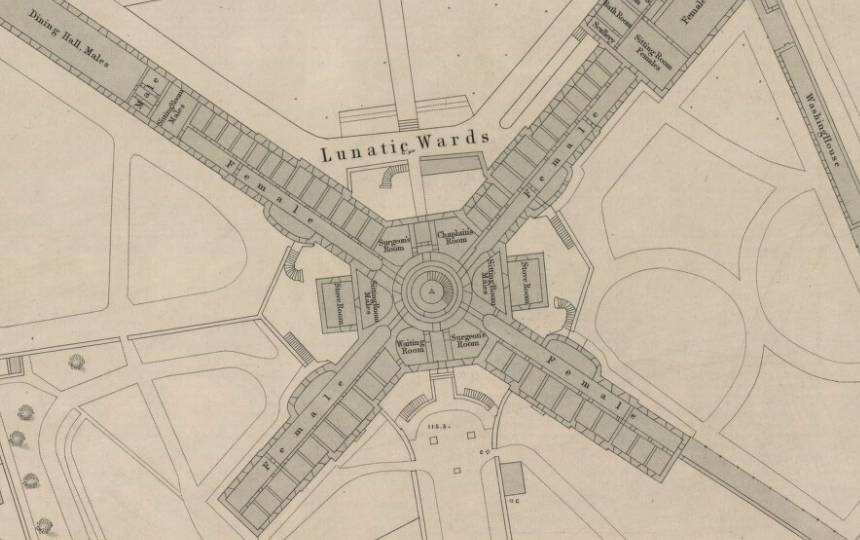
Plans for Woodilee Hospital, Lenzie (click to expand)
Govan and Gorbals
The Gorbals as an area with high deprivation struggled to raise adequate funds for poor relief and never established a poorhouse. In 1873 it was combined with Govan parish for this purpose. Prior to this they had been accommodating some of the poor of the Gorbals in Govan Poorhouse, which was built in 1852. This lay on the west side of Eglington Street, on the site of the former cavalry barracks, which lies roughly underneath the M74 extension now. Prior to that Govan had a poorhouse on Dale Street (now Tradeston Street). With demand rising a new site was found in Merryflatts. Built between 1867-1872 this consisted initially of a poorhouse, a hospital for 240 beds for medical, surgical and obstetric cases and a lunatic asylum for 180 people. As in other poorhouses the nurses were often unpaid and selected from the female residents of the poorhouse.
1912 map showing site of Govan Poorhouse (click to expand)
The map above shows the lay out of the Govan Poorhouse and asylum, which later was to become the Southern General Hospital. From 1902 major extensions added space for 700 more beds at Govan Poorhouse and in 1912 Govan became part of the Glasgow parish. In recent years the old wards at the Southern General Hospital have finally been closed down, with the building of the (so-called) Queen Elizabeth University Hospital here. The main poorhouse building can still be seen on the eastern side of the new hospital site.
Govan Poorhouse, Glasgow, with male and female wings either side of the central entrance.
Later it became the Southern General Hospital
New Queen Elizabeth University Hospital looming over the
old poorhouse/ Southern General wards
With the new hospital now open, most of the old buildings are being demolished
The excellent workhouses.org.uk website have trawled the 1881 census to find the names, ages and occupations of the residents of all the Glasgow poorhouses in that year. Follow the link here to see the names of the Govan Poorhouse inmates that year.
The 20th Century
In 1898 the City and Barony parishes merged to pull their resources. The new single poor law authority of Glasgow commissioned the building of three new establishments: Stobhill Hospital, The Eastern District Hospital and the Western District Hospital . In 1905 the City Poorhouse was closed and residents transferred to Barnhill Poorhouse. The hospital accommodation was now separate from the poorhouse facilities. In 1912 the Govan parish was also merged with Glasgow.
Stobhill Hospital was the largest of the new poor law hospitals, with nearly 1800 beds, 200 of which were for the management of patients with psychiatric problems. It consisted of 28 two-storey red brick blocks, many of which were linked by corridors over time. It was used to treat the chronically ill, needy children and the residents of the City and Barony areas with tuberculosis. Stobhill Hospital was used during the First World War for wounded servicemen, who arrived by train on a specially built platform in the hospital grounds.
Stobhill Hospital today, with its B-listed clock tower
There are still psychiatric wards at Stobhill Hospital today, and day care and out-patient facilities. The rest of the in-patient services have been transferred to other Glasgow hospitals.
The smaller Western District Hospital built from 1902-04 was also known as Oakbank Hospital. It was used for the treatment of acute medical and surgical cases. They also had a labour suite. It has now been demolished but lay at Garscube Cross, on a triangle of land between Possil Road, Garscube Road and the Forth and Clyde Canal.
Oakbank Hospital, Glasgow
It too was used by the military during the First World War. Bizarrely Muhammad Ali seems to have visited patients in Oakbank Hospital and signed autographs whilst he was in Glasgow in 1965 (then named Cassius Clay). It was closed in 1971 and demolished. This bit of land contains some shabby, modern industrial units now, some of them derelict.
Site today of the old Western District Hospital / Oakbank Hospital
Built at the same time was the Eastern District Hospital, usually referred to as Duke Street Hospital. It's grand sandstone entrance block on Duke Street is all that remains, most of the rest of the hospital site now being a car park for a branch of Lidl. When it opened in 1904 it was a 240 bed hospital, with some beds specifically for psychiatric assessment.
1912 map showing site of Eastern District Hospital on Duke Street (click to expand)
On the left, the remaining block of Duke Street Hospital
All of these poor law hospitals came under control of the municipal authorities in 1930, and were incorporated into the National Health Service, when it was formed in 1948. All services at Duke Street Hospital finally came to an end in 1996.
Requesting Poor Relief
The Mitchell Library in Glasgow has the records of all those who made a claim from the city under the Poor Law. I recently went there to look for any of my ancestors who had got into a position of having to claim poor relief. The records kept here show that the enquiries made into their claims went into a great deal of detail at times. They tried to establish the circumstances of the individual, and sought a lot of detail about family members, parentage, marriage and the income of relatives. To undertake a search here look for the names that you are interested in on the computers of the library's archive department on the 5th floor. The archivists can then retrieve the records of the individual's application for you to read.
I looked up the records on four of my relatives and on only one case were they judged to merit any assistance. The first relative that I found, Johanna, was 23 years old in 1891 when she was requesting help, as she had no means to support herself and her 1 year old son. The interview recorded that her husband had left her 2 weeks before and she had left Kilmarnock to reside with her parents in Govan. She was refused any relief on the grounds that she "Left husband". No matter the details of her situation, she was still expected to be supported by him or her parents.
Her family situation obviously did not improve as 19 years later in 1910 her son John, living with her in a flat in Ibrox, made a claim for poor relief. His claim was also rejected, as they found that a year previously he had been resident in Kyle Union Poorhouse in Ayr. It was therefore deemed that poorhouse liability for him lay with Ayr and he was advised to seek their support.
Next I looked at a claim by a 75 year old relative of mine in 1905. Margaret was living in Balshagray Avenue. Her husband had died 5 years earlier in the asylum in Ayr. Despite her age, the interview recorded her parents' occupations and the occupations of her deceased husband and of his parents. Fleshers, pithead enginemen and carriers, their job titles evoke the times they lived in. Her children and their occupations were documented too and her claim rejected as she was expected to seek support from her nearest son, who lived and worked in Lenzie.
Lastly I looked at the claim for support from William, aged 31, in November 1923. He was a "furniture packer" who it was reported, without much detail, had been unable to work for five weeks. His father, an engineer was dead and he was living with his mother, who had no other support, on Delburn Street, Parkhead. It was noted that he had been in the army for three and a half years (during the First World War) and when working was earning 20 shillings a week. He was granted 8 shillings a week but also referred to the Eastern District Hospital. A copy of a letter by the doctor who assessed him at the Eastern District Hospital was included in the file. In this brief letter which led to his detention in hospital, the doctor who signs it declares that "William...., is mental and is requiring hospital treatment." Not really the way doctors would describe someone today I hope, and no further details of William's illness are recorded.
Detained in 1923 for psychiatric treatment
He was treated in the Eastern District Hospital (Duke Street Hospital) for four weeks, before being transferred on Boxing Day 1923 to Woodilee Hospital. He was detained there for five more months before being released in May 1924, the case closed with the single word "Recovered". It is impossible to know what led to his illness, whether it was due to his war service or to other problems that he had, but these cases illustrate the hoops that people without means had to jump through to get help.
Bellgrove Hotel, Glasgow. Are poorhouses really a thing of the past?
I would like to say that we live in more enlightened times, but sadly reading about this and the way the poor were assessed and judged over the past 500 years does seem uncomfortably close to the language and system which we have in place today. Scrooge today can walk past those asking that we help the poor and demand
"Are there no foodbanks? Are there no fitness for work tests?"
NB. Can I heartily recommend that if you want to find out about old Glasgow hospitals a great place to start would be to read "The Medical Institutions of Glasgow. A Handbook" written in 1888, which is reproduced here.