Monday, 23 June 2014

Glasgow Commonwealth Games Venues - update

Last September I jogged a couple of routes around the Commonwealth Games venues as they were being made ready for the competition arriving in town. You can see what I found here and here. That was 9 months ago ad with the games starting next month it has clear that there has been a lot of changes since then. One thing which is noticeable in Glasgow is that all the fence painting, grass cutting, gap site tidying and road line painting that has been annoyingly neglected by the council for several years has been hastily sorted out as the city gets itself "dressed" for the expected arrival of visitors to the events. The council have described this as "getting the house tidy for visitors arriving" but I am kind of in the habit of keeping my house tidy for myself and fellow residents. Perhaps they could think about that. By all accounts the venues are coming together on time (if not exactly on budget).

George Square Glasgow
George Square has been fitted out with a giant Commonwealth Games logo, which seems to attract a steady stream of tourists with their cameras. When I passed it in a taxi around midnight the other night it also had a gaggle of late night revelers sitting atop it, so I do hope it has been built to withstand a bit of rough and tumble. Just beside it the council have erected another of their big tents in George Square. I really do not understand why they do this. George Square can present a dramatic open vista for visitors and lunchtime office workers, a public civic space which is endlessly obscured beneath commercial ventures and funfairs. The current building is to be a Commonwealth Games Superstore, but with all the numerous empty shops in the city centre and the planned event space on Glasgow Green I really struggle to see what benefits there are to the city in shoving this ugly temporary building in this position.

City Chambers at George Square obscured by a big shop
Another part of the city which has been dressed up for the games is the Kelvingrove bandstand. This 90 year old structure had fallen into disrepair but a successful campaign to raise the funds for renovation has led to it re-opening last month after refurbishment. During the games there will be regular cultural events held here, from concerts by Belle and Sebastian to screenings of Gregory's Girl. I was there last week at the Glasgow Mela and it was lovely to be again sitting in its amphitheatre enjoying the music and dancing.

Kelvingrove Bandstand
The bandstand is in Kelvingrove Park, beside Kelvingrove Art Galleries and Museum and the site of the lawn bowls competition in the Commonwealth Games. The city is full bowls clubs (this was my attempt to find as many as I could within a couple of miles of my front door) and this is presumably one event it was easy to shift tickets for. They have refurbished the greens which have stood for many years beside the Art Gallery building and are now installing temporary stands, although you can still access the greens and play on them free of charge at present if you so desire.


Fencing and temporary stands being put in place at Kelvingrove bowls venue
 The stands mean that the usual access road on Kelvin Way to the Art Galleries car park is closed, and it can now be accessed via Dumbarton Road.

Despite the Scotstoun Sports Campus being the home to Glasgow Warriors rugby team and the Scottish National Badminton Academy, neither the rugby 7s nor the badminton events are being held here. However the table tennis and squash competitions will take place here. The use of a temporary structure to house the squash show courts has proven controversial, criticised for the lack of "legacy", not leaving Glasgow with a venue to host international competitions in future. This temporary building which has landed on the main astroturf football pitch at Scotstoun, is huge. There has also been the rebuilding of six permanent squash courts at Scotstoun which will still be left behind after the games, but this does seem like an expensive missed opportunity.


Temporary structure at Scotstoun, opposite the badminton academy

Scotstoun Sports Campus

On my previous blog, when I visited Scotstoun I had taken a misty-eyed photo of the old crazy golf course in Victoria Park, just beside Scotstoun Showgrounds. In September this was all crumbling, nostalgic and quaint. Now, as part of Glasgow "tidying the house" it has been bulldozed and landscaped. Limmy may note that some of the fences here have actually been painted and diggers were in giving the run down playpark a bit of a facelift today.


Victoria Park, site of the crazy golf event c.1978

Next I ran through the Clyde Tunnel to visit the site of the Rugby Sevens competition, Ibrox Stadium. Presumably the financially straitened football club that resides here must feel that they've won a watch being able to rent out the old place, built in 1899, over the summer. It is a venue which is going to need little more than a swap of the goalposts and a bit of line painting inside. Outside today there were construction workers erecting security fencing around the place, whether as protection for the Ibrox board members or for the Commonwealth Games wasn't entirely clear. 


Ibrox Staduim, Glasgow

Back across the river and you pass some newly laid out roads between Ibrox and the BBC and STV buildings, there is also the new Premier Inn on the Clydeside here, open in time for the summer. There are cultural events being held on the Quayside at the Science Centre and organised by the BBC here, but across the river Clyde we come to the next sporting venues. Described on the Games website as the SECC Precinct we have the The Scottish Exhibition and Conference Centre, the Hydro and the "Armadillo" - Clyde Auditorium. This area will host the gymnastics, netball, weight-lifting, boxing, judo and wrestling. The media centre for the Games will be based here and I presume the white tents being built in the car park is the site for this. Like other venues it is in the process of getting ringed in security fencing, which has narrowed down the part of the pavement that I regularly jog along to get down to the Clydeside. 

The Scottish Exhibition and Conference Centre (SECC)

The Scottish Exhibition and Conference Centre (SECC) and new fencing emerging

The Armadillo (Clyde Auditorium) and SSE Hydro buildings

The Hydro is a 13,000 capacity arena which opened in September 2013 and has seen continuous use with concerts and the like ever since. Last night Eric Clapton was playing there, but only managed half a show before storming off in the huff apparently.

Another huddle of venues is to be found in the east end of the city. Glasgow Green is to host a variety of cultural events, opening and closing ceremony parties, as well as start and finish lines for the marathon, cycling time trial and cycling road races.Fences are at present being erected on the Green around the People's Palace area as they get ready. At the eastern end of Glasgow Green lies the Glasgow National Hockey Centre, two synthetic pitches built specifically for the Games and now the headquarters for Scottish Hockey. In the picture below it is now surrounded in fencing and more resembles a building site at present than anything else.

National Hockey Centre, Glasgow
Running around here today it is clear that there has been a lot of landscaping and turfing going on. Shabby gap sites which have been tolerated by the city council for decades are being smartened up.
Tidied up gap site near Glasgow Cross

Turfing and landscping at Dalmarnock train station

Celtic Park will host the Games Opening Ceremony on 23rd July 2014. The home of Celtic Football team since 1892. It was curiously picked by the SPFL as the venue for their opening game of the new football season on the 9th of August between Celtic and Partick Thistle. Predictably Celtic have decided it is too early to get the pitch ready for football. So this game has been postponed, which seems an avoidable hassle for Partick Thistle fans like me. The approach road to Celtic Park has a had a long overdue facelift, becoming the Celtic Way, it would appear.

Celtic Park
Across the road from Celtic Park is the new Chris Hoy Velodrome and Emirates Arena. This will host the track cycling and badminton events. I have been to see the UK Championships badminton tournament here and when Scottish competitors were playing a great atmosphere was generated.

Athletes' Village fenced in

The athlete's village is also alongside here, creating housing in an area which has been for decades a bit of a post-industrial wasteland. This hasn't gone without controversy as some people were unhappy with the forced evictions and demolitions that occurred here, and the security fencing being erected is causing access difficulties for many local residents. However I think most people will agree that this infrastructure investment will be one of the positive results from the Games. I worry though that we are making the same mistakes as previous generations in building houses first without creating employment or schools and corner shops for the future residents. Unemployment rates in the east end of Glasgow are as high as anywhere in the UK and I don't see any thought of "legacy" employment or training for the locals. We can't all work in the retail parks and new leisure facilities out here.

Fleets of cars within the Athletes' Village get ready

The last venue in the east end is Tollcross Swimming Pool, which has always been Glasgow's 50 meter pool. Money has gone into upgrading the facilities here but like many of the other venues it is currently being surrounded in a ring of steel and resembles a building site again.

Tollcross Swimming Pool

Other venues I didn't visit on my wee runs this weekend are the mountain bike trails on Cathkin Braes just south of Glasgow, Strathclyde Park where the triathlon will be held, the Edinburgh swimming pool where the diving will be held and outside the cities there is the Barry Buddon shooting centre in Carnoustie. The road signs are up warning of the traffic hassles and parking restrictions on the way, but I think most Glaswegians are excited about the Games starting and ready to show off our city. It's meant to be fun, after all.
City centre mural, Glasgow

Saturday, 21 June 2014

World Refugee Day Concert, Glasgow 2014.

Young Fathers, Skipinnish and Balkanarama.

Live concert review. Old Fruitmarket, Glasgow. June 2014.


Refugee Week in June is a festival across the UK of educational, cultural and arts events to encourage understanding between communities and celebrate the contribution of refugees to life in the UK. In Scotland this is co-ordinated by the Scottish Refugee Council and the British Red Cross, who both had stalls at the event tonight. The Scottish Refugee Council have for 30 years been campaigning for and supporting refugees in our country. Particularly in the year when Glasgow is welcoming visitors from around the world to the Commonwealth Games, the aim of the events was to show the variety and vibrancy of different cultures and people living in Scotland. The full programme for the week is available online here.


For the third year in a row they hosted on UN World Refugee Day a concert in the Old Fruitmarket in Glasgow. If they were trying to demonstrate the eclectic musical voices in Scotland, I think that they managed.


First up was Balkanarama, an occasional Glasgow and Edinburgh club night. They played pre-recorded Balkan flavoured tunes before a live performance by a Klezmer band gave us some Eastern European Jewish dancing music, and people were dancing.

Scottish Gaelic and Ceildh music band Skipinnish then tried to keep everyone dancing. With a mixture of "Gay Gordons" and "Strip the Willow" dances filling the hall at the Fruitmarket and Gaelic and Scottish songs they succeeded. The crowd at the concert was as eclectic as the music with people from all corners of the globe giving the dancing a go, reflecting the increasingly diverse make-up of Glasgow's population these days. They also introduced one song with a reference to the Highland Clearances 200 years ago, when Scots fled their country as their homes were burned down behind them.

Young Fathers at The Fruitmarket, Glasgow

Finally, Edinburgh based hip-hop trio Young Fathers were up. This was who I had come to see after not being able to attend their recent album launch in Stereo. Their latest album, Dead, released on the Los Angeles based Anticon label, has been earning rave reviews and they neatly encapsulate the idea behind Refugee Day. Of the three of them, Alloysious Massaquoi was born in Liberia, arriving in Edinburgh aged 4. Born in Edinburgh to Nigerian parents, Kayus Bankole, has also lived in Nigeria and Maryland before returning to Scotland. Alongside them is Graham 'G' Hastings from Drylaw in Edinburgh. This mish-mash of backgrounds comes out in their sound which has echoes of Massive Attack, Shabazz Palaces and Roots Manuva going on. With the three of them out front singing, rapping and flailing about they were a charismatic force, accompanied by an energetic drummer and backing music. Their songs have great stories going on, fractured families and intriguing images eg "Got me feeling Presbyterian but inside I'm still Liberian/ Never find Peace, the war is too pretty". That combined with their dancing, a cross between Ian Curtis and Wile E Coyote-style arms flapping as he falls off a cliff, makes them worth seeing live. Not once did they mention that the night before they had just been awarded the prize for Scotland's Album of The Year. Well deserved, but I'd have been crowing about that. They were happy to say that they were honoured to be at this refugee event instead.

Modest hip hop performers? Now that gives away their Scottish origins.

Wednesday, 4 June 2014

Ben Ledi Hill Race, May 2014


My Introduction to Scottish Hill Running


I started running around the streets of Glasgow a couple of years ago in an effort to get a bit fitter. I like to apply for races every few months to give me something to aim at and make sure that I don't tail off in the training. This has largely been road races and I have done numerous 10K races, the Great North Run on Tyneside, Edinburgh's 13km "Kilomathon", last year's Glasgow Great Scottish Run half marathon and most recently The Great Edinburgh Run around a handsome 10 mile course.

I've always enjoyed a day spent out on a Scottish hillside and thought I wasn't too bad at the kinda hurpling down part of any walk up a Munro. After someone bought me Richard Askwith's excellent book on Fell running ("Feet In The Clouds") I fancied a break from the monotony of going around the same Glasgow streets, with a wee run up a hill or two. I bought Susie Allison's "Scottish Trail Running" book to get some ideas for off-road routes and soon learned that, particularly in wet weather, a pair of more knobbly-soled "trail shoes" was a good investment.

So this had taken me around Mugdock Park, up parts of the West Highland Way, to Bar Hill Roman fort near Croy, along the North Esk River in Edzell and up and down hills in the Trossachs. I thought I was ready now to apply for a couple of hill races and found some on the Scottish Hill Racing website. The run up and down Ben Ledi appealed to me as it was a mountain not too far from me in Glasgow (a Corbett just 120ft shy of being a Munro) which I'd never been up before. The 10km race route looked fine as a distance I knew I could easily manage.

Above the clouds on Conic Hill

One problem is that working full time and with three young kids I can't really drive off to the countryside too often to get much practice on decent sized hills. I managed a couple of trips to jog up and down Conic Hill on Loch Lomondside, on the West Highland Way path. The next best thing was trying to do loops round the hill on Gardner Street near my house a couple of times a week. The problem with this, which I later discovered, is that dragging yourself to the top and then giving your legs a wee rest on the descent is not really the same as the 30-40 minute continuous uphill slog of going up a mountain.

Gardner Street, Partick.
Glasgow hill running
As the race day approached I was more nervous than I had been for a while before a race. I really didn't know what I was letting myself in for. Also I have diabetes and some types of sustained exercise has a bigger effect on my blood sugars than others, so this would be my first experiment in glycaemic management on the hills, without the roadside spectators and their proffered jelly babies. I still remember my hypo at the top of Ben Nevis where I abused my friends for trying to give me a Mars bar because "I'm a f****g diabetic, I can't eat that crap".

I always carry enough glucose tablets to get me through a race. I know that after 1 hour of running I need to take about 40g of glucose tablets or sweets. Last year in the Glasgow half marathon their 30 minute delay at the start blew all my running/ insulin timings out and I needed much more than this, giving my final race time a serious kicking that day. So I had to carry my glucometer and sufficient Mars bars and sweets for all eventualities. Once I knew that I needed a wee rucksack I chucked in a map and cagoule in case the weather changed at the top.

Car park for Ben Ledi race
 When the day arrived the organisation was excellent. There was clear signage telling you where to go, a field had been set aside for competitors cars and the route itself was clearly flagged out, making my sensible map-carrying ultimately unnecessary (better to Be Prepared I'd still say). The weather was also co-operating, guaranteeing excellent views from the top. At the start I also bumped into Prasad Prasad, whose name I recognised as a regular winner of hill races up and down Scotland. He and everyone else warming up looked much more as if they knew what they were doing, with many running club T-shirts on display from various corners of Scotland. Also for someone like me used to more mass participation road races, the field of 40 or so runners was smaller than I was used to. It also meant that there was a serious risk of me coming last.

Start line with Ben Ledi summit in the distance

Starting on the forestry roads I was holding my own, going along the type of roads I was used to. A short uphill run through the forest paths was then followed by a gentle downhill kilometer on the forestry roads again, unfortunately meaning having to regain these uphill meters again.

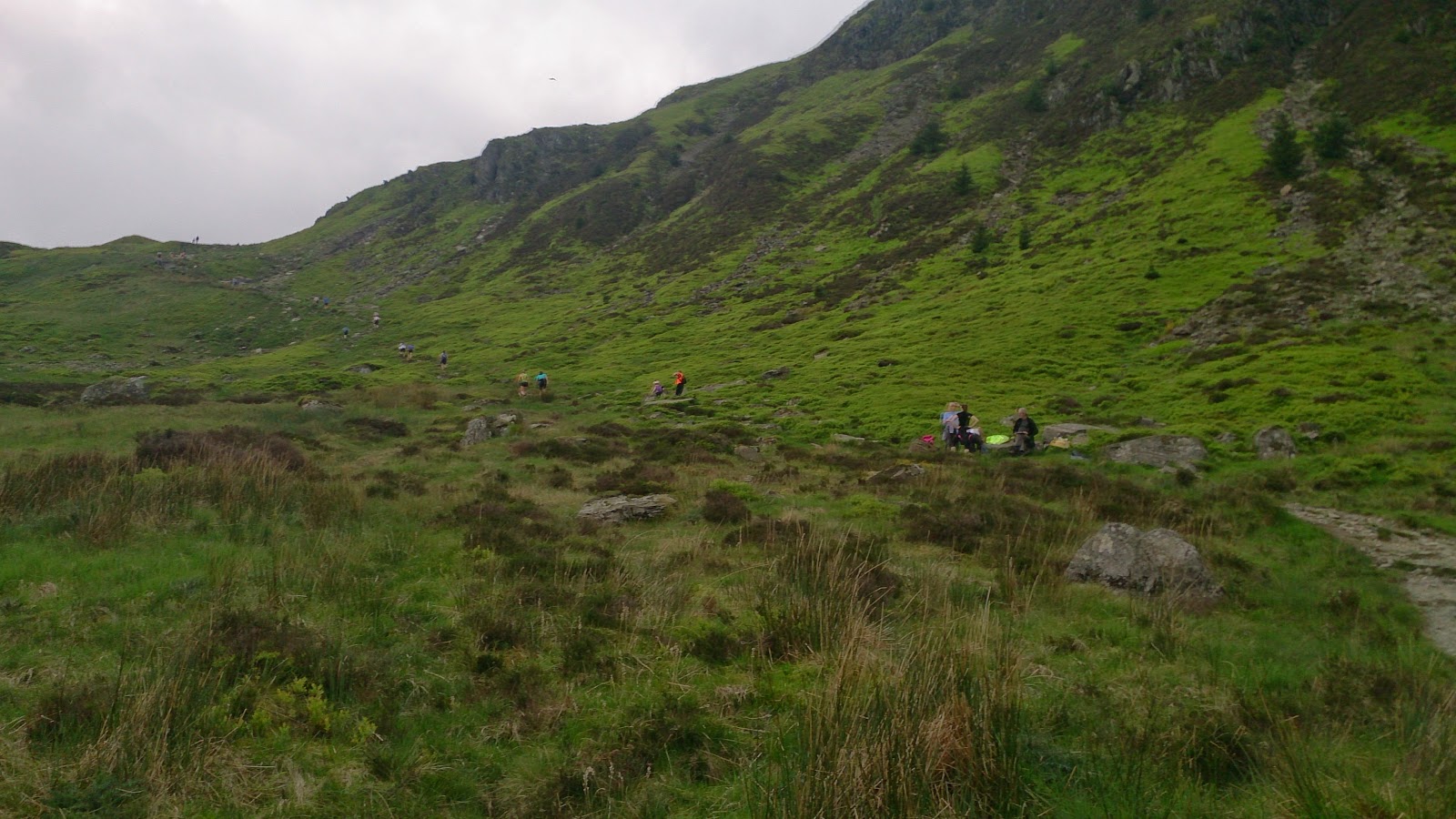
Then the path turned right onto the open hillside and kept going gradually uphill from here to the summit. On this narrower path it was impossible to pass anyone and we all shuffled along at the same tempo. Soon we were all almost at a fast walk/ clamber. Although initially I was managing to break back into a jog on the flatter bits it was soon obvious that a forced march was more the order of the day. Although I was passing hillwalkers regularly I could see that the other runners were beginning to leave me behind.


Other runners becoming dots on the path ahead of me

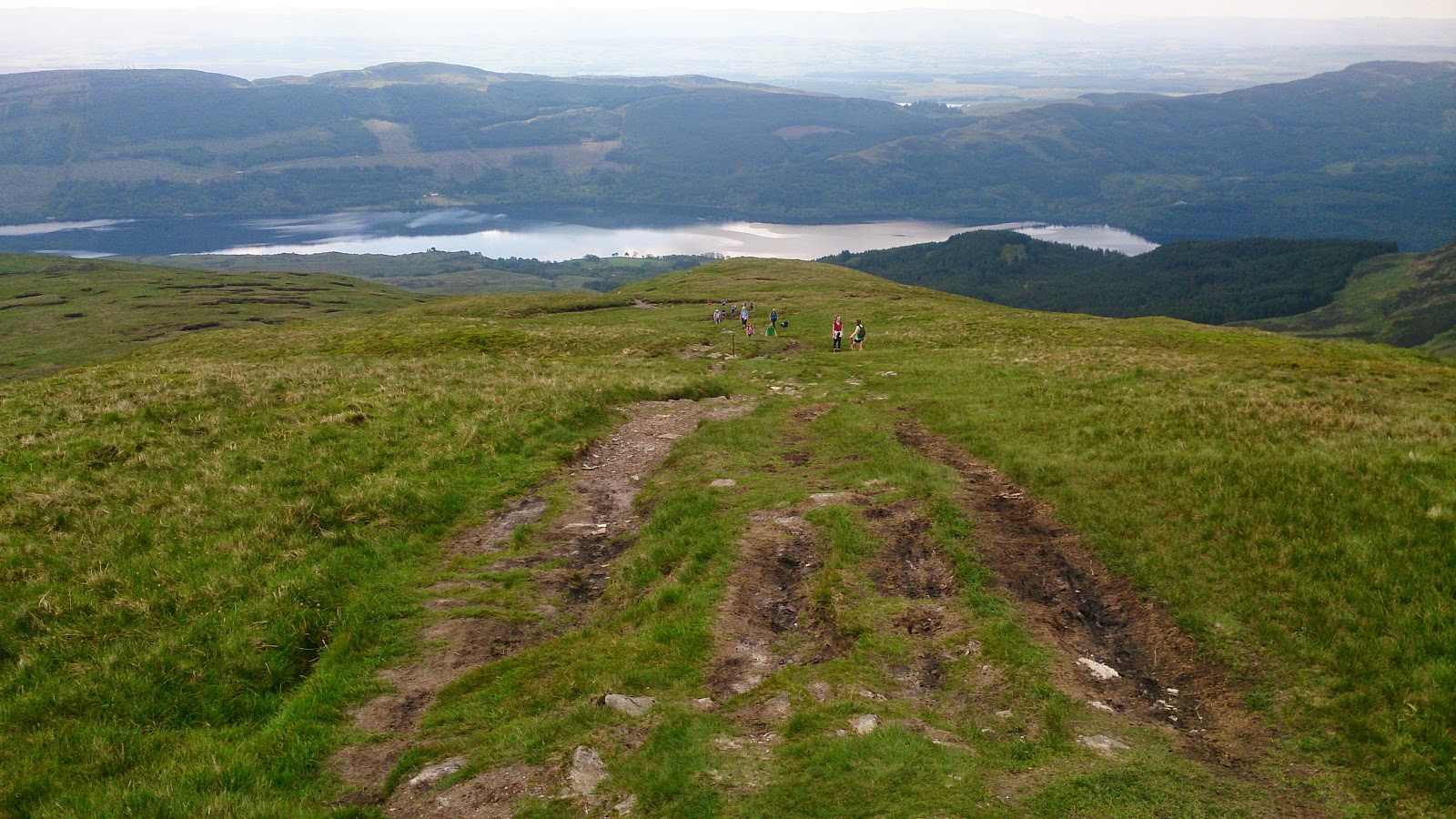
Looking back down the path towards Loch Venechar
After a couple of false summits I reached the top. My thighs were aching by now but I was still able to enjoy the glorious views. From here on a clear day like today you can see down to Loch Katrine and over to Ben Lomond, Ben Lawers, Stuc a' Chroin and Ben Vorlich.

View from Ben Ledi summit to Loch Lubnaig
I thought that I was not bad at descending and here would get my chance to reel in those that had got ahead of me but as I came over the top the runners which I had sight of a few seconds earlier appeared to have vanished, leaving only a line of fluorescent flags outlining the route for me to follow. I had checked my blood glucose a few times on the way up to see how this type of running affected my diabetes and it wasn't any different to running on the flat, with 40g of glucose tablets being necessary after an hour and seeing me safely to a finishing blood glucose of 6.5mmol/L. (If you are interested in these things 11.5mmol at the start, falling to 10.2 after 30 minutes, 4.2mmol at the summit - one packet Lucozade glucose tablets - 6.5mmol at the end).

Start the descent. Glorious views and flags showing the way
It was a relief to be stressing different muscles in my legs and I enjoyed the descent. As it came down into Stank Glen there were some boggy patches, but mostly an obvious gravel path. My plan to save a bit in my legs to catch people on the way down didn't quite work as one person came past me halfway down, and another caught me almost on the line. The last kilometer was back on the forestry roads and meant I could pick up the pace here.
Descending into Stank Glen
My best 10km time is at 42 minutes, recently I've been nearer 50 minutes and I managed this 10.5km route up and down Ben Ledi in 90 minutes. The last time that I saw Prasad Prasad was at the start line and predictably enough he won the race, in a time of about 57 minutes. In road races I can usually finish just inside the top third, here I was safely in the bottom third. However I had a great day out, everyone was very encouraging, friendly and supportive and I am already looking for another hill to run up.

Profile and route from Runkeeper.com

It would be remiss of me not to mention the nearby excellent Mhor 84 Motel at Kingshouse, Balquhidder where I had a lovely lunch after I finished.

I have the Glasgow Men's 10K in a week's time (lovely and flat), so after that I'll plan the next one. I would train differently though. If I cannot get onto more hills in training I'd try to have a weekly session on the stairmaster thing in the gym to get my quads a bit more used to it.

However no tick bites, no sprained ankles, lovely weather, gorgeous scenery.

Perfect.

Monday, 12 May 2014

How Glasgow Flourished. Kelvingrove Art Gallery and Museum

How Glasgow Flourished  1714-1837. New temporary exhibition Apr-Aug 2014, Kelvingrove Art Gallery


Kelvingrove Art Gallery and Museum in the west end of Glasgow houses a great civic collection of artefacts and art. Before it opened in 1901 the city's art collection was on show in the McLellan Galleries on Sauchiehall Street, a lovely and (sadly) largely unused space. Since then it has has shared the Kelvingrove building with an eclectic and slightly random collection of stuff. There is everything from Egyptian mummies, to a Spitfire plane, paintings from Rembrandt to Salvador Dali's Christ of St John of the Cross.

As a child we came here often and when my first son was a toddler we seemed to wander the galleries on a weekly basis. After extensive refurbishment it re-opened in 2006 to general critical approval, but my warmth for it had faded a bit. I missed the dusty old cases of fossils, it seemed slightly dumbed down, the paintings didn't seem as well hung now. It was more obviously set up to earn a bit of money on the side, whereas in the past it felt like a precious gift which our benevolent, philanthropic forefathers left to us. I have just never visited it as much with my younger children, and rarely wander in on my own now. I don't feel the same connection to it. The cafe in the main hall breaks up the splendour a bit of this grand space and the new temporary exhibition area downstairs showed that making some money from the building seemed to be an essential function of the new version of the Arty Garties.

A common sight in Kelvingrove in recent years

The reason that I wrote my first blog here was in a fit of pique after a visit with my kids where, only a few years after the re-refurbishment, the exhibits all seemed neglected and in need of repair. The majority of the fun, new interactive exhibits were broken or shabby and the lack of ongoing investment in its maintenance was obvious. I was angry, as like many other Glaswegians who loved the old place I had chipped in some money towards the refit, with our names on display in the main hall. 

One thing the museum seemed to lack was any great connection to Glasgow, it could have been anyone's museum. There was the Mackintosh furniture and many a Scottish artist on show, but the room specifically about Glasgow was a curious hotch potch of exhibits. There was a big thing about Catholic/ Protestant sectarianism and the Old Firm, a section on alcoholism and domestic abuse and at the back of this same room a couple of broken machines about James Watt devising "horsepower". These things may all be aspects of the city, but for visitors meeting us for the first time, that's a confusing barrage of themes? A board in this room for people to add their own thoughts about Glasgow on a postcard was badly maintained and after a few weeks never seemed to have any cards or pencils to allow you to join in the fun. Did this reflect the feedback they were getting?

In recent weeks it is clear that there has been a realisation that this was not on. There has been a series of repairs and rooms throughout Kelvingrove Art Gallery which were getting a bit shabby and tired have been improved.


How Glasgow Flourished 

Presumably with the imminent arrival of the Commonwealth Games in Glasgow the temporary exhibition space downstairs has been given over to an exhibition dedicated to Glasgow itself. Titled "How Glasgow Flourished 1714-1837" it aims to tell the story of how Georgian Glasgow expanded and changed from quiet rural town, to great industrial city. A bonus is that it is FREE (is this a first for an exhibition down there?) which makes a pleasant change.

Entering the exhibition we are met with the great and the good of Glasgow's merchant classes. We have the "Tontine Heads" showing the links to the tobacco trade, information about the foundation of the Glasgow Chamber of Commerce and Allan Ramsay's excellent portrait of the Duke of Argyll (immortalised in a city centre street name). Andrew Cochrane, several times Lord Provost of the city is a more complicated character than you'd know from seeing his portrait here. No mention is made of his Virginia plantations or ownership of the King Street Sugarhouse. Nor is there any mention of the fact that he was a Hanoverian supporting Provost when Bonnie Prince Charlie and his 6000 strong army arrived in the city in 1745 demanding accommodation, food and clothing. This is a recurrent problem with the exhibition. It purports to tell 120 years of the history of the city but manages to completely remove it from any historical context or narrative. There is no sense of a city, of a world, changing through this period. Also apart from the wealthy merchants almost no real people intrude upon the displays, which is strangely at odds with Glasgow's current branding "People Make Glasgow".

Family History

In the publicity surrounding the displays they come back to the idea that
A recurring theme throughout the exhibition is family history, showing how you can make connections with your life and family to the history of this wonderful city, through our incredible museum and archives collections
I presume they are hoping that visitors coming to Glasgow to see the Commonwealth Games may linger because their ancestors originated here, before spreading to the far reaches of the Empire. Whilst you are here why not stay a while and seek out your ancestors?

That seems a logical enough premise, so throughout the exhibition we come back to one family in particular, the Glassfords. Are this mob the type of family we want to connect ourselves with? I've done a bit of family history research myself, and of my relatives living in the west of Scotland at that time none were "multimillionaire businessmen" as he is described, but they certainly helped Glasgow flourish. I know my link to several Georgian servants in Glasgow, 3 or 4 weavers, 2 labourers, a stonemason, a tinsmith, a miller, a draper's hawker, a joiner, a blacksmith and a ship's pilot.

It just feels a very old fashioned way to tell history, although instead of learning history through kings and queens we are here shown Glasgow's history through the life of the merchant classes. There are rooms of their portraits and recreated front rooms, hunting jackets, Chippendale furniture and punch bowls.

Instead of being met at the entrance by the buxom stone sphinxes "which may have been from the Shawfield mansion of millionaire merchant John Glassford" I would rather know who made them, which sculptor, craftsman (even my relative, the stonemason). Are visitors from the Commonwealth not more likely to be the descendants of Glaswegian factory workers, sailors or miners or even the descendants of slaves labouring for the Glassfords and their ilk in the plantations? Why do we have a Clydesdale National Park in Jamaica visitors from that island may be pondering. Did my ancestors' sweat generate the wealth we are being impressed with here?

Portraits of John Glassford's second wife and a daughter stand in the final room. Sad though it is that his wife died in childbirth, I'd also be fascinated to hear what happened to infant mortality rates in the Calton between 1714 and 1837. That could tell a story about who was flourishing as Glasgow industrialised.

Slavery

I have previously written about Glasgow's connections to the slave trade as it is a link that is rarely made it the history of the city which we tell ourselves. During the Commonwealth Games "The Empire Cafe" will specifically explore this area and as the city's wealth during the Georgian period was almost entirely founded on the work of slaves in Virginia and the Caribbean there is some acknowledgement of this in the exhibition. However I do really think it is a polite recognition of it, rather than any serious analysis. Whereas we have rooms showing us the style and opulence of the Tobacco Lords way of life, we have half of a glass case on the topic of slavery.

Slaves did all the work so get the right hand half of this
glass case devoted to them
The famous portrait of the Glassford family by Archibald McLauchlan which normally hangs in the People's Palace is on display here. Whilst there is comment beside the picture about the face of his third wife having been painted over that of his second wife, no mention is made of the black boy that can be seen standing behind this family in their 1768 Glasgow mansion. Other allusions to the plantations and the slave system are hinted at without being clearly explored. In the section on Glasgow industry we read about
Glasgow factories produced everyday necessities for plantation stores
On a section talking about the growing iron industry in Glasgow we can read that
Ships were laden with cargoes of nails, spades, shovels, picks and ploughs to produce more tobacco, sugar and cotton
You only need to think about that for a second to see that factories were growing, were profitting and becoming mechanised by providing materials for slave owners to use to earn greater profits for merchants in Glasgow who then invested in land, railways and new docks. I just think it is negligent to underplay the importance of slavery, or even the massive compensation payments to Scottish plantation owners when abolition came into effect, in the growth and industrialisation of Glasgow at this time.

At a time when Scotland's population was a fifth of what it is today, between 1750 and 1800, 15-20,000 Scots emigrated to the Caribbean where they worked at every level of the slave trade, as overseers, financiers, suppliers, bookkeepers and as slave plantation owners.

Industry

Appropriately there are sections on mining, iron working and weaving, but as elsewhere in the exhibition they seem strangely out of context or lacking in any chronological continuity. There is a painting of a Woodside mill, an area I know well and would find it impossible from the display here to imagine where in Woodside this used to sit. James Watt gets a mention (I have written previously about his time in Glasgow) but again you would be hard pressed to see how closely he was connected with Glasgow and the University from the exhibits here. Also one of the things my inner geek came along expecting to see, a model of his Newcomen engine, the steam engine that drove the industrial revolution, is not yet installed in the exhibition! Eh? 

The sections on the workers and daily life seem rather uninspiring and sadly there are inaccuracies here. There is a wee painting of a school at "Goat Burn". Why not give a bit more context and point out where the Goat Burn ran, near Partick (where the Goat pub stood until it was recently re-named)?

The sign talking about the Calton Weavers' strike and massacre has a small photo of Ken Currie's painting on the subject from the People's Palace, but bizarrely gets the date wrong. It states that it happened on 3rd September 1789, but in fact it was 2 years earlier in 1787, before even the French were revolting. For Glasgow's premier museum to make such a schoolboy error about an important event in the history of Glasgow's workers just seems to show a lack of care and attention.

The whole exhibition has some interesting stuff but just feels a bit thrown together. It's as if different people were asked "Right, you get together three rooms of stuff about the Tobacco Lords, you do a corner on weaving and you have that wee sideroom for 'other industries'. Now, what can we do with this 'Partick Drum'?"


Glasgow Stories

I am happy to accept any accusations that I am nit-picking. There was lots of great things on show here. I liked the old flyers for events in Glasgow Green at the Fair, the old maps such as of Garscube Estate and fantastic old paintings of Glasgow streetscapes. I just would have liked to see more connections to Glasgow today, more historical context and narrative. On only one occasion, at the exit, is an old print put beside a modern photo of a street. However the way it is done, with the old print looking south on Buchanan Street and the modern photo looking north-west, it makes them impossible to compare. In fact the photo used is the exact same, stock photo that is on display upstairs in the newly laid out "Glasgow Stories" room.

View of Glasgow and the Cathedral about 1840 by John Plimmer Houston
and the same view today. All the smoking chimneys and industry seem to have gone

I am happy to say that the new improved lay out for this room just off the main hall upstairs is a vast improvement on what went before. Upstairs I think they get right some of the things which are a bit lacking in the temporary exhibition downstairs. In a single room they now show pre-historic Glasgow, Victorian Glasgow, an old painting from the necropolis showing the smoking chimneys of industrial Glasgow, trade unionism, 10th century stonework from the cathedral and modern artists from the city.

Best of all, instead of all the guff about sectarianism we have a nice 1888 photo of Glasgow's finest football team, Partick Thistle. THAT is what visitors to our city should be getting told about. 

Partick Thistle team 1888-1889


Tectonics Festival Glasgow, 2014

Review Tectonics Festival, Glasgow, May 2014


The Tectonics Festival returned to Glasgow for a second year this weekend. Originally devised by conductor Ilan Volkov with the Icelandic Symphony Orchestra in Rekyavik, he brought it to Glasgow last year. Since then it has grown arms and legs and been a platform for local and international, experimental and modern classical music in Adelaide, Tel Aviv and this year, New York.

BBC Scottish Symphony Orchestra

The programme this year did not jump out at me the way it did last year. I don't think I was alone in finding this, as audience numbers, although decent, seemed a wee bit down on last year's. I wasn't really familiar with any of the composers being performed. However, Volkov with his previous Tectonics programme and the free "Hear and Now" concerts which he still performs with the BBC SSO for Radio 3, is always a reliable guide. This meant that I was happy to be led by his reliable judgement. The Glasgow based BBC Scottish Symphony Orchestra have surely became one of the world's foremost interpreters of modern classical music. This weekend they were again given the opportunity to perform musical notation which at times can have more in common with a child's drawing book than a traditional orchestral score.

I wasn't able to attend the opening concert at St Andrew's in the Square, featuring many of the artists and composers who'd be performing across the weekend. With Bill Wells, Thurston Moore, Takehisa Kosugi and Richard Youngs amongst others on show, I was sorry to miss it.

Saturday night started with the BBC SSO, led by Volkov, performing French-born American composer, Christian Wolff's Ordinary Matter (version for two orchestras). Visually and aurally it was an interesting proposition as the counterpoint ebbed and flowed between the orchestra, split down the centre of the stage and led by separate conductors. It was slow, creeping and creaking. A high point was the to-ing and fro-ing between the pizzicato violin on the left and harp on the right.

A new BBC commission "'d love to turn by John Oswald was next up, a lighter affair. At times it was familiar, almost bursting into The Beatles "A Day In The Life" at one point, but with more assault on the piano strings in the style of Tom and Jerry. It ended with a moment of coitus interruptus, as the two percussionists raised their cymbals, then failed to climax.

The falling and rising strings of David Behrman's How We Got Here was a gentler affair, being swept away by Georg Friedrich Hass's more grandiose pieces following it. These were the highlights of the evening, with droning strings and brass, full of bombast in the Concerto Grosso No.2 for ensemble and orchestra. This was followed by his Saxaphone Concerto, with Swiss saxophonist Marcus Weiss playing in front of the dark tones of the full orchestra with his baritone sax.

Sarah Kenchington's Sounds From The Farmyard

In the interval we were ushered to the recital room where beautiful Heath Robinson style instruments constructed by Sarah Kenchington awaited our input. As shy Britons we gamely pottered about with them, deigning not to speak to one another or work together (the pipes were never going to work until someone decided to work the bellows). As the evening wore on people were more willing to give it a go. I couldn't help thinking that a bunch of kids would have made more "Sounds From The Farmyard" from it.

Muscles of Joy in The Fruitmaket

Set up next on the floor of The Fruitmarket were Muscles of Joy, a Glasgow band who I've seen before, supporting Tuneyards in Oran Mor. As before I found them interesting if a bit unengaging. They did highlight the gap in genders though as many of the performers, like them, were women whilst most of the pieces played over the weekend were composed or conducted by men. Perhaps it is a generational thing, as there were, particularly on the Sunday, several compositions by younger women.

Four men stare into a piano (whilst performing Behrman'sWavetrain

Back to City Halls where Icelandic composer/performer outfit S.L.Á.T.U.R. took us through Christian Wolff's Metal and Breath (where they either made noises with bits of metal...or their breath). Then Wolff's piece For One, Two or Three People was performed quietly by Wolff, Behrman and Kosugi. Their deferential respect for each other stole some dynamism from the piece. David Behrman's Wavetrain was excellent though, where Wolff, Behrman and Kosugi were joined by Volkov to place pick-ups on the strings of the prepared grand piano and play with the feedback.

Feedback was the watchword in The Fruitmarket for the late concert. Thurston Moore (off of Sonic Youth) wrestled with his guitar whilst Dylan Nyoukis provided accompanying noise and voice. I was amused to see the contrast between someone's child happily playing about to the noise produced and the older attendant from the halls standing behind the musicians with eyebrows more scornfully raised.  There are links appearing here, as Sonic Youth at times played the music of Christian Wolff . Scottish musician Gordon Sharp finished off the evening with his band Cindytalk.

Sunday's programme ran from 3pm until 10.30pm. One problem with this, as on Saturday, is that the performances are fairly constant. Obviously you can dip in and out of things, but I'm always afraid that I'll miss something special. Although the Merchant City is awash with bars and restaurants, there ain't no sandwich bars, cafes or fast food outlets on the weekend which makes getting food quickly an issue. As I'm diabetic, planning when to take my meals and insulin maybe means I'm a bit more obsessed with this than most people, but City Halls has no catering so maybe having a "street food" stall, music themed cafe or meal breaks in the programme could be considered in future outings? Some people came along with sandwiches but I opted to eat first and therefore missed Usurper in The Fruitmarket (who were apparently inviting us "to join them for an early tea".

SLÁTUR and their electronic score

I did catch the end of S.L.Á.T.U.R.'s performance, where their musical notation on the screens recalled the video game "Guitar Hero". The audience watched for their clapping or stomping cues. Two orchestral performances by composers from this outfit will be on show in  Glasgow in October. This highlights the fact that Tectonics is a platform for living, working composers. With its younger than average audience for "classical" music, sitting in a concert hall, pint of lager in hand, it is an idea I think is worthy of praise.

The next 90 minutes were of varied vocal/ choral music. Vocal ensemble EXAUDI, led by founder James Weeks, sang six varied pieces, three of them by Wolff. The main thing to shine through from this was the virtuoso performance of the singers in performing these, at times, challenging pieces. Leaving the hall, more cacophonous voices greeted us in the foyer as members of the Glasgow Chamber Choir and Glasgow University Chapel Choir performed James Weeks's piece, Radical Road (accompanied by pots and pans of gravel and clacking stones).

Next it was time for the BBC SSO to dust off their instruments again with music from two British composers, James Clapperton and Michael Finnissy. Catherine Lamb's "Expand" and "Saturate" from a longer work were excellent and reminded me of the soundtrack score for "Under The Skin" by Mica Levi. They both had some echoes in the final piece in this section. A new BBC commision, A Thin Tree by Austrian composer Klaus Lang, it had a lovely timbre (see what I did there?), which grew and stretched. A lovely piece, utilising the full orchestra.


Takehisa Kosugi's set up

Next we had one of the highlights of the weekend as 76 year old Japanese musician Takehisa Kosugi, once of Taj Mahal Travellers collective. He hunched over a table of electrical odds and ends in the darkened Fruitmarket and produced 30 minutes of electronic noise and interference with light sensitive switches making this improvisation entertainment for the eyes and ears. A treat which showed up some of the other music across the weekend for its lack of ambition.

Volkov and the BBC SSO in The Fruitmarket

Finally the musicians of the BBC Scottish Symphony Orchestra arranged themselves around the Fruitmarket Hall for the closing concert. It was great to see Richard Youngs, who had his guitar on the rack on stage here, take on something of this scale. With electronic sounds, guitar feedback and drums on stage, the strings were arranged around the Fruitmarket hall were the audience milled, brass on the balcony and Volkov conducted from a platform in the midst of it all. An appropriately eclectic performance to finish the evening.


Another enjoyable weekend, lots of composers here to hear their music performed and talk to the audiences. The earth maybe didn't move for me quite as much as it did at last year's Tectonics but some fabulous musicians performing for three nights in some fantastic venues. A real treat and I look forward to it's return next year.

Monday, 14 April 2014

Ivor Cutler and Aidan Moffat

Review: The Beautiful Cosmos of Ivor Cutler and Aidan Moffat's "Where You're Meant To Be"


I first started listening to Ivor Cutler's music with my children. The fundraising CD "Colours Are Brighter", aimed at children and adults, had an eclectic selection of artists from Franz Ferdinand to Four Tet and Belle and Sebastian. However the one that got everyone singing along in the car was Ivor Cutler's "Mud". This led us to look up some of his own albums and "Ludo" became a regular for long car journeys. Its surreal, gentle humour appealing to all ages. So when we saw that there was a stage show trying to tell his life story he were keen to get tickets, but with a degree of trepidation as to how they would sum up a man who described himself as "never knowingly understood".
Ludo by Ivor Cutler

However Vanishing Point theatre company and National Theatre of Scotland have co-produced an excellent piece of theatre in The Beautiful Cosmos of Ivor Cutler, currently on at the Citizens Theatre in Glasgow before touring. To try to get to know the man behind the person, writer/actor Sandy Grierson interviewed Cutler's partner Phyllis King and recreates these interviews here before the actor literally and metaphorically dons the costume and mannerisms of Cutler. Accompanied by the five onstage musicians they tell the story of his life interspersed with his poetry and interpretations of his songs. It was humorous, and as full of pathos as Cutler's songs and poems. It followed his life from Glasgow childhood, to navigator's training in the air force, art school, life as a teacher, to failing memory in old age. A nice touch was a link to a Spotify playlist of some of the songs which are used in the play, which we listened to in the car on the way to the theatre. This added to my children's enjoyment of the whole show a lot and we've been singing "I Need Nothing, I've Everything I Need." ever since.

Ivor Cutler seated aside yon Paul McCartney fella
There were some really interesting programme notes from Vanishing Point artistic director Matthew Lenton (an Englishman who has moved to Scotland). He wonders whether we still live in a country where ambitious artists like Ivor Cutler have to head south, to London, to follow their dreams. He wonders is "the cultural and political introspection of London" now alienating the rest of the UK? Should Scotland set its own agenda, in the arts, on the NHS, etc? They also have to make it clear that the views expressed are his own and not those of Vanishing Point or National Theatre of Scotland. Theatre seems to be successfully engaging in political issues, whether tangentially as in this case, or more directly (for example in the issue of refugees and asylum seekers in Benjamin Zephaniah's Refugee Boy and David Greig and Cora Bissett's Glasgow Girls, both seen at the Citizens in recent weeks).

Cover art by Aidan Moffat for Malcolm Middleton's HDBA album
(it's not Ludo, it's Frustration)

I think that Aidan Moffat is the nearest thing we have in Scotland today to an "oblique musical philosopher", as Ivor Cutler once described himself. I also hope that we know how to support and nurture our current deadpan poet, musician, artist and storyteller. Any of the tracks on the Scottish Album of the Year award winning album with Bill Wells, "Everything's Getting Older" such as "Dinner Time", could be considered a modern day version of Cutler's "Life in a Scottish Sittingroom".

Aidan Moffat in Tom Weir mode for Where You're Meant To Be

He is currently being employed by us taxpayers as part of the Commonwealth Games 2014 cultural programme, to tour the country re-interpreting Scotland's folk traditions in all their glorious bawdiness. Under the title/command/question, "Where You're Meant To Be" he'll be travelling to the likes of Lewis, the Faslane Peace Camp and Drumnadrochit before finishing off at the Barrowlands in Glasgow. The whole event will be made into a film by Paul Fegan to be shown at the closing of the Games and tickets throughout are free. I was fortunate enough to grab a ticket for the opening night on Monday 14th April, to be serenaded by Aidan and his band on boat down the Clyde, on an unexpectedly balmy Spring evening. Accompanied by James Graham (Twilight Sad), Jenny Reeve (Bdy_Prts) and Stevie Jones (from Alasdair Roberts troupe) who gave us a great wee support set. However the early evening star of the show was the River Clyde. I could not have been happier than to be sailing through Glasgow with clear skies on a beautiful evening with free whisky, and then there was still Aidan Moffat to come!

As we head down the Clyde the sunset is reflected in the Crowne Plaza Hotel
behind the Glenlee ship whilst the full moon rises above the Transport Museum
If Aidan's remit was to modernise some old songs, he has done it with bells on. These old songs are often saucy and daft, but to hear something like the Big Kilmarnock Bunnet redone with a daft laddie from Falkirk set up to meet a lady of the night at Blysthwood Square works a treat (I mentioned this old song recently in a football related jaunt to Kilmarnock). As a Partick Thistle fan I felt a wee bit let down by his re-working of Harry Lauder's "I Love a Lassie" as a different version rings out at Firhill with far worse lyrics than Aidan has conceived to pillory his English father-in-law. However others, such as the Kirriemuir Ball, were just silly, funny and struck the correct chord of modern vernacular, where effin' and blinding are just punctuation marks for most Scots in their normal conversational, away from work voices. Nice to see Cardinal Keith O'Brien up for special mention too in one ditty. Cutler also turned his hand to writing books for children and Mr Moffat for an encore recited from a children's book he has written, to be published soon. As he put it, after all the sex and drinking of the earlier songs, you inevitably end up with children.
Aidan Moffat singing on the boat. It wasn't listing, I was
 At the risk of sounding like a big sook, this was my perfect evening. Free tickets, Scottish nostalgia with a modern, sweary twist, a trip down my favourite river in the world, and me and my brother raising a (free) glass of whisky to the NHS surgeons at the Golden Jubilee Hospital as we passed Clydebank, where a few months ago he underwent exemplary and successful open heart surgery. If you get the chance to catch his show grab it. I don't know when will we see, its like again.
Coming back up river into Glasgow at the end of a great night out.