Wednesday, 23 November 2016

Disappearing Glasgow by Chris Leslie

Disappearing Glasgow by Chris Leslie


Disappearing Glasgow is a handsome and hefty book by Chris Leslie, a photographer and filmmaker based in the city. The book and the accompanying videos are a wonderful record of the demolition of some contentious Glasgow estates. For me, personally, it also brought back many memories of my years living up the flats, which I will write about below this short review of the book.

Over the past 8 years Chris Leslie has been documenting the latest cycle of urban demolition in Glasgow; the razing of many of the city's tower blocks and neglected tenements. It started as a project for an MA in Documentary Photography, recording the flattening of the last tenements in Dalmarnock for the 2014 Commonwealth Games. It then took him on to witness the bulldozing of multi-storey flats in Sighthill, Red Road, Gallowgate and in Yoker at Plean Street, and the demolition of deserted tenements in Oatlands. 

Disappearing Glasgow by Chris Leslie
Attending the book launch at the CCA this week we were able to watch some of the short films he has made whilst investigating this, which show that it was much more than just a voyeur taking elegant photographs of the end of Glasgow's flirtation with brutalism. He excavated multiple stories (sorry) of those that lived, played and grew up in the flats. This film below, available on YouTube, shows what he managed to unearth beneath the Red Road flats. Before the flats came down he went with the demolition teams to an underground bingo hall for a 1000 people, and a windowless pub fashioned as a sailing ship, The Brig. Then he tracked down former residents who had frequented the pub or the bingo hall and recorded their stories.


The book is divided into chapters featuring the six Glasgow areas documented, with introductory essays from Chris Leslie to give some context, and six essays from an interesting and varied selection of contributors providing a historical, sociological or architectural perspective. The book contains sumptuous photographs with buildings in various states of destruction or demolition. People in the foreground are often dwarfed by the scale of the ruins behind them. In other pictures when Chris Leslie has donned his hard hat and explored the stripped out buildings from within, the shadows of former residents emerge from their empty homes. Whether the peeling wallpaper reveals a hand painted picture of a stag on an empty sitting room's wall or a frameless concrete window void frames a beautiful vista of open hillside beyond the city limits you can start to put yourself in those homes.

In Dalmarnock the photographer followed the story of Margaret Jaconelli who held out in her flat in Ardenlea Street for months until forced out by the Police. Living in a sandstone tenement that in another part of the city would have been renovated and sought after, as the area was deemed a "sink estate" the decision was made that it needed flattened. The promise of jam tomorrow is something the locals awaiting their "legacy" are not holding their breath for.

In each case we are witnessing a passing of "the architecture of the welfare state". Many of the early residents of the high flats talk about the great improvement it was for them when they moved in, having more room and not only an indoor toilet but a bathroom too! It was a genuine attempt in the 1960s and 1970s to improve the living conditions of thousands of people in the city living in squalor. But it was done cheaply and quickly. When Thatcher's government passed the Housing Act in 1980 and introduced the "right to buy" for council house tenants they intentionally started unpicking of the structure of social housing in Britain. Coming at the same time as the destruction of industry in Glasgow, the flats became poorly maintained and a housing of last resort for many people in desperate situations. In the multi-storey flats you weren't allowed to buy your flat (even if you had wanted to for some reason), the rents began to rise steeply and it is hard not to see the council getting more money from placing those on housing benefits into them. If you did buy your flat in an area deemed as failing, as Margaret Jaconelli did, you still did not buy control of your future. When a local councillor is quoted as saying "someone had to take it on the chin" about the Dalmarnock demolitions, you know what social class in the city are expected to just accept the decisions of their betters. By the end of the 1980s many of those interviewed in the book complain that drugs and decay went hand and hand with neglect, making the flats unwanted and unwelcoming homes.

In one of the most interesting essays in the book, sociologist Dr Kirsteen Paton quotes Karl Marx from the Communist Manifesto saying "all that is solid melts into the air" to illustrate the impermanence and cyclical nature at the heart of Capitalism. The unmentioned second half of this quote makes an important point too, when he says "...man is at last compelled to face with sober senses, his real conditions of life, and his relations with his kind." The former residents of all this demolished housing can see where they stand in society. Ignored, unable to control their environment, and rehoused with nothing learned from the mistakes of the past.

Despite being full of dust and destruction, empty buildings and piles of rubble, the book also evokes the people who made a home in these buildings. The cycles of neglected housing and demolition have been documented by memorable photography before. Thomas Annan, with his photographs of "Old Closes and Streets of Glasgow" in 1868 to 1871, recorded the last days of the medieval buildings around the Saltmarket and Gallowgate, They were replaced by the Victorian tenements, which Oscar Marzaroli documented in the 1960s as the bulldozers moved into the Gorbals. These buildings were replaced by the tower blocks which now Chris Leslie has recorded for us. Hopefully he is "documenting a fight for housing equality" here as one of the contributors states, and not just another cycle of disjointed and ill-judged "regeneration".

BUY THE BOOK, AVAILABLE HERE.

What made this book resonate with me?


My pathetic attempt to ape Chris Leslie's trick of superimposing old family
photographs onto my flats as they were demolished in 2015
When you pass by a street that you used to live in, or see a building that was once your home for many years you remember your time there. Playing games there, the route you walked to school, the parties that you had in that place, the neighbours. You remember where you came from and who you are. With Thomas Annan's photographs of the Saltmarket I can imagine my great-grandad Peter Donnelly who lived in one of those houses at that time. When Oscar Marzaroli photographed the last days of the Gorbals tenements he was documenting the streets my mum was playing in as a child before they were moved from their home in Crown Street to the new scheme at Drumchapel. Although I am only in my forties I am already witnessing the second wave of demolition of my Glasgow homes. I was five years old when we were moved from our tenement in Whiteinch which was chosen for demolition. With my brother, my parents and a cat to keep down the mice, we were living in a room and kitchen with no bath or hot water. By the time we were the last to be rehoused we were happy to see the building fall. Where our solid tenement once stood a gap site still lies empty. In retrospect renovation and modernisation would have created pleasant, substantial housing instead but demolition is the recurrent solution in Glasgow. 

Our Whiteinch tenement
Me in our 1970s Whiteinch room and kitchen
After five years in Maryhill we moved to a flat in one of the multi-story blocks in Knightswood. In Chris Leslie's book the Plean Street flats in Yoker were exactly the same structure and lay out as the Lincoln Avenue flats that I lived in nearby as a teenager. We lived there through the 1980s and the problems that arose repeatedly in the book were seen by ourselves. 

We were very happy in our flat, with two verandas I had plenty of place to work on my bike out there and you had lovely views over Knightswood Park. The underfloor heating was only present in the hall and the living room, but could, with a couple of days run up, warm those rooms. Anybody that had it on can remember how nice it was to lie on the carpet until the half of your body that was sweating required you to stand up and cool down. Apart from the huge cost of the electricity required to heat those two rooms, the bedrooms never got the benefit of the heating. With all the condensation that built up in the flats, there was always thick ice on the inside of your bedroom windows on winter mornings. 

Winter in the 1980s at the Lincoln Flats, Glasgow
When the flats had been built, above the 19th floor was another floor where the lift mechanism was housed. Here there was an open, glass-walled space, "the roof drying area", which is seen in one of the Plean Street photos, where the residents of the 114 flats in the block could hang their washing...if they didn't mind all the pigeons that lived up there. Whenever we went up there to run about or enjoy the views, it was only a few minutes before the 19th floor residents, already in a bad mood as the lift only went to the 18th floor, would come and chase you away. Seeing Chris Leslie's photographs of the metal lifts brought back the smell they always had - a combination of urine and strong bleach. The stairs too carried that smell, and as time went on you were more and more likely to find either people lurking or suspicious wet puddles on the stairwells. 
The Lincoln Flats
We often had our flat crowded for parties or for meetings. When the council threatened to close our secondary school my mum with other parents organised against it. At one of their meetings Donald Dewar, our local MP was invited to attend and with a lack of seats in our living room I can remember him happily arranging his gangly frame on a wee telephone table we had there, as he listened to our concerns. The school didn't close. With furniture cleared we could put tables down the middle of the living room for Christmas dinner. In the book there are rooms of exactly the same lay out as the ones we lived in, but stripped and empty, looking spacious and dead, but these are the memories those pictures brought back to me - my family getting together, my bedroom, me studying for my Highers.

Christmas party up the flats


Seeing my Christmas photo there reminds me of the other post-Christmas tradition that we had, of taking the tree out onto the veranda to avoid dragging the needles all through the house. With someone keeping a lookout down below to make sure we didn't kill anyone, my dad would hurl it over the railing and my brother and me would haul it into the bin area. It came down like a dart and as it hit the ground, "bang", every needle would fall off making a heap in the car park. If you were unlucky the wind that sometimes whipped around the bottom of the flat would catch the tree and we would chase after it as it headed towards Archerhill Road. One day the wind picked me up as I came out the doors at the bottom of the flats to head to primary school. I was swept away until I crashed into a bench, which has left me with a wee scar on my ankle. I learned to look out on windy days after that. 

Demolition begins at my old tower block
on Lincoln Avenue, Glasgow. 2015
 After about 10 years living there we decided to move on. The old neighbours on our floor who used to take their turn cleaning the landing had died or moved on, replaced often by young single men who often had problems they were dealing with. Noisy parties, late night argy-bargy and less and less maintenance was becoming obvious. In my bedroom the plasterboard was cracked and a cold draught of air from the bin chute shaft behind came through that wall. The recurrent dampness in the living room plaster was crudely repaired and when the workmen were in, things were stolen from the flat. It was time to move on. With all the decent housing on the council books being bought by the people living in it, we knew we would never have enough points to get a move to another council house, so my parents were coerced, like many others, into becoming mortgage owners if they wanted to move.


Different fates awaited the many tower blocks in Knightswood. The Kingsway flats on Dumbarton Road, like the Plean Street flats were of the same design as ours and were the first to be demolished. The Kirkton Flats seem to be untouched. Two of the six blocks on Lincoln Avenue were earmarked for demolition, the others were slowly refurbished. This I find confusing. Either the council have deemed these to be housing failures, or decided that if they are properly maintained, with concierges in the ground floor and secure entry, better insulation and a fresh lick of paint they can be decent homes again. How can it be both?

My old block on the corner of Archerhill Road and Lincoln Avenue was stripped ready for demolition, but had a long stay of execution. I understand that the electricity substation for the whole row of flats on the street was built into it and needed re-directed before the block could come down. Eventually in June 2015 the demolition crews got to dismantle my old flat. Within a matter of weeks 20 floors of concrete and steel was reduced to dust. In some ways I was sad to see it go, as I had lived all my teenage years there, but in the end the flats had become neglected by years of poor housing policy that at no point engaged with the people actually living there.


I stumbled across this oil painting in the Hidden Lane Gallery a couple of years ago. Hilda Goldwag was an artist born in Vienna in 1912 who escaped from Nazism to Scotland in 1938. In 1968 she moved to Knightswood and continued painting until she died in her 90s. This abstracted painting is from Archerhill Road according to the title.  This means that the high white towers on the left are the Lincoln Flats, with the Kirkton Flats on the right and the low houses that line Archerhill Road at its western end in the foreground. Like the Red Road flats with several novels and films set there, I am glad that the Lincoln Flats were commemorated by an artist too.



Wednesday, 26 October 2016

Mark Thomas - The Red Shed.

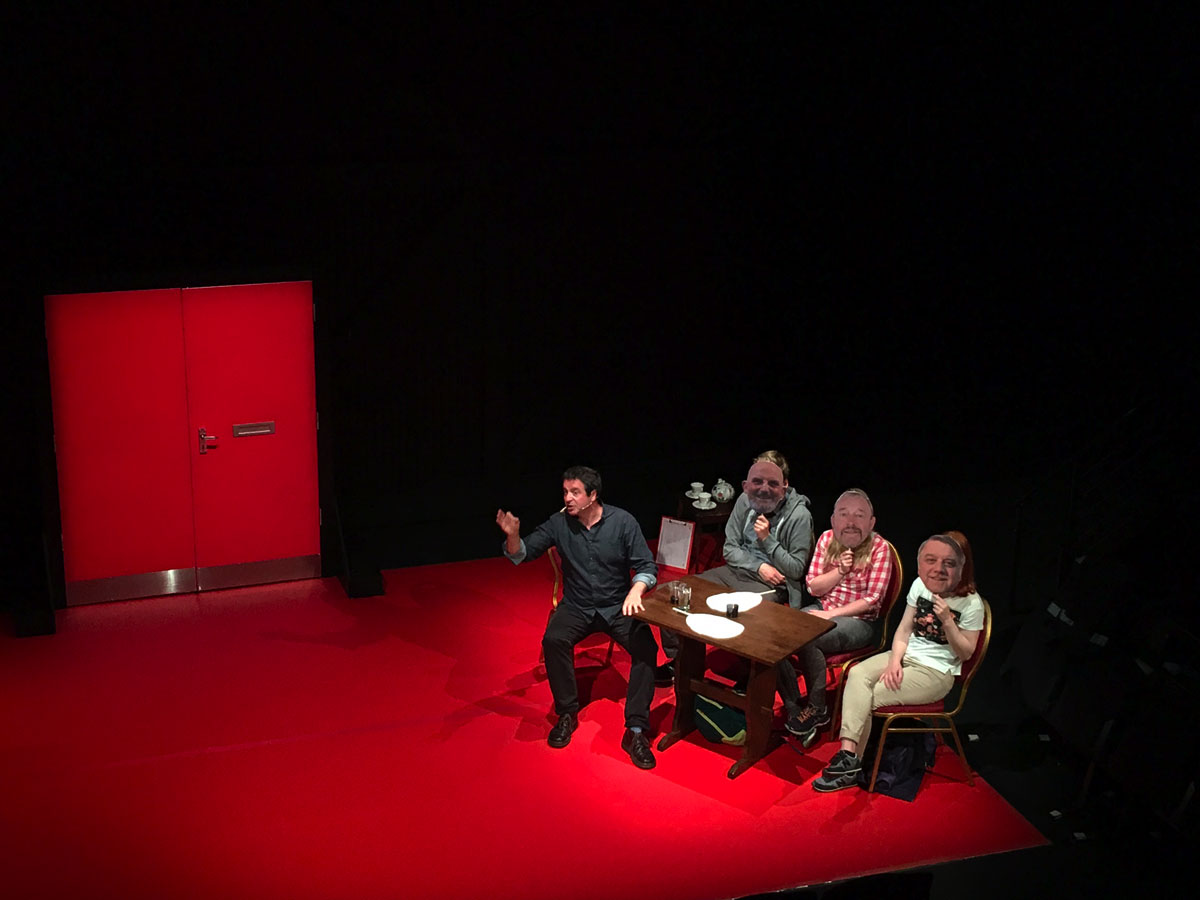
Mark Thomas - The Red Shed. Tron Theatre, Glasgow. October 2106. Review


A stage show about a Labour Club in Yorkshire? Strange as it may seem Mark Thomas's skill as a story-teller and performer makes this unlikely topic an enjoyable and moving tribute to neglected working class history.

Mark Thomas outside The Red Shed in Wakefield
Photo by Tracey Moberly from Mark Thomas website
The Red Shed is a 47 foot long red wooden shed in Wakefield, a working people's club which celebrated it's 50th anniversary earlier this year. Mark Thomas first went there as a drama student from a Yorkshire college and has returned many times since. When planning a celebration of the club's 50th anniversary Mark had recalled how he credited his activism with the 1980s miners' strike with his political awakening. In interviews he has recounted joining a miners' march back to work, with local school children singing to them as they headed down the street. Is this just a story that he has made real by repetition or, as nobody else can recall it is he mis-remembering it, making it true by repetition?

Before the performance Mark approached several members of the audience, looking for volunteers to join him on stage. I declined I'm afraid, and you can make your own allegory there about people either choosing to become actively involved in political action or preferring to be supportive, inactive voyeurs in our civic age. He introduces us to many of the stalwarts who have helped run the place, and the campaigns organised from there. The six audience volunteers hold up masks to act as the participants in this story.


In investigating the veracity of his early memory, we explore the untold histories of working people. I found this a meaty, moving and angry piece of theatre. He is an engaging raconteur. If you are going to put yourself forward as one of his volunteers on the night I would suggest a wee visit to the bathroom before you start, as certainly one of the players on stage on our night appeared to have maybe overdone it a bit at the bar before getting up there.

One reason that I write this blog, particularly the sections on local Glasgow history, is because there are huge swathes of information and stories out there that we poorly recall. There are stories that my granny used to tell me about, stories of immigrants arriving in our city, periods of unemployment and struggle, things worthy of celebrating, remembering and learning from. If we don't get to remember the past we will go along allowing the same mistakes to be made. History isn't created by the actions of kings and queens, but by ordinary men and women.

Saturday, 15 October 2016

The Marriage of Figaro - Scottish Opera

The Marriage of Figaro - Scottish Opera, Review, Theatre Royal, Glasgow October 2016.


Without having any great knowledge of classical music I have enjoyed going to see Scottish Opera at the Theatre Royal since I was a kid. They have always had a policy of having reduced price seats available for young people, so it is always worth just trying something out, with seats starting lower than tickets for a Scottish Premiership football match. With that in mind I took my three kids to see Mozart's Marriage of Figaro last night at the Theatre Royal in Glasgow. Making it a family affair my mother-in-law was there too, and at times she was almost ready to sing along in parts as she had an old, well loved cassette of this opera at home once upon a time. 

Inside the Theatre Royal, Glasgow
Although for many people a night at the opera is a good excuse to dress up, theatre-going in Glasgow is never stuffy and I always think that there is a bigger mix of people and ages here than in theatres I have been to in London and Edinburgh. I do like the new extension at the Theatre Royal, with its twisting stairwell, and roof terrace for admiring the view with a pre-theatre drink. 
View from the Theatre Royal roof terrace
I last saw Scottish Opera perform the Marriage of Figaro in 1995, in what was an English translation and it did feel a bit like a Westend farce as far as I can remember, so I was glad we were getting it sung in Italian tonight, a revival of their 2010 production. As always there is English translation in the super-titles above the stage to help you follow the plot. 

Although it is filled with wild imagined conspiracies I enjoyed sitting down to watch the 1984 Oscar-winning film Amadeus last week to get me in the mood for tonight's performance. The Marriage of Figaro was written in 1786 by a 30 year old Mozart. It is based on a French play by Pierre Beaumarchais. The play had performed amidst controversy in Paris two years earlier, controversial for it mockery of the aristocracy. An earlier play involving the same characters has also become an opera, Rossini's Barber of Seville, which includes the famous "Figaro, Figaro, Figaro.." aria when this character first comes on stage. 

As with any performance by Scottish Opera the production values are very high, with beautiful sets and ornate costumes, which is what you expect from a night at the opera. The Scottish Opera orchestra sounded crisp and perky all night, in keeping with the bouncy music, with the old fortepiano giving an atmospheric harpsichord-like sound for the rhythmically spoken interludes. 

I thought the singing of all the characters was fantastic, with Ben McAteer, who I last saw in Scottish Opera's Devil Inside, a charismatic and knowing Figaro. Eleanor Dennis's voice soared when singing her solos as the Countess and when dueting with Anna Devin (Susanna) together they made a beautiful sound. The acting of all the characters throughout was excellent too, in what is basically a farce.

Personally I find Mozart's operas a bit too close to Gilbert and Sullivan's comic operas (which isn't meant as a compliment) which this production plays up to a bit with lots of pinched bottoms and cross-dressing characters, and I do prefer operas where half the cast are dead from consumption by the end of the second act. There are too many gags in this story to make it one of my favourites. However my kids really enjoyed it despite it being three and a half hours long (still shorter than Lord of the Rings and they sat through that quite happily). Everyone else we were with really loved it too. Sometimes I think we can take Scottish Opera for granted. Despite their budgets being pinched they are still turning out high quality productions again and again. 

Thursday, 6 October 2016

The Suppliant Women. Lyceum Theatre, Edinburgh , October 2016. Review

The Suppliant Women by Aeschylus. A New Version by David Greig


Lyceum Theatre, Edinburgh on a sunny October night
As the new Artistic Director of the Lyceum Theatre in Edinburgh, David Greig has begun his stint in this role by creating a new version of an ancient Greek play. Written 2500 years ago by Aeschylus, it is one of the world's oldest plays and yet the subject is chillingly contemporary. In fact many of the lines from the original play (which I recently wrote about here) fit perfectly in describing our world today.

Edinburgh Castle in October
On a crisp autumnal night in October we made our way through from Glasgow to the Athens of the North to see The Suppliant Women. Aeschylus' play is the first part of a tetralogy telling the story of The Danaids, a tale well known to the audiences of Athens that first saw it performed in around 470BCE. The Suppliant Women is the only surviving part of Aeschylus' Danaid Tetralogy. It tells of the 50 daughters of Danaus, fleeing across the sea from near Syria, escaping from forced marriage to their cousins, the sons of Aegyptus. They land in Greece at Argos and seek asylum. Although they may look foreign, they tell the people there of how they are descendants of the Argive heifer goddess Io, basically "we're all Jock Tamson's bairns".

Theatre of Dionysos, Athens
The play was first performed in the theatre of Dionysos in Athens, where the wealthy sponsors of the plays would carry out a libation before it began. This is a tradition which has been resurrected for The Suppliant Women, with different MPs and MSPs this week having performed the libation each night on stage at the opening of the play. We were told where the funding for our play came from, and the gods are offered an offering of wine (Dionysos was not just the god of theatre). It is a smart reminder of where the funding for theatre such as this comes from (largely the people, the demos, as it turns out). In that respect they are missing a trick in fully achieving the 30p in each £10 funding provided from the theatre bar by running it as a 90 minute piece with no interval, as I missed the chance to chip in an extra £4 for a wee tub of ice cream. We are asked to see if we can see anything of our current times reflected in the mirror of this old piece of theatre.

Theatre at Epidavros
With ancient paintings of theatre performances and Aeschylus' words themselves really all we have now to go on, what did ancient Greek theatre actually look and sound like? When you look at the scale of the theatre of Epidavros, despite its famous acoustics, it is hard not to imagine that music and a raised chorus of voices would be required to lift the sound to the cheap seats at the back. The Suppliant Women is unusual because the chorus here plays a large part in the story as a character. In David Greig's telling of the story they set the mood from the moment they stride on stage, rhythmically beating out the metre with their feet.

The stage is stripped back and open. The play is set in ancient times. The modern, casual dress of the chorus keeps us in the present. The chorus themselves is made up of local volunteers with professional actors Gemma May, Omar Ebrahim and Oscar Batterham taking the lead parts. The chorus though, the suppliant women themselves, are a fantastically well choreographed, ebbing and flow, huddling and scattering ensemble. The fact that the asylum seekers are here drawn from our local community emphasises the feeling that they are our kin. Written by David Greig, directed by Ramin Gray and with music composed by John Browne, the team behind The Suppliant Women have already worked together successfully with The Events. When that play toured it triumphantly used local choirs on stage as part of the piece, and with the Suppliant Women again local people will be used. The chorus in Edinburgh will be replaced by people of Belfast and Liverpool when the play moves on.

The rhythm that started with the marching feet carries on through the play in the pulse of the language and John Browne's music, played by two musicians. I am no expert of ancient music but it feels and sounds true, equally Eastern and at times like a mournful Celtic keening. Particular credit must go to the Aulos player whose playing was very evocative.

Aulos player from Ancient Greece
When the women are met by King Pelasgus of Argos (Oscar Batterham) he is suspicious of these foreigners and the troubles that they might bring. Sharply dressed and with a politicians measured assessment he decides to put it to the people of Argos to decide - the word democracy is first found in Aeschylus' writing. It falls to a man, their father to make their case in the city, whilst the women still fearing violence against them from men stay in the safety of the holy temple they have come to. Their father warns them that people will fear them, they should "always be modest", "defer" to people, keep your head down and don't cause trouble.

Only this week the people of Hungary were asked to vote in a referendum on whether asylum seekers should be allowed into their country. Whilst 98% of Hungarians who voted stated that they would not allow refugees entry to their country, most people in the country managed to scupper the vote by not participating. I don't need to labour the point that the words from 2500 years ago seem again and again to echo to our times. Even when the people of Argos vote overwhelmingly to welcome these people in need (and more than that, to fight to defend them if required) dark clouds (or sails) are on the horizon and the men from their homeland arrive to drag them back by force. The older women of Argos welcome the women, but with the coda that they should not scorn Aphrodite but welcome men and lust as that is the way of things. The suppliant women display a more independent streak, as they leave the stage with their exiting ode (Exodus).

In a week where Theresa May's Conservative party asks employers to report foreign workers, overseas doctors are being told they are no longer welcome and there will be a crackdown on overseas students and visas, it is clear that Danaus' warning to his daughters that people fear foreigners is as resonant today as it was for the original audiences. The people of Argos are shown to have done the right thing in the play, aware of the potential consequences. We clearly still need taught this lesson.

On top of the language, words like drama, democracy and exodus that came from the Ancient Greeks, I am astounded at the modern parallels being found in the stories of ancient plays of Aeschylus. Recently the three plays of The Orestiae was retold (as This Restless House) by the Citizen's Theatre. Working with a smaller fragment of source material The Suppliant Woman packs a mighty punch. It is also the nearest that I have been to encountering what the ancient Athenians maybe saw. Stripped of marble columns and chiffony robes, the words are allowed to sing out. If the aim of David Greig's time at the Lyceum is to bring poetry and community into the theatre, he is off to a flying start.

I would really encourage you to go and get a ticket for this if you get the chance.

As it is national poetry day today, I will finish with a short poem from a modern Greek poet and playwright - Stamatis Polenakis, called Elegy.

"Nothing, not even the drowning of a child, 
stops the perpetual motion of the world. 
I know that today or yesterday some child drowned; 
a child who drowned today or yesterday 
is nothing - an inanimate puppet 
in the hands of God, a short motionless poem 
in the perpetual motion of the world."

Sunday, 2 October 2016

Castles of Glasgow

Castles In and Around Glasgow


Does Glasgow have any castles? The whole reason that Edinburgh exists is because 1000 years ago the rocky hill at its centre was the most easily defended place thereabouts. Whilst Edinburgh Castle is world-renowned, Glasgow doesn't really have the medieval grandeur of a fortified volcano in its city centre. You would not really associate Glasgow with castles. There have been castles in and around the city of Glasgow, but not much physical evidence of them exists now, however the clues are there. There is still a Castle Street in the city centre, an Old Castle Road in Cathcart and a Castlebank Street in Partick. These street names come from the castles that previously stood among open countryside hard to picture in today's city.

Castlemilk (also known locally as Chateau Lait of course) on the other hand has, disappointingly, never housed a castle. The Stuarts who owned the land and gave it the name, were from Castle Milk in Dumfriesshire. When they took the land on the outskirts of Carmunnock they brought the Castlemilk name north with them, but no castle.

So these are the castles in and around Glasgow that I could think of. Have I missed any?


Earliest fortifications around Glasgow


Roman Bar Hill Fort
People have lived around the River Clyde for thousands of years. In 142 AD the Romans camped nearby with 37 miles of  the Antonine Wall stretching from Old Kilpatrick, through Bearsden towards the River Forth, with regular fortifications along it.

Near Twechar the remains of a Roman fort can be seen at Bar Hill, and at Bearsden the Roman fort is hidden under a block of flats but you can still explore the Roman bathhouse attached to it.

At Bearsden, on the outskirts of Glasgow, all the features you would want from a Roman bathouse can be seen, with cold plunge pools, warm rooms, a hypocaust and a nine-seater, communal latrine. Many of the finds from the site are on display at the Hunterian Museum in Glasgow. The soldiers stationed here were believed to be Gauls, who may have come back with Emperor Antoninus from his North African campaign of 146-149AD. A wee change for them I would have thought.

Only 20 years after building the wall and its fortifications the Romans abandoned the Antonine Wall and withdrew to the south again. Emperor Antoninus was succeeded by the more renowned Marcus Aurelius.

Roman bathhouse at Bearsden
Roman cludgie in Bearsden
Are there other ancient fortifications in Glasgow? At the highest point in Queen's Park, hidden among the tress beside the flagpole are eroded earthworks and a mysterious stone circle.
View from the flagpole at the top of Queen's Park, Glasgow
This is Camphill and there are various theories about what once stood here. The earthworks hidden in the trees at the summit measure over 90 metres in circumference and were for a long time thought to mark the site of an iron age fort or a Roman settlement. There is a small (rather unimpressive) stone circle here also, sometimes described as thousands of years old, or maybe marking a military position from the nearby Battle of Langside in 1568. However the stones were not present when antiquarian archaeologists explored the area in the 18th century. Either somebody has put them there to jazz the place up a bit, or it is just debris from some nearby building work left because it made a nice place to sit.
Stone circle in Queen's Park
Theories about the hilltop fort have swung from it being a 3000 year old iron age settlement, or more likely medieval, or merely a couple of centuries old. All the theories have been hard to prove as the 18th century archaeologists cleared so much stuff away that they have wiped out a lot of clues. And then, in 1985, fragments of Roman pottery were found on the site. So maybe it was a Roman hilltop fort all along? Perhaps all the theories are correct. An ongoing mystery.

Two further similar, circular earthworks lie among the trees in nearby Pollok Park, on the hill above the Burrell Museum.

Bishop's Castle


It wasn't really until the 6th Century that the city of Glasgow was established. Glasgow became a religious centre after St Mungo founded his church at the Molendinar Burn, where Glasgow Cathedral still stands. The burn, now mostly covered over, used to power the Bishop's mills.

The road outside the cathedral in Glasgow is still called Castle Street. This comes from the time that the Bishop's Palace (or Bishop's Castle) stood just north-west of Glasgow Cathedral, where Glasgow Royal Infirmary now stands.

Bishop's Castle around 1560, with Glasgow Cathedral behind it
The first stone built cathedral in Glasgow dates from 1136 and the bishop's residence is presumed to date from this time, originally just a circular earthwork. By the time that Edward I invaded Scotland in 1290 the Bishop's Castle was a fortified building and Edward garrisoned his army here for a while. In the 15th century a five-storey tower was built here by Bishop John Cameron, and his successor built a defensive wall around it. However during the Reformation the Bishop's Castle was besieged six times, until the bishop of Glasgow at the time fled to France. The building later housed a jail before falling into disrepair in the 1700s, with the stone been taken away for new buildings in the growing city. There was still enough of the tower standing at the time of the 1715 Jacobite uprising for it to be used to hold 353 prisoners, guarded by 100 troops.

Castellated gate leading to Glasgow Royal Infirmary on Castle Street
In 1755 some of the stones were removed to build the Saracen's Head Inn. The building was finally flattened to make way for the hospital in 1792, and a castellated gate at the Royal Infirmary entrance commemorates the previous structure on the site. Also in Cathedral Square a pillar marks the site of the former Bishop's Castle/ Palace, although you wouldn't know this from looking at it as the brass plaque is missing from it. This pillar (and informative plaque) were unveiled in 1915. Also a line of stones in the ground near the St Mungo's Museum of Religion marks the place where castle walls were found. This museum is meant to be built in the style of the castle tower that once stood nearby.

Pillar marking the former boundary of Bishop's Castle
 in Cathedral Square outside Glasgow Cathedral

ARE THERE ANY OTHER CASTLES??

Castle Vaults pub, Maryhill
The Castle Vaults pub which still stands at the lower end of Maryhill Road, dates from the 1880s. It takes it's name from a brewery rather than any castle that once stood here. Proprieter George McLachlan also owned the Castle Brewery in Maryhill. From 1889 the brewery was located where Maryhill Police Station now stands, in a former linen and cotton factory. To meet growing demand, in 1907 MacLachlan opened a larger brewery in Edinburgh and closed the Maryhill works, taking this Castle from Glasgow to Edinburgh. "Fortress Firhill" is the only fortification in Maryhill. There are no records of any castles, apart from the brewery, in Maryhill.

There are a couple of castles still standing on the southside of Glasgow however, and archaelogical evidence of Partick Castle has finally settled the arguments about where this used to stand.

Crookston Castle


Relatively unknown to most people living in Glasgow, and tucked away in a housing estate in the southside ,stands Glasgow's last true castle. Crookston Castle sits among trees at the top of a hill in a non-descript park near to where Levern Water joins White Cart Water. The first fortification here was built by Robert de Croc in the twelfth century, timber structures surrounded by deep ditches. The area of Crookston took its name from Robert Croc, but by 1330 the Stewarts of Darnley owned the estate. Around 1400 they replaced the wooden structures with a rectangular stone castle, with towers at each of the four corners. When John Stewart took part in a rebellion against King James IV in 1489, the king bombarded the castle and destroyed two of the towers and the central block. One of the most famous of the Darnley Stewarts, Henry Stuart (Lord Darnley), was allegedly betrothed to Mary, Queen of Scots beneath an ancient yew tree here in 1565. When the tree was felled in 1816, a model of the castle was carved from its wood and can be seen on Pollok House.
Robert de Croc's defensive ditches, Crookston Castle
Although the Stewarts continued to live in the castle, they finally abandoned it in the late sixteenth century. By 1600 it was in ruins. In 1757 the Maxwells of Pollok bought the castle. In 1847 their family partially restored it for a visit of Queen Victoria to Glasgow. One of the towers still stands and the now roofless central hall can be explored. A staircase and steep ladder can take you to the roof to enjoy the views across the south of Glasgow. Entry to the castle is free, although the gates to it are locked at night.
Crookston Castle, Glasgow
The central hall at Crookston Castle, now roofless
After climbing up ladders to the top of the castle, weather permitting, views can be had
from Eaglesham Moor to The Cobbler, Ben Ledi and the southside of Glasgow
Crookston Castle, Glasgow

Haggs Castle


A photograph from 1855 by Duncan Brown of Haggs Castle
As my granny lived in nearby Mosspark as a child I was often taken to Haggs Castle in Pollokshields At that time it housed a Museum of Childhood. Haggs Castle still stands on St Andrews Drive, but is now a private residence after previous owners, Glasgow Corporation, sold it in 1998, two years after closing the museum. 
Haggs Castle today, now a private house
It was built in 1585 by Sir John Maxwell of Pollok as the family's main residence. It was named after the bogs or "haggs" that were nearby when it was built. Though they lived here in one form or another for a long time, they let it fall into decay in 1753 when the family moved to their newly completed mansion, Pollok House. Haggs Castle was later partially restored and in the 1850s became home to the Maxwell's Pollok Estate factor.
Haggs Castle today
During World War 2 it was requisitioned by the army and after the war divided into flats. In 1972 Glasgow Corporation bought it and converted it into the Museum of Childhood that I remember, which opened four years later. It had rooms filled with old toys and a big kitchen in its vaulted basement. I've still got a Haggs Castle badge that I must have got on a visit there once. 
My Haggs Castle souvenir
With walls in places five feet thick it was always more of a sturdy tower, rather than a fortified castle. To see it now you have to stand across the road and jump up and down to see over the high walls which surround it. Hidden away and fitted with modern adaptions, but still standing.

The Maxwell family's later home on their Pollok Estate

Cathcart Castle


Cathcart Castle is another one on the southside that people may remember from childhood visits, but unlike Haggs Castle and Crookston Castle, it has been flattened now. Located in what is now Linn Park, Cathcart Castle was built as a strong tower on a hilltop location in the 15th century. As the family home to the Earls of Cathcart it was originally a five-storey, stone-built, rectangular keep.

Prior to that an earlier fortification was home to Alan de Cathcart, on this site overlooking the White Cart Water. Cathcart at this time was a much larger area than on current maps, covering lands in Renfrewshire and Lanarkshire, down to Langside. Alan de Cathcart was a staunch supporter of William Wallace and Robert the Bruce. With these connections he extended the family lands into Ayrshire.
Cathcart Castle on a 1913 postcard
In 1546 the castle became the property of the Semples, who lived here until they moved into Cathcart House (also now gone) in 1740. The castle is one of the million castles in Scotland which claims Mary, Queen of Scots spent a night here. Eleven days after escaping from Lochleven Castle she had rallied 6000 men in Hamilton and was marching them to Dumbarton Castle. At the pass of Lang Loan (now Battlefield Road) on Thursday the 15th of May 1568 they faced Regent Moray's troops. She is meant to have stood on a hill here watching the battle, which lasted 45 minutes and led to the defeat of her forces. She fled south to Dundrennan Abbey, and then south into England where she was captured and imprisoned. A small hill here just outside Linn Park called Court Knowe is marked with a commemorative stone as the point where she watched the battle.
Court Knowe, with views across Glasgow beyond
From here on the other side of Old Castle Road stood Cathcart Castle. In 1927 Glasgow Corporation took ownership of the castle ruins. Planned restorations never took place and by the 1950s it was closed off to the public as it was becoming dangerous. It was finally demolished in 1980, leaving only a couple of feet of walls standing above the ground. It is no longer marked or signposted, on the edge of Linn Park. I went with my daughter to try and find it, climbing through a hole in the fence on Old Castle Road and clambering through the undergrowth, what now remains only hints at what once stood here.
Old Castle Road, access to remains of Cathcart Castle
Walls of Cathcart Castle, Linn Park
Cathcart Castle, hidden in the undergrowth of Linn Park

Partick Castle


Yes, not only is there a Partick Thistle, but there has been at least one Partick Castle. 

It was known that the Bishops of Glasgow had a country retreat in (what was then) rural Partick as long ago as the twelfth century. Before that the kings of Strathclyde were believed to have a castle or hunting lodge in this area, possibly linked with the ancient Govan church on the other side of a shallow ford which crossed the Clyde here. The bishops' castle, or country house, of Partick is depicted in the old Partick Burgh coat of arms. The other noteworthy matters depicted on the Partick coat of arms are the bishop's mitre, boats marking its maritime links and millstones and a wheat-sheaf. 
Old coat of arms of Partick
At the lower end of the River Kelvin several mills were set up in the medieval period, and were expanded over the years to supply the nearby growing city of Glasgow. It was only in 2002 that this trade ended here with the massive Meadowside Granary being demolished. Now even the Hovis factory in ....street is in the process of being converted into flats and the remaining old mill buildings that can still be seen on the banks of the Kelvin are also now flats.

The Bishops of Glasgow maintained a residence in Partick until the Reformation in 1560, when Bishop James Beaton fled to France. There he was appointed by Mary, Queen of Scots as her ambassador to France. The Partick Castle was believed to lie on the west bank of the River Kelvin, near to where it meets the Clyde. Recent archaeological excavations by Scottish Water in this area, beside Castlebank Street, may have located its location, and also a later castle.

This later Partick Castle was built in 1611 by George Hutcheson. With his brother he also founded Hutchesons' Hospital in Glasgow, and Hutchesons' Grammar School. By 1770 it was empty and fifteen years later was in ruins. In the 1830s it was demolished and its stone taken away to be re-used in local construction. With Partick rapidly expanding the site was cleared in the 1880s to build Partick Railway Station down here, and later a scrapyard occupied the site. Now it is unrecognisable from that period, with waves of student flats being built on this site.
Site of Partick Castle on the banks of the Kelvin,
near the railway bridge at the top of this picture
A few old paintings exist showing this old castle but its exact location was unknown until last year. It was thought that 140 years of industrial activity here would not have left any traces of the previous buildings. However archaeological investigations carried out before Scottish Water built a new plant on the site turned up some surprises. They found the ruins of two separate tower houses that would match the stories of old Partick Castles. This was confirmation of the 12th century Bishop's Castle and of Hutcheson's 17th century tower on almost the same site. The analysis by GUARD Archaeology  is still ongoing.
Recent archaeological dig at the site of Partick Castle
(I have written previously about other old Partick stuff here)

Two Castles in Mugdock Park


Just on the outskirts of Glasgow there are another couple of castles that I sometimes visit with my children. Mugdock Park in the 14th century was home to the Grahams of Montrose. By 1372 they had built a castle where Mugdock Castle now stands, protected on two sides by rocky promontories, and on another by Mugdock Loch which was much bigger then than its current size.
Mugdock Castle on a small hilltop
In the 1640s when the Marquess of Montrose called Mugdock home, the castle was sacked twice during the wars with Charles I. In 1650 Montrose was executed and his lands taken by the Marquess of Argyll. 11 years later when he was executed, the Grahams took possession of the land again and rebuilt the castle as a mansion within the old castle walls. Over the subsequent centuries various occupants demolished sections, built walled gardens and connected mansions to the old building, leaving today's isolated tower connected to a confusing jumble of structures. One tower remains, although you cannot get into it.
The remaining tower at Mugdock Castle
Mugdock Castle
If you walked from the main entrance of Mugdock Park towards the old castle, you probably passed a much more derelict building on the way. This is called Craigend Castle, built as a country house for the Smith family in the 17th century. John Smith was born here in 1724 and after making his money through trade with the slave economy of the West Indies, he founded the booksellers John Smith and Co. that still trades today in Glasgow. The house was rebuilt in a Gothic Regency style, with turrets and castellation in 1824 by James Smith of Jordanhill.

The ruins of Craigend Castle last winter
Craigend Castle, disappearing now into the foliage
A succession of owners lived in the house until it was sold to Andrew Wilson and his son William in 1948. They already owned "Wilson's Zoo" in Oswald Street in Glasgow and they ran the estate as a zoo for a while with elephants, lions, monkeys and crocodiles. Never a successful venture it closed in 1955. Thereafter the grounds became Mugdock Country Park and Craigend Castle has become a ruin. Unless propped up soon, it looks as if it is on the verge of collapsing forever. The former stable block of Craigend Castle is now used as the visitor centre and tearooms at the park and maybe gives an idea of how grand the old building once looked.

Visitor centre of Mugdock Park, previously the stables of Craigend Castle,
 then later still home to Charlie the elephant when the place became a zoo
Other grand villas around Glasgow were built, like Craigend Castle, in the style of a castle, such as Sherbrooke Castle in Glasgow. Now a hotel it was built in 1896 as a private villa, the only fighting it saw was when it was requisitioned by the Royal Navy during WW2 and used as a radar training centre. Similarly in Mugdock Park the emplacements of anti-aircraft guns from this period can still be visited.

Further afield...


Without going far from Glasgow there are plenty of other castley castles worth a visit. Stirling Castle is one of my favourites for taking visitors too. Edinburgh Castle I always think looks better from down in Princes Street, but is a bit of a disappointing jumble of British Army offices once you are inside it. Nearer to Glasgow but worth a visit....

Bothwell Castle
Bothwell Castle is run by Historic Scotland, and parts of it are currently under renovation (October 2016) but is a proper grand castle as drawn by any child.

Dumbarton Castle sits atop Dumbarton Rock
Built on a spectacular volcanic rock on the Clyde, Dumbarton Castle has a long history and a great location. It offers lovely views across the Clyde and, on the other side, down onto the appallingly named home of Dumbarton FC - The Cheaper Insurance Direct Stadium.

Newark Castle
On the opposite bank of the River Clyde Newark Castle is one of the most intact castles around. Just outside Port Glasgow there are no longer any defensive walls, but plenty of rooms inside to explore and a handsome doocot too.

(Okay, within two minutes of me posting this three decent suggestions for castles I had never heard of were sent to me. Any other suggestions gratefully received

Castle Levan, near Gourock

Castle Strathven, didn't know it existed, looks impressive

Springburn Castle, a gothic villa from 1820, aka Balgray Tower)


Anyway, in a country that has spent 2000 years fighting against Romans, fighting among ourselves, against Vikings and against our beloved southern neighbours there are plenty of castles and forts in Scotland. Even in a city like Glasgow, that exploded into existence with the Industrial Revolution, they are all over the place if you look hard enough.