Showing posts with label science. Show all posts

Thursday, 2 July 2020

The Progress of Science

The Progress of Science - a sculpture at Glasgow University Engineering Building
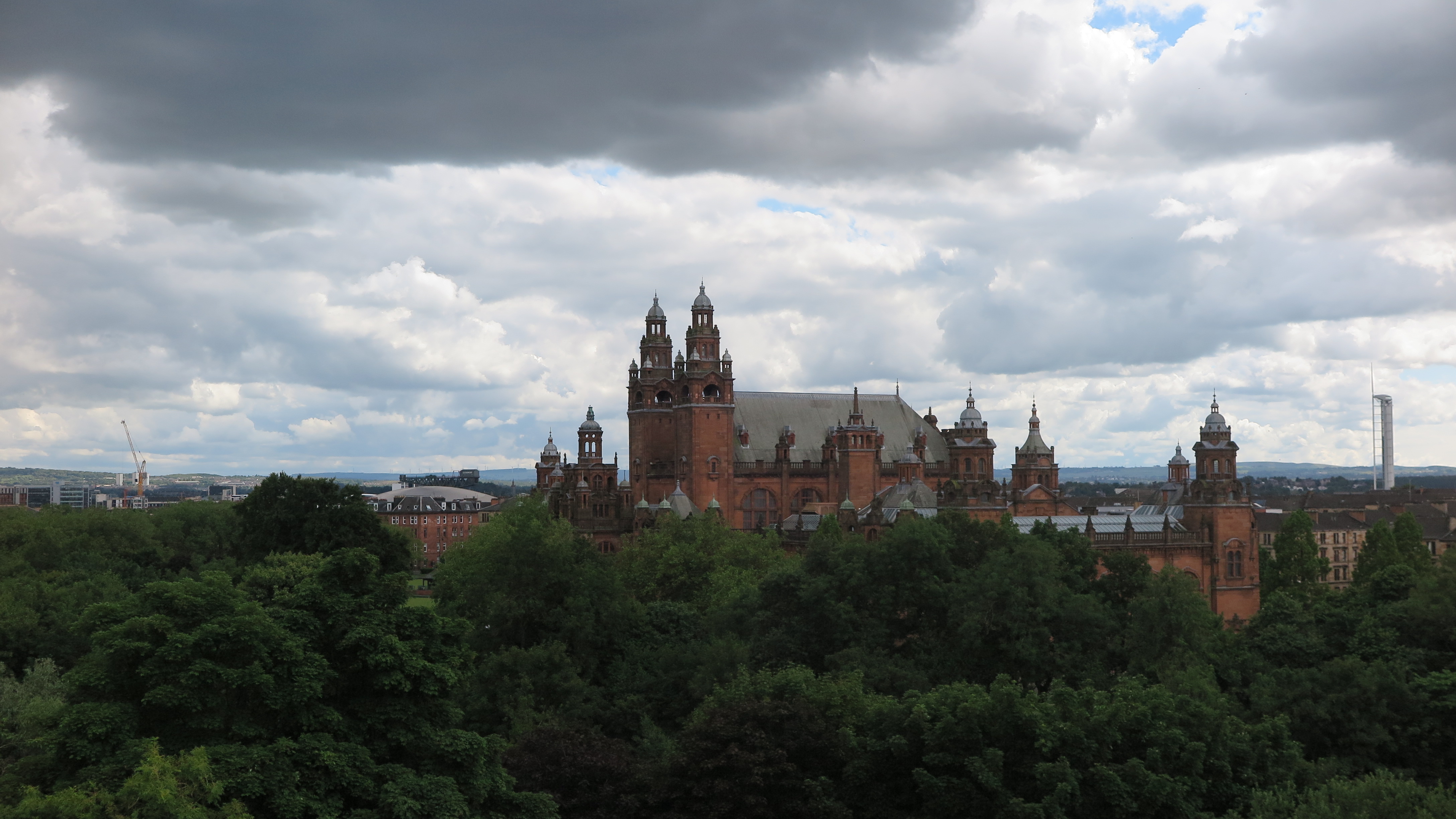

Views over Kelvingrove Park from University of Glasgow
During the recent coronavirus lockdown, like many people I have spent more evenings wandering around the streets of my hometown, and maybe paying attention to some details that had previously escaped my notice. Now 12 weeks in, I think I have now walked up and down each and every street, lane and park within a 5 mile radius of my house. One place I keep coming back to is the University of Glasgow building on Gilmorehill, either enjoying the views over Kelvingrove to the south, sheltering in the university cloisters, or just wandering about the various buildings. 

Western quadrangle, University of Glasgow
Cloisters, University of Glasgow

One of these buildings that I have looked at more closely than ever before is the James Watt Engineering Building. This sits just east of the main University building. The chemistry department was previously found here, but with the prevailing wind blowing from the west, their fumes were regularly being blown all over the main campus. So at the start of the 20th century the chemists were moved to new premises further to the west, leaving a prominent spot for the faculty of engineering to move in to.

I spent 7 years as a student at Glasgow University, and the James Watt Engineering Building was never one that I paid much attention to. Work started on it in 1899 and it was opened in 1901 by Lord Kelvin, to the north-east of the main Gilbert Scott building. Over time various extensions were added and between 1957-59 a further large extension was added, a functional, and rather non-descript building designed by architects Keppie, Henderson and Gleave. Its otherwise undecorated ashlar south-facing surface was decorated with a 30 foot high frieze carved in Portland stone. 

James Watt was born in Greenock in 1736 and was working as a mathematical instrument maker at Glasgow University on the High Street when he came up with the idea of his steam engine that would make his name. In recent times his name has been linked to the money his father made from rum, sugar and cotton produced by slaves on Caribbean estates. James Watt himself was also involved in a case of selling a slave boy to his new master in Scotland. More light has been cast on these facts in recent weeks as the spotlight from the Black Lives Matter movement spreads into previously overlooked aspects of our collective history. The "James Watt School of Engineering" at Glasgow University has been quick to flag up these issues on its website, whilst continuing to ally itself to the "innovative spirit of Watt".
James Watt (south) building in front of the main University of Glasgow building

The architects of this new building specified a relief sculpture of some kind should be an integral part of their design from the outset. The University authorities suggested that the subject of the sculpture should be "the development of engineering relative to the University". Their initial suggestion was for abstract shapes, inscribed with various important names and dates, "a unified composition of small units", rich in texture to match the Scott Gothic of the neighbouring University main building.

In the correspondence between the University authorities and the architect it is clear that the University quickly fear that none of their plans are being listened to and they complain that "the plaque is unlikely to seem a good £3000 worth", and that it does "nothing to tie the New to the Old as claimed." It would be fair to say that the building as a whole adds little to the beauty of the University of Glasgow campus, but it was the images on this frieze that caught my eye as I was walking past it today. 

James Watt building, south extension. Not the prettiest building on the university campus.

Eric Kennington - artist


A cursory look at the relief on the southern face of this building shows you that the finished sculpture bears very little comparison to the brief laid out by the architects. Entitled "The Progress of Science" it stands about 30 foot by 10 foot in size. Instead of describing the "development of engineering relative to the University" it in fact has only one scientist in it, who stands in Arabic robes, and lots of imagery from nature, religion and mythology. 
 
The Progress of Science, by Eric Kennington
The architects in their early reports to the University authorities described their plans for the sculpture and in their 1957 "Notes On Bas-Relief Sculptural Panel". With no explanation given, they recommended a "non-Scottish sculptor".They suggested Eric Kennington for the job, as the "British sculptor most likely to make an outstanding job of the panel."

In a letter to the architects from the assistant secretary to the University court, disquiet that the architects favoured Kennington to a Scottish sculptor, suggesting "What about Hew Lorimer or Benno Shotz?" Benno Shotz had recently completed a 15 foot high tablet on the side of the new chemistry building of Joseph Black, and Hew Lorimer was commissioned to sculpt the facade of the National Library of Scotland in Edinburgh. 

Joseph Black by Benno Schotz
In the end Kennington was given the commission for what was to be his final work. The work had to be completed by September 1959 for the official opening, and when Kennington took ill in June 1959 he headed back to England and his assistants, Eric Stanford and Archibald Robertson, who had been working alongside him for 2 months on the job, completed the sculpture. Kennington died, aged 72, before the work was completed.

Eric Kennington was born in 1888. After attending the Lambeth School of art he enlisted in 1914 and was injured while fighting on the Western Front. After 4 months in hospital he returned to France as a war artist. After the war he met T.E. Lawrence who had come to an exhibition of his paintings, and they became lifelong friends. In 1921 he traveled through Egypt, Palestine, Jordan, Lebanon and Syria drawing portraits or Arab subjects and many of these were used as illustrations in T.E. Lawrence's book The Seven Pillars of Wisdom

One of Kennington's illustrations from the 1935 edition of The Seven Pillars of Wisdom that belonged to my father-in-law
In 1935 he was one of T.E. Lawrence's pall bearers and sculpted the bust of Lawrence for his tomb. Throughout the 1920s and 30s he was increasingly working as a sculptor. During World War 2 he was again commissioned as a war artist, working mainly for the RAF. 
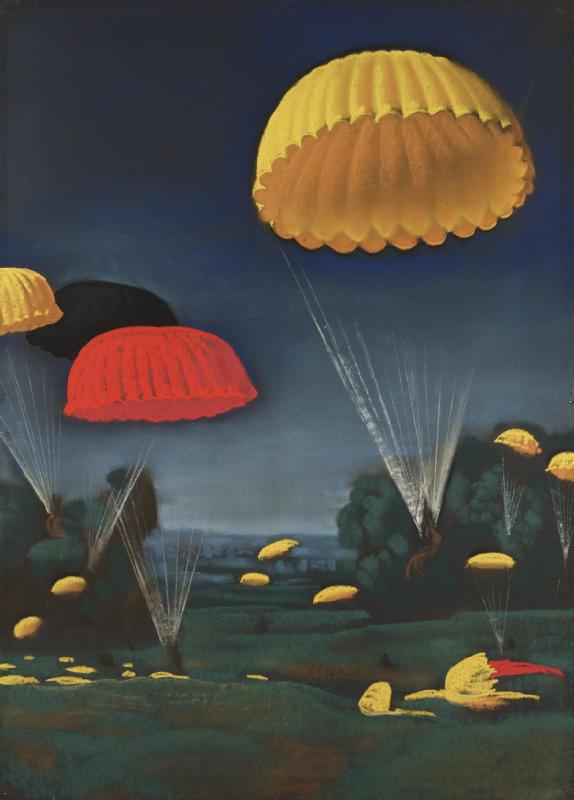
Parachutes, 1941, by Eric Kennington
After the war he continued to work and was elected as member of the Royal Academy. His sculpture for the University of Glasgow in 1959 was his last work. 

The Progress of Science

Top of Kennington's sculpture

The main features in his sculpture seem to have little connection to Glasgow, to science or to engineering. At the top stands Hermes, messenger to the Gods of Greece, with his winged feet, and his staff with entwined snakes about it in his right hand. As the Roman god Mercury he often carries his staff in the left hand, so I am going to stick with the Greek versions throughout. Also I suggest that a major source of ideas for the sculpture was Belgian scientist George Sarton. He is credited as largely being the founder of the discipline of the history of science. He wrote extensively on Greek scientists, such as in his book "Hellenistic Science and Culture in the Last Three Centuries BC". This book was published in 1955, just in time for any artist in 1957 who was looking for ideas for a work on the history of science to find inspiration.  

In this book he talks about one of the greatest scientists in the Greek world, Eratosthenes. Eratosthenes became chief librarian at Alexandria, he was known as a critic of Homer and he made some of the earliest calculations of the size of the Earth's circumference, and the tilt of the Earth's axis. He also wrote poetry, and Sarton quotes his Hermes as "his masterpiece. Such poems satisfied the scientific curiosity as well as the love of metrical words of the Ptolemic aristocracy." 

Beside Hermes can be found motifs from mythology and the natural world. Pegasus the winged horse, a swan, the sun with rays coming across towards an eagle, who seems to be bowing down. Above the eagle parachutes are falling, and Pegasus was the emblem of the newly formed British parachute regiment in the second world war. Is the eagle the German Reich succumbing to the British forces? A compass is found in the background here, and the word "PROGRESS".

Progress of Science, or memories of war?
To the left is found a kite (is this Benjamin Franklin's kite that he flew in a thunderstorm to experiment with electricity), and a quiver with an arrow (I can only guess that these belong to Artemis, goddess of hunting). A cloud of smoke adds to the mystery of this collection of items.

A quiver and a kite
Perhaps the clue is that Zeus, king of the Greek gods, and the god of thunder and the skies, stands in the middle here, ready to cast down a bolt of lightening, science explaining the mythology.

In the lower half of the panel the god Hephaestus stands at his anvil, below a volcano, with his other symbols, his hammer and tongs, in his hands. Hephaestus was the god of blacksmiths and metalworkers, forges, fire and volcanoes, artisans, stone masons and sculptors. Hephaestus epitomises George Sarton's life work, trying to combine the humanities and sciences. By creating a history of science he wanted to create a "new humanism". He felt that without science the humanities are incomplete, and without the arts, history, philosophy, religion that a life of science was empty. He looked for this in the world of ancient Greece, of Homer and in the medieval Arab world. Like Kennington he traveled around the Middle East as part of his work, learning Arabic as he sought to read original manuscripts of the Arab scholars.

Lower part of The Progress of Science
Carpenters' tools, farming implements, gears, chains and pulleys lie between the figures and below it all a boat that looks suspiciously like Noah's ark, floats on a sea filled with a whale and a shoal of fish. Other scientific instruments such as protractors, possibly an Archimedes screw, and a governor mechanism are dotted about. 

Also several words are seen. "PROGRESS", "PER MARE, PER TERRAS" (by land and sea - motto of the Institution of Engineers and Shipbuilders in Scotland), "SCIENTIA ET INGENIO" (motto of the Society of Civil Engineers), "DISCE DOCE" (learn, teach- motto of the Institution of Electrical Engineers). These mottoes hint that some of the symbols in the sculpture may be nods to the emblems of engineering societies - the swan way in fact be the crane from the Civil Engineers crest, the caduceus of Hermes, his staff, is found in the crest of the Electrical Engineers, as is the winged horse.

The one mystery that did have me scratching my head was the man on the left, standing atop some steps, his calipers measuring an orb of some description. Out of keeping with everyone else depicted he is in Arabic robes, a ghutrah or keffiyeh on his head, and a beard and moustache similar to those Kennington has drawn in his pictures for T.E. Lawrence's book, such as the portrait of Auda Abu Tayi above. This figure is the only one taken from history, and the only scientist depicted in the sculpture. 

The solitary scientist in the sculpture


Arabic scientist, but which one?
Again I have gone back to the writings of George Sarton to find out, as I suspect that Kennington found a lot to agree with in Sarton's book An Introduction to the History of Science. Over several volumes he had taken this from the time of Homer up to the 14th century by the time of his death in 1956. Like Kennington he traveled extensively in the Middle East in the 1920s as he investigated the area where many of our modern scientific ideas originated. As Professor Jim Al-Khalili points out in his book "Pathfinders. The Golden Age of Arabic Science" for 700 years the language of science was Arabic. Their scholars began translating the works of the Ancient Greek scientists and thinkers such as Euclid, Aristotle, Archimedes, and Ptolemy in the mid-8th century. They examined and improved some of these ideas with the technologies available in their time. 

The vocabulary of these ancient scientists survives in our English words, such as alkali, azimuth, alcohol, algebra, elixir, nadir, zenith, and alchemy. Ptolemy, the Greek mathematician and astronomer, wrote his Almagest, his theory on the movements and sizes of the planets and the sun. He laid out his ideas on celestial motions, his solar and lunar theories and catalogues the stars. His Almagest was translated into Arabic (and we still know it from its Arabic naming, 'The Great Book') and in the 9th century the caliph of Baghdad, Al-Ma'mun, commissioned a huge observatory to be built in Baghdad to allow his scientists to check Ptolemy's observations. With the necessary state funding behind them, a team of astronomers, mathematicians and geographers. They improved upon Ptolemy's observations and drew up charts of planetary motions and made more accurate estimates of the Earth's circumference. They also placed the Sun at the centre of the planets, with the Earth and other planets revolving around it. More accurate calculations of the Earth's circumference were made by Al-Biruni, using algebra to look to the distant horizon from the base and summit of a mountain. Born in Khiva in modern Uzbekistan, he was Persian, and wrote on physics, mathematics, anthropology, religious history, astronomy, and came up with te idea of dividing the hour into 60 minutes and seconds. His calculations on the circumference of the Earth are merely 1% out from modern measurements. Of the three giants of medieval science who all lived in the same era, Ibn al-Haytham who developed new theories of optics, Ibn Sina (Avicenna), the father of early modern medicine and al-Biruni, it is the latter who we see depicted by Eric Kennington with his calipers out, measuring the size of the Earth. In a book I suspect Kennington was reading due to their shared interest in the Middle East, George Sarton says in his Introduction to the History of Modern Science, the first half of the eleventh century was "the Age of al-Biruni".

We have here our scientist, al-Biruni, possibly

I think that this sculpture by Eric Kennington, his last work before his death, combines many elements of his life's work, his ideas and experiences. As a churchwarden in Checkendon, Oxfordshire he was a religious man and bible references can be seen in his work. He served as a war artist in both world wars and elements from that can be seen also, particularly his World War II experiences with the RAF. Parts of the sculpture try to connect the humanities and science, with classical references and the Greek god of sculptors prominently displayed. This is a theory explored by George Sarton, whose books were in circulation in the 1950s when the sculpture was conceived, developing a history of science, a similar task to that which Kennington was set. And finally we have the sole scientist portrayed in the piece being not a graduate of the Glasgow faculty of Engineering, nor a Copernicus, Einstein or Galileo but a man who would be little known to Westerners who had not spent time in the Middle East, or delved deep into the history of the Islamic world.

This therefore is my hypothesis of the motifs and characters portrayed on the sculpture of the Engineering building of the the University of Glasgow, based on my own observations and the limited evidence I have been able to find. I particularly must cite Roy MacKenzie's excellent book "Public Sculpture of Glasgow" (2002), which my mum picked up in a Brighton bookshop for £1. As with any scientific hypothesis please feel free to correct my mistakes with your own insights. 

I will leave the last words to al-Biruni, as he shakes his fist at those who would hide their own ignorance by mocking science and scientists, perhaps saying such things as "Britain has had enough of experts."
"The extremist among them would stamp the science as atheistic, and would proclaim that they lead people astray in order to make ignoramuses, like him, hate the sciences. For this will help him conceal his ignorance, and to open the door for the complete destruction of science and scientists."

Monday, 24 June 2013

15km Route Around Points of Interest in the History of Science in Glasgow

Run, Walk or Cycle Around the History of Science in Glasgow


The aphorism goes that "Glasgow built the Clyde and the Clyde built Glasgow". Basically this is saying that Glasgow deepened its shallow river to make it navigable to ocean going ships (in a scheme devised by James Watt). They made good use of this port city facing America. The wealth that the tobacco and cotton trade brought into the city led to an explosion in its size, its innovation and industrialisation. Further dredging and deepening of the Clyde led to the local resources that produced a booming steel industry to create a ship building industry and engineering expertise which has produced 25,000 ships on the Clyde and its tributaries. The city of 77,000 people in 1801 housed 784,000 people a century later. So in the end, the Clyde built Glasgow.

This growth went in tandem in the 19th Century with the city taking over Edinburgh's mantle as Scotland's scientific and engineering powerhouse. The city houses Britain's fourth oldest University, founded in 1451, which was the source of many important ideas, inventions, instruments and individuals in the history of science. However I think that there is scant evidence of these people in today's cityscape. When I was a student at Glasgow University we regularly had lectures in the ugly, utilitarian, concrete building on University Avenue near Byres Road called the Boyd Orr Building. Not once whilst sitting in there did I ever wonder who Boyd Orr was and this I think shows up one of the problems here, that the history of science in Glasgow gets very little commemoration or celebration. I can't remember there even being a plaque informing anyone wishing to know who the man was.
Boyd Orr building 1971 just after completion, partially-demolished tenements that used to line this part of University Avenue in the foreground
John Boyd Orr was born in Kilmaurs in 1880. He qualified from Glasgow University with degrees in arts, medicine and biology. A decorated veteran of the First World War he established the Rowett Institute in Aberdeen in 1919. His research was in nutrition issues and he was involved in the UN and peace organisations including CND. For his work he was awarded the Nobel Peace Prize in 1949. So there you go, the building is named after one of Scotland's 10 Nobel prize winners.

So to point out a few other names you may vaguely remember from school physics lessons, here is a wee 15 km route around some Glasgow science points of note that you may care to walk, run or cycle around. The route I came up with pretty much copies the National Road Race Championship 14.5km route used by the cyclists in Glasgow this weekend. It starts at Glasgow University, heads through Kelvingrove Park to Park Circus, then down through town to George Square. Next up Montrose Street and down High Street to Glasgow Green. If you missed the cycling then make sure you don't miss it when they return for the Commonwealth Games Road Race through the streets of Glasgow next year, it was a fantastic spectacle (here's a few snaps that I took on Sunday).

Let's start at the Boyd Orr building then. Co-incidentally this is the building in which I met another of Scotland's Nobel prize winning scientists when I was a student. James Black was a doctor and pharmacologist, born in Uddingston in 1924, he went to Beath High School in Cowdenbeath (alma mater of my mater-in-law and Ian Rankin, by the way). He established the physiology department at Glasgow University Vet School. Interested in the effect of adrenaline on the heart he developed the drug propranolol, the first beta-blocker and then later he developed cimetidine which revolutionised the treatment of stomach ulcers. These were two of the world's best selling drugs ever. He was awarded the Nobel Prize for medicine in 1988.

11 University Gardens
Whilst on this side of the road go up the hill a wee bit to University Gardens and just along from the QMU at number 11 (George Service House) is where Frederick Soddy (1877-1956) coined the term 'isotopes' whilst here at his father-in-law's house. According to the plaque hidden amongst the branches under a window "he introduced the idea whilst at a dinner party in this building." Soddy was an English chemist who lectured at Glasgow University from 1904-1914. During this time he also came up with other important theories about radioactivity such as the "displacement law" for alpha particle emission. He was awarded the Nobel Prize for Chemistry in 1921. A plaque commemorating his work is also inside the university's chemistry building so head there next.

Work on an extension to the Joseph Black Building in the 1950s halts whilst underground mine shafts are made safe. They can still be accessed from the basement of the Chemistry building apparently.
 Trot across University Avenue and back down the hill to the Chemistry Building, which since 1997 has been called the Joseph Black Building. A large plaque to Joseph Black (1728-1799) can be seen on the wall of the building facing University Place, a building which now carries his name. When he worked in the university it was still in its pre-1870 location on High Street. A medieval university it was part of a complex beside Glasgow Cathedral at that time.
Plaque to Joseph Black
Black was a physician, physicist and chemist who discovered carbon dioxide in air and developed the concepts of latent heat and heat capacity. These were important principles in steam formation - describing the extra energy required to change water from its liquid to gaseous state. In his experiments with steam engines he worked alongside James Watt.

The Botany Gate here is usually open and you can head into the University and back past the Kelvin Building of the physics department, past the Zoology building and left passing pharmacology, physiology and biochemistry. Head towards the main University building. Designed by George Gilbert Scott in neo-gothic style, it opened in 1870. Going left before the main building you'll enter Professors' Square. Lord Kelvin taught at the University in both its sites and you can see the house here that he used to live in, at No 11. This was the first house in Glasgow lit by electric lighting.
Lord Kelvin's house from 1870-1899
Go east towards the gates which commemorate the 500th anniversary of the university in 1951, with the names of various alumni of the Uni's past up there (but only one woman who was a wealthy benefactor rather than a graduate - Isabella Elder, owner of Govan shipyard). Behind this, looking for all the world like a war memorial lies a monument commemorating William Hunter (1718-1783) and his brother John (1728-1793), anatomists and surgeons born in East Kilbride.
Hunter memorial, University of Glasgow
William studied in Glasgow. He became famous as an obstetrician and anatomist and was physician to Queen Charlotte. He left his vast collection to Glasgow Uni which can be seen in the Hunterian Museum, the first public museum in Scotland, which currently lies in the building behind this monument. In the museum there is also a permanent exhibition on Lord Kelvin and some of his, Joseph Lister and James Watt's instruments on display and a marble statue of James Watt. If the Uni is open you can run down the back way, towards the south-east corner of the University where a gate behind the James Watt engineering building leads onto Kelvin Way. Here you'll find statues of two of Glasgow's leading lights. If you have to head back out to University Avenue instead, going towards Kelvin Way you'll pass a wee building on the right, the Pearce Lodge.
Pearce Lodge
This is one piece of the old university building that was salvaged from the High Street and transferred to the new university site (along with the Unicorn stairway in Professors' Square), funded by the wealthy owner of Fairfields shipyard at the time, Sir William Pearce. Across the road from here is the Rankine Building, which looks like a 70s car park with an abstract metal sculpture down one wall (by Lucy Baird which apparently draws on the history of civil engineering). This building houses the University Department Engineering. William John MacQuarn Rankine (1820-1872) was a contemporary of Kelvin at the University. He worked on establishing the science of thermodynamics, developed ways to solve the force distribution in structures and became a Professor of Civil Engineering at the university.
Statue of Lord Kelvin
Okay, so whichever way you came, halfway along Kelvin Way you'll find two statues on the right. The first statue is of Lord Kelvin. Belfast-born William Thomson (1824-1907) was made Professor of Natural Philosophy at Glasgow University aged 22 and carried on working at the university for the next 53 years. His initial interest in high science later turned to more practical engineering problems (which ultimately made him a wealthy man) such as the first trans-Atlantic cable and a marine compass design. He formulated the laws of thermodynamics and mathematically calculated "absolute zero", the scale of which immortalised his name in the units Kelvin. He took his name, of course, from Glasgow's second river, which runs nearby when he became a Lord, rather than the other way around. On the rear of his seated statue are some of his inventions which brought him his fame/wealth. He is buried in Westminster Abbey beside Isaac Newton.
Statue of Lord Lister
Seated a few yards away is a more elegant statue of Lord Lister (1827-1912), surgeon and pioneer of antisepsis. Joseph Lister worked at Glasgow Royal Infirmary where he used carbolic acid to clean wounds, surgeons' hands and surgical instruments to try to reduce the dangers of infection. He also used to spray it into the air with carbolic acid during surgery to clear the air, a concept which has fallen from favour. This was all based on contemporary work in Paris by Louis Pasteur on micro-organisms. The wards where Lister worked were demolished in 1926 although he is immortalised by this statue, the Lister Building at Glasgow Royal Infirmary, a disease named in his honour (Listeria) and of course, a mouthwash.
No 6 Park Gardens
Right. Head into Kelvingrove Park, past the fountain and up the hill going right when you come to the statue of a lion killing a peacock, towards Park Circus. If you've emerged at the correct exit you'll appear at No 6 Park Gardens. This is where Albert Einstein stayed briefly in 1933 (the year he decided he could not return to Nazi Germany) when he was in Glasgow to give a lecture and accept an honorary degree at the University. A photograph of him emerging from the door here can be found on the wall of the post office at Charing Cross.

Albert Einstein on the doorstep at Park Gardens (No. 6 not 5)

The MacEwan's house at No 3 Woodside Terrace, Glasgow

Carrying on along this road it becomes Woodside Terrace. Number 3 was home to eminent surgeon William MacEwan (1848-1924). He was a student of Lister and introduced the practice of wearing of white coats by doctors which could be sterilised. He is remembered for MacEwan's triangle and MacEwan's sign by surgeons. Do you like the high kerb for getting into your carriage from these swanky residences? Isabella Elder's grander house is now incorporated into the terrace further back here.

The Hooker house at No 10 Woodside Crescent, Glasgow
Further along the same road at 10 Woodside Crescent (it keeps changing it's name) a plaque marks the home of the Hooker family. William Hooker was Professor of Botany at Glasgow University and later first director of the Royal Botanical Gardens at Kew. His son, Joseph Hooker studied at Glasgow University and became the pre-eminent botanist of his day. He travelled the world bringing specimens back Britain such as the rhododendron (thanks for that one!) and was a close friend and the foremost defender of Charles Darwin and his ideas. Funnily enough one of the most pre-eminent opponents of Darwin's theory of natural selection was Lord Kelvin, proving that you can't be right all of the time.
No 17 Woodside Place, Glasgow. Home of Joseph Lister 1860-1869

Continue around the curve of the road onto Woodside Place where a plaque outside number 17 marks the fact that Joseph Lister lived here. From here head back to Charing Cross, just at the pedestrian bridge and go north up St Georges Road. A left once you come to West Princes St, then a quick right should bring you to the childhood home of Scotland's first Nobel Prize winner.
No 2 Queens Crescent, Glasgow, childhood home of William Ramsay

William Ramsay (1852-1916) was born at 2 Queens Crescent, Woodlands, now home to Visibility, an organisation helping the visually impaired. He won the Nobel Prize for Chemistry in 1904 for his discovery of the inert gases (argon, neon, krypton and xenon). Before heading into town swing past 63 West Princes Street (the yellow sandstone tenement in the background of the above photograph) where Marion Gilchrist was murdered in 1908. Oscar Slater was notoriously fitted up for her murder.

That's enough floating about the westend. Head towards George Square now in town. If you want to pass the Athenaeum Building at 8 Nelson Mandela Square en route you'll see one of the city's innovators most frequently immortalised in sculpture (he is remembered in at least 8 statues and carved portraits around the city - see footnote). On the left hand side of the building which is currently used by the Blood Transfusion Service is James Watt (1736-1819). With his hand on the shoulder of a youth he is sitting beside a steam condenser with a governor mechanism in his hand. So carry on to James Watt's statue in the south-west corner of George Square which I've mentioned in another blog (follow link for info/photo). James Watt was born in Greenock. Apprenticed in London as a scientific instrument maker he returned to Scotland to work at the University of Glasgow, on the High Street, aged 20. When asked to repair a Newcomen steam engine by Joseph Black (above) he came up with his own improvements. He apparently came up with the idea of a separate condenser whilst taking his regular walk on nearby Glasgow Green. His innovations revolutionised the efficiency of the steam engine and lead to incredible industrial advances. He also came up with the concept of "horsepower"and his name is immortalised in the SI unit of power, the watt.

At the south-east corner of George Square is a statue of chemist Thomas Graham (1805-1869) (see previous blog for photo). A graduate of Glasgow University he was an experimental chemist who did pioneering work on the idea of "dialysis" and gas diffusion. He developed "Graham's Law" on the rate of gas effusion. Whilst in this south-eastern corner of George Square you can look over to the City Chambers where standard measures to ensure fair trading in the city can be found, for use by merchants, surveyors, architects and builders. Marked in the ground of George Square are also the standard measures for 100 feet and for a "chain" (which is 66 feet, or 22 yards, or 100 links, or 4 rods and 10 chains make a furlong).
Standard measures in George Square, Glasgow
If you head out the north-east corner of George Square along George Street, and then head left, up the steep hill of Montrose Street (not that Mark Cavendish seemed to notice the incline) you'll see on the right a gap-site with a sculpture by George Wylie of a large nappy pin, the site of the former Glasgow Royal Maternity Hospital, or "Rottenrow" as everyone called it. One of the things every pregnant mother takes for granted now is that they'll get ultrasound scans during their pregnancy or in an emergency, but this is really quite a recent innovation. An engineering company which was originally set up by Lord Kelvin, worked with Ian Donald (1910-1987), Professor in the University Department of Midwifery to develop it here. Ian Donald had an interest from his service with the RAF during the war in sonar. On a visit to Babcock's boilermakers in Renfrew, Ian Donald saw ultrasound being used to look for flaws in metal and he developed a system for using it to look into the human abdomen, and thus, diagnostic ultrasound was born.
The entrance to Rottenrow Royal Maternity Hospital leads to nowhere now
Get to the top of the hill and turn right towards Glasgow Royal Infirmary. Although the hospital was opened in 1794, the building facing you was opened in 1914. If you care to wander around the back near the cathedral you can see that it was built pretty much on top of a graveyard. A plaque on the wall facing Castle Street, just to the left of the Gatehouse Building marks where Lister's wards stood until they were demolished in 1924.
Plaque marking the surgical wards of Joseph Lister at Glasgow Royal Infirmary
So heading south from here down Castle Street you are in the oldest part of the city with the cathedral on your left, which originated in the late 12th Century. The Provand's Lordship built in 1471, on the right hand side of the road here is the oldest house in Glasgow.
Monuments to Wee Willie Winkie and Lord Kelvin in Glasgow Necropolis
If you fancy a quick 200m detour, then pass the statue of Blantyre's famous medical missionary, David Livingstone, that stands in front of the cathedral and go over the "Bridge of Sighs" to the necropolis. Although Lord Kelvin isn't buried in the family plot, as his body lies beside Isaac Newton in Westminister Abbey, a recently erected memorial stone commemorates him. This is just to the left on entering the graveyard and slightly uphill of the memorial to the author of the nursery rhyme "Wee Willie Winkie", William Miller. Oddly enough what they both have in common (along with John Knox who stands atop the hill here) is that neither of them is buried in the necropolis.

Glasgow University was founded in 1451 in the cathedral precinct, and moved further down the hill in 1460 to its High Street site. The bishops of Glasgow served as Chancellors of the University for around 200 years. After 400 years situated here, with the advancement of industrialisation and the encroachment of factories on the site (and I suspect the encroachment of slum housing) they moved to the leafier surrounds of Hillhead in the westend in 1870. The 17th Century university buildings were all demolished to make way for a railway terminus and goods yard. After lying empty for years the land here is currently being redeveloped under the name "Collegelands". This development seems to be the final nail in the coffin for what claims to be Glasgow's oldest pub, the Old College Bar, which is marked for demolition and takes its name from its location beside the old university site. Do you think Lord Kelvin ever popped in here for a quick half?

One innovation that the College building did have was the first lightning conductor in Glasgow, fitted in 1772 by Professor John Anderson under the direct supervision of Benjamin Franklin himself who was in Glasgow at the time. If you carry on down the hill you'll come to the Saltmarket entrance to Glasgow Green. This was the site of public executions until 1865. Glasgow Green had previously housed an early golf course too and is where Rangers Football Club was founded. If you head towards the obelisk, you'll be at Nelson's Column, Britain's earliest public monument to Lord Nelson, erected in 1806, only a year after the Battle of Trafalgar. As 20 foot of it was destroyed by a lightning strike in 1810 it is clear that it still hadn't been realised that there was a wider need for lightning conductors. By 1824 the only buildings in Glasgow which had been fitted with them were the College building, the jail and the Lunatic Asylum.

In 1746 Bonnie Prince Charlie tried to revive the Jacobite cause, rallying his troops at Fleshers' Haugh on the Green. 19 years later James Watt was wandering here when he came up with the idea of a separate condenser for the steam engine. As he wrote in a letter to a friend that "on a fine Sabbath afternoon, in 1765...I had walked no further than the golf-house when the whole thing was arranged in my mind." And thus on this spot the whole course of the industrial revolution changed. To mark the alleged spot where this idea came to him, just on the south side of Nelson's Column there is a stone marking the occasion. The stone reads "Near this spot in 1765 James Watt conceived the idea of the separate condenser for the steam engine patented 1769".

So as the nineteenth century academics did, now head west via one more detour. Choose your favourite bank of the Clyde to run 4km along to the titanium clad Glasgow Science Centre. The north side is a bit more scenic I think - when I ran along it today somebody stopped me to show me two salmon he'd spotted swimming in the Clyde at Jamaica Bridge. The Science Centre is where you start to scratch your head and wonder where in today's Glasgow are all those engineering masterminds of yesteryear. The £10 million Science Centre Tower, Scotland's highest "building" is supposed to rotate on ball bearings in the wind....but it doesn't work, and apparently never will (BBC news). I have been up it on one of the few days that it was open and have a, presumably rare, certificate to prove it. It has a wee cramped, pokey space at the top, the view is marred by the grainy windows, basically don't rush when it re-opens. The Science Centre itself is a good day out for children, plenty of hands on things purporting to teach scientific principles and I would go more often if it didn't cost £44 at present for my family to visit. Ouch! One interesting section in it is an explanation of John Logie Baird's (1888-1946) early design to transmit what we now know as television pictures. Born in Helensburgh he studied at Glasgow Technical College and Glasgow University.
Glasgow Science Centre and tower, by the River Clyde
If you follow the cycle path on the north of the Clyde along to the Transport Museum, then veer off to the right you'll come out near the bottom of Byres Road, and that's you back to the start. To see a map of this route see mapmyrun.com

Q. Can you think of the other seven Scottish Nobel Prize Winners which I didn't mention above? (See below)

Q. There are apparently only three women commemorated in Glasgow by statues. Having just ran this route today I've realised that it passes 2 of them and the house of the third. Who are they? (See below)

Much of the info on the westend locations was found on a blogpost by Ian Mitchell "Glasgow's Square Mile of Science". I also got info from Ray MacKenzie's book "Public Sculpture of Glasgow".
The two old photos of the University are from the University Archive. The other photos I've taken myself on a not very sunny day.
Any mistakes are entirely mine and let me know if you find any I should change.

Footnote 1 - those other Scottish Nobel Prizewinners

  • Alexander Fleming (Nobel Prize for Medicine 1945) discoverer of penicillin
  • Arthur Henderson (Nobel Peace Prize 1934) Labour politician, born in Anderston in 1863 and president of the League of Nations 1932 disarmament conference
  • John James Rickard MacLeod (Nobel Prize for Medicine 1923) born near Dunkeld in 1876, he was part of the team working in Toronto alongside the more famous Banting and Best which discovered insulin. This later allowed treatment for people with diabetes, which until then had been a fatal disease
  • James Mirrlees from Kircudbrightshire (Nobel Prize for Economics in 1996) for his work on "incentives under asymmetric information"
  • Ronald Ross (Nobel Prize for Medicine in 1902), eldest son of General Sir Campbell Claye Grant Ross, born in India in 1857, discoverer of the mosquito transmission of malaria.
  • Alexander Todd (Nobel Prize for Chemistry 1957) student of Allan Glen's School and Glasgow University, later worked on nucleosides (which are in DNA), synthesised ATP and elucidated the structure of various vitamins.
  • Charles T. R. Wilson (Nobel Prize for Physics 1927) from Midlothian who invented the cloud chamber in which the actions of ions can be observed, inspired from his work in an observatory on Ben Nevis

Footnote 2 - those other James Watt statues in Glasgow

  • there may be more, but above I've mentioned the marble statue of James Watt inside the Hunterian Museum, the statue on the Athenaeum Building at Nelson Mandela Square and the statue in George Square
  • one report I read says that the figure on the frieze to the right of the main doors of Glasgow City Chambers representing engineering is of James Watt
  • Strathclyde University have a sandstone statute of him in the foyer at the former Royal College, 204 George Street
  • James Watt can also be found atop the Clydeport Building at 16 Robertson Street in the Broomielaw, with one hand on that bloody "separate condenser" again
  • his face is one of the many adorning the first floor of "Connal's Building", 34-38 West George Street, on the Dundas Street facade
  • a sandstone sculpture of him is in the Winter Gardens enclosure alongside the People's Palace. This one (of him standing leaning on a condenser) originally stood over the gateway of M&J Martin's Atlantic Mills leatherworks in Bridegton. It was moved to a McPhun Park on the Green on their demolition and until it was renovated and moved to its current location, spent several decades without a head
  • on the former Glasgow Academy, then High School then Strathclyde House building at 94 Elmbank Street a statue of James Watt stands in eclectic company. Cicero, Galileo, Homer and James Watt. ("A Scotsman, a Roman, a Greek and an Italian walk into a bar....")
  • finally of course there is the boulder in Glasgow Green where he found his inspiration
  • Watt Brothers department store on Sauchiehall Street was not named to commemorate James Watt's achievements

Footnote 3 - those woman in statues

In George Square you'll pass Queen Victoria astride her horse, then down by the Clydeside is a statue of the Spanish Civil War Republican leader, La Pasionaria, Dolores Ibarruri. Also at Park Circus the route passes the former house of Isabella Elder, owner of Fairfields Shipyard who has a statue in Elder Park, Govan. There may be others, if I've missed any out, let me know.