Your Complete Guide to the Disused and Abandoned Railway Lines of the West of Glasgow - Autumn 2017
Many of the world's city centres are grinding to a halt due to traffic congestion. Pollution levels are climbing due to the effects of the internal combustion engine, and Glasgow has two of the most heavily polluted streets in Scotland on recent measures, with Hope Street and Dumbarton Road getting unwanted spots in a recent top ten list. Improved public transport is often mooted as the best way forwards, so it seems a shame that whilst many cities have built urban tram systems and expanded their underground rail networks, modern Glasgow has a public transport system that seems to be a shadow of its former self. It was again suggested recently that there should be a serious look at expanding the Glasgow underground system.
A network of old train tunnels still lies below the city streets, and are often talked about as potential routes for a new system. I have tried to have a look at what remains of the old rail infrastructure of Glasgow.
I know that there are many old railway cuttings and tunnels in the east end too, but this will focus on the pathways of the west end of Glasgow where I have grown up, and where I have noticed strange boarded up tunnels, cycle paths going over heavy duty iron bridges and several mysterious former platforms. My aim is to try and sort out in my head how this all used to join together.
The Glasgow Subway is not a sandwich shop
Subway - There are 157 cities around the world that can boast an underground rail or metro system. As the third city in the world to build one (after the London Underground and the Budapest Metro), the Glasgow's Subway, built in 1896, is one of the oldest in the world. However whilst the rest of the world kept building and expanding their networks, once we got to 15 stations serving the city centre, we stopped.
Tram to Maryhill, in Glasgow Riverside Museum
Tram - Many cities in the north of England run efficient, modern tram systems. Edinburgh seems alone in managing to make a complete hash of installing one, which should not act as a deterrent to other cities' plans. Glasgow was ahead of the game here too, with over 100 miles of tram lines in the city by 1922, carrying over 1000 trams. By the 1960s it was decided that cars and diesel engined buses were the future and the last tram ran in the city in 1962. Proposals have been put forward to build a new tram-train link between Glasgow Airport and the city centre. I would love to see it being a great success, as the other recent tram line proposals in Glasgow (between Maryhill and Easterhouse and along the Clydeside to the new Queen Elizabeth Hospital) have come to nothing. All that's left now of the old tram network are a few supports for overhead electrical cables on the side of tenements here and there and scraps of tracks in the odd un-tarmacked stretch of road. There is still a great affection for the old trams in Glasgow, although at present you need to go to the Riverside Museum to see them now, or to Summerlee Museum in Coatbridge if you want a short hurl in one.
Buses on Renfield Street, Glasgow
Bus - Ever since Margaret Thatcher de-regulated bus services they have been run by private companies for profit, rather than as part of an integrated transport scheme planned by local authorities. This can mean several companies competing for the profitable routes and local needs taking a back seat. Complaints of poor reliability, over-priced and over-crowded buses are common. As a major contributor to the pollution in city centres, new regulations are being brought forwards to force change upon the bus companies. What was once viewed as the modern transport solution is now part of the problem. The main effect of bus de-regulation was that across the country bus passenger numbers have fallen dramatically - except in London, where passenger numbers continue to climb, perhaps because de-regulation was blocked in London.
Detail from a 1951 map of the Glasgow rail lines. Click to expand
Train - The first train lines in Glasgow were built to deliver coal to the growing city and its industries. More train routes in Glasgow emerged as the city grew. Much of this was fed by the growth of various industries, with passenger services and freight lines serving stations for eg Dawsholm Gasworks, iron works in Possil and Maryhill or the Clydeside shipyards. With competing companies often duplicating routes and with the rise and fall of various industries the number of lines and stations in Glasgow has gone up and down. The most dramatic fall was in the 1960s with the swingeing Beeching cuts to the rail network. In Glasgow this led to the closure of many lines and stations, including the large St Enoch and Buchanan Street stations. Since then several once closed old lines and stations in Glasgow have been re-opened and the idea of re-using some of the old underground tunnels has often been floated as a way to improve our transport links. However as time goes on, more of these lines are being built upon, making their re-appearance increasingly unlikely.
Current train lines in the west of Glasgow
Old train lines added in red to this map of Glasgow. Click to expand
Many of these old train lines are still empty, overgrown gap sites. Others are known to dog walkers, cyclists and joggers as quiet paths between the city streets. Having noticed disjointed hints of former rail lines all over the place, I hoped to spend a couple of days trying to see how much of this old infrastructure is still there, before it is all obliterated under huge blocks of student flats.
NB - Going anywhere near live train lines is incredibly dumb and runs the risk of death from trains breaking all your bones, electrocution or at the very least, a £1000 fine for trespass. Nowhere on these jaunts have I gone near current train lines, and the couple of tunnels mentioned below which do lead into existing lines should be avoided at all cost.
Kirklee Station to Kelvinbridge
Firstly I would like to point out that I am no cartographer and these wee maps that I have drawn up are purely to give an indication where the old train lines are, they are not 100% precise. Also train lines, names and stations were opened/ closed/ changed over time so really there is no point in time that all the stations mentioned here were operating together as described by me.
I will start at Kirklee Station as that was where I was a couple of weeks ago when I meandered down the line to see where it took me. Kirklee Station (also called Kirklee for North Kelvinside) was opened in 1896 and the line was run by the Caledonian Railway until the station closed in 1939. The line continued to run until 1964. The red sandstone station building was demolished in 1971 and modern flats stand where it once was on the northern side of Ford Road. The station platform ran across a bridge into the Botanic Gardens where the platform can still be found.
Former Kirklee Station building
Kirklee platform straddled Ford Road here, but the bridge has now gone
Wall at the end of the old Kirklee platform in the Botanic Gardens,
modern flats beyond stand where the station building previously stood
Looking down from among the shrubbery in the Botanics you can see the former train line enter a tunnel and the line then ran all the way under the Botanic Gardens. It then went underneath Great Western Road, briefly re-emerging into the open air at Kelvinbridge.
In the Botanic Gardens looking down the the tunnel entrance under the park
Tunnel entrance at old Kirklee Station, the tunnel heading south under the Botanic Gardens
Not much light in the tunnel as it bends up ahead
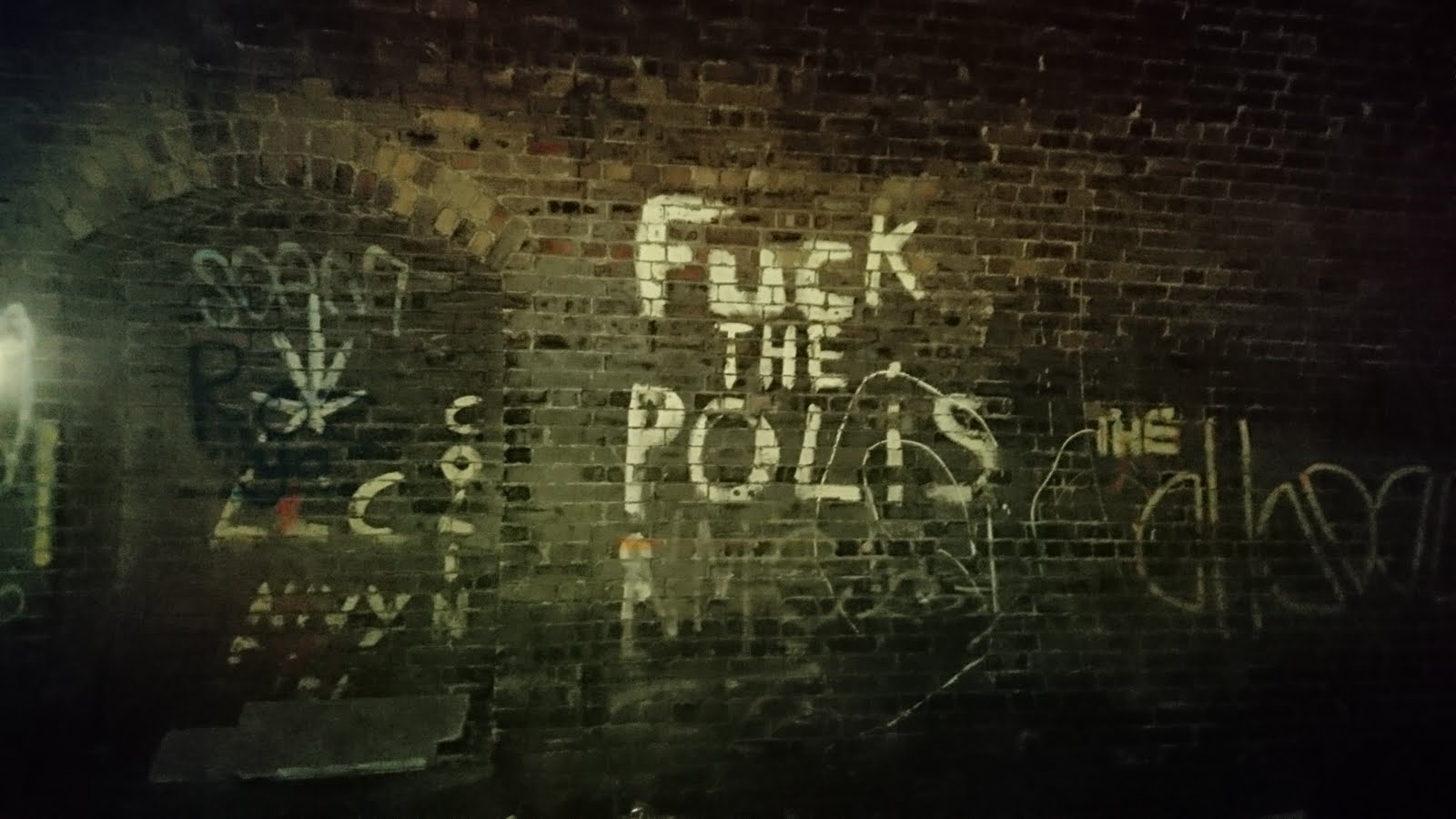
Some of the tunnel graffiti
As you walk along the tunnel the light you see up ahead is from the Botanic Gardens station. The station entrance was above ground on Great Western Road, with the platforms underground. As these were steam trains running along here there are large ventilation shafts overhead, from which you can peer down into the station from the park above.
Botanic Gardens Station ahead
End of the tunnel, when viewed from the park above
Looking down into the ventilation shafts of Botanic Gardens station from the park above
Botanic Gardens station building in 1969
From the platform, the remains of the stairs leading down into the station
Botanic Gardens station platforms
Botanic Gardens station platforms
Art work below ground at Botanic Gardens station
Botanic Gardens station platforms
Botanic Gardens station was opened in 1896 and closed in February 1939, three months before nearby Kirklee Station. After the station closed the handsome station building on Great Western Road served many purposes, housing a plumber's shop, the Silver Slipper cafe that my mum frequented and Sgt. Peppers nightclub. In March 1970 fire badly damaged the building, and the decision was taken to demolish it. Leaving the Botanic Gardens the train tunnel continues underground along Great Western Road to Kelvinbridge station.
Girders support the tunnel roof here as it leaves the station, underneath the junction at the top of Byres Road
A long tunnel eventually emerges into the open air behind the red sandstone "Caledonian Mansions" flats. Kelvinbridge station opened in 1896 and in 1901 was the main station used to take visitors to the Glasgow International Exhibition in Kelvingrove Park. The station continued for passenger services until 1952, and continued for freight until the line closed in 1964. The goods yard lay where the car park for Kelvinbridge subway station is now found. Four years after closing the handsome station building which stood up above Otago Lane was destroyed by fire. When Caledonian Railways bought the land to build the tunnel they also built the handsome flats on it up above which carry the company name and also on one wall, the "CR" company logo. After bending along the banks of the River Kelvin for a couple of hundred metres, the line then goes into a tunnel under Kelvingrove Park.
Under Great Western Road a name plaque of Bank Street above helps orientate you
Caledonian Mansions on Great Western Road
The tunnel emerges beneath the back courts of Caledonian Mansions
The tunnel entrance viewed from above from Caledonian Crescent
Up above only a few fragments of ornate sandstone cornice survive from the station building
The platform emerges from under the former tunnel onto a short bridge over the River Kelvin
The train line came from the station, along the east bank of the
River Kelvin before disappearing into a tunnel under Eldon Street/Gibson Street
The north end of the old Kelvinbridge station platform
In the darkness of the station platform the remnants of the staircases climb up to the former platform
Kelvinbridge Station in all its former glory
In this 1969 picture workers clear the debris from the demolished station, into the river by the looks of things.
Note the path along the Kelvin in front of what is now Inn Deep bar does not yet exist.
Heading south below Eldon Street the line heads next into a tunnel beneath Kelvingrove Park
The routes of the rail tunnels can be found on this old map
The tunnel underneath Kelvingrove Park is now soundly locked up but this tunnel and the one underneath Yorkhill were common venues for illegal raves in the 1990s. If you were to wander into it today, you would travel under the length of Kelvingrove Park and Kelvingrove Street and emerge south of St Vincent Crescent briefly.
As you can see below the old Caledonian line you will have been following is here crossed by the live line between Partick and Charing Cross stations (the relative height of the two lines has changed over time) before it then enters another tunnel. To the south of here it used to join the line at the Stobcross Junction below ground, roughly where the current Exhibition Centre train station is today, on the Partick to Anderston/Central Station line.
Looking down from St Vincent Crescent onto the former Caledonian line
Again from St Vincent Crescent looking down to the current train line,
with the old Caledonian line crossing at right angles
From Minerva Way looking north into the foliage filled former train line
Partick Central to the Yorkhill Tunnel
Partick was formerly served by three train stations, none of them on the site of the current Partick station on Merkland Street. On a line that ran from Stobcross to Dumbarton serving the industries along the north bank of the Clyde such as Scotstoun, Yoker, Clydebank and Bowling, Partick Central railway station was built in the 1890s. In 1959 it was renamed Kelvin Hall station and passenger services stopped in 1964. The sidings still functioned for another 14 years serving the scrap merchant and oil depot on the site and the site was used by travelling people and a scrap merchant until recently. After Tesco lost their planning permission to build a superstore here massive blocks of student flats now fill the site and the former train cuttings have been obliterated. Interestingly archaeological surveys before the flats were built discovered that this was the former site of Partick Castle.
Partick Central Station in 1955, looking east with Castlebank Street on the left
Ongoing construction of flats on the former station site. The train from the west entered under this bridge and curved round beside the bank of the River Kelvin
Former Partick Central station building
Before receiving planning permission for their store on the site, the station building was cleared without warning one weekend in 2007
Position of the former station building, with the platforms below the bridge here at Benalder Street
Iron pillars of the former station
Platform of Partick Central station
The end of the platform can be found to the east of Benalder Street down by the River Kelvin
After leaving Partick Central station, trains heading east towards town would cross over the River Kelvin on a low bridge, and then into the opening of the Yorkhill Tunnel. The way in was previously visible at this point but a large block of student flats here on Old Dumbarton Road now seems to cover the entrance.
Rail bridge over the River Kelvin, Glasgow University tower in the background
Disused rail bridge over the River Kelvin at Partick
The entrance to the Yorkhill tunnel lies in that direction, below these modern flats
The line would emerge south of Yorkhill below the Drill Hall on Gilbert Street. An overgrown bit of wasteland between Gilbert Street and Kelvinhaugh Street is all that remains of this short stretch, now back-filled. A hump in the road at Kelvinhaugh Street (below) shows you where the line then went underground again , shortly to join the current train line, roughly where it splits now towards Anderston or towards Charing Cross Stations.
Train line passes underneath Kelvinhaugh Street, then under another huge complex of student flats
Partick West then north to Kelvinside station
After passing under a tunnel at Merkland Street, the line west from Partick Central would soon come to Partick West station. Much of the line here was obliterated by the building of the Clydeside Expressway. Here the line split to head either west towards Dumbarton, or north up through what is now Thornwood Park. The area where the station was and the triangular train junction now lie underneath the new Partick Police Station. The line north has been developed into a park above Dumbarton Road and modern flats higher up the hill. The disused rail bridges here over Dumbarton Road were not removed until much later as I remember looking out the window of my aunt's flat on Dumbartron Road in the 1970s onto one of them.
At the lower end of Meadow Road, Partick a wall that used to carry the train line vanishes under the expressway
Some scraps of sandstone walls from the area around Partick West station are all that remain
Thornwood Park, with the curved sandstone wall on the eastern side that marks where the former train line headed north
The train line headed north, where these modern flats on Thornwood Avenue now stand
Just North of Crathie Drive, Thornwood, the former train line heads into a tunnel
As the hill here climbs the train line entered a straight tunnel for about 100 yards, just north of Crathie Drive. The tunnel goes underneath Cross Park and Crow Road and emerges briefly before going under Clarence Drive near Broomhill Cross. Under the road here Crow Road Station can be found. The station building would have been on Clarence Drive, opposite what is now a couple of garages.
Tunnel under Thornwood/ Broomhill
The northern entrance to the tunnel, below Crow Road, near Broomhill Cross
The platform of Crow Road Station beneath Clarence drive
The platform of Crow Road Station beneath Clarence drive
From Crow Road station the line followed an open cutting north, behind the houses on Chuchill Drive, until it went under another train line, close to where present day Hyndland station is found. Crow Road station was open from 1896 until November 1960, when it closed the day after the new Hyndland station was opened. North beyond Hyndland station the former line is no longer apparent below a complex of modern flats, until it reaches the former Kelvinside station, on Great Western Road beside Gartnavel General Hospital. The former station building here operates as the bar and restaurant 1051 GWR. Despite the extravagant building the station was being little used by the time of its closure in 1942, two decades before the line closed. The building has been damaged several times in the past by fire. The one I remember was in 1995 as I was working a night shift nearby when I heard an explosion in the middle of the night, not finding out until the next day that this was Carriages (as it was called then) going up in flames.
Pedestrian tunnel to present day Hyndland station
The rear of the former Kelvinside station where the stairs would have gone down to the platform.
An old photo of Kelvinside station shows that the train line was down in a deep cutting
Now open as 1051 GWR
Below the station the line entered the Balgray tunnel to head north towards Kirklee station and Maryhill.
There is currently a shopping trolley in the Balgray tunnel under Kelvinside station
On a separate line from the one I've been following above lay the third Partick station, this one actually called Partick station (although it changed its name to Partickhill station in 1953). Opened in 1874 by the North British Railway Company on the north side of Dumbarton Road, trains from here ran north to either (old) Hyndland station or Jordanhill or Anniesland. When the Argyle line was re-opened in 1979 a new Partick train station was built above the Merkland Street subway entrance and Partickhill station closed. The station buildings stood until 1997. The entrance to the station can still be seen on Dumbarton Road, under the rail bridge, beside what was formerly Woolworths.
Old Partick station platform is visible from current Partick platform, looking north up the line
Entrance up to the old Partick train station, on Dumbarton Road
Looking up the stairs towards the station platform
Heading north a branch of the line curved east when it crossed Clarence Drive, and followed the bend of Hayburn Lane until it reached Hyndland Road. At the end of the line here was Hyndland station. Opened in 1886 this was a busy station which continued to run until 1960 when the new Hyndland station opened. The station building was demolished in the late 1960s. The space here continued to serve as a depot for electric trains until 1989, and has recently been refurbished by local groups as "Old Station Park".
Hayburn Lane, the line ran behind this wall.
Hyndland Station, past and in its present guise, the chimney at Gartnavel visible in both pictures
Hyndland station's grand building on Hyndland Road
Whiteinch Victoria Park to Jordanhill
The Whiteinch Railway was built in 1874 as a goods line for the new industries developing in the area. In 1897 the station was rebuilt as Whiteinch Victoria Park, to take passengers north, in a line paralell to Westland Drive to Jordanhill station. Entered at Dumbarton road, the station has now all gone underneath road redisign and a housing development west of Victoria Park bowling club. However you can follow the line north to where it joined the main line in Jordanhill, a path well known to dog walkers in the area. In 1951 the station closed but was used for another 16 years as a depot.
Whiteinch Victoria Park station
The line heads north below a bridge carrying Danes Drive, now a nature walkway
Bridge carrying Danes Drive
Below Danes Drive
The path north follows the contours of the former rail line
The old rail line comes up to the current line near Jordanhill station underneath Westbrae Drive
Whiteinch/ Scotstoun Cycle Path
The Caledonian Railway line that left Central station through Partick West would then head along the north bank of the Clyde towards Balloch and Dumbarton. It ran in an elevated position above South Street, easy to imagine as the route is now a cycle path and walkway. Other train sidings at street level served the shipyards, cattle byres and granary buildings on South Street. Opened in 1896 Whiteinch (later Whiteinch Riverside) was the first station you came to, which stood just where you join the cyclepath from South Street. The next station was Scotstoun East at the bottom of Scotstoun Street, where an impressive station building can still be seen below the bridge that carried the platform. Scotstoun West station is in Yoker, just where the line crosses Dumbarton Road on a bridge. It was a successful line carrying goods traffic and workers to the industry along here, but with the decline of these industries the traffic fell. With the nearby North British Railway line electrified, this line closed in 1964.
Whiteinch Riverside station
Up on the old line in Whiteinch
Platform of Scotstoun East station, with a dookit now on its western end
Platform edge
Entrance to Scotstoun (later Scotstoun East) station below the line
Scotstoun East station, on Fore Street
Dawsholm to Maryhill and Possil
At the end of the 19th century there were a lot of important industries at Dawsholm - textile printing works, a large corporation gasworks and associated chemical industries. The station at Dawsholm only served as a passenger station until 1908, but a six-road engine shed was built here which continued in use until 1964. On leaving Dawsholm the line immediately crossed the River Kelvin on a handsome bridge with many arches. The line then splits to go right towards Kirklee station, or left, back over the River Kelvin towards Maryhill (later Maryhill Central) station.
Arches of the rail bridge above visible in the bottom right corner of this 1939 photo of Temple and Dawsholm gasworks
From the gasworks bridge piers cross the River Kelvin
From beside the Kelvin a bridge crosses over Kelvindale Road and back across the Kelvin again
The northern end of the bridge can be seen on one side of Kelvindale Road
Looking down the River Kelvin from the road bridge on Kelvindale Road, you can see the remnants of the old bridge that carried the line into Dawsholm
If you are walking along the Kelvin walkway behind the Wynford, you will see two bridges high above the river. These took the line from Maryhill Central station (now vanished below the Tesco superstore on Maryhill Road) sweeping right towards Dawsholm, or left, over the more substantial looking stone bridge) to Kirklee station.
Bridge over the Kelvin between Dawsholm and Maryhill
From the Kelvin Walkway looking south towards the two bridges, the straight pillars of the line to Dawsholm advertising Maryhill Fleeto, the arches of the bridge to Kirklee behind it
Looking at one bridge and the Kelvin below, from the other
The elegant bridge between Kirklee station and Maryhill Central
The Kelvin Walkway goes under the bridge
Over the bridges the lines converge and the cutting they took can be followed until it enters a bridge under Garrioch Road. On the other side of the bridge the line lies below the carpark of the Tesco superstore. Present day Maryhill station out near the Ram's Head pub, is on the site of the first station in Maryhill, opened in 1858. The Lanarkshire and Dumbarton line Maryhill station opened as Maryhill Barracks station, in 1894. The line was used by the local barracks to transport soldiers and their equipment. The name later changed to Maryhill station, then in 1952 this station became known as Maryhill Central. The station closed in 1964. When Maryhill shopping centre was built in the early 1980s a void was maintained in the basement to allow the line to be re-opened in the future. However, since 1999 the land along many sections of the line has now been sold for housing and there will not be trains running again along here anytime soon.
Tunnel heading under Garrioch Road
Iron balustrade on the Garrioch Road bridge
The road surface has been raised on the other side of the Garrioch Road bridge and the station and line filled in below Tesco and its car park
The line then passes under Maryhill Road and can then be traced behind the Gala Bingo. The bingo hall was built just north of the line of the train track to allow it to be re-opened if required. The line lies below the car park and as it goes into a tunnel beneath the Forth and Clyde Canal behind the bingo and into Ruchill, you can only see the top of the tunnel entrance behind the shrubbery, the tunnel filled in with the raised road level.
Hints of the tunnel under the canal behind the Gala Bingo in Maryhill
Top of the tunnel under the canal
North of the canal the line goes into a tunnel before it emerged below Ruchill golf course and sweeps round towards Balmore Road. It goes through what is now a scrap yard (the site of the former station goods yard) and under the former Possil station building. This striking building is listed, but crumbling and neglected. The station opened in 1897, closing in 1908. It re-opened in 1934, and was called Possil North for 10 years before it closed in 1964. The "CR" of Caledonian Railways can be seen in the stonework of the station building.
Former Possil train train station
Caledonian Railways initials on Possil station building
Okay, almost done now. Just to come around in a circle I will follow the line from Possil back down through Maryhill towards Kirklee station. Once over the River Kelvin the line passes between Kelvinside allotments and a complex of new flats called Kirklee Mansions. It passes underneath the block nearest to Kirklee Road and the iron balustrade of the rail bridge can be seen here on Kirklee Road. The tunnel under Kirklee Road has been filled in and the line can be followed down below a set of clothes line poles towards the flats that now cover the site of Kirklee station.
The line went under Kirklee Road where a metal fence reveals a former bridge
The line came out of the tunnel ahead and straight under the washing lines here in Kirklee
The rise and fall of these train networks followed the ups and downs of industry in Glasgow. The Beeching cuts of the 1960s set public transport on a wrong course, but were the consequence of many years of under-investment in the transport infrastructure. The remaining industrial architecture gives wee hints at the skilled craftsmen who lived in Glasgow and built these metal railings, stone bridges and dug the tunnels. I would love to see a modern light railway or tram system built in Glasgow, to take some of the buses and cars off the roads that are grinding to a halt, but I won't hold my breathe. If it is built, it will never be on the scale of what was here 100 years ago.
While American cities have recently been taking down Confederate statues, it has been greeted with both protests and with cheers. Some people have been looking a how public sculpture in Glasgow tells one version of our history, and questioning whether some of our statues showed be condemned to the scrap heap. This left me wondering who the men are (they are pretty much all men, except for the odd horse) that stand on the plinths of Glasgow, and do we still want them in our public spaces? Do they represent a manipulated version of history that omits the victims? Are these the people we should be proud of?
"Their effigies should no longer be allowed to thrust themselves upon public attention"
When I was growing up "General Lee" was just the car from Dukes of Hazard. Those "good ol' boys, never meaning no harm" drove about with their car decorated in the Confederate flag. For many this flag represents the ideas of slavery and of white supremacy which the southern states fought for in the American Civil War. General Robert E. Lee was a slave owner, and a commander of the defeated Confederate Army in the Civil War. He has been revered by some in the South ever since the defeat of their armies, an embodiment of their cause, and he has become a totemic figure for many white supremacists.
However the crux of the matter is that the war was fought by the southern states to defend their right to enslave black people, attitudes that continued long after the end of the American Civil War in 1865. It wasn't until 1964 that America repealed racist laws which allowed segregation in schools, public places, and jobs. Not until The Voting Rights Act of 1965 were black people given the right to vote in some American states. America clearly still remains a deeply divided country, with economic equality still a long way off. Now under the presidency of Donald Trump, newly emboldened racists are openly chanting Fascist slogans on the streets of America. For many the statues no longer represent historical figures, but represent an entrenched racism from the past that has never been expunged. Like many other cities, Charlottesville's city council voted to remove their Confederate statues, and in the backlash an anti-fascist protester was murdered.
Statue of General Lee in Charlottesville erected in 1924,
which recently triggered violence in the city with it's planned removal
Statues represent more than the individual portrayed. They can display the craftsmanship and skill of the artist that created the work. They can provide a rallying point, a lesson from the past or recall a painful collective memory. They can be designed to provide humour, pride or fear and a statue can sell an image or an idea to a local population, or to the wider world. But ideas are fluid things, and when your time has passed, there is literally no more iconoclastic an image than that of a statue of a once mighty leader being torn down.
US Marines tear down a statue of Saddam Hussein in Baghdad, 2003
1500 year old Buddha of Bamiyanin Afghanistan, destroyed by the Taliban in 2001
In a rather prophetic speech (1) given in 1913 at the unveiling of a statue to scientist and inventor Lord Kelvin in Glasgow, then Lord Rector of Glasgow University, Augustine Birrell MP, described statues as "often doubtful joys" and said
"...some day orators might be employed to go about the country, not unveiling but veiling old statues, and delivering speeches not in appreciation but in depreciation of their subjects, and showing cause why their effigies should no longer be allowed to thrust themselves upon public attention."
Once he had got that rather unorthodox unveiling speech off his chest he asserted that "...no such unkind fate will ever befall the statue which it is my honour to unveil." before revealing the statue that still stands, or actually sits, in Kelvingrove Park to this day.
One of over 1,000 Lenin statues removed in Ukraine
A flaccid Confederate statue in North Carolina, 2017
In recent times statues around the world are being re-evaluated. Often this is in the context of looking at the history of empire from a more reflective perspective. In South Africa a statue of colonialist Cecil Rhodes was removed from the University of Cape Town in front of cheering crowds, and in Australia there are some calling for statues of Captain Cook to be removed, as the place was actually there before he "discovered" it.
In Edinburgh a new plaque is to be placed on the statue of Henry Dundas in St Andrew's Square, more accurately reflecting his role in delaying the abolition of slavery. However even though this is referencing actions he took in the 1790s it has caused complaints from his descendants, including "professional polo player and aristocrat", the current Viscount Melville.
Who do we remember in Glasgow's statues?
Off the top of my head I was not able to name any great tyrants among the statuary in Glasgow city centre, I more thought of them as a collection of anonymous merchants and non-specific colonialists. I walk past many of the statues in Glasgow without paying the slightest attention to who we have raised on a pedestal above the common man in this city. So I have tried to get a handle on who we have memorialised.
When a proposal to move the statues in George Square was made five years ago I spent a morning trying to look a bit more closely at who the statues were (for more information read here).
The people who got to choose which individuals were commemorated were, by and large, those who had influence in the 19th century administration. The statues show us the image that the city burghers were trying to portray of Glasgow's place in the Empire, respecting the imperialists of the day, and the scientists and artists that contributed to their worldview.
Robert Burns is now remembered for his liberal views, and his poetry espousing the common man. However, before his poetry brought him fame he was on the verge of travelling to Jamaica in 1786, to take up the post as bookkeeper on an estate there. At the time these estates were powered by slave labour, and in the end he did not travel. Burns's only recorded comment on slavery comes in the poem he wrote six years later, The Slave's Lament which shows a more critical view of slavery at a time when abolitionists were beginning to speaking out about it in the British Empire. Thomas Campbell was a poet of some renown in the early 19th century, but is a rather forgotten figure now. Moving to Virginia in about 1737, his father made his fortune as a tobacco merchant, trading between the colonies, where slave labour was used, and Glasgow. With the American War of Independence he lost his business and returned to Glasgow, where his son was born in 1777.
In 1819 Sir John Moore's was the first statue placed in George Square, 10 years after the Glasgow born soldier died in the Peninsular War whilst securing a famous victory against Napoleon's army. He had also served in Ireland, Egypt, the American Wars and in India. In 1796 he helped retake St Lucia from rebel slaves. You may only known him as the name of an anonymous Wetherspoons pub in Argyle Street, but no plaque or information in Gerorge Square gives you any context to his military career. His fellow soldier in George Square is Colin Cambell, First Baron Clyde, whose list of actions on behalf of the British Empire includes fighting in the war against the United States in 1812, suppressing a slave rebellion in Demerara, Guyana in 1823, fighting in the First Opium War against China in 1842, the Sikh Wars in India in 1848-9, in 1854 he commanded the Highland Brigade in the Crimean War and he relieved the siege of Lucknow in the Indian Mutiny in 1857. It is estimated that up to 800,000 Indians died during the uprising, including many from subsequent famine.
Sir Robert Peel was the most prominent Tory politician of his day. The son of a wealthy industrialist and a hereditary baron he held posts in government as under-secretary for war and the colonies, secretary for Ireland, Home Secretary and twice Prime Minister. After initially opposing The Reform Act and laws allowing Catholics the right to vote, he later supported these legislations and led the repeal of The Corn Laws. His only real Glasgow connection is his election in 1836 as Rector of Glasgow University.
Liverpool born politician William Gladstone was Prime Minister of the United Kingdom four times and is depicted in George Square in his robes as rector of Glasgow University. His father, a corn merchant from Leith, moved to Liverpool and increased his wealth via the sugar trade. He was a slave owner who received a fortune at the time of emancipation. His father's money gave William Gladstone access to an education in Eton and Christ Church, and he spent 60 years as a member of parliament. Though Gladstone became known a the archetypal "liberal" politician in his later years, his first speech in parliament was in opposition to a slavery-abolition bill.
James Oswald is immortalised in George Square holding his hat by his side, which was at one time used as a common challenge among locals, trying to toss a stone into it. He was a Whig MP for Glasgow in the the 1832-1847. His statue was initially in Sandyford Place but friends and family campaigned for it to be given the same prominence as his parliamentary colleague, Robert Peel. He inherited a fortune from his great-uncle Richard Oswald of Auchincruive a prominent Glasgow slave owner with interests in the West Indes, Virginia and Madeira, but James Oswald himself was a signatory to a petition in 1836 calling for the abolition of the Apprenticeship Scheme. After 1847 he retired to the family estate.
Cathedral Square
King William of Orange in Glasgow, a copy of a Roman statue
If you were asked what is the oldest sculptural landmark in Glasgow, would you have guessed that it is King Billy? King William III, Prince of Orange died in 1702 from pneumonia after being injured in a fall from his horse. Thirty-three years later he was memorialised atop a horse, in a statue in Glasgow commissioned by James Macrae, who had made his money as "Governor of the Presidency of Madras". On his return to Scotland, Macrae purchased an estate in Ayrshire, and renamed it Orangefield. From 1735 the statue stood prominently outside the Tontine building at the Trongate, initially with four canons allegedly from the Battle of the Boyne protecting its base. Here it stood for many years until the re-development in the area required its removal, and from 1926 it has stood rather more discreetly in the gardens at Cathedral Square. Renovations at this time added the curious articulation to the tail to let if blow in the wind.
Thomas Annan photograph from 1868 showing the statue of King William of Orange outside the Tontine Building
As a piece or art it isn't the greatest sculpture in town, modeled on the ancient statue of Marcus Aurelius that sits atop the Capitoline Hill in Rome, with King Billy dressed as the Emperor of Rome. This statue is a good example of a diplomatic compromise. Those who commissioned this work want to promote their hero and their perspective on the world, whereas there are many other people in the same city, who would have a diametrically opposite view of this person. The compromise here is a less prominent position where those who hold him high can gather on the 12th of July, whilst others can ignore him if they chose.
The other statues in and around Cathedral Square include a statue of he one-time minister of the nearby Barony Church, Reverend Dr Norman Macleod, the first statue erected in the square, in 1881.
James White of Overtoun, lawyer, businessman and chemical manufacturer whose Shawfield business, J&J White, employed 500 people and at one time produced 70% of the UK's chromate products. Today there is a significant legacy of soluble chromium waste in the area as a result.
James Arthur, clothing manufacturer and wholesaler who went into business with Hugh Fraser to create a business on Buchanan Street that later became Fraser's when they went their own way. His wife, Jane Glen, was related to the Coat's family of thread manufacturers and was a prominent supporter of women's suffrage. She became the first woman to stand for and be elected to a school board, in Paisley in 1873. After her husband's death she established the Arthur Bursary to promote the medical education of women. Their son, Matthew Arthur, 1st Baron Glenarthur, ran the Lochgelly Iron and Coal Company, so was boss to my wife's grandfather who worked in the mines of Fife.
Statue of James Lumsden in Cathedral Square, Glasgow
James Lumsden,one time stationery manufacturer, chairman of the Clydesdale Bank and Lord Provost of Glasgow from 1843-1846. He is praised for his promotion of "the public interests and benevolent enterprises of his native city" on the plinth of his statue. As honorary treasurer for the Royal Infirmary he was placed nearby after his death for the money he raised for Royal Infirmary over 19 years. He also as lord provost laid the foundation stone for the University of Glasgow's new Gilmorehill building. However, he is also known to have been investing illegally in blockade runner ships. These profitable enterprises ran ships through the Union blockade to supply the Confederate army with guns and ammunition, therefore prolonging the American Civil War (2).
David Livingstone statue, Cathedral Square, Glasgow
Last but not least, in Cathedral Square, stands David Livingston, I presume. He is a complex character who sums up much of the rights and wrongs of the Victorian era. He started work at the age of 10 in the local cotton mill at Blantyre where he worked for 16 years to support his family. He saved money to enter Anderson College and trained as a doctor, whilst also studying divinity, with the aim of becoming a medical missionary. His divinity lectures from Ralph Wardlaw, a prominent anti-slavery campaigner, had a strong influence upon his views. He became a missionary in Africa and his expeditions led to commercial and imperial expansion. He believed that "legitimate trade" in Africa would push out slavery in the continent and he tried to create Christian, commercial highways into Africa. He spent time reporting on the horrors of slavery on his returns from African expeditions. His travels later inspired colonial rule in Africa and white settlement in the African interior. His statue in front of Glasgow Cathedral was moved here from its original position in George Square in 1960 (see, they don't need to stay in the same place forever).
A more dramatic statue of David Livingstone, created by Ray Harryhaussen for the David Livingstone Centre, Blantyre
Kelvingrove Park
Statue of Lord Kelvin, in Kelvingrove Park, Glasgow
The other place in Glasgow where a collection of figurative sculptures is to be found is Kelvingrove Park. This includes one sculpture, that of Field Marshal Earl Roberts, for which a change.org petition has been started to call for its removal.
Sculpture of a Bengal Tigress, Kelvingrove Park, Glasgow
The first sculpture to be put in Kelvingrove Park was much less controversial though, a handsome sculpture of a Bengal tigress bringing a dead peacock to its cubs, unveiled in 1867. It was a gift to the city from an expatriate son of a Glasgow merchant, a John S. Kennedy. He ordered this cast of a sculpture produced from the original he had seen at the Paris Exhibition that year. Another copy of this tiger stands in Central Park Zoo in New York.
War Memorials in Kelvingrove Park, Glasgow
Two dramatic war memorials can be found in the park. The Highland Light Infantry Memorial records the names of the locals who died in the South African wars of 1899-1902. The pith-helmeted soldier on scouting duty perches atop a rocky outcrop, looking as if he is ready to fall off, a veritable embodiment of British Empire soldiery. The other war memorial is equally dramatic, the Cameronians (Scottish Rifles) War Memorial, unveiled in 1924 to the memory of those who lost their lies in the First World War, with a soldier dramatically going over the top, with his fallen colleague lying beside him. This memorial was unveiled by Earl Haig, a man whose name has now become synonymous with the futile carnage of the First World War.
Two scientists can be found just off Kelvin Way, the seated figures of Lord Kelvin, renowned phsyicist and inventor and of Joseph Lister, the pioneer of antiseptic surgery. Both these men had close Glasgow connections in their lifetimes and I have written about them elsewhere.
Statue of Thomas Carlyle in Kelvingrove Park
A 1916 addition the the sculptures in the park is that of Thomas Carlyle, the Scottish philosopher and social commentator, who was born in Ecclefechan. He wrote essays and histories on many topics. His controversial views on slavery, expressed in his essay "Occaisional Discourse on the Negro Question" tarnished his reputation and expressed racist attitudes that were obviously common in te circles he was keeping. His statue appears to be forcing its way out of a rough lump of granite and I don't think it is entirely successful as a sculpture. Unfortunately his nose has repeatedly fallen off (although when I went to have a look today, it has actually been repaired again), which gives his face an unfortunate similarity to Dr Zaius from the original Planet of the Apes film.
Dr Zaius
Given the most prominent position in Kelvingrove Park, is Field Marshal Earl Roberts. Riding his Arab charger "Volonel" he stands on top of an impressive plinth, looking out over Glasgow University and the Kelvingrove Art Gallery from his lofty position. As a work of sculpture it is designed to impress, and it does. The horse is skillfully portrayed and Earl Roberts stares steadfastly ahead of his tense beast. He was the type of 'hero soldier' that appealed to Rudyard Kipling, who wrote three poems in his honour.
Field Marshal Earl Roberts statue looks out over Glasgow
Figures representing "War" and "Victory" are found front and back of the plinth, and the frieze around the sides shows Roberts leading infantry and cavalry divisions of Sikh, Gurkha and Highland regiments marching from Kabul to Kandahar. Below is a silent film of the Glasgow unveiling in 1916, shortly after his death. It is incorrectly labelled that his wife performed the unveiling, but it was actually performed by his daughter, Lady Roberts and the Earl of Derby.
The statue is a replica of the original which was erected in Calcutta (now Kolkata) in 1894, on a parade ground there. After independence the statue was removed, and now stands in an Artillary Centre in Nashik, in Maharashtra. Another copy of the statue was made in 1924 and stands on Horseguards' Parade in London.
The original of the Earl Roberts statue, still in India (photo from TripAdvisor)
As you come and look around the plinth, the list of all his great achievements as commander of the British forces greets you. Eyebrows begin to be raised. Listed here are British Imperial campaigns to demonstrate his valour, but now looking at those place names it seems you can recognise too many of the world's ongoing, festering conflicts, ignited by British Imperial rule.
How to remember the past?
To tell the story of any of the Victorian worthies above is to tell the story of the British Empire. Even those not directly connected to for example, the slave trade, often earned their family wealth and position in society from the exploitation of others in the preceding generations. Whilst the Empire brought wealth and trade for some in Britain, it brought terror, oppression, exploitation and indentured servitude for many people, long after slavery had been nominally abolished. A quick search of "British Empire atrocities" brings up stories of Boer concentration camps, the Armritsar massacre, the crushing of the Iraqi revolution in the 1920s, the 10 million people displaced by the partitioning of India and exacerbation of the Irish famine to pick a few at random. None of these stories are remembered on our statues.
Looking at these Imperial statues today it is hard not to think of the sonnet by Percy Shelley, Ozymandias, where a crumbling statue tells you to gaze at the might of the ancient king. But as you look around, there is only hubris. Nothing remains of the mighty kingdom, and all the traveller can admire and be impressed by is the skill and craftsmanship of the sculptor who created the king's memorial.
Ozymandias
I met a traveller from an antique land Who said: Two vast and trunkless legs of stone Stand in the desert... near them, on the sand, Half sunk, a shattered visage lies, whose frown, And wrinkled lip, and sneer of cold command. Tell that its sculptor well those passions read Which yet survive, stamped on these lifeless things, The hand that mocked them and the heart that fed: And on the pedestal these words appear: 'My name is Ozymandias, king of kings: Look on my works, ye Mighty, and despair!' Nothing beside remains. Round the decay Of that colossal wreck, boundless and bare The lone and level sands stretch far away.
I am not convinced that we benefit from crushing these statues to dust. Many of them seem to have lost any relevance to the modern city, and they portray a world that no longer exists. However our current world grew from our collective past and unless we study how we got here, it will be hard to see where we should go next. I would prefer that the statues remain, but are used to tell the stories of the past properly. I can think of many more deserving people who should be in that place of prominence above Glasgow occupied by Earl Roberts. However I would still like this fine statue to be placed somewhere that it can be used to tell the story of the people oppressed by those men that former generations placed upon these lofty pedestals. If we know them, we can look out for them in the present. Raise new statues to the great men and women of our cities that we don't learn about in school - the Mary Barbours, John MacLeans, the Calton Weavers who died in Scotland's first industrial strike, Helen Crawfurd, Robert Owen, Thomas Muir. Have a change from the usual Old Firm footballing statues with Emma Clarke, the first black woman to play football for Scotland in 1881 or Scotland's first boxing world champion, Benny Lynch. The last of the literary figures immortalised in George Square died in 1844, I am sure we could update that. Perhaps with poet Marion Bernstein, or living legend, Tom Leonard.
This would be a better story to tell.
(1) - Glasgow Weekly Herald, 11 Oct 1913 (2) - Sunday Herald, Sept 9, 2017 Many of the details included here were taken from the fantastic book "Public Sculptures of Glasgow" by Ray McKenzie 2002.
Edinburgh International Festival - EIF 2017 - Reviews
My musical introduction
Mitsuke Uchida In Recital - 21 August 2017
I have no great knowledge of the minutiae of classical music, and learned most of what I know about it from my grandad's 12 album Reader's Digest collection of "light classical music". So with an open mind I have tended to just give things a go, without any pre-conceived notions about it. I have found that I particularly enjoy opera and twentieth century classical music. My oldest son however has been learning to play the piano for several years now, and has given me great insights into the music that he likes, of Mozart and Chopin. About 8 years ago when he had not long started playing piano, we took him to see Mitsuke Uchida play in Glasgow City Halls. So I was delighted to take the chance to see her again in the Edinburgh Festival this year.
The Japanese pianist is a world renowned interpreter of the works of Mozart and Schubert, but the main reason that I rushed to get tickets for this recital in Edinburgh was because of the mention that she got in a book that I read recently. Absolutely On Music is written by Haruki Murakami, recounting his discussions about music, from several afternoons spent with Japanese conductor Seiji Ozawa. As they listen to a recording of Uchida playing Beethoven, Murakami says
"Her touch is so clear. You can hear everything so clearly - every strong note, every quiet note. She plays with total mastery: there is nothing vague in her performance"
Ozawa adds...
"Listen to that, those perfect moments of silence....What an ear she has for music!"
Murakami describes the next section of the music with a flourish
"(a) beautiful piano solo unfolds, like an ink painting in space. A string of notes, perfectly formed and brimming with courage, each note thinking for itself."
It is a great book, with specific details about the music they are listening to whilst they speak, and timings about which sections they are discussing - the master and the enthusiast. In the era of music streaming you can find most of the recordings online and listen along as you read, part of the conversation.
The stage is set at the Usher Hall, Edinburgh, for Mitsuku Uchida
Anyway, I loved that book and Murakami's description of Uchida's playing drew me to the Usher Hall tonight. The programme started with Mozart's piano sonata facile in C major K545. I didn't recognise it from the title, but the first 5 bars of this piece is the ONLY bit of music that my dad can still play, 50 years after he stopped learning the piano. My childhood was punctuated by his enthusiastic playing of 20 seconds of this before it faded into plinkity-plonkety, every time we passed piano somewhere. Though I had my own reasons, I am sure that I wasn't the only one with a grin on their face listening to this rendition of Mozart's playful, frisky tune. The reason for starting with this was evident in the second half of the performance which began with a modern Sonatina facile from German composer Jorg Widmann, a homage to Mozart's well known piece. When recognisable neo-classical phrases bubbled up they were scattered sideways by wild distortions. This was my favourite piece of the evening. The main meat of the evening was in two longer, and more dramatic, pieces by Robert Schumann. His tribute to Hoffman, Kreisleriana, crashed about one minute, before, quietly fading away and Fantasy in C major was a grandiose way to finish the night. Uchida is a star performer who held the attention of the whole hall. With her total mastery, there was indeed nothing vague about her performance.
Edinburgh Castle
Mariinsky and RSNO - 23 August 2017
So back again to the Usher Hall two days later to see another classical music celebrity, conductor Valery Gergiev, tonight conducting his own Mariinsky Orchestrafrom St Petersburg and our very own RNSO. The reason for the combined forces was to do the final piece of the night justice. Shostakovich's Symphony No 4 calls for an orchestra of 100+ musicians and is a masterclass in grandiose music, conjuring up the "gigantomania" of the USSR in the 1930s.
To begin we had the Mariinsky perform a piece from another major Russian composer of the 20th century, Sergei Prokofiev. His "Classical"symphony rolled along sweetly, with crisp playing throughout, particularly from the lead violin. It is a piece of music written in 1917 at the time of the Russian Revolution, that straddles the music of two centuries, the 20th century and the 18th. It was a controlled and professional performance, without any great drama. As the Mariinsky Orchestra shuffled off stage, the string section of the Royal National Scottish Orchestra came on, to be led by Gergiev in a rendition of Benjamin Britten's 1937 piece Variations on a theme of Frank Bridge. The theme of the piece sweeps across the orchestra in the opening and swirls around again at the end with more force. In between the musicians are put through every possible method to play their instruments, at one moment pizzicato, the next strumming their violins like ukuleles. A slight lack of variation between the "variations" started to make the piece sag a bit in the middle, and Gergiev seemed to perform with greater languor than when he was guiding the music of Prokofiev. Overall the piece feels a bit cinematic, but the RSNO played as a tight unit, with humour and levity in their manner under the inscrutable gaze of Gergiev.
The combined orchestras assemble on stage at the Usher Hall
In the second half the concert caught fire, with Shostakovich's Symphony No 4. The massed ranks of both orchestras filled the stage and Gergiev conducted with energy, holding the two orchestras together as one unified instrument. There is a lot of clashing drama in the symphony, but also moments of quiet, with lovely solos from various musicians showing how calm and quiet 100+ musicians on stage can be (I didn't count, that's a quick guesstimate). There was impressive musicianship throughout, playing a fantastic piece of music and when the final hush fell, the full Usher Hall paused in sat in silence, waiting for Gergiev's permission to applaud. Special mention must go to Lynda Cochrane of the RSNO who had the nerve-wracking role of striking out the final notes of the symphony alone on the celesta, and mopped her brow in relief at the end after. Поздравляем всех вас.
Every year I try to have a quick run around as much as I can in a day at the Edinburgh festivals. Every year I underestimate how long it will take me to get from venue to venue when the pavements are all choc-a-bloc with people dragging wheelie suitcases or trying to hand out flyers. So as usual I tried to squeeze in too much.
Here are some quick reviews of the shows that I managed to catch, in case you are planning to take in a couple.
Thoughtful
Issues of refugees are being discussed in several shows at the Fringe this year. The Sleeper (by Henry C. Krempels in a pokey space in the top floor of the Jury's Inn Hotel) starts with the testimony of real Syrian refugees. An Englishwoman on an overnight train across Europe returns from the bathroom to find "a pair of eyes" in her couchette. Reporting it to a world-weary staff member on the train he asks her to decide if she wants him to deal with it. They replay the confrontation, to see what choices we can all make in such a situation. The person who seems powerless to determine her fate is Amena, whose voice we struggle to listen to in all this (well played by Aya Daghem with a startled air of confusion). A quick wake up call to your brain in its 10.30am slot in the fringe programme. (Their shows have a later 11.40am time for the remainder of the run).
Angry
It is difficult doing a stand-up show at noon, when your more sobre audience requires a bit more work to loosen them up, but Eleanor Morton at The Stand gives it a good go. In a show titled Angry Young Woman, she is angry about most things. Particular ire is aimed at the everyday sexism in our world which, funnily enough, female comedians (or comediennes if you prefer) are exposed to on and off stage. It would be good to see more of her, but as TV panel shows already meet their one woman per show quota, you probably won't.
Also apparently very angry is Lucy Porter, with her show Choose Your Battles at the Pleasance Courtyard. However it is the middle-class rage of losing the keys for the Volvo that is the subject of her show. Where Eleanor Morton was earlier talking about faking it by going about on public transport with a yoga mat prominently displayed under her arm, Lucy Porter was talking about her yoga classes. All a bit cosy.
Classy
The one name that jumped out at me when I saw the programme for this year's Edinburgh International Book Festival, was James Kelman's. With a new collection of short stories released this month (That Was A Shiver available now - go buy it at your local bookshops). He was on top form, and I was delighted that instead of reading from his new book he decided to talk to us about his thoughts on literature in general and the position of artists in Scotland today. TV's Brian Taylor was a good host, reflecting on his university studies of Descartes as they talked. Kelman talked about his own learning, starting from the Realism of Zola and moving on to Camus, Kafka, Kierkegaard, Dostoyevsky, Pushkin, and so it goes on. A curious mind exploring his world, and finding his voice in trying to express the subjective experience of his characters. Nobody else in Scottish (or British) literature comes close to this existential ventriloquism. Good painters start by first observing people and the world around them, and Kelman is a master of his art because of his ability to observe, and to listen, to people.
I bought a ticket for The Flying Lovers of Vitebsk as it is based on paintings I like by Marc Chagall, who often pictures himself and his wife floating over the town. Thinking of Chagall's paintings gives me terrible flashbacks, as my then 2 year old daughter all but managed to crash straight through a 10 foot painting of his when we visited the Musée National Marc Chagall. Thankfully no damage was done to either her or the painting. The play, by Kneehigh theatre company, is a two-header with Marc Antolin as Chagall and Audrey Brisson as his wife Bella, accompanied by two musicians. The fantastic choreography and Marc Antolin's floppy-haired physical similarity to Chagall does make the paintings appear before your eyes. Clever stagecraft throughout manages to carry a love story and a turbulent historical period, without distracting from the storytelling. A lovely way to spend an hour and a half.
Over the Town 1918 by Marc Chagall
Topical
Written by Sabrina Mahfouz (whose essay was one of the stand out's in the excellent book The Good Immigrant) and Hollie McNish, the play Offside benefits from the poetry that both writers excel at, with a rhythm and beat to the script that matches the muscular physicality of the story. On stage Daphne Kouma, Tanya-Loretta Dee and Jessica Butcher tell the real stories of Emma Clarke, a black footballer who played for Scotland in the 1890s and of Lily Parr from the 1920s. Flicking back and forwards to the current day the play tackles issues of prejudice, sexism, mental health, intrusive journalism, body image matters and more, but manages to stay on track by having a story that you want to follow weaving through all of this. The melodrama that real football can generate sometimes translates badly to film or theatre, but my problem was that Emma Clarke's life sounds so interesting that I wanted to hear more about her, playing in Glasgow in the 1890s, than the imagined England players of the modern phase of the play. If it's true drama that you area after, the Scottish Women's Premier League is about to kick off again after a short hiatus for the Euros there. Glasgow City FC's next home game is against Hamilton Accies on Sunday 3rd September.
Goalkeeper Emma Clarke, in the back row here of Mrs Graham's XI in 1895
Oddity
Described as an "experimental opera" and written by Roddy Bottum, keyboardist with Faith No More, I found Sasquatch: The Opera a lot of fun. As a rock-opera the live music from Bottum himself on keyboards, accompanied by electronic beats, timpani drums and brass was very impressive, and far more dramatic than the story playing out in front of the musicians. I did not ever expect to see an opera where a drug-addled hill-billy family con tourists with their fake Sasquatch, before the chained up daughter of the family flees into the woods and falls in love with the real beast, who it turns out is a real pussycat with a falsetto voice. The surprising chorus working the forest meth lab in the second half of the story help hunt down the beast and...well you can go and see it if you want to find out what happens. Bass-baritone singer Joe Chappel should have his own show on at the fringe whilst he is here, as he has a great voice. It's a strange hotchpotch of ideas and maybe needs stronger direction and better acting to knock the story into shape, but if you want entertained you should see it now in case it gets the rough edges knocked off of it.
Stuffy
Part of the official Edinburgh International Festival, Had We Never, Robert Burns: Chains and Slavery, was a late night concert performed in the Scottish National Portrait Gallery. The museum currently has two fascinating exhibits that offer a dialogue between Robert Burns's idealised character as demonstrated by the white marble statue of him in the main hall here, and the truer, more flawed character, who was on the verge of heading to Jamaica to work on the plantations before his poetry took off. Douglas Gordon has copied the white marble statue, in black marble, and as a literal iconoclast, has thrown its broken parts onto the hall floor at the feet of Burns. Graham Fagen has a video installation of reggae singer Ghetto Priest singing a new version of Burns's The Slave's Lament by composer Sally Beamish.
Reflecting on these works an evening of Burns's poems and songs was promised, with new works by Jackie Kay and a live performance by Ghetto Priest and musicians from the Scottish Ensemble. It was a terribly Edinburgh affair, stilted and old fashioned. Instead of trying to see Burns differently much of it was based around old fashioned, churchy performances of Burns's works from bass singer Brian Bannatyne-Scott and counter-tenor David James. Away from the Caribbean angle, the international works were a bit dry. I like Avro Part's version of My heart is in the Highland's but like much of his work it feels very religious and churchy. I know the Shostakovich Burns stuff in Russian as I heard many earnest renditions of them at the Scotland-USSR Friendship Society, but again that took me to the late 1970s/ early 1980s. Jackie Kay brought fresher moments with her playful poems on Douglas Gordon's sculpture and on Burns, such as Resume The Plough, where she spoke of Burns getting "Awa frae polite society/ And Edinburgh literary soirees". I bet she was thinking the same thing. I have never been to a Jackie Kay reading which wasn't filled with laughter and applause and I have never, ever heard such a fussy rendition of A Man's A Man, in which I seemed to be the only person wanting to join in. All in all it was a very strange programme.
I was maybe getting a bit tired by midnight when it finished, but I was now ready to go back to Glasgow, where audiences are a bit more bawdy.
Review - Greek by Mark-Anthony Turnage. Scottish Opera and Opera Ventures at Edinburgh International Festival 2017
Hibernian vs Partick Thistle. Incest patricide and plague
Two years ago I combined an afternoon at a Partick Thistle away game in the capital, with an evening at the Edinburgh Festival. Unfortunately that day a 3-0 defeat by Hearts was what preceded an evening of Greek tragedy, with Juliette Binoche as Antigone. Much as the heroes of Greek plays often fail to learn the lessons of their ancestors, I optimistically tried to combine a trip to Easter Road to see Partick Thistle open their season with a match against Hibs, with another Greek tragedy in the evening. The day started much as it did two years ago, with a 3-1 Partick Thistle defeat setting a dark mood for the evening's entertainment.
Hibernian 3-1 Partick Thistle
The Greek stories persist because they are good stories. They also give us a prism with which to examine our current world. This year at the Edinburgh Festival alongside Mark-Anthony Turnage's Opera, Zinnie Harris's re-telling of The Oresteia, which I saw (and loved) last year, in on show (Oresteia: This Restless House review).
In Greek mythology Antigone is the daughter of Oedipus, her tragic fate set in motion by the history of her father's actions. Tonight we were going to hear about the deeds of the father. Mark-Anthony Turnage's Greek is an opera of Steven Berkoff's play of that name, which re-staged the Oedipus myth in the east end of London in the 1980s.
Oedipus in Greek mythology, was left on a hillside to die by his father, King Laius, to prevent a prophecy that he would grow up to kill his father and marry his mother. Found and raised as their own by King Polybus and Queen Merope he hears the prophecy of what he is fated to do, from the Delphic oracle, and not knowing his real parentage flees Thebes to avoid his fate. In the classic example of the Scot's phrase "whit's fir ye'll no go by ye" he ends up unknowingly killing his father, marrying Queen Jocasta his mother, and bringing a plague upon the lands by his actions. Discovering the truth he rips out his eyes and lives on forever in the strange mind of Sigmund Freud who believed we all want to emulate Oedipus' complex family dynamics.
The cast of Greek
Scottish Opera have recently become very competent at modern, smaller scale productions, such as their excellent The Devil Inside. Greek has a cast of four artists playing several roles and an orchestra of 18 or 19 musicians, yet it still packs a mighty punch. The co-production with Opera Ventures uses a bare, revolving stage set onto which imaginative projections give a stark, and when necessary, humourous atmosphere to the whole performance. The costumes, often requiring a quick turnover, also give it a distinctive, consistent and crisp feel. Taken from Berkoff's play, it is a story set not among Greek kings and queens, but working class families in Thatcher's dystopian Britain. Coming here straight from Easter Road, the opening scene greeted me with the rhythmic chanting onstage of Arsenal fans in an London pub. Alarmed by the racist chants of his father and his parents' belief in a fairground fortune-teller's alarming prophecy, shell-suited Eddy leaves home.
Alex Otterburn as Eddy
The cast of Susan Bullock, Andrew Shore, Allison Cook and "Scottish Opera Emerging Artist" Alex Otterburn as Eddy were excellent throughout, both in singing and in the extravagant acting required of their parts. The words are sharp and witty throughout, with much dark humour at times. As London descends into riots and plague (the play was written whilst AIDS was running out of control) Eddy kills a cafe owner in a fight and marries his wife, before inevitably finding out at the end when his parents arrive years later that his true origins mean he has unknowingly fulfilled the prophecy. Oedipus pleaded to be excused his actions because he was unaware of what he was doing. Now Eddy knows what he has done, should the shame destroy everything he has?
The orchestra keep the story moving along, with brassy jazz sounds at times, and a cacophony of percussion, with truncheons and riot shields at other moments. The 1980s setting feels unfortunately contemporary in a Tory led Britain fermenting division along racist lines and between those that have and have not. Are people responsible for their actions when they know not what they are doing?
It was nice to see Steven Berkoff on stage at the end to take the plaudits from the audience, alongside Mark-Anthony Turnage and the cast and crew.
A thoroughly enjoyable night out, and I find it bizarre that the audience for this type of thing remains elusive. Opera has got to tear down its elitist image to make people aware of the imaginative and entertaining material it can provide. After a second night at the Edinburgh Festival, Greek will be coming to Glasgow in February 2018. I am planning to go see it again.