Showing posts with label James Kelman. Show all posts

Tuesday, 23 August 2016

Edinburgh Festival 2016 - Edinburgh International Book Festival

Edinburgh International Book Festival 2016


Edinburgh Book Festival now runs for two weeks each August in Charlotte Square, and get 220,000 visitors in that time. Their bookshop is always worth a visit as it tends to be a bit different from the usual set up, and if you aren't coming to the ticketed events, the Square still makes a good place to eat your picnic on a sunny day during the festival. I saw three events during the festival this year (for £39 in total, before you buy the books). Here are some quick reviews of a couple of book festival events that I went to.

Edinburgh International Book Festival

Alice Oswald ***


I enjoyed Alice Oswald's previous book, Memorial, an unusual invocation of Homer's Iliad. It starts with a list of the 200 soldiers who die during the Iliad, then recounts their fates, from Protesilaus to Hector. She read from her new collection Falling Awake, which features poems reflecting her education as a classicist to her observations on the minutiae of nature from her work as a gardener. For Alice Oswald poetry is a serious business and her reading was earnest and full of portent. The rhythms of her poems were clear in the rhythms of her reading, and death was an ever present part of life. She then revealed that she does have a lighter side, which her editor kept out of the latest book, reading Living Under the Digestive System. I hope that this brighter aspect of her poetry gets room to breathe in the future


James Kelman  *****


A full house awaited James Kelman, including Liz Lochead, Tam Dean Burn and other well kent faces, as he read from his exceptional new novel Dirt Road. He gave us a passage from early in the book, that told of 16 year old Murdo and his dad settling into a cheap motel for the night on their travels to meet American relatives, a break from their travails in Scotland. They are both recently bereaved and alone, after the death of Murdo's mother and sister. As Murdo heads out to the local shop to seek breakfast for them both he comes across Queen Mozee-ay, her music and the music of the south that will drive him and the story onwards. Like Alice Oswald it was good to hear the rhythm of Kelman's reading, the rhythm of the music that Murdo has a drive to make. There are clear echoes of Kelman himself in Murdo, the artist as a young man. I hadn't realised that as a 17 year old Kelman traveled with his family to America as they planned to emigrate there. Immigration/emigration and the mixed up origins of America and American music, from the Gaels to Mexicans feature as a background to the personal journey Murdo and his dad make in the book.

I have seen Kelman talk many times before and every time he gently shares his knowledge with the audience, on subjects as diverse as the Clearances, Russian literature, the co-operative movement, the Newport Folk Festival or the history of the Gaelic language. Whether you notice it or not you will always come away from one of his books or his talks having learnt an awful lot of stuff, mostly about people.

He also revealed a lot about his writing technique here, and talked about scenes he had written then cut out of the final book - a "director's cut" of a James Kelman book would clearly be a fascinating read. I hadn't noticed the name of the elderly Creole singer, Queen Monzee-ay, hints at her Menzies hinterland and in the book various tiers of Scottish immigration to America are apparent. When asked about his ending for this book he said that "the best type of ending takes me by surprise", then when he looks back at it there is not any alternative ending. It just fits.


Wi' the Haill Voice *****


As well as being renowned for his own works as a poet, Edwin Morgan was also a translator of the works of Mayakovsky, Racine and Pablo Neruda among others. Soviet poet and playwright Vladimir Mayakovsky is a controversial and complicated figure. He lived through the Russian Revolution and worked as a playwright, poet, artist, propagandist and was a prominent Futurist. He committed suicide in 1930 aged 36. His poem "Talking With The Taxman About Poetry" gave its title of Billy Bragg's third album. I have read some of his works before, but like many poems in translation, you are never sure how much of the original sense and feeling you are getting reading it in English. The book I have has the Russian version on the page opposite the translation, and it was clear that there were rhythms and shapes, repeating sounds that you could see in the Russian, that weren't happening on the other side of the page that I could read. Edwin Morgan felt the power of the poems evaded him, translating them into English, so for his translation he brought them into the Scots language.

Try these couple of lines as an example and I think you can see that this was a good decision. In English the lines are rendered as...
Pineapple, pheasant's breast, 
stuff till you vomit, for that is your last feast
or as Edwin Morgan has it in his Scots translation...
Stick in, douce folk.-Pineaipple, feesant's breist: 
stuff till ye boke, for thon is your last feast.
Already you can hear the sounds and anger missing from the first version, and to me this feels more like an angry Russian revolutionary's voice. To celebrate the re-printing of Morgan's poems we had Tam Dean Burn and the improvisational musicians of Ferlie Leed (double bass, harp, electric guitar and keyboards) taking us through a selection or poems from the book. With an energy and enthusiasm they brought the words off of the page to be looked at in a new way. If this had been a standard poetry reading, somebody standing up and reading from the page, this would have had niche appeal to these fluent in Scots. I had read through the poems in the days before attending this, using the glossary in the book to get the sense of the poem then reading through the sounds and feelings on the page. As Edwin Morgan is no longer with us to read his own words, this performance was a great way to give them a novel force. Tam Dean Burn definitely read them wi' his haill voice, and with all of his body. I am very sure Edwin Morgan would have whole-heartedly approved.

Tam Dean Burn gie'ing it laldy

Edwin Morgan's beautiful book, now re-issued by Carcanet is well worth getting. I managed to find another piece of Edwin Morgan's poetry on show at the Edinburgh Festival. I made my first visit to the Scottish Poetry Library, just off the Royal Mile. They have a small exhibition of concrete poetry, including some of Edwin Morgan's concrete poems, alongside those of Ian Hamilton Finlay and Vaclav Havel. There's a nice wee shop and, of course, their lending library for all your poetry needs.

Scottish Poetry Library, just off the Royal Mile


Monday, 3 November 2014

Alasdair Gray

Alasdair Gray Season, a Glasgow Polymath


I don't know Alasdair Gray but I feel that I should as he has been such a familiar sight in Glasgow for many years.

I've seen him at things. I've been to events that he has been involved in, and heard him talk at events I've been to. I've heard him talk about Scottish Independence, about books and about nuclear war. I've been to events where he was meant to be talking, but had nodded off and nobody wanted to wake him. I've been enticed into buying other people's books for his illustrations. I've walked over floors with his murals upon them and sat in bars with his murals adorning the walls. I've read and enjoyed some of his books and read and not enjoyed some of his other books. In September 2012 I came up an escalator to find myself amidst Nicola Sturgeon's official "opening ceremony" of his mural at Hillhead subway station. (They were kind enough to let me duck under the red ribbon to escape before they cut it.) He is literally and metaphorically in with the bricks of Glasgow.

Hillhead Subway station mural being officially opened by Nicola Sturgeon in 2012

Just taking a few minutes to ponder what I think about Alasdair Gray makes me think of the diverse things that he does. Brought up in the east end of Glasgow he went to Glasgow School of Art where he spent 4 years training in mural making. His distinctive novels usually have the author's hand not only in the story but in designing the typeface and layout, with pictures and words coming together to tell the tale.

Alasdair Gray in book format
On my shelves I've got novels, short stories, some history of English literature, a play, an essay on "Why Scots Should Rule Scotland", pictorial autobiographies and an illuminated book of Scottish song. They are all instantly recognisable from his style which is often described as being inspired by William Blake and Hieronymus Bosch but also has elements of his childhood readings of the Beano and the Dandy where, according to a video interview on show in Kelvingrove at present, he became familiar with the idea of words and pictures telling a story together.

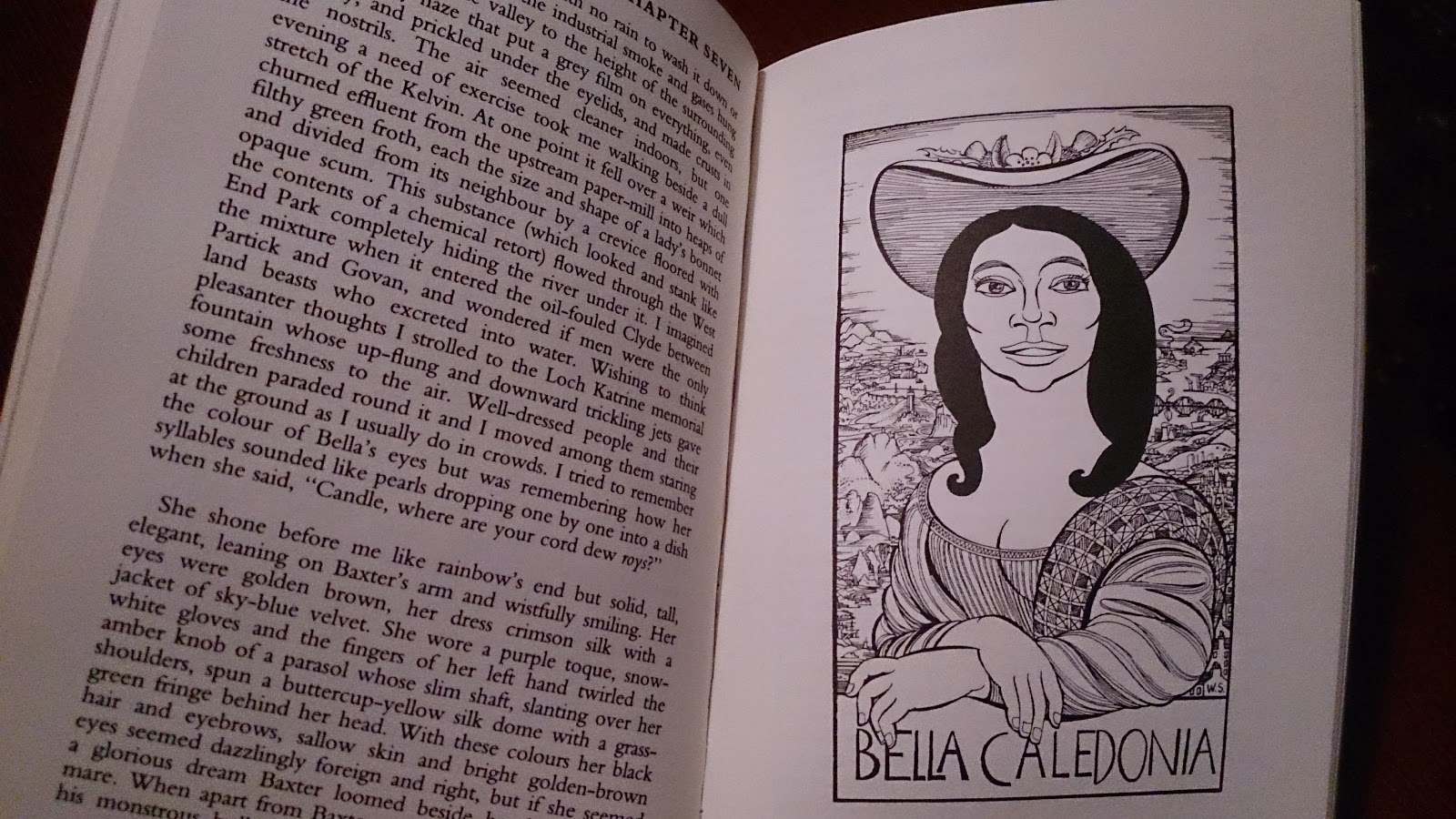
Characters and ideas are often remembered and reworked in other places, such as Bella Caledonia who is first seen in the book Poor Things in 1992. She also appears on the ceiling mural of Oran Mor, has become the symbol of an online magazine since 2007 and an illustration for the First Minister's Christmas card in 2011. The Christmas card artwork is now on display in Colin Beattie's Granny Gibbs pub in Whiteinch. The Hillhead illustration adorning the walls of the subway station on Byres Road is adapted from an illustration in the book Old Men In Love.

Bella Caledonia in Poor Things, 1992.
As he celebrates his 80th birthday this year, Alasdair Gray says in an interview on show at the Kelvingrove exhibition "Oh dear, I'm becoming popular in Glasgow. I never expected that in my lifetime."

To mark his birthday there is currently an "Alasdair Gray Season" running in Glasgow. At present there are exhibitions on at the Glasgow Print Studio in the Trongate (for free) and in the basement at Kelvingrove Art Gallery and Museum (for £5). Later there will be linked exhibitions within the Gallery of Modern Art and the Glasgow School of Art looking at his "Spheres of Influence".

The Glasgow Print Studio exhibition is titled "A Life In Print and Posters". This includes numerous old posters for plays and the like, which he has produced over the years at the Print Studio as well as showing draft versions of some of his prints to illustrate the process which he goes through. There are also early written pieces, produced by the Print Studio's old literary wing, Print Studio Press, such as his "The Comedy of The White Dog". Screenprints of illuminated poems which have more recently been on display here also line the walls but for me the highlight was seeing a series of new screenprints he has produced, based upon the artwork of his most famous book, Lanark. Some of these, the title pages of the four "books" of Lanark are versions of classic title pages from Versalius's anatomical book De Humani Corporis Fabrica, from Hobbes's Leviathon, from Bacon's Novum Organum and Raleigh's History of the World.  Each is given his individual twist, such as the Glasgow University logo appearing in one and James Kelman's face in another and these new versions are great to see (view here).

Lanark, the book, is now regarded as a Scottish classic. Published in 1981 it tells the parallel stories of Duncan Thaw in Glasgow, and of a young man called Lanark in a Glasgow-like town of Unthank, with Kafkaesque oddities and twists. I read and enjoyed it years ago now, but seeing the new versions of the prints has made me dust down my copy and give it a go again.

The exhibition in the basement space at Kelvingrove Art Gallery is titled "From The Personal to the Universal". Excellently curated by Sorcha Dallas who continue to represent Alasdair Gray, it is a retrospective of his work from his schoolboy art classes in Kelvingrove galleries, to the present day. As is often the case with many of his works, some are listed as unfinished as he often goes back and alters and colours old works. From his earliest works on show here he really grabs the attention. In the first room a piece from his student days in the Glasgow School of Art of the "cutty sark" episode in Tam O'Shanter show his already developing distinctive style.

A room of seemingly simple portraits belies the attention to small detail contained within them. In one, which is only shown as a photograph, of Scottish Nationalist and Socialist Bill Skinner in his Otago Street flat in 1968, if you look closely a fire can be seen outside his window. This is the old Kelvinbridge train station burning down, which I had only read about a week before. This attention to documenting detail was picked up on by Elspeth King when she commisioned him as "city recorder". Whilst curator of the People's Palace in Glasgow in the early 1970s she was aware that it contained no scenes of Glasgow or its people from its more recent past. There is great pleasure to be gained by spending some time looking at the detail he got into these drawings. Whether it is the ticket stubs collected from a typist's handbag when she was sketched on a break from work or the shop hoardings, crumbling buildings or a motorbike in the background of a drawing of Arcadia Street. Some of the best are of Glaswegians he knew and he documented their lives with great insight such as poet Tom Leonard, union leader Jimmy Reid both pictured with their families or of James Kelman, with his influential bookshelves behind him.

London Road Between Templeton's Carpet Factory and Monaco Bar, 1977 by Alasdair Gray
 Several of his own self portraits are seen here too, a familiar sight in many of his books, often with the artists' hand still drawing in the style of Escher's hands drawing each other.


There is a brief section on his mural painting here, with a recreation of his first mural commission. This was for the Scotland-USSR Friendship Society premises on Belmont Crescent and rather than ape the Socialist Realism style that you may have expected, he created a rather more dystopian vision in "Horrors of War", inspired by works of Durer and Brueghel. As a child I attended many functions in this building with my family, and cannot for the life of me recall ever seeing this mural before, but I do remember playing in the long garden that they had at the back of the building. The building has since been sold on and the mural is now underneath wallpaper apparently.
Part of the roof mural at Oran Mor by Alasdair Gray

Other murals however can be seen in the west end of Glasgow, such as mentioned above in the entrance to Hillhead underground station, outside the bar in the Western Baths Club, lining the walls of the Ubiquitous Chip stairwell and most famously adorning the roof and walls of Oran Mor's auditorium.

Floor mural at the Western Baths Club, Glasgow

Palacerigg Nature Reserve, Cumbernauld
If you aren't handy for the west end of Glasgow then you can see other murals out at the Greenbank Parish Church in Clarkston, Kirkfield Tavern near Lanark or in Cumbernauld on the walls of the exhibition centre of Palacerigg Nature Reserve (which is a grand wee day out if you've got children).

Alasdair Gray has spent years recording a version of Glasgow in words and pictures, so it is great to see Glasgow trying to return the compliment and I would encourage anyone who hasn't been to these exhibitions yet to go along and see them.

Monday, 11 November 2013

Reflections on Scottish Independence Inspired By James Connolly's Songbook


In Glasgow's Glad Cafe recently I attended an evening of music from Mat Callahan. He and fellow musicians have made a recording of some songs by and about James Connolly and were reprinting his book from 1907, "Songs Of Freedom". He talked of the lengths he had to go to in order to see a copy of it (afterwards Eddi Reader offered a copy she had) and gave a rendition of one of the songs printed in the original book, by Irishman Connell, "The Red Flag" but with a "Motown feel" to change it from the traditional dirge it has become. James Kelman had got involved when Mat was in Ireland and persuaded him to also visit the country of James Connolly's birth, Scotland, for two nights. It was a fantastic evening, with James Kelman in fine form, talking at length about the influence that Connolly had on Scottish socialists such as John MacLean.


As we approach our Scottish independence referendum it made me want to read a bit more about Connolly and why he took up arms for Irish independence from Britain. What did he think independence would achieve for Ireland? I asked my dad if he had anything on him. He said "I've got a few of his books. I used to have his Songbook, but I think I loaned it to someone and never got it back." (Aaaargh!) I consider myself not so much as an 'undecided' on the referendum question, but as a 'yet to be persuaded'. Too much nationalist language in general is about being better than others, whether it is the rest of the world, or a close neighbour. This is something that can only be negative and parochial. Nowhere in the current debate am I hearing about the ideals that we can aspire to in an independent country. Perhaps we could aim to be greener, more peaceable, more just, fairer. Liberty, egality, fraternity - that sort of thing.

Looking at the headlines on a newspaper website by searching the word 'independence' the lofty subjects include "would face greater security risk", "face tough choices on tax", "jobs fears" and "we're all doomed" (I made that last one up). It is almost as if a country of 5 million people is unheard of. People can apparently only succeed as a giant supermarket of a nation, there's no room for a worker's co-operative corner shop on these streets. Maybe one angle the 'Yes' campaign should emphasise is that becoming independent has not stopped Bosnia-Hercegovina getting to the World Cup finals in Brazil next year, and Croatia are also still in with a shout. But maybe this highlights part of the problem. Scotland has always been a wee bit of a separate country from England anyway whether in law, sport, education, history or perspective. None of these benefits other states may fight for can be so prominent in our debate as they may be in other parts of the world. So I think we need to hear about what Scots, given a blank canvas, think they could achieve. What virtues could our country aspire to?
James Connolly
James Connolly is known as a socialist and trade unionist who fought, and died for the Irish Nationalist cause. He is maybe more well known in Ireland than in the country he was born. In Dublin a statue of him stands outside Liberty Hall and he is remembered in the name of Connolly Station, whilst it is reported that all his life he spoke in a Scottish accent. He was truly an internationalist. He opposed the false divisions of people along lines of religion or gender, and the nationalism he fought for was not nationalism for nationalism's sake, but for the establishment of an "Irish Socialist Republic". As he said
"If you remove the English army tomorrow and hoist the green flag over Dublin Castle, unless you set about the organisation of the Socialist Republic your efforts would be in vain. England would still rule you. She would rule you through her capitalists, through her landlords, through her financiers, through the whole array of commercial and individualist institutions she has planted in this country and watered with the tears of our mothers and the blood of our martyrs. England would still rule you to your ruin, even while your lips offered hypocritical homage at the shrine of that Freedom whose cause you had betrayed."
He was born to Irish immigrant parents in the Cowgate of Edinburgh in 1868 where he was reportedly a fan of Hibernian football club. He left school aged 10 to start working, and aged 14 lied about his age to join the British army. The time he spent in the army in Ireland opened his eyes to the treatment of the Irish people at the hands of the British. He met his future wife here, Irish protestant Lillie Reynolds, and returned with her to Scotland in 1890 where he became active in trade unionism and the socialist movement. He was involved in the Independent Labour Party which Keir Hardie established in 1893. In 1895 he moved to Dublin where he founded the Irish Socialist Republican Party. After a speaking tour of America in 1902 he returned to Edinburgh and launched the Socialist Labour Party before emigrating to the USA for 6 years. Working initially as an insurance salesman, then in a Singer sewing machine factory in Newark, he became involved in the IWW (International Workers of the World or the "Wobblies") and became paid as the national organiser for the Socialist Party of America. He had established various socialist newspapers and was publishing his ideas in pamphlets and on speaking tours. Whilst in America he published "Songs for Freedom" in 1907 and the words of the songs clearly encapsulated his ideas. As he says in the introduction

"No revolutionary movement is complete without its poetical expression. If such a movement has caught hold of the imagination of the masses, they will seek a vent in song for the aspirations, the fears and hopes, the loves and hatreds engendered by the struggle. Until the movement is marked by joyous, defiant singing of revolutionary songs, it lacks one of the most distinctive marks of a popular revolutionary movement; it is a dogma of a few and not the faith of the multitude."
In 1910 he returned to Ireland and became involved with the Irish Transport and General Workers Union. The police brutality against workers in the 1913-14 Dublin 'lock-out' lead him to found a workers' militia, the Irish Citizens Army (ICA). He spoke out against the division of Ireland, wrote to warn Orangemen in Ulster from being blinded to the common cause they should have with the working people of Ireland, against their capitalist bosses "hiding their sweat shops behind orange flags". With regards to women he wrote that "of what use...[was the re-establishment of an Irish State]...if it does not embody the emancipation of womanhood". He saw the First World War as an imperialist war and campaigned against sending Irishmen abroad to fight. Today's conflicts around the world could be being referenced with these words
"If these men must die, would it not be better to die in their own country fighting for freedom for their own class, and for the abolition of war, than to go forth to strange countries and die slaughtering and slaughtered by their own brothers that tyrants and profiteers might live?"
In the rising in Dublin of Easter 1916, James Connolly and members of his ICA tried to make their stated aims a reality. Whilst Commandant of the Dublin Brigade at the GPO he was badly wounded in the fighting. He was one of the seven signatories of the 1916 Proclamation. Following the surrender he was arrested and at his court-martial again mentioned the role of women and the war in Europe,
"We succeeded in proving that Irishmen are ready to die endeavouring to win for Ireland those national rights which the British government has been asking them to die for in Belgium . . . I personally thank God that I have lived to see the day when thousands of Irish men and boys, and hundreds of Irish women and girls, were ready to affirm that truth and to seal it with their lives if necessary."
Sentenced to death he was taken to Kilmainham Goal, still seriously ill from his wounds, on a stretcher where he had to be tied to a chair to be shot.
My mother-in-law in the yard of a wet
Kilmainham Gaol
He had crystal clear aims for the nationalism for which he was fighting, something I have yet to hear in Scotland's current debate. His programme included a republic
"based upon public ownership by the Irish people of the land and instruments of production, distribution and exchange."
Also, there was to be nationalisation of the railways (and canals), abolition of private banks and government financed loans at cost price, graduated income tax, universal suffrage, establishment of a minimum wage, free maintenance for all children, free education up to higher university grades and public management of schools. What was the point of self-determination if it didn't provide a programme to benefit all of the ordinary citizens?

Prompted by James Kelman talking about him as though we were all familiar with his ideas, I recently sought out a book on an early Scottish Marxist called Willie Nairn. He was born in 1856 in Brechin, and aged 18 he gravitated to Glasgow where he worked as a labourer and stonebreaker. He lived in exciting times. Agitated by questions of land ownership in a country still reeling from the Highland clearances and by the ideas of the Paris Commune of 1871 he studied the writings of Marx and Engels in his evenings. The Communist Manifesto (first translated into English by Barrhead's Helen MacFarlane) and Das Kapital were hot off the presses when he first read them. As John MacLean later would, he spoke at meetings and in Cathedral Square and Glasgow Green trying to spread the ideas he found there. He was a founder member of one of Glasgow's first Socialist organisations, the Social Democratic Federation and active in the infant Cooperative movement. He was president of the St George Cooperative Society which stood at St George's Cross. Nothing is left of this building except for the statue of George and the dragon which once stood atop it, but now marks the junction beneath the Great Western Road flyover. Like Keir Hardie and James Connolly he spoke out against the Boer War and criticised the socialist leaders who could "out-jingo the jingoists" as they fell in behind the war bandwagon. In 1902 he died, aged 46. Despite his origins, the poverty and hardships he endured, he looked for a better way and tried to put it into effect.

My great-great uncle Robert
standing beside Keir Hardie
Early Scottish socialists often had a desire for Scottish independence. Keir Hardie is often quoted as an advocate of home rule for Scotland. He first stood for election, in 1888, as the "Labour and Home Rule" candidate but as Bob Holman points out in his biography of Hardie "this was to let the sizeable number of Irish residents in the constituency know where he stood on the question of home rule for Ireland". I have struggled to find any statements or writings by him on the issue of Scottish Home Rule. Later in 1888 Keir Hardie founded the Scottish Labour Party (not to be confused in ANY way with a party currently using that name), soon to merge with the Independent Labour Party he was to lead into parliament. In 1908 Hardie travelled to South Africa and was unusual in his day in condemning the treatment of blacks there. He also visited New Zealand, Australia and India on his tour. Writing in his book on India he writes about the Indians' desire for self government. He felt that the Indians had a right to self-determination, for their benefit and the benefit of future relations between Britain and India.
"Concerning political reforms, I am certain that no matter what is done for India there can be no real pacification, no allaying of discontent, no breaking down of the barrier rising between European and Asiatic, until the people of India have some effective form of self-government."
His book, which he wrote of his two months in India, is a fascinating read. The effort he goes to in order to meet people, to research facts and figures to support his arguments is just not something that you see in political analysis now. The fact that in the USA of the 1960s it was thought acceptable to segregate public transport on racial grounds seems even more bizarre than it was, when a Victorian mine worker from Holyton found it so obviously odd in the India of 1908.
"When I entered the train at Madras there were  two Indian gentlemen in the compartment. One of them rose as I entered and said: "Shall we move to another compartment, sir?" I stared at the gentleman and asked whether he had paid his fare.....Now I knew that in parts of America the colour line was strictly drawn, but I was not prepared for this kind of thing in India. Here, be it remembered, is a people who have inherited a civilisation which was old ere the West had begun to emerge from savagery." 
Again, like Connolly, Hardie was a man from a previous age who shaped his opinions through no narrow, parochial viewpoint. Hardie's colleague in The Scottish Labour Party it's president, Robert Cunninghame-Graham later founded the National Party of Scotland, forerunner to the Scottish Nationalist Party so there were other socialists at that time who did feel that Scottish home rule was an important issue of the time.

John MacLean took this idea and ran with it, calling for
"a Scottish Communist Republic as a first step towards World Communism with Glasgow as its headquarters."
No matter how many times I read over that statement, the only response I can think of is "Build a Scottish Communist Republic, and make Glasgow the centre of this world. Bloody brilliant. Think big - when do we begin?" He also issued a leaflet in 1920, 'All Hail! The Scottish Communist Republic' with echoes of Connolly's call for an "Irish Socialist Republic", in which he made his views clear.

"Scotland must again have Independence, but not to be ruled by traitor kings and chiefs, lawyers and politicians....The control must be in the hands of the workers only, male and female alike...".
10 days before his death in 1923 at the age of 44,  he wrote in his last political address that
"Before England is ready I am sure the next war will be on us. I therefore consider that Scotland's wisest policy is to declare for a republic in Scotland, so that the youths of Scotland will not be forced out to die for England's markets."
Sitting to write this and trying to find the views of these men, I struggled with my lack of knowledge about these thinkers from Scotland's recent history, and that is from someone brought up as a child in a politically active, trade unionist household. I could lay my hands on some of their writings I've bought from obscure online bookstores over the years or borrowed from relatives. Even then, what I could access in these days of the internet being the font of all knowledge, the amount of detail I could find was very limited. This is where the gap is in the current debate. It is a knowledge gap. We don't know about these working class people with sparkling, positive, idealistic ideas. We aren't taught about these men in school history, or of the tanks in George Square in 1919 or the UCS work-in. My granny, living in the Gorbals had seen and heard John MacLean, my great uncle was involved in the UCS work-in but they are dead now. The link to these words and ideas dies with that generation unless it is documented and today's children are shown what working people can and have achieved.

Why fight for a new state which will keep people as enslaved as the old state? That is a question that is not being heard in the current referendum. What sort of Scotland do you envisage in the future and how can we get there? 'That's no fair' is something we see as an unbeatable argument when we are schoolchildren. We should start with this fine axiom as adults too. Surely it is clear that the historical, socialist beliefs and feelings of our country should still be our guiding principles. Take Connolly's programme and start from there. Add in the maintenance of a free NHS, the scrapping of Trident and highlight the benefits of creating a country welcoming immigrants and I'd vote for that country. Free education and childcare, minimum wage and a graduated income tax (not tax breaks for the wealthy), nationalisation of essential services. Why not add democratic control of our rich energy resources too? Yes, hoist the Scottish flag over Edinburgh Castle, but not if we end up being run by the same capitalists, financiers, commercial institutions and individuals as before.

The politicians debating the referendum all look and sound like middle management people discussing how they'll run the office stationary fund better than the other mob. Come on, people.
Raise the level of the debate, as so far the politicians are grinding it down to their mundane level.  Think a bit bigger. Okay, you could regard a lot of what I've written above as complete pie in the sky. But if we aim for the pie, we might miss and land in the beans.

There are people trying to look forwards and see what benefits we could all gain with a vote for independence, such as the Radical Independence Campaign. The Jimmy Reid Foundation, named in honour of the union leader at the heart of the UCS work-in, launched their "Common Weal Project" with the aim of starting a debate about how Scotland could develop socially and economically with "mutuality and equity" as guiding principles. I agree that we should take advantage of this juncture to start from scratch. The question shouldn't be whether we want independence or not, but what type of society we want. If independence will be used to make a better society then I'd vote for it. If not, I really don't see the point.

Lenin famously said that for a revolution to occur required "mass action strong enough to break (or dislocate) the old government, which never, not even in a period of crisis, 'falls', if it is not toppled over”. I quite like the idea of jolting our political situation enough to dislocate our current politics.

A simple cairn in Pollokshaws is the only memorial we have in Glasgow to John MacLean. It reads
FAMOUS PIONEER OF WORKING CLASS EDUCATION
HE FORGED THE SCOTTISH LINK IN THE
GOLDEN CHAIN OF WORLD SOCIALISM
Start with this as a simple aspiration for a new nation and I think it would be off to a good start. Pioneer working class education and forge Scotland as a Socialist link in a worldwide chain.

Scotland is a small country. However people should try to think a bit bigger.

Monday, 20 August 2012

12 Hour Blitz of Edinburgh Festival 2012

Over the past few years I've annually tried to spend a day or two through at the Edinburgh festival. So, buoyed by a successful trip through on Saturday to the mysterious eastern side of Scotland to watch Partick Thistle beat Dunfermline 1-0 in Fife, I was back east again today, this time to do a 12 hour blitz around the festival.

First up something for the younger children, Petya and the Wolf, by Theatre Pushkin at the Assembly Roxy. My children's reviews of it suggest that they found it interesting but ultimately rather bamboozling as a pair of Russian clowns act out the well known story. It is maybe something that more appeals to 42 year olds like their dad, brought up on Czechoslovakian animated short films on BBC2, and I think the demographics of the audience reflected that with slightly more unaccompanied adults than children present.
Sunny morning at the Edinburgh Book Festival venue
Over at the Edinburgh Book Festival I went to see Michael Grant with my 12 year old son. He is the author of piles of books but has found recent success with his teenage fiction, the GONE series and his new series BZRK which he revealed has got Sam Raimi lined up to direct the film if/when it gets made. I haven't ever read his books but my son devours them. Michael Grant has clearly lead an interesting life and was an engaging and honest speaker, a big shaven headed guy who manages to call people "dude" with a straight face and it doesn't sound odd. He tries to temper his language for the age of the audience and almost succeeds but would clearly be good company discussing cigars and whisky.

Quick dash along to the Pleasance in time to see Horrible Histories Barmy Britain, based on the popular books and TV series, a light hearted romp through British history, jammed with gory stories and facts in the usual Horrible Histories manner. The two performers through a variety of costume changes go from the Roman diet as "Manky-Chef" characteers, to WWI with Earl Haig reporting back to Lord Sugar on the Apprentice. The show is an adapted version of the longer one running in England just now and they've played up the Scottish stories for playing in (Jessie King baby farmer, Burke and Hare, William Wallace) but it is funny how a show about British history jars a bit when the Scottish vs British vs English bit gets a little hazy.
City Art Centre's exhibitions this year are a bit disappointing after David Mach's dramatic show there last year. The Leslie Hunter and Scottish Colourists are a bit of a safe option and very familiar. The top floor has "Human Race", an exhibition allegedly "Inside the History of Sports Medicine", but its a bit of a jumble of disparate items and feels more like a cash grab for Lottey funding in an Olympic year.

More memorable and as mad as a sack of badgers are Harry Hill's paintings, My Hobby, up on the second floor of the clothes shop White Stuff on George Street. If I tell you it has everything from a coconut painted with the face of Jarvis Cocker to a painting of a multi-headed Chris Tarrant running about on the surface of Mars, you'll understand that his work has something for everyone.
Past the sale rack and upstairs to Harry Hill's stuff
Walking about I now had Bruce Springsteen playing in my ears to get me in the right mood for the next show, Sarfraz Manzoor doing 'The Boss Rules' at the Assembly Rooms. As I am ages with him, his stories of living through the80s, finding Bruce's music, starting a family and finding song lyrics chiming with what is going on struck a chord with me. He makes great play in the opening that he's not a comedian, but it is a humorous and warmhearted show and I was inspired to buy his book afterwards. I don't know why I bother as I feel foolishly self-conscious at these things ("yes, sign it to Paul, nobody else would thank me for it") and you can always get the books cheaper on Amazon. It just seems polite.

As the rain was now pelting down outside I decided to try and stay in one building for a couple of hours. Last time that I was at the Assembly Rooms on George Street I think was at a fundraising ceilidh to help the Eigg islanders buy out the landowner. The space which I was in back then now seems to have become Jamie Oliver's restaurant in Edinburgh so I had a wild rabbit tagliolini where last I'd done a Gay Gordons.

Arranging what shows to see sometimes was more to do with what was on at a free slot I had than any great plan, so it was good fortune for me that Stewart Lee's show at the Assembly Rooms was on at 6pm as it was one of the best things that I saw all day. He appears prickly as he delivers a fine monologue/rant about not having any material for a show and complains that half the audience aren't knowledgeable enough to get the jokes anyway. But it is comedians that are really the subject of his gaze. People tweeting and those emailing abuse also get it in the neck as he nicely lands back at the Carpet Remnant World of the show's title at the end.

Finally I'd saved the thing I'd been looking forward to most of all for last, James Kelman and Liz Lochead back up at the book festival in Charlotte Square. Familiar faces such as Irvine Welsh and Jackie Kay were in the audience too. I've long been an avid reader of Kelman's books and Liz Lochead's plays are some of the best I've seen in recent years. Her poetry I've only come to recently. Kelman is promoting his new book "Mo Said She Was Quirky" and gave a good reading from it. It was great to hear him read his stuff. In my head I find his writing makes perfect sense, it just sounds like real people's thoughts, ideas, actions and voices and he reads it as I envisage it when reading. I cannot equate that with some of the uncomprehending and sniffy reviews his books get. When asked about reviewers he breezily shrugged it all off. His early influences maybe explain my affection for his work as he basically read off my youthful reading list when asked; Kafka, Dostoyevsky, Zola and Camus. Interesting too was his comparison with the visual arts in how he works and admiration for Cezanne, Rodin and Modigliani. Also nice to hear the Pewter Pot and Rubiyat bars getting a name check. I swallowed my pride again and bought his book to get it signed, he feigned signing my book "to Pall", one of those occasions you think of the witty retorts on the drive home. Also the only time anyone has ever made that funereal pun with my name - dark humour, eh? Back to Glasgow.