Showing posts with label Alasdair Gray. Show all posts

Sunday, 16 August 2015

Lanark: A Play In Three Acts. Citizens Theatre Company

Lanark: A Play In Three Acts. Citizens Theatre Company. Glasgow, August 2015


(David Greig's adaption of Alasdair Gray's "Lanark" had it's preview showing in Glasgow last night and this is a brief review. If you haven't read the book before going to see the play, and don't want to know the story, look away now as it may contain some spoilers.)

Saturday 15th August promised to be an exciting day. First up Partick Thistle were taking on Kilmarnock in the afternoon at Firhill, followed by the opening night of Lanark, Alasdair Gray's classic book adapted as a play by David Greig at the Citizens Theatre. Both left me with the same nervous feeling of anticipation, hoping that they would live up to my hopes.

The players take their place at Firhill

At Firhill the one character that never disappoints is that one created by an artist. Kingsley the mascot, the work of David Shrigley. This surreal, untalking vision wanders around the ground before games and is greeted as if it is perfectly normal to raise a smile at a piece of spikey sunshine walking around in Maryhill. More people around Britain, around the world even, are able to imagine a club called Partick Thistle from Glasgow now because of the work of an artist (and the ongoing efforts obviously of the man inside the costume). The Guardian had a photographer following Kingsley around for a couple of hours yesterday, so it still goes on.

The football itself was a piece of theatre in three acts. In Act One Partick Thistle were all over an agricultural Kilmarnock team for half an hour, but despite numerous chances only managed to get one goal. Those in the audience who have seen this type of performance before could guess what the final act would bring, as Kris Boyd warmed up on the touchline like Chekov's gun. In Act Two Kilmarnock equalised, and before the interval could have been ahead. Then the referee nudged things along by reducing Thistle to 10 men. In Act Three we were amazed to find hope as Kris Doolan put Thistle in the lead, before Kris Boyd came off the bench to inevitably snuff it out. It was a great game of football...for the neutral, but left a feeling of injustice and of a missed opportunity for those of us of a Partick Thistle persuasion.

"Man is the pie that bakes and eats himself, and the recipe is separation." - Alasdair Gray, Lanark

I don't think Alasdair Gray had the Firhill pies in mind when he wrote that, which today could generously be described as "well fired".

"Boo!"

As a huge fan of his work I've written about Alasdair Gray before, when a series of events and exhibitions celebrated his 80th birthday last year. That year focused largely of his artworks. His first novel, which cemented his reputation, is "Lanark: A Life In Four Books". First published in 1981 it was apparently written over several decades and, as is the case in most of his books, has both words and pictures provided by Gray creating a unified vision. It tells the parallel and intersecting stories of a young man, who takes the name Lanark, awakening in the sunless city of Unthank (which has a passing resemblance to Glasgow), and of a young man called Duncan Thaw (who has a passing resemblance to the author). "A life in four books" their stories are told in the order of book three, one, two then four, with Duncan Thaw's story being sandwiched in the middle of Lanark's when read this way. Neither men truly fit in or understand their worlds, which seals their fate. In an extended epilogue the "author" meets Lanark and discusses the book and the plagiarisms he filled it with (some real, some invented). He tells Lanark that...
"The Thaw narrative shows a man dying because he is bad at loving. It is enclosed by [Lanark's] narrative which shows civilization collapsing for the same reason" 
The book is full of nods to other stories, artists, authors and ideas. An "index of plagarisms" in the margins of the epilogue contains refences as varied as William Blake, Joseph Conrad, Walt Disney, Tom Leonard and HG Wells. Of note is the mention of Robert Burns
"Robert Burns' humane and lyrical rationalism has had no impact on the formation of this book, a fact more sinister than any exposed by mere attribution of sources" 
The artwork of the separate book frontispieces also references those that have gone before such as this from "Book Four". The frontispiece of Hobbes Leviathon is redrawn with a landscape of Scotland in the foreground, complete with Dunoon, Faslane and the Forth Rail Bridge. (If you want a colour print of this beautiful image to own, Alasdair Gray recently reworked these for the Glasgow Print Studio).

Hobbes Leviathon, Lanark Book Four
In this spirit the theatre company have created a wee Pinterest board of plagarisms that they may have used, and they suggest that you look out for more in the play.

One of the main characters in the story is Glasgow, with the necropolis in the East End featuring as a gateway to another world (or to a building resembling Stobhill Hospital if you prefer). The book is witty, political, confusing, poignant, frustrating and brilliant. When I heard that David Greig and the Citizens' Theatre planned to make a stage version of the book the obvious question was "How the hell are they going to manage that?" Some of the challenges that they faced are maybe evident in the fact that the first preview night at the Citizens' had to be cancelled, meaning we were watching it tonight on its opening night in Glasgow, before it transfers to the Edinburgh Festival. David Greig seemed to me a perfect choice to interpret the book. He has had success with adaptions as diverse as Euripides' The Bacchae with National Theatre of Scotland and a musical version of Charlie and the Chocolate Factory. I've enjoyed his plays Dalgety, Dunsinane, The Glasgow Girls and The Events. If you don't already follow David Greig on twitter I would heartily recommend it for terrible puns, political rants and energy sapping tales of his hill running exploits. His works are the kind of things a country can produce when art is funded and supported. To quote Alasdair Gray...
“People in Scotland have a queer idea of the arts. They think you can be an artist in your spare time, though nobody expects you to be a spare-time dustman, engineer, lawyer or brain surgeon.”
In the year that the Citizens Theatre celebrates its 70th anniversary "Lanark: A Life in Four Books" now becomes "Lanark: A Life in Three Acts". Of note in the theatre tonight there was a palpable buzz of excitement amongst the gathered audience. Also they were a more diverse crowd than you often see in the theatre with both young and old drawn to it.


The solutions that they have found to some surreal passages in the book is evident from the first minute with the clever use of projections and animation throughout, often with a nod to the authors original artworks.  Sandy Greirson, who recently played Ivor Cutler on this stage, plays the role of Lanark, and seems to fit the role well. Never manic or hysterical, he presents an essentially good man beneath an emotional carapace.

“He watched them with the passionate regret with which he saw them play football or go to dances: the activity itself did not interest, but the power to share it would have made him less apart.” - Alasdair Gray, Lanark

Jazz tinged music adds an atmospheric sense of place and time as Lanark and the audience arrive in Unthank and a huge degree of choreography goes into revolving the seemingly simple stage set to create a variety of scenes. Greirson is supported by a fantastic ensemble cast, with several well-kent faces from the Scottish stage (Andy Clark, George Drennan, Jessica Hardwick, Paul Thomas Hickey, Louise Ludgate, Helen Mackay and Gerry Mulgrew. Camrie Palmer and Ewan Somers). The first act (Act Two, obviously) finds Lanark trying to work out who he is, trying to fit in and find love in a world where people inexplicably disappear. As his itchy patches of skin inexorably reveal themselves as dragonhide, a metaphorical carapace made real, he descends in a literal sense to a futuristic (in a 1970s Logan's Run type of way) Institute, where those who seem to run the world reside. 

The second act (or Act One - keep up), connects Lanark to Duncan Thaw, the real life of a "Proletarian snob" from the east end of Glasgow determined to be an artist. The cast lead Thaw through his life from the scaffold that becomes Ben Rua and his workplace on an epic church mural. A child with asthma and itchy eczema becomes a man unable to find love and falling into despair and mental illness. Again the script and Greirson don't play this with melodrama but with pathos and an ebbing away of hope.

The final act thrusts us back to Unthank after the characters wander aimlessly and surreally across the Intercalendrical Zone, where the actors break through the theatrical "fourth wall". Whilst civilisation is descending into chaos Lanark must try to save his city and try to connect with his wife and man-child (Ewan Somers doing an impressive turn in the style of Baby Brent from Cloudy With a Chance of Meatballs). In the book Gray smashes through the fourth wall with his epilogue to talk to Lanark, on stage this is done in a clever and incredibly imaginative way which chimes so well with the book.

It is a book rammed full of ideas, images, metaphors and devices and it feels as if almost everything in the book has managed to find a place in the play. If you asked 100 different uber-fans of the book which bit had to be kept in for the play you might get 100 different replies. Whilst satisfying the geeks, the play also opens up the book to those who have never got around to reading it in a way that is accessible, whilst entirely in keeping with the unique spirit of the original. That feat may have taken almost four hours of work this evening by all involved in the production, but it was a fantastic and mind-spinning evening of theatre.
"Glasgow is a magnificent city," said McAlpin. "Why do we hardly ever notice that?" "Because nobody imagines living here," said Thaw... "Think of Florence, Paris, London, New York. Nobody visiting them for the first time is a stranger because he's already visited them in paintings, novels, history books and films. But if a city hasn't been used by an artist, not even the inhabitants live there imaginatively." - Alasdair Gray
I hope that these words by Alasdair Gray are no longer true and that his works help ignite the creative energy of Glasgow and its people. The play certainly feels like it adds to this legacy.

Alasdair Gray's mural on the wall of Hillhead subway station, Glasgow

Monday, 3 November 2014

Alasdair Gray

Alasdair Gray Season, a Glasgow Polymath


I don't know Alasdair Gray but I feel that I should as he has been such a familiar sight in Glasgow for many years.

I've seen him at things. I've been to events that he has been involved in, and heard him talk at events I've been to. I've heard him talk about Scottish Independence, about books and about nuclear war. I've been to events where he was meant to be talking, but had nodded off and nobody wanted to wake him. I've been enticed into buying other people's books for his illustrations. I've walked over floors with his murals upon them and sat in bars with his murals adorning the walls. I've read and enjoyed some of his books and read and not enjoyed some of his other books. In September 2012 I came up an escalator to find myself amidst Nicola Sturgeon's official "opening ceremony" of his mural at Hillhead subway station. (They were kind enough to let me duck under the red ribbon to escape before they cut it.) He is literally and metaphorically in with the bricks of Glasgow.

Hillhead Subway station mural being officially opened by Nicola Sturgeon in 2012

Just taking a few minutes to ponder what I think about Alasdair Gray makes me think of the diverse things that he does. Brought up in the east end of Glasgow he went to Glasgow School of Art where he spent 4 years training in mural making. His distinctive novels usually have the author's hand not only in the story but in designing the typeface and layout, with pictures and words coming together to tell the tale.

Alasdair Gray in book format
On my shelves I've got novels, short stories, some history of English literature, a play, an essay on "Why Scots Should Rule Scotland", pictorial autobiographies and an illuminated book of Scottish song. They are all instantly recognisable from his style which is often described as being inspired by William Blake and Hieronymus Bosch but also has elements of his childhood readings of the Beano and the Dandy where, according to a video interview on show in Kelvingrove at present, he became familiar with the idea of words and pictures telling a story together.

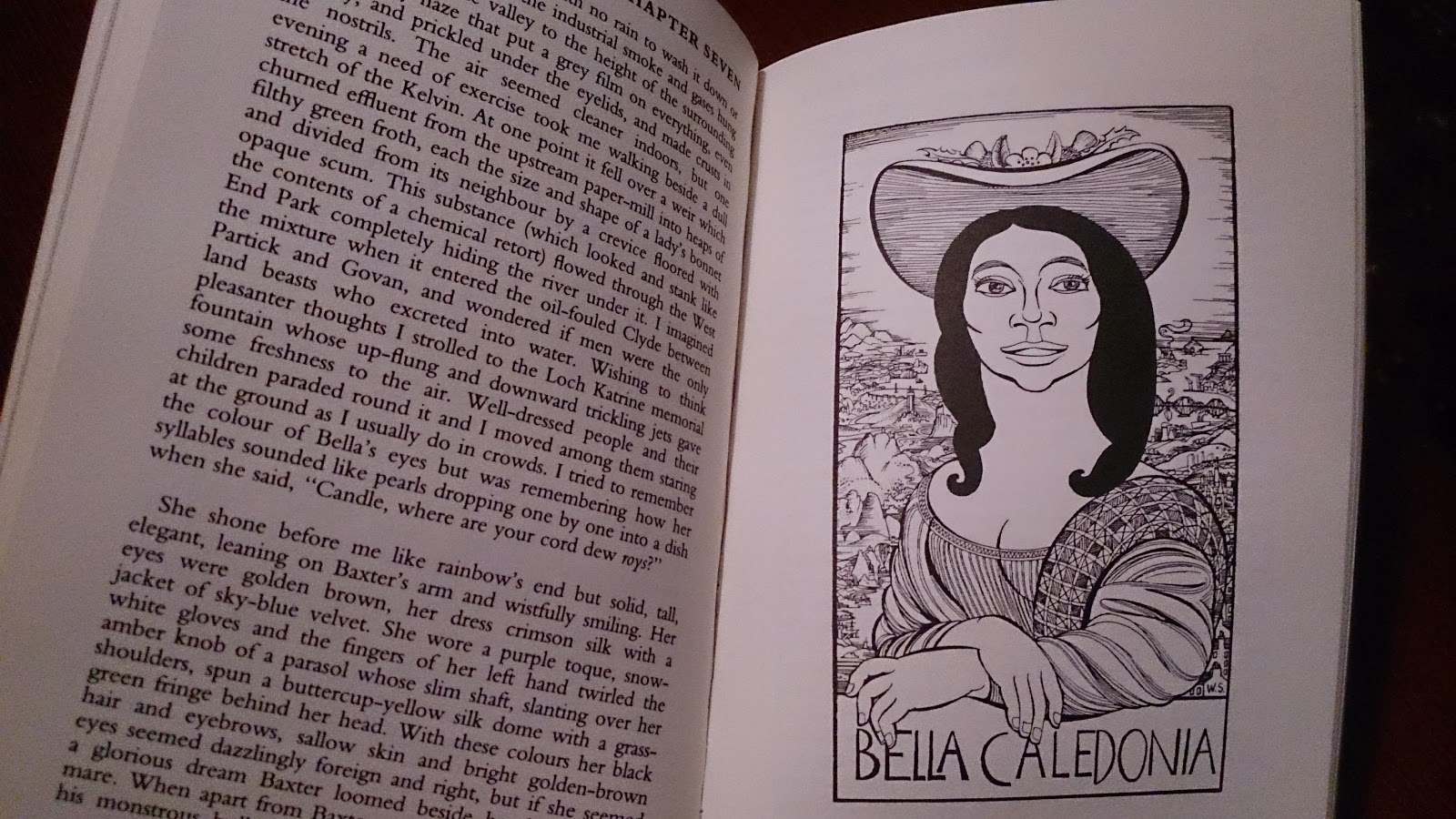
Characters and ideas are often remembered and reworked in other places, such as Bella Caledonia who is first seen in the book Poor Things in 1992. She also appears on the ceiling mural of Oran Mor, has become the symbol of an online magazine since 2007 and an illustration for the First Minister's Christmas card in 2011. The Christmas card artwork is now on display in Colin Beattie's Granny Gibbs pub in Whiteinch. The Hillhead illustration adorning the walls of the subway station on Byres Road is adapted from an illustration in the book Old Men In Love.

Bella Caledonia in Poor Things, 1992.
As he celebrates his 80th birthday this year, Alasdair Gray says in an interview on show at the Kelvingrove exhibition "Oh dear, I'm becoming popular in Glasgow. I never expected that in my lifetime."

To mark his birthday there is currently an "Alasdair Gray Season" running in Glasgow. At present there are exhibitions on at the Glasgow Print Studio in the Trongate (for free) and in the basement at Kelvingrove Art Gallery and Museum (for £5). Later there will be linked exhibitions within the Gallery of Modern Art and the Glasgow School of Art looking at his "Spheres of Influence".

The Glasgow Print Studio exhibition is titled "A Life In Print and Posters". This includes numerous old posters for plays and the like, which he has produced over the years at the Print Studio as well as showing draft versions of some of his prints to illustrate the process which he goes through. There are also early written pieces, produced by the Print Studio's old literary wing, Print Studio Press, such as his "The Comedy of The White Dog". Screenprints of illuminated poems which have more recently been on display here also line the walls but for me the highlight was seeing a series of new screenprints he has produced, based upon the artwork of his most famous book, Lanark. Some of these, the title pages of the four "books" of Lanark are versions of classic title pages from Versalius's anatomical book De Humani Corporis Fabrica, from Hobbes's Leviathon, from Bacon's Novum Organum and Raleigh's History of the World.  Each is given his individual twist, such as the Glasgow University logo appearing in one and James Kelman's face in another and these new versions are great to see (view here).

Lanark, the book, is now regarded as a Scottish classic. Published in 1981 it tells the parallel stories of Duncan Thaw in Glasgow, and of a young man called Lanark in a Glasgow-like town of Unthank, with Kafkaesque oddities and twists. I read and enjoyed it years ago now, but seeing the new versions of the prints has made me dust down my copy and give it a go again.

The exhibition in the basement space at Kelvingrove Art Gallery is titled "From The Personal to the Universal". Excellently curated by Sorcha Dallas who continue to represent Alasdair Gray, it is a retrospective of his work from his schoolboy art classes in Kelvingrove galleries, to the present day. As is often the case with many of his works, some are listed as unfinished as he often goes back and alters and colours old works. From his earliest works on show here he really grabs the attention. In the first room a piece from his student days in the Glasgow School of Art of the "cutty sark" episode in Tam O'Shanter show his already developing distinctive style.

A room of seemingly simple portraits belies the attention to small detail contained within them. In one, which is only shown as a photograph, of Scottish Nationalist and Socialist Bill Skinner in his Otago Street flat in 1968, if you look closely a fire can be seen outside his window. This is the old Kelvinbridge train station burning down, which I had only read about a week before. This attention to documenting detail was picked up on by Elspeth King when she commisioned him as "city recorder". Whilst curator of the People's Palace in Glasgow in the early 1970s she was aware that it contained no scenes of Glasgow or its people from its more recent past. There is great pleasure to be gained by spending some time looking at the detail he got into these drawings. Whether it is the ticket stubs collected from a typist's handbag when she was sketched on a break from work or the shop hoardings, crumbling buildings or a motorbike in the background of a drawing of Arcadia Street. Some of the best are of Glaswegians he knew and he documented their lives with great insight such as poet Tom Leonard, union leader Jimmy Reid both pictured with their families or of James Kelman, with his influential bookshelves behind him.

London Road Between Templeton's Carpet Factory and Monaco Bar, 1977 by Alasdair Gray
 Several of his own self portraits are seen here too, a familiar sight in many of his books, often with the artists' hand still drawing in the style of Escher's hands drawing each other.


There is a brief section on his mural painting here, with a recreation of his first mural commission. This was for the Scotland-USSR Friendship Society premises on Belmont Crescent and rather than ape the Socialist Realism style that you may have expected, he created a rather more dystopian vision in "Horrors of War", inspired by works of Durer and Brueghel. As a child I attended many functions in this building with my family, and cannot for the life of me recall ever seeing this mural before, but I do remember playing in the long garden that they had at the back of the building. The building has since been sold on and the mural is now underneath wallpaper apparently.
Part of the roof mural at Oran Mor by Alasdair Gray

Other murals however can be seen in the west end of Glasgow, such as mentioned above in the entrance to Hillhead underground station, outside the bar in the Western Baths Club, lining the walls of the Ubiquitous Chip stairwell and most famously adorning the roof and walls of Oran Mor's auditorium.

Floor mural at the Western Baths Club, Glasgow

Palacerigg Nature Reserve, Cumbernauld
If you aren't handy for the west end of Glasgow then you can see other murals out at the Greenbank Parish Church in Clarkston, Kirkfield Tavern near Lanark or in Cumbernauld on the walls of the exhibition centre of Palacerigg Nature Reserve (which is a grand wee day out if you've got children).

Alasdair Gray has spent years recording a version of Glasgow in words and pictures, so it is great to see Glasgow trying to return the compliment and I would encourage anyone who hasn't been to these exhibitions yet to go along and see them.

Wednesday, 5 September 2012

Africa Express and other Collaborations

I had tickets for 2 very different, but in some ways similar, events this week. Rodge Glass is an author/ editor who has been based in Glasgow for several years. Known for his recent books "Bring Me the Head of Ryan Giggs" and his biography of Glasgow institution Alasdair Gray, he is moving back to Manchester which was an excuse for an evening in the Old Hairdresser's in Renfield Lane, hosted by "Rodge", to raise money for a Middle Eat charity under the title "(What's So Funny 'Bout) Peaceniks, Love and Understanding". It featured musicians playing short sets, alternating with writers performing readings. There was a fantastic collection of local worthies at the event such as the above mentioned Alasdair Gray, Ewan Morrison (author of the excellent Tales From The Mall), Kirstin Innes, Allan Wilson. Music was supplied by Beerjacket, Rick Redbeard (off of The Phantom Band), Paul Carlin (off of Dananananakroyd), a full bloodied performance by Adam Stafford and the evening finished off beautifully by Emma Pollock (off of The Delgados). Star turn for me was author Alan Bissett (author of Pack Men, The Incredible Adam Spark) who performed an exert from his one man play "The Red Hourglass". I went straight home and bought a ticket for the full thing which after a successful run at the Edinburgh Fringe he is doing at The Arches in November. It finished off the evening nicely to win the raffle and get a pile of books and cds from some of the above. All there was left for me to do was to fight my way through the lighting trucks and curious gawpers to find my car on the Glasgow streets getting used by a crew filming "The Fast and the Furious 6". Thankfully they'd decided my car wasn't what the film needed in it and it had been left in peace. (That's my brother's birthday present sorted!).

On a grander scale this Tuesday night was another evening of artists jamming and collaborating, this time under Damon Albarn's supervising eye as he brought his Africa Express thing to Glasgow for the first time. Africa Express has being rumbling on for 6 years now under Damon Albarn's beady eye, but with funding as part of the cultural Olympiad this year Africa Express now literally has a train taking them between towns on a short UK tour which will end in London in a few days time. The sell-out show last night in Glasgow went on for the best part of 4 hours over 2 stages in The Arches tunnels beneath Central Station and with DJs taking the stage playing on for another couple of hours afterwards apparently (I was in bed by then).

Damon Albarn with Afel Bocoumb
It kicked off with Malian singer Afel Bocoumb, joined by Damon for a couple of songs and then he was off. That was the way the rest of the night went. There was no main conducter or stage presence, no headline act directing traffic, but one or two songs by a collection of people, then off, 5-10 minutes of the crew changing things around, then one or two songs from the next mob. This was a shame as it made it all a bit episodic but is inevitable with so many musicians involved. Longer sets were then taking place on the second stage. When I've seen some of these African musicians before they mananged to convey a much more natural coming and going of collaborations on stage within a standard show. Carl Barat was up next with Rizzle Kicks and others doing a bouncy version of his Libertines song "Don't Look Back Into the Sun", going into the Rizzle Kicks' own "Down With the Trumpets". If at times the Western musicians felt a bit B-list, it was African musical royalty all the way. Bassekou Kouyate playing Ngoni alongside the silky voice and broad smile of Fatoumata Diawara and then Amadou playing guitar whilst John McLure of Reverend and the Makers sang the Clash’s "Train in Vain".
Bassekou Kouyate and Fatoumata Diawara
Things I wasn't expecting? I found hearing the rap and hip hop artists live conveyed the energy and
spontanaiety of the various MC's such as whilst singing Dead Prez's "It's Bigger Than Hip Hop", and earlier Baltimore's Rye Rye were more impressive than any recorded rap/ hip hop stuff which never really grabs me and Baaba Maal, who I've never really listened too until now, oozed charisma when he was briefly on stage.

The problem at times wasn't the quality of the music on show, but the quantity. Some people I'd been looking forward to seeing were off again before you knew it. With no ringmaster or supervising stage presence to introduce people you had to try to guess who they were at times, and with 80 musicians advertised it was beyond me who I was watching at points in the show despite doing a bit of homework before going. "Was that big guy with the beard playing guitar at the back of the stage Romeo Stodart from the Magic Numbers?", "Which one is Jack Steadman?", "Rokia Traore, she's the one with the shaved head who sang on the Gorillaz song and Mim Sulemain the one with crazy hair, yes?" Damon flitted distractedly on and off stage, avoiding being the star turn and trying to let the music tell its own story. In a lot of ways having so many performers dilutes the individual talents and risks being less than the sum of its seperate parts. Being so spoilt for choice I looked at the line-ups for the various venues and grumbled about the ones I wouldn't see who weren't coming to Glasgow (eg Gruff Rhys is always an entertaining performer and Nneka I've bought tickets for before at King Tuts and never seen as she cancelled, you lucky Cardiff and Bristol people). One highlight that I need to try to track down to hear more of was Jupiter and Okwess International mixing African drums with Hammond organ sounds, making a funk-filled noise that wasn't upstaged when they were joined on stage by 3 bagpipers "Mull of Kintyre" style. Its not often that a Scottish crowd gives it a nonchalant "oh yeah, that'll be bagpipes" but in a night when everything but the kitchen sink was being thrown at the audience they just got the same warm applause everyone else was given.
 
Jupiter & Okwess International at The Arches, Glasgow
It is clear that the musicians are having a lot of fun, and there was no evidence of egos clashing as the bonhomie built up on board their train seemed to carry onto the stage, but the good natured feel of musicians and crowd meant it simmered along all night without quite coming to the boil. There are a few acts I've pencilled in to seek out their music as the bits on show were tantalisingly brief for some. However it felt like the kind of night that would have benefited from a programme of notes, but maybe that just reveals my personality. At the end of the night after 4 hours I was leaving the venue wanting more, and that surely is the point of it.

(And they're still filming Fast and Furious on the Glasgow streets at night down here.)