Coast to Coast. Greenock to Weymss Bay
Over the space of several weekend runs, I had been trying to jog across Scotland, a proper cross-country run.
However, there are more important things on the go just now with the Covid-19 pandemic, and as I write, we are only just at the beginning of this. Part of the reason for me writing these blogs was to flag up various lesser-visited parts of Scotland, that can be beautiful, and always have a fascinating history. It was for my own personal curiosity, but I hoped that people would maybe use the blogs as a prompt to head off somewhere different for a Sunday drive, or a walk with the dog, maybe buy some lunch or a coffee when you were there. I fear people often overlook these places, and we quickly forget the damage that 20th century political decisions brought to various Scottish industrial towns. All along my route across the Central Belt of Scotland, from Fife to Ayrshire, whether it has been shipbuilding, or coal mining, sugar refining or car making, I have found community after community abandoned when the local industry moved on elsewhere.
The optimist in me hopes that whatever damage the Covid-19 outbreak brings, government will realise it cannot just let market forces pick up the pieces this time. So, enjoy a virtual tour of Scotland by reading my ramblings, rather than making unnecessary journeys at this time. As I have already run it to Weymss Bay, I will stop there and await further developments before heading for a pokey hat in Nardini's to finish my route. Anyway...
Greenock
Having now run from Glasgow, across to Falkirk, then into Fife at Kincardine, and to the coast at St Andrews, it seemed only fair to turn my face the other way and head for the Ayrshire coast. It has given me a chance to find out more of the local history (and my own family history) along the way. My last run took me from Johnstone to Greenock.
Having now got to Greenock, for this stage I had a quick stoat about the town before I followed the coastal path, which took me through Gourock, on to Inverkip and then Weymss Bay. My original plan had been to eventually reach Largs, then complete a 10 mile race around the island of Millport that I'd applied for but, hey ho! Another time.
 |
| Greenock and its distinctive Victoria Tower, with the river Clyde and the Luss Hills beyond |
My great-great grandfather moved from Kilbarchan, where his father was a handloom weaver, coming 15 miles up the road to Greenock in the 1850s. On one census he was working at the docks as a "boat ranger". By 1867, when my great-grandfather was born in Ingleston Street in Greenock, he was described as a "labourer (sugar)". Looking at the old Ordnance Survey maps from that time, there were three foundries, three mills and two sugar refineries within a 100 yards of their front door. Sugar refineries were one of the biggest employers in town by then.
Sugar was refined from the 1700s in Greenock, but by the 1800s it was big business, while the tobacco trade had suffered with American independence. The port at Greenock, on the west coast of Scotland, provided favourable routes for merchants importing sugar cane from the Caribbean. This was being produced by slaves until the 1833 Abolition act was passed, and their sweat enriched Glasgow's merchants. By 1852 some 500 men in Greenock were employed producing 50,000 tons of sugar annually. Twenty years later, thousands of men (including my great-great grandad, Robert Speirs) were producing 250,000 tons each year, and supplying half of the UK's needs. Greenock docks were filled with ships from all around the world; Cuba, Brazil, Mauritius, the West Indies, and steamers coming from Belgium and France with cargoes of sugar beet for refining. As refining from sugar beet took off in Europe, demand for Greenock's sugar began to fall away, and slowly the refineries began to close. The last sugar refinery closed in 1997, the Tate and Lyle refinery on Lynedoch Street, although many of the warehouses built with multi-coloured brickwork that stored the sugar cane and tobacco arriving at the docks, still remain.
 |
| Former warehouse in Greenock |
My great-grandfather was born in Greenock, but the family soon moved to Glasgow, where he trained as a plumber. His big brother (my grandad's uncle Bob) stayed in Greenock and worked in shipping. In 1881 he was an office boy in a shipping company. A few years later he had taken to sea and I have this photograph of him (below), taken in Bombay. The photographer's company in Bombay only worked under that name for a few years, so it dates the picture to the mid-1890s. The map of the world was covered in pink when he was growing up, with the British Empire offering trade, work and, in desperate times, opportunities to emigrate.
The dock at Greenock was where thousands and thousands of Scots departed their homeland. People left for a variety of reasons, but for many it was destitution that drove them to seek a better life abroad in Canada, the USA, South Africa, Australia, New Zealand and elsewhere. The years of economic hardship and unemployment in Scotland were also the years of high emigration.
 |
| My great-great uncle Bob. Born in Greenock, ended up in Bombay |
Part of the municipal buildings in the town, the Victoria Tower is the 245 feet tall tower visible from miles around, completed in 1886. When one shop owner refused to sell the land he was on, the building was completed around his shop, leaving a bite out of one corner, faced with two blank walls (seen in my photo below). Cowan's Corner as it was known was cleared of the shop when a German bomb landed on it in 1941 but the building has never been completed as originally intended. The Lyle Drinking Fountain outside the municipal buildings in the picture below was gifted to the town by Abram Lyle, businessman and one time provost of Greenock. Initially involved in shipping and cooperages, he bought a sugar refinery in Greenock in 1865. In 1921 his grandson merged his business with a Mr Henry Tate to form Tate and Lyle.
 |
| Victoria Tower, Greenock |
On the opposite side of Cathcart Square from the Victoria Tower stands "The Toon Kirk", or Wellpark Mid Kirk to give it its Sunday name. Built in 1760 it was the church used by a young James Watt and his family.
 |
| Wellpark Mid Kirk, Greenock |
The James Watt docks, the James Watt Pub, James Watt College. In case you were unaware of the fact, James Watt came from Greenock, the man who supercharged the industrial revolution with his invention of the improved steam engine. The son of a prosperous shipbuilder, James Watt was born in William Street, Greenock in 1736. A red sandstone building (The James Watt Building) stands on the site now with a statue of James Watt where his former home stood. When his mother died and his father's company struggled he set off to London, then settled in Glasgow, making and repairing academic instruments. Walking on Glasgow Green he was struck by an idea for how to improve the efficiency of the Newcomen steam engine, but lacking finances could not realise his idea. He was introduced to John Roebuck who financed his invention (in return for two thirds share). Roebuck had helped found the Carron Iron Works in Falkirk. It was after moving to Birmingham with a new partner that his engine found success, initially in collieries, but then in flour, cotton and iron mills. James Watt died in 1819, aged 83, a wealthy and famous man having made his last visit to Greenock three years earlier aboard the steam powered ship PS Comet. In 1882 a unit of mechanical and electrical power was named the Watt in his honour.
 |
| Statue of James Watt, Greenock |
When I ran from Kirkintilloch (where the Lyle Water Fountain above was cast at the Lion Foundry) to Falkirk (where parts for Watt's steam engine were cast at the Carron Iron Works) I came to the site of the Battle of Bonnymuir. This was the place where a period of Radical revolt in Scotland came to a head in 1820, and a group of workers were captured as they marched towards Carron Iron Works, trying to seize weapons there. On April 5th these men were arrested, and their leaders later executed. This led to other Radicals being rounded up across the country. On April 8th 1820 the Port Glasgow Volunteers were bringing five prisoners from Paisley, to Greenock prison. Expecting hostility along the way they increased the armed escort to 80 men and successfully delivered the prisoners to Greenock prison.
As the Volunteers headed back to Port Glasgow a crowd had gathered on Cathcart Street and began shouting, and throwing stones and bottles at them. Apparently the firing of warning shots over the crowd was ordered, but two people fell down injured. Enraged, the crowd turned on the soldiers who fired indiscriminately into the crowd as they fled as far as Cartsdyke, roughly where Cappielow Stadium now stands. The crowd gave up the pursuit and turned back towards the prison. The wooden gates of Greenock prison were quickly forced open and the five Radical prisoners released (all the other prisoners were left in their cells- this was clearly not the work of people intent on anarchy). The prisoners and the crowd dispersed before reinforcements arrived.
The episode left eight people dead, shot by the soldiers, and many others seriously injured. Among the dead were an 8 year old boy, James McGilp, and a 65 year old man John McWhinnie. A 14 year old boy had to have a leg amputated due to his injuries, as did a 65 year old woman Mrs Catherine Turner. (source)
The episode left eight people dead, shot by the soldiers, and many others seriously injured. Among the dead were an 8 year old boy, James McGilp, and a 65 year old man John McWhinnie. A 14 year old boy had to have a leg amputated due to his injuries, as did a 65 year old woman Mrs Catherine Turner. (source)
A memorial now stands at the spot where the incident occurred, at the junction of Bank Street and Cathcart Street. The 200th anniversary of this episode on 8th April 2020 will largely pass unnoticed amidst all the other events around the world at this time, but I still find it remarkable that this incident, a mere seven moths after The Peterloo Massacre is so little known.
 |
| Radical War Memorial, Greenock commemorates events of April 1820 |

Greenock to Gourock
 |
| Ginger The Horse, by Andy Scott |
James Watt's improved steam engine all but ended the days of the horse powered machine. This statue stands just off the A8 in the centre of Greenock, opposite the Police station. "Ginger" is its name, after the horse in the American novel about Scottish immigrants, Dancing at the Rascal Fair. In the book Ginger is a cart horse transporting sugar on the quay. Apparently based on a true story, when cart and horse accidentally tumble into the water, the owner is distraught and has now lost his beloved horse, and source of income. Ginger the statue, by Andy Scott (creator of the Kelpies at Falkirk), is here to commemorate the working men and horses that powered the growth of Greenock as docks, and ship building centre.
 |
| Custom House Quay, Greenock |
 |
| Custom House and the Beacon Arts Centre, Greenock |
On the day I was in town all was quiet at the dockside, and it is impossible to imagine the bustle and activity that used to go on down here. Custom House Quay is where the Waverley still docks when it stops in town, but was once where Canadian timber for the shipyards, tobacco and fish from North America, wine from Spain and sugar from the Caribbean would be arriving. Also thousands of people left Scotland for the last time from here. All incoming goods had to pay government duty, and from 1714 Greenock was a custom house port. The current Custom House that stands here was built in 1818 and housed HM Revenue and Customs from then, until 2010. It has now been redeveloped as office space, and stands alongside the Beacon Arts Centre, a new building which opened here in 2013.
Heading west from the centre of town along the seafront you pass the Greenock Ocean Terminal, where ships unloading containers or cruise ships giving passengers a whirlwind visit to Scotland can dock. There is not much to it at present but a new terminal building has been given planning permission.
When Albert Harbour was excavated, the spoil was used to create the Greenock Esplanade, a pleasant place for a morning walk or run, with views north over the river towards the hills above Helensburgh and the entrance to Gare Loch. At low tides the wreck of "the sugar ship" can be spotted halfway to Helensburgh. The Greek owned, sugar carrying ship MV Captayannis sank in January 1974, and was grounded on the sandbank, The Tail 'o the Bank.
When Albert Harbour was excavated, the spoil was used to create the Greenock Esplanade, a pleasant place for a morning walk or run, with views north over the river towards the hills above Helensburgh and the entrance to Gare Loch. At low tides the wreck of "the sugar ship" can be spotted halfway to Helensburgh. The Greek owned, sugar carrying ship MV Captayannis sank in January 1974, and was grounded on the sandbank, The Tail 'o the Bank.
This point on the river was often crowded during World War II as the merchant ships and naval vessels formed up here before heading off in the North Atlantic convoys, a vital supply line to Britain during the war.
 |
| Greenock Esplanade |
 |
| There were many gulliemots on the Clyde this crisp March morning |
There is an excellent leaflet available here that tells you about some of the former residents of the grand villas that line the road behind the esplanade, including ship owners and shipyard owners, the Algie family of coffee and tea merchants, Abram Lyle of Tate and Lyle fame, and Henry "Birdie" Bowers, polar explorer and one of the men that died on Captain Scott's ill-fated expedition to the South Pole.
Further along the path comes around the green space of Battery Park. As the name suggests this was where gun batteries were positioned. In the wars with America in 1812 it was decided to build defences to protect the Clyde from attack and a gun battery was positioned here in 1813. Fort Matilda was a military post here from 1818, and in 1907 land here was purchased by the government to create Britain's main torpedo manufacturing facility, using Holy Loch on the opposite bank as a torpedo test range. The Clyde Torpedo Factory opened in 1910, employing 700 people at that time. During World War II the factory switched entirely to torpedo manufacture and anti-aircraft guns were again located at this point. Several batteries of guns were positioned around other potential military or industrial targets on the Clyde on both sides of the river. The factory carried on at this site as the Torpedo Experimental Establishment until 1959. The military looking buildings that now house Fun World Leisure are the only hints at the former military life of this corner of Greenock.
 |
| Open space at Battery Park, Greenock |
Another reminder of the effects of World War II in this part of Scotland can be spotted on the skyline from here, on the brow of Lyle Hill. The Free French Cross memorial here, with the Cross of Lorraine combined with an anchor. In commemorates the 1500 members of the Free French naval forces who were based in Greenock during the war. It specifically commemorates several of their vessels which sank, and locally it unofficially commemorates the Maillé Brézé. While anchored in the Firth of Clyde in 1940, an accident fired off one of the torpedoes, sinking the ship, and killing 37 crewmen.
Lyle Hill shares its name with the Greenock family that brought the world tins of Golden Syrup, the only sugar by-product marketed with the image of a swarm of bees around a lion carcass filled with honeycomb. However, I cannot find out if Lyle Hill is specifically named after them, or even their teeth rotting products.
Lyle Hill shares its name with the Greenock family that brought the world tins of Golden Syrup, the only sugar by-product marketed with the image of a swarm of bees around a lion carcass filled with honeycomb. However, I cannot find out if Lyle Hill is specifically named after them, or even their teeth rotting products.
 |
| Lyle Hill and Free French Memorial on the brow of the hill, from Battery Park |
 |
| Views from the Free French Memorial at Greenock, from a previous visit |
Following the path around coast towards Gourock, it comes around Cardwell Bay. The old jetty rotting away in the bay is known as Admiralty Pier, having been built by the admiralty to service ships during World War II. It was later used by US servicemen at the submarine base across on Holy Loch, landing here on "liberty boats" to enjoy some R&R on this side of the water. With the Americans departing in the 1980s it has been slowly rotting away since then.
 |
| Gourock's Cardwell Bay |
 |
| Admiralty Pier, Cardwell Bay, Gourock |
Gourock grew from small fishing village to an important cross roads on the Firth of Clyde, with ferries from here going to numerous points from the 1600s. With the arrival of the railway in 1889 Gourock became a popular holiday destination and the Clyde steamer service here expanded. A gazetteer of 1882 describes Gourock as having...
"...so neat and cheerful an aspect, such snug and comfortable houses, such capital bathing grounds...to merit the character of a first-class watering-place."
One of the "first-class watering-places" that was around in 1882 is the Victoria Bar on Shore Street. On 25th January 1883 the Gourock Jolly Beggers Burns Club held its first Burns supper here. Local artist George Wyllie is commemorated in a small garden on the other side of the road from the bar, but surely such a fantastic sculptor merits something more grand from his hometown? A new terminal at Greenock for cruise ships is being planned to welcome visitors, and as part of this they aim to incorporate a gallery of George Wyllie's works. But Gourock looks like it needs a bit more of the great man's work about town.
?
 |
| Victoria Bar, Gourock |
 |
| George Wylie Memorial Garden |
An earlier sculpture, created by the residents of this part of the world approximately 4000 years ago, stands on the hill behind Kempock Street in Gourock. The Kempock Stone, or The Lang Stane, also known as "Granny Kempock", this monolith of mica-schist stands about six foot tall and vaguely resembles a shrouded figure...allegedly. Before all the houses here crowded around it, the stone was a prominent object for passing sailors. Fishermen and sailors of yore are supposed to have made offerings to the stone, and chanted as they marched around it in order to be granted a safe voyage. Many of the stories about the stone, including the quote on the plaque beside it come from the 1880 book by Revd. David MacRae, Notes About Gourock, Chiefly Historical (image below). He supposes that the site was once "an altar to Baai in druid times" but the good reverend seems to be the only source of many of these stories.
 |
| The Kempock Stone, Gourock |
 |
| "Granny Kempock" |
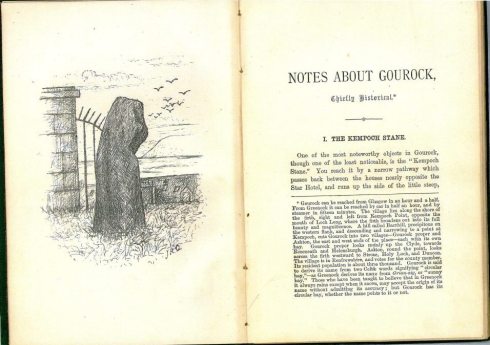 |
| Notes About Gourock, Chiefly Historical by Reverend D. Macrae |
Sadly the stone is tied up in a more depressing episodes of local history. Just as I had found stories in the villages of Fife, and in Paisley of supposed witchcraft, the mania for finding witches in the 17th century also came to Gourock, and nearby Inverkip. Researchers from Edinburgh University have mapped the location of witch trials. They record the story of Janet Love from Greenock, who in 1632 was taken to Inverkip to be interrogated by being "pricked", and tortured on the "stocks", "bow strings", and "wedges on the shins". Over a period of 50 years, at least 30 people (mostly women) were sent to trial at Inverkip for witchcraft.
One of the most well-known cases was that of Mary Lamont. In 1662 she was aged only 15 or 16 when she was accused of conspiring with the devil. She confessed to dancing around the Kempock Stone, and, with others, plotting to throw the stone into the sea to bring on bad weather and disrupt shipping. Found guilty of witchcraft, she was executed by burning, possibly outside the Auld Kirk in Inverkip.
A curious TV appearance from the Kempock Stone is in an STV drama from 1987, Shadow of the Stone, which features Shirley Henderson, and Alan Cumming. It is available on Youtube, but the trailer was enough for me to get the gist.
Leaving behind a 4000 year old standing stone, I ran on past the fabulous Gourock Outdoor Pool, which sits down on the river's edge. Closed over the winter months I would encourage you to come and enjoy one of the few remaining outdoor pools in Scotland. Every Scottish seaside resort used to boast such a pool, Gourock's being first opened in 1909, often tidal pools right down at the water's edge. The pool at Gourock is now a bit classier than that, with the water heated, but still filled with salt water, which catches you by surprise when you get a mouthful of it.
 |
| Gourock Outdoor Pool, March 2020 |
There are spectacular views from the terrace here across the Clyde Estuary and if you haven't been for a while, I would encourage you to make the effort. I have always enjoyed swimming outdoors, but I am a mere amateur compared to my grandfather, who would jump into any river, sea or pool when he was outdoors. This photo below is him on the diving dale at Stonehaven Open Air Pool, in about the 1930s. That pool is still open, but the outdoor pool at Helensburgh that I can remember visiting with my grandparents, is long gone.
 |
| Old photo of my grandad at Stonehaven Open Air Pool |
 |
| Gourock Outdoor Pool, Summer 2019 |
 |
| Gourock Outdoor Pool, Summer 2019 |
Gourock to Weymss Bay
 |
| My mum, her brother and sister, and my great-uncle Andy on holiday in Dunoon in the late 1950s |
If I think of Gourock, it is "Gourock to Dunoon" that I think of. Ferries across the Clyde have ran from Gourock for hundreds of years. It is positioned at a strange point on the Clyde, where you can cross to Dunoon on the Cowal peninsula, to Kilcreggan on the Rosneath peninsula, or in the past, to Helensburgh. With train connections and steamers, Gourock and the coast around about became the holiday destination for Glaswegians heading "doon the watter" at the Glasgow Fair. This was the main source of income for these towns in the early twentieth century and led to their rapid growth.
There are still two ferry terminals in Gourock and the photos below are of the Western Ferries terminal at McInoy's Point at the western edge of town.
 |
| Gourock to Dunoon ferry, at Gourock |
 |
| Gourock Dunoon ferries on the Cyde, passing in front of Ben Ime and Gare Loch |
 |
| Cloch lighthouse on the Clyde |
At Cloch point between Gourock and Inverkip, the lighthouse was first lit in 1797, one of Robert Stevenson's early designs. Chains from a boom across the river between the Cloch lighthouse and Dunoon prevented enemy submarines coming further up the Clyde in both World Wars. On the frosty morning in early March that I ran down here there were dozens of birds up and down the coast. Colourful bullfinches in the bushes by the path, cormorants, guillemots, duck and swans in the sea and the most gorgeous views across to the snow-topped hills on the northern side of the Clyde. Coming around the bend at Cloch lighthouse, the snowy mountaintops of Arran came into view, with the distinctive shape of Goatfell.
 |
| Cormorant on the Clyde |
 |
| Arran on the horizon, beyond Bute, as I came into Lunderston Bay |
 |
| Lunderston Bay |
Heading south now, the coastal path comes around Lunderston Bay which has a couple of sweeping beaches, and wonderful rock pools. In the past when Port Glasgow and Greenock closed down for their Fair fortnight this was one of the most popular destinations on the coast and a tent city would spring up on the grass behind the beach. There is a fantastic old photograph from those days on one of the information boards at the beach, where it looks absolutely rammed.
 |
| The Isle of Arran in the distance |
 |
| Beaches at Lunderston Bay, much quieter than in the past. |
Although I only knew Inverkip as the place where the marina is found, it is actually a very old settlement, with a church built here by the monks of Paisley Abbey in 1188. King Robert III, of the Renfrewshire Stewart line gave lands here to his son, Sir John Shaw Stewart, in the 1400s, who built a castle here. The Shaw Stewart family later built nearby Ardgowan House in 1798 and have lived there ever since. See what a few family connections 600 years ago grants you?
In the 1600s Inverkip, as mentioned above, was notorious for its zealous witch trials and several alleged witches were burnt here. Over the centuries the village was known as a hotbed for smugglers, transferring tea, tobacco and alcohol from ships travelling up the Clyde to port. The area at the mouth of the Kip Water river was excavated by army engineers during World War II to allow barges to be stored here. In the 1970s, building work for the Inverkip power station further down the coast involved dredging this area for sand and gravel to be used in the construction. This left a sheltered area of water that was converted in 1973 into Kip Marina. It has grown in size since then and can provide space for over 600 boats. A recent housing development beside the marina is a wee bit brutal, and not exactly to my taste. Presumably in part it provides accommodation for many people who may come and go to their boats here in the marina.
 |
| Kip Marina |
The path then skirts around Inverkip Power Station and reaches Weymss Bay. Since 1865 Weymss Bay has been at the end of the train line from Glasgow, allowing passengers to quickly disembark and hop onto the ferry to Rothesay on the Isle of Bute. The current train station is surely one of the most handsome in the whole of Britain. Built in 1903, it has curving steel beams supporting tons of glass. A glass covered corridor sweeps passengers straight down to the ferry.
 |
| Weymss Bay train station |
 |
| Glass roof of the Weymss Bay train station |
 |
| To the ferry |
 |
| Rothesay to Weymss Bay ferry |
That brings me to the end of my run, and to the end of my run across Scotland, for now. Since I did this run, the Covid-19 outbreak in Britain has escalated and all unnecessary travel has to stop to reduce the spread of the disease. So I'm stopping.
In 1849 a third of the people living in Inverkip died from a cholera outbreak. SO to avoid the same thing happening to all of us, stay at home and wash your hands. No more day trips for me until this is all over. Once we can travel again, I will finish my coast to coast run at Largs and do a lap of honour around Millport. Until then, look back over some of my other runs, and maybe plan your own next jaunt.

While I am down in this part of the world I will leave you with one last old photo. This is my great-great granfather, James McKellar, and his fine beard. He didn't just go to Rothesay for the Glasgow Fair, he grew up there and, married my great-great granny Agnes Donaldson from Bo'ness. He worked as stone mason and moved to Glasgow, living on Hope Street in the 1860s, just where Glasgow Central Station would be built 15 years later. His daughter Flora McKellar married my great-grandad Andrew, the plumber from Greenock, that I mentioned above.
I have particularly enjoyed this run today, enjoying the views, remembering childhood day trips, and ferry trips. Remembering my grandad's love of swimming in the sea and pools down here, and remembering the lives of his parents and grandparents at sea, in the sugar warehouses and on the islands. I'll be back again soon.
I have particularly enjoyed this run today, enjoying the views, remembering childhood day trips, and ferry trips. Remembering my grandad's love of swimming in the sea and pools down here, and remembering the lives of his parents and grandparents at sea, in the sugar warehouses and on the islands. I'll be back again soon.


