Showing posts with label classical. Show all posts

Saturday, 3 February 2018

Celtic Connections 2018. Live review

Julie Fowlis, Live Review. City Halls, Glasgow.
Max Richter, Live Review. Glasgow Royal Concert Hall. 

Celtic Connectios 2018. The 25th anniversary edition.

Julie Fowlis, City Halls, Glasgow. Celtic Connections. January 20th 2018

Of all the stand out shows at this year's Celtic Connections music festival in Glasgow, a big pile of them were all on the same night. Julie Fowlis's sold out solo show at Glasgow City Halls was the one I plumped for, and it was a good choice. On stage she was accompanied by fiddlers Duncan Chisolm and Patsy Reid, bass, two guitarists (including husband Eamon Doorley) and various harmonium and keyboards from Celtic Connections director Donald Shaw. Much of the set drew from the new album, Alternum, from opening piece Òran an Ròin (Seal's Song) to Cearcall mun Ghealaich in the encore, and was a mixture of old, old songs and new. 

With no percussion, the singing provided much of the rhythm, the back and forth that often creates a connection to the world of the singer in Gaelic songs. Bright and breezy throughout Julie Fowlis led from the front, introducing us to the story of one song with a cautionary "because it is happening in a Gaelic song, we know it won't end well."

Going out of her comfort zone, one song was given to us in English (or "the other language"), a version of "Go Your Way", whilst another was taken into Gaelic ("Blackbird" by The Beatles.) When I have seen Julie Fowlis before, it is when she gets out the whistle that the audience are getting ready to tap their feet, and it was the same again here, and I had completely forgotten that she is an excellent bagpipe player too, until the pipes appear as a finale. There were several young children in the audience, I thought drawn there in the hope of hearing the soundtrack songs from the Disney movie "Brave". I was wrong, the wee super-fan sitting behind me sang along in perfect Gaelic to every song in the set. A warm and smile filled evening's entertainment.

Max Richter Ensemble : Three Worlds. Glasgow Royal Concert Hall. Celtic Connections. January 23rd 2018.

With his increasing involvement in soundtracks, modern classical composer Max Richter seems busier than ever. The concert he performed at Celtic Connections harked back to a ballet score he produced for Royal Ballet's Woolf Works, a triptych of works choreographed by Wayne MacGregor in 2015. The recently released recording based on this music was brought to the Glasgow Concert Hall by Max Richter and the Scottish Chamber Orchestra tonight, though much of the orchestra were hidden behind the banks of keyboards, pianos and celesta that Richter played at front of stage. 

Virginia Woolf's books, Mrs Dalloway, Orlando and The Waves were the inspiration for the three pieces of music performed here. I am not a great fan of her books, but the recording of her voice that introduced the first piece was electrifying. The music that followed was melodic, with the violins and piano ebbing and flowing, but ultimately going nowhere, so pretty much like the book. Orlando was introduced as an other-worldly tale and the music representing it was more dynamic, with pizzicato strings and synthesizers leading to an impressive cello solo. The music felt quite cinematic, like a Philip Glass piece from 40 years ago, but was no poorer for that. The unimpressive flashing LED light show was a pointless distraction. Gillian Anderson's recorded voice reading Virginia Woolf's poignant suicide note led us into the final piece, where solo soprano voice of Grace Davidson made the whole thing more like a requiem.

The music was not quite muscular enough to fill the venue, but pleasant and graceful none the less. An encore of On The Nature of Daylight was enough to please the screaming super-fans at the front in a congenial, rather than barn-storming, evening of music.

Thursday, 24 August 2017

Edinburgh International Festival 2017 - Reviews

Edinburgh International Festival  - EIF 2017 - Reviews 


My musical introduction
  • Mitsuke Uchida In Recital  - 21 August 2017
I have no great knowledge of the minutiae of classical music, and learned most of what I know about it from my grandad's 12 album Reader's Digest collection of "light classical music". So with an open mind I have tended to just give things a go, without any pre-conceived notions about it. I have found that I particularly enjoy opera and twentieth century classical music. My oldest son however has been learning to play the piano for several years now, and has given me great insights into the music that he likes, of Mozart and Chopin. About 8 years ago when he had not long started playing piano, we took him to see Mitsuke Uchida play in Glasgow City Halls. So I was delighted to take the chance to see her again in the Edinburgh Festival this year. 

The Japanese pianist is a world renowned interpreter of the works of Mozart and Schubert, but the main reason that I rushed to get tickets for this recital in Edinburgh was because of the mention that she got in a book that I read recently. Absolutely On Music is written by Haruki Murakami, recounting his discussions about music, from several afternoons spent with Japanese conductor Seiji Ozawa. As they listen to a recording of Uchida playing Beethoven, Murakami says
"Her touch is so clear. You can hear everything so clearly - every strong note, every quiet note. She plays with total mastery: there is nothing vague in her performance" 
 Ozawa adds...
"Listen to that, those perfect moments of silence....What an ear she has for music!"
Murakami describes the next section of the music with a flourish 
"(a) beautiful piano solo unfolds, like an ink painting in space. A string of notes, perfectly formed and brimming with courage, each note thinking for itself." 
It is a great book, with specific details about the music they are listening to whilst they speak, and timings about which sections they are discussing - the master and the enthusiast. In the era of music streaming you can find most of the recordings online and listen along as you read, part of the conversation. 

The stage is set at the Usher Hall, Edinburgh, for Mitsuku Uchida
Anyway, I loved that book and Murakami's description of Uchida's playing drew me to the Usher Hall tonight. The programme started with Mozart's piano sonata facile in C major K545. I didn't recognise it from the title, but the first 5 bars of this piece is the ONLY bit of music that my dad can still play, 50 years after he stopped learning the piano. My childhood was punctuated by his enthusiastic playing of 20 seconds of this before it faded into plinkity-plonkety, every time we passed piano somewhere. Though I had my own reasons, I am sure that I wasn't the only one with a grin on their face listening to this rendition of Mozart's playful, frisky tune. The reason for starting with this was evident in the second half of the performance which began with a modern Sonatina facile from German composer Jorg Widmann, a homage to Mozart's well known piece. When recognisable neo-classical phrases bubbled up they were scattered sideways by wild distortions. This was my favourite piece of the evening. 

The main meat of the evening was in two longer, and more dramatic, pieces by Robert Schumann. His tribute to Hoffman, Kreisleriana, crashed about one minute, before, quietly fading away and Fantasy in C major was a grandiose way to finish the night. 

Uchida is a star performer who held the attention of the whole hall. With her total mastery, there was indeed nothing vague about her performance. 

Edinburgh Castle

  • Mariinsky and RSNO - 23 August 2017
So back again to the Usher Hall two days later to see another classical music celebrity, conductor Valery Gergiev, tonight conducting his own Mariinsky Orchestra from St Petersburg and our very own RNSO. The reason for the combined forces was to do the final piece of the night justice. Shostakovich's Symphony No 4 calls for an orchestra of 100+ musicians and is a masterclass in grandiose music, conjuring up the "gigantomania" of the USSR in the 1930s. 

To begin we had the Mariinsky perform a piece from another major Russian composer of the 20th century, Sergei Prokofiev.  His "Classical"symphony rolled along sweetly, with crisp playing throughout, particularly from the lead violin. It is a piece of music written in 1917 at the time of the Russian Revolution, that straddles the music of two centuries, the 20th century and the 18th. It was a controlled and professional performance, without any great drama. 

As the Mariinsky Orchestra shuffled off stage, the string section of the Royal National Scottish Orchestra came on, to be led by Gergiev in a rendition of Benjamin Britten's 1937 piece Variations on a theme of Frank Bridge. The theme of the piece sweeps across the orchestra in the opening and swirls around again at the end with more force. In between the musicians are put through every possible method to play their instruments, at one moment pizzicato, the next strumming their violins like ukuleles. A slight lack of variation between the "variations" started to make the piece sag a bit in the middle, and Gergiev seemed to perform with greater languor than when he was guiding the music of Prokofiev. Overall the piece feels a bit cinematic, but the RSNO played as a tight unit, with humour and levity in their manner under the inscrutable gaze of Gergiev. 

The combined orchestras assemble on stage at the Usher Hall
In the second half the concert caught fire, with Shostakovich's Symphony No 4. The massed ranks of both orchestras filled the stage and Gergiev conducted with energy, holding the two orchestras together as one unified instrument. There is a lot of clashing drama in the symphony, but also moments of quiet, with lovely solos from various musicians showing how calm and quiet 100+ musicians on stage can be (I didn't count, that's a quick guesstimate). There was impressive musicianship throughout, playing a fantastic piece of music and when the final hush fell, the full Usher Hall paused in sat in silence, waiting for Gergiev's permission to applaud. Special mention must go to Lynda Cochrane of the RSNO who had the nerve-wracking role of striking out the final notes of the symphony alone on the celesta, and mopped her brow in relief at the end after. Поздравляем всех вас.  

Friday, 12 May 2017

Tectonics Glasgow 2017

Tectonics Glasgow, May 2017. Review


For the fifth Glasgow outing of the Tectonics music festival all its familiar elements of experimentation, improvisation and collaboration were on display. Female composers and performers were to the fore this year, with the ever reliable BBC Scotland Symphony Orchestra and conductor Ilan Volkov the glue holding the whole weekend together.

The Old Fruitmarket, Glasgow
Whilst most of Glasgow lay about in glorious sunshine, decent crowds were drawn into the cool darkness of the Old Fruitmarket to see jazz musician and composer Roscoe Mitchell, who would bookend the festival, kick things off. Resplendent in some fantastic green knitwear and sunglasses despite the gloom of the Fruitmarket he wheezed and parped his saxophone like some exuberant snake charmer to get us started. They were followed by artist Luke Fowler and musician and composer John Chantler squatting in the centre of the room over a jumble of cables and string instruments creating fantastic electronic drones and distorted sounds. 

Luke Fowler and John Chandler
Next up we were through to the City Halls where New York musicians Yarn/Wire, a quartet of two percussionists and two pianists who started on conventional instruments to perform a piece by Andrew MacIntosh, before gravitating to bowed wine glasses and cymbals. Twitchy samples, shaken foliage, kitchen utensils and coloured beads agitated on drums were required for Thomas Meadowcroft's "Walkman Antiquarian". Their playing throughout, and across the weekend was crisp, clear and precise. If you want four musicians to fit a kitchen for you I would go for them - neat, particular and perfectly measured.

Back into the main concert hall and members of the BBC SSO combined with Yarn/Wire to play François-Bernard Mâche's "Kassandra", a tight performance conducted by Volkov combining the musicians with recorded voices and natural sounds. A strident babble of diverse voices. The first piece of the weekend from composer Linda Caitlin Smith, "Wilderness", was sweetly mellifluous before cellist Lori Goldston's composition for amplified cello and orchestra. A darker, more forceful piece and a good contrast to what had gone before.


My personal highlight of the weekend was the collaboration between Australian trio The Necks and the complete BBC SSO being guided in an extended piece of improvised playing by the energy of conductor Ilan Volkov. With The Necks front of stage, performing away, Volkov looked to be composing live with the orchestra, as he waved his hands and sculpted sounds, much as Tony Stark does with his VR computer system in the Iron Man movies. It was phenomenally beautiful, and a reflection of the close working over many years between Volkov and the orchestra.

Triangulum brought the evening to a close in the Old Fruitmarket featuring Julia Holter, Catherine Lamb and Laura Steenberge. A gentle, and slightly anti-climactic end to the day.


Sunday started with many of the musicians from the festival performing on the floor of the Old Fruitmarket Eddie Prévost's 'Spirals'. With members of Yarn/Wire, The Necks, Triangulum and others playing whilst dressed in gold lamé tabbards, the tone for the second day was established.

Two more pieces by Linda Caitlin Smith were performed in the main concert hall. First the baroque and melancholic 'Ricercar' performed by solo cellist Alison Mcgillivaray, followed by Yarn/Wire on two marimba and two grand pianos playing the more halting, laconic, and haunting 'Morandi'.

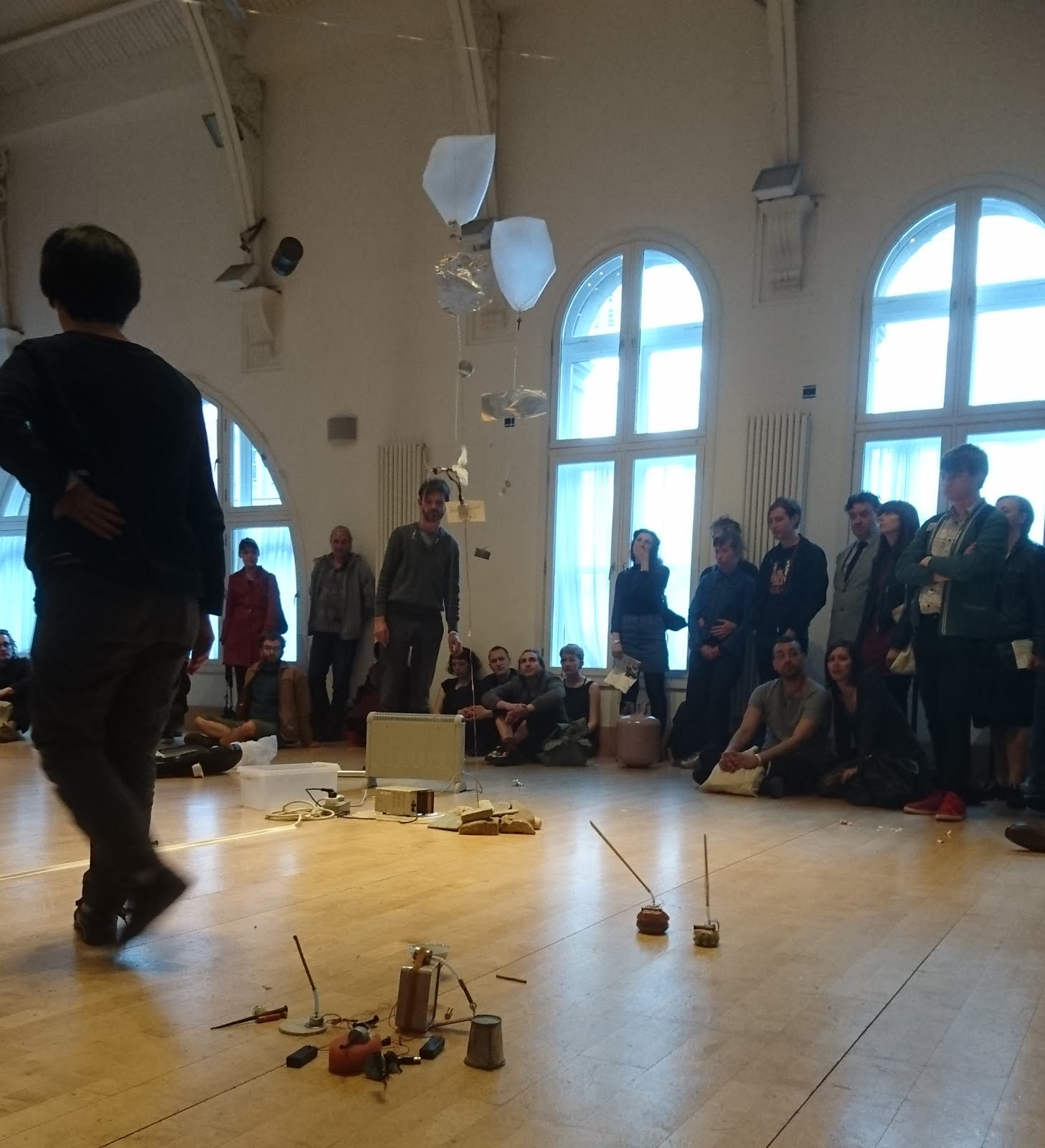
Pierre Berthet and Rie Nakajima
Across the weekend Pierre Berthet and Rie Nakajima had an installation on display in the building's recital room, where they gave occasional performances, animating their assorted creations. Gently diverting but never amounting to more than the sum of its little parts.

James Saunders and Tim Parkinson gave us two entertaining pieces ('in which one thing depends on another' and 'songs') which played with word association, a variety of dropping, plopping and banging of everyday objects and tabletops, accompanied by vocal ejaculations.

After these carefully written and choreographed pieces Ash Reid's piece of agitprop theatre in the Old Fruitmarket felt a bit self-indulgent and shambolic. A tighter piece, 'Felt Events' by Ilana Halperin and Raymond MacDonald featuring further contributions from the musicians of The Necks, brought a jazz cafe feel to a piece reflecting on volcanoes and earthquakes. Tectonics, you might say. Tut Vu Vu were a noisy wake up call to the audience after all that, with distorted, fluorescent guitars and electronic beeps and sqwaks.

The closing concert squeezed in six more performances starting with Shiori Usui's 'from scratch', a piece of music based on her experiences of eczema (which was making me feel itchy). Lawrence Dunn's 'Ambling, waking' followed in the City Halls, with more from Linda Caitlin Smith, James Saunders and Roscoe Mitchell bringing the weekend to a close.

Always an enjoyable way to spend a weekend, the whole thing this year felt less fresh than in previous years. Much of the music was similarly toned 1960s and 1970s pieces, and with many of the same musicians playing across the weekend it ended up with a familiar tone over the two days. There just seemed to be less chaos - more chin stroking this year and less drama.

Wednesday, 24 August 2016

Edinburgh Festival 2016 - Edinburgh International Festival

Edinburgh International Festival 2016


I only realised a couple of years ago that the Edinburgh Festival is a whole pile of festivals all happening at the same time. The fringe, the art festival, the book festival, the gardening festival (I made one of those up). The main Edinburgh International Festival has a much more focused and normally highbrow atmosphere. This year the world of alternative popular music has elbowed its way into the International Festival with Mogwai, Young Fathers, Sigur Ros, God Speed You! Black Emperor and Karine Polwart in the programme alongside the likes of the Russian National Orchestra and Scottish Ballet. Several of these concerts it was impossible for me to get to from Glasgow and others were sold out very quickly. I made do with a couple of Edinburgh jaunts to wonder around the galleries, catch some fringe theatre and book readings. There is only so long I can join the Edinburgh festival-going crowd before I want to scream though. There is a particular demographic that fills the city in August, and it feels like a good proportion of them will all trudge to the Henley Regatta and Glyndbourne at other times of the year.

I did make it to two International Festival events at the Usher Hall. A concert by a Swedish Orchestra and one by a Senegalese superstar. 

Hello Edinburgh

Usher Hall, Edinburgh

Swedish Radio Symphony Orchestra - Usher Hall

Beethoven Piano concerto No. 1 in C major Op 15
Mahler Symphony No. 9


English conductor Daniel Harding, led the Swedish Radio Symphony Orchestra at the Usher Hall on Friday night. First up was Beethoven's Piano Concerto No. 1, which was actually the third piano concerto he had written, but the first to be published. Written by the 26 year old Beethoven he performed the piano himself on the first performances of the piece. As you would, he has written the best parts for himself and Russian pianist Daniil Trifonov took this role. His performance was mesmeric, without being overly showy and flamboyant. At times hunched over the keyboard with his face inches from his fingers I fear he has an old age filled with back pain ahead of him if he keeps that up, but his playing was fantastic.

After the interval the orchestra had to pause for a while until someone silenced an electronic alarm (getting a round of applause when they managed). Mahler's 9th Symphony is often described as a contemplation on death and the first movement was indeed very dramatic. I found the rest of the evening rather colourless after that and a bit disjointed. Beautiful crisp playing throughout, particularly the strings, but the music didn't sing out to me.

Summer in Scotland

Youssou N'Dour - Usher Hall


One of the greatest figures in African music, "Senegalese superstar" Youssou N'Dour was in the incongruous setting of the stuffy Usher Hall on Wednesday night. His appearance was like a slash of light and warmth in a cold, wet Scottish summer. His audience were a refreshing change from the majority of Edinburgh crowds that I've been sat amongst this week, with many black and younger people dressed up to the nines mixed up with the usial Edinburgh Festival white, middle class, elderly audience.

I have seen him play once before, but that was 26 years ago now, a brief set in a Wembley concert for Nelson Mandela, so I was greatly looking forward to seeing him here tonight with his band in full flow. The band were impressive, 10 musicians and an acrobatic dancer and two singers backing him. With four of them on percussion rhythm was to the fore.

Youssou N'Dour at the Usher Hall 

Youssou N'Dour himself is a slight figure, out front in his shiny white suit, with a voice that's uniquely his. A few songs in we were given a piece of impromptu Scottish cabaret as ushers tried (ineffectually) to usher an obstreperous man away from the front row, where he had planted himself. They needn't have bothered as Youssou soon had sections of the crowd on their feet and dancing at the front of the stage and in the aisles. He slowed things down for a bit with "7 Seconds" before whipping the crowd up again as the tumbling dancer started jumping over the head of the djembe player, who was now draped in a Senegal flag from the crowd.

A captivating performance. Would love to have seen him in a more relaxed venue. Maybe next time.

Look. Youssou even brightened up the Edinburgh weather