Showing posts with label Modern Institute. Show all posts

Saturday, 21 April 2018

Glasgow International 2018 - Ah, but is it art?


Glasgow International 2018. Festival of Contemporary Art


A quick first impressions review of some of the stuff that is on at the sprawling Glasgow International art festival in the city for the next two weeks. It is an absolute pleasure to have this kind of gala appear in the city every two years, and much of it feeds off of the community of people making art in Glasgow. In the space of a few hours I battered around over 30 different exhibitions at 18 different venues on my bike, and would have kept going if I hadn't needed to get home for my daughter getting in from school, and I still felt that I had barely scratched the surface.

Maybe by Urs Fischer
However, it must be said that a fair amount of the stuff on show this year is high in concept, low on execution. If it takes you longer to read the accompanying blurb than it does to ponder the work itself, that's not usually a good thing. Sometimes you need no explanation, such as with the fabulous pair of mechanical (and very life-like) snails crawling around the floor of the Modern Institute's Aird Lane space. "Maybe" by Urs Fischer makes you laugh, makes you linger and is beautifully executed. Another highlight for me is found in the main space on Osborne Street of the Modern Institute, given over to the powerful post-modernist images created by Duggie Fields.

Inside Oxford House
Less successful are the many exhibits at House For an Art Lover, the Oxford House and Stallan-Brand Architect Office beside the Sherriff Court, and the Savings Bank on Bridge Street. However even in these places it is at least a chance to get inside these beautiful and fascinating Glasgow buildings not always open to the public.

Toby Paterson's Pallisade on High Street
Nicolas Party's big purple head outside Aird Lane and Toby Paterson's "Pallisade" outside the old Linen Bank on High Street are colourful distractions, whilst Turner Prize winner Lubaina Himid's jolly dragon which stretches across the main hall in Kelvingrove Art Gallery looks like the kind of bland decoration you would find in a department store during some nondescript festival.

More head scratching ensued when we came across the combined efforts of eight artists in the Botanic Gardens glasshouse. I really did not feel that it explored either the "paradoxes relating to the interplay of global and local forces upon the communities and places of Glasgow" or the "heterotopic space containing its own oppositions; interior and exterior, nature and culture, global and local." Equally disappointing was Lauren Gault and Sarah Rose's "Sequins" floating in the Forth and Clyde Canal, resembling little more than the other detritus floating nearby.

In the Kibble Palace, Glasgow
One exhibition where it was productive to read the accompanying blurb was in the Briggait, where Montreal-based artist Nadia Myre had riffed on the once upon a time sizable Glasgow industry of clay tobacco pipe production. With old pipe stems fashioned into various other items it raised questions about colonialism and waste and was a rare instance of concept and execution coming together to create something memorable.

Soft Measures by Kapwani Kiwanga
Ciara Phillips's prints in Glasgow Print Studio were beautifully presented and fascinating to see, and also worth seeing were the sculptural creations of Kapwani Kiwanga at Tramway, lumps of granite suspended on curtains of fabric. Next door in the main hall at Tramway Mark Leckey had a solitary carved figure, a blown up version of an 18th century figurine, facing off against a video of his cavities being explored, all perfectly entertaining once your eyes had adjusted to the gloom.

Nobodaddy by Mark Leckey
Two highlights for me were the photography on show at the Hunterian Art Gallery at Glasgow University and that on show at SWG3. German photographer and film-maker Ulrike Ottinger has an extensive exhibition of bizarre and unsettling photographs, evoking cabaret acts and freak shows, on show alongside some of her films at the Hunterian. At SWG3 Hugo Scott's street photographs are full of humour and interesting characters, each one a short story.  Also worth seeing at SWG3 were the sculpture in the main hall from Richard Wentworth and Victoria Miguel, and across the lane the creations and collages of punk designer Judy Blame.

A Roomful of Lovers by Richard Wentworth and Victoria Migual
The Gallery of Modern Art has a jumble of interesting ideas and images, nine artists collectively displayed under the name Cellular World, but it all feels rather disjointed. If you rummage about in the main hall there are some interesting bits and pieces among all the clutter, Joseph Buckley's concrete wall I found the most engaging.

Cellular World at GOMA 
Finishing off my day at The Common Guild felt like a gentle palate cleanser after the barrage of stuff earlier in the day. A solo exhibition by German artist Katinka Bock, a collection of small, quiet, clay and, slowly oxidising, bronze sculptures.

There are two weeks to go, and at times it is a bit hard to sift out the wheat from the chaff, but there is surely something there for all tastes. Just keep looking.


Wednesday, 7 October 2015

The Turner Prize and Other Exhibitions in Glasgow

Art Galleries in Glasgow and the Turner Prize Exhibition


With the annual jamboree of the Turner Prize visiting Glasgow at present a few national newspapers have done "What to see in Glasgow" sections, which have been a wee bit on the unimaginative side I have to say. So I wanted to have a quick run around some of the galleries in Glasgow that I like to visit in order to encourage other people to go and have a wee look at them from time to time. As attractions go these Glasgow galleries generally have the advantage of regularly changing their exhibits, so that if there is nothing that you fancy when you visit, there'll be another one along soon. Also they are usually absolutely free to visit.

Glasgow has established a reputation for being home to some of the best and most imaginative contemporary artists in Britain, often referred to as the "Glasgow miracle". The galleries in the city, and their visitors, have been an important part of that.

Kelvingrove Art Gallery and Museum, Glasgow

Kelvingrove Art Gallery and Museum

Anybody wanting to find art in Glasgow should start at Kelvingrove Art Gallery and Museum .

Main Hall at Kelvingrove Art Gallery
Alasdair Gray often talks about his childhood visits here starting him on his road to becoming an artist and like many people I can remember being brought here with my school class and being asked to pick an exhibit from the galleries and draw it for their regular competitions. The museum lies on Dumbarton Road in the west end of Glasgow. Opened in 1901 as The Palace of Fine Arts for the Glasgow International Exhibition of that year it has been an integral part of the city ever since It is where my great-uncle Andy who worked in the shipyards liked to take my mum for a day out and where I have spent many days with my own children. I really don't visit it as often as I used to since it re-opened after refurbishment in 2002, I knew the dusty old layout like the back of my hand and felt it lost a bit of character with the revamp. However it remains the most visited museum in the UK outside of London, a great advert for free entry to museums. 


As well as an impressive collection of French impressionists' paintings and Dutch and Flemish art there is a large collection of Scottish art on permanent display. This includes a small selection of works by the Scottish Colourists and a room of works by the Glasgow Boys, a loose alliance of about 20 artists from the 1880s. However many people come specifically to see one painting, Salvador Dali's Christ of St John's on the Cross. A controversial acquisition in 1952, at one time attacked in protest, it has proven to be a very astute purchase by then director, Tom Honeyman. I presume that any controversy over Dali's depiction of Christ has died down, as when I went to see it last week there was a nun sitting alongside me inspecting it.

Salvador Dali's Christ of St John on the Cross

Downstairs there is a temporary exhibition space, which charges an entry fee, currently for an exhibition on 19th century fashions.


Hunterian Art Gallery


Hunterian Art Gallery and Mackintosh House, Glasgow

Not far from Kelvingrove Art Gallery is found another fine collection of world class paintings. The University of Glasgow is home to the Hunterian, one of Scotland's oldest public museums, founded in 1908. The collection is currently displayed on two separate sites within the university, although part of it will soon be moving to a new space in nearby Kelvin Hall (opening summer 2016). It was founded with a bequest from 18th century anatomist Dr William Hunter and has many artifacts collected by him on display in the museum, which is housed in the main university building. Across University Avenue in a modern building beneath the high towers of the University Library is The Hunterian Art Gallery. 


Works by Joan Eardley in the Hunterian Art Gallery, Glasgow

Behind the large metal doors designed by Eduardo Paolozzi  are paintings from the likes of Rubens and Rembrandt. The Glasgow Boys and Joan Eardley are well represented and there is a fabulous selection of works from the Scottish Colourists. This includes one of my favourite pictures in the world, Les Eus by JD Fergusson, a huge and joy-filled canvas painted about the same time as Matisse's Dance. 


Les Eus by JD Ferguson

Other highlights here are the extensive collection of works by James Abbott McNeill Whistler and by Charles Rennie Mackintosh, the latter of which are on display in a recreation of his (now demolished) nearby house. There are also rotating temporary exhibitions here (currently on animals in the art of George Stubbs and others). In the upper floor there is another temporary exhibition space which houses an ever changing selection of displays which sometimes incur an entry fee, although the current one on Scottish archaeology is free.


The Common Guild 


The Common Guild, Woodlands Terrace, Glasgow

A lesser known gallery space in nearby Park Circus is The Common Guild. Home to a visual arts organisation you can browse through the art books in their library whilst visiting their exhibitions. They use the ground floor and first floor of a handsome Victorian town house as gallery space, usually open from Wednesdays to Sundays. Until 13th December they have an exhibition by German artist Thomas Demand called "Daily Show". As so many people record all sorts of images day to day, on phone cameras he has used a mobile phone camera to record undramatic scenes from daily life and produced large prints of them, from missing roof tiles in an office to clothes pegs on a line. As a camera phone addict myself I enjoyed seeing his take on this sort of thing. I must try harder with my efforts.


Glasgow Print Studio


Trongate 103

The next galleries are all housed in one block in the city centre at Trongate103. At the corner of Trongate and King Street can be found a building where you can see, amongst other things, the fantastical junk sculptures of Sharmanka Kinetic Theatre  (makers of the big mechanical clock in the National Gallery of Scotland in Edinburgh), the gallery space of Project Ability, a visual arts workshop for people with learning difficulties and the Glasgow Print Studio. Here a diverse and constantly changing range of exhibitions make it a place worth coming back to again and again. Having just finished with an exhibition of comicbook art from the world of Mark Millar, they now have on upstairs an exhibition of  etchings and monotypes by Ken Currie (until 18th October). He became known as one of the "New Glasgow Boys" along with fellow 1980s Glasgow Art School trained Adrian Wisniewski, Steven Campbell and Peter Howson.


Dead Finches, Kelvingrove, Ken Currie
There is a lot of death and darkness on show in Ken Currrie's prints, and known for portrait painting his portraits stand out in the exhibition. Amongst images of dead birds from North Uist I did like this one above of "Dead Finches, Kelvingrove" showing that the days of my primary school trips to draw from the Kelvingrove displays live on in this 2015 etching.

Iranian born Jila Peacock's paintings downstairs depicting scenes from the medieval Persian poem The Conference of the Birds were a colourful contrast to what's going on upstairs. Loved them.

Transmission Gallery


Also housed here at Trongate103 is Transmission Gallery. This gallery is often cited as one of the reasons the Glasgow art scene has blossomed in recent decades. Set up in 1983 by Glasgow Art School graduates it aims to encourage, support and exhibit young artists. If you are walking down to get a mushroom burger and some music at Mono, you might be tempted in by some strange offering in the big windows here. At present it looks like they are clearing up between exhibitions or from a Transmission party.


Street Level Photoworks


Next door to Transmission gallery is found Street Level Photoworks, a gallery for local and international art photography. Their current exhibition Surface Tension (until 8th November) shows the work of four artists. I was attracted to the pictures by Karen L Vaughan of east coast fishing villages from Angus to Pittenweem, presented as fragmentary panoramas. 

The Modern Institute


The Modern Institute, Glasgow

Just around the corner from the Tron Theatre on Osborne Street is The Modern Institute which presents a very varied selection of exhibitions from artists which they represent. Currently their ground floor exhibition space is showing works by Merseyside born Michael Wilkinson called Sorry Had To Done. As well as there being plenty of visual fun here, there were pieces that left me stroking my beard in contemplation. I liked the fluorescent strip light bulbs bound together as "fasces" and the huge tower of Lego beside "Dream a Garden", a pile of concrete rubble from a recently demolished tower block in the east end of Glasgow arranged into a neat rectangle. A former tower block resident myself I've watched my childhood home of grey concrete be reduced to rubble recently. I liked the whole range of ideas the title triggered off. 

SORRY HAD TO DONE by Michael Wilkinson, Modern Institute, Glasgow
The Modern Institute have another space across the road from the Briggait on Aird's Lane.


The Centre For Contemporary Arts (CCA)


CCA on Sauchiehall Street, Glasgow

The Centre For Contemporary Arts (CCA) on Sauchiehall Street occupies an old 'Greek' Thomson building and has exhibition space, a cinema, music venues, a vegetarian cafe, a bookshop and arty gift shop. It has been home to the Glasgow avant-garde since the 1970s when it was called the Third Eye Centre. In the late 70s my mum worked in the cafe whilst she was at college. During the school holidays their laid back approach to childcare meant that my brother and me spent a lot of time there when my mum was working: refilling the filter coffee machine, changing the big boxes in the milk fridge or just playing in the gallery spaces. It wasn't me that kicked over the lines of sawdust we didn't realise were an exhibition (that may have been my wee brother).

The Referendum Made Me Horny by In The Shadow of the Hand, at CCA, Glasgow

The current exhibition The Shock of Victory is a sad/ironic look at the world exactly a year after the Scottish independence referendum, including building an archive from the campaign. It is as unusual as you would expect from an exhibition here, but benefits from the viewer spending a bit of time reading the ideas behind the pieces. Symposia, talks and films run alongside the exhibition. Lovely place to have a beer, a coffee or a lunch.

Gallery of Modern Art Glasgow


When The Gallery of Modern Art Glasgow opened in the Royal Exchange Square in 1996 Douglas Gordon that year became the first Scottish artist to win the Turner Prize. Yet the modern Scottish artists of the time, who were successfully exhibiting their works around the world had any works on display in this gallery of modern art. No longer. With the Turner Prize exhibition visiting the city at present at the Tramway, the main hall of the gallery is at present given over to an exhibition of works made in the city since that time. Over twenty artists, including several former winners or nominees for the Turner Prize are on show, starting with the neon signs outside, by Ross Sinclair. I am glad to see such a comprehensive exhibition being put on, whilst some of the space in the museum is closed off for renovation. David Shrigley has some animations on show, paintings and sculptures by Martin Boyce, Toby Paterson Jim Lambie and others fill the hall.

Devils in the Making at GOMA, Glasgow
Upstairs there are exhibitions worth seeing including rarely seen works from the Glasgow Museums archive chosen by modern artists, including a lovely oil painting by Walter Sickert and a painting by Bridget Riley. On the top floor woman in art are highlighted in an engaging exhibition in collaboration with the Glasgow Women's Library.

Glasgow Sculpture Studios


Glasgow Sculpture Studios at The Whisky Bond building

On the banks of the Forth and Clyde Canal lies The Whisky Bond building, now home to numerous studio spaces and the Glasgow Sculpture Studios. Their gallery on the ground floor is open Wednesday to Saturday, making it a wee place to stop off at on your way to get some shopping at SeeWoo or on your walk along the canal to see Partick Thistle. Currently they have some work by Nicolas Deshayes, Darling, Gutter, expanded foam around the hot water pipes of the room, making these blobby shapes also functioning radiators as it were.

Darling, Gutter by Nicolas Deshayes

Tramway


Enterence to the Tramway in Pollokshields, Glasgow

Okay, last but not least, I made it to the Tramway where the current Turner Prize exhibition is displayed. Originally a tram shed built in 1893 the building was made into the Glasgow Transport Musuem in the 1960s when Glasgow decided that trams were the transport of the past (Doh!). As my granny lived in Mosspark we came here regularly to see the vehicles that are now housed in the modern Riverside Museum designed by Zaha Hadid. Since 1988 this old industrial building has been an arts venue and now also home to Scottish Ballet. 

Turner Prize nominees 2015
The main hall at the Tramway has been broken up into large white cubes where the four nominees for this years prize show their stuff. There is a long and illustrious list of past winners and nominees on one wall of the exhibition, from Gilbert and George to Antony Gormley, Damien Hirst and Rachel Whiteread. Then Scottish based artists start to feature regularly like Martin Boyce who won in 2011 and David Shrigley and Ciara Phillips nominated in recent years. Ironically in the year the show is in Glasgow no locals are represented.

I arrived at the Tramway today a bit hungry and the food I got in the cafe was, to say the least, disappointing so I may have looked around the exhibition in a bit of a bad mood. However the exhibition didn't really lift my spirits much. Nicole Wermers spoke of people claiming public space for themselves by putting a coat on a chair, when I would have thought it is usually just that it would be otherwise too hot or a case of dumping it on the floor. To illustrate it with pelts of dead animals stripped of their coats just annoyed me. Then nothing winds me up more than people going on about the paranormal, so a roomful of it from Bonnie Camplin was never going to be for me. Janice Kerbel has some unaccompanied opera singers reciting her words, something I've seen Richard Youngs producing more effectively recently at  Counterflows festival in Glasgow without a nomination for an art prize. The final display is of a showroom/workshop of the Assemble collective about their work in working with a Liverpool housing re-development.

As a visual spectacle the Turner exhibition is a bit earnest and the logo emblazoned everywhere "Show Me Some Thing New" feels a bit at odds with the actual exhibits.

There are plenty of new, innovative, imaginative, thoughtful, fun, interesting exhibitions on in Glasgow just now. I haven't included some galleries which I didn't get to, or which didn't have an exhibition on the days this week I was wandering about such as the Collins Gallery, The Pipe Factory or David Dale Gallery. So go beyond the Turner exhibition to see if you can spot next year's nominees.

Wednesday, 9 April 2014

Glasgow International 2014, Quick Review

I was looking forward to the return of the Glasgow International festival this year, after it being such an entertaining and engaging event two years ago. Sadly, however, I have found very few of the exhibits in this year's Glasgow International to be particularly relevant, engaging, interesting or thought provoking in any way whatsoever. Many times the idea behind the exhibits are so cryptic and pretentious that the festival guide reads like the Pseuds Corner world cup event qualifying, the navel-gazing round perhaps.

I like a lot of modern art. I particularly enjoy it when it elicits some kind of response, whether it is sadness, disgust, happiness, memories, laughter or even just admiration for the skill or technique on display. Artists should be part of the real world and can engage with events, politics, life, injustices, etc. On spending a couple of days catching up on things at various venues this year the most common emotion it created was disappointment. So much of it seemed cobbled together, cheap, pointless or pretentious. It seemed to be occurring in another reality where there is no national debate on whether Glasgow should be part of a new country, where there is no politics or emotion or engagement. It feels very petty. The real world seems not to have touched many of the things on show, they are happening in a bubble removed from anything I could connect with.

So what did I like?

  • Counterflows is an annual event in Glasgow of experimental and contemporary music. This year it was included under the umbrella of Glasgow International and was a resounding success. (Review here)
"The Colours of the Palestinian Flag" by Khaled Hourani
  • Khaled Hourani is a Palestinian artist who has work on display at the Centre for Contemporary Arts. Some of the work reflects the surreal nature of current events in Palestine with works here commenting on the Palestinian winner of "Arab Idol", donkeys painted as zebras in a Gaza zoo and a photo of a Picasso painting on display in Palestine. I didn't even notice the Picasso at the centre of the photo until I read the title, so distracted was I by the guards in the forefront. Every piece is stimulating, thought provoking and double edged.
Aleksandra Domanovic's work at GOMA
  • Aleksandra Domanovic's work is on show in the main hall at the Gallery of Modern Art. The Berlin based artist has filled the hall with huge celluloid screens with images from sci-fi films, reflecting the inferior roles women are often given in science fiction literature and films. The punchline comes on the last panel where a letter to a woman applying as an artist in the Disney studios is reproduced, showing where a woman's place is in that world. 

Reclaimed
  • Reclaimed-The Second Life of Sculpture is an exhibition in the main hall at the Briggait. You could put an ice cream van on display and I would come in to see it as I just enjoy getting into this building where my great-great granny used to have a fish stall. This exhibition displays sculptures held in long term storage and raises questions about fashions in art and when it becomes disposable. Much of the exhibits on at other venues in Glasgow International give weight to the argument that there is plenty of sculpture out there that should have by-passed the galleries and gone straight into storage. A treat for any Glaswegian is seeing the "love it or loathe it" sculpture Spirit of Kentigern that used to sit at the bottom of Buchanan Street on display. I always thought it was meant to be a whale's tail until I read this week that it is actually representing the bird that never flew. Who knew?
Bricolage
  • Bricolage at The Pipe Factory. An interesting collection of stuff in an interesting building.

So what was mildly distracting?


  • At the Modern Institute Tobias Madison, Emanuel Rosseti, Stefan Tcherepnin have changed the frontage to resemble a ghost train, whilst the inside has become a sort of carpetted corridor. Ten out of ten for effort.
  • Gabriel Kuri at The Common Guild has made a colourful and interesting collection of sculptures, which make more sense once you flick through his book whilst going around (this was a recurring problem, exhibitions with no gallery staff helping to explain things or not raising their faces out of their iPhones to engage with you or with no leaflets left). The staff at The Common Guild and Modern Institute were very helpful, chatty and engaging as always.
Henrik Patzke at Project Ability
Work by Gareth Moore at Glasgow Sculpture Studios
  • Canadian sculptor Gareth Moore shows the products of his three month residency at Glasgow Sculpture Studios, drawing from the surroundings with discarded materials from the adjacent Forth and Clyde Canal and clay dug from local claypits.
Le Swimming at Fleming House
  • Also interesting, although maybe a bit unevenly executed, was Le Swimming in the disused underground car park under a shabby modernist building, Fleming House, in the city centre. It was quite witty and made a good point about the lack of such non-commercial amenities in the city centre and the folly of the construction of these buildings 
  • At David Dale Gallery in Bridgeton Claudia Comte has a collection of interesting sculptures, and top marks for venue goes to those behind Baldachini  under one of the arches on Cleland Lane by the Citizens Theatre.

So what was rubbish?

  • Well, following on from the point made about the lack of public amenities in Glasgow city centre I was keen to see inside the old Govanhill Baths, closed several years ago by Glasgow City Council but trying to find a second life as a community resource. It is meant to be home to a collection of inflatables (LOVE) by Anthea Hamilton and Nicholas Byrne but on the two days I tried to go I wasn't allowed in to see the building, because one of the inflatables had a leak. I really feel I could have mustered the imaginative powers to conceive the exhibition in all its glory without the full display but was told I wasn't getting in. Poor show. 
  • Kling Klang, an installation at Queen's Park Train Station was impossible to fathom. Were the two turned off electric guitars meant to be the "open access electronic music studio" promised in the programme?
  • The McLellan Galleries building was more impressive to see then any of the four exhibitions therein. Photocopies of an artist's genitals, video installations akin to many pop videos complete with someone shagging the pavement. I've got a bit tired of exhibitions where the attendants stop you at the door to say "oh....you might not want to take your children in there..."
  • Hydrapangea at the Botanic Gardens and Simon Martin at Kelvingrove sounded good on paper, but in reality were unengaging. Kelvingrove Art Gallery and the Botanics were both mobbed during the school holidays when I was in them, but the bland video installations in both were completely ignored by everyone. They were making no connection with their surroundings or the visitors to them who were all walking past. Both exhibitions were overwhelmed by their settings. This seemed particularly ironic in Simon Martin's case as the description claimed he was paying "attention to the relationship between viewer and artefact".
  • Gymnasia was full of ideas that sounded better than its actual execution, as were another pile of exhibitions I could mention, but won't.
  • Welshman Bedwyr Williams and America's Michael Smith have video installations at Tramway, the former in the main hall given a creepy twist with an abandoned coach illuminating the darkened main hall. However both seemed in thrall to TV and not unlike too many well known shows or similar characters I know drawn as roundly in comics I've read. Both were entertaining but there are a lot of videos on show in the festival. These installations come over as cheap and easy enough to dispatch to festivals around the world, but the world watches these things on YouTube, on their phones and tablets these days. It just often feels too disposable.
  • Sometimes getting access to buildings housing the exhibits was more worthwhile than the exhibits they held. SWG3 have a couple of disjointed exhibitions on in the studio spaces in the top floor there. It was nice to get to see the huge space up there but I would have been disappointed if I had climbed the stairs hoping to find a hidden artistic gem. Nowhere was this more apparent than at the new Glasgow Art School building in Garnethill. It was great to see inside the new building and to use Michael Stumpf's exhibition across the road as an excuse to re-visit the Mackintosh Building.
Atelier Public #2 takes over a floor at GoMA
  • Atelier Public #2 at GoMA? Is this really the best use of the space, recreate a children's play area in a shopping mall, but give the public less art materials than you'd get in one of these places.

So...

The Glasgow International 2014 festival seemed incredibly bitty and disjointed. There were too many videos and exhibitions which seemed to lack a curator's touch or any point to them. Some of the favourite things which I saw were not part of the festival, such as the new art school building and Martin Boyce's glasswork in its entrance or Iain Hamilton Finlay's exhibition of prints in the GOMA. These displayed more wit, skill and bite than so much of the stuff that is in the festival. However it is all free, there is tons more that I haven't managed to see yet. I just think it requires more of a guiding hand than it seems to have, or maybe that just costs more money.

Martin Boyce's glasswork in the foyer of the new Reid Building at the Art School 


Saturday, 2 November 2013

Rainy Day Indoor Distractions - Glasgow Exhibitions

House Style - Tramway

Lucy Skaer: Exit, Voice and Loyalty - Tramway

Release: The Koestler Exhibition for Scotland - Tramway

Jack Vettriano: A Retrospective - Kelvingrove Art Gallery

Roman Ondák: Some Thing - The Common Guild

Allan Ramsay: Portraits of the Enlightenment - Hunterian Art Gallery

Chris Johanson: Considering - The Modern Institute

Jeremy Deller: English Magic - The Modern Institute


So the weather is miserable in Glasgow this weekend, rivers of water running down the cold, grey streets. Yet again there is no Partick Thistle match on this Saturday afternoon and the weather has put me off casting an eye over a Juniors match, or even Albion Rovers vs Deveronvale in the Scottish Cup, which I half thought about for a couple of minutes. So what better distraction than a random stoat about some of the exhibitions on (indoors) in galleries around Glasgow this weekend.

Dragging the kids away from the warmth of the house we started at the Tramway, on the southside. The stuff on there is usually wacky enough to entertain the kids, even if the Hidden Garden out back was at risk of turning into a swamp today. In the first room we found House Style, a series of four short films commissions using material from the BFI institute archive. This has been plundered very effectively already by Public Service Broadcasting who are still touring with their album (Inform Educate Entertain). If you fancy trawling through this phenomenal archive, you can do it with a Glasgow library ticket at Bridgeton Library. The results on show here varied from the pompous (Travis Jeppesen's "I, An Object") to the entertaining and thought-provoking (Rob Kennedy's "What Are You Driving At?").

House Style - Tramway
Next door is a major exhibition by previous Turner Prize nominee, Lucy Skaer who plays with ideas of memory, representing or abstracting things from the real world. You enter via a recreation of the corridor she used to walk down on the way to her studio in New York. Afterwards these ideas are played out in film, print and sculpture - stretching from the worn steps of her childhood home to casts of pre-historic axeheads and images created from the Guardian newspaper's printing plates. My kids' favourite were the ceramics laid out on the floor of the exhibition space as a terracotta army.

Lucy Skaer - Tramway
Upstairs in the Tramway there is the return of the annual exhibition of artworks by inmates of Scotland's prisons, Release: The Koestler Exhibition for Scotland. This always presents an interesting and varied body of work including painting and drawings, sculpture, music, video and some excellent poetry.

The imagination and originality on display in the Tramway exhibitions was what we found completely absent in the basement of Kelvingrove Art Gallery, where Jack Vettriano: A Retrospective chunters on. So many of his images are very familiar from posters, tea towels and greetings cards but seeing room after room after room of them really brings home the banality of it all. They are also much smaller in the flesh than I expected. My 11 year old son, unbidden, asked "Why have all the ladies got hardly any clothes on?". Quite.  If you like the styling of Downtown Abbey, but think that the women are all a bit over-dressed, then this is the exhibition for you. The only painting which made me pause in front of it was a rather sheepish self-portrait. Beyond that I'd save your £5 and have a coffee and some scones upstairs.
An Allan Ramsay selfie
At the opposite end of the artistic spectrum, showing what it is possible to achieve when painting people, look no further than the Hunterian Art Gallery at Glasgow University. To mark the 300th anniversary of his birth, they have an exhibition of portraits by Allan Ramsay, entitled Portraits of the Enlightenment (I think that the Scottish National Gallery in Edinburgh also have an exhibition of his work on just now). Born in Edinburgh he travelled to London and Italy to learn his craft and became painter to the court of George III. The portraits on show here include a surprising number of women, painted as real and intelligent people with real stories to tell (and all of their clothes on) such as Flora MacDonald and Frances Boscawen. In that sense he also encapsulated the times, whether painting surgeon William Hunter, Jean-Jacques Rousseau or the Duke of Argyll. Each portrait makes you feel very much as if you are coming face to face with the real person, none moreso than in his self-portraits.
Roman Ondak
Still raining so it was time to head back towards town via Park Circus and The Common Guild. They have a free exhibition (and they often offer you tea and biscuits too) by Slovakian Roman Ondák there at present (titled "Some Thing"). Much like Lucy Skaer above, he plays with ideas of memory and interpreting reality as many of the pieces show paintings or drawing he did as a teenager 30 years ago, alongside (or interacting) with the original objects from the still life. We all enjoyed that one.

Then finally off to Parnie Street to The Modern Institute to see what they had on. Downstairs is a selection of paintings and constructions by American artist and musician Chris Johanson ("Considering"). Well, considering the fun, childlike style of it, I found it hard to get any humour or engagement with much of this stuff although I did quite like the flimsy structures down the middle of the room, Glasgow windows apparently.

What did keep me from dashing back into the deluge though was the small selection of stuff upstairs by Jeremy Deller ("English Magic"). Deller brought his inflatable, bouncy Stonehenge to Glasgow last year. The highlight here is the light hearted and shambolic "Procession", a film of a project he did through the streets of Manchester in 2009, a parade of the most odd, the most wonderful and the most normal local groups. All human life was there, from football mascots to "unrepentent smokers". Worth catching if you want to feel a warm glow. Like his Stonehenge bouncy castle, his stuff is fun and engaging, but has further depths, for example the simple signs on the wall presenting song lyrices in the style of fluorescent posters outside a church. Sean Ryder's words are funny seen like this, but you can also ponder whether musicians are taken as prophets, or whether churches extract the best lines from folk tales, presented full of portent, to tell a different story. Then heading home I kept going over other songs in my head, to pick out my texts. The best I managed was "Do the dog, not the donkey." Terry ch6 v1.

Sign by Jeremy Deller
 
In the end Albion Rovers won 1-0 and I did miss seeing a (Partick Thistle on loan player) Mark McGuigan goal there in Coatbridge. Ah, well. Another time.

Sunday, 21 April 2013

East End Entertainments In Glasgow.

Review of Outskirts Festival, Platform. Easterhouse and BFI Mediatheque, Bridgeton Olympia Library, Glasgow.

 
Last year's inaugural Outskirts Festival was a sell out. No surprise with popular acts such as Aidan Moffat, Vashti Bunyan and readings from the likes of William Letford that time around. This year the festival stuck more closely to its own goals as "a venue on the outer reaches of a major city ought to doff its cap to artists on the edge of their disciplines or those creative people who are simply too curious to stick to one artform". They had advertised it as "recommended for the whole family". So taking them at their word we headed to the Platform as a family. There were options to include food in the ticket price and price reductions available if you had "local links". I was going to claim this on the fact that a decade ago I had spent a year working in Easterhouse but in the end "local links" just meant having a Glasgow postcode. The venue is not one I'd been to before. It is part of the Bridge complex in Easterhouse, which also includes the swimming pool, library, John Wheatley college and plays host to Scotland's National Youth Theatre.

Olympia building at Bridgeton Cross
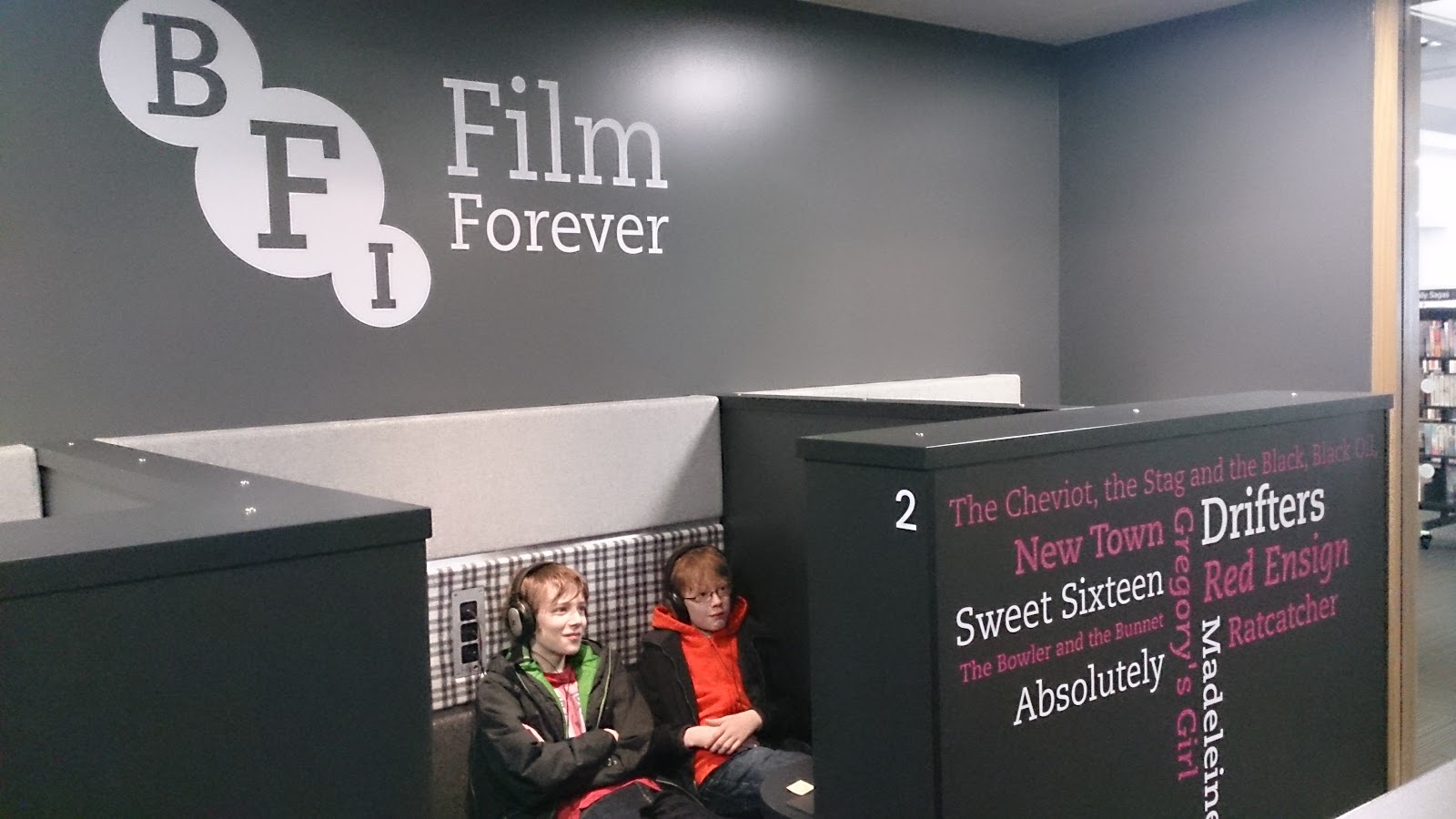
We decided to make a day of it in the east end and started at Bridgeton Library. This recently re-opened in the former Olympia cinema and music hall building right at Bridgeton Cross and includes Scotland's "first BFI Mediatheque". This is a film and television archive from Scottish Screen and the BFI. Armed with just your library ticket you access this at a computer screen in wee booths in a dedicated section of the library. The choice is so wide and varied the hard part is deciding where to start, whether you go for old 50s Horlicks adverts and documentaries about Glasgow shipbuilding or the first episode of TV show Swap Shop. There are films too, from Gregory's Girl to Great Expectations. We ended up dipping in and out of a lot of things but our collective favourites were footage of the 1908 London Olympics and watching Peter Cushing as Doctor Who in Dalek Invasion Earth 2150.

BFI Mediatheque, Bridgeton
We also wandered round the corner to a gallery which has been open for a couple of years in an industrial building here but which I only heard about when there was a feature on it in The Skinny this month. The David Dale Gallery was hosting an exhibition by Harry Meadley featuring some other Leeds based artists. You wouldn't stumble across the gallery by accident unless you had come here on purpose but it is certainly worth seeking out. After this we swung past the Modern Institute in Osborne Street which has an exhibition just now of paintings by Swiss artist Nicolas Party. From here we could pop around the corner to get a vegetarian lunch at Mono and join in the fun of Record Store Day, the day when lots of men with beards queue up at record shops to buy vinyl they don't want but hope to flog later on ebay. Mono were also running a bus to Easterhouse for the Outskirts Festival, so wiping the last falafel crumbs from the corners of our mouths we headed for it.
David Dale Gallery

Outskirts Festival

As I'm visiting Denmark and Holland during the summer I was drawn by the chance to hear Danish Frisk Frugt (it means fresh fruit apparently), and Dutch performer/ musician Jaap Blonk. A Hawk and a Hacksaw's Balkan-influenced folky music was also a draw and the chance to hear a reading from Rob Newman, once part of The Mary Whitehouse Experience. There were other more eclectic offerings promised to and performance art promised throughout the evening.
Florence To
Jaap Blonk set the tone giving us a sound poetry recital. I've been to lots of sound poetry performances and I'm not convinced that it brings anything more than the reading of words or the playing of music could to tell a story or express an emotion. This was the first time that I'd forced it upon my three children though and their less filtered opinions are always interesting. They found it bonkers but amusing, which is probably fair enough. He gave us a history of Sound Poetry, from early 20th Century Russian to Dutch members of the De Stijl movement. Between acts in one of the rooms Florence To played projections of geometric shapes onto white pyramids to a background of ambient electronic music. It was hypnotic stuff and the later performers got her to leave it on to add to their performances. Some of the other art on show was a bit hit or miss, although I did end up with a bag from the screenprinting Poster Club. In the main auditorium next up was "Sonata for a Man and a Boy" by Greg Sinclair and an excellent turn by young Bartek Bialucki. It was a performance involving movement, conversation and a cello lesson where the man's inner child and boy's adult interplay. It was gentle and engaging and warm and fuzzy without feeling the need to be dark or foreboding. A poetry reading by Ryan Van Winkle never quite hit the right note, whereas acapella singers Crying Lion, were note perfect and oddly one of my children's favourite performances with their olde England cider-appley sound.
 
We were disappointed that Rob Newman wasn't well, as we'd been quite keen to hear him, but Scottish writer Kirstin Innes stepped in for him, reading her tales of social dancing torture at school.
Frisk Frugt
Frisk Frugt's latest album got a rave review in The Quietus so I was looking forward to hearing them. Danish musician Anders Laug Meldgaard comes from a country where jazz is apparently not a bad word, but also a country where it has not been allowed to stagnate and has positive influences on the experimental, jazz-tinged sounds of Frisk Frugt. Driven on by his forceful percussionist who used a variety of bells, drums and chimes Anders moved from keyboard to mini-sax and his homemade organ put together from an array of swanee whistles and recorders. Their last piece was particularly impressive and beautifully put together, moving from chaos to order. This was definitely the highlight of my day. The evening was finished in style by A Hawk and a Hacksaw, the two-piece from Albuquerque, New Mexico rattling off their Balkan soaked tunes on violin and accordion. It was a foot-tappingly good performance but a bit unengaging for me. Central European folk music is not something I have a great handle on so it is hard for me to know where respectful imitation ends and original music making begins here. I think perhaps the setting didn't help this with the audience sat in the auditorium chairs looking down on the musicians. It was music that would be better heard sat around a fire with them or dancing in a village hall.
A Hawk and a Hacksaw
Overall it was a well organised, interestingly curated festival. The atmosphere was pleasant and the unusual settling with library book shelves you could browse between acts and a sports centre cafe serving bottled beer and paninis worked well. It didn't feel like it had imposed itself on the area either but tried to engage with it. When a group of local boys kept wanting into things they were invited in without anyone fussing over it. Even after they ran out from the sound poetry guffawing theatrically I later saw Jaap Blonk and one of the festival organisers talking to them in a hall trying to show them how he makes his loudest farting noises. Other kids who had wandered in seemed to be getting a chance to do some screenprinting. Good effort all round, but maybe needs to work on the publicity a bit next year as this felt a bit like a wee secret.