Tuesday, 27 October 2015

Battles. Glasgow ABC. October 2015

Battles. Buke and Gase. Live review. Glasgow ABC. October 2015


Last time that I saw Battles play in Glasgow was in the Arches in about 2011. The intensity of their sound and the sheer volume in those tunnels under Central Station blew me away and left my ears ringing for days afterwards. It was absolutely packed as well, with a lively, sweaty crowd. 

Four years later and touring to promote their latest album "La Di Da Di", the Arches has now closed down and we find ourselves in the more open space of the ABC on Sauchiehall Street. Maybe the space is too big, maybe their latest album isn't generating so much buzz, or maybe it wasn't a great idea to play on the same night as Godspeed You! Black Emperor are playing along the other end of the M8. Whatever the reason, the hall seems to have a bit too much space in it, and the audience remain a bit subdued throughout. 

Battles (and their improbably high cymbal) ABC, Glasgow

Support act Buke & Gase play an excellent, jerky, unpredictable set and start to rouse the crowd. When Battles arrive on stage, Dave Konopka crouches on the floor for 5 or 10 minutes building up loops and rhythms before Ian Williams and John Stanier join him and give us "Dot Net" from the new album. The new album continues their experimental, post-rock/ math-rock/ jazz-rock sound. "Rock" is at the heart of it all though, with the forceful drumming of John Stanier front and centre on stage and in the sound. They batter through some great tunes, all angular and twitchy, but fail get the crowd engaged. Older songs like "Ice Cream" and "Atlas" get the biggest responses of the night, but when the band pause to briefly chat they acknowledge the flat feeling of the evening, asking "Did somebody die in the audience?". Their biggest cheer of the night, as they note themselves, is when they thank Glasgow for giving the world Mogwai.

I've seen them before and know that they are a great live act, but tonight they just seemed a bit flat. I think that was more down to them than to us. 

Friday, 23 October 2015

A Geeks' Trip to London. Codebreakers, Boy Wizards and Cosmonauts

Last weekend I had reason to be in London and although we had some things to attend to whilst there, decided to take the opportunity to see some sights during our trip. As my teenage son was coming with me, a few other trips got added to our itinerary at his suggestion.

Here are the three highlights of our trip. It turned into a bit of a geeks' weekend.


Bletchley Park


Driving to London we made a detour to Milton Keynes. This was not to admire the bland curves of the MK Stadium, 30,000 seater home of the MK Dons and venue for three 2015 Rugby World Cup matches, but to visit Bletchley Park. 


MK Stadium, Milton Keynes
A German Enigma machine,
at Bletchley Park
Bletchley Park was home to the World War 2 codebreakers. Churchill described their work here as shortening the war by two years, and it was home to an eclectic group of people. Most well known amongst them was Alan Turing, the mathematician generally considered to be the father of computing. Persecuted during his lifetime for his homosexuality, his achievements are only now getting the recognition which they deserve. In the early 1990s a campaign was launched to save the codebreakers' huts at Bletchley Park from demolition by housing developers and now preserved, a museum has been built in the huts to explain the work of the codebreakers. The development of the exhibits is an ongoing process and now the grounds and the mansion house, which dates back to the 1870s, have been restored to their wartime appearance. The German Enigma machines were used to scramble messages into unintelligible ciphers. The settings were changed daily to allow trillions of possible combinations, making the cipher virtually unbreakable. 

Pride of place is given to a rebuilt Bombe machine, the machine which Alan Turing and Gordon Welchman devised to break the Enigma code used by the Germans during the war. Daily it was set running to try to work out the combination for the day, to allow messages to be understood whilst they were still operationally relevant.

A rebuilt Bombe machine at Bletchley Park being tested

In this room a bunch of men in tanktop sweaters with pliers sticking out of their pockets and cables slung around their neck proudly demonstrated the machine in action.

Sculpture in slate of Alan Turing

In other buildings on the site are found equally geekish exhibitions. One building houses the National Radio Centre, a museum on the history of radio communication. Here we found more excited middle aged men huddled around their equipment, as they tried to contact a home made satellite which was apparently passing overhead whilst we visited. Nearby is the National Museum of Computing which houses an amazing collection of ancient computers and mainframes. Among them is a working version of the world's first electronic computer, "Colossus", which they have rebuilt. It was developed at Bletchley Park in 1944 to decipher the more complex German Lorenz codes. It could do the calculations required to break the code in a matter of hours that were taking people weeks to break. With 2,500 thermiotic vacuum tube valves in each machine there were two of these working at Bletchley Park by June 1944, meaning the Allied army could be sure that Hitler had swallowed their deception plans prior to D-Day on 6 June 1944. 


Colossus at the National Museum of Computing
Bletchley Park was an unexpected treat, suitably amateurish and homespun at times, but conveying an excitement and buzz about the place too. Nice cafe in one of the huts and no need to pre-book tickets, just turn up and wander around


Warner Brothers Studio Tours, London. Harry Potter


As my teenage son got to choose where else we visited on our trip, we inevitably ended up at the Warner Brothers Studio Tour in Leavesden, just outside the M25. The Harry Potter films were produced here over a ten year period and now many of the sets, props and costumes are laid out as a visitor attraction. Some people have seen the films and found them mildly distracting, some people read the books cover to cover on the day of publication, re-read the whole series monthly and can identify each brand of confectionery which acts as a background prop in the film. One of these descriptions fits for me, one for my son.
The Hogwarts Express at Warner Brothers Studio

We arrived on a Friday afternoon when the London children were at school, but the place was absolutely heaving, with apparently equal numbers of French families, Japanese tourists and locals jostling for position. Entry times had to be pre-booked before visiting and there were very few slots left on the day we wanted to go. They recommend spending three hours on the visit, and that is probably about right as the place is absolutely huge. Film sets for other films still ongoing can be seen behind fences outside the exhibition space, in what is still an active film studio. 


Dolores Umbridge stuff at Warner Brothers Studio

You start off by being led as a group into the set of the Great Hall at Hogwarts, which was laid out for a Hallowe'en feast when we were there. After that you wander through a large hall of props and sets from the films. My son had been before and reliably informs me that they had changed a few things around since his last visit.


I found the attention to detail and the craft of the prop makers fascinating, from labels on bottles, to portraits decorating hallways (many of which feature wee Easter eggs of cast and crew members or incidental characters from the books, apparently).


An outdoor section which is home to the houses of Privet Drive also has a Ford Anglia and Hagrid's motorbike from the films, which you can pose upon. You can also hand over money to get photos of yourself flying a broom or sitting in a railway carriage in front of a green screen.

Impressive models used to create sets for the films

Detailed model of Hogwarts used for filming
We decided against a frothy pint of (alcohol free) Butterbeer in the cafe, as my son had tasted it before and warned me it is rotten, but we did get waylaid in the gift shop buying armfuls of junk, chocolate frogs and Bertie Bott's Every Flavour Beans. I'll be honest and say that my son enjoyed it more than me, but he did absolutely love it, so we were all happy.

Cosmonauts: Birth of the Space Age. Science Museum, London


I have tried to find an excuse to get to the current exhibition at the Science Museum in London ever since I heard that they were planning it. Running until March 2016 this exhibition tells the story of how the Soviet Union became the first nation to explore space. It starts with early Soviet art and science fiction from the 1920s, including some fascinating sketches of ideas for space suits, airlocks and spacewalks by Tsiolkovsky, the early pioneer of astronautic science.


A samovar shaped like Sputnik, which launched in 1957

There is plenty about Sputnik, the iconic first ever artificial Earth satellite, and its cultural impact (a 1957 edition of Paris Match said the "the dogma of the USA's technical superiority has been shattered"). The remarkable stories of the first dog in space Laika, of the first Cosmonaut, the ever-smiling Yuri Gagarin and the first man to walk in space, Alexei Leonov are great to hear. Leonov's story demonstrates the relatively Heath Robinson attitude of early space travel, as he had to let air out of his suit, which had over-inflated in the vacuum of space, to fit back into the narrow door of his Voskhod 2 module.


Vostok landing module
As impressive as seeing the actual Vostok and Soyuz landing modules are some of the Socialist Realism artworks and propaganda created around the Cosmonauts. One of the most iconic cosmonauts, and a hero of mine, the first woman in space Valentina Tereschkova is well represented here, with some of her actual space suits. Models of the Soviet moon landing modules and rovers are seen too, missions abandoned after the Apollo astronauts got there first.

An actual Orion M Suit from about 2000,
which has been on 12 extra-vehicular walks in space

Base module table from Mir space station, containing food and drink

From the modern era we have equipment from the Mir space station, which was in action from 1986, through my teenage years when I was right into all this stuff. Mir meaning peace, seemed to show a way to use space for peace and science, as opposed to Reagan's Star Wars fantasies of missile-destroying laser satellites. The exhibition on Mir captures the history of the end of the Soviet Union, as the cosmonauts launched as Soviets in 1991 and came down to earth as Russians in 1992. 

This was an exhibition that thrilled and excited me, as someone who grew up loving this stuff. As a youth I was in Moscow in 1985 and the space exhibitions which I saw then still stick in my mind. At that time it was clear that the local people were very proud of their accomplishments in space, and one man gave me a badge (of a Soviet postage stamp) with two cosmonauts on it, which I love. On that visit I was thrilled to see the "Monument to the Conquerers of Space" statue which was near to my hotel in the "Park of Economic Achievements" as it was known then. The "All Russia Exhibition Centre" as the park is now known just doesn't have the same ring to it. This titanium clad monument of a rocket and its contrail stands 110 metres high, with figures from the Soviet space age depicted on the plinth. Yuri Gagarin is there and out front is a statue of Tsiolkovsky whose early work is well represented in the Science Museum exhibition.

When I went to Moscow with my family 10 years ago the park was a bit shabby, although I understand it has been renovated since. My children were clambering over this glorious monument, staring up to the rocket and to Yuri Gagarin, as many Russian children must have done before them. 


Monument to the Conquerors of Space, Moscow

Two of my children clambering about on the
Monument to the Conquerors of Space, Moscow 10 years ago

Also in the park, between exhibitions on mammoths and the wheat harvest, was a Soyuz rocket, the carrier rocket that to this day still takes crews and supplies to the International Space Station.

Soyuz rocket in Moscow
So for me the Cosmonaut exhibition re-awakened all of my youthful enthusiasm for space exploration. My (now 16 year old) son also enjoyed it so it is not just for nostalgia that it is notable. The bravery and excitement of the early space pioneers shines through in the exhibition. Just as it is easy to get blasé about computers, the same is true about space exploration as we watch astronauts on Youtube playing in weightlessness today. Space exploration has always been a technology test-bed, and even if the eventual benefits are tangential, we all benefit from it. 


Postscript - London's Public Transport Doesn't Work

In recent years, each time I travel within London by public transport it all goes pear-shaped. Yet again we made the mistake of believing that we could make our way between two points 20 miles apart in the capital in under 2 and a half hours by public transport. What naive fools we were. Surely this must drive anyone living in London to despair. London seems to function more as a clump of overlapping, but not very well connected towns, rather than as a coherent whole. Each time it is a different problem: lines shut for repairs, replacement buses that get lost and attempt three point turns on side streets, signalling problems, "passenger incidents". Londoners, why aren't you all up in arms about this? Nowhere else in the world have I found getting from A to B so unnecessarily difficult.

Wednesday, 7 October 2015

The Turner Prize and Other Exhibitions in Glasgow

Art Galleries in Glasgow and the Turner Prize Exhibition


With the annual jamboree of the Turner Prize visiting Glasgow at present a few national newspapers have done "What to see in Glasgow" sections, which have been a wee bit on the unimaginative side I have to say. So I wanted to have a quick run around some of the galleries in Glasgow that I like to visit in order to encourage other people to go and have a wee look at them from time to time. As attractions go these Glasgow galleries generally have the advantage of regularly changing their exhibits, so that if there is nothing that you fancy when you visit, there'll be another one along soon. Also they are usually absolutely free to visit.

Glasgow has established a reputation for being home to some of the best and most imaginative contemporary artists in Britain, often referred to as the "Glasgow miracle". The galleries in the city, and their visitors, have been an important part of that.

Kelvingrove Art Gallery and Museum, Glasgow

Kelvingrove Art Gallery and Museum

Anybody wanting to find art in Glasgow should start at Kelvingrove Art Gallery and Museum .

Main Hall at Kelvingrove Art Gallery
Alasdair Gray often talks about his childhood visits here starting him on his road to becoming an artist and like many people I can remember being brought here with my school class and being asked to pick an exhibit from the galleries and draw it for their regular competitions. The museum lies on Dumbarton Road in the west end of Glasgow. Opened in 1901 as The Palace of Fine Arts for the Glasgow International Exhibition of that year it has been an integral part of the city ever since It is where my great-uncle Andy who worked in the shipyards liked to take my mum for a day out and where I have spent many days with my own children. I really don't visit it as often as I used to since it re-opened after refurbishment in 2002, I knew the dusty old layout like the back of my hand and felt it lost a bit of character with the revamp. However it remains the most visited museum in the UK outside of London, a great advert for free entry to museums. 


As well as an impressive collection of French impressionists' paintings and Dutch and Flemish art there is a large collection of Scottish art on permanent display. This includes a small selection of works by the Scottish Colourists and a room of works by the Glasgow Boys, a loose alliance of about 20 artists from the 1880s. However many people come specifically to see one painting, Salvador Dali's Christ of St John's on the Cross. A controversial acquisition in 1952, at one time attacked in protest, it has proven to be a very astute purchase by then director, Tom Honeyman. I presume that any controversy over Dali's depiction of Christ has died down, as when I went to see it last week there was a nun sitting alongside me inspecting it.

Salvador Dali's Christ of St John on the Cross

Downstairs there is a temporary exhibition space, which charges an entry fee, currently for an exhibition on 19th century fashions.


Hunterian Art Gallery


Hunterian Art Gallery and Mackintosh House, Glasgow

Not far from Kelvingrove Art Gallery is found another fine collection of world class paintings. The University of Glasgow is home to the Hunterian, one of Scotland's oldest public museums, founded in 1908. The collection is currently displayed on two separate sites within the university, although part of it will soon be moving to a new space in nearby Kelvin Hall (opening summer 2016). It was founded with a bequest from 18th century anatomist Dr William Hunter and has many artifacts collected by him on display in the museum, which is housed in the main university building. Across University Avenue in a modern building beneath the high towers of the University Library is The Hunterian Art Gallery. 


Works by Joan Eardley in the Hunterian Art Gallery, Glasgow

Behind the large metal doors designed by Eduardo Paolozzi  are paintings from the likes of Rubens and Rembrandt. The Glasgow Boys and Joan Eardley are well represented and there is a fabulous selection of works from the Scottish Colourists. This includes one of my favourite pictures in the world, Les Eus by JD Fergusson, a huge and joy-filled canvas painted about the same time as Matisse's Dance. 


Les Eus by JD Ferguson

Other highlights here are the extensive collection of works by James Abbott McNeill Whistler and by Charles Rennie Mackintosh, the latter of which are on display in a recreation of his (now demolished) nearby house. There are also rotating temporary exhibitions here (currently on animals in the art of George Stubbs and others). In the upper floor there is another temporary exhibition space which houses an ever changing selection of displays which sometimes incur an entry fee, although the current one on Scottish archaeology is free.


The Common Guild 


The Common Guild, Woodlands Terrace, Glasgow

A lesser known gallery space in nearby Park Circus is The Common Guild. Home to a visual arts organisation you can browse through the art books in their library whilst visiting their exhibitions. They use the ground floor and first floor of a handsome Victorian town house as gallery space, usually open from Wednesdays to Sundays. Until 13th December they have an exhibition by German artist Thomas Demand called "Daily Show". As so many people record all sorts of images day to day, on phone cameras he has used a mobile phone camera to record undramatic scenes from daily life and produced large prints of them, from missing roof tiles in an office to clothes pegs on a line. As a camera phone addict myself I enjoyed seeing his take on this sort of thing. I must try harder with my efforts.


Glasgow Print Studio


Trongate 103

The next galleries are all housed in one block in the city centre at Trongate103. At the corner of Trongate and King Street can be found a building where you can see, amongst other things, the fantastical junk sculptures of Sharmanka Kinetic Theatre  (makers of the big mechanical clock in the National Gallery of Scotland in Edinburgh), the gallery space of Project Ability, a visual arts workshop for people with learning difficulties and the Glasgow Print Studio. Here a diverse and constantly changing range of exhibitions make it a place worth coming back to again and again. Having just finished with an exhibition of comicbook art from the world of Mark Millar, they now have on upstairs an exhibition of  etchings and monotypes by Ken Currie (until 18th October). He became known as one of the "New Glasgow Boys" along with fellow 1980s Glasgow Art School trained Adrian Wisniewski, Steven Campbell and Peter Howson.


Dead Finches, Kelvingrove, Ken Currie
There is a lot of death and darkness on show in Ken Currrie's prints, and known for portrait painting his portraits stand out in the exhibition. Amongst images of dead birds from North Uist I did like this one above of "Dead Finches, Kelvingrove" showing that the days of my primary school trips to draw from the Kelvingrove displays live on in this 2015 etching.

Iranian born Jila Peacock's paintings downstairs depicting scenes from the medieval Persian poem The Conference of the Birds were a colourful contrast to what's going on upstairs. Loved them.

Transmission Gallery


Also housed here at Trongate103 is Transmission Gallery. This gallery is often cited as one of the reasons the Glasgow art scene has blossomed in recent decades. Set up in 1983 by Glasgow Art School graduates it aims to encourage, support and exhibit young artists. If you are walking down to get a mushroom burger and some music at Mono, you might be tempted in by some strange offering in the big windows here. At present it looks like they are clearing up between exhibitions or from a Transmission party.


Street Level Photoworks


Next door to Transmission gallery is found Street Level Photoworks, a gallery for local and international art photography. Their current exhibition Surface Tension (until 8th November) shows the work of four artists. I was attracted to the pictures by Karen L Vaughan of east coast fishing villages from Angus to Pittenweem, presented as fragmentary panoramas. 

The Modern Institute


The Modern Institute, Glasgow

Just around the corner from the Tron Theatre on Osborne Street is The Modern Institute which presents a very varied selection of exhibitions from artists which they represent. Currently their ground floor exhibition space is showing works by Merseyside born Michael Wilkinson called Sorry Had To Done. As well as there being plenty of visual fun here, there were pieces that left me stroking my beard in contemplation. I liked the fluorescent strip light bulbs bound together as "fasces" and the huge tower of Lego beside "Dream a Garden", a pile of concrete rubble from a recently demolished tower block in the east end of Glasgow arranged into a neat rectangle. A former tower block resident myself I've watched my childhood home of grey concrete be reduced to rubble recently. I liked the whole range of ideas the title triggered off. 

SORRY HAD TO DONE by Michael Wilkinson, Modern Institute, Glasgow
The Modern Institute have another space across the road from the Briggait on Aird's Lane.


The Centre For Contemporary Arts (CCA)


CCA on Sauchiehall Street, Glasgow

The Centre For Contemporary Arts (CCA) on Sauchiehall Street occupies an old 'Greek' Thomson building and has exhibition space, a cinema, music venues, a vegetarian cafe, a bookshop and arty gift shop. It has been home to the Glasgow avant-garde since the 1970s when it was called the Third Eye Centre. In the late 70s my mum worked in the cafe whilst she was at college. During the school holidays their laid back approach to childcare meant that my brother and me spent a lot of time there when my mum was working: refilling the filter coffee machine, changing the big boxes in the milk fridge or just playing in the gallery spaces. It wasn't me that kicked over the lines of sawdust we didn't realise were an exhibition (that may have been my wee brother).

The Referendum Made Me Horny by In The Shadow of the Hand, at CCA, Glasgow

The current exhibition The Shock of Victory is a sad/ironic look at the world exactly a year after the Scottish independence referendum, including building an archive from the campaign. It is as unusual as you would expect from an exhibition here, but benefits from the viewer spending a bit of time reading the ideas behind the pieces. Symposia, talks and films run alongside the exhibition. Lovely place to have a beer, a coffee or a lunch.

Gallery of Modern Art Glasgow


When The Gallery of Modern Art Glasgow opened in the Royal Exchange Square in 1996 Douglas Gordon that year became the first Scottish artist to win the Turner Prize. Yet the modern Scottish artists of the time, who were successfully exhibiting their works around the world had any works on display in this gallery of modern art. No longer. With the Turner Prize exhibition visiting the city at present at the Tramway, the main hall of the gallery is at present given over to an exhibition of works made in the city since that time. Over twenty artists, including several former winners or nominees for the Turner Prize are on show, starting with the neon signs outside, by Ross Sinclair. I am glad to see such a comprehensive exhibition being put on, whilst some of the space in the museum is closed off for renovation. David Shrigley has some animations on show, paintings and sculptures by Martin Boyce, Toby Paterson Jim Lambie and others fill the hall.

Devils in the Making at GOMA, Glasgow
Upstairs there are exhibitions worth seeing including rarely seen works from the Glasgow Museums archive chosen by modern artists, including a lovely oil painting by Walter Sickert and a painting by Bridget Riley. On the top floor woman in art are highlighted in an engaging exhibition in collaboration with the Glasgow Women's Library.

Glasgow Sculpture Studios


Glasgow Sculpture Studios at The Whisky Bond building

On the banks of the Forth and Clyde Canal lies The Whisky Bond building, now home to numerous studio spaces and the Glasgow Sculpture Studios. Their gallery on the ground floor is open Wednesday to Saturday, making it a wee place to stop off at on your way to get some shopping at SeeWoo or on your walk along the canal to see Partick Thistle. Currently they have some work by Nicolas Deshayes, Darling, Gutter, expanded foam around the hot water pipes of the room, making these blobby shapes also functioning radiators as it were.

Darling, Gutter by Nicolas Deshayes

Tramway


Enterence to the Tramway in Pollokshields, Glasgow

Okay, last but not least, I made it to the Tramway where the current Turner Prize exhibition is displayed. Originally a tram shed built in 1893 the building was made into the Glasgow Transport Musuem in the 1960s when Glasgow decided that trams were the transport of the past (Doh!). As my granny lived in Mosspark we came here regularly to see the vehicles that are now housed in the modern Riverside Museum designed by Zaha Hadid. Since 1988 this old industrial building has been an arts venue and now also home to Scottish Ballet. 

Turner Prize nominees 2015
The main hall at the Tramway has been broken up into large white cubes where the four nominees for this years prize show their stuff. There is a long and illustrious list of past winners and nominees on one wall of the exhibition, from Gilbert and George to Antony Gormley, Damien Hirst and Rachel Whiteread. Then Scottish based artists start to feature regularly like Martin Boyce who won in 2011 and David Shrigley and Ciara Phillips nominated in recent years. Ironically in the year the show is in Glasgow no locals are represented.

I arrived at the Tramway today a bit hungry and the food I got in the cafe was, to say the least, disappointing so I may have looked around the exhibition in a bit of a bad mood. However the exhibition didn't really lift my spirits much. Nicole Wermers spoke of people claiming public space for themselves by putting a coat on a chair, when I would have thought it is usually just that it would be otherwise too hot or a case of dumping it on the floor. To illustrate it with pelts of dead animals stripped of their coats just annoyed me. Then nothing winds me up more than people going on about the paranormal, so a roomful of it from Bonnie Camplin was never going to be for me. Janice Kerbel has some unaccompanied opera singers reciting her words, something I've seen Richard Youngs producing more effectively recently at  Counterflows festival in Glasgow without a nomination for an art prize. The final display is of a showroom/workshop of the Assemble collective about their work in working with a Liverpool housing re-development.

As a visual spectacle the Turner exhibition is a bit earnest and the logo emblazoned everywhere "Show Me Some Thing New" feels a bit at odds with the actual exhibits.

There are plenty of new, innovative, imaginative, thoughtful, fun, interesting exhibitions on in Glasgow just now. I haven't included some galleries which I didn't get to, or which didn't have an exhibition on the days this week I was wandering about such as the Collins Gallery, The Pipe Factory or David Dale Gallery. So go beyond the Turner exhibition to see if you can spot next year's nominees.

Sunday, 20 September 2015

Religious Sites of Glasgow. Doors Open Day 2015

Glasgow Doors Open Day, 2015


The annual "Doors Open Day" in Glasgow has been running for 26 years now. Organised by the Glasgow Buildings Preservation Trust it aims to celebrate the architecture, history and people of the city by public talks, walks and open access to many buildings normal closed to the public. This year, endeavouring to see some buildings which I haven't previously visited I seem to have ended up going to several religious buildings for a change. Despite these buildings being such prominent parts of the city skyline I had never before been inside the Glasgow Central Mosque, the 'Greek' Thomson designed St Vincent Street Church or the Catholic St Andrew's Cathedral down by the Clyde. So this is what I saw, arranged for no particular reason chronologically by their religion's origins. Religious bigotry and sectarianism has an ugly history in the west of Scotland, and I have avoided taking any interest in religion, so I apologise in advance for any wild factual inaccuracies in what follows.

Tallits, Jewish prayer shawls


Judaism


Garnethill Synagogue, Glasgow
Judaism is usually dated back to the times of the Biblical patriarchs Abraham, Isaac and Jacob, over 3000 years ago. Widespread throughout Europe in the modern era, the earliest records of Jewish people in Scotland come from the 1600s. The first openly Jewish graduate of the University of Glasgow was Levi Myers in 1787, forty-eight years after the earliest university graduate in Scotland, Jakob de Castro Sarmento qualified in medicine from Aberdeen in 1739.  The first person buried within the newly laid out Glasgow Necropolis was Joseph Levi, a quill merchant who died of cholera in 1832. This was because the Jewish community of the city contributed to the fundraising when the necropolis was being created, and a Jewish section was designed within it. In the early twentieth century larger numbers of Jewish immigrants arrived in Glasgow, escaping persecution in Europe and Russia. Like the Irish and Italian immigrants to Glasgow they lived in large numbers in the Gorbals area of the city. Glasgow's first synagogue apparently dates from 1823, on High Street. It moved several times before finding a permanent home in Garnethill in 1879 in Scotland's first purpose-built synagogue.

The words carved in Hebrew above the door are from Deuteronomy and translate as "God alone let him, and there was no strange God with him". I am not sure how the calculation works, but apparently the numerical value of the Hebrew letters used in this verse adds up to the date of the foundation of the building.

Inside the Garnethill Synagogue, Glasgow
So, donning the yarmulke I was given at the door to cover my head, I stepped inside. It is strange that I have visited synagogues before on holiday, but never actually been in one in Glasgow. It contains a strange mixture of familiar Victorian Glasgow architecture mixed with exotic extras, evident straight away from the floor tiles in the entrance hallway.

Floor tiles
Downstairs there was an interesting Scottish Jewish Archive Centre, where a group of local Muslim women were having their numerous questions answered.

Catholicism


The Christian church can be dated back to the followers of Jesus Christ and the term 'Catholic' was used from about 110AD. After the East-West schism of 1054 the Eastern church became known as "Orthodox" and followers of the Bishop of Rome "Catholic". In Glasgow St Mungo is said to have founded his church in the 7th century at the site of the Glasgow Cathedral on Castle Street. From the 12th century this was the seat of the bishop of Glasgow and became an archdiocese of the Catholic Church in 1492. In the late 16th century Glasgow Cathedral was one of the few churches which was not destroyed during the Scottish Reformation and passed into use as a Protestant church. The current Catholic Cathedral of Glasgow, St Andrew's Cathedral, was designed in 1814 by James Gillespie Graham. It lies in the city centre on the north bank of the River Clyde, almost overwhelmed by a modern day cathedral of commerce, the St Enoch's Shopping Centre, which sits behind it. Saint Enoch was a saint of medieval Glasgow, the mother of Saint Mungo (or Kentigern as he is also known).

Saint Andrew's Cathedral, Glasgow
From the time of the Scottish Reformation in 1560 until the Roman Catholic Relief Act of 1791, which restored the freedom of worship, Roman Catholics in Glasgow had to worship covertly.  With industrialisation in the city and increasing numbers of Catholics arriving in Glasgow from the Highlands and from Ireland it was decided to build a church for their use. The Catholic church to St Andrew was completed at this site on Clyde Street in 1816. This was not a trouble-free construction, with saboteurs damaging the nascent building at night in the early stages, requiring guards to be employed to protect the construction site initially.

Interior of Saint Andrew's Cathedral, Glasgow
A major renovation project was undertaken between 2009-2011 with new artwork commissioned and the construction of a cloister memorial garden to Italian Scots who died aboard the Arandora Star. This ship was torpedoed and sunk in 1940 whilst carrying "enemy aliens" during the war. Of the 734 Italians on board, 486 died.

As well as St Mungo establishing his church on Castle Street in Glasgow of the 7th century, St Constantine had arrived maybe 100 years earlier, about 500AD, and established a wooden church at Govan. With Glasgow only a small town at this time, Govan was a completely separate hamlet for centuries. The first Govan church was built beside a ceremonial hill and sacred well. The people here were Britons, different from their neighbouring Picts and Scots and Govan means "little hill" in their language. Ironically the hill in Govan no longer exists, as it was flattened in making the industrial Govan we know from the 20th century, to make space for the sheds of the Harland and Wolff shipbuilding company. The kingdom of the Clyde Britons was controlled from Dumbarton (Dun Breatann meaning "fort of the Britons") and was a powerful kingdom in the British Isles after defeating the Scots of Dalraida. In 756 the combined Picts and Nothumbrians ford the Clyde at Govan and defeat the Britons at Dumbarton. The early church in Govan is at the site of what is now called Govan Old Parish Church. Although I have previously read about the Govan Stones, I had never gone to see them before. The church is home to many famous early medieval stones, carved between the 9th and 11th century. One of the earliest is a beautiful stone sarcophagus from around 850AD, carved from a single block of stone.

Carving on the Govan Sarcophagus

Norse Paganism


After a four month siege in 870AD Vikings destroyed the fortress at Dumbarton. The king of the Britons is killed. A new king is appointed and moves up river, becoming based at Govan and a new name appears for the kingdom, "king of the Britons of Srath Clúade (Strathclyde)". The other stones found in Govan Old Parish Church come from the period 900-1100AD.

Five carved Norse "Hogback" stones in Old Gorbals Parish Church
These include carved recumbent stones, free-standing crosses and Norse 'hogbacks'. The hogback stones are usually associated with Viking settlement and suggest that over this period high status Vikings were living in this area. Although Vikings had their own pagan beliefs, in Denmark and Sweden they converted largely to Christianity in the 11th and 12th century. To which gods the Vikings of Govan prayed may never be known.

The 'sun stone'
Around 1000AD the kings of Strathclyde have their palace across the river Clyde in Partick, but worship in the old church of St Constantine at Govan, and use the hill to the east of the church for ceremonial purposes. Their royal graves are in the churchyard at Govan. Around 1050 King David I conquers the kingdom of Strathclyde and takes it into his Scottish kingdom. The importance of Govan fades as he bases religious activity in the cathedral in Glasgow. The royal lands at Partick are taken over by the bishops of Glasgow. Over 500 years the village of Govan grows up around Govan Cross. A new church is built and the gravestones from this time show the trades of the contemporary local residents.

Gravestone in Govan churchyard. Date looks like 1690
After the Scottish Reformation of the 16th century the church here became run as a Protestant church. The village of Govan continued to get bigger and in 1864 was made into a Burgh, with its own administration. Soon the church was felt to be too small for its needs and was replaced with the current building, constructed between 1884-1888. Over the next 50 years Govan continues to boom and grow with the arrival of shipbuilding. The growing town was annexed to Glasgow in 1912. In the same year Harland and Wolff buy three small shipyards and flatten the Doomster Hill to build their slipways and huge worksheds.

Current Old Govan Parish Church
A notable minister of the Govan Old Parish Church from 1930 was Rev George MacLeod. Disillusioned with post-war Britain after the first World War and concerned over social inequality in Scotland he became a Socialist and an active member of the Peace Pledge Union. He resigned his position in Govan in 1938 and set up the Iona Community.


Former fitting out basin of Harland and Wolff,
across the Clyde from the current Museum of Transport


Islam


Muslims follow the Islamic faith, a monotheistic Abrahamic faith which originated in Arabia. The Qur'an is the holy book for Muslims, which was revealed to the prophet Muhammed over 23 years by the angel Gabriel. Muhammed lived from about 570AD - 632AD.

Although many more may have been undocumented, the first Muslim known to live in Scotland was a medical student from Bombay, Wazir Beg, in Edinburgh in 1858. Manufacturing and trade in Glasgow meant that many Muslims arrived in the city working as lascars or sailors. Records from the Glasgow Sailors Home on the Broomielaw from 1903 show that at that time nearly a third of the 5500 boarders were Muslim lascars. Immigrants from South East Asia, particularly Pakistan, in the late 20th century increased the Scottish Muslim population to about 1.4% of the population by 2011. More recent immigrants from Africa, Afghanistan and the Balkans have added to the diversity of this population. The first purpose built mosque in Glasgow opened its doors in 1984.

Glasgow Central Mosque
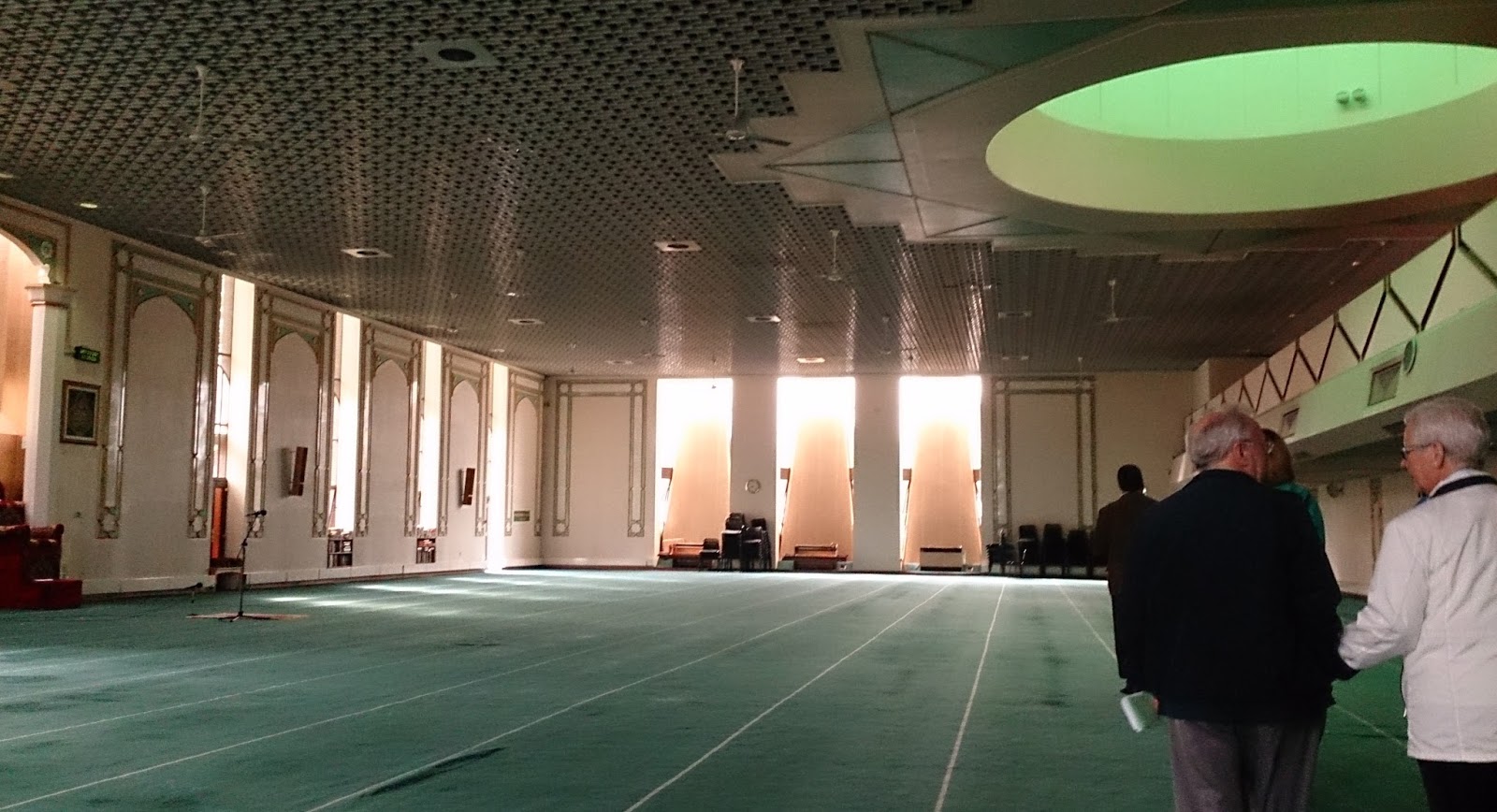
I have visited some of the smaller mosques of Glasgow before but this was my first visit to the Glasgow Central Mosque, just south of the River Clyde at the edge of the Gorbals. It is one of the most recognisable buildings in the city with its dome illuminated at night and its prominent minaret. The majority of early Muslim immigrants to Glasgow, like the Irish, Jews and Italians before them, lived in the Gorbals area of the city where the mosque was later built. The main hall can accommodate 2,500 people at prayer and will be busy later this week with Eid marking the end of the Hajj.

Inside Glasgow Central Mosque

Taken on a tour of the building, with its adjacent community centre, our Malcolm X quoting guide was at pains repeatedly to clarify misconceptions about Islam. It is clear that some Muslims can feel at times there are constant media reports of their perceived role in all the problems round the world, causing misunderstanding and fear. When he talked about the un-Islamic actions of those fighting their fellow Muslims in Syria just now, it was hard not to see echoes of this in accusations down through the centuries within several other religions. It seems to me that most wars and battles fought in the name of a religion tend to be about power, resources and land once you break it down rather than a battle of ideals. This is the same whether talking about ISIS in the Middle East, the Christian Crusades, the Rough Wooing of Mary Queen of Scots, King Billy and the Battle of The Boyne, the Israeli-Palestinian conflict, the Troubles in Northern Ireland... Take your pick.

Not remembered in the current portrayal of Islam are the contributions Muslim thinkers have given to the world, particularly in science, medicine and mathematics. You only need to think about the origins of the words algorithm, algebra and alchemy to see where they originated.

Protestantism


The Christian church in Scotland means many different things to different people. The Church of Scotland website has an "Historical Directory To Glasgow Presbytery" listing the changes in parishes and churches over the years in the city and it runs to 360 pages if you have an interest in this. The roots of the Church of Scotland date back to the Scottish Reformation of 1560, led amongst others by John Knox, whose statue looks out over Glasgow from a pillar atop the Necropolis behind Glasgow Catherdral. He established a Protestant church on Calvinist principles.

Glasgow Cathedral
Glasgow Cathedral is one of the few medieval churches that survived the Reformation and the current building dates back to the 12th century, allegedly on the site where St Mungo (a.k.a. St Kentigern) built his church in the 7th century. If you want to get an impression of how close it came to being destroyed during the Reformation look at the bullet riddled door in the Sacristy from this time. It was saved because the organised trades of the city took up arms to defend it from the mob intent on bringing it down. The defenders outnumbered the attackers and it survived, "cleansed of its Catholic trappings". The University of Glasgow was founded at this site too, within the precinct of the cathedral in 1451, before later moving west in the city. 
St Vincent Street Church, Glasgow
In contrast to the austere, gothic medieval cathedral, the Glasgow City Free Church have their home in one of the most grand and beautiful creations of famous Glasgow architect Alexander "Greek" Thomson. At the time he rejected the popular Gothic Revival style of many of his contemporary architects, getting his inspiration from Greek Classical styles. Built in 1859 for the former United Presbyterian Church of Scotland, the St Vincent Street Church is currently used by a congregation of the Free Church of Scotland. It is the only one of the three churches Thomson designed which is still in tact.

Interior of St Vincent Street Church, Glasgow
Here you can see the interior which he designed for it too, full of light and space. the decorative motifs inside are more flamboyant than would normally be acceptable in a Presbyterian church. It is so sad to see the empty shell of the Greek Thomson designed Caledonia Road Church sitting in the Gorbals, with its interior destroyed by fire in the 1960s.


Another church that I visited on the Doors Open Day was also commissioned by the Free Church using an innovative Glasgow architect. In 1896 the Free Church of St Matthew, Glasgow commissioned a new church and hall from architects Honeyman and Keppie. The job was allocated to their young, talented, trainee architect Charles Rennie Mackintosh.

Architectural drawings for the Queens Cross Church
Following the beliefs of their religion the design had to be simple, yet Mackintosh managed to handle this beautifully, producing a distinctive, charming, warm and functional building. Queens Cross Church is one I pass whenever I head to see Partick Thistle, whose ground lies just behind the church. Built between 1898 and 1899 it was the only church he designed.
The nave of the Queens Cross Church, Glasgow
 In 1929 the Free Church was reunited with the Church of Scotland, which took over ownership of the Queens Cross church. In 1976 with a declining congregation, the church merged with Ruchill Church and vacated the building, which has become the headquarters of the Charles Rennie Mackintosh Society.

Mackintosh designed pulpit in Queens Cross Church
In this building Mackintosh designed the interior artwork and fittings too, right down to the communion table, alms dishes and armchairs. His distinctive designs can be seen on the wood carvings of the pulpit.


Sikhism


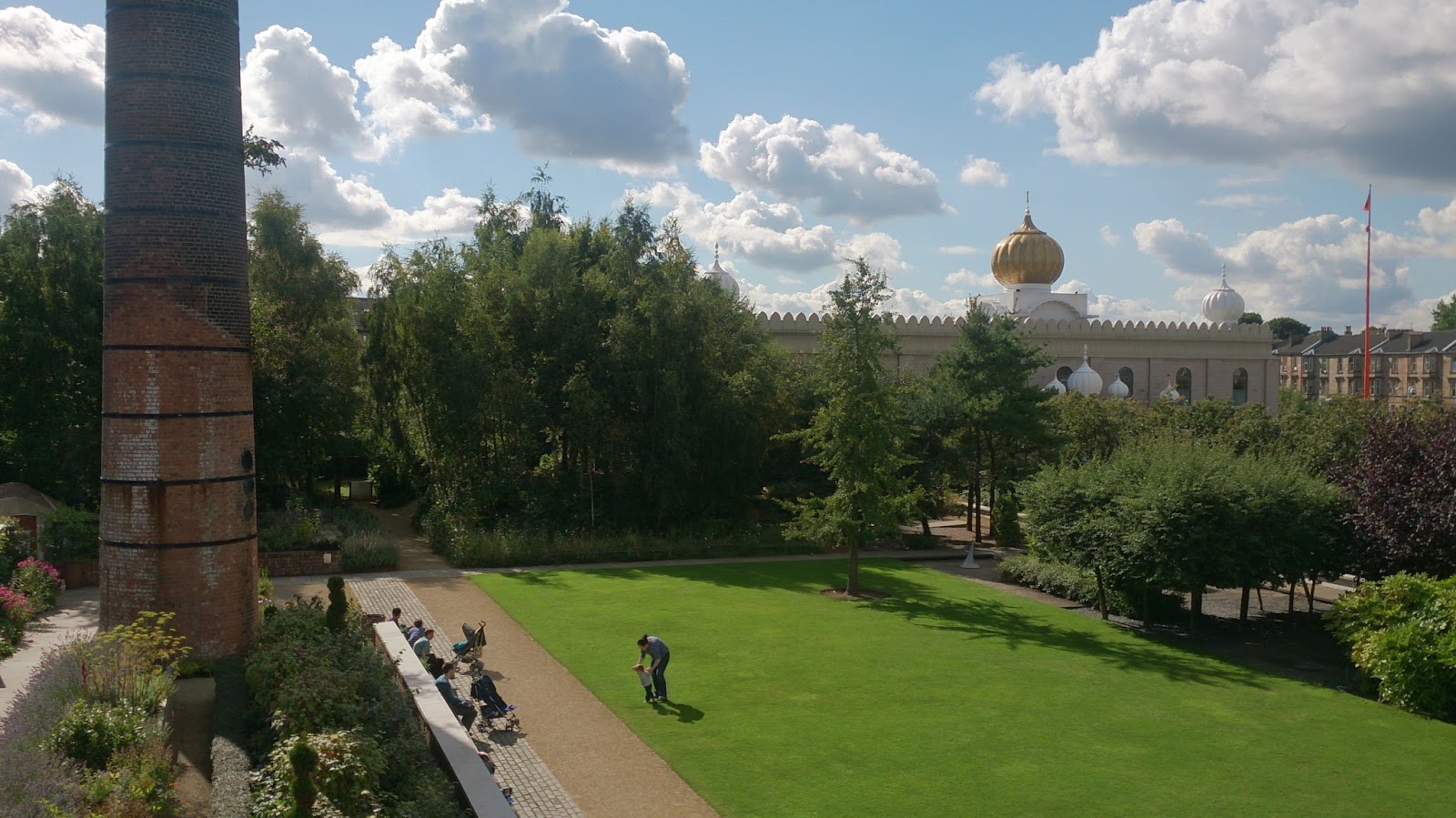
Topped with their golden domes, there have been two distinctive new additions to the Glasgow skyline in recent years. The first purpose-build Sikh Gurdwara in Scotland opened its doors in 2013, in Polloksheilds beside the Tramway. Another new Gurdwara will also soon be opening soon in Glasgow on Berkeley Street, opposite the Henry Wood Halls. 

Glasgow Gurdwara on Albert Drive, behind the Tramway's 'Hidden Garden'
Sikhism was founded in the Punjab region of India in the 15th century. It is based on the teachings of Guru Nanak (the first Guru) and the ten successive Sikh Gurus. Now the book of Sikh scripture is the Guru and is treated with great respect. The first documented Sikhs living in Scotland are from 1854 in Perthshire. Sikhs date the first Glaswegian Sikhs to the 1920s when a Gurdwara was established in South Portland Street. Further immigration in the later 20th century means that Sikhs now make up 0.2% of the Scottish population, with the largest population being in Glasgow. In the synagogue I had my head covered, in the mosque I had taken my shoes off to enter the prayer hall. Here my head was covered and shoes off to enter the Gurdwara. Our young guide told us with obvious enthusiasm about Sikhism and the Gurdwara and encouraged us to visit the free food kitchen, or Langar, an important part of any Gurdwara.

Hinduism


Although their place of celebration was not open during the Doors Open Day, it seems only fair to also mention the Glasgow Hindu Mandir. Hinduism contains a broad range of philosophies and religious cultures and has many deities. It dates to the 6th century BCE and is the religion followed by the majority of people in India and Nepal. The majority of Hindus in Scotland arrived in the second half of the 20th century, many escaping Idi Amin's Uganda in the 1970s. Hindus now make up 0.3% of the Scottish population. I have previously been in the Hindu Mandir Glasgow building at Belle Place, near Kelvingrove Park, for a wedding which was a very laid back, friendly and colourful event. Unfortunately you will have to make do with a photo of the outside which I took when I passed it on my bike today.

Hindu Mandir Glasgow
Summary

In Glasgow I think we are now getting away from the days when the first question a stranger (or someone interviewing you for a job) asked was "what school did you go to?" to work out if you were a Catholic or a Protestant. However we are far from being a city that can preach to anyone about religious tolerance. I sadly think that we are defining people more and more by religion. There is talk of the Muslim population or Jewish community. Religion is only one aspect of a people's culture. I am not a great fan of defining people or a population by their religious views and each religion has a spectrum of differing perspectives and beliefs. Scottish Christians can be a member of the Roman Catholic, Scottish Episcopal, Free Church, United Free Church, Church of Scotland, Free Presbyterian Church, Associated Free Presbyterian Church or the Reformed Presbyterian Church of Scotland. That's just our local ones. People living in the same street, or working in the same factory have much more in common with each other than do a businessman and a shop worker of the same religion.

A lot of people, particularly immigrants, feel a cultural link and connection with a religion. The rituals and celebrations their parents and grandparents enjoyed. I am an atheist but still enjoy rolling eggs down a hill with my children at Easter. I understand the symbolism of it and remember doing it as a child with my own parents, but I don't define myself as a Christian. The diversity of religious institutions in Glasgow that I have visited this weekend just reflects the diversity of Glasgow's immigrants over centuries. From Norsemen to Lithuanians, people from the Punjab and Sri Lanka, Scottish Highlanders, Italians and Irish.

I know it sounds corny to end this way but I agree with the city's current slogan that "People Make Glasgow" and I religion is a small part of the culture of those people, if they wish. So I finished my day in Dowanhill Church, built in 1865. I admired the work of the artist Daniel Cottier who designed its interior, the craftsmen that erected the building and those restoring it. I then had a nice pint of beer and some lunch and wondered if the day will come when all the places I saw today will become museums, theatres, community centres, restaurants and bars.
Cottiers Bar and Theatre, Glasgow