Saturday, 16 November 2019

Fife Pilgrim Way - Part 3. Lochore to Markinch

Fife Pilgrim Way - Part 3


Lochore Meadows to Markinch


The Fife Pilgrim Way is a new long distance walking path, following in the footsteps of medieval pilgrims coming from Culross or North Queensferry to see the relics of St Andrew. Over several weekends I am trying to run the route, and find out a bit about the local history on the way.

After coming from Dunfermline to Lochore last time, this section from Lochore to Markinch brings me to a part of Fife that I am more familiar with. My wife is from Glenrothes, and going back several generations her family have lived in Lochgelly, Markinch and Balbirnie. Also it finally gives me an excuse to walk over the Cabbagehall Viaduct.

Lochgelly


I have been running these stages of The Fife Pilgrim Way whenever I get the chance. I live in Glasgow so am relying on public transport to get me to and from different starting and finishing points. Lochore isn't easy to get to from here, so I have started 1 mile further down the road in Lochgelly, where there is a train station. The eccentricities of ScotRail's Fife Circle timetable meant that it wasn't as easy to get a few miles back down the track from Markinch as I'd imagined, but nonetheless it gave me the chance to have a quick stoat about Lochgelly. This suited me just fine as my wife's grandparents lived in Lochgelly, and it is a place that I have not been to for a while. Jimmy Herd started working down the mines here at the age of 14 and worked underground for over 50 years. He spent many years in the dangerous job of setting the explosives to break up the coal seam.

My mother-in-law as a child, a coal miner's daughter
After Jimmy had retired in the early 1980s, and given up on blowing things up, he turned his hand to making things. He would turn his hand to anything; conservatories, garages, swing seats, and even garden strimmers made from re-purposed washing machine motors. His finest piece I think was the violin he decided to make I think than for no other reason than to see if he could, which is a thing of beauty.

Jimmy with his violin, ready for a final varnish
Lochgelly has a longer history than some of the other mining towns nearby, already a noted town for weavers in the 1600s before iron ore and coal extraction began 200 years later. When the nearby Jenny Pit closed in 1957, and the Nellie closed in 1965 there was still plenty of work nearby for the miners of Lochgelly. Jimmy ended his working life in the Seafield Colliery at Kirkcaldy, which extended under the River Forth. Seafield Colliery closed in 1988.


Today the only miner in Lochgelly stands in Lochgelly Square, a statue by David Annand of a miner supporting pit props which have lines of poetry, "God The Miner", on them from William Hershaw.

Lochgelly sculpture


Radical Politics


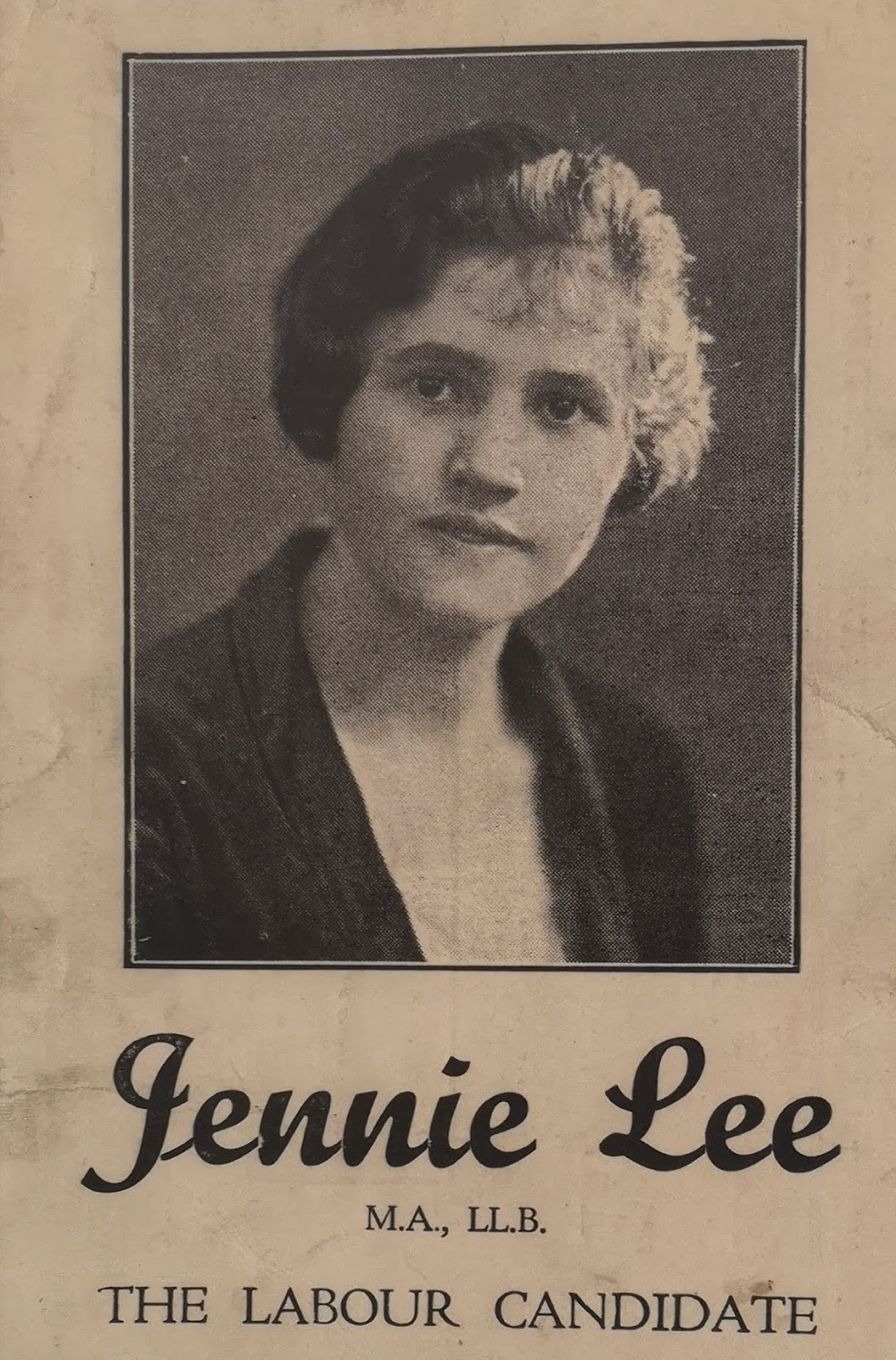
Just like my mother-in-law, another coal miner's daughter from Lochgelly was Jennie Lee. Born in 1904 she left Beath High School and headed for Edinburgh University, initially for teacher training. She was a socialist, like several other members of her family, and her grandfather was a friend of  Keir Hardie, who later became leader of the ILP.

1929 election card, Jennie Lee
In 1879 the 23 year old Keir Hardie was elected leader of the National Conference of miners at a meeting in Dunfermline, and led several local strikes against mine owners who were forcing a reduction in miners' wages that year. Jennie joined the ILP (The Independent Labour Party, the forerunner of the modern Labour Party) and was elected to parliament as their candidate in a by-election in North Lanarkshire in 1929. At that time she became the youngest MP in the House of Commons, aged 24 in an era when women under the age of 30 were not allowed to vote. Her first time in parliament overlapped with that of my great-uncle Robert Climie, who was the ILP MP for Kilmarnock until he died in October 1929.

In 1933 she married Welsh Labour MP Aneurin Bevin, and she was re-elected into parliament in 1945 for the Labour Party. She remained an out-spoken left-winger throughout her political career, and is most well-known for creating the Open University in the 1960s, when she was the first Minister of State for Education in Harold Wilson's government. The OU's goals were to offer education to those who had not had the opportunity to gain access to traditional universities. Appropriately the library in Lochgelly is now called the Jenny Lee Library.

Jennie Lee Library, Lochgelly
At Lochore Meadows the visitor centre is named after Willie Clarke. As I write this in November 2019, Willie Clarke has just died a couple of weeks ago, Britain's last Communist local councillor. Born in 1935 in Glencraig near Lochgelly he was a former miner, starting work when he was 14, and had been a trade unionist in the mines. For 43 years he was the councillor for Ballingry, standing on behalf of the Communist Party. In 1973, when he was first elected, there were 12 Communist councillors elected to the Lochgelly and Cowdenbeath Council. Before this West Fife had been represented in Parliament by the last Communist MP in Britain, Willie Gallacher. He was born in Paisley and worked in the Albion Motor Works in Glasgow. He was influenced by John MacLean and in January 1919 was one of the organisers of a mass strike to demand a 40 hour week in Glasgow. This had sent the authorities into a panic as crowds in George Square raised the red flag. He was arrested and spent 5 months in prison at this time. In 1935 he was elected as the Communist Member of Parliament for West Fife after several previous unsuccessful attempts elsewhere. The West Fife constituency covered the area from Culross to Kirkaldy, taking in Lochgelly, Leslie and Markinch. He remained the MP for the area until 1950.

Willie Gallacher MP
When miners' wages had almost halved in the 7 years since the end of World War 1 a general strike was called in 1926. Although the general strike was called off by the TUC after 9 days, many miners remained on strike for months, showing that that their unions had the power to organise over 1 million men across the whole of the UK into action. In the 1960s when many of the pits in Fife were closing down, again the miners fought against the loss of their jobs, and a delegation of Lochgelly miners marched to London in the early 1960s in protest. The coal industry in Britain was killed off in the 1980s under Margaret Thatcher's government. The 1984 miners strike started in Fife a month before it spread elsewhere. After a belt broke in the Frances colliery in Dysart, miners were sent home from work and the miners of Frances and Seafield collieries walked out to defend their jobs. The miners strike led by the NUM lasted over a year, and became increasingly brutal as time went on. The subsequent closure of mines in Fife led to permanent change in the communities and the landscape of this part of Scotland.

Lochgelly to Lochore Meadows


So, that's the part of the world The Fife Pilgrim Way now heads through. Trotting a mile up the road to Lochore Meadows from Lochgelly you first pass the site of the Nellie Pit, now a small industrial estate. The site of Williie Clarke's home village, Glencraig, is just along the road from here. Little of it now remains, and people began to be moved out in the 1940s to the new model village of Ballingry up the road. In 1966 Glencraig Pit closed, which led to the demise of the village. Glencraig Pit operated from 1896 to 1966 with an average workforce of 1,105 men. An information board at the side of the road here lists the names of 111 men who died in Glencraig Pit during this period. You see this again and again at every former pit, lists of hundreds of men from the region who died at their work, not to mention the many others who were seriously injured. The scale of it is hard to picture.

A football ground, Ore Park, home to Ballingry Rovers FC, and a memorial to a former resident of the village can be found here too. Peter Johnstone was born in Cowdenbeath in 1887 and his family moved to Glencraig when his father got work in the new pit here. Peter worked alongside his father from the age of 13, and was a skilled junior footballer with several local teams. When Celtic directors saw him play for Glencraig Celtic FC against Strathclyde FC in a Junior Cup game, he was signed to Glasgow Celtic in 1908. He enlisted for the army in 1916 during World War 1, and was killed in action at the Battle of Arras in May 1917. A memorial to him stands opposite Ore Park.

Ore Park, Glencraig
Memorial to Glencraig miner and Celtic player Peter Johnstone


Getting back on the Fife Pilgrim Way at Lochore Meadows, the first thing that greets you is the ruins of Lochore Castle which stands at the entrance to the country park. The castle stood on an island until 1792 when the loch was drained. The tower that stands there now is from the 14th century, but is on the site of a 10th century crannog that once stood on an island in Loch Ore.

Lochore Castle, Fife

Pit winding wheel, Lochore Meadows
A former pithead wheel marks the entrance to Lochore Meadows and from here the path heads across the countryside to Kinglassie. 

Kinglassie


Benarty Hill and Balingry
Heading out from Lochore you get views back towards Benarty Hill and Ballingry, and onwards the Lomond Hills up ahead pop into view. Running along here a beautiful peregrine falcon flew just over my head, not in its high speed dive, but seemingly as curious to see me there as I was to see it.

A coo, and west Lomond appearing on the horizon
Around Kinglassie there is much evidence of the pre-historic residents of the area. A Pictish stone, Dogton Stone, stands in a farmer's field just south of the town, the remains of a 10th century Celtic Cross that, it has been argued, may commemorate a Pictish victory over the Danes around 900AD. When the field is in crop you cannot access it, and as I ran across the stubble to see the rock a small flock of meadow pipits rose up from the ground with their bright, chirping call.

Dogton Stone, in a field near Kinglassie
Dogton Stone


Churches in the town of Kinglassie can trace their history back to the 1100's, and pilgrims would stop and pray at the waters of Finglassin's Well which lies just north of the town. This well has recently been renovated and Kinglassie has definitely decided it is going to make an effort to lay on some attractions for those passing on the Pilgrim Way. I was drawn more to the home pitch of Kinglassie FC, and the Miners Welfare Institute and bowling green next door. 

Kinglassie Parish Church, with ruins of former church forming an entrance

St Finglassin's Well, Kinglassie

Kinglassie Miners Welfare Institute

Kinglassie 
From 1906 to 1966 Kinglassie swelled in size when the pit here brought employment. The colliery football team started the career of some notable players. James Bowthorne played at East Fife and Dundee, and later managed Aberdeen FC. Also Willie Fernie started with Kinglassie Hearts. He went on to play for Celtic and Scotland, and also spent some time playing at Middlesborough (he joined my team, Partick Thistle, in 1963 but left to play with Alloa without starting any games according to Wikipedia). He coached for a while at Celtic under (former coal miner) Jock Stein, before finishing his footballing career managing at Kilmarnock.

Heading past the Braefoot Tavern in Kinglassie, a former Goth pub, the path goes through the centre of town and then turns left up over a short hil towards the River Leven. North out of town, you get views towards Blythe's Folly, a tower on the hillside above the town. It was built by a wealthy linen merchant in 1812, and he watched cargo ships arriving on the Forth from it. It was used as an observation post during World War 2.

Foyle's Folly on the right, the River Forth on the left

Leslie


The villages of Leslie and Markinch nowadays merge into Glenrothes. I have been visiting Glenrothes for almost three decades and I am always surprised when I come across the old buildings or village greens here, hiding among the concrete and roundabouts of their much younger neighbour.

The origins of the Leslie family that gave their name to the town date back to Bartolf, a Hungarian merchant who came to Scotland in the 11th century as part of Queen Margaret's entourage. He was given lands by Malcolm III in Leslie, Aberdeenshire and it is from there that the family took their name. His descendant Norman de Leslie, was given the lands of Fettykill here on the banks of the River Leven in Fife in 1283. Leslie House was completed by the family in 1672, a veritable palace according to Daniel Defoe who visited, which burnt down in 1763. The replacement Leslie House stood until a few years ago, latterly run as a care home by the Church of Scotland. Sadly it also went on fire, a few years after the care home closed, and it now stands as an empty shell.

The chimney of a former mill, down by the River Leven below Leslie
In the 1800s the River Leven powered mills in the town here, and at Markinch, producing lint, linen, cotton, flax and even snuff. Production increased with steam power and in 1861 the handsome Cabbagehall Viaduct brought the railway to Leslie. When the textile mills closed down paper mills replaced them here and in Markinch, Tulliss Russell being one of the largest. Now these have largely gone the way of the linen mills. Solitary brick chimneys are all that remain of some of the former mills. In the town The Bull Stone (below) stands in the village green at Leslie, behind the war memorial. It was apparently used for tethering bulls (hence the groove in the stone) when crowds assembled to watch some bull baiting. Since 1805 the sport of setting dogs against bulls has been banned, but for hundreds of years before it was a common form of entertainment.

The Bull Stone, Leslie
 The Fife Pilgrim Way then leaves Leslie and crosses the Cabbagehall Railway Viaduct, going straight through the green ribbon of the Riverside Park without ever really emerging onto the streets of Glenrothes.

Cabbagehall Viaduct, Leslie

Glenrothes


The Riverside Park (usually known as The Town Park) is a place that I have been to many times with my children. Before that my wife grew up in Glenrothes, and was a reluctant cross-country runner in the park when at school. Glenrothes is one of the five post-war New Towns built in Scotland. (Can you name the other four? Bonus points if you know the name of the sixth one planned for Lanarkshire that was never built - answers at the bottom).

New Towns are towns laid out and planned from scratch, and are certainly not new. Construction of Edinburgh's New Town began in 1767 and New Lanark a couple of decades later. Glenrothes was part of the wave of New Towns devised as a response to overcrowding and dilapidated housing in some British cities post-World War 2. It is now home to almost 40,000 people. It was designed to house workers for the newly established Rothes Colliery, officially opened by the Queen in 1958 in one of  the most incongruous photo opportunities ever.

The Queen blending in with the local on her visit to Rothes Colliery in 1958
As had been predicted by many older miners in Fife the pit was not a success and was forced to close in 1964 due to geological faults and unmanageable flooding. Electronics and manufacturing industries moved into the town to join the paper mills at Leslie and Markinch as the main employers.

Irises by a roundabout in Glenrothes
Going through Glenrothes much public art is always on display. Some of it may be familiar to Glaswegians like me, such as the sculpture of irises above that sit by a roundabout. They were built in 1988 as part of Glenrothes's contribution to the Glasgow Garden Festival by the town artist at the time, Malcolm Robertson, and afterwards returned home. Glenrothes took an original approach to creating a sense of identity for its residents in the 1960s by appointing a "town artist". It was such a success that it is a model that has been copied around the world. Often working with the same materials that had been used to build the housing and being inspired by local history (such as "The Henge", a row of concrete standing stones) these pieces of public art are often humorous or involved input from local residents and schools. The first town artist, David Harding, later went on to develop the department of Enviromental Art at Glasgow School of Art which has since produced several Turner Prize winning artists. 

Concrete hippos at a pond in Glenrothes Riverside Park

Hippo going to inspect a newly created labyrinth in the grass
Within Riverside Park one of the hippos appears to be ready to try walking around a newly created labyrinth. This was the idea of St Columba's Parish Church in the town, inspired by the labyrinth in Chartres Cathedral. Labyrinths have often featured on pilgrimages, and the idea is that you walk your way slowly around the whorls, quietly praying or contemplating. 

At Balfarg the path crosses through an area of housing before heading into Balbirnie Park. Here it takes the chance to pass some art work from the people that lived hereabouts 6000 years ago, Neolithic farmers who were spreading across Fife. Balfarg Henge is a curious structure, incongruously sitting amongst a suburban housing scheme. There are two upright stones that would have once been part of a larger circle, and a 60 meter diameter ditch surrounding them. Stakes mark out the positions of timber posts that were discovered at excavation. Cremation goods and a later burial from 2000BC have also been found here. I quite like the idea of contemporary families living and playing amidst the evidence of their ancestors, rather than all our history being put up upon a special pedestal marked "Do Not Touch".

Balfarg Henge
Just around the corner in Balbirnie Park lies the Balbirnie Stone Circle, which was moved to its current site when a road was widened nearby. It is thought to have been a site of ritual and burial, and had a hearth at the centre. 

Balbirnie Stone Circle

Markinch


The path then skirts past Balbirnie House and out from Balbirnie Park into the town of Markinch. Balbirnie House was built from 1777 by the Balfour family who had made the estate their home since 1640. Arthur Balfour, who was Conservative Prime Minister from 1903-1905 and drew up the Balfour Declaration in 1917, establishing a Jewish homeland in Palestine, is a relative of these Balfours. Nowadays Balbirnie House is a popular hotel and wedding venue. The family made their money here from agriculture and mining interests.

The Stob Cross, Markinch
As you emerge onto the road to Markinch, above you sits the ancient Stob Cross, a weathered stone cross, thought to be Pictish. The signs into town declare Markinch to be "the ancient capital of Fife" and it was thought to be the centre of power in Fife in Pictish times, when 1000 years ago there was a substantial Pictish settlement here. Iron Age agricultural terraces cut in the hillside above Markinch show that people had lived here long before then. In the 12th century the arrival of feudal rule in Scotland led to Balbirne and Markinch being laid out as feudal estates, gifted in return for allegiance to the king. Markinch Parish Church has a Norman tower incorporated into it, which dates to at least 1130.

Markinch Parish Church

By the 14th century Markinch was in decline as a centre of religion and power. In the Industrial era workers came to dig coal here and on the Balbirnie estates, and the River Leven powered corn mills, and later linen and paper mills. In the 20th century Haig whisky was one of the biggest employers here, with their huge bottling plant still standing on the edge of town. The history of mining in the town is old though. A gravestone that I saw at Markinch Parish Church marks the grave of Janet Forret, who died in 1785 aged 62. It says it was erected by her husband, a "coal hewar in Balbirnie", a pair of crossed bones on the back of the gravestone.

Grave of a "coal hewar"'s wife 1785
As well as Lochgelly miners on one side of her family, my wife has miners down another branch of her family tree too. The picture below is of Henry Wyse. He was born in Markinch in 1875 and later lived in Lochgelly where he worked as a miner. His father, and grandfather before him were miners in Markinch, and in the late 1700s their parents before them had come from Collessie to Markinch for work. Henry's mother was a mill worker in the town. Other Markinch relatives were employed in the Balbirnie estate, one looking after the horses, another employed by the Balfours as a wet nurse.

Henry Wyse, Lochgelly miner, born 1875 in Markinch
The Fife Pilgrim Way begins heading away from the major Fife coalfields now, into more agricultural land. The next stage is from Markinch to Ceres...

(NB New towns of Scotland- East Kilbride, Cumbernauld, Livingston and Irvine. Also planned but never built was Stonehouse in Lanarkshire)


Fife Pilgrim Way Links

  • Part 3 - Lochore to Markinch - Lochgelly to Lochore, then through Kinglassie and along the River Leven to Leslie, Glenrothes and Markinch


Sunday, 10 November 2019

Fife Pilgrim Way - Part 2 - Dunfermline to Lochore

Fife Pilgrim Way - Part 2


Dunfermline to Lochore - Built on Coal


The Fife Pilgrim Way is a new long distance walking path, following in the footsteps of medieval pilgrims coming from Culross or North Queensferry to see the relics of St Andrew. Over several weekends I am trying to run the route, and find out a bit about the local history on the way.

Arriving in Dunfermline from either Culross, or North Queensferry, the medieval pilgrims would head on towards St Andrews, out of Dunfermline through open countryside. One hundred years ago travellers would have been walking through mile upon mile of mine-workings, pit bings and bustling communities. Now the coal mining has all gone. Although many of the miners' villages still struggle on they are a shadow of their former selves. It seems amazing that so much of the infrastructure of Fife's industrial past has been completely erased from the landscape, and between Dunfermline and Ballingry few hints at what was there before now remain. 

Dunfermline


On the Fife Pilgrim Way you arrive in Dunfermline from the south, into its "heritage quarter" past weavers cottages and abbeys. You leave through the centre of town and out through the east end.

With a population of 50,000 it is the most populous town in Fife. It was a royal town and an abbey town. Then it grew as a mining town and flourished with linen weaving.  Now few industries remain and the service sector is the biggest employer in town, with Dunfermline being the main shopping area in Fife. Dunfermline is home to the Alhambra Theatre, and now the old art deco fire station on Carnegie Drive has been re-modelled as an arts centre. Dunfermline's other contributions to the arts include gifting the world members of the bands Nazareth, Jethro Tull and Big Country, as well as the inimitable Barbara Dickson. They should all get together as a Dunfermline supergroup.

The Carnegie Hall
As you head east through town, you pass "the second" Carnegie Hall as its website describes it, which I see has Danny John Jules and Neil Oliver performing there soon, though I suspect not together. There aren't many signposts for the Fife Pilgrim Way over the next couple of miles, so following the directions on the official website or using a map is necessary. Skipping onto a path parallel to the main road we pass between Dunfermline Cemetery and East End Park, home to Dunfermline Athletic Football Club. Before getting there on the left you will see the former Poorhouse of Dunfermline. Built in 1843 it was extended several times, before later being known as the Dunfermline Combination Home and Hospital, being incorporated into the NHS when it was founded in 1948.

Dunfermline Poorhouse, now converted into housing
The path behind East End Park football ground
The path here passes between Dunfermline Athletic Football Club and Dunfermline Cemetery. The football club was started in the late 19th century as a way to keep players of Dunfermline Cricket Club fit during the winter months. By 1885 they had split away to become a separate club. The club's greatest achievements were in the 1960s, twice winning the Scottish Cup and reaching the semi-final of the European Cup Winners Cup in 1969. As a Glaswegian child it was the club crest that I knew before I got to know the team as a travelling Partick Thistle fan, as it was so totally unlike the badge of any other Scottish club. It was designed by a local school art teacher in 1957 and features Malcolm's Tower (the ruins of which lie in Pittencrieff Park), the "hanging tree" of Malcolm III's time, and what looks like a glass building of contemporary 1957 Dunfermline that I haven't been able to identify. A splash of green at the bottom represents East End Park. Mr Dymock, take a bow. There ain't no club badge like that one. As a Partick Thistle fan I write this in November 2019, looking up to Dunfermline FC's mid-table Championship mediocrity with envy. 

Club badge of Dunfermline Athletic Football Club
Leaving Dunfermline the Pilgrim Way heads around the town's modern Queen Margaret Hospital, named after the saintly Queen Margaret that we have met already, and heads up the Townhill road and on to Kingseat. From here, looking out across the M90 off to the right lies Hill of Beath. The hill itself was used for Covenanters gatherings, held here in the 1670s, a good place to look out for approaching soldiers coming from afar to break up your meetings. From the days of The Reformation 100 years earlier, to the Covenanters and beyond, the splits and divisions over religious doctrine in Scotland were tied to many other social changes, with shifting allegiances, land ownership and royal interventions mixed into a murky theological mix which still brings problems to Scottish society today.

Hill of Beath, off to the right of The Fife Pilgrim Way
The village of "Hill of Beath" just beyond the hill was established to house miners, as were most of the villages in this area. In 1963 once the local pits had all closed, dismantling the pit bing here was the first of many subsequent land reclamation projects in the area. The land between the path and the Hill of Beath in the photograph above had been home to coal mining from the 1700s, now all gone.

If Hill of Beath rings any bells for you, it may be due to its football connections. This small village, which is still home to a Juniors team, was the childhood home of three famous Scotland internationals; 'Slim' Jim Baxter (whose statue stands on Main Street), Willie Cunningham, and current Celtic captain Scott Brown.

Kingseat


Kingseat
We come next to Kingseat, another former coal mining village, with four pits sunk in this area in the mid-1800s. The village grew up about the mines and a report in 1875 bemoans the fact that there were few amenities here, with "no ashpits or closets over all the village". The report also mentions that for those living here "(t)he water for the village is got from a field near at hand. It is surface water and becomes dirty in rainy weather". All this for 6s 8d a month for a room and kitchen. Mining continued here until 1945 when the last pit up beside Loch Fitty flooded, and was abandoned. On the edge of town new houses are being built, and like several of the towns around here, many people live in this area and commute to work in Edinburgh and surrounding areas. 

The village allegedly takes its name from a large rock that sat near by, beside the long gone Craigencat Quarry. King James was supposed to favour this as a place to sit when journeying between Falkland and Dunfermline, enjoying views across to Arthur's Seat.

Even in this small village, home to 800 people at its peak, for those who worked the local pits death was an ever present danger underground. By the time the last pit closed in 1945, 27 people had lost their lives in the Kingseat pits, the youngest being an 11 year old and two aged only 14 year old. The last to die were in November 1945, when two brothers-in-law died working their last shift in the flooded Pit No. 3 that was being closed down.

Between Dunfermline and Kingseat lies the former Muircockhall Colliery, on the edge of Townhill Wood. From 1868 until 1943 this pit was worked. Towards the end of World War 2 with growing demands for coal, men were conscripted not to serve in the armed forces, but to work underground on producing coal. Over 5 years 48,000 men served as "Bevin Boys" across Britain. Muircockhall was where these men from Scotland and the North of England, including my great-uncle Peter, received 4 weeks of training. After the war Muircockhall continued as a miners training centre until 1969. Did my great-uncle decide to carry on as a miner after the war? Not on your nelly. He hated it from day one, and only a few weeks in, working in a pit in East Lothian, he was caught in a cave-in, breaking his leg which left him with a limp for the rest of his life. Once he had recovered he was sent back down the mine, at which point he deserted in terror, refusing to go down again.

Kingseat
Leaving Kingseat the path heads down towards Loch Fitty, and across the causeway here. Walking this way you pass over the former route of one of the many mining railway lines and the site Kingseat colliery Pit No. 3, the last one to close here, which stood just by the loch. Though once a trout fishery, Loch Fitty is surrounded now by just farmland, with the sounds of ducks and swans, cows and horses rather than that of machinery.

The path across Loch Fitty

Lassodie


New Rows, Lassodie
On the other side of Loch Fitty the path leads you into a curious area. On some maps this area is described as "Lassodie" but no signs of human habitation exist. The rise and fall of Lassodie village is an extreme example of what has befallen much of this area, whose fortunes have come and gone with the Scottish coal industry. In 1901 Lassodie was a village of over 1400 people and several mines. There was a post office, a church and two co-op stores. By 1931 the cost of pumping the water out of the remaining pits made them unprofitable and they were closed down, with some families given 14 days notice to quit their homes.

1854 map, before the miners' houses were built
If you click on the 1854 map above to expand it, the Lassodie estate is there, in the days before the landowner had built any miners' houses. Also on this map is "St Margaret's Well" showing that centuries earlier, this area probably did have associations with those on their pilgrimage from Dunfermline Abbey to St Andrews. 

In the 1930s the Reverend David Patrick Thomson maintained the church and manse for a while as an evangelical retreat, in the now quiet village. Scotland's one time Olympic athlete Eric Liddell was one visitor to the centre. Another visitor to the village in the 1930s and 1940s was a young Sean Connery whose gran and granda had retired to the village. Young Sean (at that time still known as Tommy) was taken on the bus to Dunfermline to watch the football by his grandad. Another former Lassodie resident was my wife's uncle Archie. He spent his working life as a driver, and was a keen amateur footballer. We have his runners-up medal from the 1931-2 Fife Cup, when his Inverkeithing team were beaten in the final by Bowhill Rovers, 3-0 after two replays.

Archie Notman (R). Driver and one time footballer. Picnic in Dunning Glen
For a short while at the start of World War 2 the quiet village became a place of refuge for people fleeing Nazi Germany. All the remaining buildings from the deserted village were swept away when mining briefly returned to the area. St Ninian's open cast mine operated here in the 1960s, and then again from the late 1990s until 2013.

On running along this way the village has completely vanished from the face of the Earth, but one thing remains. A slight detour off the Fife Pilgrim Way brings you to the village's war memorial, which sits now at the side of the B912. On it are listed the names of the 21 men from Lassodie that died in the First World War, and 4 men that died in the 1939-1945 war. As the memorial says "we will remember them". However it feels strange to find that no other record on the ground of the village that these men grew up in survives today. All but forgotten.

Lassodie war memorial

The Fife Earth Project or The Scottish World


St Ninian's opencast mine has now closed down, and the area partly remodelled by landscape architect Charles Jencks. Sometimes called "The Fife Earth Project" or "The Scottish World" the project was abandoned in 2014. By then he had created a sort of mappa mundi in stones, with areas where Scots have settled around the world in four imagined continents, and had carved out two artificial hills. One of the hills is fitted out with sculptures of trees and tyres, and a row of old mining equipment that looks as if it is a twentieth century henge lined up to catch the winter solstice. The Fife Earth Project is now a strange curio, and with so much empty land and not a soul in sight it feels rather desolate. If you look at his website, he had ambitious plans to create a major attraction for the area, which would have involved carving out a watery map of Scotland. As Charles Jencks died in October 2019, it seems unlikely his vision will ever be realised and you will need to look at his works outside the Gallery of Modern Art in Edinburgh and Jupiter Artland to imagine a completed version. Here are some pictures I took when I went to explore the area. It seems odd and neglected now, this vast swathe of empty land. The half finished artwork feels like some strange archaeological vestige of a vanished civilisation. It is all rather melancholy.


Kelty


After passing through Blairdam Forest the Fife Pilgrim Way then comes into Kelty.

Entrance to Blardam Forest
 Kelty is one of the larger towns in this area, much reduced in size from its peak when mining was in full swing. A century ago the authorities were concerned about the negative effects of alcohol on the workers. So a number of towns established bars on the Gothenberg principle, a Swedish model of co-operatives which refused to allow credit, no gambling, dominoes or other vices on the premises, and they were generally unadorned. In return they could promise an unadulterated product for sale at the bar, and profits fed back into the well-being of the local community. The No.1 Goth still stands in Kelty but looked decidedly closed when I passed through town. A mural here marks the life of young boxer Connor Law from the town, who died earlier this year. 

Totem pole, Kelty
An unexpected sight were several totem poles in and around the town. These were carved by Canadian aboriginal totem carvers who visited Kelty in 2005. You may be unaware, as I was, that Kelty was once home to an undefeated world champion. Robert Stewart became world draughts champion in 1922 after a narrow victory in Glasgow over the reigning champion from America (a narrow victory after 2 wins, 1 loss and 37 draws). His obituary in the Montreal Gazette reports that he "lost only 2 out of 8000 games" in his draughts career and retired as British champion after multiple victories "for want of competition". The table and chairs in Kelty's memorial garden are an appropriate tribute I think you would agree.

Sit and remember Robert Stewart. Champion.

Lochore Meadows 


The Fife Pilgrim Way as it is routed manages to just miss several other notable former mining villages. A short detour will be required if you want to pass through the villages of Ballingary, Lochgelly, Cardenden or Lochore. I ran up to Lochore to catch sight of a notable Goth pub that was still very much in business when I passed, The Red Goth, possibly named after a famous Communist Robert Smith fan (or maybe I just made that up).

Red Goth, Lochore
Before getting to Lochore, we pass through Lochore Meadows, a large country park on the edge of Lochore which has Fife's largest loch in the shape of Loch Ore. 'The Meadies' as it is more commonly known, is now an area of grass, hills and lakes used for dog-walking, outdoor pursuits and sports, but it is all laid out on land reclaimed from former mines and pit bings. A few mementos of the former industry of this site still exist, but you have to seek them out. (This short film shows the extent of the work that had to be carried out here to create the park-> Lochore Meadows Reclamation.)

Still from amateur footage early 1970s of pit bings at Lochore being landscaped
Canoeists and dog walkers are what can be found now in Lochore Meadows
Some memorials to the mining heritage of the area exist, in some subtle ways. The children's playpark consists of several hillocks, and each represents a pit from the area - the tree house below represents the Nellie Pit for example. The cafe and community building is called the Willie Clarke Centre, after Fife's longest serving Communist councillor, who just died last week. He had served as a councillor for over 40 years. He had began working as a miner in 1949 aged 14, and he was elected as the councillor for the Benarty ward in 1973, representing the Communist Party. Fife has a strong history of elected Communist representatives, founded in the radical history of the miners here, who had to fight for every advance in their conditions. We will come back to this in the next part of the Fife Pilgrim Way as we continue through mining areas.

Playpark at Lochore Meadows
Willie Clarke Centre, Lochore Meadows, Fife
The concrete headframe and winding wheels of No. 2 Mary pit stand beside the visitor centre at Lochore Meadows, beside a decaying NCB steam engine. Like other pits in Fife and elsewhere, the work of the miners was never safe and a board nearby lists the names of the 78 men who lost their lives in the Mary colliery that worked here from 1902 until 1966. Apart from maybe fishermen and soldiers it is hard to think of any other profession where death is accepted as an occupational hazard.

The concrete headframe of No. 2 Mary pit, Lochore
 A small plaque stands opposite the Willie Clarke Centre to commemorate the miners strike of 35 years ago that effectively marked the end of mining in the UK. It reads "Erected by the Scottish people in recognition of the struggle by Fife miners and their families during the year long strike 1984-1985".

Small plaque commemorating the miners strike of 1984-85
Nothing was put in place to succeed the mines when they all closed down. Thousands of skilled workers were abandoned and years later these former mining communities are still suffering. A report out this week (November 2019) shows that "Fife's former mining communities are being left behind the rest of the UK" with regard to unemployment rates, ill health and rates of incapacity benefits, both in former miners and in the generation that has followed.


Next the Fife Pilgrim Way heads towards Glenrothes, skirting past the delights of the Kingdom Shopping Centre for the more traditional pleasures of Leslie and Markinch....


Fife Pilgrim Way Links

  • Part 3 - Lochore to Markinch - Lochgelly to Lochore, then through Kinglassie and along the River Leven to Leslie, Glenrothes and Markinch